
Plot Summary
1. The Gathering at Littlegreen
In the quaint English town of Market Basing, Miss Emily Arundell, elderly and ailing, prepares for an Easter holiday visit from her immediate relatives: her niece Theresa, her nephew Charles, another niece Bella (now married to Dr. Tanios), Bella's husband, and her live-in companion, the meek Miss Wilhelmina Lawson. Though the air is civil, each visitor quietly hopes for financial assistance, as Emily is the matriarch with considerable wealth. Gossip swirls in the town about divided loyalties and the odd mix of personalities under Littlegreen House's roof. From the start, subtle rivalries and suspicions crackle beneath polite exchanges, setting the stage for the tragedy to come.
2. An Old Lady's Fall
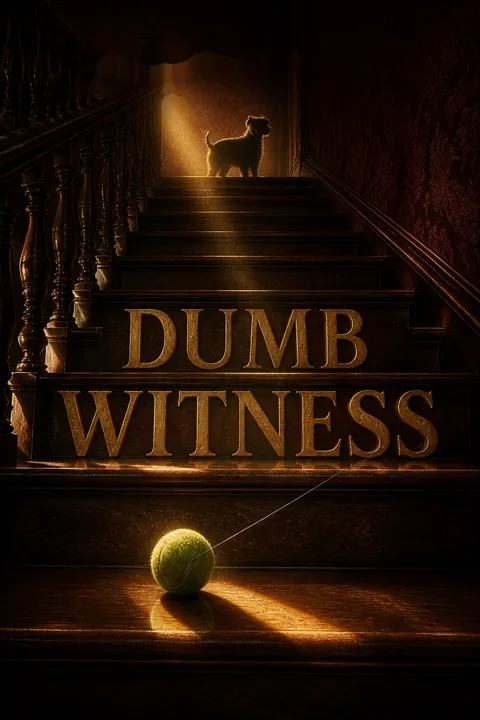
One night soon after Easter, Emily Arundell falls violently down the stairs. It is immediately blamed on her beloved terrier Bob, who supposedly left his ball at the top step. However, when Emily regains her senses, shattered but alive, doubts creep in. She feels certain that she did not slip on the ball, and her memory of the event suggests obstruction rather than misfortune—a thread perhaps, or something subtler. Hurt but lucid, and unable to confide in anyone, Emily is haunted by the idea that the fall was not an accident, but an attempt on her life by someone close to her.
3. Shadows on the Staircase
Recuperating in her sickbed, Emily scrutinizes her family and her companion through a steely, suspicious lens. She is acutely aware of her relatives' financial interests in her well-being—or lack thereof. Her relationship with her companion Miss Lawson seems the only one untouched by suspicion. Isolated, she senses the necessity of action to safeguard herself yet dreads scandal. Worries about her own memory nudge her toward decisive steps. Haunted by the incident on the stairs and "Bob's ball," she recognizes that only drastic measures can secure her safety and her fortune's fate.
4. The Letter That Waited
Unable to trust anyone in person, Emily writes two vital letters—one to her solicitor and one, most significantly, to famed detective Hercule Poirot. In these letters, she hints (in vague, anxious prose) at her deep sense of threat and the incident of the "dog's ball." She urges secrecy, knowing all too well the explosive scandal if her suspicions become public. These letters, underlined and marked by trembling hands, express both her dread and her need for outside intervention. Unbeknownst to her, only one of these letters will reach its recipient—poignantly, only after her death.
5. Poirot Summoned, Too Late
Weeks later in London, Poirot and his friend Hastings open Emily's letter dated months prior—its arrival long delayed by mishap. The letter is cryptic, filled with anxiety and veiled references, but makes clear that something about the fall at Littlegreen House has deeply unnerved its author. Intrigued, Poirot notes the odd timing and the sequence of events the letter suggests. He resolves to visit Market Basing, motivated by the possibility that, however late, he may still uncover the truth and offer justice to a woman who reached out from beyond the grave.
6. Littlegreen House Revisited
Poirot's arrival in Market Basing arouses local curiosity, but he and Hastings pose as potential house buyers to gain access to Littlegreen House. They meet the staff and observe the preserved, orderly household, now under Miss Lawson's care. Through subtle questioning, Poirot learns about the unusual spring accident and the shifting family dynamics that followed Emily's death. He notes the sudden, complete transfer of fortune to Miss Lawson and the quick departure of all Emily's relatives, sensing powerful undercurrents of regret and betrayal. The problem of the ball, the possible presence of a thread or trap, and the rearrangement of wills all surface.
7. Inheritance and Outrage
The town is abuzz: Emily's will, hastily changed before her death, leaves nearly everything to Miss Lawson. The relatives are scandalized and protest, but the document is legal and unassailable. Some consider contesting the will; most suspect Miss Lawson of "undue influence." Meanwhile, Poirot systematically interviews the principal players. He finds Theresa and Charles hiding their desperation, Bella torn between self-preservation and a chilling domestic reality, and Miss Lawson herself fluctuating between pleasure and guilt in her new role as heiress. The mood is distinctly uneasy; the sense of a mislaid secret pervades.
8. Suspects and Confessions
As Poirot and Hastings continue their investigation, cracks begin to show amongst the family. Charles admits minor theft and his blunt conversation with Emily about "being bumped off." Theresa, pressed by Poirot, admits to her insatiable need for money and offers to cooperate in any deception to break the will. Bella reveals herself as haunted and hesitant, terrified of what she cannot quite say aloud. Poirot also discovers the ambiguous origins of the fateful household ball and begins to see how each person's psychology could intersect with Emily's deadly accident.
9. Family Tensions Unleashed
Under Poirot's gentle but persistent questions, family resentments spill over. An unspoken blame game commences: Charles eyes Tanios as a threat, Theresa dismisses Bella as a nonentity, and Tanios privately chastises his wife's loyalty. Poirot learns of potential financial embarrassments, previous criminal hints in Charles's past, marital strains between Bella and Tanios, and ongoing rivalry over Emily's favor. Meanwhile, the shadow of "the accident" colors every reminiscence. Poirot, with patience, listens, seeking not only who might have wished Emily dead, but who possessed the right mix of opportunity, motive, and subtlety.
10. The Faithful Companion
Poirot shifts his focus to Miss Lawson. Is she a gullible pawn, or a sly manipulator? Interviewing the staff and Lawson herself, Poirot hears of the companion's conflicting emotions: she was surprised by her windfall, wracked by guilt, yet also self-justifying. Her story of events the night of the accident aligns with the surface evidence, but Poirot senses she is not telling all she knows. Furthermore, he learns of Lawson's habit of eavesdropping and her anxiety about being perceived as more clever than she lets on. Poirot catalogues these nuances, attentive to contradictions and subtle distress.
11. Bella's Secret Fear
Bella Tanios, increasingly distraught, confides in both Miss Lawson and Poirot. She wants desperately to leave her domineering husband and escape with her children. Her manner vacillates between abject fear and bursts of courage. Poirot suspects Bella knows the truth of what happened to Emily but is frightened into silence by Tanios—and perhaps by her own involvement. Her confession is partial, interrupted by doubt, self-reproach, and maternal instinct. Poirot's attempts to shield her seem to come just a step too late, as ominous portents gather around Bella's fate.
12. Disputed Legacies
Poirot consults Mr. Purvis, Emily's lawyer, assembling legal facts: the previous family-oriented will, the inexplicably sudden change in Emily's testament, and the solidity of the new document. At the same time, Poirot unearths rumors of spiritualist séances that, for some, seem to explain Emily's posthumous decisions. The faithful companion, the bitter relatives, even the eccentric spiritualists, each interpret Emily's gift to Miss Lawson through their own lens of grievance and denial. All the while, Poirot sees the hand of someone who manipulated the chain of events for psychological as well as financial gain.
13. Poirot's Quiet Observations
Not content with witness statements alone, Poirot closely inspects the scene of the fall and objects involved: the ball, the banister, a nail and a suggestion of varnish. He confirms, through practical experiment and staff accounts, that Emily's fall could only have been caused by a subtle yet deliberate trap—a thread, strung invisibly, attached to a nail, and blamed on the dog's ball. The more Poirot probes, the more he feels the criminal mind at work was neither brilliant nor deeply malevolent—just clever, desperate, and opportunistic.
14. The Truth About Bob's Ball
Poirot's suspicion coalesces around the events of the night of the fall. The story of Bob's ball, the missing thread, the use of varnish, and the odd testimony about seeing someone on the stairs all crystallize. Poirot uncovers the key: a reversed set of initials (A.T., not T.A.) seen in the mirror, proving that the person seen was not Theresa as assumed, but Bella Tanios. Each subtle point—a borrowed brooch, a dressing-gown, a woman's shadow—confirms that Bella laid the trap, acting out of deep resentment and thwarted longing with both simplicity and intent.
15. A Murderer Among Us
When pressed, Bella's psychological profile fits: a frustrated, overlooked woman, embittered by lost opportunities and a controlling husband, desperate for financial rescue for herself and her children. With the accident unsuccessful, Bella resorts to chemistry and patience: she poisons Emily's medicine with phosphorus or similarly insidious agents, mimicking her chronic illness. Poirot, cautious to avoid igniting more tragedy, isolates Bella and offers her the chance to unburden herself, but she remains silent—her last words shaped by despair and defeated hope.
16. Final Revelations
In her final flight, Bella leaves her husband and, shielded by Miss Lawson and Poirot's intervention, attempts to start anew. However, she is hounded by guilt, fear of capture, and the knowledge that her secret has been uncovered. When a mysterious visitor retrieves her children and Bella is later found dead—ostensibly by her own hand with an overdose—Poirot's reconstruction of the psychological and circumstantial evidence is complete. The tragic end spares further scandal but underscores the emotional destruction within the family.
17. Quiet Aftermaths
Littlegreen House is emptied, its legacy divided among the survivors. Miss Lawson relinquishes much of her inheritance in acute remorse; Charles squanders his share and disappears; Theresa and Dr. Donaldson marry, fortifying a partnership of sharp intellect and self-knowledge. The children go on under new guardianship. Poirot's compassion for human frailty is evident: he sought not just justice, but also to limit suffering for the innocent. The faithful terrier Bob, at the center of the original "dumb witness," is adopted into a loving home. Life resumes, cleansed by truth, though tinged forever by the shadows of ambition and regret.
Analysis
Christie's meditation on family, greed, and invisible desperation stands tallDumb Witness weaves classic murder-mystery intrigue with acute psychological insight, using the quiet rural setting and domestic rivalries as a crucible for examining how disappointment, envy, and thwarted longing can curdle into crime. The "dumb" witness—the terrier Bob—and the fateful "ball" epitomize the way innocent acts can be misused as camouflage by the desperate. Christie's greatest achievement here is her layered presentation of motive: every major figure is multidimensional, capable of virtue, folly, and malice, producing both red herrings and shared guilt. Poirot's method—balancing empathy and logic—emphasizes that justice is not only a matter of law, but also of compassion. The late-arriving letter, and Poirot's race against yet more tragedy, highlight the theme that truth, even when delayed, can heal—but never wholly erase—the wounds inflicted by secrecy and self-interest. In the end, Dumb Witness is less a tale of perfect justice than a study in the cost of silence, the danger of overlooked pain, and the complex redemption possible after loss.
Review Summary
Dumb Witness receives generally positive reviews, averaging 3.92/5. Readers consistently praise Bob the dog as a highlight, with many calling him the story's best character. The Poirot-Hastings dynamic is warmly received, with fans noting this is one of the last Hastings appearances. Some critics find the plot formulaic or overly long, and a few identified the murderer early. The motive of inheritance-driven greed is considered standard Christie fare, though most agree the novel is an entertaining, cozy mystery.
Characters
Emily Arundell
Emily is a formidable, independent, and deeply traditional elderly woman, last scion of a once-distinguished family. She is haunted by disappointment in her relatives but derives strength from her sense of duty and position. Though ill, she is sharp and skeptical, especially regarding her family's motives. After her near-fatal fall, Emily's vigilance sharpens; she determines to safeguard her estate from unworthy inheritors—even as she dreads scandal and betrayal. Her letter to Poirot, written in growing paranoia and loneliness, becomes a voice from beyond. In her death, Emily's choices and shrewd last measures set the entire machinery of justice in motion.
Wilhelmina Lawson
Once a subservient lady's companion, Miss Lawson inherits Emily's entire fortune unexpectedly, becoming the embattled center of suspicion and envy. Socially awkward, sentimental, and alternately humble and self-important, she is manipulated by others and wracked by guilt. The pressure of her windfall forces her to grow, from a background character to a crucial witness—her testimony (albeit muddled) about what she saw on the stairs unravels the mystery. Psychologically, Miss Lawson illustrates the ambiguities of passive virtue: her honesty is genuine, but her failure to speak directly nearly derails justice.
Charles Arundell
Charles is Emily's nephew—handsome, reckless, and irreverent. Charming on the surface, he is the family's perennial bad penny, suspected in minor thefts and outright manipulation, but not intellectually equipped for subtle murder. He projects a devil-may-care attitude, is close to his sister Theresa, and displays both protected affection and calculated guile. Under scrutiny, he is forced to confront his lack of purpose, commitment, and moral backbone. Charles embodies the dangers of charm without substance: his proximity to true malice is accidental, and his life trajectory is defined more by wasted potential than villainy.
Theresa Arundell
Theresa, Emily's niece, is a striking, complex figure: sophisticated, deeply self-involved, and energetic. Her pursuits are selfish and extravagant; she oscillates between genuine love for Dr. Donaldson and desperation for wealth to sustain her preferred lifestyle. Her candor—she offers to break the law—shocks, but beneath her bravado is vulnerability. Her psychological arc is one of disenchantment and growth: following the tragedy, she forges a stable life and marriage, gaining maturity and moral perspective. Her initial willingness to rationalize questionable acts underscores how desperate circumstances twist character.
Bella Tanios
Bella, plain and overlooked, enters the story as the obedient wife of Dr. Tanios, mother of two children, and the dullest of Emily's heirs. Yet her docility covers intense suppressed anger and longing. Dominated by her husband, marginalized by her "English" relatives, she rationalizes and ultimately acts on her feelings of injustice. She is the classic "invisible" woman—her criminality emerges not from malice, but from years of bitterness, deprivation, and unfulfilled yearning. Bella's psychological spiral into murder and suicide is the novel's most tragic character journey.
Dr. Jacob Tanios
Bella's Greek husband, Dr. Tanios presents as an affable, clever, and urbane foreigner. He is kind yet subtly domineering, and his outsider status makes him both attractive and suspicious in the eyes of the English family. Confident in his own medical knowledge, he is nevertheless underestimated and mistrusted by nearly all. Psychologically, he represents both the threat and allure of the "other"; ultimately, he is a victim of circumstance, not of guilt. The revelations of the case destroy his dignity, costing him both wife and peace.
Dr. Donaldson
Theresa's fiancé, Dr. Donaldson is a precise, emotionally cool physician, representing a contrast to the family's chaotic emotions. His ambitions are pure—medical greatness, not wealth—but his lack of connection to the Arundell family isolates him. He sees through others' facades (especially Theresa's), balances her out, and provides a psychological anchor. His methodical, clinical approach to both science and relationships is both his greatest strength and his central psychological limitation—a detached observer in a world rife with drama.
Ellen
The household's senior maid, Ellen is loyal, perceptive, and proud of her standing in the Arundell home. She serves as a touchstone of common sense and continuity—where others dissemble, she says what she sees. Her recollections are crucial to Poirot's reconstruction, especially regarding the events of the fateful night. Psychologically, Ellen inhabits the world of traditional service, with values of honesty, discretion, and duty. She becomes an unwitting protector of secrets, yet ultimately supports justice through straightforward testimony.
Miss Peabody
This local doyenne is sharp, garrulous, and tolerant of—if amused by—others' failings. She knows all the gossip and family scandals, and her clear-eyed assessments illuminate the darker truths lurking beneath the proprieties of Market Basing. Psychologically, she is Christie's representative of common sense and earthy wisdom, breaking the tension with wit and reminding Poirot (and the reader) that "bad blood" and human frailty are the root of so many tragedies.
Bob (The Terrier)
Bob, Emily's loyal dog, is blamed for the fatal accident—his ball serving as the pretext for murder. Unwittingly, he is the pivot on which the whole plot turns; his innocence and animal constancy contrast with the manipulations of the humans around him. Bob becomes the living symbol of loyalty, truth, and the devastating effects of being used by those one trusts.
Plot Devices
Testament as Trigger
The last-minute changing of Emily's will is the central plot device, acting as both cause and cover for a web of motives among those close to her. This plot twist subverts expectations by leaving the fortune not to greedy relatives, but to a seemingly neutral companion—forcing suspects to the surface and laying bare the tensions in themes of inheritance, justice, and entitlement.
False Accidents and Dumb Clues
The attempted murder is initially disguised as an accident involving Bob's ball. Christie uses classic misdirection: attention is drawn to the dog's innocent playfulness while a thread and a nail provide the real, nearly invisible instrument of harm. This device triggers Poirot's signature reconstruction, as he replays the crime in both physical and psychological dimensions.
Delayed Communication
Emily's urgent letter to Poirot, misplaced and delivered after her death, creates narrative suspense and fuels Poirot's belated engagement with the case. This device heightens the emotional stakes: justice for the dead must be reconstructed from memory, psychology, and subtle evidence—transforming the investigation into an act of moral as well as logical duty.
Psychological Misdirection
Christie deepens the mystery by layering psychological profiles—each major character is both sympathetic and suspect. Red herrings abound in their interactions: from spiritualist diversions, to self-serving confessions, to the subtle roles of guilt, self-loathing, and dependency. Poirot's empathy as well as logic become essential tools in untangling the narrative.
Foreshadowing and Mirrored Crime
The reversed initials seen in a mirror, the presence (or absence) of a brooch, and "Bob's ball" as the scapegoated object all serve as recurring motifs. These threads—literal and metaphorical—demonstrate Christie's skill at hiding truth in plain sight, rewarding meticulous attention from both detective and reader.
Hercule Poirot Series























About the Author
Other books by Agatha Christie


Download PDF
Download EPUB
.epub digital book format is ideal for reading ebooks on phones, tablets, and e-readers.








































