
Plot Summary
Unexpected Invitation
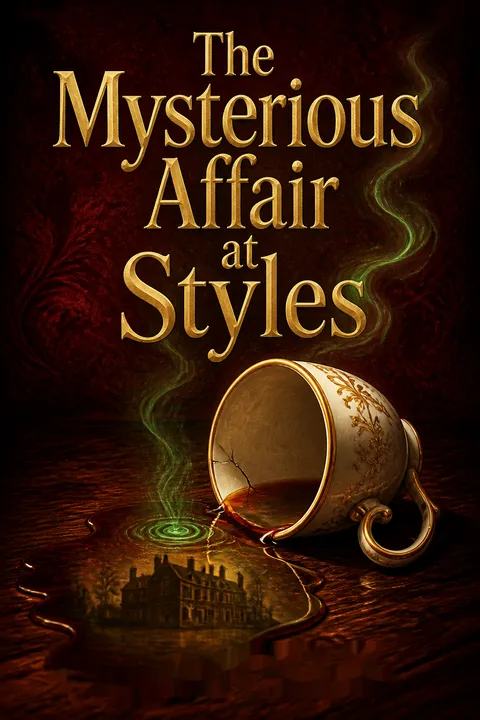
Captain Hastings, recovering from war injuries, is invited by his old friend John Cavendish to stay at Styles Court, the home of John's stepmother, Emily Inglethorp. Hastings is introduced to the household, including John's wife Mary, his brother Lawrence, and Emily's new husband, Alfred Inglethorp. The atmosphere is tense, with underlying family tensions and suspicions about Alfred's intentions.
The Quarrel Unveiled
Hastings learns of a heated argument between Emily and an unknown person, overheard by the maid Dorcas. Emily is upset and later makes a new will. The family dynamics are strained, with suspicions about Alfred's motives for marrying Emily, who is significantly older and wealthy.
A Night of Tragedy
Emily is found dead in her locked bedroom, having suffered a violent seizure. The household is thrown into chaos. Hastings calls upon his friend, the famous detective Hercule Poirot, to investigate. Poirot begins his meticulous examination of the scene, noting several peculiarities.
Poirot's Intriguing Methods
Poirot's investigation reveals a fragment of green fabric, a coffee cup, and a mysterious letter. He questions the household, uncovering alibis and motives. Poirot's methods are unconventional, focusing on small details that others overlook, such as the timing of events and the behavior of the suspects.
The Inquest's Revelations
At the inquest, it is revealed that Emily died from strychnine poisoning. Suspicion falls on Alfred Inglethorp, who has a weak alibi and a motive. However, Poirot is not convinced of his guilt and continues to probe deeper, suspecting a more complex plot.
A Web of Deceit
Poirot uncovers a web of deceit involving multiple household members. He discovers that Emily's will was destroyed, and there are conflicting accounts of the events leading up to her death. Poirot's investigation reveals hidden relationships and motives, complicating the case further.
The Arrest and Alibi
Alfred Inglethorp is arrested for the murder, but Poirot believes he is innocent. Poirot uncovers an alibi for Alfred, involving a secret meeting with a local woman. Poirot's investigation shifts focus to other suspects, including members of the household who had access to the poison.
Poirot's Final Gambit
Poirot gathers everyone at Styles Court to reveal the murderer. He explains how the poison was administered and the motive behind the crime. Poirot's deductions point to Evelyn Howard, Emily's companion, who conspired with Alfred to inherit Emily's fortune. Poirot's meticulous attention to detail and psychological insight solve the case.
Truth and Reconciliation
With the true murderer exposed, the household begins to heal. John and Mary Cavendish reconcile, and the family is relieved of the suspicion that had plagued them. Poirot's intervention not only solves the crime but also restores peace to Styles Court.
Analysis
Themes of deception and justice"The Mysterious Affair at Styles" explores themes of deception, justice, and the complexity of human relationships. Agatha Christie masterfully weaves a tale of intrigue, where appearances are deceiving, and the truth is hidden beneath layers of lies. Poirot's investigation reveals the intricate web of motives and secrets that drive the characters, emphasizing the importance of justice and the pursuit of truth. The novel also highlights the impact of war on society, as Hastings returns from the front to find a world filled with suspicion and uncertainty. Christie's use of red herrings and psychological insight keeps readers engaged, while the final reveal showcases Poirot's brilliance and the triumph of justice.
Review Summary
The Mysterious Affair at Styles introduces Hercule Poirot in his first published case. Set in an English country house, the plot revolves around a poisoning murder with multiple suspects. Readers praise Christie's intricate plotting, red herrings, and Poirot's deductive skills. While some find the narrative style dated, most appreciate the classic whodunit elements and Christie's ability to keep readers guessing. The book is considered a strong debut, showcasing Christie's talent for crafting complex mysteries and memorable characters, particularly Poirot.
People Also Read





Characters
Hercule Poirot
Poirot is a retired Belgian detective known for his methodical approach and attention to detail. He uses his "little grey cells" to solve the mystery, focusing on psychological insights and seemingly trivial clues. Poirot's calm demeanor and sharp intellect make him a formidable investigator.
Captain Arthur Hastings
Hastings is a former soldier and Poirot's close friend. He narrates the story, providing a perspective that contrasts with Poirot's analytical mind. Hastings is loyal and eager to assist Poirot, though he often misses the detective's subtle deductions.
Emily Inglethorp
Emily is the wealthy owner of Styles Court and the victim of the murder. She is known for her strong personality and charitable work. Her sudden death sets off the investigation, revealing hidden tensions and secrets within the household.
Alfred Inglethorp
Alfred is Emily's much younger husband, whose motives are questioned due to his financial dependence on her. He is initially the prime suspect, but Poirot's investigation reveals a more complex plot involving other household members.
John Cavendish
John is Emily's stepson, who struggles with financial difficulties and a strained marriage. He is devoted to his family but becomes entangled in the investigation due to his proximity to the crime and his complex relationship with his wife, Mary.
Mary Cavendish
Mary is John's wife, known for her beauty and strong will. She is initially suspected due to her secretive behavior and strained relationship with Emily. However, her loyalty to John and her own struggles are revealed as the investigation unfolds.
Lawrence Cavendish
Lawrence is John's brother, a former medical student with a quiet demeanor. He is initially suspected due to his knowledge of poisons and his aloof behavior. Lawrence's complex emotions and hidden affections are uncovered during the investigation.
Evelyn Howard
Evelyn is Emily's companion and confidante, known for her bluntness and loyalty. She harbors a deep resentment towards Alfred and is revealed to be part of the conspiracy to murder Emily, motivated by greed and jealousy.
Cynthia Murdoch
Cynthia is a young woman living at Styles Court under Emily's guardianship. She works at a nearby hospital and is initially suspected due to her access to poisons. Cynthia's innocence and charm are eventually proven, and she plays a key role in the resolution of the case.
Dorcas
Dorcas is the trusted maid at Styles Court, providing valuable insights and observations to Poirot. Her loyalty to the family and attention to detail make her a crucial witness in the investigation.
Plot Devices
Locked Room Mystery
The murder of Emily Inglethorp occurs in a locked room, creating a classic "locked room mystery." This plot device adds complexity to the investigation, as Poirot must determine how the murderer entered and exited the room without being detected.
Red Herrings
The story is filled with red herrings, including false leads and misleading evidence that divert attention from the true culprit. Poirot's ability to see through these distractions is key to solving the case.
Psychological Insight
Poirot's investigation relies heavily on psychological insight, as he analyzes the motives and behavior of the suspects. This plot device emphasizes the importance of understanding human nature in solving crimes.
Alibi and Timing
The investigation focuses on the alibis and timing of events, as Poirot meticulously reconstructs the timeline of the crime. This plot device highlights the importance of detail and precision in detective work.
The Final Reveal
Poirot's final reveal is a dramatic and conclusive resolution to the mystery. He gathers all the suspects and presents his deductions, exposing the true murderer and their motives. This plot device provides a satisfying conclusion to the story.
FAQ
Synopsis & Basic Details
What is The Mysterious Affair at Styles about?
- A War-Weary Invitation: Captain Arthur Hastings, recovering from injuries sustained in WWI, accepts an invitation from his old friend John Cavendish to stay at Styles Court, the family estate in Essex, setting the stage for a classic country house mystery.
- A Tense Family Dynamic: Upon arrival, Hastings discovers a household rife with tension, particularly surrounding John's wealthy stepmother, Emily Inglethorp, and her much younger, recently married husband, Alfred Inglethorp, whose motives are widely distrusted by the family.
- Sudden Death, Master Detective: The fragile peace is shattered when Emily Inglethorp is found dead, seemingly poisoned, in her locked bedroom. Hastings, recalling his past acquaintance with the brilliant Belgian detective Hercule Poirot, who is now a refugee living in the nearby village, enlists his help to unravel the perplexing crime.
Why should I read The Mysterious Affair at Styles?
- Birth of a Legend: This novel marks the debut of Hercule Poirot, one of fiction's most iconic detectives, offering readers the chance to witness his "little grey cells" in action for the very first time, establishing his unique methods and eccentricities.
- Masterclass in Misdirection: Agatha Christie expertly crafts a complex plot filled with red herrings, intricate alibis, and subtle clues, challenging readers to piece together the truth alongside Hastings, making for a highly engaging and satisfying puzzle.
- A Glimpse into Post-WWI Society: Beyond the murder, the story provides a fascinating snapshot of English society immediately after World War I, touching on themes of class, financial strain, and changing social norms, all observed through the eyes of a returning soldier.
What is the background of The Mysterious Affair at Styles?
- Post-WWI Setting: The story is set in England shortly after World War I, a period of significant social and economic upheaval. Hastings's convalescence from the Front and the presence of Belgian refugees (including Poirot) directly reflect the war's impact, influencing character circumstances and the overall atmosphere of the novel.
- Country Estate Dynamics: Styles Court, a grand but financially strained country house, serves as a microcosm of the era's changing class structures. The Cavendish family's dependence on Emily Inglethorp's wealth, and their resentment towards Alfred, highlight the anxieties of maintaining aristocratic lifestyles in a new economic reality.
- Christie's Personal Experience: Agatha Christie herself worked in a dispensary during WWI, gaining knowledge of poisons that she meticulously wove into the plot. This personal background lends authenticity to the details of strychnine and bromide, making the medical and chemical aspects of the murder particularly convincing.
What are the most memorable quotes in The Mysterious Affair at Styles?
- "Everything matters.": Poirot's foundational philosophy, stated early in his investigation (Chapter IV), emphasizes his meticulous attention to even the smallest details, which Hastings often dismisses, and serves as a guiding principle for his detective work.
- "Imagination is a good servant, and a bad master.": Poirot's caution to Hastings (Chapter V) highlights the danger of jumping to conclusions or letting personal biases cloud judgment, a recurring theme as Hastings frequently misinterprets clues.
- "The happiness of one man and one woman is the greatest thing in all the world.": Poirot's profound justification for his unconventional actions (Chapter XIII) reveals a deeper, humanistic side to his pursuit of justice, suggesting that sometimes, the restoration of personal happiness can be as important as legal retribution.
What writing style, narrative choices, and literary techniques does Agatha Christie use?
- First-Person Narrative (Hastings): The story is told through the eyes of Captain Hastings, providing a limited, often biased, and occasionally naive perspective. This narrative choice allows Christie to mislead the reader alongside Hastings, making Poirot's eventual deductions more surprising and impactful.
- Meticulous Detail & Red Herrings: Christie's style is characterized by precise descriptions of the crime scene, character interactions, and timelines, yet she masterfully sprinkles in numerous red herrings and seemingly irrelevant details that divert attention from the true culprit, challenging the reader's own powers of observation.
- Poirot's Eccentric Method: The introduction of Hercule Poirot showcases his unique blend of psychological insight, logical deduction, and fastidious nature. His reliance on "little grey cells" and his insistence on "order and method" establish a distinct detective archetype that would become a hallmark of the Golden Age of Detective Fiction.
Hidden Details & Subtle Connections
What are some minor details that add significant meaning?
- The Pink vs. White Candle Grease: Poirot's observation in Mrs. Inglethorp's room (Chapter IV) that the large patch of candle grease on the floor is white, while Lawrence's candle (the only one brought in during the alarm) is pink, subtly indicates that another person was in the room before the family arrived, a crucial detail for the "locked room" puzzle.
- The Unprinted Chemist's Label: The empty bromide powder box found in Mrs. Inglethorp's room (Chapter IV) lacks a chemist's name on its label, a detail Poirot points out as "odd." This seemingly minor omission later becomes a key indicator that the powders were not dispensed by a professional chemist, but rather by someone with medical knowledge within the household, like Cynthia or Miss Howard.
- The "L." on the Parkson's Parcel Label: The initial "L." on the theatrical costumier's parcel label (Chapter IX), found by Miss Howard, is initially debated by Hastings as possibly a "T." or "J." Poirot's certainty that it's an "L." (for Lawrence) is a subtle hint that Lawrence Cavendish ordered the disguise, linking him to the plot, even if his role is later revealed to be one of protection rather than guilt.
What are some subtle foreshadowing and callbacks?
- Mary Cavendish's Poison Remark: Early in the novel (Chapter I), during a casual conversation about murder, Mary Cavendish states, "Not in a case of poisoning... Dr. Bauerstein was saying yesterday that, owing to the general ignorance of the more uncommon poisons among the medical profession, there were probably countless cases of poisoning quite unsuspected." This seemingly innocent remark foreshadows the method of murder and her later, albeit innocent, involvement with a narcotic.
- Miss Howard's "Instinct": Miss Howard's vehement declaration (Chapter I) that if someone she loved were murdered, she would "know at once" who the criminal was, even if she couldn't prove it, is a powerful piece of foreshadowing. Poirot later uses this very "instinct" against her (Chapter VIII), revealing that her outward hatred for Alfred Inglethorp masked a deeper, more complex, and ultimately incriminating, emotional connection.
- The Bell Wire Incident: Dorcas's casual mention (Chapter IX) that Mrs. Inglethorp's bell wire was "nibbled through" on Monday, the day before the murder, and repaired on Tuesday morning, is a critical piece of foreshadowing. It reveals the murderer's initial plan to isolate Emily, which was thwarted by her forgetting her medicine, leading to the delayed poisoning and the "last link" of evidence.
What are some unexpected character connections?
- Alfred Inglethorp and Evelyn Howard's Secret Alliance: The most unexpected connection is the conspiratorial relationship between Alfred Inglethorp and Evelyn Howard. Initially presented as bitter enemies, their shared motive of greed and their pre-existing romantic entanglement are revealed as the true driving force behind the murder, subverting reader expectations based on their outward animosity.
- Lawrence Cavendish's Protective Love for Cynthia: Lawrence's seemingly aloof and nervous demeanor towards Cynthia is revealed to be a mask for deep affection. His actions, such as crushing the coffee cup and falsely testifying about the bolted door (Chapter XIII), are driven by a desperate desire to shield Cynthia from suspicion, highlighting a hidden romantic connection.
- Mary Cavendish's Jealousy and Pride: Mary's strained relationship with John and her flirtation with Dr. Bauerstein are initially presented as signs of her independence or even infidelity. However, Poirot reveals her "madly jealous" nature (Chapter XII) and her deep pride, which, combined with a misunderstanding about John's infidelity, drove her to administer the narcotic to Emily, believing she was protecting her husband.
Who are the most significant supporting characters?
- Dorcas, the Observant Maid: Dorcas, the parlourmaid, is far more than a background figure. Her detailed recollections of the quarrel (Chapter IV), Emily's agitated state, the "slip of paper," and the order for a fire (Chapter XII) provide crucial, often overlooked, pieces of the puzzle that Poirot meticulously reconstructs.
- Dr. Bauerstein, the Red Herring/Spy: Dr. Bauerstein serves as a multi-layered supporting character. Initially presented as a potential love interest for Mary and a red herring for the murder, his true role as a German spy (Chapter X) adds a layer of wartime intrigue and explains his suspicious movements, while also diverting attention from the real culprits.
- Cynthia Murdoch, the Unwitting Accomplice: Cynthia's role as a V.A.D. in the dispensary (Chapter II) and her access to poisons make her a plausible suspect, but her innocence is key. Her unwitting administration of the narcotic to Emily (given by Mary) and her later discovery of the "extra coffee-cup" (Chapter IX) are pivotal to unraveling the complex plot, making her an essential, if often passive, player.
Psychological, Emotional, & Relational Analysis
What are some unspoken motivations of the characters?
- Emily Inglethorp's Need for Control: Emily's constant "running a hundred societies" (Chapter I) and her habit of making new wills annually (Chapter V) reveal an unspoken motivation: a deep-seated need to exert control over her family and her fortune, even from beyond the grave, which ultimately makes her vulnerable to manipulation.
- Alfred Inglethorp's Calculated Greed: While outwardly playing the devoted husband, Alfred's unspoken motivation is pure, calculated greed. His "impassive" face (Chapter I) and "unctuous" voice mask a cold, methodical mind focused solely on acquiring Emily's wealth, as evidenced by his pre-marriage will and his later scheme with Miss Howard.
- Mary Cavendish's Protective Jealousy: Mary's "intense power of stillness" (Chapter I) and her later "icy unconcern" (Chapter IX) regarding Bauerstein's arrest hide a fierce, unspoken jealousy for John. Her actions, including administering the narcotic, are motivated by a desperate desire to protect her husband from perceived infidelity and scandal, even if her suspicions were misplaced.
What psychological complexities do the characters exhibit?
- Hastings's Bias and Blind Spots: Captain Hastings, the narrator, exhibits a psychological complexity rooted in his personal biases and romantic inclinations. His immediate distrust of Alfred Inglethorp and Dr. Bauerstein, coupled with his admiration for Mary Cavendish, consistently blinds him to crucial clues and Poirot's subtle deductions, making him an unreliable, yet endearing, observer.
- Lawrence's Introverted Protectiveness: Lawrence Cavendish, initially described as "unusually shy and reserved" (Chapter II), displays a complex psychological depth. His quiet nature masks a fierce protectiveness, particularly towards Cynthia, leading him to commit acts of misdirection (crushing the coffee cup, lying about the bolt) to shield her, even at his own peril.
- Evelyn Howard's Mask of Gruff Loyalty: Miss Howard's "hearty, almost painful grip" and "deep voice, almost manly" (Chapter I) present a gruff, loyal exterior. However, her "unnatural vehemence" against Alfred (Chapter VII) is a psychological mask, concealing her true, passionate, and ultimately criminal, alliance with him, driven by a shared desire for Emily's fortune.
What are the major emotional turning points?
- Miss Howard's Departure and Warning: Evelyn Howard's dramatic departure after her "row with Alfred Inglethorp" (Chapter I), where she warns Hastings to "watch that devil—her husband!", is a major emotional turning point. It injects a palpable sense of foreboding and suspicion into the household, shifting the emotional landscape from simmering tension to overt distrust.
- Mary Cavendish's Panic and Confession: Mary's "sudden cry that startled me: 'No, no—not that—not that!'" (Chapter III) upon Hastings's suggestion of poison, followed by her later, quiet confession to Poirot about administering a narcotic (Chapter XII), marks a significant emotional turning point. It reveals her deep fear and panic, and her desperate attempt to protect John, even if it meant concealing her own actions.
- Poirot's "Woman's Happiness" Deliberation: Poirot's internal struggle over whether to immediately clear John Cavendish, knowing it might hinder the conviction of the real criminals, is a profound emotional turning point (Chapter IX, XIII). His decision to allow the trial to proceed for the sake of John and Mary's reconciliation highlights his complex moral compass and his belief in the transformative power of shared adversity.
How do relationship dynamics evolve?
- John and Mary's Reconciliation Through Adversity: The relationship between John and Mary Cavendish undergoes a significant evolution, moving from a strained, distant marriage marked by "drifting apart" and "misunderstanding" (Chapter IX, XIII) to a profound reconciliation. The shared ordeal of John's murder trial forces them to confront their pride and rediscover their love, ultimately strengthening their bond.
- Emily and Alfred's Deceptive Alliance: The dynamic between Emily and Alfred Inglethorp is revealed to be a calculated deception. What appears to be an infatuated older woman and her devoted, if opportunistic, young husband (Chapter I) is exposed as a cold, manipulative partnership designed to exploit Emily's wealth, culminating in her murder.
- Lawrence and Cynthia's Budding Romance: The initially "constrained" (Chapter II) relationship between Lawrence Cavendish and Cynthia Murdoch subtly evolves into a mutual affection. Lawrence's protective actions during the investigation, driven by his love for Cynthia, and Cynthia's later "You dears!" kiss (Chapter XIII), signify the blossoming of a genuine, if understated, romance.
Interpretation & Debate
Which parts of the story remain ambiguous or open-ended?
- The Exact Nature of John's Affair with Mrs. Raikes: While the prosecution asserts John's "intrigue with a certain Mrs. Raikes" (Chapter XI) and Miss Howard alludes to it (Chapter I), the full extent and emotional depth of this relationship remain somewhat ambiguous. It serves primarily as a motive and a red herring, rather than a fully explored subplot, leaving readers to infer its true significance to John's character and marriage.
- The Depth of Mary's Feelings for Dr. Bauerstein: Mary's relationship with Dr. Bauerstein is presented with deliberate ambiguity. Hastings suspects a romantic connection, and Mary herself says "Perhaps" when John asks if she's in love with him (Chapter IX). However, Poirot later dismisses this, stating she "does not care, and never has cared one little jot" (Chapter X), leaving the reader to ponder whether her actions were purely strategic or if there was a fleeting emotional component.
- The Long-Term Impact of the Trial on John and Mary: While Poirot orchestrates the trial for John and Mary's "happiness" and they reconcile, the long-term psychological impact of being accused of murder and the public scandal on their relationship is left open-ended. The narrative concludes with their immediate reconciliation, but the lasting scars of such an ordeal are only hinted at.
What are some debatable, controversial scenes or moments in The Mysterious Affair at Styles?
- Poirot's Deliberate Deception of Hastings: Poirot's decision to intentionally mislead Hastings throughout the investigation, particularly about his suspicions and the true identity of the murderer (Chapter XIII), is a debatable point. While Poirot justifies it by Hastings's transparent nature, it raises questions about the ethics of a detective manipulating his closest friend and narrator.
- The Ethical Justification of Poirot's "Woman's Happiness" Gambit: Poirot's choice to allow John Cavendish to be brought to trial, even though he knew John was innocent, to force a reconciliation with Mary (Chapter XIII), is highly controversial. It prioritizes a specific outcome (conjugal happiness) over immediate justice and potentially puts an innocent man through immense suffering, sparking debate about the boundaries of a detective's role.
- Alfred Inglethorp's Calculated Self-Incrimination: Inglethorp's strategy of manufacturing evidence against himself to secure an acquittal and immunity (Chapter XIII) is a morally ambiguous and controversial act. It highlights a loophole in the legal system and presents a villain who is not only a murderer but also a master manipulator of justice, challenging the reader's sense of fairness.
The Mysterious Affair at Styles Ending Explained: How It Ends & What It Means
- The True Culprits Revealed: The Mysterious Affair at Styles ending explained reveals that the murder of Emily Inglethorp was a meticulously planned conspiracy between her new husband, Alfred Inglethorp, and her companion, Evelyn Howard. They intended to inherit her fortune, with Howard administering bromide to precipitate strychnine already in Emily's tonic, and Inglethorp creating a false alibi and manufactured evidence to frame John Cavendish.
- Poirot's "Last Link" and Hastings's Insight: Poirot discovers the "last link" – a charred fragment of a letter from Alfred to Evelyn, detailing their plot and the "stroke of genius" bromide idea – hidden in a spill vase, thanks to Hastings's casual observation about Poirot's shaking hand (Chapter XI, XII). This letter, combined with the discovery of the black beard and pince-nez (used by Howard to impersonate Alfred at the chemist's), provides irrefutable proof.
- Justice, Reconciliation, and Poirot's Philosophy: The ending signifies the triumph of Poirot's "little grey cells" and his unique brand of justice. Beyond solving the crime, Poirot orchestrates events (allowing John's trial) to force a reconciliation between John and Mary Cavendish, believing that "the happiness of one man and one woman is the greatest thing in all the world" (Chapter XIII). This highlights themes in The Mysterious Affair at Styles of love, forgiveness, and the complex interplay between legal justice and emotional well-being, leaving the Cavendish family to rebuild their lives while the true villains face their fate.
Hercule Poirot Series























About the Author


Download PDF
Download EPUB
.epub digital book format is ideal for reading ebooks on phones, tablets, and e-readers.








































