
Plot Summary
Apple Bobbing and Boasting
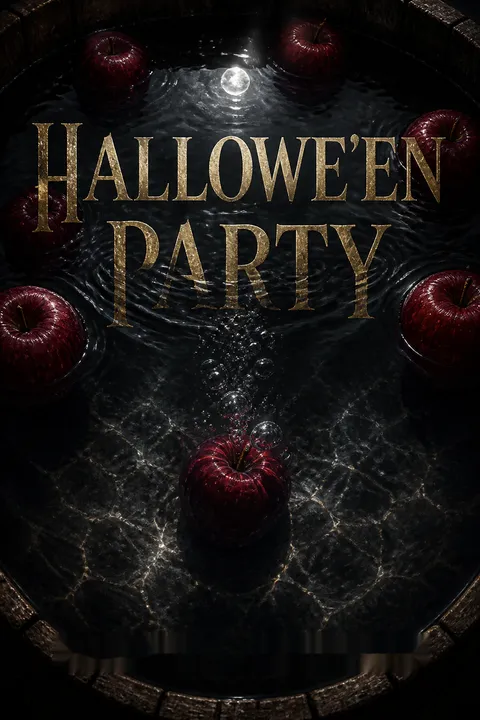
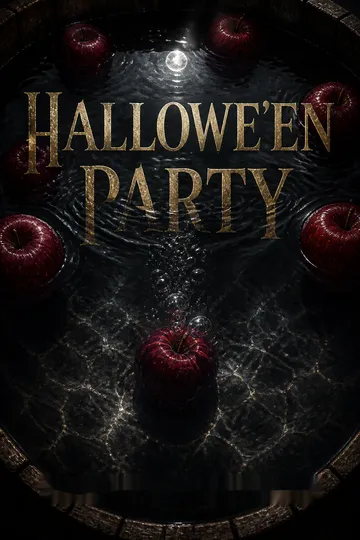
Woodleigh Common is bustling ahead of its local Halloween party at Apple Trees, hosted by the efficient Rowena Drake. Amidst laughter and pumpkin-laden chaos, gossip and local color intermingle as children—Joyce, Miranda, and others—giggle and prepare for contests. Mrs. Ariadne Oliver, famous for her murder mysteries, is in attendance, bemused and talkative. Joyce, a precocious thirteen-year-old, claims in front of the whole group that she once witnessed a real murder, insisting against scoffing, "I did, I did, I saw a murder!" Her boasts are dismissed as attention-seeking, but a shadow flickers as games begin, setting in motion a chain of events that will transform innocent fun into terror.
A Party Turns Tragic
The night is full of music, snacks, and traditional games—bobbing for apples, flour cakes, mirrors, and the climactic Snapdragon. Mrs. Oliver notes the children's competitiveness; Rowena manages everything with brisk perfection. The children participate in lively rituals, giggling over broomstick prizes and ghostly reflections. As the party winds down, Joyce is discovered missing. What follows is a dreadful revelation—her body is found face down in the apple-bobbing bucket, drowned by deliberate force. The cheerful home is instantly transformed into a crime scene. The party's guests whisper in shock, and dreadful uncertainty descends over the adults and children alike.
Summoning Poirot's Intellect
The shocking murder rattles the entire community. Mrs. Oliver, convinced by a gnawing sense that Joyce's claim about witnessing murder was more important than anyone realizes, presses her friend Hercule Poirot for help. Poirot, aging and increasingly contemplative, reluctantly agrees, drawn in by Mrs. Oliver's intuition that Joyce died because of her boast. The police inquiry roots through alibis and strange behaviors, but Poirot—methodical and skeptical—seeks to understand not merely the 'who' but the 'why,' focusing on psychological detail and motive amid local rumors.
The Boast That Killed
Poirot and Mrs. Oliver systematically interview those present at the party and at earlier preparations. The recurring theme is that Joyce was a notorious liar with a disruptive need to be noticed. Her claim of having witnessed a murder is repeatedly dismissed by adults and children alike. Yet Mrs. Oliver's conviction that Joyce's story was real only grows after the murder. Poirot challenges everyone's assumptions: was Joyce killed to silence her? Or had she falsely accused by chance? Poirot's inquiry shifts focus to times, places, and the psychology of adolescent girls desperate for attention and belonging.
Faces Behind Masks
Interviewing the children, parents, school staff, and hired help, Poirot learns that many are hiding behind village respectability. Rowena Drake is strong and organized yet oddly defensive; Nick and Desmond, helpful teenage boys, are more interested in their costumes and tricks than murder. The local witch, Mrs. Goodbody, sows suspicion as gossip turns from strangers to the familiar. Each new perspective—schoolteachers, mothers, siblings—unveils old grudges, dark secrets, and the complicated entanglements of small-town life, which make every "face in the mirror" a potential mask for something darker.
The Tangle of Lies
Poirot's interviews return again and again to the issue that complicates the case: Joyce's chronic dishonesty. The community believes her murder claim was just another tall tale, like stories of elephants in India or unlikely adventures. Her siblings and the adults don't mourn deeply; restraint mingles with relief. The village's tolerance for "little liars" has allowed secrets to spread unchecked beneath the surface. Poirot, however, notes that sometimes, when a liar tells the truth, nobody believes her—and this, he suggests, might be the point of origin for the tragedy.
Suspects, Secrets, and Suffering
Poirot's scrutiny falls on notable deaths within the community: a forged will, the sudden death of Mrs. Llewellyn-Smythe (wealthy matriarch), an au pair girl's disappearance, a teacher named Janet White strangled on a woodland path, and the stabbing of a lawyer's clerk, Lesley Ferrier. Each crime, unresolved or unsettled, implicates possible suspects and motivations. Poirot systematically questions the role of each—Was the will's forger also a murderer? Who benefited? He considers opportunities and motives involving family, love affairs, and money, tracing complex webs between schoolgirls' idle boasting and lethal adult ambition.
The Shadows of Woodleigh Common
The village seems peaceful, yet Poirot perceives the psychological tension beneath its traditions. Miss Ernlyn, the shrewd headmistress, drills Poirot for logic, but sees the "pattern of violence" in her students and staff. Mrs. Drake, anxious about social standing, is both competent and cold. Poirot's methodical process uncovers resentment, fear, and long-held secrets. He reflects on the differences between justice and mercy, and how "too much mercy" has enabled dangerous behaviors to go unchecked—the perfect cover in a place where everyone claims to know everyone, yet truly knows none.
Old Sins, New Blood
Poirot and the lawyer Mr. Fullerton explore the intricate aftermath of the Llewellyn-Smythe inheritance scandal: a forged codicil left her vast fortune to a foreign au pair, Olga, but handwriting analysis revealed fraud. The girl vanished before trial; suspicion lingers that she might also have been murdered. Poirot senses that the murderer of Joyce feared an accidental witness—someone who had seen yet not understood a past crime. The detective links the murder of Ferrier (tied to jealousy and criminal pasts) and the disappearance of Olga, suggesting that the shadow of old crimes has returned to menace Woodleigh Common's children.
Beneath the Surface—Motives
Poirot continues to sift fact from invention, questioning community members about their timing, whereabouts, and emotional reactions during the party and in prior years. Mrs. Drake's moment of nervousness on the landing, dropping a vase, is re-examined after a teacher, Miss Whittaker, insists she was startled by something or someone turning a doorknob. Poirot hypothesizes that hidden connections—especially the fear of exposure—are at the core. Whom did Mrs. Drake see exiting the library? Who benefits from drowning a child to silence the truth? Slowly, Poirot narrows his field to those with the knowledge and nerve to kill.
The Codicil Conundrum
A cleaning woman, Mrs. Learnan, steps forward with a vital witness statement. She asserts that a genuine codicil was indeed witnessed and hidden by Mrs. Llewellyn-Smythe, perhaps later destroyed. Poirot deduces that the obviously forged will, intended to cast blame on Olga and remove her from the picture, was orchestrated by more cunning hands—someone with a vested interest in keeping the fortune with the Drakes and who understood the power of legal ambiguity. The tangled codicil mystery connects past deaths, the present murder, and the murderous intent deeply rooted in greed.
Ghosts in the Quarry
Poirot visits the quarry garden, designed with uncanny beauty by Michael Garfield. Amid the picturesque setting, shadows of murder and scheming hang over the place. Children speak of wishing wells, old bones, and vanished people. Poirot senses that what looks like art and order is, in fact, the camouflaged aftermath of cruelty, deception, and avarice. Interviews with Garfield reveal a philosophy that puts beauty above morality—a clue that creation and destruction may walk together, and that "sacrifice" can be both metaphorical and very physical in the right hands.
The Truth in Water
The method of murder—drowning in water—emerges as a central clue. Poirot realizes the murderer must have gotten soaked, so orchestrated an alibi by deliberately drenching herself—with Miss Whittaker as unwitting witness. The water motif ties the murders of both Joyce and, soon, a second child, Leopold—whose penchant for eavesdropping and blackmail cost him his life—as the killer seeks to eradicate anyone who might have seen too much. The symbolism of water, regeneration in rituals, and its role in past village deaths coalesce to expose not only motive and opportunity, but also the killer's psychological makeup.
The Fatal Witness
With mounting dread, Poirot maneuvers to protect Miranda, Joyce's best friend, as he realizes she is the true witness to the quarry murder—traumatized, uncomprehending at the time, recalling only as an adolescent what she saw. As those who stand to lose most become desperate, another death almost occurs: Miranda is lured under the guise of "ritual sacrifice" by her biological father, Michael Garfield, whose narcissism and amorality know no bounds. Nick and Desmond, suspicious, intervene just in time to save the girl and expose the heart of the conspiracy at last.
Murderous Pair Unmasked
Consulting with police and Miss Ernlyn, Poirot gathers survivors, witnesses, and officials. Through Miranda's testimony, he demonstrates how Michael Garfield and Rowena Drake murdered Olga (the au pair), staged her disappearance, forged documents to secure the Llewellyn-Smythe fortune, and drowned Joyce and Leopold to cover their tracks. Miranda's naïve acceptance of "sacrifice" as a kind of magical necessity is laid bare—mirroring her manipulative father's vision of murder as necessary for artistic beauty. Rowena's Lady Macbeth-like coldness and Garfield's Luciferian beauty and selfishness are exposed as the dark core behind the small town's tragedies.
Sacrifice and Salvation
On Kilterbury Down, with symbols of ancient sacrifice looming, Miranda nearly becomes a final victim. Poirot's network of precautions and Mrs. Oliver's quick thinking keep her alive, while her testimony breaks the murderers' spell. Garfield, narcissistic and grandiose, succumbs to his own hubris; Rowena is revealed as a powerful yet fatally compromised woman. The ritual language of "sacrifice" is at last exorcised, with the community's blood price paid. Poirot, aging yet formidable, delivers justice—not with violence but with method, empathy, and the power of truth.
The Garden's Price
The story's heartbreaking irony is made explicit: Garfield's obsession with creating a garden—his personal Eden—drove him to orchestrate and condone a succession of murders, including those of lovers, children, and rivals. Inheritance, artistry, and human lives were all tools to achieve his vision. Rowena's complicity stems from her devotion to him and her own need for control. The revelation echoes through the village: order built on cruelty is fragile, and the cost of 'beauty' can be unspeakably high. Poirot, reflective, recognizes evil can appear in beautiful forms.
Reflections and Farewell
Poirot's reconstruction and Miranda's emergence as a survivor bring a subdued resolution. Mrs. Oliver, comforted yet shaken, observes that evil has been unmasked but at tremendous cost. Miranda, quietly wise beyond her years, lives on, her innocence preserved but her understanding deepened. Poirot, melancholy but satisfied, bids farewell—knowing that old sins do cast long shadows, and that in small communities as elsewhere, monsters may hide behind competent smiles and flowers. The fates of Lady Macbeth and Narcissus echo as warnings: that truth must be sought even in the most unlikely—most beautiful—places.
Analysis
"Hallowe'en Party" is both a classic whodunit and a searing psychological critique of mid-century village England, exposing the darkness behind the safety of tradition, community, and even beauty itself. Christie plunges the reader into a world where children's voices are dismissed, their inventions discounted—until one truth cuts through the denial with fatal results. The novel investigates not just murder, but the deeper perils of denial, complacency, and the consequences of adults' refusal to take children's fears seriously. In the figure of Miranda, the book reclaims the capacity of innocence to reckon with horror, and in Poirot's method, it valorizes both logic and empathy. Ritual, folklore, and the all-too-human desire for order mask greed, narcissism, and the compulsion to control. In the end, Christie argues that truth matters more than comfort: the pursuit of beauty, security, or authority can lead to evil when not checked by conscience and memory. The story's final lesson, echoed in Poirot's meditative farewell, is unsettling: monsters may hide in the most respectable or beautiful faces, and only a persistent, questioning mind—willing to listen even to little liars—can lay them bare.
Review Summary
Reviews of Hallowe'en Party are mixed, averaging 3.56/5. Many readers find it enjoyable as a seasonal Halloween read featuring Hercule Poirot and Ariadne Oliver investigating a child's murder at a party. Praise highlights Christie's atmospheric writing, clever plot resolution, and the charming dynamic between Poirot and Oliver. Criticism centers on repetitive dialogue, bland characters, predictable plotting, and minimal Halloween atmosphere beyond the opening. Several reviewers note it feels dated and lacks the tension of Christie's best work, though most still recommend it to established fans of the series.
People Also Read



Characters
Hercule Poirot
Poirot's legendary intellect drives the investigation's heart. Once worldly, now an aging legend, he is both cerebral and compassionate. He refuses to accept society's ready explanations, delving into psychology, motive, and consequence. He is skeptical of village reputations and the fallacies adults comfort themselves with, preferring hard truths and logical constructs. Poirot's interrogation style is gentle but relentless; he senses emotional resonance in the most minor details—a dropped vase, a boast, an untidy garden. The murder investigation reinvigorates him, demanding deep empathy to understand the adolescent liar, the cold matriarch, the deluded artist, and the victim-child. Ultimately, his wisdom exposes not just individual guilt, but the social systems that enable evil.
Ariadne Oliver
Mrs. Oliver is both comic relief and the engine of action; her presence gives the story a meta-textual flavor as a detective novelist immersed in a real crime. She is muddled and loquacious, but her instincts are razor-sharp—her horror at the sight of Joyce's drowned body is visceral, and her conviction that the murder is linked to an earlier crime is crucial. Psychoanalytically, Mrs. Oliver is sensitive to the unspoken, the irrational—it is she who draws Poirot to the puzzle Joyce embodied, and her care for Miranda ensures the child's survival. Her humanity, intuition, and network of friendships play a key role in gathering evidence and offering emotional support to the trauma-affected community.
Rowena Drake
Mrs. Drake epitomizes outward competence and organizational skill. As hostess and local leader, she is the community's pillar. But beneath the surface, she is rigid, controlling, and, ultimately, murderously protective of secrets and assets. Her marriage was defined by caretaking an invalid husband, fueling both her martyrdom and her ambition. The guilt that torments her is less about crime than about misjudgment and the loss of control—"I meant well," she insists. Her manipulation of events, from creating an alibi for wet clothes to orchestrating murders with Garfield, channels a Lady Macbeth complex: powerful women undone by their fatal desire for influence and love. Her relationship with Garfield is transactional and passionate, leading her to sacrifice her morality for a vision of security and beauty.
Michael Garfield
Michael Garfield is strikingly handsome, intelligent, and coldly ambitious. His creativity is magnetic, but also amoral—he adores beauty "at any price," even murder. As the garden's designer, he represents the allure and the peril of unchecked artistic vision. Garfield's charm conceals his manipulativeness: he seduced both Olga and Rowena to gain access to fortune and means, orchestrated crimes, and was prepared to murder his own daughter, Miranda, for self-preservation. He is a psychological "Narcissus," capable of intellectualizing crime as sacrifice for higher ideals. His relationship with Miranda is chillingly ambiguous—part paternal, part predatory, never loving enough to restrain his own murderous impulses.
Miranda Butler
Miranda is introduced as an ethereal, introspective girl—distant, odd, and beautiful. Her psychological complexity is profound: at twelve, she is both more mature and more naïve than her peers. She is the true witness to Olga's murder in the quarry, but was too young to comprehend what she saw. Her silence and trauma are at the root of the chain of deaths that follow. As the story unfolds, Miranda's sense of guilt, her relationship with Joyce, and her strange acceptance of "sacrifice" mark her as both victim and surviving heroine. She is pivotal to Poirot's reconstruction and, ultimately, to disrupting the murderers' plans. Her survival and growth symbolize hope; she represents innocence preserved through wisdom, not ignorance.
Joyce Reynolds
Joyce's defining trait is chronic dishonesty—a desperate bid for recognition and belonging. Her claim to have seen a murder is dismissed as performance, yet it is this boast that seals her fate. Joyce's psychology is shaped by a craving for attention, dissatisfaction, and a family that alternately ignores and disbelieves her. Ironically, in death her words become more scrutinized than in life. She is both catalyst and casualty: her lies enable the murderer to act with impunity, yet her brief grasp at truth exposes secrets long kept hidden. Ultimately, Joyce is a poignant symbol of the dangers of adults refusing to listen to children.
Leopold Reynolds
Leopold, younger brother to Joyce, embodies a more calculating childhood cunning. Obsessed with secrets and money, he listens at doors and blackmails those he catches in deceit. He is the only one to suspect Miranda's secret—a knowledge that costs him his life as the murderer eliminates any loose ends. Leopold's moral compass is ambiguous; his intelligence is dangerous in a world where children's games intersect with adult crimes. His fate illustrates the perils faced by the unusually clever—and the community's failure to protect its most vulnerable.
Judith Butler
Judith is gentle, melancholy, and loving; Miranda's mother lives in the shadow of past grief. Her relationship with Michael Garfield is tainted by old love and fear of his mysterious nature—she intuits his dangerous side before realizing its full extent. Judith's defense of Miranda, her friendship with Mrs. Oliver, and her quest for safety for her child drive emotional core of the latter story. She is ultimately a tragic survivor—reflective about the cost of secrets, and grateful for Poirot's intervention. Her psychological journey moves from denial and confusion to acceptance and painful clarity.
Miss Ernlyn
Miss Ernlyn is the narrative's voice of reason—clear-eyed, unsentimental, and justice-focused. She serves as Poirot's intellectual equal, comprehending the psychological darkness in the community without being swept up in hysteria or sentiment. Her sharp observations, and her ability to judge character dispassionately, help guide Poirot to the truth. She is a guardian of children, fierce and fair, but never naïve about evil. Psychoanalytically, she stands for the guardian superego—demanding evidence and integrity at every turn.
Mrs. Learnan
Mrs. Learnan's role is critical in breaking through the layered lies surrounding the will's codicil. Her account as a simple cleaning lady, driven by curiosity and fear, offers an outside, honest perspective. She is the story's embodiment of the "unseen observer," whose testimony enables Poirot to reconstruct the deeper history of treachery. Her experience demonstrates the potential for ordinary people, often dismissed, to disrupt larger crimes just by telling what they saw.
Plot Devices
Layered Narrative Structure and Delayed Revelation
Christie structures the narrative as a series of interviews, recollections, and point-of-view shifts; key facts and confessions only surface when repeated under different contexts. Literarily, the story's engine is delayed revelation—each chapter withholds some truth, adds gossip, then later corrects or amplifies. Poirot's investigation reverses the assumption of cause and effect—he treats Joyce's death as the result of a crime she witnessed years earlier, creating a puzzle that links past to present and adult to child.
Unreliable Narration and Child Psychology
The novel's greatest device is the unreliable child witness. Joyce's and Miranda's testimonies are filtered through communities that habitually dismiss children, especially those who are "liars." The psychological motif of attention-seeking, boasting, and the peril of adult disbelief is central. The truth only emerges by understanding why children lie or remain silent—mirroring the adult liars and conspirators who manipulate the narrative for their own ends.
Foreshadowing via Ritual and Folklore
Rituals—bobbing for apples, mirrors, Snapdragon, witch stories—foreshadow the violence hidden just beneath the surface of local custom. These traditional games and nursery rhymes double as clues: water and apples become methods of murder; the motif of sacrifice in folk tales becomes literal. Christie uses folklore and ancient myth (the "wishing well," the "old sins" of the quarry, the ritual of the double axe at Kilterbury Down) as a symbolic template for exposing how old evil repeats itself, and how the community's surface order is haunted by sacrificial violence.
Motif of Water and Cleansing
Drowning serves both as the murder method and as a metaphor for hidden sins surfacing; only those "wet" at the right time could be killers. The vase incident provides both an alibi and a clue: washing away blood or guilt is impossible. Water links crimes, rituals, and even the community's gossip, making it the ever-present medium through which truth finally surfaces—cleansing, but fatally so.
Guilt, Projection, and the 'Unmasking' Scene
Characters routinely project guilt onto children, the mad, or the "outsider." Christie stages a classic unmasking in which Poirot's patient questioning strips away these projections to reveal that evil resides at the heart of the respectable, the beautiful, and the trusted. In the climactic scene, Miranda's ability to finally articulate what she witnessed—a murder presented to her as a "sacrifice"—enacts the communal catharsis and exposes the fatal consequences of refusing to believe children.
Hercule Poirot Series











About the Author
Other books by Agatha Christie

Download PDF
Download EPUB
.epub digital book format is ideal for reading ebooks on phones, tablets, and e-readers.








































