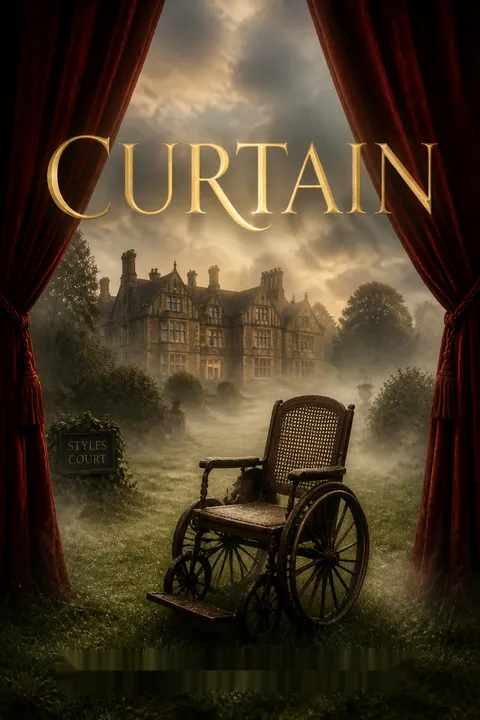

Plot Summary
The Return to Styles
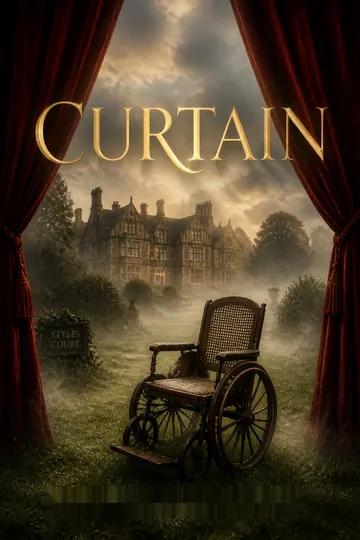
Captain Arthur Hastings, widowed and adrift, answers an invitation from his old friend, Hercule Poirot, to return to Styles—the country house where their first great case began years previously. Styles has changed, now a guesthouse run by the Luttrells, but its ghosts and legacy remain. Poirot is much aged and crippled by arthritis, yet his mind retains its acuity. He summons Hastings not merely for companionship but for a purpose: he senses evil stirring again at Styles, a gathering of people and passions reminiscent of the past. For Hastings, this homecoming is a wave of nostalgia—of beginnings, endings, and warning of new trouble. The tension is quiet but immediate: Poirot's reason for returning is not nostalgia, but premonition. For both, old landscapes blend memory with an uneasy sense of fate circling back.
Poirot's Dark Revelation
Poirot reveals his alarming conviction: a murder will soon occur at Styles, and the perpetrator is already under their roof. He introduces Hastings to "X," a shadowy, possibly serial, murderer linked to five previous deaths shrouded as accidents or crimes of passion—cases where evidence pointed only to the obvious suspect, but where one figure always lurked on the periphery. Poirot believes X—someone in the house—manipulates others into committing murder. Yet Poirot does not share X's identity, explaining this is for Hastings' protection. Their partnership becomes fraught with urgency. Poirot's physical frailty contrasts with the deadly sharpness of his mind: he cannot act himself, but needs Hastings' mobility. A chilling sense of doom arrives: they cannot tell who will die, or how, only that the murder is inevitable.
The Gathering of Suspects
The guesthouse is populated with complex personalities: Judith Hastings, Hastings' enigmatic daughter; Dr. Franklin and his invalid wife, Barbara; Nurse Craven, Dr. Franklin's dedicated nurse; the energetic Sir William Boyd Carrington; ethereal Elizabeth Cole; mysterious Stephen Norton; Major Allerton, the charming "bad lot"; and the Luttrells. Hastings observes each, seeking X, noting undercurrents—resentments, strange alliances, unrequited loves. Poirot warns that none appear capable, yet one is a master manipulator. Judith's distracted moods distress her father, while he suspects the worst of Allerton's intentions. Each guest harbors motives for anger, disappointment, or despair. The first act of the drama is the quiet weaving of tension; loyalties and antipathies are seeded, with Poirot watching, invisible yet in control.
Secret Motives Unearthed
As days at Styles unfold, guests reveal private resentments and confessions. Judgmental Nurse Craven expresses her opinions of the Franklins' marriage. Judith debates the moral ambiguity of euthanasia—should the strong take responsibility for removing suffering, even through death? Boyd Carrington resembles an old knight with secrets; Elizabeth Cole, haunted by her family's murderous past, confides in Hastings. Subtle pressures bubble up: unfulfilled lives, a sense of waste, and the ferocious desire to be free—especially from marital or familial burdens. The sense grows that these are people whom—if turned the right way—could be made to cross a fatal moral boundary. Invisible hands nudge them closer to the brink.
A Near-Fatal Accident
A tense afternoon shatters with a gunshot: Colonel Luttrell, distracted and belittled by his wife, accidentally shoots Mrs. Luttrell while aiming at what he claims was a rabbit. Though she survives, the incident narrowly mirrors Poirot's theory: a murder masked as justified or accidental, with an "obvious" perpetrator, but perhaps engineered by another. The event sows discord and suspicion, particularly as guests, including Hastings, question whether the event was truly accidental. Poirot analyzes meticulously. In the margin, he notes that such near-misses can be orchestrated, the invisible hand ensuring both the opportunity and the right emotional milieu. The real danger—manipulation—is still at large.
Webs of Influence
Hastings and Poirot parse the relationships at Styles: who resents whom, who loves or despises another, who might crave release—from illness, poverty, or a stifling marriage. Major Allerton's roguish charm, Franklins' bleak marriage, Judith's misfit intensity, and Norton's unassuming nature are all scrutinized. The realization dawns that the real threat is not the overtly evil but the unremarkable—someone who nudges others to act on dark impulses. Poirot explains that the X-figure's power lies in "catalysis," inciting others to cross the line into crime. Nobody at Styles is immune to influence; lines between victim and perpetrator blur. Suspicion is everywhere, but the mastermind is so well-camouflaged, no one thinks them dangerous.
Judith's Descent and Temptation
Judith's self-possession cracks. She is at war with her father, with Styles' constrictions, and with her own heart—torn between the ethically upright but cold Franklin and the dangerously magnetic Allerton. Hastings, believing Judith's affections are for Allerton, is tormented by fear for her reputation, her future, and her soul. Norton and Boyd Carrington attempt to reassure Hastings, but Judith's fury only increases under his scrutiny. Unbeknownst to Hastings, Judith's real struggle is over forbidden love for Franklin, locked in an impossible triangle—personal passion, responsibility, and the possibility of a new future. She teeters between despair and temptation, watched and perhaps influenced by unseen eyes.
Lovers and Dangers
As love affairs—real, imagined, or aspiring—intensify, more dangers appear. Allerton's entanglement with Judith is actually a red herring; his real assignation is with Nurse Craven. Hastings, blinded by his own traditional morals, contemplates murder to "save" Judith from a fate with Allerton, almost poisoning him, but is stopped by Poirot's intervention. Judith, meanwhile, contemplates breaking free with Franklin. Manipulative currents twine tighter, pushing the vulnerable to plan or almost commit violence. Each character becomes both puppet and player—driven by love, jealousy, or fear, steered dangerously close to the edge by influences neither they nor the reader see, but which Poirot begins to deduce.
The Poisoned Cup
After many days of tension, Mrs. Franklin suddenly dies, in apparent agony, from poisoning. The laboratory's dangerous substances—alkaloids from the Calabar bean—are found tampered with. The coroner's inquest suggests suicide, bolstered by persuasive testimony: Mrs. Franklin was depressed and hinted at "ending it all." Poirot himself supports this view, swaying the jury. Yet beneath the surface, it is clear her death is no suicide but an expertly orchestrated murder. The method mirrors earlier X-cases: opportunity, obvious suspect, inscrutable means. Poirot has controlled the course of public inquiry, but privately reveals to Hastings that Barbara Franklin was murdered. The conspiracy deepens.
Shadows and Suspicion
As mourning and suspicions swirl, Poirot's health deteriorates. Judith announces she will marry Franklin and go to Africa, shocking Hastings and stoking old fears—was his daughter complicit in murder so they could be together? Poirot confides that Barbara Franklin's death was averted from Franklin's cup to her own—an accidental twist in the murderer's plan. Meanwhile, Norton, the quiet birdwatcher, grows anxious. He hints to Hastings and Poirot that he has seen something crucial—perhaps the real secret behind the deaths at Styles—but feels targeted and afraid. Poirot grows more restless, knowing the killer, pressed by threat of exposure, may again strike.
The Locked Room Death
The house is stunned when Stephen Norton is found dead in his room, shot in the centre of the forehead, door locked from within, key in his pocket; all the signs point to suicide. Poirot, privately, tells Hastings this is murder; Norton was silenced before he could reveal what he knew. The means of the crime—locked door, no escape—mirror Poirot's most difficult cases, and deliberately so: someone is both staging murder and mocking detection. Poirot is now physically failing, his battle with "X" nearing a tragic conclusion; Styles is now a haunted house with three dead or nearly dead from unnatural causes.
Poirot's Final Act
After Norton's death, Poirot himself dies in his bed overnight. The world presumes natural causes—the decline of old age and a weak heart. Hastings mourns his friend deeply, but suspects foul play. He is left only with Poirot's locked dispatch box, a cryptic message, and an urgent sense that things are unresolved. Through a posthumous letter, Poirot finally reveals all: Norton, mild-mannered birdwatcher, was "X"—a psychological sadist who manipulated others to murder by suggestion. Poirot, physically failing and unable to obtain legal justice, committed a final murder himself, killing Norton to end his reign of influence. Poirot manipulated events not just to expose but to prevent further suffering.
Curtains Fall
Poirot's confession, delivered posthumously, is both shocking and redemptive: the perfect detective has committed the perfect crime for a noble cause. He reveals how he faked his disability, laid traps for both X and Hastings, and even protected Judith, who was not guilty. Poirot's final letter reassures Hastings—who nearly became a murderer himself under influence—that good people can be manipulated, but also redeemed. Hastings is exhorted to find new purpose, aiding Elizabeth Cole (whose own family's tragedy was another of X's twisted games). Poirot's legacy is bittersweet: he is both judge and executioner, haunted by doubt, yet certain he stopped evil that justice could never reach. The curtain falls; the age of Poirot ends at Styles where it began.
Analysis
Curtain: Poirot's Last Case presents Christie's most profound meditation on the nature of evil, justice, and the limitations of law. The novel subverts classic whodunnit conventions—not merely by hiding clues but by posing a fundamental question: is it ever right for one person to kill for the greater good? Poirot—once the most principled defender of civilization—becomes the executioner out of moral necessity, killing not in cold blood but to save innocents from psychological prey. Through the character of X, Christie exposes the terrible power of suggestion and the ordinary person's vulnerability to manipulation. The plot's locked-room brilliance is matched by a psychological portrait of the cost of conscience. Final lessons are sobering: evil flourishes when hidden in the soul's blind spots; justice may require great personal sacrifice; even the best can be driven to darkness by perfect evil. At the end, redemption is possible—but only through self-awareness, humility, and the courage to confront what lies beneath the skin of ordinary life. "Curtain" is not just the farewell to Poirot; it is Christie's curtain call, asking us to look past the puzzle to the human truth beneath.
Review Summary
Curtain is widely praised as a fitting and emotional farewell to Hercule Poirot, reuniting him with Captain Hastings at Styles, where their adventures began. Readers appreciate Christie's clever, original plot featuring a manipulative killer who orchestrates murders through others. Many were moved to tears by Poirot's death, though some found the ending controversial. The novel's symmetry, sharp mystery, and nostalgic tone earn it high marks, with most reviewers considering it among Christie's finest works, despite a minority finding certain plot decisions frustrating or the conclusion unsatisfying.
Characters
Hercule Poirot
Poirot, now elderly and nearly immobilized by arthritis, is as mentally sharp as ever. His sense of justice is matched only by his growing awareness of his own limitations—both moral and physical. Poirot is driven by a deep horror at the "perfect evil" he sees in the manipulative X, and the knowledge that traditional justice is powerless here. His relationship with Hastings, always affectionate if laced with impatience, has become protectively secretive—he shields his friend both from knowledge and from complicity. Poirot's psyche is torn between pride in solving crimes and the humility, even agony, of becoming murderer in turn. The connection between mind and conscience is his final battleground.
Arthur Hastings
Hastings is the soul of decency, warmth, and upright Britishness—sometimes naive, sometimes blundering, but always sincere. The death of his wife has left him adrift, and Judith's independence both awes and pains him. His devotion to Poirot is unwavering, though he is frequently frustrated by being kept in the dark. Hastings is manipulated—almost fatally so—by X, and nearly becomes a murderer himself. Throughout, his character is tested: love for Judith, susceptibility to panic and jealousy, and his slow, painful learning that good people can be bent to evil ends. In stories and life, he is the archetypal "everyman witness" to true genius and true evil.
Judith Hastings
Hastings' daughter is intelligent, passionate, and fundamentally restless. She is caught between condemnation and compassion—for illness, for weakness, for waste. Her brooding belief in the rightness of "necessary" deaths puts her dangerously close to being a pawn for X, but at heart Judith is courageous and fundamentally moral. Her secret love for Dr. Franklin is the real emotional core of her arc, yet her greatest vulnerability is her father's fear for her. Through the novel, Judith grows from a secretive, angry young woman to someone who can finally accept love and start anew, her strength tested but unbroken.
Dr. John Franklin
Brilliant, ungainly, introverted, Franklin is wrapped up in research but tormented by the unfulfillment of his marriage to Barbara and his growing love for Judith. Outwardly brusque and rational, inwardly he struggles with the desire to be free—yet, crucially, he will not take that freedom at the cost of honor or murder. His singlemindedness is a force for both good and danger, and he is, like Judith, almost ensnared by Norton's machinations. His evolution is toward emotional truth and courage, symbolized by his and Judith's post-Styles life in Africa.
Barbara Franklin
Barbara is a "Madonna" type: gentle, appealing, yet emotionally manipulative and self-dramatizing. Her sense of inadequacy and failure—feeling herself a burden to Franklin, never achieving romance with Boyd Carrington—makes her vulnerable both to her own despair and the subtle insinuations of others. Her tragic death is the pivot of the second half, a carefully staged "suicide" that is actually the work of X but, in a twist of fate, rebounds upon her rather than Franklin.
Nurse Craven
Dedicated, competent, with her own ambitions and resentments, Nurse Craven straddles the boundaries between servant and confidante. Her attraction to Franklin is barely concealed, her bitterness at being overlooked sharp. Craven is a voice of reason, but also of envy, and nearly ensnared by Allerton's flirtations. Her role as witness, and almost as victim, makes her both vehicle and observer of the house's emotional crosscurrents.
Sir William Boyd Carrington
A classic Englishman of the old order—big-game hunter, colonial administrator—Carrington is both genial and haunted by grief. His unrequited, possibly paternal love for Barbara Franklin is a source of both warmth and sadness. Socially astute, he is quick to intuit the shifting alliances at Styles, but hampered by his own loneliness and nostalgia. His character arc is that of one who knows what it is to lose, but still tries to protect others.
Elizabeth Cole
Elizabeth Cole (née Litchfield) is marked by the shadow of her family—her sister, Margaret, was convicted of murdering their monstrous father. She is intelligent and compassionate, but disillusioned, her life put on hold by the perceived taint of inherited guilt. Her friendship with Hastings represents the hope that dark legacies can be redeemed. She is a symbol of lives nearly broken by evil but capable of healing through truth.
Stephen Norton
The most dangerous character stands in the deepest shadow: Stephen Norton, the limping, bird-loving observer. Outwardly apologetic, nervous, and "quiet"—inwardly, a psychological predator. His technique is the catalyst: by understanding and subtly suggesting others' worst temptations, he induces murder vicariously. His motivations are rooted in a mixture of frustration, power-lust, and sadistic pleasure. Poirot recognizes him as a rare, almost unprecedented kind of villain—one who kills not with a weapon but with words, leaving no trace but devastation.
Major Allerton
Allerton's role is that of the charming, casually wicked guest whose very presence provides cover for others' suspicions. His escapades with Judith and Nurse Craven rouse Hastings' anxiety, yet he is more a plot device than a true suspect. His connections to past crimes (such as the Etherington case) make him appear suspicious, but in the end, his function is to occupy the attention of both reader and characters while the real murderer works unseen.
Plot Devices
The Psychological Manipulator
The heart of the novel is the concept of murder-by-proxy—the manipulator "X," who achieves evil not by action but by guiding others to act on their darkest impulses. This requires a mastery of psychology and performance, turning victim and perpetrator into unwitting accomplices. All evidence points to the "obvious" suspect, but it is the subtle pressure—the suggestion, the dare, the catalysis—that enables the crime, leaving the true mastermind incognito and blameless.
Locked Room and Misdirection
"Curtain" employs multiple layers of misdirection: the obvious suspects, the "accidental" shootings, and, in the climax, a locked-room shooting designed as an impossible murder (or suicide). Poirot's own physical incapacity is itself a misdirection, allowing him to act when nobody expects. Clues are seeded innocuously—dialogue fragments, passing observations, and duplicated keys—requiring the reader (and Hastings) to distrust the façade of reality.
Posthumous Confession
Poirot's death and his posthumous letter invert the detective tradition—resolution comes not from a public denouement, but through a deeply personal (and morally ambiguous) disclosure to Hastings alone. This letter is both explication and apology, forcing reader and protagonist alike to re-examine the boundary between justice and murder.
Redemption and Psychological Realism
The novel's plot devices are not merely puzzles but serve the purpose of testing, redeeming, and psychologically evolving the characters. Themes of inherited guilt, the power of suggestion, and the fragility of "goodness" make the mystery a study in the dark corners of morality. Even the most upright can be led to contemplate or commit evil—the book's structure and revelations force acknowledgment of uncomfortable realities.
Hercule Poirot Series
























About the Author
Other books by Agatha Christie


Download PDF
Download EPUB
.epub digital book format is ideal for reading ebooks on phones, tablets, and e-readers.








































