
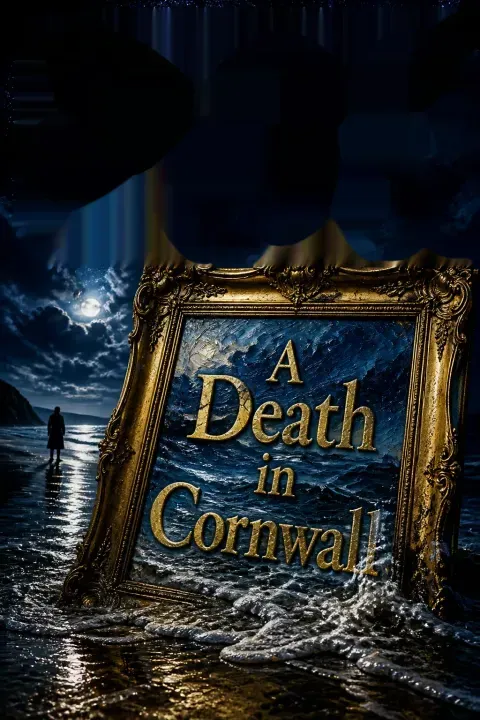


Plot Summary
A Light Left Burning
Vera Hobbs, owner of the Cornish Bakery in Gunwalloe, spots a light burning in the kitchen of Wexford Cottage at 5:25 a.m. on a January morning. The owner, Professor Charlotte Blake, is an environmentalist who would never waste electricity and typically leaves for Oxford on Monday afternoons.
When Vera and Dottie Cox investigate, they find dirty dishes in the sink and no sign of Blake. A call to Oxford University yields only voicemail. Vera rings the Devon and Cornwall Police hotline and reaches Detective Sergeant Timothy Peel,2 a local boy who once lived next door to a reclusive art restorer in Port Navas.
The restorer was Gabriel Allon,1 now retired from Israeli intelligence and attending a Van Gogh unveiling at the Courtauld Gallery in London. Peel2 phones him there, requesting help with the investigation. Gabriel1 agrees to come to Cornwall.
This opening establishes the novel's dual identity: a cozy village mystery wrapped around a global conspiracy. Vera's vigilant nosiness, the very quality that makes small communities suffocating, becomes the first domino in unraveling a multinational money-laundering operation. The burning light functions as a perfect symbol: an anomaly that the conscientious professor would never permit, signaling that something has already gone catastrophically wrong. Peel's connection to Gabriel roots the high-stakes espionage in genuine human history, giving emotional weight to what might otherwise be a procedural cold open.
The Professor's Notes
Gabriel1 meets Peel2 in Port Navas at the quay where his old sailing ketch, now Peel's,2 is moored. Peel2 explains the inconsistencies in Blake's murder: the overkill, the concealed body, the missing mobile phone. None match the Chopper's pattern. At Wexford Cottage, they find her office untouched.
On her desk lies a printout of every Picasso looted by Nazis during the Occupation, all highlighted. A yellow legal pad contains notes tracing a specific painting: an untitled surrealist portrait of a woman from 1937, bought from Galerie Paul Rosenberg by Bernard Lévy, sold privately in Paris in 1944.
The final notation reads simply OOC. Gabriel1 photographs the page. A copy of Blake's own book on Picasso's war years sits nearby, her acknowledgments singling out Naomi Wallach,12 the world expert on wartime French art markets. Gabriel1 heads to Paris.
The physical details of Blake's research materials transform academic work into detective fiction. Her yellow legal pad becomes a treasure map, and the cryptic OOC notation plants the first seed of a much larger conspiracy. The specificity of art historical references grounds the thriller in real cultural history: Nazi looting wasn't just theft, it was a systematic erasure of Jewish ownership that continues to shape the art market. Gabriel's recognition of this stakes his investigation in moral imperative, not mere curiosity.
Murder on the Steps
Naomi Wallach12 meets Gabriel1 at the Louvre and reveals she commissioned Blake's research. Bernard Lévy was deported to Auschwitz in 1944 and gassed. His daughter survived, married, and had a son named Emanuel Cohen.
Cohen believed his grandfather's Picasso was inside the Geneva Freeport and had seen it at a gallery there, but the dealer refused to show him the provenance. Wallach12 referred Cohen to Blake. Then she delivers the second blow: the previous evening, Cohen fell to his death on the rue Chappe steps in Montmartre.
Gabriel1 visits the steps that night and finds Amadou Kamara, a Senegalese vendor of counterfeit handbags, who witnessed the fall. A man shoved Cohen in the chest after he answered a phone call, then escaped on a waiting scooter. Kamara took Cohen's phone and sold it to a local crime figure named Papa Diallo. Gabriel1 buys it for a thousand euros.
Wallach's revelation transforms a single murder into a pattern of elimination. Cohen's death, staged as an accident, reveals that whoever owns the Picasso will kill to maintain anonymity. The Senegalese street vendor as witness is a shrewd narrative choice: global migration and counterfeit economies intersect with high art crime, reminding us that the wealthy's shell companies exist in the same physical world as the dispossessed. Gabriel's thousand-euro transaction with Papa Diallo, while absurd on its face, demonstrates how intelligence work often depends on the informal economies that official channels ignore.
The Washing Machine
Gabriel1 flies to London and joins Sarah Bancroft5 for a boozy lunch at Claridge's with art consultant Nicholas Lovegrove.8 In exchange for restoring a Gentileschi at a steep discount, Lovegrove8 describes his dealings with Edmond Ricard at the Geneva Freeport.
A client bought a Rothko for seventy-five million dollars through Ricard, left it in Freeport storage, then sold it months later for the exact same price, paying Lovegrove8 a commission on both ends. The buyer and seller were the same: a shell company called OOC Group, Limited. The transaction was a sham, a mechanism for moving money offshore untaxed and untraced.
Lovegrove8 explains that the Freeport functions as a six-hundred-thousand-square-foot laundry for the superrich, where paintings change ownership on paper while never physically moving. OOC stands for Oil on Canvas. This is the same entity that owns the Picasso.
The Claridge's lunch scene crystallizes the novel's thesis: high art and high finance have merged into a single opaque system designed to defeat taxation and accountability. Lovegrove's cheerful cynicism implicates even the likeable characters in the machinery. The Rothko anecdote, with its circular sale and identical price, illustrates how completely the art market has been captured by wealth concealment. OOC Group's name functions as a knowing wink: the most valuable canvas isn't paint at all, but the legal fiction painted over ownership.
Six Forgeries, One Target
Gabriel1 recruits Anna Rolfe,7 the world's most famous violinist and his former lover, after her concert in Munich. She agrees to pose as a seller of six paintings inherited from her disgraced banker father, using Ricard's gallery to place them at the Freeport.
The goal: establish credibility so Ricard will show her the Picasso, which she will then acquire through a trade. Gabriel1 then travels to Mykonos to enlist Ingrid Johansen,3 a Danish professional thief and hacker, to pose as Anna's7 assistant and provide technical support.
Over ten days in Venice, Gabriel1 forges six works (Modigliani, Van Gogh, Renoir, Cézanne, Monet, Toulouse-Lautrec) on period-appropriate French canvases. Naomi Wallach12 creates fictitious provenances. Lovegrove8 contacts Ricard, who is immediately interested. The six paintings are valued at three hundred twenty-five million dollars. Negotiations begin.
The recruitment sequences reveal Gabriel's operational genius: he weaponizes personal history (Anna's lingering feelings, Ingrid's compulsive skills) without exploiting either woman. The forgery montage in Venice, where Gabriel channels dead masters while his wife watches, becomes a meditation on artistic identity. His ability to paint a convincing Toulouse-Lautrec while drinking Cortese di Gavi and listening to Debussy suggests that forgery, like espionage, requires not just technical skill but a kind of moral compartmentalization that borders on the pathological.
Blood at the Freeport
After weeks of negotiations and viewings, Ricard secures the owner's agreement: Anna7 will trade her Modigliani, Van Gogh, and Cézanne for the Picasso, with other works covering the balance. On the appointed Thursday at 4 p.m., Gabriel,1 Anna,7 and Ingrid3 arrive at Galerie Ricard. No one answers.
Gabriel1 picks the lock. In Ricard's office, they find him slumped behind his desk, shot three times. A blood-soaked sales agreement bears Anna's7 name. The Picasso is gone, its empty frame discarded on the floor. A security guard confirms a man calling himself Andreas Hoffmann arrived at 2:17 p.m. and left with an art transport case.
The Freeport's surveillance video has been wiped. Swiss intelligence chief Christoph Bittel arrives, covers up Anna's7 involvement, and authorizes Gabriel1 to pursue the matter quietly. The stolen painting, it appears, crossed into France at Bardonnex.
Ricard's murder transforms the operation from sting to crisis. The killer's precise timing (arriving hours before the exchange) proves the conspiracy has penetrated Gabriel's own operation. The empty frame becomes the novel's central absence: the painting everyone kills for remains perpetually out of reach, a void that structures the entire narrative. Bittel's cover-up illustrates how even well-intentioned officials prioritize institutional reputation over justice, mirroring the very secrecy that enables the Freeport's existence.
The Hacker in Cannes
Ingrid3 works from a service flat in Geneva, penetrating the Freeport's network and resurrecting deleted security footage. The video shows the killer clearly. More important, she identifies the hacker who erased the footage: someone operating from an apartment on the rue d'Antibes in Cannes.
Gabriel1 and Ingrid3 travel there, surveil the building, and identify the occupant of Apartment 3B, a man called Philippe Lambert.9 Ingrid3 breaks in while Lambert9 is out, photographing his computers and notes. He is clearly a professional, with multiple hacks in progress.
As she leaves, Gabriel1 spots Lambert9 returning and, more ominously, a motorcyclist assassin approaching. Gabriel1 steps into the street, disrupts the hit, and shoves Lambert9 through the building door. The motorcycle speeds away. Upstairs, Gabriel1 confronts Lambert,9 who recognizes him immediately.
This sequence inverts the surveillance dynamic: the watcher becomes the watched, the hacker the hacked. Ingrid's ability to resurrect 'deleted' footage from the Freeport's hard drive serves as a technological parable: nothing digital truly disappears, a truth that threatens the entire offshore secrecy industry. The motorcycle assassin materializing on a quiet Cannes street at the precise moment of confrontation confirms that Lambert's employers are monitoring him as closely as he monitors others, a hall-of-mirrors surveillance state where even the spies are spied upon.
Kleptopia Exposed
Lambert9 reveals he works for Trevor Robinson,10 security chief at Harris Weber and Company, a Monaco law firm. Robinson10 is former MI5 counterintelligence. The firm creates anonymous shell companies in the British Virgin Islands, helping kleptocrats, oligarchs, and billionaires conceal wealth and evade taxes.
They also use the art strategy: purchasing paintings through shell companies like OOC Group, storing them in the Geneva Freeport, and conducting sham sales to launder money. When Charlotte Blake discovered OOC Group's ownership of the Picasso, Robinson10 had Lambert9 hack her phone, uncover her affair with Leonard Bradley, and send a fake text luring her to the murder site.
Robinson10 also ordered the Freeport hack and sent the killer to eliminate Ricard. As Lambert9 confesses, another assassin pursues them. Gabriel1 kills the pursuer during a high-speed escape through Provence. They flee to Corsica aboard a smuggler's yacht.
Lambert's confession crystallizes the novel's architecture of conspiracy: a law firm staffed by former intelligence officers, deploying hackers and assassins, serving the global ultra-rich. The line between state and private power dissolves completely. Robinson's MI5 background is particularly damning: the skills meant to protect democracy are being used to subvert it. The revelation that Blake was killed not for what she knew but for who she slept with adds a cruel irony: her private life, stolen and weaponized, became the mechanism of her public erasure.
The Monaco Heist
On Corsica, Gabriel1 secures protection for Lambert9 from Don Anton Orsati,13 a mafia don whose legitimate business is olive oil. René Monjean, a Marseilles art thief, joins the team. The signadora, a village healer, inexplicably provides the safe combination.
That night in Monaco, while Lambert9 controls security remotely, Ingrid3 and René enter the darkened offices of Harris Weber. The combination works. They copy 3.2 terabytes of attorney-client files and photograph physical documents, revealing twenty-five thousand shell companies and their secret owners: monarchs, oligarchs, sports figures, and criminals.
At 1:30 a.m., Robinson10 unexpectedly heads to the office. Christopher Keller4 intercepts him on the street, posing as a business consultant. Ingrid3 and René escape minutes before Robinson10 discovers the theft. The external hard drives contain the names of every beneficial owner behind Harris Weber's offshore empire.
The heist sequence is a masterclass in tension through parallel action: Ingrid's deliberate data extraction against Robinson's methodical approach. The signadora's supernatural knowledge introduces an element of Corsican mysticism that complicates the novel's otherwise hyper-rational spycraft epistemology. Her accurate safe combination suggests that in a world of encrypted secrets, some truths are accessible only through channels that intelligence services cannot comprehend or control, a humbling reminder of the limits of technological omniscience.
The Manor in Somerset
Back in London, Gabriel1 and Ingrid3 review the files and discover that Lord Michael Radcliff, the disgraced Tory treasurer, received ten million pounds from Russian oligarch Valentin Federov just days after resigning over the Federov contribution scandal. Ingrid3 traces the payment through BVI Bank.
Gabriel1 meets Lucinda Graves,11 wife of the home secretary and soon-to-be prime minister, who denies knowing anything. But Courtauld Gallery security footage proves she met Charlotte Blake in person on December 15, contradicting her claim of only a phone call. Leaving the gallery, Gabriel1 and Ingrid3 are ambushed in a Garrick Street car park.
Gabriel1 is knocked unconscious. They wake hooded and bound at a Somerset manor owned by Federov's shell company. Trevor Robinson10 offers twenty million pounds and the Picasso's return if Gabriel1 signs a nondisclosure agreement. Gabriel1 refuses. Robinson10 beats him, then extracts his phone password.
The kidnapping marks the point where financial crime becomes physical violence, revealing the true nature of the 'legitimate' wealth management industry. Robinson's offer of hush money is both bribe and threat, a microcosm of how the kleptocracy operates: participate and prosper, resist and die. Gabriel's refusal, even while bound and bleeding, asserts the novel's moral center. The password extraction scene, with its escalating brutality and Gabriel's deliberate wrong answers, demonstrates how even in total vulnerability, the intelligence operative maintains an arsenal of tactics, turning his concussion into a weapon of delay.
Timothy Peel's Baptism
While Gabriel1 is being beaten, his phone briefly connects to the network when Robinson10 removes it from the Faraday pouch. GCHQ traces the signal to a mast near Petton Cross in Somerset. Christopher Keller4 recruits Timothy Peel,2 who drives through the night. Using night-vision equipment, they locate the manor.
Peel,2 a rural detective who has never fired his weapon in the line of duty, follows Keller4 across darkened pastures. They breach the estate and find Gabriel1 and Ingrid3 in the drawing room with Robinson10 and four ex-SAS guards. Keller4 drops three men with surgical precision.
Peel2 kills the fourth guard, then shoots Robinson10 as he raises a gun toward Ingrid.3 Gabriel,1 bloodied and concussed, watches his childhood protégé become something new. Keller4 photographs the corpses, and the team vanishes into the night, leaving five dead men on a Russian oligarch's floor.
Peel's transformation from small-town detective to killer is the novel's most psychologically complex moment. The boy who signaled Gabriel with a flashlight now extinguishes lives to save him, completing a cycle of mentorship that raises uncomfortable questions about what Gabriel has actually taught him. Keller's casual efficiency (photographing bodies, orchestrating escape) contrasts with Peel's visceral shock, yet both are necessary. The cover-up, attributing the deaths to Russian infighting, implicates the British state in Gabriel's extrajudicial methods, just as it did throughout his intelligence career.
Lucinda's Betrayal
Graham Seymour, SIS chief, reveals that Prime Minister Hillary Edwards was planning sweeping anti-money-laundering reforms that would have crippled the London Laundromat. Home Secretary Hugh Graves opposed the reforms, as did his wife Lucinda,11 whose wealth management firm funneled clients to Harris Weber.
The Federov scandal that brought down Edwards was manufactured: Lucinda Graves11 and Lord Radcliff orchestrated the contribution, leaked it to the press, and then Radcliff 'resigned' and received ten million pounds from Federov for his trouble. Gabriel1 takes this evidence to Samantha Cooke14 of the Telegraph.
She confronts Radcliff, who confesses on tape, naming Lucinda11 as the ringleader. The Telegraph prepares to publish. Meanwhile, Hugh Graves is scheduled to meet the King at Buckingham Palace to become prime minister. Gabriel1 goes to Lucinda's11 office and presents her with an ultimatum: withdraw her husband or face murder charges.
The conspiracy's exposure reframes the entire preceding narrative: the serial killer investigation, the art theft, the Freeport scheme were all tributaries flowing into a single river of political corruption. The most chilling revelation is that the coup against Edwards required no violence, just the manipulation of existing systems: campaign finance loopholes, press gullibility, and party machinery. Lucinda Graves embodies the banality of kleptocratic evil: she didn't kill anyone herself, but her phone call to Robinson set every murder in motion.
The Palace Gates
Samantha Cooke's14 story breaks as Hugh Graves's Range Rover enters the Buckingham Palace quadrangle. The BBC broadcasts Lucinda's11 recorded confession. Gabriel,1 standing in Lucinda's11 office, watches with her as the television shows the vehicle stopped in the courtyard, the King's equerry conspicuously absent.
Gabriel1 offers terms: Lucinda11 calls her husband, tells him to withdraw, and in exchange she faces no charges for Charlotte Blake's murder. She complies. Graves's car retreats from the Palace. The 1922 Committee convenes and selects former PM Jonathan Lancaster to lead the Party. Lancaster appoints Hillary Edwards as Chancellor and keeps Stephen Frasier at the Foreign Office.
The London Laundromat faces its first serious regulatory threat. In the weeks that follow, Ian Harris is shot dead on a Monaco street, Konrad Weber is pushed under a Zurich tram, and the Graveses flee to Malta, equipped with new passports from the island's Harris Weber-connected prime minister.
The climax at Buckingham Palace transforms political journalism into a last-minute rescue of democratic legitimacy. Cooke's story functions as the structural inverse of the original Federov leak: where the first story was a weapon of the kleptocrats, the second is a shield for the republic. The fates of Harris and Weber suggest that the conspiracy's architects were themselves disposable assets of even more powerful forces. The Graveses' Maltese exile extends the novel's critique beyond British borders, implicating an entire ecosystem of micro-states that profit from global corruption.
The Real Chopper
Months later, Gabriel1 and his family summer in Cornwall, having purchased a cottage near Gwennap Head. The Telegraph publishes the full 'Picasso Papers,' triggering protests worldwide and pledges of reform. Charlotte Blake's murder is officially removed from the Chopper's tally.
Timothy Peel,2 while investigating a burglary ring in Plymouth, notices an anomaly: the thieves confessed to twenty-three jobs, but only twenty-two were reported. The unreported burglary was at a house on Tresawle Road in Falmouth, where a rare coin collection was stolen. The occupant, a lorry driver named Miles Lennox, never called police.
Peel2 visits the house. While Peel2 questions Lennox inside, Gabriel1 waits in the car. Minutes later, Peel2 calls with the news: he has found the hatchets. Gabriel1 calls Chiara6 to tell her he has taken care of that little problem. The Chopper is caught at last.
The Chopper's capture by a mundane investigative detail (an unreported burglary) rather than high-tech espionage brings the novel full circle to its Cornish roots. Lennox's failure to report the theft, driven by fear of police discovering his true nature, is psychologically consistent with serial killer pathology. Gabriel's role as silent backup, letting Peel take the collar, completes the mentor arc: the student has surpassed the teacher, but the teacher still watches from the shadows. The resolution suggests that for all the global conspiracies and offshore billions, justice sometimes arrives through the patient accumulation of small-town police work.
Analysis
A Death in Cornwall operates as both thriller and polemic, using the architecture of a spy novel to anatomize the global wealth concealment industry. The central metaphor is the Geneva Freeport itself: a six-hundred-thousand-square-foot black box where priceless art sits in darkness, owned by anonymous shell companies, generating no tax revenue, serving no public purpose except the enrichment of those already rich beyond measure. Daniel Silva draws explicit connections between Nazi art looting and contemporary offshore finance, suggesting that the mechanisms of plunder have simply evolved from military force to legal artifice. Bernard Lévy's Picasso, stolen once by collaborators and again by shell companies, becomes a symbol of how Holocaust-era theft was never truly redressed but merely transferred to new institutional forms. The novel's narrative structure mirrors its thematic concerns. The investigation begins in the intimate scale of a village murder and expands concentrically outward: to Parisian Holocaust history, to Swiss banking secrecy, to Monégasque legal corruption, to a conspiracy that reaches the gates of Buckingham Palace. Each layer reveals another set of actors who consider themselves blameless because they never wielded the hatchet or pulled the trigger. Lucinda Graves11 embodies this diffusion of culpability: she killed no one, but every death in the novel traces back to her phone call.
Gabriel Allon's1 role as both restorer and destroyer is central to the book's moral vision. His ability to forge a Modigliani indistinguishable from the original makes him uniquely equipped to penetrate the art world's systems of authentication, which are themselves revealed as arbitrary and manipulable. When he later cuts his forgeries to ribbons, the act is both practical (preventing their future misuse) and symbolic (rejecting the market logic that assigns eight-figure values to canvas and pigment). The novel ultimately argues that the art market's opacity is not a bug but a feature, deliberately maintained to enable the very money laundering the Freeport facilitates.
The Cornwall framing provides emotional counterweight to the global conspiracy plot. Peel's2 arc from boy with a flashlight to man with a gun traces the cost of Gabriel's1 mentorship, while the Allon family's purchase of a cottage near Gwennap Head suggests a longing for rootedness that the life of espionage perpetually denies. The Chopper subplot, resolved in the final pages, insists that some evil remains local, comprehensible, and solvable through old-fashioned police work rather than cyber-espionage and political maneuvering.
Review Summary
A Death in Cornwall receives mixed reviews, with an average rating of 4.33/5. Many fans enjoy the familiar characters and international intrigue, praising Silva's research and storytelling. However, some find the series becoming formulaic and repetitive. Critics note a shift from espionage to art-focused plots, with less involvement from Allon's Israeli intelligence colleagues. While some appreciate the new direction, others miss the spy elements. The book's exploration of art theft, money laundering, and political corruption intrigues many readers.
People Also Read



Characters
Gabriel Allon
Retired Spy, Master Art RestorerFormer director of Israeli intelligence, now running the Tiepolo Restoration Company in Venice with his wife Chiara6. His mother was a prominent Israeli painter; he inherited her talent and his grandfather's tradecraft. Haunted by the Vienna bombing that killed his son and destroyed his first wife, he rebuilt his life in Cornwall and then Venice. Carries a Beretta with British approval, speaks multiple languages, and maintains operational relationships with Western intelligence services despite his retirement. His implacable moral code drives him to pursue the Picasso not for money but because a wrong was done to a Holocaust victim's heir. Father of twin children, Irene and Raphael, whose futures he worries about in a warming, corrupting world. His green eyes are famously perceptive, missing nothing.
Timothy Peel
Detective Sergeant, Former NeighborA thirty-five-year-old officer with the Devon and Cornwall Police. As a boy of eleven, he lived next door to Gabriel1 in Port Navas and signaled him with a torch from his bedroom window each time Gabriel1 returned from sailing. Gabriel's1 mentorship shaped his decision to become a police officer. On the Chopper task force, he alone questions whether Professor Blake's murder fits the serial killer's pattern, demonstrating the independent thinking Gabriel1 modeled. His decision to involve Gabriel1 and later to participate in the Somerset rescue costs him plausible deniability but secures his moral integrity. Unmarried, lives in Exeter, owns the ketch Gabriel1 restored and bequeathed to him.
Ingrid Johansen
Danish Thief and HackerA Danish woman of exceptional technical skill and criminal compulsion. Her kleptomania began at age nine after being molested by a neighbor named Lars Hansen, a trauma she never disclosed. She financed a luxurious villa on Mykonos through hotel thefts across Europe and a twenty-million-dollar payment for stealing a secret Russian document for Gabriel1 in Moscow. Her hacking abilities penetrate both the Geneva Freeport and Harris Weber's network. On Corsica, the signadora's ritual temporarily relieves her of the compulsion to steal, suggesting her criminality was always a symptom of unhealed pain. Cool under pressure, she maintains operational discipline even during the Monaco heist when millions in cash sit within reach.
Christopher Keller
SIS Officer, Former SAS AssassinA former SAS operative who faked his death after a friendly-fire incident in Iraq, became an assassin for Don Anton Orsati13 on Corsica, and was later repatriated by British intelligence. Now an SIS officer married to Sarah Bancroft5. His operational skills remain lethal; he kills three ex-SAS guards during the Somerset rescue with clinical precision. Speaks French fluently, drives a Bentley, and maintains his villa on Corsica as a safe house. His loyalty to Gabriel1, forged through mutual near-death experiences, overrides institutional caution. Smokes constantly, drinks single malt, and deflects emotional intimacy with sardonic humor. The notch in his chin and bright blue eyes make him instantly recognizable.
Sarah Bancroft
Gallery Manager, Former CIA OperativeChristopher's4 wife and manager of Isherwood Fine Arts in St. James's, London. A former CIA clandestine operative who holds a PhD from Harvard and an MA from the Courtauld Institute, where she now serves on the board of trustees. Her art world expertise and intelligence background make her an essential bridge between Gabriel's1 investigation and legitimate institutional access. She handles the hacking of Emanuel Cohen's phone and provides logistical support throughout. Her marriage to Christopher4, conducted under his cover identity as business consultant Peter Marlowe, requires constant compartmentalization. Drinks Belvedere martinis at Wiltons and manages a sometimes-solvent gallery with pragmatic ruthlessness.
Chiara Allon
Gabriel's Wife, Restoration Firm ManagerDaughter of Venice's chief rabbi, she was an Israeli intelligence operative when she met Gabriel1 during his Venice exile. Now co-manages the Tiepolo Restoration Company and raises their twins. Her beauty is legendary; Gabriel1 has never successfully captured her caramel eyes on canvas. She gently mocks Gabriel's1 jealousy of Gennaro the barman while managing the family finances and pushing for the Cornwall cottage purchase. Her tolerance of Gabriel's1 operational life is rooted in her own intelligence past.
Anna Rolfe
World-Famous Concert ViolinistThe only surviving heir to the Rolfe banking fortune, she discovered her father's photograph with Hitler and Himmler as a young woman. Her relationship with Gabriel1, which ended with her throwing a vase at his head, left her with a string of disastrous marriages and the conviction that Gabriel1 is to blame for her romantic misfortunes. Her willingness to help despite their history speaks to a core decency beneath the diva exterior. Plays a Guarneri and a Stradivarius; her performances can silence concert halls.
Nicholas Lovegrove
Art Consultant and AdviserA major figure in the London art world who earns commissions on both sides of transactions, often representing anonymous buyers and sellers. His knowledge of the Geneva Freeport's shady practices is extensive but he has never before been asked to weaponize it. Agrees to help Gabriel1 in exchange for a discount on a Gentileschi restoration, maintaining plausible deniability through carefully negotiated terms. His cheerful cynicism masks a genuine appreciation for art amid the venality of the market.
Philippe Lambert
Hacker, Former French IntelligenceA graduate of École Polytechnique who worked in the DGSE's Technical Directorate before being recruited by Trevor Robinson10 for millions of euros a year. He hacked Charlotte Blake's phone, sent the text that lured her to her death, and erased the Geneva Freeport's surveillance video. Lives in a digital world of ones and zeros, his Cannes apartment nearly unfurnished. His cooperation after Gabriel1 saves his life is motivated by self-preservation, not conscience, but his stolen files prove essential.
Trevor Robinson
Ex-MI5, Law Firm Security ChiefFormer MI5 counterintelligence officer who now runs security for Harris Weber and Company in Monaco. Orchestrates the murders of Blake, Cohen, and Ricard, and the kidnapping of Gabriel1 and Ingrid3. His philosophy is stark: the old order is crumbling, power and money are all that matter, and those who resist the kleptocracy will be eliminated. Smokes cigarettes from an antique silver box, drinks single malt, and inhabits the opulent world his firm's clients pay to protect.
Lucinda Graves
Wealth Manager, PM's WifeCEO of Lambeth Wealth Management and wife of Home Secretary Hugh Graves. Her firm funneled wealthy clients to Harris Weber for years, earning hundreds of millions in fees. She orchestrated the Federov scandal that brought down PM Edwards, positioning her husband to take power and block financial reforms. When confronted with evidence, her composure never cracks; she negotiates her exit from scandal with the same calculating precision she applied to her clients' offshore structures.
Naomi Wallach
Holocaust Art Restitution ExpertEmployed by the Louvre to purge its collection of looted artworks, she was the one who commissioned Charlotte Blake's research on the Picasso. Survived the Islamic State attack on the Weinberg Center only because she was running late. Her cigarette habit and willingness to create fake provenances for Gabriel1 suggest a pragmatic approach to justice.
Don Anton Orsati
Corsican Crime BossHead of the Orsati Olive Oil Company, which fronts a murder-for-hire business. Gabriel1 is one of only two people to survive an Orsati contract. Speaks in Corsican proverbs, provides protection for Lambert9, and arranges René Monjean's participation. His black eyes study visitors like a canine assessing potential prey.
Samantha Cooke
Telegraph Political CorrespondentThe journalist whose Federov scandal story brought down PM Edwards, unaware she was being manipulated by Lucinda Graves11 and Lord Radcliff. Gabriel1 gives her the Harris Weber files, enabling her to correct the record and stop the Graves premiership. Her career has been defined by access to Gabriel's1 leaks; this one redeems her earlier mistake.
Plot Devices
Proteus Malware
Israeli phone surveillance softwareThe world's most formidable cell phone hacking malware, developed by Israeli intelligence and installed on Gabriel's1 laptop. It can attack a target phone remotely or, when physical access is available, extract all stored data including geolocation history, messages, and call logs. Gabriel1 uses it to mine Emanuel Cohen's recovered phone, discovering his trip to Geneva and the call to Galerie Ricard. Later, he deploys it against Trevor Robinson's10 device, enabling the team to monitor Robinson's10 movements and conversations in real time during the Monaco heist. The malware can also disable inferior tracking software, as Ingrid3 demonstrates by removing Lambert's9 Macedonian malware from Robinson's10 phone. Proteus represents the technological asymmetry that allows a small team to operate against a well-resourced conspiracy.
Geneva Freeport
Tax-free art storage and transaction hubA six-hundred-thousand-square-foot facility housing over a million artworks, including the largest collection of Picassos outside the artist's heirs. Paintings enter under customs suspension, technically 'in transit,' and can be stored indefinitely without taxation. Owners rent vaults through anonymous shell companies, concealing their identities. Transactions occur within the Freeport's boundaries, with money changing hands offshore, making them invisible to tax authorities and law enforcement. Edmond Ricard's gallery operates within this ecosystem as a broker. The Freeport's security includes screened fencing, razor wire, surveillance cameras, and strict access controls, all of which prove vulnerable to a skilled hacker. The facility embodies the intersection of high art and high finance that enables global wealth concealment.
Harris Weber Shell Companies
Anonymous offshore wealth concealmentHarris Weber and Company created over twenty-five thousand shell companies registered in the British Virgin Islands, each with a nominal director (a secretary named Adele Campbell) but secret beneficial owners. These entities enabled clients to purchase real estate, yachts, art, and other assets while hiding their identities from tax authorities, law enforcement, and the public. The firm's 'art strategy' used shell companies like OOC Group, Limited to buy paintings, store them in the Geneva Freeport, and conduct sham sales that laundered billions. The client files, stored on an air-gapped hard drive in the firm's Monaco safe, constitute the novel's MacGuffin: three terabytes of data identifying kleptocrats, oligarchs, and criminals who used the system.
Gabriel's Forged Paintings
Bait to access the missing PicassoSix paintings created by Gabriel1 in his Venice studio: pastiches of Modigliani, Van Gogh, Renoir, Cézanne, Monet, and Toulouse-Lautrec. Executed on period-appropriate French canvases scraped clean of inferior works, using historically accurate pigments and techniques. Accompanied by fictitious provenances crafted by Naomi Wallach12 that imply Nazi-era looting. The works are valued at three hundred twenty-five million dollars by Edmond Ricard, who never suspects they are forgeries. Their function is twofold: to establish Anna Rolfe7 as a credible seller and to create a transaction large enough to compel Ricard to reveal the Picasso. Gabriel1 photographs each work to prevent them from ever entering the legitimate market. The forgeries are destroyed (cut to ribbons) after Ricard's murder.
Courtauld Gallery Security Video
Proof of Lucinda Graves's deceptionInternal surveillance footage from the Courtauld Gallery's café, dated December 15. It shows Professor Charlotte Blake arriving at 4:12 p.m. and sitting alone until 5:04 p.m., when Lucinda Graves11 joins her. They converse for forty-three minutes. This contradicts Lucinda's11 claim that she only spoke to Blake briefly by phone and never met her in person. The video provides the leverage Gabriel1 needs to confront Lucinda11 and force her husband's withdrawal from the premiership. The gallery director initially refuses to release the footage but permits Gabriel1 to view it. Its existence demonstrates that even in a world of offshore secrecy and encrypted communications, physical presence in public spaces remains traceable.
Gabriel Allon Series

About the Author

Download PDF
Download EPUB
.epub digital book format is ideal for reading ebooks on phones, tablets, and e-readers.








































