

Key Takeaways
Chase a Crazy Idea with an athlete's single-minded devotion
The founding gamble. In 1962, a shy, rail-thin twenty-four-year-old named Phil Knight pitched his Stanford business paper as reality: Japanese running shoes could invade the American market the way Japanese cameras had crushed German ones. His father called it "jackassing around," but funded a trip to Japan anyway. Knight talked his way into a meeting with Onitsuka, invented a company name on the spot (Blue Ribbon, after his childhood track ribbons), and secured distribution rights.
Play, not work. Knight's driving philosophy was that life is a game, and the happiest people find work that feels like play. He didn't want money as an end. He wanted his daily existence to hold the electric charge of a race approaching its finish.
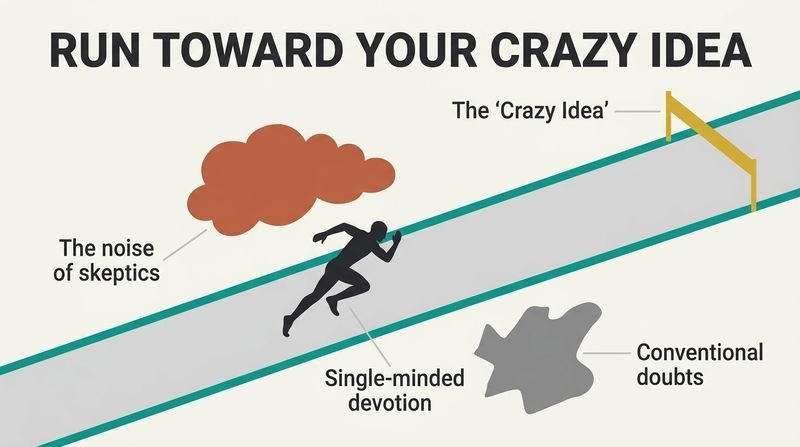
What's striking is how Knight reframes entrepreneurship as an extension of competitive sport rather than finance. This aligns with psychologist Mihaly Csikszentmihalyi's concept of flow, the total absorption athletes and artists describe. Knight essentially built a career around chasing flow states. The counterpoint worth noting: survivorship bias haunts every founder memoir. For every Knight who "just kept going," thousands persisted into bankruptcy. His own statistic, that 26 of 27 new companies failed, underscores that persistence alone guarantees nothing. What made his gamble rational was asymmetric downside: a young man with no dependents risking little but time. The advice reads better for the young than the mortgaged.
Sell what you genuinely believe in, and belief becomes contagious
Belief outsells slickness. Knight failed miserably at hawking encyclopedias door to door in Hawaii. He froze, got rejected, hated it. Yet selling running shoes out of the trunk of his green Plymouth Valiant at track meets, he couldn't write orders fast enough. The difference wasn't technique. He believed running made the world better and that these shoes were better to run in. Runners sensed that conviction and wanted a piece of it.
Truth as a strategy. Years later at a Chicago trade show, skeptical salesmen bought the untested new Nike brand purely because Blue Ribbon's people had a reputation for shooting straight while competitors bragged and exaggerated. Honesty, it turned out, was a durable competitive moat.
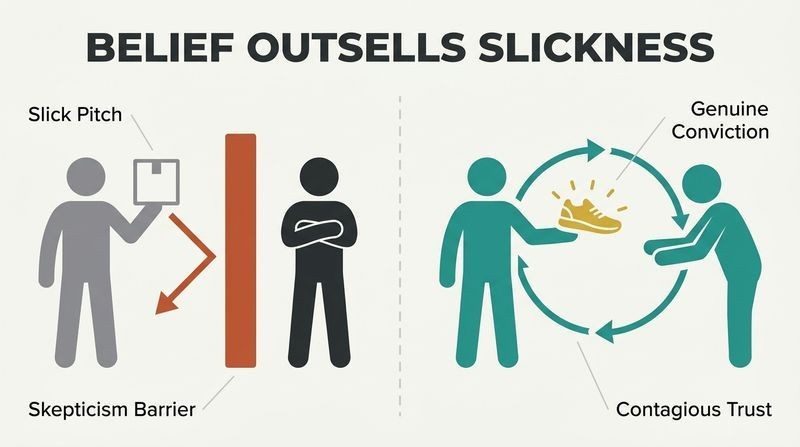
This anticipates modern research on authenticity in sales and marketing. Studies on "emotional contagion" show that a communicator's genuine enthusiasm transfers measurably to audiences, while performed enthusiasm often backfires. Knight stumbled onto what behavioral economists call credible signaling: telling customers the truth, including a product's flaws, raises trust more than polished pitches. The nuance is that belief-driven selling scales poorly at first. It works brilliantly among fellow tribe members (runners talking to runners) but Knight still needed advertising, endorsements, and distribution to reach the mainstream. Authenticity opens the door; infrastructure fills the room. His disdain for advertising was arguably his biggest blind spot.
Growth is oxygen; refuse to slow down even when bankers beg
Grow or die. Knight ran Blue Ribbon on a knife's edge for over a decade, doubling sales nearly every year (from $8,000 to $150,000 to millions) while his bankers at First National and Bank of California pleaded for caution and "equity." He loathed that word. Any spare dollar went straight back into ordering more inventory, because he believed demand always outstripped his sales.
Living on the float. He habitually ordered more shoes than he could pay for, gambling that revenue would arrive just in time. This chronic cash starvation nearly killed the company repeatedly, culminating in a 1975 crisis when a bank froze his accounts and called the FBI, alleging fraud.
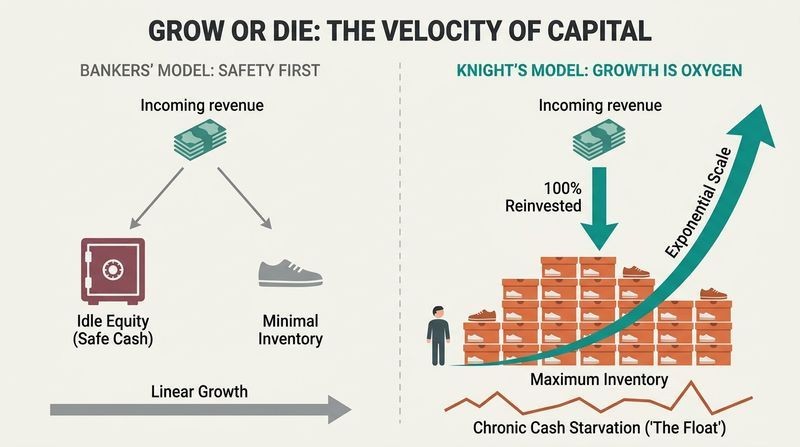
Knight's philosophy runs directly against conventional corporate finance, which prizes liquidity buffers. He was effectively maximizing growth at the cost of solvency risk, a strategy later canonized in Silicon Valley's "blitzscaling." What saved him was not prudence but a patient partner (Nissho) willing to act like equity. The deeper lesson is about capital structure fit: banks optimize for downside protection, trading companies for upside volume. Knight kept pitching a growth story to lenders structurally incapable of hearing it. The near-fatal 1975 crisis validates the critics as much as Knight. He survived partly on luck and relationships, not just conviction.
Hire loyal misfits, trust them fully, and let them surprise you
The Buttfaces. Knight assembled a management team of self-described losers and eccentrics: a paraplegic (Woodell), two morbidly obese men (Hayes, Strasser), and an obsessive letter-writing loner (Johnson). At semiannual retreats they called "Buttface" meetings, they hurled insults, drank hard, and solved problems with brutal candor. The only unforgivable sins were a thin skin and sobriety.
Hands-off leadership. Knight borrowed General Patton's maxim: don't tell people how to do things, tell them what to do and let them astonish you with results. He rarely praised (his highest compliment was "not bad") and rarely micromanaged. This bred fierce two-way loyalty. After the Bork episode, he faced almost no mutinies despite paying below-market wages.
This is a case study in what management scholars call psychological safety paradoxically coexisting with abrasive candor. The Buttfaces could savage each other's ideas precisely because personal loyalty was non-negotiable, separating the idea from the ego. Amazon's later "disagree and commit" and Pixar's Braintrust echo this. The risk Knight glosses over: his hands-off style worked with a hand-picked band of self-motivated outsiders who shared his outsider chip. It scales badly with employees who need direction, as his own admission about failing new hires suggests. His guilt over neglecting his sons reveals the same detachment applied at home, where it wounded rather than empowered.
Innovate relentlessly; customers forgive noble failures, not complacency
Bowerman's waffle iron. Knight's old track coach and cofounder, Bill Bowerman, poured urethane into his wife's waffle iron to create a lightweight, high-traction outer sole, an innovation unchanged in shoe design for fifty years. He shaved ounces obsessively, believing one ounce off a shoe saved 55 pounds of lifted weight over a mile.
Failure as fuel. Nike's flared-heel LD 1000 caused injuries and was recalled; the air-cushioned Tailwind literally shredded itself apart. Yet customers stayed loyal because Nike was visibly trying new things when rivals stood still. Knight's motto became "fail fast": fail quickly, learn, and improve. Every botched experiment was tuition, not defeat.
Bowerman embodies the tinkerer-innovator archetype that design thinking now formalizes: rapid, cheap, physical prototyping over theoretical planning. His willingness to ruin waffle irons prefigures the "fail fast" ethos of lean startups by decades. The subtle insight is reputational: Nike earned permission to fail because its failures were sincere attempts at customer benefit, not cost-cutting. Research on brand forgiveness confirms consumers punish perceived greed far more than perceived incompetence. One caution: the recalled shoes caused actual injuries. "Move fast and break things" reads charming in sneakers and dangerous in, say, medical devices or aviation. Context determines whether noble failure is heroic or reckless.
Full transparency beats clever concealment when your survival is at stake
Two existential crises, one strategy. When Onitsuka betrayed Knight by secretly courting other U.S. distributors, and again when the Bank of California froze his accounts alleging fraud, Knight chose radical honesty. In the 1974 Onitsuka trademark trial, Judge "James the Just" ruled for Blue Ribbon explicitly because its story was more truthful, catching the opposing witness lying through a fake translator.
Confessing to save the company. During the 1975 bank collapse, Knight fully disclosed his secret Exeter factory to his Japanese financier Nissho, expecting fury. Instead, executive Tadayuki Ito (the "Ice Man") gave a half-smile, forgave the deception, paid off the bank in full, and doubled down on the partnership. Truth disarmed both adversaries.
Knight repeatedly discovered that transparency functions as a trust-accelerant, especially in relationships built over years. Game theory illuminates why: in repeated games, honest signaling builds the reputation capital that lets partners extend extraordinary credit during crises. Ito's rescue was not charity but rational long-term investment in a proven, now-vulnerable, and therefore loyal partner. The contrast with Knight's own earlier deceptions (the spy memo, rifling Kitami's briefcase) is instructive: he learned honesty partly by suffering the anxiety of its opposite. There is a limit, though. Transparency worked because Knight had underlying value to reveal. Disclosure cannot save a business that is genuinely rotten.
When your competitors weaponize rules, invent an equally bold counterattack
The $25 million ambush. In the late 1970s, American rivals Converse and Keds lobbied to enforce the archaic "American Selling Price" law, which let customs assess Nike's import duties based on a competitor's inflated domestic price. The government billed Nike $25 million, nearly a full year's revenue, retroactively. It could have ended the company.
Fight fire with fire. Rather than merely litigate, Nike counterpunched creatively: it manufactured a cheap knockoff shoe called One Line in Maine to reset the duty baseline, ran a patriotic TV ad casting Nike as a small Oregon firm battling government tyranny, and filed a $25 million antitrust suit. The government, wanting the fight to end, settled for $9 million.
This episode is a masterclass in reframing a legal defense as a multi-front offensive combining litigation, manufacturing tactics, public relations, and political lobbying (via Senator Hatfield). Modern strategists call this "non-market strategy," the discipline of competing through regulation, media, and politics rather than products alone. Knight's instinct that incumbents often win by capturing rulemaking bodies is well documented in economics as regulatory capture and rent-seeking. The patriotic ad was especially shrewd, converting a dry customs dispute into a morality tale voters could feel. The lesson: when attacked through institutions, respond through institutions, and control the narrative before your opponent does.
Structure ownership so growth never costs you control
The going-public dilemma. By 1980, Nike desperately needed capital but Knight feared an IPO would hand control to strangers, corporate raiders, or a single dominant shareholder, destroying the culture he'd built. He resisted for years, calling it the thing he'd "spent his life running from."
Dual-class shares. Advisor Chuck Robinson offered the breakthrough: issue two classes of stock. The public gets Class B shares (one vote each); founders and insiders hold Class A shares that name three-quarters of the board. Knight kept roughly 46 percent and near-total control while raising enormous sums. Nike went public December 2, 1980, at $22 a share, the same price as Apple that week, instantly making Knight worth $178 million.
The dual-class structure Knight adopted, pioneered by newspapers like the New York Times, later became the defining governance tool of founder-led tech (Google, Facebook, Snap). It solves a real tension: capital markets demand accountability, but visionary founders fear short-term shareholder pressure diluting long-term bets. Critics argue dual-class shares entrench management and disenfranchise investors, and empirical studies show governance quality often decays over time under such structures. Knight would counter that preserving founder vision protected the very culture that generated returns. The episode reveals his deepest value: control over cash. His flat emotional response to sudden wealth ("regret" that he couldn't do it all again) confirms money was never the point.
Business is not just profit; it's participating in the human drama
Redefining winning. For most of the journey, Knight's goal was narrow: simply not to lose, because losing meant death for his "business child." But somewhere in the late 1970s, standing amid Chinese factories and global markets, he expanded the definition. Business, he concluded, is no more about making money than being human is about making blood. Blood is necessary, but it enables higher aims.
Creating and contributing. Naming a shoe, building a factory in postwar Vietnam, employing thousands, delivering something that made strangers healthier or happier, all of it, done crisply and well, was participating more fully in the grand human drama. "If that's business," he wrote, "call me a businessman."
Knight arrives, through practice rather than theory, at something close to Aristotle's concept of eudaimonia: flourishing through the excellent exercise of one's capacities toward worthy ends. His blood analogy elegantly dissolves the false binary between profit and purpose that dominates business ethics debates. Contemporary stakeholder capitalism and "conscious business" movements formalize this intuition. The tension Knight never fully resolves surfaces in Nike's sweatshop controversy: participating in the "human drama" looked very different to factory workers than to the founder. His later factory reforms and the Girl Effect suggest he took the critique seriously, but the gap between lofty framing and on-the-ground reality is where such philosophies get tested.
Athletes aren't just endorsers; sign the rebels and share their fire
The Pre effect. Nike's identity crystallized around Steve Prefontaine, the swaggering Oregon distance runner who ran flat-out, refusing to conserve energy, declaring anyone who beat him would have to bleed to do it. Knight hired him as "National Director of Public Affairs," which meant he ran fast and made Nike a symbol of rebellion. When Pre died at 24, Nike preserved the rock where he crashed as a shrine.
Betting on hotheads. Knight's endorsement instinct favored iconoclasts: he ignored officials' warnings and fell for a "hothead" teenager on Court 14 named John McEnroe. When marathoner Frank Shorter switched to rival Tigers before the 1976 Olympics, Knight collapsed in anguish, realizing Nike had become inseparable from his own identity.
Knight intuited what marketing scholars call brand personality transfer: athletes don't merely display a logo, they lend their character to it. By choosing rebels (Pre, McEnroe, later Jordan and Agassi), Nike encoded defiance into its DNA, which the "Just Do It" era would later monetize globally. The strategy carries risk, as rebellious icons can implode reputationally. But Knight's deeper realization is psychologically raw: he outsourced his own competitive identity to his athletes, feeling their losses as personal rejections. This emotional fusion between founder and brand is both Nike's rocket fuel and, arguably, a source of the defensiveness that hampered his response to later criticism.
Seek a calling, not a career, and let fatigue become fuel
Knight's parting advice. Reflecting near the end, Knight urges young people not to settle for a job, profession, or even a career, but to pursue a calling, even if they cannot yet name it. When you follow a calling, he argues, exhaustion is bearable, disappointments become fuel, and the highs are unmatched. He built Nike on a feeling first glimpsed on a foggy morning run in 1962: the exuberant clarity of the moment before winning and losing are decided.
Luck and faith. He also credits luck bluntly, ranking it alongside hard work and talent, and warns that innovators always wear a target that grows with their success. "Don't ever stop," he says, though he adds that sometimes knowing when to quit one path is genius.
Knight's distinction between career and calling maps onto research by Amy Wrzesniewski on "job, career, calling" orientations, which finds that people who view work as a calling report higher satisfaction and resilience regardless of the work's prestige. His willingness to foreground luck is refreshingly honest in a genre prone to attributing success purely to grit. Psychologists warn of the "narrative fallacy," the tendency to impose tidy causation on chaotic outcomes; Knight partly resists this by admitting he cannot say what made his decisions work. His caveat that giving up a path can be genius wisely tempers the toxic "never quit" dogma that ruins many founders.
Analysis
Shoe Dog is a founder memoir that succeeds precisely because it refuses the genre's usual triumphalism. Rather than a retrospective ladder of brilliant decisions, Knight offers a chronicle of near-death experiences, self-doubt, and improvised survival. The book's structure, organized year by year from 1962 to 1980, mirrors his cash-flow existence: each chapter a fresh crisis barely survived before the next arrives. This is its central literary achievement and its honesty. Nike's story is not inevitability but a series of coin flips that happened to land right, buttressed by loyal partners and timely luck.
What distinguishes the book intellectually is Knight's evolving definition of winning. He begins with a purely defensive posture, not losing, which he equates with death for his "business child." Only gradually does he articulate a generative vision of enterprise as contribution to the human drama. This arc gives the memoir genuine philosophical weight, though it also exposes tensions Knight cannot fully reconcile. The lofty framing sits uneasily beside the sweatshop controversy, which he addresses with a mixture of defensiveness and genuine reform. The most credible parts are where he admits fault: neglecting his sons, misjudging Strasser, reacting emotionally to criticism.
The book is also a study in relationship capital. Nike survived because of Bowerman's genius, Johnson's obsessive devotion, Woodell's steadiness, and above all Nissho's willingness to function as patient equity when banks fled. Knight's hands-off, loyalty-first management created a band of committed misfits, but the same detachment wounded his family. The memoir's emotional climax, the death of his son Matthew, reframes everything preceding it: the workaholic's bargain has costs no IPO can offset. Ultimately Shoe Dog earns its place as a business classic not by teaching replicable tactics, which it distrusts, but by conveying the texture of building something against long odds, and the ambiguous accounting of a life spent chasing a Crazy Idea to its improbable end.
Review Summary
Shoe Dog receives mostly positive reviews for its captivating storytelling and insights into Nike's early struggles. Readers appreciate Knight's candid account of building the company, his perseverance through challenges, and the book's inspirational qualities. Many found it difficult to put down, praising Knight's writing style and the book's pacing. Some criticism focuses on Knight's perceived lack of self-awareness and treatment of employees. Overall, reviewers recommend it for entrepreneurs, sports fans, and those interested in business memoirs.
People Also Read




Glossary
Crazy Idea
Knight's founding business conceptKnight's shorthand for his original entrepreneurial vision, first drafted in a Stanford seminar paper: that low-cost, high-quality Japanese running shoes could seize the American market the way Japanese cameras had displaced German ones. The phrase captures both the improbability of the venture and Knight's conviction that history advances through ideas everyone else dismisses as crazy.
Buttface
Nike's freewheeling management retreatThe name for both Nike's semiannual leadership retreats and their participants. Coined by Jeff Johnson, it captured the informal, insult-laden, alcohol-fueled culture where executives ruthlessly mocked each other and every idea while solving the company's gravest problems. The only intolerable traits were a thin skin and sobriety. It embodied Nike's anti-corporate, loyalty-bound ethos.
Pay Nissho First
Knight's cash-flow survival ruleKnight's operating mantra during Nike's leveraged early years. Nissho Iwai, the Japanese trading company financing Nike's inventory, functioned like equity and took second position to banks, making it the single most critical creditor. Keeping Nissho satisfied above all others, even before banks or payroll, was the rule that kept the company alive and its credit lines open.
American Selling Price
Archaic import-duty lawA protectionist customs rule dating to before the Great Depression. It assessed import duties on nylon shoes as 20 percent of the manufacturing cost, unless a competitor made a "similar" shoe domestically, in which case duties were 20 percent of the competitor's selling price. Rivals exploited it to hit Nike with a retroactive $25 million bill that nearly bankrupted the company.
Shoe Dog
Lifelong devotee of shoemakingIndustry slang for a person wholly consumed by the making, selling, designing, or buying of shoes, someone who thinks and talks about little else. Knight uses it affectionately for lifers he encountered, and the title claims the identity for himself, framing his obsessive decades building Nike as the mark of a true shoe dog.
Fail Fast
Fail quickly, learn, improveKnight's internal chant and design philosophy: expect failure, but fail quickly enough to have years left to apply the hard-won lessons. Rather than fearing failure, Nike treated botched products like the recalled LD 1000 and Tailwind as tuition. The approach prefigured later lean-startup and iterative-innovation methodologies.
FAQ
What's Shoe Dog: A Memoir by the Creator of Nike about?
- Phil Knight's Journey: The memoir details Phil Knight's transformation from a young entrepreneur with a "Crazy Idea" to the co-founder of Nike, highlighting the challenges and successes he encountered.
- Founding Nike: It covers the inception of Blue Ribbon Sports, which evolved into Nike, and the company's growth amidst financial struggles and competition.
- Personal Reflections: Knight shares personal stories about his family, friends, and mentors, offering insights into his character and the relationships that influenced his life and business.
Why should I read Shoe Dog?
- Inspiring Entrepreneurial Story: The book provides an inspiring narrative of entrepreneurship, illustrating the determination needed to build a successful business from the ground up.
- Authentic Insights: Knight offers candid reflections on the realities of running a business, including failures and the importance of perseverance.
- Cultural Context: It gives readers a glimpse into the cultural and economic landscape of the 1960s and 70s, enriching the narrative with historical context.
What are the key takeaways of Shoe Dog?
- Embrace Uncertainty: Knight emphasizes that uncertainty is inherent in entrepreneurship, stating, "Life is growth. You grow or you die."
- Value of Relationships: Building strong relationships with partners, employees, and mentors is crucial, as demonstrated by Knight's collaborations with Bowerman and Johnson.
- Persistence is Key: Knight's journey shows that persistence and resilience are essential for overcoming obstacles, as he faced rejection and doubt but continued to push forward.
What are the best quotes from Shoe Dog and what do they mean?
- "In the beginner’s mind...": This quote by Shunryu Suzuki underscores the importance of maintaining an open and curious mindset, especially when starting something new.
- "The cowards never started...": Reflects Knight's belief in the pioneer spirit and the necessity of courage and strength in the face of adversity.
- "Let everyone else call...": Encapsulates Knight's determination to pursue his vision despite skepticism, reinforcing the idea that belief in oneself is essential.
How did Phil Knight come up with the idea for Nike?
- Stanford Seminar Inspiration: Knight's "Crazy Idea" originated from a seminar on entrepreneurship at Stanford, where he wrote a paper about Japanese running shoes.
- Market Observation: He noticed the success of Japanese products in other markets and believed Japanese running shoes could similarly disrupt the American market.
- Personal Passion: As a runner, Knight's passion for the sport fueled his desire to create a better product for athletes, leading to the founding of Blue Ribbon Sports.
What challenges did Phil Knight face while building Nike?
- Financial Struggles: Knight faced significant financial challenges, including cash flow issues and the constant need for loans to keep the business afloat.
- Competition: He dealt with fierce competition from established brands like Adidas and Puma, making it difficult to gain market share.
- Supply Chain Issues: Knight often encountered delays and problems with shipments from Onitsuka, complicating his ability to meet customer demand.
How did Phil Knight's relationship with Bowerman influence Nike's success?
- Mentorship and Guidance: Bowerman served as a mentor to Knight, providing invaluable advice and support throughout the early years of the company.
- Innovative Designs: Bowerman's obsession with creating better running shoes led to innovative designs foundational to Nike's product line, such as the Cortez.
- Credibility and Reputation: Bowerman's status as a legendary coach lent credibility to Blue Ribbon Sports, helping attract customers and build brand recognition.
What role did Johnson play in the growth of Nike?
- Sales Strategy: Johnson was instrumental in developing a sales strategy focused on building relationships with customers and promoting the brand through grassroots efforts.
- Expansion: He helped expand Blue Ribbon's reach by opening the first retail store in Santa Monica, which became a model for future locations.
- Customer Engagement: Johnson's dedication to customer service and engagement fostered a loyal customer base, crucial for the brand's early success.
How did Phil Knight handle setbacks and failures?
- Resilience: Knight demonstrated resilience by learning from his failures and using them as stepping stones for future success, stating, "You grow or you die."
- Adaptability: He adapted his strategies based on market feedback and changing circumstances, showing a willingness to pivot when necessary.
- Support System: Knight relied on his relationships with partners, employees, and mentors to navigate tough times, emphasizing the importance of a strong support network.
How did Phil Knight's relationship with athletes influence Nike?
- Steve Prefontaine's Impact: Prefontaine, a legendary runner, played a pivotal role in shaping Nike's identity, inspiring the brand and its mission.
- Endorsements and Loyalty: Athlete endorsements were crucial in building Nike's reputation, as having top athletes wear Nike products helped establish credibility.
- Cultural Connection: Relationships with athletes created a cultural connection between Nike and the running community, fostering loyalty and turning Nike into a symbol of athletic excellence.
What role did Frank Rudy play in Nike's innovation?
- Air Sole Technology: Frank Rudy introduced the concept of air soles, revolutionizing the running shoe market with greater cushioning and support.
- Collaboration with Nike: Rudy's partnership with Nike led to the development of the Air Max line, iconic in the athletic shoe industry.
- Enduring Legacy: Rudy's contributions have had a lasting impact on the industry, influencing how running shoes are designed and marketed.
What is the significance of the title Shoe Dog?
- Passion for Shoes: "Shoe dog" refers to someone deeply passionate about shoes and the shoe industry, reflecting Knight's dedication to athletic footwear.
- Community of Enthusiasts: The title signifies a community of like-minded individuals who share a love for shoes, running, and sports.
- Personal Connection: For Knight, being a "shoe dog" represents his journey, struggles, and triumphs in building Nike from the ground up.
Download PDF
Download EPUB
.epub digital book format is ideal for reading ebooks on phones, tablets, and e-readers.








































