


Key Takeaways
Success depends more on ecology than individual talent
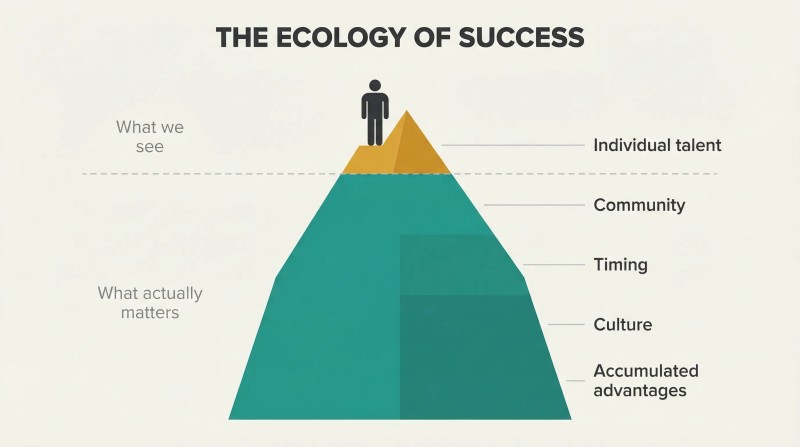
Gladwell's central argument upends self-made mythology. Individual talent is necessary but wildly insufficient for extraordinary success. He opens with Roseto, Pennsylvania — an Italian-American community where heart disease rates were 30 – 35% lower than the national average. The cause wasn't diet (41% of calories came from fat), exercise, or genetics. It was the town's social fabric: three-generational homes, 22 civic organizations in a town of just 2,000, and an egalitarian ethos discouraging displays of wealth.
Roseto reveals the book's method. Stop asking what successful people are like and start asking where they're from — their timing, community, culture, and accumulated advantages. Every chapter applies this lens to hockey players, software billionaires, rock bands, lawyers, and pilots, revealing that no one succeeds in isolation.
Arbitrary cutoff dates lock in lifelong advantages
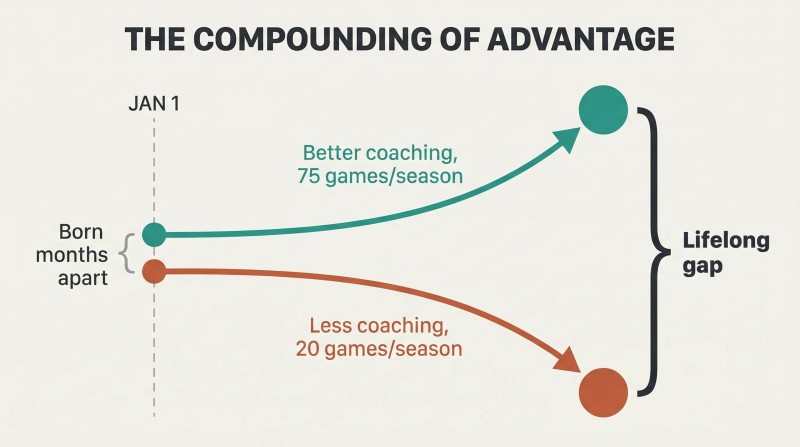
Canada's hockey eligibility cutoff is January 1. A boy born in January can be nearly twelve months more mature than a December-born teammate — a huge gap at age nine. Coaches select bigger, more coordinated kids for all-star teams, who then get better coaching, more games (75 vs. 20 per season), and triple the practice. By fourteen, the initial maturity advantage has become a genuine skill gap. Psychologist Roger Barnsley found this iron law across hockey, European soccer, and US baseball.
The same bias infects education. Economists Bedard and Dhuey found the oldest fourth-graders scored 4 – 12 percentile points higher than the youngest on international math tests — the difference between gifted programs and not. The effect persists into college, with the youngest students underrepresented by 11.6% at four-year universities. Sociologist Robert Merton called this the Matthew Effect: early advantages compound relentlessly.
Mastery demands roughly 10,000 hours of deliberate practice
No naturals, no grinds. Psychologist K. Anders Ericsson studied violinists at Berlin's elite Academy of Music. By age twenty, the future soloists had each accumulated 10,000 hours of practice; merely "good" students had 8,000; future music teachers about 4,000. The researchers found no one who floated to the top on less practice, and no one who put in the hours without improving. Even Mozart didn't produce a recognized masterwork until he'd been composing for ten years.
But 10,000 hours requires opportunity, not just grit. The Beatles performed 270 nights in Hamburg — eight hours a night, seven days a week — amassing 1,200 live shows before their first hit. Bill Gates programmed nonstop from age thirteen thanks to a rare chain of access: a school computer club in 1968, free time at C-Cubed, overnight sessions at the University of Washington. By the time he dropped out of Harvard, he was past 10,000 hours.

Being born at the right moment can matter more than talent
Fourteen of the 75 richest people in human history were Americans born within nine years of each other in the 1830s — Rockefeller, Carnegie, J.P. Morgan — positioned perfectly for the railroad and industrial boom of the 1860s – 70s. Too old and your mindset was pre – Civil War; too young and you missed the window.
The same pattern holds for tech. The personal computer revolution dawned in January 1975. The ideal birth year: 1954 or 1955 — old enough to seize the moment, young enough to not be locked into the mainframe paradigm. Bill Gates was born October 1955. Steve Jobs, February 1955. Bill Joy, November 1954. Eric Schmidt, April 1955. All four founders of Sun Microsystems were born within thirteen months of each other. Timing isn't everything, but without it, everything else is insufficient.
Past an IQ of about 120, more brainpower barely helps
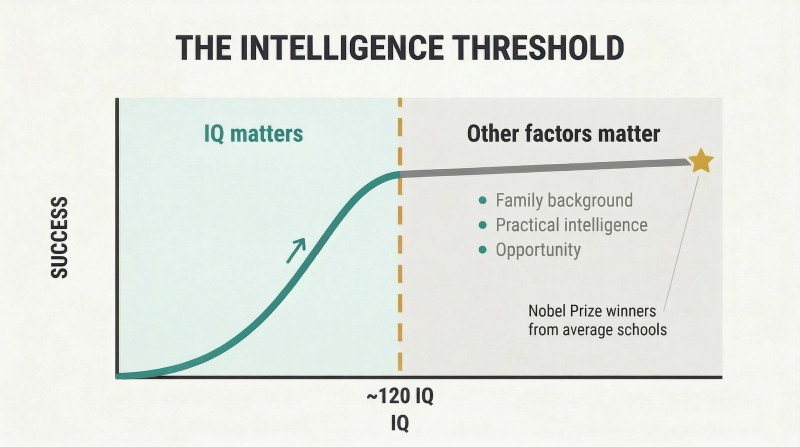
Intelligence has a threshold. Nobel Prize winners come from Gettysburg College and Holy Cross, not just Harvard and MIT. The University of Michigan law school found its affirmative-action graduates — admitted with lower test scores — performed "every bit as well" in their careers as higher-scoring peers. Once you're smart enough, other qualities matter more.
Terman's genius study proves the point. Psychologist Lewis Terman tracked 1,470 children with IQs averaging 140+. Many ended up ordinary; a surprising number were outright failures. Two children his fieldworkers tested and rejected — William Shockley and Luis Alvarez — went on to win Nobel Prizes. What separated the high-achievers from the underperformers among his geniuses wasn't IQ. It was family background. The lesson: being brilliant is like being tall in basketball. You need enough, but past that point, the game is won on other skills entirely.
Teach children to negotiate with authority, not defer to it
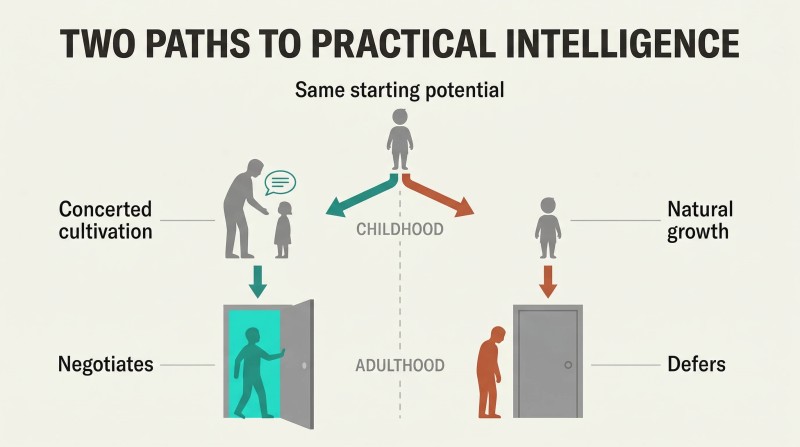
Practical intelligence — knowing what to say to whom and when — is learned, not innate. Sociologist Annette Lareau found two parenting styles split along class lines. Wealthier families practice concerted cultivation: scheduling activities, reasoning with children, coaching them to assert themselves with doctors and teachers. Poorer families practice accomplishment of natural growth — letting kids develop independently. Both styles have merits, but concerted cultivation builds the institutional savvy needed for professional success.
The contrast between Chris Langan and Robert Oppenheimer is devastating. Langan (IQ 195) grew up in poverty, never learned to navigate institutions, and lost his college scholarship over a missed financial aid form. Oppenheimer tried to poison his tutor at Cambridge and talked his way into mere probation — then convinced a skeptical general to let him lead the Manhattan Project. Same genius. Vastly different practical intelligence, shaped entirely by upbringing.
Apparent disadvantages often disguise golden opportunities
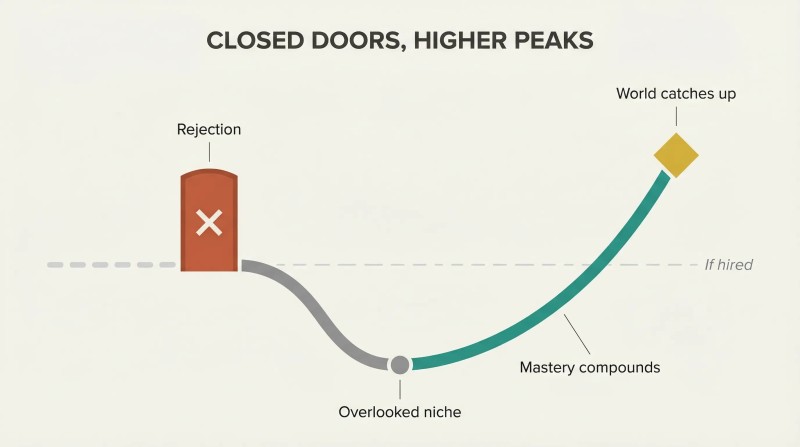
Joe Flom couldn't get hired. In the 1950s, white-shoe law firms rejected Jewish applicants for their "antecedents." Flom landed at a tiny startup called Skadden Arps, doing whatever walked in the door — mostly hostile takeovers and litigation, work the establishment considered beneath them. Then the M&A boom hit: deal volume increased 2,000% from the mid-1970s to the late 1980s. Flom had been perfecting his craft for twenty years. Skadden Arps became one of the world's largest law firms.
The garment industry played the same role one generation earlier. Jewish immigrants arrived with tailoring skills perfectly suited to New York's booming clothing trade. Their children watched parents run small businesses — learning autonomy, problem-solving, and the connection between effort and reward. Sociologist Louise Farkas traced family trees: tailor → garment maker → lawyer → doctor, repeated across dozens of families.
Seek work with autonomy, complexity, and effort-reward links
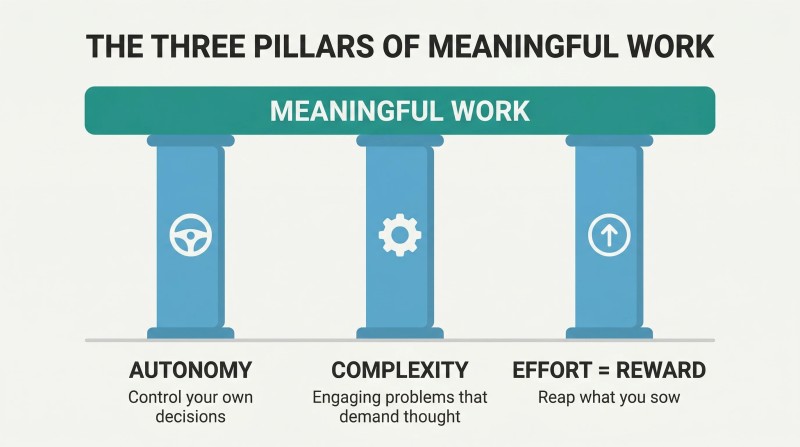
Satisfying work requires three qualities:
1. Autonomy — control over your own decisions
2. Complexity — engaging problems that demand thought
3. A clear connection between effort and reward
Louis Borgenicht, a penniless Jewish immigrant, noticed children's aprons missing from Lower East Side stores. He and his wife Regina built a business from $125 in savings, working eighteen-hour days cutting and sewing. The labor was grueling — but it was theirs. They chose the products, set the prices, and reaped what they sowed.
Chinese rice farming had the same three qualities. Wet-rice agriculture demanded three thousand hours of labor per year — but farmers controlled every decision, from seed selection to irrigation timing. French proverbs reflected fatalism: "If God does not bring it, the earth will not give it." Chinese proverbs reflected agency: "Don't depend on heaven for food, but on your own two hands carrying the load."
Cultural legacies override reason — and can crash planes
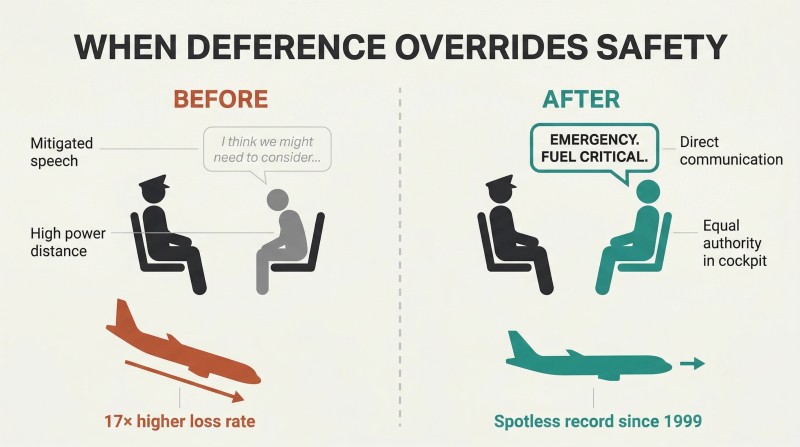
Korean Air's loss rate was 17 times higher than United Airlines'. The cause wasn't pilot skill — it was cultural deference. Hofstede's Power Distance Index measures how much a culture fears authority; Korean pilots ranked second-highest in the world. First officers used mitigated speech — sugarcoating warnings into hints — even in emergencies. On Avianca flight 052, the copilot told JFK controllers they were "running out of fuel" instead of declaring an emergency. Seventy-three people died because a subordinate couldn't be blunt with an authority figure.
Korean Air fixed itself radically. Delta's David Greenberg made English the mandatory cockpit language, freeing pilots from Korean hierarchy's six levels of conversational deference. Crews retrained in Western communication norms. The airline's safety record since 1999 has been spotless — proof that cultural legacies are powerful but not permanent.
Poor kids lose ground in summer, not in school
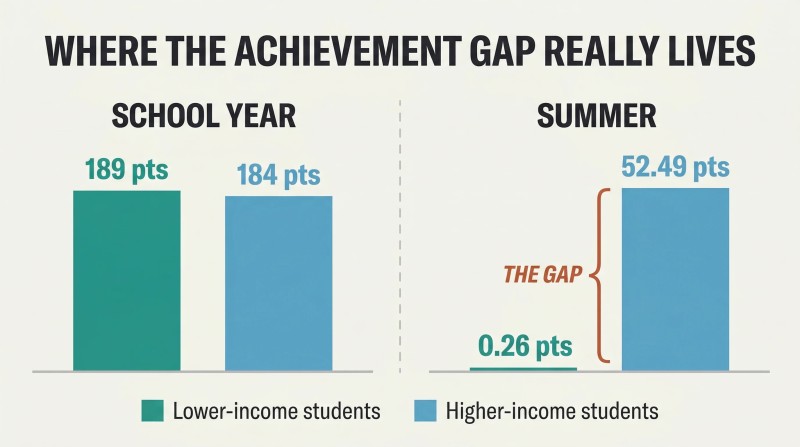
During the school year, poor kids actually out-learn rich kids. Johns Hopkins sociologist Karl Alexander tracked 650 Baltimore first-graders over five years. Poor students gained 189 reading points during school versus 184 for wealthy students. But over summers, rich kids gained a cumulative 52.49 reading points; poor kids gained just 0.26. The achievement gap is almost entirely a summer gap — the result of concerted-cultivation households filling breaks with books, camps, and museums while lower-income homes cannot.
Countries shaped by rice-paddy culture don't take long summers. South Korea's school year is 220 days; Japan's is 243. America's is 180. KIPP Academy in the South Bronx adopted this logic: school from 7:25 a.m. to 5 p.m., Saturdays, plus three extra summer weeks. Result: 84% of randomly selected low-income students perform at or above grade level in math, versus 16% districtwide.
Analysis
Outliers performs an intellectual maneuver so simple it's almost invisible: it applies epidemiology to achievement. Just as Stewart Wolf studied Roseto's heart health by looking at community rather than cholesterol, Gladwell treats success as an ecological phenomenon that cannot be understood at the level of the individual. This reframing is the book's true contribution — more lasting than any single statistic.
The most vulnerable element is the 10,000-Hour Rule itself. K. Anders Ericsson, whose research Gladwell popularized, later objected that the book conflated accumulated hours with deliberate practice — the effortful, feedback-rich kind that actually drives improvement. Gladwell's version implies a more democratic view of talent (put in the hours, achieve mastery), while Ericsson's original research still acknowledged that innate differences determine how efficiently those hours are spent. The number has entered popular consciousness as a fact; it functions better as a heuristic — a corrective to the myth that talent alone suffices.
The cultural legacy chapters — Appalachian feuds, Korean cockpits, rice paddies — are the most intellectually ambitious and the most contested. The inferential leap from Hofstede's Power Distance Index to specific cockpit behaviors involves assumptions that cross-cultural psychologists might not endorse so confidently. Yet the Korean Air transformation provides a compelling natural experiment: change the cultural context (language, training norms), and behavior follows. This undercuts crude determinism even as it affirms culture's power.
What makes Outliers endure is not its data — much of which has been refined since 2008 — but its narrative argument that success is collectively produced. The epilogue, in which Gladwell applies every lesson to his own mother's Jamaican story — tracing her education to colonial riots, a Chinese shopkeeper's loan, and the skin-color politics of slavery — demonstrates rare intellectual honesty. In an era of widening inequality, the book's closing question grows sharper with time: how many potential outliers never received their chance, and what would the world look like if they had?
Review Summary
Outliers explores factors behind extraordinary success, challenging the notion of self-made individuals. Gladwell argues that success depends on opportunity, cultural background, and 10,000 hours of practice. The book examines various case studies, from Canadian hockey players to Bill Gates, revealing how timing, birth date, and societal advantages contribute to success. While some readers find Gladwell's storytelling engaging and thought-provoking, others criticize his cherry-picking of examples and oversimplification of complex issues. Despite mixed reviews, many readers appreciate the book's ability to challenge conventional wisdom about success.
People Also Read










Glossary
Matthew Effect
Advantages compound over timeNamed after a verse in the Gospel of Matthew. The sociological principle that those who already have advantages receive further advantages, widening initial gaps. In Outliers, it explains how a hockey player born in January gets better coaching, which makes him genuinely better, which leads to more opportunities—a self-reinforcing cycle of accumulative advantage.
10,000-Hour Rule
Practice threshold for world-class masteryGladwell's popularization of K. Anders Ericsson's research on expertise. The claim that achieving world-class performance in any complex skill—music, programming, chess—requires roughly ten thousand hours of practice. The rule emphasizes that mastery demands not just talent but sustained opportunity to practice, often requiring support systems like family wealth or institutional access.
Practical intelligence
Knowing how to navigate situationsRobert Sternberg's term for the ability to read social situations and get what you want from them—knowing what to say to whom, when, and how. It is 'orthogonal' to analytical intelligence (IQ): having one doesn't imply having the other. In the book, it explains why Chris Langan (IQ 195) failed where Robert Oppenheimer succeeded—Oppenheimer had the social savvy to negotiate with authority figures.
Concerted cultivation
Deliberate parenting that builds institutional skillsAnnette Lareau's term for the middle- and upper-class parenting style in which parents actively schedule activities, reason with children, and coach them to negotiate with authority figures like teachers and doctors. It produces a sense of 'entitlement'—the positive belief that one has the right to assert preferences in institutional settings—and builds the practical intelligence needed for professional success.
Accomplishment of natural growth
Hands-off parenting styleAnnette Lareau's term for the working-class and poor parenting philosophy in which parents see their role as providing care while letting children develop independently. Children raised this way tend to be more creative, independent, and less whiny, but they develop a sense of 'distance, distrust, and constraint' toward institutions and authority that can limit professional advancement.
Power Distance Index (PDI)
Cultural tolerance for hierarchyGeert Hofstede's measure of how much a culture values, respects, and fears authority. High-PDI cultures (Brazil, South Korea) expect subordinates to defer to superiors and rarely challenge them. Low-PDI cultures (United States, Australia) treat authority figures more as equals. In aviation, high PDI correlates strongly with plane crash rates, because first officers are reluctant to challenge captains' errors.
Mitigated speech
Downplaying urgency when speaking upA linguistics term for any attempt to soften or sugarcoat the meaning of what is being said—through hints, hedging, or indirect phrasing—often out of deference to authority. Gladwell identifies six levels ranging from direct commands ('Turn thirty degrees right') to hints ('That return at twenty-five miles looks mean'). In aviation, mitigated speech by copilots has been a direct cause of fatal crashes.
Culture of honor
Reputation-driven aggression normA sociological concept describing cultures—typically rooted in herding economies—where a man's reputation is central to his livelihood and self-worth, making him willing to respond violently to even minor insults. Gladwell traces it from the Scottish-Irish borderlands to Appalachian feuds to modern southern U.S. behavior, citing Cohen and Nisbett's experiment where southern students' cortisol and testosterone spiked after being called an insult, while northerners laughed it off.
Demographic trough
Generation born during low birthratesA period of significantly reduced birthrates, such as the 1930s during the Great Depression. Children born in a demographic trough benefit from less competition: smaller class sizes, better teacher-to-student ratios, easier college admissions, and a favorable job market. Gladwell argues that being born in the early 1930s was ideal for New York Jewish lawyers, giving them advantages at every stage of their careers.
FAQ
What's Outliers: The Story of Success about?
- Exploring success factors: Malcolm Gladwell examines the various elements that contribute to extraordinary success, arguing that individual talent alone is insufficient.
- Outliers defined: The book defines "outliers" as individuals who stand out due to unique circumstances or opportunities that allow them to excel.
- Cultural and social influences: It highlights how cultural legacies and social structures shape individual opportunities, suggesting success is often a product of collective circumstances.
Why should I read Outliers: The Story of Success?
- Challenging conventional wisdom: The book encourages readers to rethink the traditional notion of the "self-made" individual and the interplay between effort and external factors.
- Real-life examples: Gladwell uses compelling stories and case studies to illustrate his arguments, making the concepts relatable and engaging.
- Practical insights: Readers can gain valuable insights into creating environments that foster success, both personally and for others.
What are the key takeaways of Outliers: The Story of Success?
- Importance of opportunity: Success often results from being in the right place at the right time, as seen in stories like those of Bill Gates and the Beatles.
- 10,000-Hour Rule: Mastery in any field typically requires around 10,000 hours of practice, emphasizing dedication and hard work.
- Cultural legacies matter: Cultural backgrounds and family influences significantly shape individuals' paths to success.
What is the 10,000-Hour Rule in Outliers?
- Mastery through practice: The rule posits that approximately 10,000 hours of dedicated practice are necessary to achieve mastery in any field.
- Not just talent: Gladwell argues that consistent practice and the right opportunities are crucial, challenging the idea that genius is purely natural ability.
- Examples of success: Stories like those of Bill Joy and the Beatles illustrate how hard work and perseverance lead to extraordinary outcomes.
How does Malcolm Gladwell define "outliers" in Outliers?
- Statistical anomalies: Outliers are individuals who deviate significantly from the average, often achieving extraordinary success.
- Cultural context: They are often products of their cultural and social environments, which provide unique opportunities.
- Examples of outliers: The book provides examples of successful athletes, musicians, and entrepreneurs to illustrate how backgrounds and opportunities shape success.
What is the Roseto mystery discussed in Outliers?
- Health anomaly: The Roseto mystery refers to the low rates of heart disease among Roseto, Pennsylvania residents, despite poor diets and lifestyles.
- Community impact: Gladwell argues that the close-knit community and strong social ties contributed to their overall health.
- Cultural legacy: It illustrates how cultural legacies and community dynamics can significantly influence health outcomes.
How does Outliers address the role of culture in success?
- Cultural legacies: Cultural backgrounds shape individuals' opportunities and behaviors, influencing their paths to success.
- Social structures: The importance of social networks and community support in fostering success is emphasized.
- Cultural practices: Specific cultural practices, such as the emphasis on education, contribute to success by encouraging hard work and perseverance.
What is the significance of relative age in Outliers?
- Age cutoffs: Relative age affects success in sports, where players born earlier in the year have advantages due to physical maturity.
- Self-fulfilling prophecies: Early selection and streaming can create a self-fulfilling prophecy, reinforcing advantages for older players.
- Broader implications: This concept extends beyond sports, affecting educational and professional opportunities.
How does Outliers challenge the idea of the "self-made" individual?
- Interconnectedness of success: Success is influenced by a web of social, cultural, and historical factors, not just individual effort.
- Hidden advantages: Many successful individuals benefit from hidden advantages like family connections and educational opportunities.
- Rethinking meritocracy: The analysis questions the meritocratic ideal, suggesting context and opportunity are essential for understanding success.
What are the best quotes from Outliers: The Story of Success and what do they mean?
- “We do owe something to parentage and patronage.” This emphasizes that success is influenced by family background and social connections.
- “Success is the result of what sociologists like to call ‘accumulative advantage.’” It highlights how small advantages can compound over time, leading to disparities in success.
- “The people who stand before kings may look like they did it all by themselves. But in fact they are invariably the beneficiaries of hidden advantages.” This reinforces the idea that success often comes from a combination of personal effort and external factors.
How does Malcolm Gladwell use case studies in Outliers?
- Diverse examples: Gladwell employs a range of case studies, from entrepreneurs to athletes, to illustrate his points about success.
- Real-life implications: Each case study highlights specific factors contributing to success, such as timing and cultural background.
- Engaging narrative: The storytelling approach makes the concepts more relatable and easier to understand.
How does Outliers explain the success of Asian students in mathematics?
- Cultural emphasis on hard work: Success is attributed to cultural legacies prioritizing hard work and diligence, especially in rice farming societies.
- Language advantages: The structure of Asian languages aids in easier memorization and understanding of numbers.
- Longer school years: Longer school years and less vacation time allow for more consistent learning and retention of knowledge.
About the Author
Other books by Malcolm Gladwell









Download PDF
Download EPUB
.epub digital book format is ideal for reading ebooks on phones, tablets, and e-readers.








































