


Key Takeaways
Jobs's personality and products formed one inseparable system
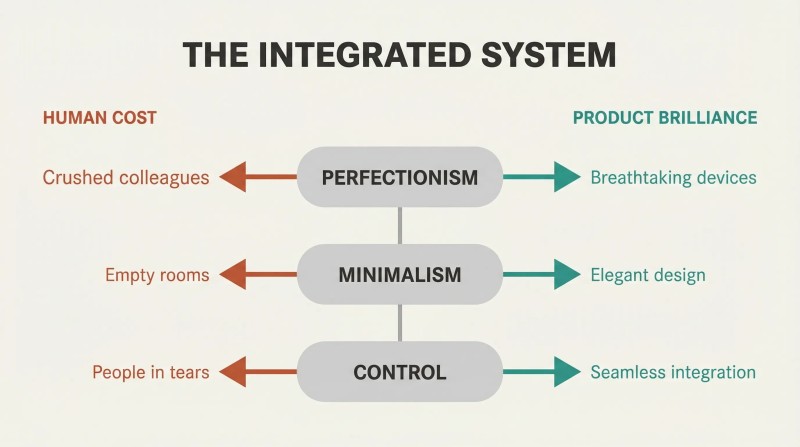
This is the biography's unified field theory. Jobs's obsessive perfectionism produced both breathtaking devices and brutalized colleagues. His Zen minimalism created elegant designs and an inability to furnish his own house for a decade. His need for control yielded seamlessly integrated gadgets and a management style that regularly drove people to tears.
Isaacson's core argument is that you cannot separate the man from the machine. Jobs's passions, demons, and artistry were the same forces that revolutionized six industries — personal computers, animated movies, music, phones, tablet computing, and digital publishing. The biography is thus both instructive and cautionary: it teaches us about innovation but also warns about the human cost of genius untempered by empathy.
Own the whole widget — hardware, software, and services in one hand
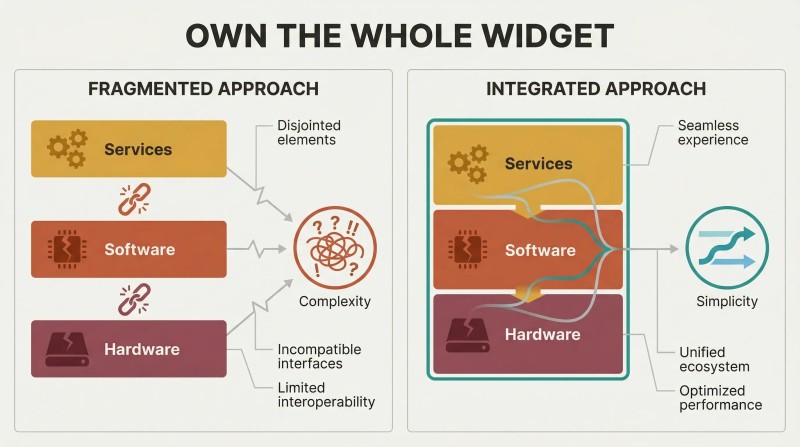
Apple's defining strategic conviction was the "whole widget" approach — designing and controlling every element from chip to screen to software to store. When Microsoft licensed Windows to any hardware maker, it gained market dominance but produced mediocre experiences. When Sony's hardware and music divisions fought each other, the Walkman company missed the iPod revolution despite owning every necessary asset.
Apple did what neither could. The iPod worked seamlessly with iTunes software and the iTunes Store because one company controlled all three. The iPhone's touchscreen, operating system, and App Store were designed as a single experience. By 2010, Apple had just 7% of PC market revenue but captured 35% of the industry's operating profit — and surpassed Microsoft as the world's most valuable technology company.
Simplicity demands mastering complexity, not avoiding it
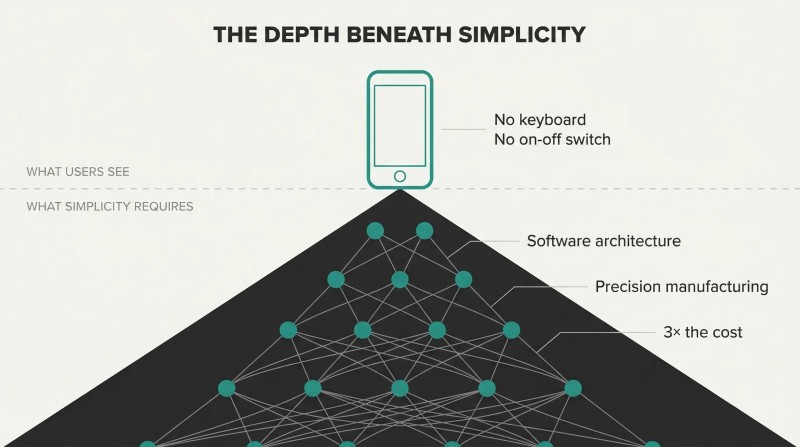
Apple's first brochure proclaimed "Simplicity is the ultimate sophistication." When Jony Ive designed the iMac's handle, it wasn't primarily functional — it was semiotic. It gave users "permission to touch" the computer, signaling approachability. Manufacturing that recessed handle cost three times more than a standard case, but Jobs approved it instantly.
The iPhone had no physical keyboard because a software keyboard could transform for every task. The iPod had no on-off switch because Jobs deemed one inelegant. Each removal required harder engineering beneath the surface. As Ive explained, true simplicity meant digging through depth of complexity and understanding everything about how a product is manufactured — not just stripping features away.
Brilliant failures teach what early success never could
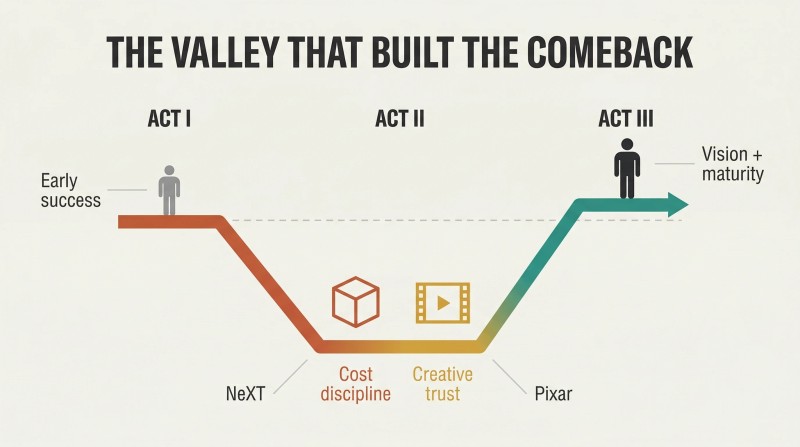
When Apple's board sided with CEO John Sculley in 1985, Jobs was stripped of all duties at age thirty. He sold all but one share of Apple stock. But the "wilderness years" that followed proved essential. At NeXT, he indulged every instinct unchecked — spending $100,000 on a logo, $650,000 on molds for a perfect cube case — and built a gorgeous factory that produced only 400 computers a month instead of the projected 10,000. Beautiful failures taught him cost discipline.
At Pixar, he learned something rarer: how to empower creative people without controlling them. He let John Lasseter run the artistic process and restrained his own impulses. When Jobs returned to Apple in 1997, he combined the artistic vision of his youth with the operational maturity forged by a decade of spectacular failures.
Focus by killing — cut until your best people do their best work
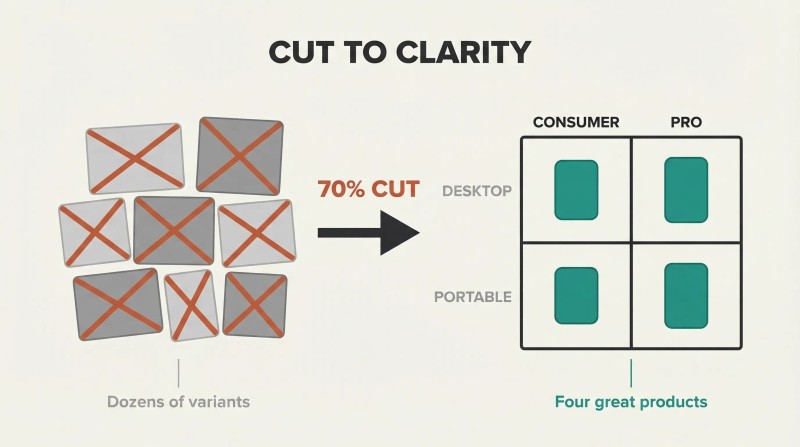
When Jobs returned to Apple in 1997, the company sold dozens of Macintosh variants with confusing numbers from 1400 to 9600. After weeks of product reviews, he drew a simple two-by-two grid on a whiteboard — Consumer and Pro across the top, Desktop and Portable down the side. Apple would make four great products, one per quadrant. He cut 70% of existing product lines.
The same ruthlessness applied to strategy sessions. At his annual "Top 100" retreat, employees would fight to get ideas on a whiteboard list of ten. Then Jobs would slash the bottom seven: "We can only do three." The result was immediate. Apple went from losing $1.04 billion the year he returned to earning a $309 million profit the next fiscal year.
The best innovations live where technology meets the humanities
Jobs dropped out of Reed College but audited a calligraphy class that taught him about serif typefaces, proportional spacing, and what makes typography beautiful. A decade later, the Macintosh became the first computer with elegant fonts. When Microsoft copied the Mac, every PC inherited that legacy. A wandering pursuit of beauty only made sense in retrospect.
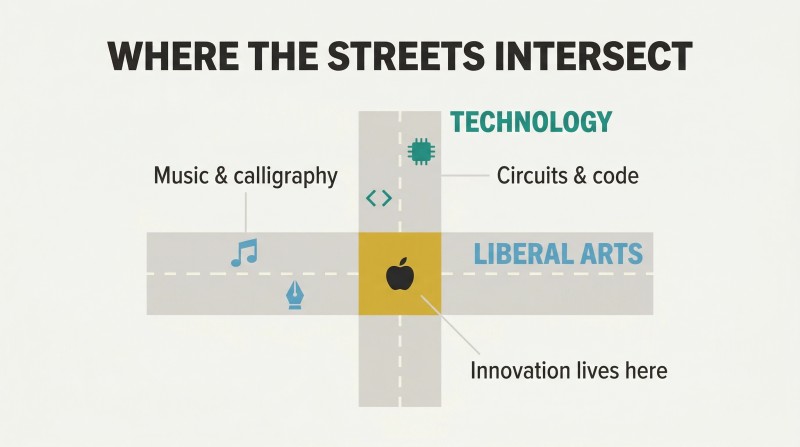
This was not an accident but a philosophy. Jobs's Zen Buddhism produced Apple's minimalist aesthetic. His obsession with Bob Dylan's perfectionism — he kept a bootleg showing the Beatles revising "Strawberry Fields Forever" over months — inspired Apple's iterative design process. At every major product launch, he stood before a slide showing the intersection of a "Technology Street" and a "Liberal Arts Street" — Apple's permanent home address.
The reality distortion field bends teams — and can break the bender
Apple colleagues coined the term "reality distortion field" to describe Jobs's ability to convince anyone of almost anything through charisma, intensity, and willful defiance of facts. An engineer told the Mac would take too long to boot was persuaded by Jobs's argument that shaving ten seconds across five million users equaled a hundred lifetimes saved per year. He came back with a boot time twenty-eight seconds faster.
But the field had a lethal edge. Jobs delayed cancer surgery for nine months, convinced alternative diets could cure him — a potentially fatal miscalculation. He denied paternity of his daughter Lisa for years despite a 94.41% DNA match. The same force that pushed teams beyond their limits also enabled catastrophic self-deception. Colleagues found that even awareness of the distortion couldn't shield them from it.

Cannibalize your own hit product before a rival does
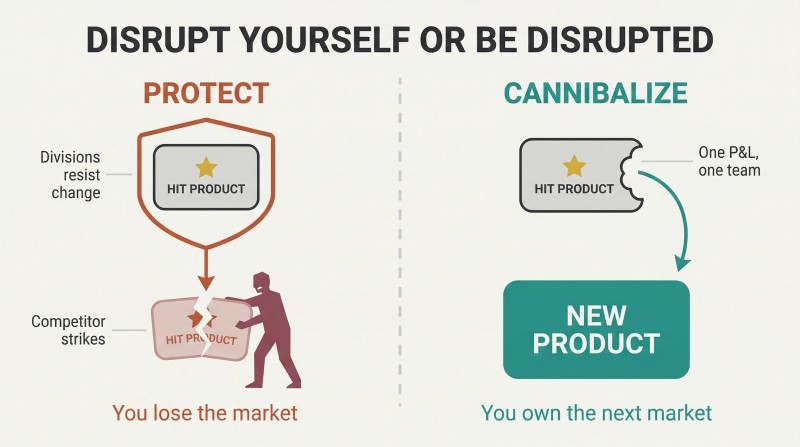
Sony owned the Walkman, a major record label, and a consumer electronics empire — every asset needed to build the iPod. But its hardware and music divisions fought to protect their own revenue, and the company never integrated. Jobs used Sony as his cautionary tale. Apple's organizational structure had no semi-autonomous divisions with their own profit-and-loss statements. "We run one P&L for the company," Tim Cook explained.
This structure let Jobs make moves that division-based companies couldn't stomach. The iPhone knowingly undercut iPod sales. The iPad competed with MacBook sales. Each time, Jobs reasoned that if Apple didn't disrupt itself, a competitor would. The willingness to eat your own revenue before someone else does required a structural design that removed internal incentives to resist.
Pour craftsmanship into what nobody will see
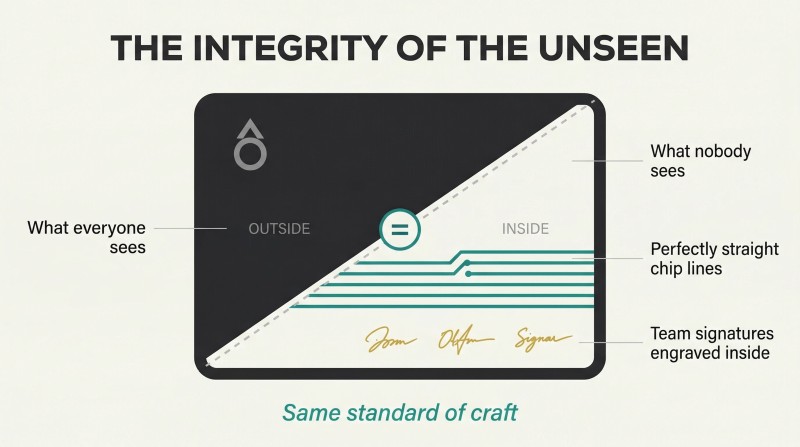
Jobs's father taught him that a drive for perfection meant caring about the hidden parts. When building a fence, Paul Jobs insisted the back look as good as the front — "You'll know it's there." Steve applied this lesson obsessively. He rejected a Macintosh circuit board because the chip lines weren't straight enough, even though no customer would ever see it. When an engineer asked why it mattered, Jobs was incredulous.
The principle extended to every Apple product. When the Macintosh design was locked in, Jobs had all forty-five team members sign a sheet of paper; their signatures were engraved inside each machine. The NeXT computer's matte black finish coated the inside of the case — visible only to repairmen. For Jobs, the integrity of the unseen was the truest measure of craftsmanship.
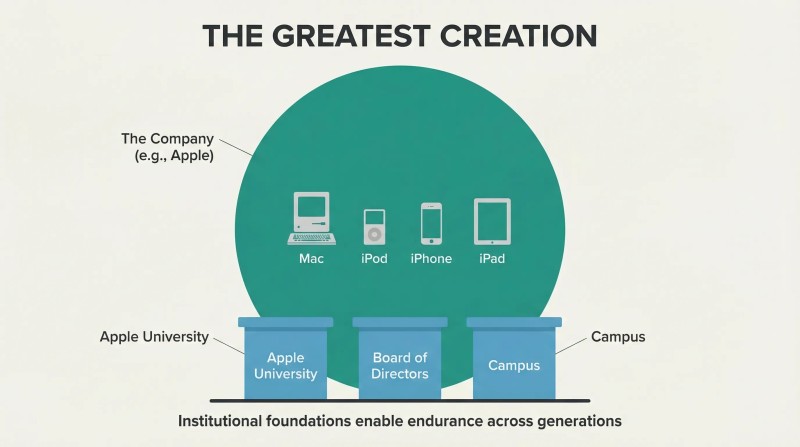
The greatest creation isn't a product — it's the company itself
Jobs told Isaacson that his greatest creation was not the Mac, iPod, or iPhone — it was Apple itself. He studied how Hewlett and Packard had built an institution that outlived them, reinventing from instruments to calculators to computers. When Jobs returned, he asked Mike Markkula what lasting companies do. "They reinvent themselves," Markkula answered. "You've got to be like a butterfly and have a metamorphosis."
Jobs acted on this. He founded Apple University to codify decision-making through case studies. He recruited a board of directors loyal enough to protect Apple's culture. He designed a new headquarters — a massive circular building in Cupertino — as a physical expression of the company's values for generations. "I want to leave a signature campus that expresses the values of the company for generations," he said.
Analysis
Isaacson's biography operates on a central paradox that no amount of hagiography or criticism can resolve: Jobs's cruelty and his creativity were fed by the same neural wiring. The reality distortion field that enabled the iPhone also delayed cancer treatment. The controlling perfectionism that produced seamless devices also destroyed relationships. The book's genius is in refusing to untangle these threads and instead presenting them as a single braid.
The most underappreciated insight is structural. Jobs didn't just design products — he designed an organization incapable of the compromises that destroy great products. Apple had no divisional P&Ls, no consensus-driven product reviews, no tolerance for B-players in A-player meetings. This organizational architecture is harder to replicate than any specific product, which is why competitors who copied Apple's designs consistently failed to match its execution.
Isaacson's framing of the closed-versus-open debate deserves scrutiny. He presents it as a philosophical disagreement between Jobs and Gates, but the evidence suggests something more pragmatic: closed integration works spectacularly when you have a taste-making genius at the helm, and open systems work better when you don't. The question Isaacson leaves unresolved — whether Apple's integrated approach survives without its reality-distorting founder — is the most consequential business question of the post-Jobs era.
The biography has an important limitation: it was completed while Jobs was dying and cooperating fully. Isaacson was remarkably candid about Jobs's flaws, but the proximity to death inevitably shaped the narrative toward legacy-building. The sections on Jobs's abandoned daughter Lisa, his treatment of early Apple employees like Daniel Kottke, and his initial refusal of cancer treatment are presented with more sympathy than pure journalism might have afforded. Still, the result is the most complete portrait we will likely ever have of a figure whose influence on how humans interact with technology is rivaled only by the inventors of the printing press and the personal computer itself.
Review Summary
Steve Jobs is a comprehensive biography that offers an unflinching look at the complex personality of Apple's co-founder. Readers praise Isaacson's balanced portrayal, highlighting Jobs' genius and flaws. The book details his innovations in technology and business, as well as his difficult relationships and management style. Many found it inspiring and insightful, though some felt it was overly long or repetitive in its criticism. Overall, it's considered a thorough and engaging account of Jobs' life and impact on the tech industry.
People Also Read






Glossary
Reality distortion field
Jobs's power to bend perceptionsA term coined by Apple engineer Bud Tribble, borrowed from Star Trek, describing Steve Jobs's ability to convince people of almost anything through charisma, intense staring, and willful defiance of facts. It combined rhetorical skill, indomitable will, and eagerness to bend any fact to fit the purpose at hand. It motivated teams to achieve the impossible but also enabled dangerous self-deception.
Impute
Signal quality through every touchpointA marketing principle from Mike Markkula's one-page 'Apple Marketing Philosophy' memo, written when Apple was founded. It held that people form opinions about a company or product based on the signals it conveys—packaging, store design, advertising, even the box a product comes in. 'People DO judge a book by its cover,' Markkula wrote. Jobs applied impute throughout his career, from Apple Store design to iPhone packaging.
Whole widget
End-to-end integrated product controlJobs's philosophy that a company should design and control every element of a product—hardware, software, operating system, and services—rather than licensing components to third parties. This approach produced tightly integrated, user-friendly products like the iPod-iTunes ecosystem and the iPhone, but also meant Apple products were incompatible with competitors' systems. It was the opposite of Microsoft's strategy of licensing its OS to multiple hardware makers.
Digital hub
Computer as digital lifestyle centerJobs's 2001 strategy declaring that the personal computer should serve as the central hub coordinating music players, video recorders, cameras, phones, and other digital devices. Content would be managed on the computer, and portable devices would sync with it. This vision transformed Apple from a computer company into a consumer electronics powerhouse and spawned the iPod, iPhone, and iPad. By 2008, Jobs evolved the concept further, moving the hub from the computer into the cloud.
iCEO
Jobs's interim CEO titleThe title Steve Jobs adopted when he officially took over running Apple in September 1997, abbreviated from 'interim CEO.' He was reluctant to commit fully, partly from uncertainty about Apple's future and partly from his obligations at Pixar. He took only $1 per year in salary and signed no contract. The 'interim' designation lasted until January 2000, when he finally dropped it after Apple's successful turnaround.
Think Different
Apple's brand identity campaignA brand image advertising campaign created by Lee Clow and TBWA\Chiat\Day in 1997, shortly after Jobs returned to Apple. It featured black-and-white portraits of iconic figures—Einstein, Gandhi, Lennon, Dylan, Picasso—with just the Apple logo and the words 'Think Different.' Rather than promoting specific products, it reasserted Apple's identity as a company for creative rebels. Jobs helped write the campaign's manifesto, which began: 'Here's to the crazy ones.'
FAQ
What's "Steve Jobs" by Walter Isaacson about?
- Comprehensive biography: The book is a detailed biography of Steve Jobs, co-founder of Apple Inc., based on extensive interviews with Jobs and those close to him.
- Revolutionary impact: It explores how Jobs revolutionized industries such as personal computing, music, and mobile phones with his innovative products.
- Complex personality: The biography delves into Jobs's intense personality and how it influenced his approach to business and innovation.
Why should I read "Steve Jobs" by Walter Isaacson?
- Insight into innovation: The book provides valuable insights into how Jobs's passion for connecting creativity with technology led to groundbreaking innovations.
- Leadership lessons: Readers can learn about Jobs's unique leadership style, which was both inspiring and controversial, offering lessons on character and values.
- Cultural impact: Understanding Jobs's influence on modern technology and culture can provide a deeper appreciation of the digital world we live in today.
What are the key takeaways of "Steve Jobs" by Walter Isaacson?
- Passion for perfection: Jobs's relentless pursuit of perfection drove him to create products that were not only functional but also beautifully designed.
- Reality distortion field: Jobs had a unique ability to bend reality to his will, convincing others to achieve what seemed impossible.
- Integrated systems: He believed in creating end-to-end integrated systems, where hardware and software were tightly linked, ensuring a seamless user experience.
How did Steve Jobs's early life influence his career?
- Adoption and identity: Jobs's knowledge of being adopted and feeling special shaped his independent and driven personality.
- Early exposure to technology: Growing up in Silicon Valley, Jobs was surrounded by engineers and technology, which fueled his interest in electronics.
- Counterculture influence: His experiences with the counterculture movement and Eastern spirituality influenced his approach to business and innovation.
What role did Steve Wozniak play in Apple's success?
- Engineering genius: Wozniak was the engineering mastermind behind the Apple I and Apple II, creating groundbreaking circuit designs.
- Complementary partnership: Jobs and Wozniak had a symbiotic relationship, with Wozniak focusing on engineering and Jobs on marketing and vision.
- Generosity and ethics: Wozniak's generous nature and ethical approach contrasted with Jobs's more ruthless business tactics, highlighting their different personalities.
What is the "reality distortion field" in the context of Steve Jobs?
- Charismatic influence: The "reality distortion field" refers to Jobs's ability to convince himself and others to believe in his vision, often bending reality to fit his desires.
- Motivational tool: It was a powerful tool that inspired his team to achieve seemingly impossible goals, though it could also lead to unrealistic expectations.
- Complex personality trait: This trait was a mix of charisma, willpower, and a tendency to ignore inconvenient facts, making Jobs both a visionary and a challenging leader.
How did Steve Jobs's design philosophy shape Apple's products?
- Simplicity and elegance: Jobs believed in the Bauhaus principle that "simplicity is the ultimate sophistication," leading to products that were both functional and aesthetically pleasing.
- Attention to detail: He insisted on perfection in every aspect, from the internal circuit boards to the packaging, ensuring a seamless user experience.
- End-to-end control: Jobs's desire for control led to tightly integrated systems where hardware and software worked harmoniously, setting Apple apart from competitors.
How did Steve Jobs return to Apple and what impact did he have?
- NeXT acquisition: Jobs returned to Apple after the company acquired NeXT, the computer platform development company he founded after leaving Apple.
- Revitalizing Apple: He played a crucial role in revitalizing Apple by streamlining the product line and focusing on innovation, leading to the development of iconic products like the iMac.
- Leadership style: His leadership style, characterized by intense focus and a demand for excellence, helped transform Apple into a leading tech company.
What role did Pixar play in Steve Jobs's career?
- Acquisition and growth: Jobs acquired Pixar from Lucasfilm and played a crucial role in its growth, transforming it into a leading animation studio.
- Financial success: Pixar's success, particularly with films like "Toy Story," provided Jobs with significant financial gains and a reputation as a visionary in the entertainment industry.
- Creative collaboration: His collaboration with Pixar's creative team, including John Lasseter, demonstrated his ability to blend technology with art to create groundbreaking animated films.
How did Steve Jobs influence the music industry?
- iTunes and iPod: Jobs revolutionized the music industry with the introduction of iTunes and the iPod, changing how people purchased and listened to music.
- Digital distribution: He championed digital distribution, convincing major record labels to sell their music online, which reshaped the industry's business model.
- Focus on user experience: Jobs's focus on user experience ensured that Apple's music products were not only innovative but also easy to use and appealing to consumers.
What are some of the best quotes from "Steve Jobs" by Walter Isaacson and what do they mean?
- "The people who are crazy enough to think they can change the world are the ones who do." This quote encapsulates Jobs's belief in the power of innovation and bold thinking.
- "Simplicity is the ultimate sophistication." This reflects Jobs's design philosophy, emphasizing the importance of creating products that are both simple and elegant.
- "Real artists ship." This mantra highlights Jobs's focus on delivering products, balancing perfectionism with the need to bring ideas to market.
How did Steve Jobs's leadership style affect Apple and its employees?
- Demand for excellence: Jobs's leadership style was characterized by a high demand for excellence, often pushing employees to their limits to achieve groundbreaking results.
- Reality distortion field: His ability to convince himself and others to believe in the impossible often led to innovative breakthroughs but could also create unrealistic expectations.
- Impact on culture: While his style could be abrasive, it fostered a culture of innovation and creativity at Apple, attracting top talent and driving the company's success.
About the Author
Other books by Walter Isaacson







Download PDF
Download EPUB
.epub digital book format is ideal for reading ebooks on phones, tablets, and e-readers.








































