

Key Takeaways
Musk poured his entire $180M PayPal fortune into rockets and cars
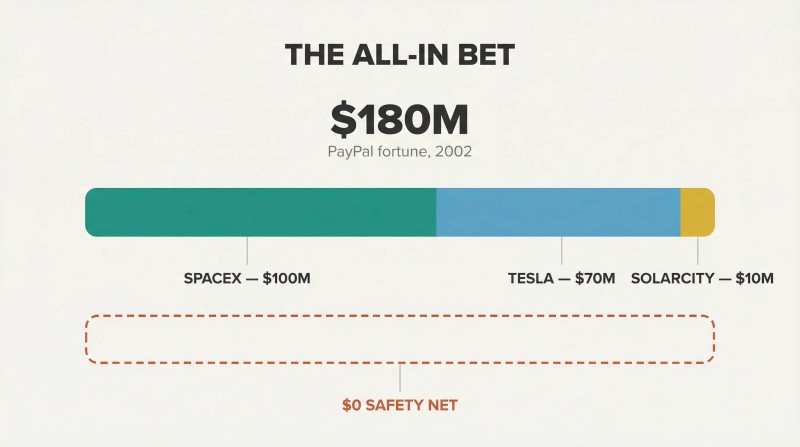
After eBay bought PayPal for $1.5 billion in 2002, Musk netted roughly $180 million after taxes. Most dotcom millionaires at the time were sitting on their cash, waiting for the next cycle. Musk rejected that playbook entirely. He poured $100 million into SpaceX, $70 million into Tesla, and $10 million into SolarCity — simultaneously, in the most capital-intensive industries on Earth.
No safety net remained. By 2008, both companies were faltering, his marriage was collapsing, and Musk was borrowing from friends for rent. He sold his McLaren F1 supercar for cash and flew Southwest instead of his private jet. "I will spend my last dollar on these companies," Musk told a friend. "If we have to move into Justine's parents' basement, we'll do it."
SpaceX, Tesla, and SolarCity are one plan disguised as three companies
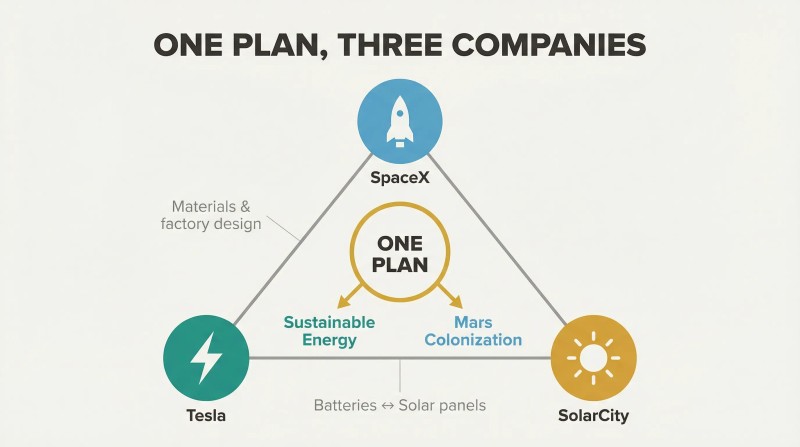
Vance describes the "unified field theory" of Elon Musk: these aren't three separate bets but interconnected components of one system. Tesla makes battery packs that SolarCity sells to homeowners. SolarCity supplies solar panels to Tesla's Supercharger stations. SpaceX and Tesla exchange knowledge around advanced materials, welding, and factory design. All three serve Musk's twin obsessions: sustainable energy on Earth and colonizing Mars as a civilizational backup plan.
The mission is the management tool. SpaceX employees tolerate 90-hour weeks because they believe they're building mankind's escape route. Tesla engineers endure brutal criticism because they're ending the oil era. As Vance writes, Musk is "less a CEO chasing riches than a general marshaling troops to secure victory."
Reject quoted prices; rebuild costs from the raw physics up
The Russia trip sparked SpaceX. Musk flew to Moscow three times trying to buy refurbished ICBMs. The Russians quoted outrageous prices or literally spit on him. On the flight home, while his companions drank in defeat, Musk built a spreadsheet from raw physics — material costs, assembly labor, performance specs — showing rockets could be made far cheaper than anyone charged.
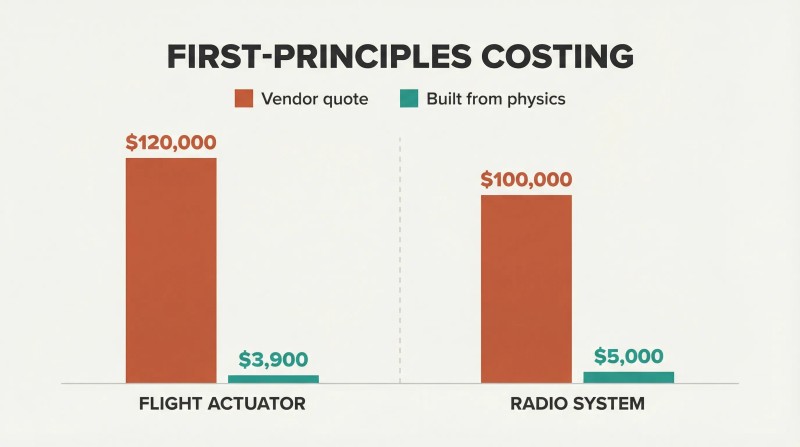
This first-principles approach became SpaceX's DNA. When an engineer got a $120,000 vendor quote for a flight actuator, Musk called it no more complex than a garage door opener and set a $5,000 budget. The engineer built it for $3,900. SpaceX's homemade radios cost $5,000 versus the industry's $50,000 – $100,000. Most pricing reflects decades of unchallenged convention, not underlying physics.
Build 80 – 90% of your product in-house when rivals outsource
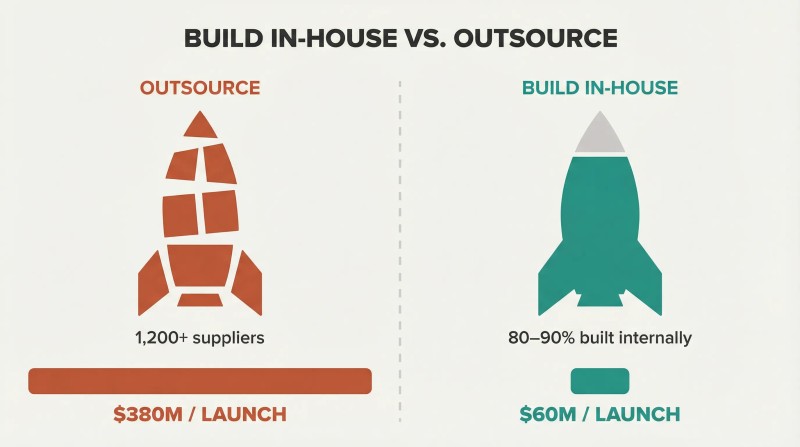
SpaceX manufactures 80 – 90% of its rockets, engines, electronics, and capsules internally. Its competitor United Launch Alliance openly brags about depending on 1,200-plus suppliers. Tesla followed the same philosophy — designing its own battery packs, power electronics, software, and the 17-inch touchscreen when the auto supply chain said no such thing existed.
The results speak in dollars. SpaceX pioneered friction stir welding for rocket bodies — a technique creating stronger bonds than traditional methods — then transferred the equipment to Tesla for lighter car frames. SpaceX charges $60 million per launch versus ULA's $380 million. The tradeoff is punishing complexity: you must master dozens of disciplines simultaneously. But the payoff is speed, cost control, and independence from vendors who can't keep up.
Absorb any field by grilling its experts until you match them
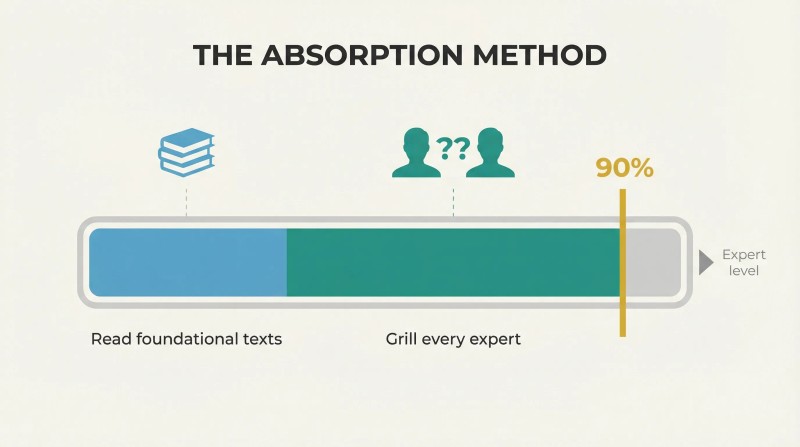
Musk taught himself rocket science. He began with textbooks — Rocket Propulsion Elements, Aerothermodynamics of Gas Turbine and Rocket Propulsion — then began cornering SpaceX engineers in the factory and interrogating them about valves, materials, and propulsion systems for hours. "He would quiz you until he learned ninety percent of what you know," said early engineer Kevin Brogan.
This absorption technique dates to childhood. Musk read ten hours a day, consumed two sets of encyclopedias by fourth grade, and memorized facts so thoroughly his sister told visitors, "Just ask genius boy." The method: master foundational texts, then mine experts for the practical knowledge books can't capture. The result is a CEO who spots a flawed equation on a whiteboard — and corrects it on the spot.
In a crisis, force yourself to get more rational, not less
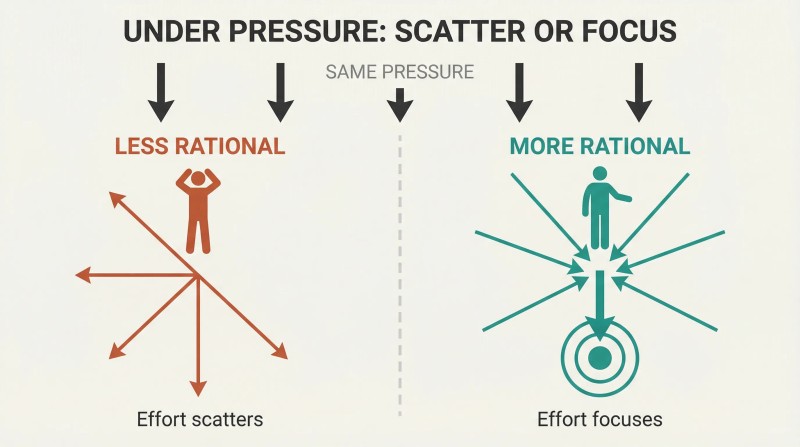
2008 was Musk's crucible. SpaceX's third rocket had exploded. Tesla's Roadster cost $200,000 to build but sold for $85,000. The global economy was collapsing. His wife filed for divorce publicly. He had cash for maybe one more SpaceX launch, and Tesla needed funding by Christmas Eve or it would go bankrupt.
Instead of cracking, Musk became surgical. He restructured Tesla's funding round as debt to outmaneuver a hostile investor. He lobbied NASA contacts for a contract. On September 28, SpaceX's fourth launch succeeded. On December 23, NASA awarded SpaceX $1.6 billion. On Christmas Eve, Tesla's round closed — hours before insolvency. Musk had a few hundred thousand dollars left and could not have made payroll the next day.
Ask your team to own the 'impossible' deadline themselves
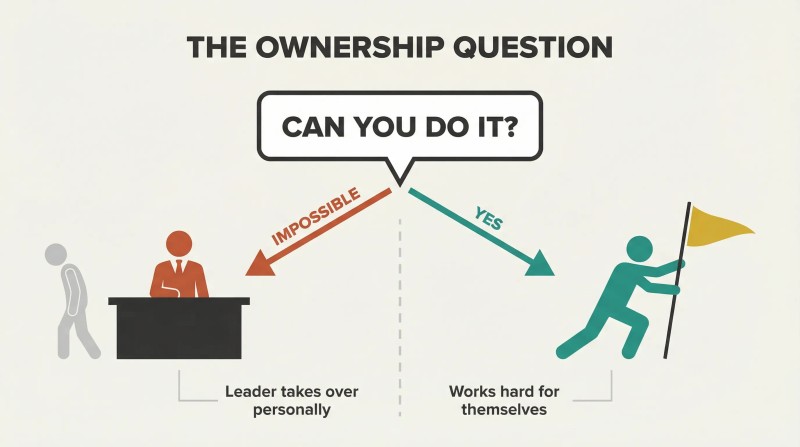
Musk doesn't assign deadlines — he extracts commitments. "He says, 'I need the impossible done by Friday at two P.M. Can you do it?'" explained an engineer. "When you say yes, you're working hard for yourself." This ownership transfer is psychologically powerful — and it has teeth. Tell Musk something is impossible, and he'll personally take over the project and deliver it.
SpaceX also found that one person working sixteen hours outperforms two working eight — no meetings, no consensus-building, no handoffs. Musk's timelines are always wildly optimistic; the Falcon 1 launched four years late. But aggressive targets produce faster results than realistic ones ever could. "I've certainly always been optimistic on time frames," Musk conceded. "I'm trying to recalibrate."
After being ousted twice, Musk made founder control non-negotiable
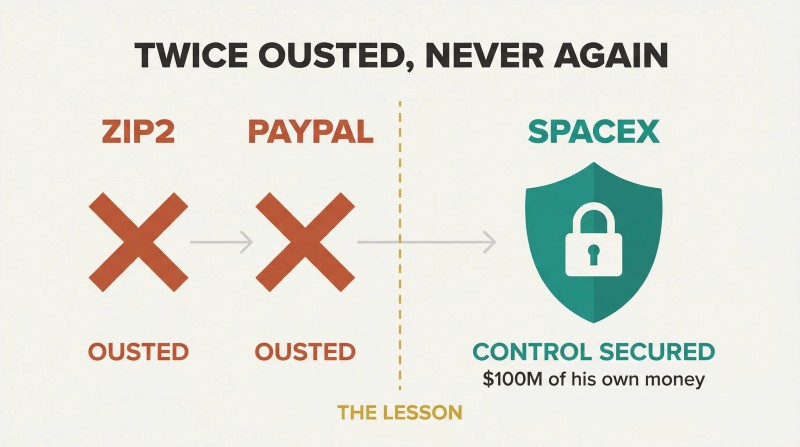
Musk was deposed as CEO twice. At Zip2, his first company (sold to Compaq for $307 million), venture capitalists replaced him with a professional CEO. At PayPal, executives staged a boardroom coup while Musk was literally mid-flight for his honeymoon — delivering letters of no confidence before he could land.
Both times, replacements steered the companies away from Musk's ambitious visions. Had Zip2 chased consumers as he urged, it might have become a mapping giant. PayPal could have become his envisioned "online bank to rule them all." These losses burned a permanent lesson into Musk's operating system. When founding SpaceX, he invested $100 million of his own money — enough to ensure no investor could ever overrule him again. Control became sacred.
Tesla won by building the car people desired, not the compromise
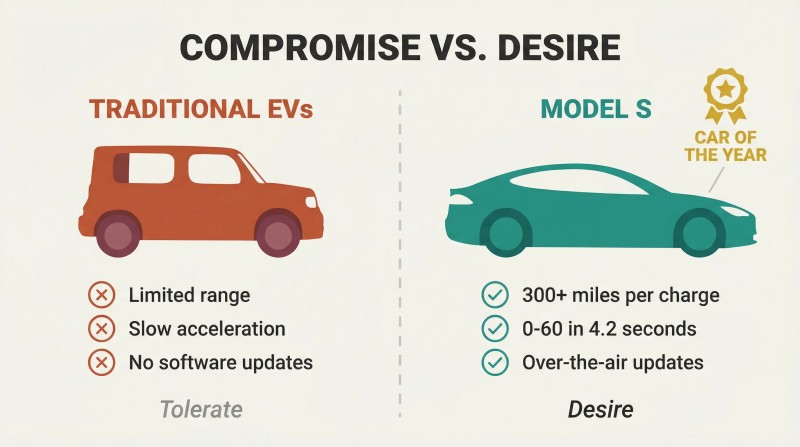
The Model S obliterated every excuse against electric cars. Over 300 miles per charge. Zero to 60 in 4.2 seconds. Room for seven. Two trunks. Motor Trend gave it a unanimous Car of the Year — the first non-combustion engine car to win. Consumer Reports scored it 99 out of 100. No new American car startup had achieved this since Chrysler in 1925.
What truly separated the Model S was its software DNA. Over-the-air updates added features while owners slept — fixing glitches, improving range, adding autopilot capabilities. A 17-inch touchscreen replaced hundreds of buttons. A nationwide network of free, solar-powered Superchargers eliminated range anxiety. Tesla sold directly to consumers, bypassing dealers entirely. Rather than build a car people would tolerate, Musk built one they lusted after.
Musk's brutal childhood forged his inhuman tolerance for suffering
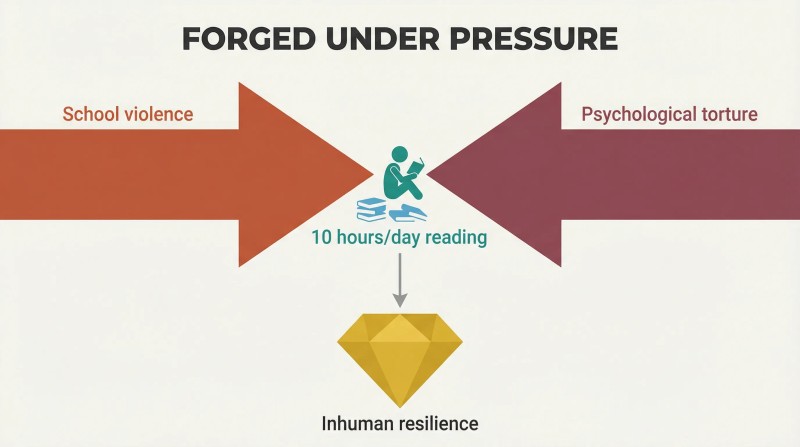
Musk grew up under siege. At school in South Africa, gangs beat him so badly he was hospitalized — one attack left permanent nose damage requiring surgery. His closest friend was coerced into luring him out for another beating. At home, his father Errol subjected Elon and brother Kimbal to hours-long psychological lectures and what both brothers describe only as "a form of psychological torture."
Books became his refuge. Musk read so deeply — ten hours a day — that his parents thought he was deaf; doctors surgically removed his adenoid glands before realizing he was simply blocking out the world to concentrate. Two sets of encyclopedias consumed before fourth grade. Science fiction visions of saving humanity. The violence and isolation forged someone who could endure 2008's cascading catastrophes without breaking.
Analysis
Ashlee Vance's biography accomplishes something rare in business nonfiction: it presents a subject who is simultaneously admirable and disturbing without resolving the tension. Vance doesn't redeem Musk or condemn him. He shows you the man who paid for an employee's Lasik surgery on impulse and the man who fired his twelve-year executive assistant without ceremony. The reader is left to adjudicate.
The book's enduring intellectual contribution is its documentation of a managerial archetype the MBA curriculum cannot produce. Musk combines the depth of a specialist with the breadth of a generalist — knowing enough about rocket propulsion to correct an engineer's quantum mechanics equation while simultaneously negotiating NASA contracts and redesigning car door handles. This polymathic intensity isn't merely biographical curiosity; it's a competitive moat. Competitors who separate 'the business guys' from 'the engineering guys' cannot iterate at Musk's speed.
What distinguishes Vance's account from typical Silicon Valley hagiography is his treatment of the human cost. The book catalogs destroyed marriages, engineers who burned out at thirty, and a corporate culture where being told 'you're off the project' is the mildest feedback. Vance traces this directly to Musk's traumatic childhood — the bullying, the psychological abuse, the isolation — creating an implicit argument that extreme achievement and extreme dysfunction may share the same root system.
The book's notable limitation is its 2015 publication date, capturing Musk at peak credibility before the Twitter acquisition, Model 3 production hell, and increasingly polarizing public persona. In retrospect, it reads as the high-water mark of the 'visionary Elon' narrative. Yet the core business insights endure: vertical integration beats outsourcing in complex hardware, first-principles thinking defeats convention, and a sufficiently compelling mission can extract superhuman effort from ordinary people — at least until they break.
Review Summary
Elon Musk: Tesla, SpaceX, and the Quest for a Fantastic Future is a captivating biography that offers insights into Musk's visionary ideas and relentless drive. Readers praise Vance's thorough research and engaging writing style, highlighting Musk's ambitions in space exploration, electric vehicles, and renewable energy. While many admire Musk's determination and innovative spirit, some criticize his demanding management style and treatment of employees. The book provides a comprehensive look at Musk's life, from his childhood to his current ventures, inspiring readers with his audacious goals for humanity's future.
People Also Read

Glossary
Musk Land
SpaceX/Tesla LA campus complexAuthor Ashlee Vance's coined name for the interconnected cluster of SpaceX and Tesla facilities in Hawthorne, California, near Los Angeles. The complex includes SpaceX's 550,000-square-foot rocket factory, Tesla's design studio in a converted Boeing hangar, and several surrounding buildings. Vance uses the term to convey the self-contained, industrialist quality of Musk's physical empire.
unified field theory of Elon Musk
Musk's companies as interconnected systemVance's framework for understanding how SpaceX, Tesla, and SolarCity function as interlocking parts of a single strategy rather than independent businesses. Tesla makes battery packs SolarCity sells to consumers; SolarCity supplies solar panels to Tesla's Supercharger stations; SpaceX and Tesla exchange manufacturing knowledge. All three serve Musk's dual goals of sustainable energy and Mars colonization.
PayPal Mafia
PayPal alumni ruling Silicon ValleyThe collective term for the group of former PayPal employees who went on to found or lead major technology companies and investment firms. Members include Peter Thiel (Palantir, Founders Fund), Reid Hoffman (LinkedIn), the founders of YouTube and Yelp, and Roelof Botha (Sequoia Capital). Vance calls them 'more or less the current ruling class of Silicon Valley' and identifies Musk as the Mafia's most famous and successful member.
Supercharger
Tesla's free fast-charging stationsTesla's proprietary network of solar-powered recharging stations placed along major highways worldwide. Superchargers can add hundreds of miles of range to a Model S in about twenty minutes, and Tesla owners pay nothing to refuel. The network was designed to eliminate 'range anxiety' and was secretly engineered into the Model S from the beginning as part of Musk's plan to make long-distance electric driving viable.
Gigafactory
World's largest battery manufacturing plantMusk's term for Tesla's massive lithium ion battery manufacturing facility in Nevada, announced in 2014. Each Gigafactory employs approximately 6,500 people and is designed to produce enough batteries to support Tesla's mass-market Model 3 and SolarCity's energy storage products. Musk considers the Gigafactory essential to lowering battery costs enough to make a $35,000 electric car viable.
rapid unscheduled disassembly
SpaceX euphemism for rocket explosionThe tongue-in-cheek term SpaceX engineers used to describe rocket explosions during testing at the company's McGregor, Texas test site. Rather than calling failed tests 'explosions' or 'disasters,' engineers adopted this clinical phrasing. The term reflects SpaceX's startup culture of treating failures as learning opportunities rather than catastrophes, while maintaining a sense of humor under extreme pressure.
Falcon-wing doors
Model X's hinged upward-opening doorsMusk's coined term for the Tesla Model X SUV's distinctive double-hinged rear doors that open upward and then fold over, allowing passengers to enter the second and third rows without bending over. Unlike traditional gull-wing doors, falcon-wing doors are constrained enough to avoid hitting adjacent cars or garage ceilings. Musk designed them specifically so parents could install child car seats without contorting their bodies.
frunk
Tesla's front trunk storage spaceTesla's term for the front trunk on the Model S sedan—a storage compartment located where a traditional car's engine would be. Because the Model S uses a small electric motor placed between the rear wheels and a flat battery pack on the car's base, the entire front area becomes usable cargo space. The frunk gives the Model S two trunks, a practical advantage unique to electric vehicle architecture.
ASS Rule
SpaceX ban on unauthorized acronymsThe employee nickname for Musk's company-wide policy at SpaceX banning the use of made-up acronyms without his personal approval. Originating from a May 2010 company email titled 'Acronyms Seriously Suck,' the policy reflects Musk's obsession with clear communication as the company scales. Musk argued that excessive acronyms create a 'huge glossary' that intimidates new employees and wastes time.
Hyperloop
Musk's proposed high-speed transportA new mode of transportation proposed by Musk in 2013, consisting of a large-scale pneumatic tube that would transport people and cars in pods at approximately 800 mph between cities less than a thousand miles apart. Pods would float on a bed of air under low pressure, propelled by electromagnetic pulses. Musk conceived it as an alternative to California's proposed high-speed rail system, which he called 'the slowest bullet train in the world at the highest cost per mile.'
FAQ
What's "Elon Musk: Tesla, SpaceX, and the Quest for a Fantastic Future" about?
- Biography of Elon Musk: The book is a comprehensive biography that traces Elon Musk's journey from his early life to becoming a pivotal figure in technology and space exploration.
- Focus on Companies: It highlights Musk's work with Tesla, SpaceX, and SolarCity, showcasing how he has transformed the automotive, space, and energy industries.
- Vision for the Future: The narrative delves into Musk's ambitious plans for sustainable energy and space exploration, emphasizing his long-term vision for humanity.
Why should I read "Elon Musk: Tesla, SpaceX, and the Quest for a Fantastic Future"?
- Inspiration from Innovation: The book offers an inspiring look at Musk's innovative thinking and relentless drive, which have led to significant technological advancements.
- Understanding Modern Entrepreneurship: It provides insights into the challenges and triumphs of modern entrepreneurship, particularly in high-tech industries.
- Insight into Musk's Mindset: Readers gain a deeper understanding of Musk's problem-solving approach and his impact on the world.
What are the key takeaways of "Elon Musk: Tesla, SpaceX, and the Quest for a Fantastic Future"?
- Relentless Pursuit of Goals: Musk's story emphasizes the importance of perseverance and dedication in achieving ambitious objectives.
- Impact of Technology: The book highlights how technology can address global challenges, such as sustainable energy and space exploration.
- Complex Personal Life: It sheds light on the complexities of Musk's personal life and how it intertwines with his professional endeavors.
How did Elon Musk start SpaceX and Tesla?
- SpaceX Beginnings: Musk founded SpaceX in 2002 with the goal of reducing space transportation costs to enable Mars colonization, starting with the Falcon 1 rocket.
- Tesla's Formation: Tesla Motors was incorporated in 2003 by Martin Eberhard and Marc Tarpenning, with Musk joining as a major investor and chairman, focusing on electric vehicles.
- Challenges and Innovations: Both companies faced significant challenges, but Musk's leadership and innovative approaches helped them overcome obstacles and achieve success.
What challenges did Elon Musk face with SpaceX and Tesla?
- Technical and Financial Hurdles: Both companies encountered numerous technical challenges, such as rocket failures at SpaceX and production issues at Tesla, alongside financial difficulties.
- Industry Skepticism: Musk faced skepticism from established industries, with many doubting the feasibility of his ambitious goals in space exploration and electric vehicles.
- Personal Struggles: The book also details Musk's personal struggles, including a high-profile divorce and the pressure of managing multiple ventures simultaneously.
How did Elon Musk revolutionize the automotive industry with Tesla?
- Electric Car Innovation: Musk's vision for Tesla was to create electric cars that did not compromise on performance, leading to the development of the Model S.
- Direct Sales Model: Tesla's direct-to-consumer sales model bypassed traditional dealerships, offering a unique buying experience and fostering a closer relationship with customers.
- Focus on Sustainability: Tesla's commitment to sustainability and renewable energy has pushed the entire automotive industry towards more eco-friendly practices.
How does "Elon Musk: Tesla, SpaceX, and the Quest for a Fantastic Future" portray Musk's leadership style?
- Demanding and Intense: Musk is depicted as a demanding leader with high expectations, often pushing his employees to their limits to achieve company goals.
- Hands-On Approach: He is known for his hands-on involvement in technical details and problem-solving, often working alongside engineers to address challenges.
- Visionary and Inspirational: Despite his intensity, Musk's visionary ideas and ability to inspire his teams are highlighted as key factors in his companies' successes.
What role did Elon Musk's childhood and early life play in shaping his career?
- Early Interest in Technology: Musk's childhood in South Africa was marked by a deep interest in technology and science fiction, which fueled his later ambitions.
- Challenging Upbringing: He faced bullying and a difficult family life, which may have contributed to his resilience and determination.
- Influence of Family: Stories of his adventurous grandfather and supportive mother are noted as influences that encouraged his risk-taking and entrepreneurial spirit.
What role does SolarCity play in Musk's vision for sustainable energy?
- Solar Energy Solutions: SolarCity, founded by Musk's cousins with his guidance, aims to make solar energy accessible and affordable for consumers and businesses.
- Integration with Tesla: The company complements Tesla's mission by providing solar panels and energy storage solutions, creating a comprehensive sustainable energy ecosystem.
- Utility Disruption: SolarCity's business model challenges traditional utilities by offering consumers an alternative to fossil fuel-based energy sources.
What are some of the best quotes from "Elon Musk: Tesla, SpaceX, and the Quest for a Fantastic Future" and what do they mean?
- "Do you think I’m insane?" This question reflects Musk's awareness of how his ambitious goals might be perceived and his introspection about his own drive.
- "I would like to die thinking that humanity has a bright future." This quote underscores Musk's long-term vision and commitment to advancing human progress.
- "It’s Elon’s world, and the rest of us live in it." This statement by Musk's ex-wife, Justine, highlights his dominant personality and the impact of his vision on those around him.
How did Elon Musk's vision for the future influence his business decisions?
- Focus on Sustainability: Musk's commitment to sustainable energy and reducing humanity's carbon footprint drove Tesla's mission to popularize electric vehicles.
- Space Exploration Goals: His vision of making humans a multiplanetary species guided SpaceX's development of cost-effective space travel technologies.
- Long-Term Thinking: Musk's decisions often prioritize long-term impact over short-term gains, reflecting his desire to address global challenges.
What future projects and goals does Musk have, according to "Elon Musk: Tesla, SpaceX, and the Quest for a Fantastic Future"?
- Mars Colonization: Musk's ultimate goal is to make humans a multiplanetary species by establishing a colony on Mars, which he sees as essential for humanity's long-term survival.
- Space Internet: He plans to create a global communications network using satellites, which would provide high-speed internet access worldwide and support Mars colonization efforts.
- Continued Innovation: Musk remains committed to pushing the boundaries of technology and innovation, with ongoing projects in electric vehicles, space exploration, and sustainable energy.
About the Author
Other books by Ashlee Vance
Download PDF
Download EPUB
.epub digital book format is ideal for reading ebooks on phones, tablets, and e-readers.








































