

Key Takeaways
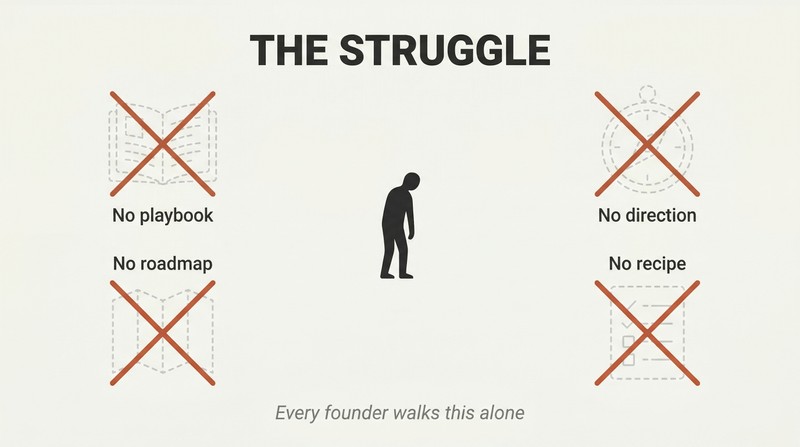
The hardest CEO moments have no playbook — just the Struggle
Ben Horowitz nearly lost everything — twice. He built Loudcloud during the dot-com boom, watched it crater during the crash, took it public with three weeks of cash left at $6 per share, sold the cloud business to EDS, rebuilt the remaining software (Opsware) from a stock price of $0.35, and ultimately sold to Hewlett-Packard for $1.65 billion. Along the way: three consecutive layoffs totaling 400 employees, a largest customer going bankrupt overnight, and a competitor threatening to end the company.
The Struggle — Horowitz's term for the psychological hell every founder endures — is where food loses its taste, where you're surrounded by people yet completely alone. Every great founder went through it. The Struggle is not failure, but it causes failure — especially if you're weak. Most management books tell you how to avoid mistakes. This one tells you what to do after the mistakes have already been made.
Stop sugarcoating — share bad news so your team can actually fix it
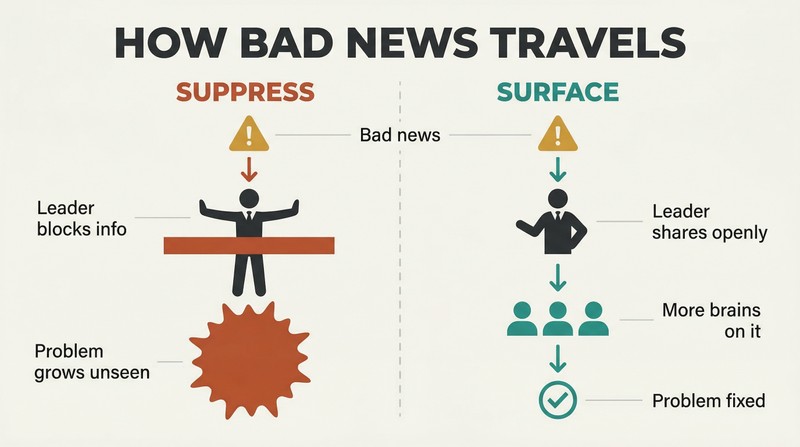
Positivity becomes a liability. Early as CEO, Horowitz believed shielding employees from bad news was protective. His wake-up came from his brother-in-law, an AT&T lineman, who described a senior executive's quarterly visits: "He comes by to blow a little sunshine up my ass." Horowitz realized his team saw through his forced optimism the same way.
Three reasons transparency beats cheerfulness:
1. Trust — employees who trust the CEO need fewer explanations; those who don't will ignore every explanation
2. More brains on the problem — engineers can't fix bugs they don't know about, and the CEO isn't writing the code
3. Cultural health — good companies make bad news travel fast and good news slow; bad companies suppress problems until they're fatal
A culture that rewards surfacing problems will outperform one that punishes it, every time.
Fire lead bullets, not silver ones — fix the core product
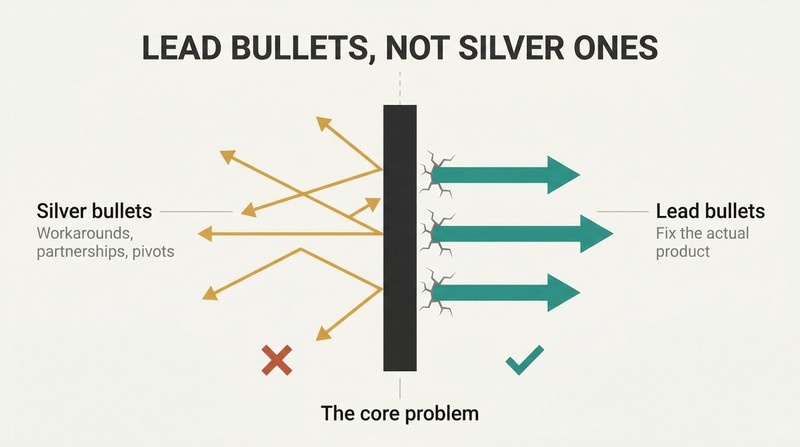
Lead bullets mean doing the hard, direct work instead of seeking clever workarounds. At Netscape, Microsoft released a web server that was five times faster and free. Rather than pursue partnerships to outflank them — silver bullets — engineer Bill Turpin insisted they fix the actual performance gap. They did, and the server line grew into a $400 million business.
Years later at Opsware, competitor BladeLogic was winning key deals. Employees pitched workarounds: go down-market, acquire a simpler product, target different customers. Horowitz rejected them all. Customers were buying — just not Opsware's product. After nine months of grueling development called the Darwin Project, they regained their lead. The lesson: when you're losing an existential battle, there is no side door. You go through the front and deal with the big, ugly problem blocking it.
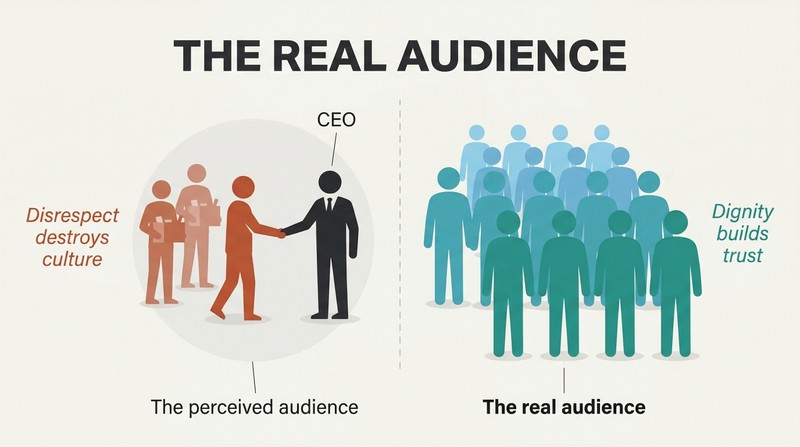
When laying people off, the survivors are your real audience
Dignity preserves culture. Legendary VC Doug Leone told Horowitz he'd never seen a company survive three consecutive layoffs and reach a billion-dollar outcome. The secret was doing it right. Six principles guided each round:
1. Don't delay — leaked rumors poison everything
2. Frame it as company failure, not individual failure
3. Train managers to deliver news personally — never outsource the conversation
4. The CEO addresses the entire company first
5. Stay visible afterward — talk to people, help them carry boxes to their cars
6. Provide generous severance details upfront
Bill Campbell's crucial insight shaped the approach: the layoff speech is really for the people who remain. If survivors see friends treated poorly, they'll never trust the CEO again. Opsware's culture held through all three rounds because departing employees felt respected.
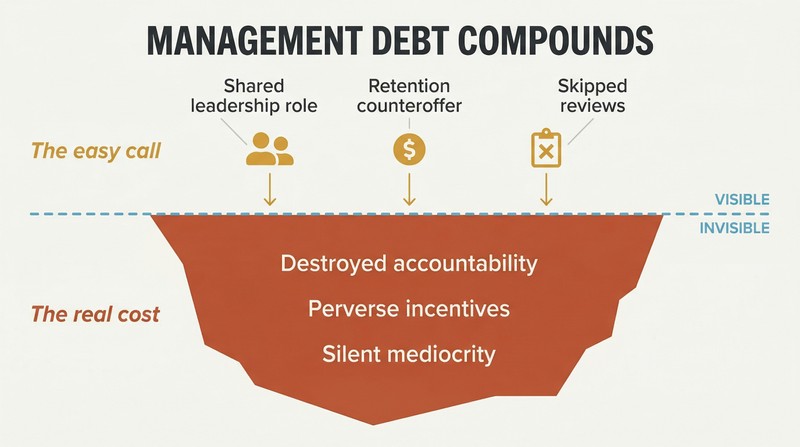
Management debt compounds: skip the hard call now, pay double later
Management debt — Horowitz's coined analogy to technical debt — describes expedient short-term management decisions that create expensive long-term consequences. Three common forms:
1. "Two in the box" — giving two people the same leadership role to avoid choosing, which destroys accountability and slows every downstream decision
2. Matching a competing offer to retain someone — which secretly teaches every employee that threatening to quit is the fastest route to a raise
3. Skipping performance reviews — which means weaknesses go unaddressed and mediocrity becomes the silent default
The danger is invisibility. Unlike technical debt that eventually crashes a system, management debt rots culture quietly. You may think the counteroffer was confidential, but the recipient told a friend who told engineering, and now everyone knows the squeaky wheel gets the grease.
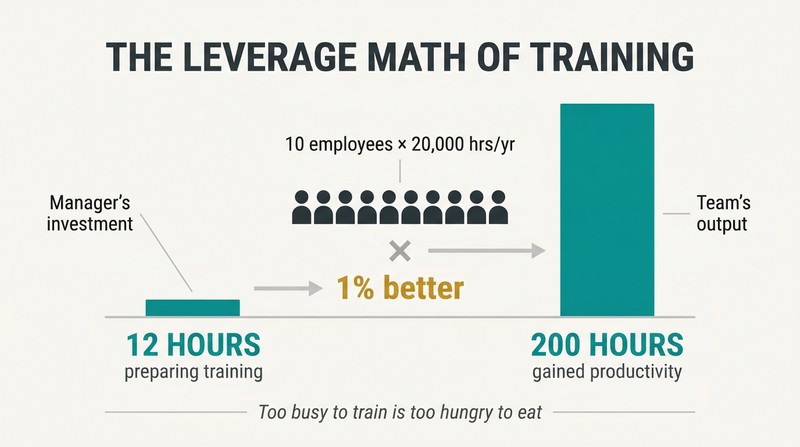
Training is the highest-leverage thing you're 'too busy' to do
Andy Grove's math is irrefutable. If a manager spends twelve hours preparing training for ten people who will work twenty thousand hours next year, even a 1% improvement yields two hundred hours of gained productivity. Yet most startups invest heavily in recruiting and ignore everything after the hire.
Horowitz discovered this at Netscape when he wrote "Good Product Manager/Bad Product Manager" — a simple expectations document that instantly transformed underperformers into effective contributors. At Loudcloud, he made training mandatory with two hard rules: managers couldn't request new hires without a training plan, and the CEO personally taught management expectations. Without training, there's no basis for performance management — you can't hold people to standards they were never taught. Two main reasons employees quit: they hated their manager's lack of guidance, or they stopped learning.
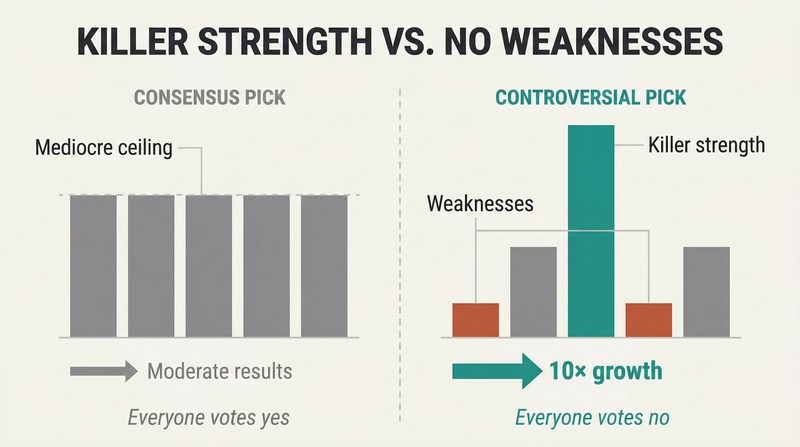
Hire for a killer strength, not the absence of weaknesses
Mark Cranney broke every pattern. When Opsware needed its fourth head of sales in three years, Horowitz ran sales himself first to learn exactly which strengths mattered. Cranney didn't fit any stereotype: average height, square build, Southern Utah University graduate. Every board member and executive voted no. He made people uncomfortable.
But his strengths were unmatchable. He produced a training manual thicker than a textbook. He'd already mapped competitors' active deals. He gave seventy-five references — every one returned calls within an hour. Horowitz's argument to Marc Andreessen: someone this talented wouldn't join a company trading at $0.35 unless he had flaws. Under Cranney, sales grew tenfold and market cap twentyfold. Consensus hiring swayed by group dynamics almost always selects for polished mediocrity over transformational capability.
Wartime and peacetime require opposite CEO playbooks
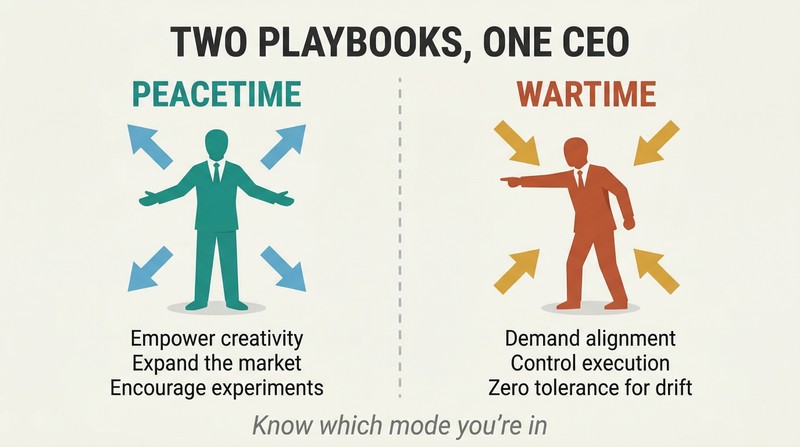
Peacetime means large market advantage and growth — the CEO empowers creativity, expands the market, encourages experimentation. Wartime means existential threat — the CEO demands strict alignment, violates protocol when necessary, and obsesses over execution details. Google under Eric Schmidt was peacetime; Google under Larry Page declared war. Apple nearly bankrupt under returning Steve Jobs was pure wartime.
Horowitz calculated he spent three days as a peacetime CEO and eight years at war. Almost no CEOs can function effectively in both modes. Most management books only describe peacetime techniques — broad buy-in, employee empowerment, big hairy goals. Wartime looks radically different: zero tolerance for disagreement on the core mission, detailed personal involvement in execution, and training so employees survive the battle. Knowing which mode you're in determines which playbook will save or sink you.
Nobody cares about your reasons — just find the way out
Football coach Bill Parcells once worried that injuries would ruin his New York Giants season and called his mentor, Raiders owner Al Davis, for sympathy. Davis replied: "Nobody cares, just coach your team." Horowitz found this applied to every CEO crisis — when Loudcloud's customers went bankrupt, when 221 IPOs in 2000 collapsed to 19 in 2001, when his largest client stiffed him $25 million.
The mental trap is elaborating misery. A CEO can burn enormous energy proving circumstances were impossible, but none of it preserves a single dollar or a single job. The energy spent justifying failure would be infinitely better spent finding one seemingly impossible way out. There is always a move — even taking a company public with $2 million in trailing revenue and six weeks of cash. Horowitz made that move. In 2001.

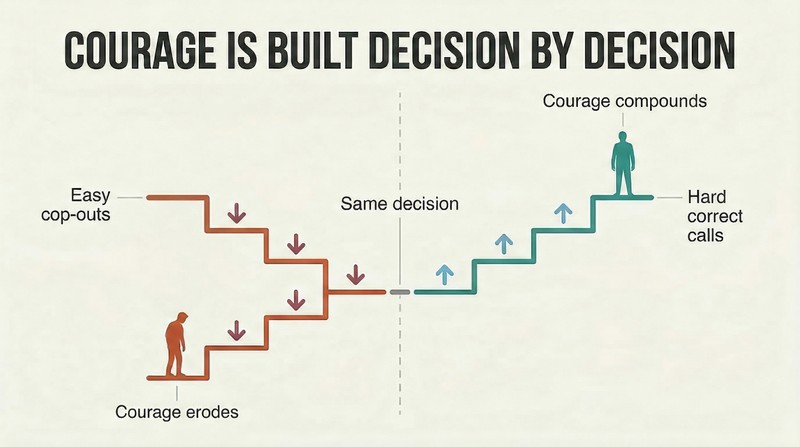
Every hard, correct call builds courage; easy cop-outs erode it
Courage is a practice, not a trait. Horowitz watched a founder agonize over rejecting a rich acquisition offer when his board and team all favored selling. The data was ambiguous — maybe 54% keep the company, 46% sell. The founder chose to stay independent. The moment he decided, the entire team rallied behind him. It turned out their preference for selling was largely driven by reading the founder's own ambivalence — they were following his uncertainty, not leading.
Social pressure creates a dangerous trap. If you decide with the crowd and succeed, everyone remembers your wisdom. If you decide against the crowd and fail, you're finished. This asymmetry pushes CEOs toward safe consensus choices. But going along often transforms a 70-30 decision into a perceived coin flip. The only antidote: practice making the lonely, correct decision until it becomes habit.
Analysis
Horowitz's book occupies a rare niche: it's simultaneously a startup war memoir, a management manual, and an existential meditation on leadership under duress. Where most business literature deals in patterns of success, Horowitz focuses on the pathology of near-failure — and that's precisely what makes it valuable.
The book's core intellectual contribution lies in surfacing the emotional substrate of executive decision-making. Management theory since Peter Drucker has largely treated organizations as rational systems optimizable through correct frameworks. Horowitz treats them as emotional systems where the CEO's psychological state propagates through every layer. His concept of The Struggle does for entrepreneurship what Kübler-Ross did for grief — it names and normalizes an experience that millions of founders suffer in silence, creating permission to acknowledge what most CEO communities actively suppress.
His framework innovations — management debt, peacetime/wartime CEO, lead bullets — succeed because they're not theoretical constructs but battle-tested heuristics forged in genuine crisis. Management debt is particularly powerful because it imports a concept engineers already understand into a domain where shortcuts are even more common and consequences even harder to trace.
The book has blind spots. Horowitz's survivorship lens means every anecdote resolves in ultimate success — we never hear the same techniques applied and still fail. His advice on hiring for strength can slide into justifying abrasive culture if applied without nuance. And the wartime/peacetime dichotomy, while viscerally useful, may encourage founders to default to wartime identity longer than circumstances warrant.
Still, the book's enduring influence stems from its emotional honesty. In a genre dominated by TED-talk optimism, Horowitz writes about vomiting from stress, wearing mismatched suits during road shows, and calling his wife from an IPO tour to learn she'd stopped breathing. This vulnerability is not performative weakness — it's the book's structural argument. The hard things are hard precisely because no one talks about them. By talking, Horowitz makes the next founder a few degrees less alone.
Review Summary
The Hard Thing About Hard Things receives mostly positive reviews for its honest, experience-based advice on entrepreneurship and CEO challenges. Readers appreciate Horowitz's candid approach to difficult decisions and management issues. The book is particularly praised for its practical insights and real-world examples. Some criticize the structure and repetitiveness, while others find the hip-hop quotes jarring. Many reviewers consider it essential reading for CEOs and entrepreneurs, though less relevant for general readers. Overall, it's regarded as a valuable resource for understanding the realities of leading a tech startup.
People Also Read






Glossary
The Struggle
Entrepreneurial psychological ordealHorowitz's term for the emotional and psychological hell that every founder endures when things go wrong—when food loses its taste, you can't sleep, and you question why you started the company. It is not failure itself, but causes failure if the founder is too weak to endure it. Horowitz argues that every great entrepreneur from Steve Jobs to Mark Zuckerberg went through The Struggle, and it is where greatness ultimately comes from.
Lead Bullets
Direct fixes over clever workaroundsHorowitz's concept that when facing an existential competitive threat, companies must do the hard, direct work of fixing the core problem rather than searching for clever workarounds (silver bullets). Originated when Netscape engineer Bill Turpin rejected partnership-based strategies and insisted they fix their web server's performance gap against Microsoft head-on. Applied again at Opsware when the team rebuilt their product to beat BladeLogic instead of pivoting to easier markets.
Management Debt
Short-term management shortcuts compoundingHorowitz's analogy to technical debt, describing expedient short-term management decisions that create expensive long-term consequences. Common forms include 'putting two in the box' (dual leaders for one role), matching competing job offers to retain employees (teaching everyone that threatening to quit earns raises), and skipping performance feedback processes. Like technical debt, the trade-off sometimes makes sense, but failing to account for it leads to 'management bankruptcy'—systemic cultural decay.
Peacetime CEO/Wartime CEO
Two opposite leadership modesHorowitz's framework distinguishing two radically different management contexts. A Peacetime CEO leads when the company has a large market advantage and is growing—she empowers broad creativity and expands the market. A Wartime CEO leads when the company faces existential threat—she demands strict alignment, violates protocol, and personally oversees execution details. Most management books teach only peacetime techniques. Almost no CEOs naturally excel in both modes.
Ones and Twos
Strategic vs. operational CEO typesHorowitz's classification of managers. Ones prefer setting company direction, making big decisions with incomplete data, and strategic thinking. Twos prefer making the company perform at its highest level through processes, accountability, and operational excellence. Most founding CEOs are Ones. Effective CEOs must develop competence in both dimensions. The framework is critical for understanding CEO succession, since most executive teams consist of Twos reporting to a One.
The Freaky Friday Management Technique
Swapping executives' jobs permanentlyHorowitz's technique for resolving intractable conflict between two departments, inspired by the movie Freaky Friday. When two teams (in his case, Sales Engineering and Customer Support) were at war despite having excellent managers, he permanently swapped the two executives' roles. Within one week, both diagnosed the core issues causing conflict and implemented simple process fixes. The teams worked harmoniously from that point until the company was sold.
Law of Crappy People
Talent converges to lowest performerHorowitz's principle that for any title level in a large organization, the talent will eventually converge to the worst person holding that title. The mechanism: employees at lower levels benchmark themselves against the weakest person at the next level up and demand promotion once they reach that low bar. The antidote is a rigorous, cross-organizational promotion process that maintains quality standards—analogous to karate dojos where advancing requires defeating someone at that level.
Scale Anticipation Fallacy
Prejudging future executive performanceHorowitz's term for the common mistake of evaluating current executives based on whether they can theoretically handle the company at a future, larger scale. He argues this is counterproductive because managing at scale is learned (not innate), the prediction is nearly impossible to make accurately, the act of prejudging retards development, and you still must re-evaluate when the company actually reaches that scale. Instead, evaluate executives on current performance relative to available alternatives.
WFIO
We're Fucked, It's OverAcronym (pronounced 'whiff-ee-yo') used by Horowitz's partner Scott Weiss to describe the recurring moments when a startup faces what appears to be an insurmountable existential crisis. Weiss observed that every company goes through at least two and up to five WFIOs. Horowitz notes he went through at least a dozen at Opsware. The key insight: WFIOs feel much worse than they actually are, especially for the CEO.
FAQ
What's "The Hard Thing About Hard Things" about?
- Guide for entrepreneurs: "The Hard Thing About Hard Things" by Ben Horowitz is a guide for entrepreneurs and CEOs on navigating the challenges of building and running a business.
- Personal experiences: Horowitz shares his personal experiences as a CEO and venture capitalist, providing insights into the struggles and solutions he encountered.
- No easy answers: The book emphasizes that there are no easy answers or formulas for dealing with complex business challenges, highlighting the importance of resilience and adaptability.
Why should I read "The Hard Thing About Hard Things"?
- Real-world insights: The book offers real-world insights from someone who has successfully navigated the ups and downs of the tech industry.
- Practical advice: It provides practical advice on handling difficult situations, such as layoffs, executive firings, and company culture issues.
- Inspirational stories: Horowitz's stories of perseverance and overcoming adversity can be inspiring and motivating for entrepreneurs and business leaders.
What are the key takeaways of "The Hard Thing About Hard Things"?
- Embrace the struggle: Horowitz emphasizes that the struggle is an inherent part of building a business and that leaders must learn to navigate it effectively.
- Importance of transparency: The book highlights the importance of being transparent with your team, especially during difficult times.
- Focus on people: Taking care of your people is crucial for long-term success, stressing the importance of hiring, training, and retaining the right talent.
What are the best quotes from "The Hard Thing About Hard Things" and what do they mean?
- "There is no recipe for really complicated, dynamic situations." This underscores the book's theme that there are no easy solutions to complex business problems.
- "The Struggle is where greatness comes from." Horowitz highlights that enduring and overcoming the struggle is what leads to success and greatness.
- "If you are going to eat shit, don’t nibble." This advises leaders to confront problems head-on rather than avoiding or minimizing them.
How does Ben Horowitz suggest handling layoffs?
- Be clear and honest: Horowitz advises being clear about the reasons for layoffs and communicating them honestly to the team.
- Train managers: Ensure that managers are trained to handle layoffs with empathy and professionalism.
- Address the company: The CEO should address the entire company to provide context and reassurance.
What is "The Struggle" according to Ben Horowitz?
- Definition of The Struggle: "The Struggle" refers to the difficult, often overwhelming challenges that entrepreneurs and CEOs face when building a business.
- Inevitable part of leadership: Horowitz emphasizes that The Struggle is an inevitable part of leadership and that every great entrepreneur experiences it.
- Source of greatness: The Struggle is where leaders find the strength to overcome obstacles and achieve greatness.
How does Ben Horowitz define a good company culture?
- Trust and transparency: A good company culture is built on trust and transparency, where employees feel informed and valued.
- Focus on people: Taking care of employees is a priority, ensuring they have the resources and support needed to succeed.
- Alignment with values: A strong culture aligns with the company's values and mission, creating a sense of purpose and belonging for employees.
What is the significance of "Lead Bullets" in "The Hard Thing About Hard Things"?
- No silver bullets: Horowitz uses the term "Lead Bullets" to emphasize that there are no quick fixes or magical solutions to business problems.
- Focus on fundamentals: The concept encourages focusing on the fundamentals and making incremental improvements rather than seeking shortcuts.
- Example from Netscape: Horowitz shares an example from his time at Netscape, where they had to improve their product's performance through hard work.
What is the "Peacetime CEO/Wartime CEO" concept in "The Hard Thing About Hard Things"?
- Different leadership styles: Horowitz describes two distinct leadership styles: peacetime and wartime.
- Adapting to circumstances: A CEO must be able to switch between these styles based on the company's situation.
- Examples in the book: Horowitz uses examples like Steve Jobs and Andy Grove to illustrate how different situations require different leadership approaches.
How does Horowitz suggest managing your own psychology as a CEO?
- Managing stress: Horowitz emphasizes the importance of managing one's own psychology, as being a CEO is inherently stressful.
- Avoiding isolation: CEOs often feel isolated due to the nature of their role, and Horowitz suggests building a support network of peers.
- Facing the pain: He advises not to avoid difficult situations but to face them head-on, which is crucial for overcoming leadership challenges.
How does Ben Horowitz approach hiring executives?
- Know what you want: Horowitz stresses the importance of knowing exactly what you need in an executive before starting the hiring process.
- Run a thorough process: Conduct a thorough interview process that tests for the desired criteria.
- Make a lonely decision: Ultimately, the CEO must make the final decision based on all the information gathered.
What advice does Horowitz give on deciding whether to sell your company?
- Logical analysis: Horowitz advises considering whether the market is large and if the company has a good chance of being number one.
- Emotional factors: Selling a company is an emotional decision, and Horowitz suggests muting emotions to make a rational choice.
- Case study of Opsware: Horowitz shares his experience with selling Opsware, highlighting the factors he considered and the emotional challenges he faced.
About the Author
Other books by Ben Horowitz

Download PDF
Download EPUB
.epub digital book format is ideal for reading ebooks on phones, tablets, and e-readers.








































