

Key Takeaways
Go from 0 to 1 — create new technology instead of copying old success
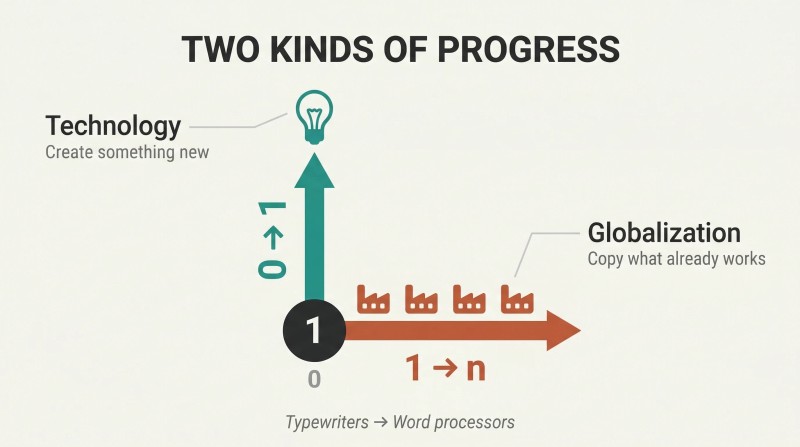
Thiel distinguishes two kinds of progress. Horizontal progress (1 to n) copies things that work — like China building 19th-century railroads and 20th-century air conditioning. Vertical progress (0 to 1) creates something genuinely new — going from typewriters to word processors. Globalization is the single word for horizontal progress; technology is the word for vertical.
Thiel's own contrarian answer to his famous interview question — "What important truth do very few people agree with you on?" — is that most people think globalization will define the future, but technology matters more. If China doubles its energy production using existing methods, it doubles its air pollution. Spreading old ways to create wealth will cause devastation, not riches. Only new technology makes the 21st century better than the 20th.
Build a monopoly — competition and capitalism are opposites
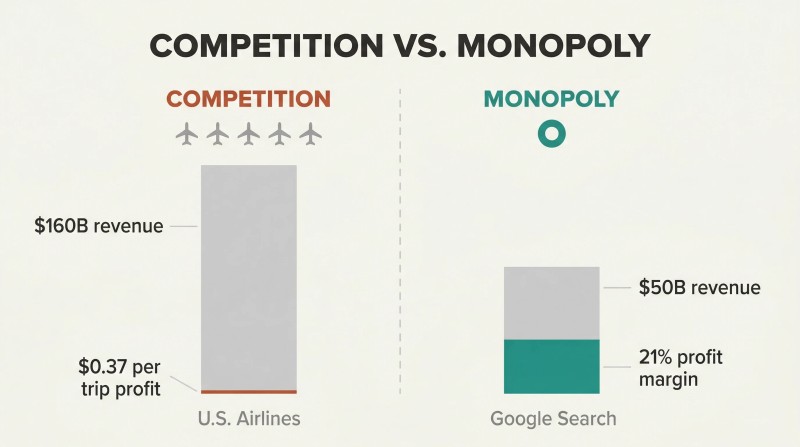
The numbers are damning. In 2012, U.S. airlines generated $160 billion in revenue but earned only 37 cents per passenger trip. Google brought in $50 billion but kept 21% as profit — over 100x the airlines' margin. The difference: airlines compete fiercely with each other; Google stands alone with 68% of search. Under perfect competition, all profits get competed away. Monopoly is not a pathology — it's the condition of every successful business.
Both sides lie about their position. Google frames itself in the $495 billion global advertising market to appear small. Meanwhile, a hypothetical startup opening a British restaurant in Palo Alto claims zero competition by defining its market impossibly narrowly. Monopolists disguise dominance through union of large markets; competitors exaggerate uniqueness through intersection of tiny ones.
Dominate a tiny niche first, then expand outward
PayPal's first product failed precisely because it aimed too broadly. Beaming money between PalmPilots was interesting technology, but users were scattered and had nothing in common. When PayPal shifted to eBay auctions — a few thousand high-volume "PowerSellers" who desperately needed faster payments — they served 25% of that niche within three months.
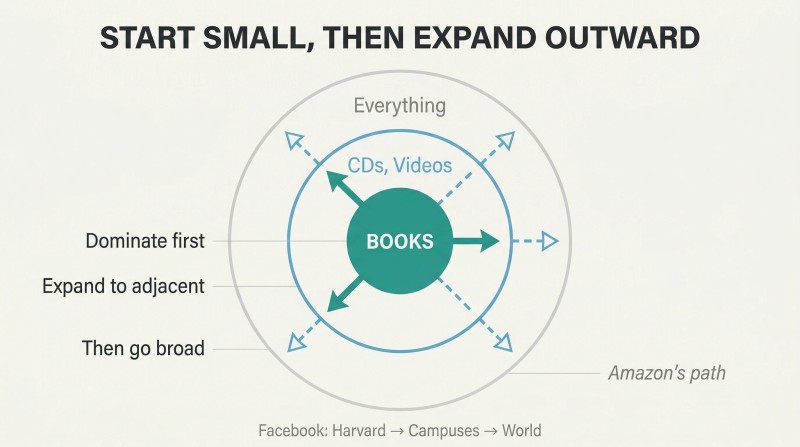
Amazon, eBay, and Facebook followed the same playbook. Amazon started with books (easy to ship, enormous catalog, enthusiastic niche buyers) before expanding to CDs, videos, and eventually everything. Facebook launched at Harvard, then other campuses, then the world. eBay began with Beanie Baby collectors. The pattern is consistent: dominate one concentrated market, then expand to adjacent ones. Big markets either lack a good starting point or invite brutal competition.
Choose a definite plan over indefinite iteration
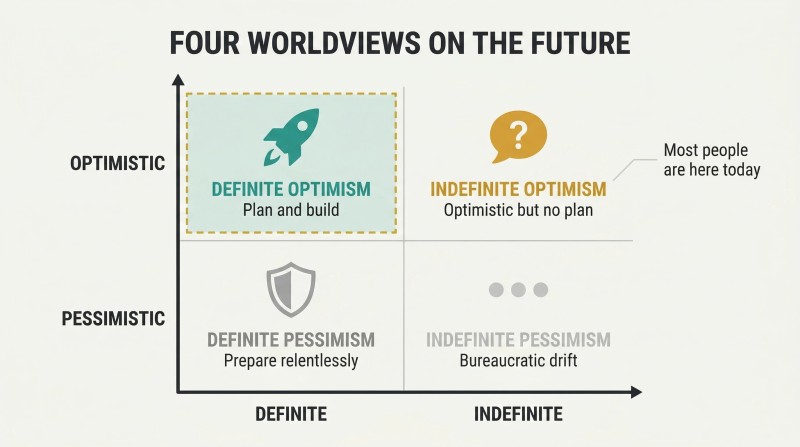
Thiel maps four worldviews based on optimism and planning:
1. Definite optimism (1950s America): plan and build — moon landings, Interstate Highway System
2. Indefinite optimism (post-1982 America): future will be better, but nobody plans how
3. Definite pessimism (modern China): future is bleak, so prepare relentlessly
4. Indefinite pessimism (modern Europe): bleak future, no plan, bureaucratic drift
Indefinite optimism dominates today. Bankers rearrange capital, lawyers resolve disputes, consultants optimize old businesses — nobody creates anything new. The lean startup movement embodies this: "minimum viable products" and iteration can optimize existing categories but won't produce breakthroughs. Steve Jobs planned multi-year product roadmaps that created the iPod, iPhone, and iPad. When Yahoo offered $1 billion for Facebook, Zuckerberg said they obviously weren't selling. Definite founders with robust plans don't sell.
Focus relentlessly — the power law means one move dwarfs all others
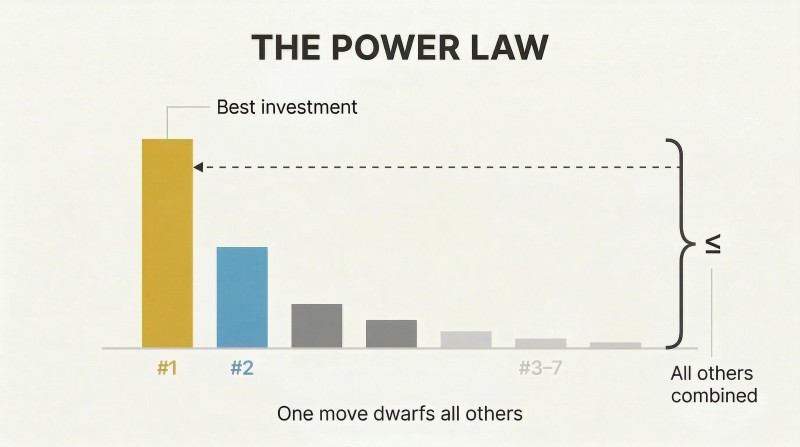
In Thiel's 2005 Founders Fund, Facebook returned more than every other investment combined. Palantir, the second-best, returned more than everything else minus Facebook. This pattern repeated across all their funds. Most VCs miss it because early-stage companies look alike in their first years, and investors spend disproportionate time nursing struggling companies instead of doubling down on winners.
The power law extends to your career and decisions. Schools teach the opposite: 45-minute class periods treat every subject equally, and students hedge by assembling diverse skills. But it does matter what you do. One market, one distribution channel, and one key decision will matter far more than any other. Joining the right fast-growing company might beat founding your own mediocre one — 0.01% of Google was worth over $35 million.
Build your company around a secret hiding in plain sight
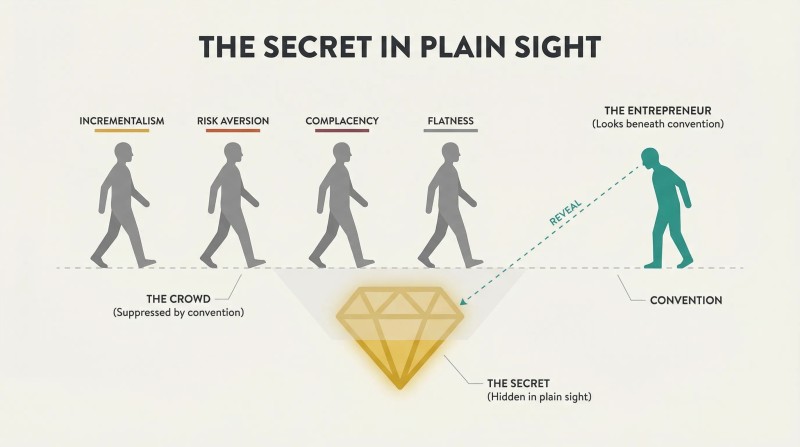
Every great business is built around a secret — something important and unknown, hard to do but doable. Airbnb saw untapped supply in empty rooms and unaddressed demand among travelers. Lyft and Uber discovered billion-dollar businesses connecting riders with willing drivers. These opportunities hid in plain sight; only entrepreneurs who believed undiscovered truths still existed could see past convention.
Four forces suppress the search for secrets: incrementalism (education rewards safe small steps), risk aversion (fear of being lonely and wrong), complacency (elites coasting on past achievements), and "flatness" (assuming someone smarter would have found it already). When Hewlett-Packard stopped hunting for technological secrets after 2000, the company collapsed from $135 billion to $23 billion in a decade — replacing invention with governance battles and gossip.
Nail your foundation — broken startup beginnings can't be repaired
Co-founder selection is like marriage. One of Thiel's early investments failed after the founder partnered with a stranger met at a networking event — they had no shared history and their visions diverged immediately. Founders should share a prehistory before starting a company; otherwise they're rolling dice.
Three structural elements must align: ownership (who holds equity), possession (who runs things daily), and control (who governs via the board). Keep boards to three people — five maximum. Ensure every team member is full-time; part-timers and consultants are fundamentally misaligned. Keep early-stage CEO salary under $150,000: low pay aligns the leader with long-term equity value over short-term comfort. Box CEO Aaron Levie paid himself less than everyone else and slept on a mattress four years after founding the company.
Most startups die from bad distribution, not bad products
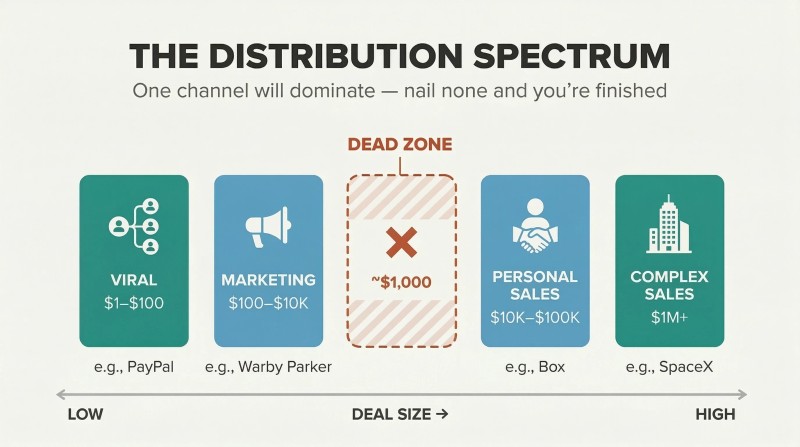
Engineers think great products sell themselves, but distribution — everything it takes to sell a product — is at least as important. Sales works best when hidden: salespeople carry titles like "account executive" and "business development." Thiel maps five distribution tiers: complex sales (CEO-led $1M+ deals, like SpaceX winning NASA contracts), personal sales ($10K – $100K, like Box starting with Stanford's Sleep Clinic), marketing and advertising (mass consumer products, like Warby Parker), and viral marketing (PayPal paid users $20 for sign-ups, achieving 7% daily growth).
Distribution follows its own power law. One channel will likely dominate all others for any given business. Between personal sales and advertising lies a "dead zone" where products priced around $1,000 lack an economical channel. Get one channel right and you have a great business; nail none and you're finished.
Build technology that empowers humans rather than replacing them
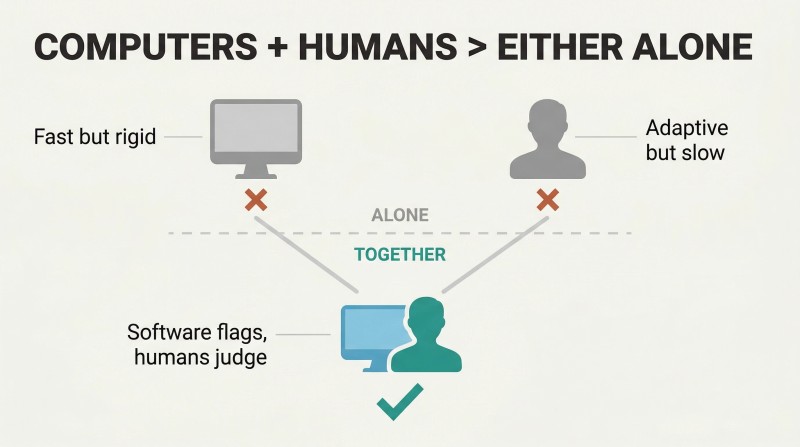
PayPal was losing $10 million monthly to credit card fraud in 2000. Automated software couldn't keep up because thieves adapted tactics hourly. Human analysts alone couldn't review thousands of transactions per minute. The breakthrough: software flagged suspicious transactions and human operators made the final judgment. This hybrid system — nicknamed "Igor" — was so effective the FBI asked to use it, and PayPal posted its first profit.
This insight became Palantir, the data analytics company Thiel co-founded in 2004, which helps human analysts extract insight from vast data — predicting IED placements in Afghanistan, prosecuting insider trading, detecting fraud. LinkedIn followed the same principle: instead of replacing recruiters with algorithms, it transformed how they work. The most valuable future companies won't ask what computers can do alone but how computers can help humans solve hard problems.
Stress-test your startup against seven questions or expect failure
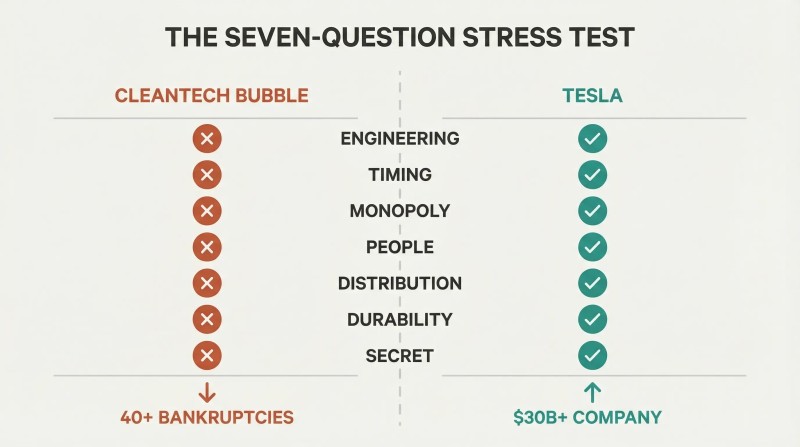
Thiel's seven questions every business must answer:
1. Engineering: 10x-better technology?
2. Timing: Right moment to start?
3. Monopoly: Big share of a small market?
4. People: Right team?
5. Distribution: Can you actually deliver?
6. Durability: Defensible in 10 – 20 years?
7. Secret: Unique opportunity others don't see?
The cleantech bubble proved the cost of ignoring them. Over $50 billion poured into companies with zero good answers — 40+ solar manufacturers went bankrupt in 2012 alone. Tesla nailed all seven: 10x-better integrated design, a perfectly timed $465 million government loan, starting with $109,000 electric sports cars, an engineer-CEO, company-owned dealerships, a durable brand, and the secret that cleantech was a social phenomenon as much as an environmental imperative.
Analysis
Zero to One is part manifesto, part anti-textbook. It deliberately subverts conventional MBA wisdom at nearly every turn — monopoly over competition, planning over iteration, boldness over incrementalism. The book's intellectual DNA draws from Schumpeterian creative destruction (capitalism progresses through monopolies that displace incumbents), René Girard's mimetic theory (which informs Thiel's view of competition as unconscious imitation between similar rivals), and a strain of libertarian futurism that distrusts both bureaucratic regulation and crowd consensus.
What makes the book enduringly provocative is its willingness to state uncomfortable positions as simple truths. Thiel doesn't hedge when he calls competition destructive or declares capitalism and competition opposites. This rhetorical strategy — framing contrarian positions as overlooked common sense — is itself a masterclass in the hidden salesmanship the book describes.
The most underappreciated tension in Zero to One is between its determinism and its humility. Thiel argues forcefully for definite planning, yet acknowledges that 'no authority can prescribe in concrete terms how to be innovative.' The seven questions framework gives structure without guaranteeing outcomes. This is philosophically honest: the book offers lenses for thinking, not recipes for cooking.
The book's blindspots deserve mention. Thiel's monopoly argument works elegantly for software companies with near-zero marginal costs but applies less neatly to industries with physical constraints. His survivorship bias is acute: we hear about PayPal's boldness but not the equally bold companies that crashed alongside Pets.com. The cleantech chapter, while brilliant as strategic analysis, may overstate how predictable those failures were in real time.
Still, Zero to One's lasting contribution is cultural more than tactical. It gave Silicon Valley an intellectual framework for ambition at a time when post-crash timidity had become orthodoxy. Its central provocation — that creating something genuinely new is both harder and more important than optimizing what exists — remains the most productive question any entrepreneur can sit with, even a decade after publication.
Review Summary
Zero to One receives mixed reviews. Many praise Thiel's contrarian thinking and insights into startups and innovation. Readers appreciate his focus on creating unique value and avoiding competition. However, some criticize the book's Silicon Valley-centric perspective and find certain arguments simplistic or self-serving. The writing style is generally praised for being clear and engaging. While some find the ideas thought-provoking, others view them as impractical or overly idealistic. Overall, it's considered a valuable read for entrepreneurs and those interested in technology and business.
People Also Read
Glossary
Zero to One (0 to 1)
Creating something entirely newThiel's term for vertical progress—doing something nobody has done before, as opposed to going from 1 to n (copying things that work). Going from a typewriter to a word processor is 0 to 1; building 100 typewriters is 1 to n. The book's central concept: the most valuable companies create new categories rather than competing in existing ones.
Horizontal progress
Copying what already worksGoing from 1 to n—spreading existing solutions to new places or producing more of something familiar. At the macro level, the single word for horizontal progress is globalization. China building railroads and air conditioning by replicating what works in the West is the paradigmatic example. Contrasted with vertical progress (technology).
Vertical progress
Doing genuinely new thingsGoing from 0 to 1—inventing or discovering rather than copying. The single word for vertical progress is technology, properly understood as any new and better way of doing things, not just computers. Requires doing something nobody else has ever done, making it harder to imagine than horizontal progress.
Creative monopoly
Monopoly earned through innovationA company so good at what it does that no other firm can offer a close substitute—distinguished from monopolies gained through government licenses or anticompetitive bullying. Creative monopolies give customers more choices by adding entirely new categories of abundance to the world, and their profits incentivize further innovation. Google in search and Apple in smartphones are examples.
Last mover advantage
Being the final dominant playerThiel's reframing of the popular 'first mover advantage' concept. Rather than racing to enter a market first, the goal is to make the last great development in a specific market and enjoy years or decades of monopoly profits. Achieved by dominating a small niche and scaling outward toward an ambitious long-term vision.
Definite optimism
Planned optimism about the futureOne of Thiel's four worldviews, combining the belief that the future will be better with concrete plans to make it so. Exemplified by 1950s–60s America: the Apollo Program, Interstate Highway System, and other grand engineering achievements. Thiel considers this the most productive stance for entrepreneurs and argues it has largely been replaced by indefinite optimism in modern America.
Indefinite optimism
Planless optimism about the futureOne of Thiel's four worldviews. The belief that the future will improve without any specific vision of how. Thiel argues this has dominated American thinking since 1982, producing a culture where finance eclipses engineering, diversification replaces conviction, and process trumps substance. Manifests in lean startup methodology, portfolio careers, and the worship of optionality.
Thiel's Law
Broken foundations are irreparableThiel's principle that a startup messed up at its foundation cannot be fixed. Decisions made at the very beginning—co-founder choice, equity allocation, board composition, team structure—are qualitatively different from later decisions and extremely difficult to reverse, much like a country's founding constitution.
Power law
Extreme inequality in outcomesAs applied by Thiel, the mathematical principle that a small number of outcomes radically outperform all others combined. In venture capital, the best investment in a fund returns more than all others combined. Thiel extends the concept to careers, markets, distribution channels, and time allocation: the most important things are singular, not normally distributed.
Secrets
Important truths yet undiscoveredIn Thiel's framework, secrets are things that are important, unknown, and achievable—distinguished from conventions (things everyone already knows) and mysteries (things that may be impossible to figure out). Every correct answer to 'what valuable company is nobody building?' is necessarily a secret. Thiel divides them into secrets of nature (about the physical world) and secrets about people (what's forbidden or taboo).
The contrarian question
Thiel's signature interview question'What important truth do very few people agree with you on?' Thiel asks this in every job interview. Good answers take the form 'Most people believe X, but the truth is the opposite of X.' The business version is 'What valuable company is nobody building?' The question tests for independent thinking, courage, and insight into hidden truths about the present.
FAQ
What's "Zero to One: Notes on Startups, or How to Build the Future" about?
- Focus on Innovation: The book emphasizes creating new things rather than copying existing models. It argues that true innovation takes the world from "zero to one."
- Unique Insights: Peter Thiel shares insights from his experience as a co-founder of PayPal and an investor in companies like Facebook and SpaceX.
- Contrarian Thinking: It encourages readers to think differently and find value in unexpected places by questioning conventional wisdom.
- Building the Future: The book is a guide on how to build companies that create new things, focusing on the importance of technology and innovation.
Why should I read "Zero to One"?
- Entrepreneurial Guidance: It offers valuable advice for entrepreneurs looking to build successful startups by focusing on innovation and unique value creation.
- Insightful Perspectives: Thiel provides a unique perspective on business and technology, challenging readers to think critically about the future.
- Practical Advice: The book includes practical advice on building a strong company foundation, recruiting the right team, and creating a monopoly.
- Inspiration for Innovators: It's an inspiring read for anyone interested in technology, startups, and the future of business.
What are the key takeaways of "Zero to One"?
- Monopoly Over Competition: Thiel argues that creating a monopoly is more beneficial than competing in a crowded market.
- Importance of Secrets: Finding and leveraging secrets—unknown truths—can lead to groundbreaking innovations.
- Definite Optimism: Planning and working towards a better future is crucial, as opposed to relying on chance or indefinite optimism.
- Power of Technology: Technology is a key driver of progress, and companies should focus on creating technological breakthroughs.
What is the "contrarian question" in "Zero to One"?
- Definition: The contrarian question asks, "What important truth do very few people agree with you on?"
- Purpose: It encourages thinking differently and identifying unique opportunities that others might overlook.
- Application: This question is crucial for entrepreneurs to find untapped markets and create innovative solutions.
- Example: Thiel uses this question to challenge conventional beliefs and inspire new ways of thinking about business and technology.
How does "Zero to One" define a successful startup?
- Monopoly Creation: A successful startup creates a monopoly by offering a unique product or service that others cannot easily replicate.
- Proprietary Technology: It should have proprietary technology that is significantly better than existing alternatives.
- Network Effects: The startup should leverage network effects, where the product becomes more valuable as more people use it.
- Scalability and Branding: It should be scalable and have a strong brand that differentiates it from competitors.
What is the "power law" in venture capital according to "Zero to One"?
- Definition: The power law states that a small number of companies will achieve exponentially greater success than others.
- Venture Capital Application: VCs should focus on investing in companies that have the potential to return the value of the entire fund.
- Portfolio Strategy: Instead of diversifying, VCs should concentrate on a few high-potential investments.
- Implication for Entrepreneurs: Entrepreneurs should aim to build companies that can achieve exponential growth and dominate their markets.
What does "Zero to One" say about the role of technology in the future?
- Complementarity with Humans: Technology should complement human abilities rather than replace them.
- Empowerment Over Replacement: The most valuable businesses will empower people to solve complex problems using technology.
- Avoiding Substitution: Thiel argues against the idea that technology will make human workers obsolete.
- Focus on Innovation: Companies should focus on creating new technologies that enhance human capabilities.
What are the seven questions every business must answer according to "Zero to One"?
- Engineering Question: Can you create breakthrough technology instead of incremental improvements?
- Timing Question: Is now the right time to start your particular business?
- Monopoly Question: Are you starting with a big share of a small market?
- People Question: Do you have the right team?
- Distribution Question: Do you have a way to not just create but deliver your product?
- Durability Question: Will your market position be defensible 10 and 20 years into the future?
- Secret Question: Have you identified a unique opportunity that others don’t see?
What is the "founder's paradox" in "Zero to One"?
- Extreme Traits: Founders often have extreme and contradictory traits, making them both insiders and outsiders.
- Public Perception: They are often idolized and demonized, reflecting society's complex relationship with innovation.
- Importance of Founders: Founders are crucial for driving innovation and creating new value in a company.
- Caution for Founders: Founders should be aware of the dangers of believing their own myths and losing touch with reality.
How does "Zero to One" view competition and capitalism?
- Opposition to Competition: Thiel argues that competition and capitalism are opposites; true capitalism involves creating monopolies.
- Avoiding Competition: Startups should aim to create unique products that eliminate competition rather than engage in it.
- Creative Monopolies: Monopolies drive progress by providing the incentive and resources for long-term innovation.
- Ruthlessness of Competition: Competitive markets destroy profits and lead to a struggle for survival.
What are the best quotes from "Zero to One" and what do they mean?
- "Every moment in business happens only once." This emphasizes the uniqueness of each business opportunity and the importance of innovation.
- "The most contrarian thing of all is not to oppose the crowd but to think for yourself." It highlights the value of independent thinking in discovering new opportunities.
- "A startup is the largest endeavor over which you can have definite mastery." This underscores the potential for startups to shape the future through focused effort and innovation.
- "Monopoly is the condition of every successful business." It stresses the importance of creating a monopoly to achieve lasting success and drive progress.
How does "Zero to One" suggest building a strong company culture?
- Mission-Driven Team: A strong company culture is built around a shared mission that excites and motivates the team.
- Recruiting for Fit: Hire people who are not only talented but also a good fit for the company's culture and mission.
- Unique Identity: Encourage a unique company identity where employees are different in the same way, fostering a sense of belonging.
- Avoiding Perk Wars: Focus on meaningful work and mission alignment rather than superficial perks to attract and retain talent.
About the Author
Download PDF
Download EPUB
.epub digital book format is ideal for reading ebooks on phones, tablets, and e-readers.








































