

Key Takeaways
His childhood beatings became the engine of his epic ambitions
Trauma forged the man. Growing up in apartheid South Africa, Musk was bullied so badly that classmates once beat him unconscious and threw him down concrete steps, leaving his face an unrecognizable swollen mass. Worse than the schoolyard was his father Errol, a charismatic fantasist who subjected Elon to hours of unrelenting verbal abuse, calling him worthless and pathetic while forbidding him to leave.
Isaacson argues this pain rewired Musk permanently. His first wife Justine observed that when your father constantly calls you an idiot, you shut down emotionally, killing fear but also joy and empathy. Musk himself credits adversity with raising his pain threshold. The result: a man who feels most alive during crises and cannot savor calm.
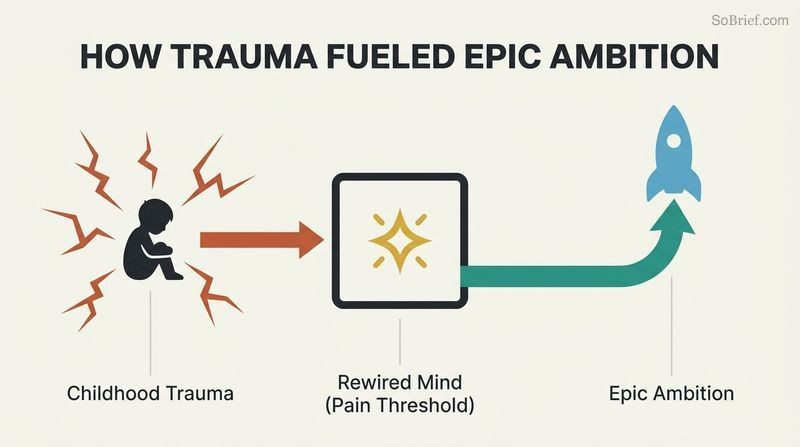
What's striking is how Isaacson resists the redemption arc. He does not claim Musk overcame his wounds; he claims Musk weaponized them. This aligns with research on post-traumatic adaptation, where early adversity can produce both resilience and lasting dysregulation. Yet the biography risks a determinism trap: millions endure abusive fathers without launching rockets. The trauma is necessary but wildly insufficient. The more honest reading is that trauma plus extraordinary cognitive gifts plus timing produced Musk. Attachment theory would note that his craving for constant company alongside emotional detachment is a textbook anxious-avoidant signature, visible across his marriages and his need to sleep at his own factories.
Reason from physics fundamentals, not from what others charge
First principles beat analogy. Furious after Russian officials mocked him and quoted $21 million per used missile, Musk flew home calculating the raw cost of aerospace-grade aluminum, carbon fiber, and fuel. He discovered finished rockets cost roughly fifty times their materials. That gap became his opportunity.
He formalized this into the idiot index: the ratio of a finished component's price to the cost of its raw materials. A high ratio signals lazy manufacturing, not physical necessity. When a valve supplier demanded $250,000, SpaceX built it in-house for a fraction. An actuator quoted at $120,000 got built for $5,000 because Musk insisted it was no harder than a garage-door opener. Eventually SpaceX made 70% of its rocket components internally, slashing costs an order of magnitude.
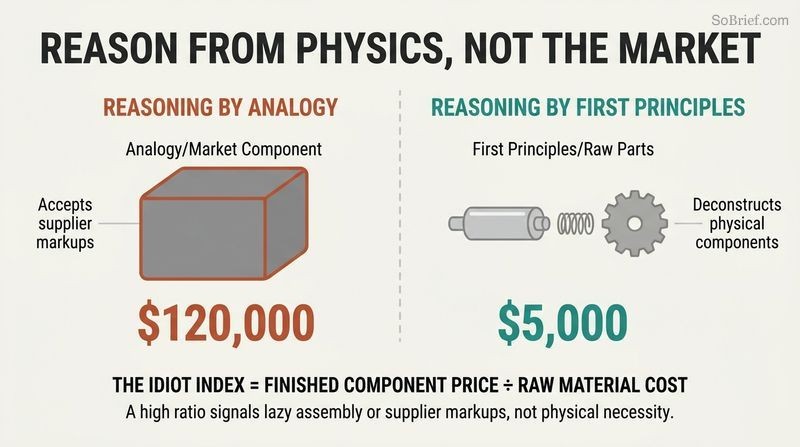
First-principles reasoning is ancient (Aristotle, Descartes) but Musk operationalized it into a cost-cutting scalpel. The idiot index is genuinely useful across industries: it forces you to separate what physics demands from what convention and supply-chain inertia impose. The danger, well documented in Tesla's production hell, is that first-principles confidence curdles into contempt for hard-won expertise. Sometimes the requirement everyone follows exists because someone already crashed learning why. Chesterton's Fence warns against removing barriers before understanding them. Musk's genius is questioning requirements relentlessly; his recurring failure is deleting the ones that turn out to be load-bearing, like the slosh baffles that doomed a Falcon 1.
Follow the five-step algorithm: question, delete, simplify, accelerate, automate
Order matters more than intensity. After the Nevada and Fremont production hells, Musk distilled his manufacturing philosophy into five sequential commandments he repeats obsessively:
1. Question every requirement, and attach the name of the real person who made it.
2. Delete parts or processes; if you don't restore at least 10%, you didn't cut enough.
3. Simplify and optimize (only after deleting, never before).
4. Accelerate cycle time.
5. Automate last.
His biggest mistakes came from inverting this order. At the Nevada battery factory he tried to automate everything first, building an over-engineered line with robots that dropped fiberglass strips and jammed. The fix: rip robots out, put humans back, and discover the fiberglass strips (specified for noise reduction) were unnecessary anyway. He tweeted that excessive automation was his mistake and humans are underrated.
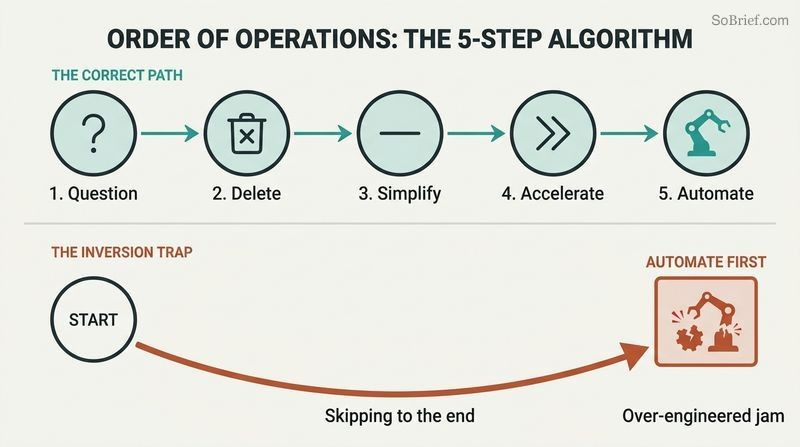
The sequencing insight is the real gold, and it is widely misapplied by executives who automate broken processes, thereby scaling their waste. Toyota's Production System reached similar conclusions decades earlier: eliminate waste (muda) before mechanizing. What Musk adds is the discipline of naming the person behind each requirement, which attacks diffusion of responsibility, the organizational disease where rules persist because no accountable human owns them. The 10% restoration rule is clever calibration: it treats deletion as an experiment with an expected error rate, not a one-way door. The weakness is human cost. The algorithm optimizes throughput while treating engineers as replaceable tools, which Isaacson shows produced real casualties.
Set impossible deadlines to force first-principles thinking, accept the casualties
Manufactured urgency as management. Musk repeatedly declares a maniacal sense of urgency his operating principle. He orders surges: all-hands, round-the-clock sprints toward artificial deadlines. He slept on the Fremont factory floor, at the Nevada battery plant, and later at Twitter headquarters, performing hardship to rally his troops like a general on the battlefield.
The method produces miracles and demoralization simultaneously. When a fourth Falcon 1 needed to reach Kwajalein, he chartered an Air Force C-17; the rocket's tank crumpled mid-flight and engineers saved it by hand. Tom Mueller, his engine chief, admits the schedules were often physically impossible, which he calls Musk's biggest weakness because engineers aren't stupid and get demoralized by targets they can't hit. Yet SpaceX still beat every competitor to reusable orbital rockets.
This is where admirers and critics talk past each other. Behavioral economics offers Parkinson's Law (work expands to fill available time), which validates aggressive deadlines. But Mueller's critique is sharper than it looks: there is a difference between a stretch goal that mobilizes effort and an impossible one that signals the leader is untethered from reality, eroding trust. Musk's saving grace, per launch director Tim Buzza, is that he could pivot fast when shown engineering data, shifting responsibility onto his own shoulders with a nod. The pattern resembles high-reliability organizations inverted: instead of engineering out risk, Musk engineers it in, betting that speed of iteration beats caution. It works for rockets. It nearly destroyed his marriages and reputation.
Own the factory, not just the design, to control your destiny
The machine that builds the machine. Tesla's early Roadster was cobbled together from a Lotus body, Asian batteries, and an AC Propulsion drivetrain, creating a globe-spanning supply chain that took nine months to turn $1.50 battery cells into a sellable car and nearly bankrupted the company. Musk drew a lifelong lesson: designing the manufacturing process is harder and more important than designing the product.
Larry Ellison noted the key difference between Musk and Steve Jobs: Jobs obsessed over conception and software but outsourced manufacturing to China and never visited his factories. Musk took on materials, factories, and assembly lines himself, spending more time walking production floors than in the design studio. He bucked the offshoring trend, put engineers' desks beside the assembly line so they'd feel the pain of bad designs, and built vertically integrated Gigafactories.
This is arguably Musk's most underappreciated strategic bet, and it looks prescient after COVID exposed the fragility of offshored supply chains. Between 2000 and 2010 the US lost a third of its manufacturing jobs; companies traded daily manufacturing intuition for labor savings. Musk's insistence on co-locating design and production echoes the tacit-knowledge arguments of economists like Gary Pisano, who warned that offshoring hollows out a nation's ability to innovate because process and product knowledge are inseparable. The counterpoint: vertical integration is capital-intensive and rigid. It worked because Musk had patient capital and a monopoly-scale vision. Most firms lack both and would drown attempting it.
Start with a mission, then reverse-engineer the business to fund it
Mission first, profit as fuel. Reid Hoffman puzzled over how colonizing Mars could be a business until he realized Musk starts with a grand mission, then backfills a financial model to sustain it. SpaceX exists to make humanity multiplanetary; satellite launches and Starlink internet pay for it. Musk explicitly says the lens of getting to Mars has motivated every SpaceX decision, and he holds a weekly Mars Colonizer meeting purely because it energizes him.
Starlink illustrates the pattern: global internet revenue runs about $1 trillion annually, so capturing even 3% yields $30 billion, more than NASA's budget, all funneled toward Mars. Similarly, Tesla's mission is sustainable energy; Neuralink's is protecting humans from hostile AI. The commercial products are means, not ends.
This inverts the standard startup playbook, which begins with a market and a customer pain point. Musk's approach resembles what management scholars call a transformative purpose, and it explains his ability to recruit fanatics and endure years of losses that would spook a profit-first CEO. Bill Gates embodies the contrast: when he shorted Tesla stock, Musk was baffled that anyone claiming to care about climate would bet against the company doing the most about it. Gates thought like an investor; Musk thinks like a missionary. The risk is that mission fervor rationalizes reckless bets and treats skeptics as heretics. Missions inspire, but they also blind. The graveyard of visionary founders is full of true believers who ran out of runway before the mission paid off.
His success and his cruelty may be inseparable strands of one cloth
Can you have one without the other? Isaacson keeps returning to the question Steve Wozniak posed about Jobs: did he have to be so mean? Interim Tesla CEO Michael Marks concluded that some people are simply assholes who accomplish so much you sit back and accept it as a package deal. Musk fired a young engineer, Gage Coffin, on the spot during a late-night factory walk simply for being unable to answer a barrage of hostile questions.
Musk's own defense is utilitarian: being everyone's friend means caring more about the person in front of you than the mission, which ultimately hurts far more people. His empathy gap, which he attributes to Asperger's and childhood trauma, let him make ruthless calls. Isaacson quotes Shakespeare: even the best people are molded out of faults.
This is the biography's central moral tension, and Isaacson deserves credit for refusing an easy verdict. The steelman: transformative innovation may require someone willing to absorb social punishment and impose discomfort, a tolerance most well-adjusted people lack. The counter-evidence is strong, though. Plenty of category-defining companies (Costco, Pixar under Catmull) were built by leaders who were demanding without being cruel. Amy Edmondson's research on psychological safety shows that fear-based cultures suppress the bad news leaders most need to hear, which is exactly what happened when Twitter's engineers couldn't warn Musk about the Sacramento server dependencies. The cruelty may be correlated with the achievement without being causal. That distinction matters enormously for anyone tempted to imitate him.
He treats calm as a threat and manufactures crises to feel alive
A drama magnet by design. Kimbal calls his brother's compulsion for drama the theme of his life. In early 2022 Musk had it all: Tesla worth $1 trillion, SpaceX dominant, richest man on Earth. Instead of savoring it, he secretly bought Twitter shares. Shivon Zilis observed that extended periods of calm are unnerving for him, that winning the game leaves him at a loss for what to do next.
Musk himself admitted he'd been in crisis mode for fourteen years and needed to change, calling it a wistful comment rather than a resolution. He connects this to childhood: fighting to survive keeps you energized, but when you're no longer in survive-or-die mode, motivation evaporates. So he launches surges, picks fights, and bites off new ventures precisely when things go well.
There is a clinical shape to this that Isaacson gestures at without diagnosing: the pattern resembles what psychologists studying high-achievers call an addiction to allostatic load, where the nervous system recalibrates to treat crisis as baseline and peace as deprivation. Andrew Jackson's line, quoted in the book, that he was born for a storm and calm did not suit him, captures it. The productive reframe for ordinary readers: notice whether you unconsciously sabotage good periods because stability feels like stagnation. The cautionary note is that Musk's crisis-seeking has real collateral, from the pedo-guy defamation to the impulsive Twitter purchase he later regretted. What energizes the individual can devastate the people orbiting him.
Buying Twitter let the bullied boy finally own the playground
Owning the schoolyard. Isaacson's most psychologically resonant thesis is that Musk's $44 billion Twitter purchase was only partly about free speech or business. Twitter is the ultimate playground: taunting, bullying, and status combat, the same rugged terrain where young Elon got punched in the nose. Now, instead of being dissed, he could own the arena.
The acquisition unleashed his worst impulses. He fired roughly 75% of staff across three brutal rounds, gutted a nurturing culture that prized psychological safety and replaced it with hardcore opt-in emails invoking Shackleton's expedition. He suspended journalists who criticized him, tweeted conspiracy theories about Paul Pelosi, and watched advertising revenue fall by more than half. Yet the platform survived on a skeleton crew, vindicating his belief that a small band of driven engineers outperforms a large comfortable one.
The playground frame is elegant but should be held skeptically; it is unfalsifiable psychobiography that can explain any behavior after the fact. Still, it illuminates why Musk's Twitter decisions felt so personal and impulsive rather than strategic. The business lessons are genuinely double-edged. He proved that many tech companies are overstaffed and that ruthless cuts need not crash the product, a real challenge to Silicon Valley orthodoxy. But he also demonstrated the Barbra Streisand effect, the Sacramento data-center meltdown from ignoring domain experts, and how quickly free-speech absolutism collapses when the speech targets the owner. The episode is a live experiment in whether the traits that built rockets translate to a human-relationships business. Early evidence: they don't transfer cleanly.
In self-driving, teach machines to imitate humans, not follow rules
From rules to neural nets. For years Tesla's Autopilot ran on hand-coded rules: stop at red, stay between lane lines, hundreds of thousands of lines of if-then logic. Engineer Dhaval Shroff pitched Musk a fundamentally different approach he compared to ChatGPT for cars: a neural network path planner trained on millions of video clips of real human drivers handling complex situations.
Crucially, the system learns only from good driving. Human labelers grade clips, keeping the ones a five-star Uber driver would produce. Tesla's fleet of nearly two million cars collects billions of video frames daily, an unmatched training-data advantage. After a flawless twenty-five-minute test drive through Palo Alto in 2023, Musk became a believer, directing resources toward deleting some 300,000 lines of rule-based code in favor of the learned system.
This is the sleeper insight for understanding the AI era. The shift from explicit rules to learned imitation mirrors the broader triumph of machine learning over expert systems, the same transition Alan Turing anticipated in 1950 when he proposed machines that learn like children rather than follow programmed instructions. Tesla's structural advantage is data: real-world video at a scale no lab can replicate, which Musk realized only after the fact was also true of Twitter's text corpus. The unresolved question is whether imitating human drivers can ever exceed human safety, since the training ceiling is human behavior itself. Musk's answer, filtering for only excellent examples, is clever but unproven at the tail-risk edge cases where autonomy actually kills or saves.
Show up in person and hustle visibly to multiply your luck
Serendipity favors the present. A recurring, almost humble theme runs beneath the drama: good things happen to people who physically show up and demonstrate hunger. Kiko Dontchev sat outside Musk's cubicle for five hours to get an interview, then unloaded about his frustrations at Boeing; Musk hired him on the spot, prioritizing attitude over resume. Gwynne Shotwell cornered Musk with a blunt critique of his salesperson and became SpaceX's president. James Musk met future colleague Ross Nordeen at a youth hostel over a peanut-butter jar.
Musk applies this to himself. He runs across parking lots so troops see the general hustling, believing that wherever Napoleon was, his armies fought best. His hiring maxim: skills can be taught, but attitude changes require a brain transplant.
Beneath the mythology sits a replicable, democratic lesson. Sociologist Ronald Burt's work on network brokerage and Richard Wiseman's research on luck both find that lucky people simply expose themselves to more chance encounters and act on them. Musk's in-person bias, controversial in the remote-work debate he reignited at Twitter, has real grounding: informal, high-bandwidth collision drives idea flow, which is why he clustered engineers beside assembly lines. The nuance worth adding is selection bias in these hero anecdotes. For every hostel meeting that led to Tesla, thousands of ambitious hustlers showed up and got nothing. Presence and hunger are necessary multipliers of luck, not guarantees. Still, the actionable core stands: you cannot get struck by lightning if you never stand in the storm.
Video game strategy trained his instincts for business war
Polytopia as life curriculum. Musk relaxes and sharpens simultaneously through strategy games, from coding Blastar at thirteen to obsessively playing the empire-building mobile game Polytopia three decades later. He and Kimbal literally call the transferable insights Polytopia Life Lessons. The principles map directly onto how he runs companies:
1. Empathy is not an asset in pure competition.
2. Do not fear losing; after fifty losses you play fearlessly.
3. Optimize every turn, because you get a finite number.
4. Double down, reinvesting everything to keep growing.
5. Pick your battles, or you exhaust your resources fighting everyone.
He told Zilis that as a kid he must have kept playing life as if his mother never unplugged the game. The one lesson he never mastered, front minimization, is why he attacks too many enemies at once on Twitter.
The idea that play rehearses real cognition is well supported; games compress feedback loops that reality delivers too slowly, letting players run thousands of decision cycles cheaply. Musk's list is essentially a decision-theory primer: sunk-cost immunity, expected-value thinking, resource allocation under constraint. What is revealing is his self-diagnosed failure at front minimization, the discipline of not fighting on every axis simultaneously. His inability to apply in life the lesson he grasps in-game is a poignant illustration that insight and behavior change are different achievements. Knowing your flaw does not fix it. The deeper caution: treating life as a strategy game optimizes for winning while quietly discarding the empathy, loyalty, and slack that make a life, and a company, humane and durable.
Analysis
Isaacson's Musk is less a business manual than a clinical case study dressed as an epic, and its central argument is causal: the abuse Elon absorbed from his father Errol and the bullies of Pretoria did not merely mark him, it manufactured the specific psychological machinery, fearlessness, empathy suppression, crisis addiction, that later launched rockets and electric cars. This is the book's boldest and most contestable claim. It flirts with determinism, and Isaacson is too careful a writer to state it outright, instead layering testimony from Justine, Kimbal, Grimes, and Shivon Zilis until the pattern feels inescapable. The structural genius is that the same trait explains both triumph and catastrophe: the drama addiction that willed SpaceX through four Falcon 1 launches is the same compulsion that bought Twitter and tweeted pedo guy.
What the book gets right, and what makes it durable, is its refusal to resolve the tension Wozniak posed about Jobs. Isaacson presents the evidence for the package-deal hypothesis (Marks, Ellison) alongside the evidence against it, and lets Shakespeare have the last word: molded out of faults. A more critical read, drawing on Edmondson's psychological-safety research and the Sacramento server debacle, suggests the cruelty is correlated with the achievement rather than causal, a distinction with enormous stakes for the imitators Musk inspires.
The biography is weakest where it is closest to its subject. Written with unprecedented access, it occasionally adopts Musk's own framing, treating manufactured surges and impossible deadlines as strategy rather than symptom. Yet the sheer volume of unflattering scenes, the fired friends, the estranged daughter, the vomiting from stress, rescues it from hagiography. The lasting value is diagnostic: it shows how first-principles reasoning, mission-driven capital, and vertical integration built world-changing companies, while documenting the human wreckage that accountability-free power leaves behind.
Review Summary
Elon Musk by Walter Isaacson presents a complex portrait of the controversial entrepreneur. Reviewers praise Isaacson's thoroughness and engaging writing, though some criticize his apparent bias towards Musk. The biography explores Musk's troubled childhood, his drive for innovation, and his often abrasive management style. While some readers found the book insightful and thrilling, others felt it glossed over Musk's flaws. Overall, opinions are divided, reflecting the polarizing nature of its subject.
People Also Read


Glossary
The Algorithm
Five-step manufacturing improvement methodMusk's oft-repeated five-part production process, applied in strict order: (1) question every requirement and name who made it, (2) delete parts or steps, restoring at most 10% later, (3) simplify and optimize, (4) accelerate cycle time, (5) automate last. He insists inverting the order, especially automating before deleting, is his most costly recurring mistake.
Idiot Index
Finished cost versus material costMusk's diagnostic ratio comparing a finished component's price to the cost of its raw materials. A high index means the design is too complex or the manufacturing too inefficient, signaling major savings are possible. He developed it after calculating that rockets cost roughly fifty times their material value, and used it to drive SpaceX to build most parts in-house.
Demon mode
Musk's cold, dark, ruthless stateThe term Musk's family and partners use for his darkest personality state, when he retreats into a storm inside his brain, becomes coldly furious, and makes harsh or authoritarian decisions. Grimes noted it causes chaos but also gets things done. Associates learned to ride it out and not act on his orders until he reprocessed the situation.
Surge
All-hands round-the-clock crisis sprintMusk's signature management tactic of declaring an emergency and mobilizing an all-in, 24/7 push toward an artificial deadline, often personally moving onto the factory floor and sleeping there. Examples include the Nevada battery factory, Fremont Model 3 line, the Starship stacking, and the Twitter takeover. Designed to shake out obstacles and instill a maniacal sense of urgency.
Neural network path planner
Self-driving AI trained on humansTesla's machine-learning approach to autonomous driving that replaces hand-coded rules with a system trained on millions of video clips of skilled human drivers. Human labelers keep only high-quality examples so the car imitates five-star driving. It leverages Tesla's fleet of nearly two million cars collecting billions of video frames daily, enabling deletion of hundreds of thousands of lines of rule-based code.
Open-loop warning
Alert that feedback is brokenA phrase Musk and his brother Kimbal use for when someone stops responding to feedback and no longer seems to care about outcomes, like an unguided bullet versus a guided missile. Kimbal issued open-loop warnings during Elon's 2018 psychological tailspin and again during the Twitter acquisition, signaling his brother had lost his corrective feedback loop.
Hardcore
Intense all-in work cultureMusk's favored term for the demanding, high-intensity workplace culture he imposes, valuing long hours, urgency, and total commitment over comfort, work-life balance, or psychological safety. At Twitter he forced employees to opt in by clicking yes to a hardcore future or leave with severance; 69% stayed.
Woke-mind virus
Musk's term for progressive orthodoxyMusk's pejorative label for what he sees as the excesses of progressive political correctness and social-justice activism, which he considers anti-science, anti-merit, and anti-humor. His concern intensified after his daughter's gender transition and embrace of radical politics, and it became a stated rationale for buying Twitter to protect free speech.
FAQ
What's Elon Musk by Walter Isaacson about?
- Comprehensive Biography: The book is a detailed biography of Elon Musk, covering his life from childhood in South Africa to his rise as a billionaire entrepreneur.
- Focus on Ventures: It explores Musk's major ventures, including Tesla, SpaceX, Neuralink, and Twitter, highlighting the challenges and successes in each.
- Personal Insights: The narrative delves into Musk's personal life, examining his relationships, family dynamics, and the psychological impacts of his upbringing.
Why should I read Elon Musk by Walter Isaacson?
- Inspiration from Adversity: Readers can find motivation in Musk's journey, as he overcame significant personal and professional challenges.
- Understanding Innovation: The book provides insights into Musk's innovative thinking and risk-taking approach, valuable for aspiring entrepreneurs.
- Complex Character Study: It offers a nuanced view of Musk, exploring both his brilliance and the darker aspects of his personality.
What are the key takeaways of Elon Musk by Walter Isaacson?
- Resilience in Failure: Musk's story emphasizes the importance of resilience, as he faced numerous failures yet continued to push forward.
- Visionary Thinking: The book illustrates Musk's ability to think big and envision a future where humanity is a multiplanetary species.
- Leadership Style: Musk's leadership is characterized by intense focus, high expectations, and a willingness to take risks.
What are the best quotes from Elon Musk by Walter Isaacson and what do they mean?
- "Adversity shaped me": Reflects Musk's belief that his difficult childhood experiences contributed to his resilience.
- "I reinvented electric cars...": Highlights Musk's ambitious nature and transformative impact in the automotive and space industries.
- "The people who are crazy enough...": Encapsulates Musk's philosophy that bold ideas and risk-taking are essential for change.
How did Musk's childhood influence his career, as described in Elon Musk by Walter Isaacson?
- Difficult Upbringing: Musk faced bullying and emotional abuse, which instilled a high pain threshold and drive to prove himself.
- Survival Skills: Experiences like attending a harsh wilderness camp taught him resilience and self-reliance.
- Emotional Shutoff: His childhood led to emotional shutoff, contributing to his risk-seeking behavior and innovative mindset.
What challenges did Musk face while building SpaceX, according to Elon Musk by Walter Isaacson?
- Initial Failures: SpaceX experienced three consecutive launch failures, putting immense pressure on Musk and the company.
- Financial Struggles: Musk faced personal bankruptcy and had to secure funding from friends and family.
- High Expectations: Musk's relentless pursuit of perfection often led to intense pressure on his team.
How did Musk's leadership style impact Tesla's development in Elon Musk by Walter Isaacson?
- High Expectations: Musk's leadership is marked by extremely high expectations, leading to intense pressure to perform.
- Hands-On Involvement: He is deeply involved in design and engineering, often making significant changes.
- Culture of Urgency: Musk instills a sense of urgency, pushing teams to meet aggressive deadlines.
What role did Gwynne Shotwell play at SpaceX, as described in Elon Musk by Walter Isaacson?
- Key Partnership: Shotwell became the president of SpaceX, complementing Musk's technical focus with business expertise.
- Balancing Act: She managed operations while Musk concentrated on engineering, creating a balanced leadership dynamic.
- Crisis Management: Shotwell's ability to navigate complex relationships was crucial to SpaceX's success.
How did Musk's relationship with his father affect him, according to Elon Musk by Walter Isaacson?
- Emotional Impact: Musk's relationship with his father was fraught with emotional abuse, leaving lasting scars.
- Desire for Approval: Despite estrangement, Musk's desire for his father's approval affected his personal relationships.
- Complex Legacy: His father represents a complicated legacy of both inspiration and pain.
What is the significance of the Falcon 1 rocket in Elon Musk by Walter Isaacson?
- First Private Rocket: Falcon 1 was the first privately developed liquid-fueled rocket to reach orbit.
- Validation of Vision: Its success validated Musk's vision of a private space industry.
- Foundation for Success: Lessons from Falcon 1 laid the groundwork for future SpaceX projects.
How does Elon Musk by Walter Isaacson address the topic of innovation?
- Disruptive Thinking: Musk challenges conventional wisdom, believing in creating the future through innovation.
- Iterative Process: He views failures as learning opportunities, emphasizing trial and error.
- Integration of AI: Musk's ventures into AI illustrate his vision for integrating technology into everyday life.
What is Musk's vision for the future as outlined in Elon Musk by Walter Isaacson?
- Colonization of Mars: Musk aims to establish a human presence on Mars for humanity's survival.
- Sustainable Energy: He is committed to transitioning the world to sustainable energy through electric vehicles and solar power.
- Integration of AI: Musk sees AI as crucial for enhancing human capabilities and solving complex problems.
About the Author
Other books by Walter Isaacson

Download PDF
Download EPUB
.epub digital book format is ideal for reading ebooks on phones, tablets, and e-readers.








































