
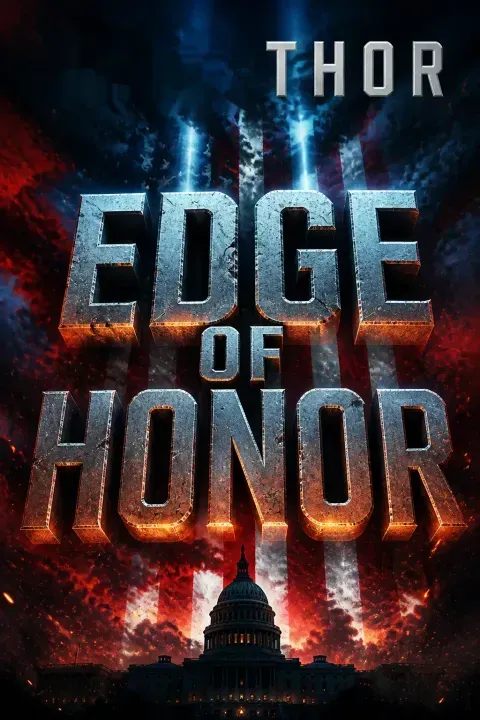


Plot Summary
Massacre at Thirty-Fourth Street
Scot Harvath1 and his wife Sølvi2 are driving to a Norwegian embassy party when they encounter a large protest at the Vice President’s Residence. As they wait in traffic, two hooded men toss backpacks under a government van. The bombs detonate, lifting Harvath1’s Tahoe off the ground.
Harvath1 and Sølvi2 retrieve weapons and engage multiple shooters wearing body armor, killing several in a running gunfight. Harvath1 chases a sixth attacker into the Norwegian ambassador’s residence, where the man has shot two security agents and taken the ambassador and a critically wounded chef hostage.
Harvath1 enters the kitchen, throws a cast-iron krumkake iron as a diversion, and kills the gunman with a single headshot. The attack leaves seven protesters, twelve police officers, and two embassy guards dead, and shatters the city’s sense of safety.
The novel’s opening refuses the comfort of a slow start, thrusting the retired Harvath and his new wife directly into mass violence. The attack’s location, at the physical intersection of protest, diplomacy, and executive power, signals that the story’s threat will be intimate and systemic. Harvath’s instinctive return to operator mode reveals that his identity is inseparable from tactical action. The couple’s seamless teamwork under fire also foreshadows the novel’s central emotional anchor: a marriage forged and tested in combat, not merely domesticity.
The Debt Comes Due
The morning after the attack, Ambassador Kari Hansen visits the Harvaths’1 historic home. After returning Scot1’s lost sunglasses, she requests a private word with Sølvi.2 At their dock, Sølvi2 reveals that Prime Minister Anita Stang wants her as a temporary protective agent for the NATO Summit.
Stang does not trust the U.S. Secret Service after budget cuts and recent failures, and she believes Sølvi2’s involvement will force the Americans to provide better personnel.
More critically, Stang is calling in a life debt Sølvi2 owes to her late mentor, a promise now inherited by the PM. Sølvi2 accepts. Harvath,1 though uneasy, supports her decision and immediately shifts into tactical planning mode, arranging transportation and leveraging his Secret Service contacts to assist.
This turning point deepens Sølvi’s character by revealing the moral weight of her past promises and the professional identity she has not fully relinquished. The Norwegian Prime Minister’s distrust of the Secret Service is both a specific political commentary and a narrative setup: the institution that should provide safety is itself a vulnerability. Harvath’s swift pivot from protective husband to tactical partner illustrates the adaptive trust that defines their marriage, while the debt theme reinforces the novel’s emphasis on loyalty over institutional allegiance.
Rogers’ Run for Life
Brendan Rogers, the former Hostage Czar and National Security Advisor,3 is training for the Marine Corps Marathon when he notices two men tailing him on a trail. They pursue him aggressively uphill; he escapes only by tumbling down an embankment onto a road, where a park ranger rescues him.
Rogers3 is convinced the Iranians are retaliating for the Soleimani drone strike he helped authorize. Two of his former Situation Room colleagues have already died under suspicious circumstances.
After ditching his phone in a stranger’s bag at the airport and paying cash for a cheap motel, Rogers3 contacts Nicholas5 at the Carlton Group. He uses an alias to gain entry and pleads for help. Nicholas5 sends a single text to the one man who owes Rogers3 his life: Scot Harvath.1
Rogers represents the vulnerable insider, highly skilled in negotiation but helpless in personal defense. His flight from the “two wolves” reframes bureaucratic power as illusory when faced with physical threat. The suspicion of Iranian vengeance is logical but also a red herring, setting up the deeper conspiracy to come. Rogers’ careful tradecraft (ditching his phone, using cash) demonstrates that even non-operators absorb survival instincts. His approach to the Carlton Group initiates the story’s central alliance, built on past sacrifices and mutual obligation.
Abandoned by His Country
At the Carlton Group, Harvath1 listens to Rogers3’ full account and calls his old Secret Service friend Russ Gaines.12 Gaines12 reveals that the White House has explicitly denied protection for Rogers,3 citing the two-million-dollar monthly cost and the President’s anger at Rogers3’ television criticisms.
Harvath1 is outraged. He decides to use Rogers3 as bait, with Nicholas5 cloning the former advisor’s phone signal to simulate a return from Denver while Harvath,1 Haney,14 and retired CIA director Bob McGee4 prepare a trap at Rogers3’ McLean estate.
Though Harvath1 has formally resigned from the Carlton Group, he calls in favors. Haney,14 still in rehab from a previous gunshot wound, and McGee,4 enjoying quiet retirement, agree to stand watch. Rogers3 reluctantly consents to being the lure.
This section crystallizes the novel’s core betrayal: a government servant is discarded for petty political spite. The cost argument masks vindictiveness, and Harvath’s fury reflects a deeper moral code: a nation that sends its people into danger must shield them afterward. The bait plan is classic Harvath, converting vulnerability into tactical advantage. Calling in Haney and McGee underscores that in this broken system, only personal loyalty remains dependable. The Secret Service’s refusal also plants the seed of an internal leak.
The Sword-and-Tree Tattoo
FBI agents Joe Carolan6 and Jennifer Fields7 are banished to a basement office by their boss, Gallo,13 to secretly investigate a possible Russian link to the Naval Observatory attack.
Gallo13 shows them a video of a captured Russian intelligence officer describing a new Kremlin unit, the Department of Special Tasks, and an operation called Black Line, designed to destabilize America through orchestrated violence. Carolan6 and Fields7 visit the D.C. morgue and photograph the dead attackers.
Among the tattoos, a half-sword, half-tree design catches Carolan6’s eye. He remembers seeing it in underground fight club footage linked to a White supremacist network called Iron Tree. They plan to track it, starting with a Baltimore gym manager named Lucas Weber, who sports the same symbol.
The FBI subplot introduces a parallel investigation that will converge with Harvath’s. Carolan and Fields operate in bureaucratic twilight, their own agency suspicious of their pursuit. The tattoo functions as a narrative key, unlocking a subculture of disaffected young men radicalized through combat sports. The Russian dimension, while initially speculative, injects a transnational layer, suggesting that America’s internal fissures are deliberately exploited from abroad. The morgue scene, grim and clinical, grounds the thriller in the physical reality of the violence.
Eight Assassins Storm the House
At Rogers3’ house, the security cameras flicker and die. Harvath1 launches Dragonfly drones, which spot eight armed men advancing, two of them carrying a ladder toward the roof. The attackers, who know Rogers3’ alarm code and the safe room’s weaknesses, split into an assault group and a roof team.
Harvath1 sneaks outside, kills the two men with the ladder, then flanks the main group as they shatter the living room windows. McGee4 and Haney14 fire through the walls. In a chaotic close-quarters fight, all eight attackers are killed.
Rogers3 identifies two of the dead as his Rock Creek Park pursuers. McGee4 recognizes one as a former CIA Ground Branch operator. The inside information confirms a leak in the Secret Service, and the ex-CIA connection points to an organized conspiracy.
The siege transforms Rogers’ home into a battlefield, proving that the threat is not foreign assassination but domestic insurgency. The attackers’ knowledge of the alarm code and safe room implicates a mole within the protective services, deepening the mystery of the conspiracy’s spread. Harvath’s solo flanking maneuver demonstrates his lethal competence, while the presence of Haney and McGee emphasizes the shrinking circle of trustworthy allies. The revelation that the shooters are ex-CIA paramilitary redefines the enemy as one that has emerged from inside America’s own security apparatus.
Dulles Highway Inferno
Sølvi,2 on her first day with the Prime Minister’s detail, rides in the armored motorcade from Dulles Airport. As the convoy passes a wooded stretch, multiple rocket-propelled grenades slam into the vehicles. The SUV carrying the Dutch Prime Minister is obliterated. The Norwegian Tahoe, with Sølvi2 inside, nearly flips. The lead Secret Service agent is killed by a sniper.
Sølvi2 takes charge, sprinting through burning wreckage into the trees. She locates the sniper’s hide, kills him, and then, aided by her wounded colleague Bente Bergstrøm,18 neutralizes two more attackers. The ambush kills dozens, including numerous Dutch and Norwegian delegation members, and profoundly shakes U.S.-allied relations hours before the NATO Summit.
The motorcade attack escalates the novel’s stakes from targeted assassination to mass atrocity on American soil. The use of RPGs transforms a bland commuter artery into a war zone, and the loss of allied dignitaries makes the attack an international crisis. Sølvi’s counteraction, deliberate and independent, showcases her mastery of fieldcraft and refuses the role of passive victim. Her rescue of the Norwegian delegation, despite the carnage, solidifies her identity as a warrior, not a diplomatic appendage.
The Senator’s Cabal
Missouri Senator Bill Blackwood,9 furious that President Mitchell denied him a cabinet position despite Blackwood9’s tireless campaigning, meets regularly with a secret group that includes the Vice President’s chief of staff.
Their mouthpiece is podcaster Chuck Coughlin,17 who uses his show to blame Mitchell for the terrorist attacks and to position Vice President Cates as a decisive leader. Blackwood9’s lover, lobbyist Claire Bennet,10 records every meeting for “insurance.” She is actually a deep-cover Russian SSD agent, guiding the conspiracy toward maximum chaos.
After the motorcade attack, Cates delivers a fiery speech calling for America First and denouncing Washington’s weakness. Coughlin17 immediately broadcasts a screed demanding Mitchell resign and hailing Cates as the true protector. A coup is underway in plain sight.
The conspiracy reveals that external violence is mirrored by internal political treachery. Blackwood’s grievance is personal and petty, making him ideal for manipulation. Coughlin’s character embodies how modern media can weaponize patriotic fervor for seditious ends. Claire Bennet’s true allegiance exposes the conspiracy as a nested deception: the American plotters think they are saving the nation, but they are pawns in a Russian destabilization campaign. The theme of invisible influence, where authentic anger is hijacked by calculated malevolence, underpins the entire narrative.
Kidnapping the Security Chief
McGee4’s CIA source identifies the dead attackers as ex-Ground Branch operatives all recruited by Dennis Hale,11 a former Green Beret who left the Agency under suspicion of stealing shoulder-fired weapons from a Mexican cartel.
Hale11 now runs security for the wealthy Willis family on a heavily guarded Potomac estate. With Nicholas5’s help, Harvath1 swims ashore, spoofs the security system using magnetic “Goblin” devices carried by a dog, and reaches the carriage house where Hale11 sleeps. A creaking floorboard wakes the giant.
A brutal fight ensues: Harvath1 delivers a Taser shock, a headbutt that shatters Hale11’s nose, and finally injects him with ketamine. He drags Hale11 into a Mercedes, triggers a fake police strobe to open the gate, and escapes. The entire extraction leaves no trace.
The infiltration sequence showcases meticulous planning and raw physicality. The technological sabotage, from drones to magnetic spoofers, contrasts with the primitive violence of the fight. Harvath’s willingness to dose and abduct a man underscores his pragmatic amorality: when the system fails, he becomes judge and executioner. The detail that Hale’s compromised past provided the weapons for the current conspiracy illustrates how institutional rot cascades, turning dismissed operatives into mercenaries for treason.
Chemical Confession
In Harvath1’s basement, Hale11 is subjected to a chemical interrogation compound from a Maltese doctor. The hood forces him to inhale fumes that target the amygdala’s fear center, breaking his resistance over several hours.
Hale11 reveals his paymaster is Andrew Conroy,8 the CIA’s deputy director of operations, the same man who once froze Harvath1’s assets and tried to blackmail him. Conroy8 assembled the ex-Ground Branch teams and orchestrated the attacks on Rogers3 and the motorcade, using weapons Hale11 had stolen from the cartel.
Hale11 admits he knows nothing about the next attack. He says another cell is handling that. Harvath1 and McGee4 realize the conspiracy extends further, involving a domestic extremist group and a mole inside the FBI or Secret Service. They decide to take the intelligence to Gallo.13
The chemical interrogation is a narrative and ethical accelerant. Harvath’s use of a banned substance reflects his utilitarian morality: preventing mass murder justifies any tool. Conroy’s unmasking personalizes the conspiracy for Harvath, linking past grievances to present threat. Hale’s compartmentalized knowledge, that the next strike belongs to a separate cell, heightens the ticking-clock tension and confirms that the plot is hydra-headed, not hierarchical. The decision to involve Gallo introduces the risk of trusting another potential traitor.
Iron Tree’s Last Stand
Carolan6 and Fields7 secure cooperation from Iron Tree member Ricky Russell by getting his sick son into a clinical trial. Russell reveals the group’s training camp location. In a predawn raid on Paul Jordan16’s Virginia farm, FBI SWAT teams and armored Bearcats face booby-trapped buildings and heavy machine-gun fire.
The farmhouse explodes when a breacher touches the door. The remaining gunmen are killed as vehicles ram through the barn and bunkhouse. Jordan16 is captured in an escape tunnel.
When he refuses to talk, Harvath1 is flown in and uses the chemical interrogation compound. Jordan16 confesses to a plan to attack the NATO Summit using sarin gas dispersal devices hidden in defense contractor booths, triggered by short-range Bluetooth. He names the FBI mole: Agent Matthew Kennedy.15
The Iron Tree raid demonstrates how domestic extremism has evolved into paramilitary capacity with booby traps and escape tunnels. The alliance between a white supremacist militia and the political conspiracy shows how disparate grievances can be welded into a coordinated assault. Harvath’s continued use of chemical interrogation, now with implicit FBI sanction, shows how the investigation’s success has made even rule-bound institutions complicit in extraordinary measures. The revelation of Kennedy as the mole completes the triangle of institutional betrayal, linking the FBI, CIA, and Secret Service to a single coordinated conspiracy.
Sarin at the Summit
At the Walter E. Washington Convention Center, Harvath,1 Gallo,13 Carolan,6 and Fields7 spread out to find Kennedy15 and the Iron Tree operatives. Nicholas5 determines the detonators use a weak Bluetooth signal, meaning the trigger man must be close to the hidden sarin devices.
Harvath1 is ambushed in an elevator by four fake Secret Service officers; he and a QRF agent kill them. On the lower level, Harvath1 tracks three Iron Tree workers to the exhibit storage cages, kills two, and wounds a third. He extracts the details of the sarin dispersal units.
Racing to the exhibition hall, he warns Sølvi,2 who evacuates the Norwegian Prime Minister without alerting Secret Service. Kennedy15 opens fire with a submachine gun, but Carolan6 and Fields7 drop him with headshots before he can trigger the devices. The attack is foiled.
The summit sequence is the climax of the physical threat. The sarin plot transforms the convention center into a potential death trap, and the fake Secret Service attackers confirm that the conspiracy has infected even those sworn to protect. Harvath’s coordination with his allies, from Nicholas’s remote technical analysis to Sølvi’s improvised evacuation, demonstrates the resilient network of personal trust that survived institutional rot. Kennedy’s death, while necessary, is also tragic: a career agent turned traitor, emblematic of the corrosion at the heart of government.
The Mastermind’s Reckoning
That night, Harvath1 transports Hale11 to Conroy8’s Bethesda home. They restrain the unconscious Hale11 in a chair and wait. When Conroy8 arrives, Harvath1 Tasers him and secures him as well.
Using the chemical interrogation compound, Harvath1 extracts the full scope of the conspiracy: Conroy,8 Senator Blackwood,9 the VP’s chief of staff, and radio host Coughlin,17 enabled and manipulated by the Russian SSD through Claire Bennet,10 sought to so weaken President Mitchell that he would resign and let Vice President Cates take power.
Conroy8 provided the weapons and operators; Blackwood9 provided political cover. After obtaining a recorded confession, Harvath1 stages the scene: pistols in both men’s hands, a narrative of mutual argument turned fatal. He erases all traces of his presence and leaves.
The confrontation with Conroy is the moral zenith and nadir of Harvath’s arc. Extracting the truth is righteous; staging an extrajudicial execution is not. Yet the novel frames it as necessary because the official justice system is too compromised to deliver accountability. Harvath acts as judge, jury, and executioner, embodying the theme that when institutions fail, individual honor must fill the void. The revelation that the conspiracy was both Russian-manipulated and homegrown complicates the binary of foreign versus domestic threat.
Epilogue
One week later, Harvath1 and Sølvi2 host a small Fourth of July gathering on a borrowed boat on the Potomac to watch the fireworks. Rogers,3 the Haneys,14 and Bob McGee4 join them. Admiral Tyson’s boat floats nearby. Sølvi2 playfully serves Harvath1 a container of lutefisk, the Norwegian cured fish he loathes. He promptly dumps it overboard.
Earlier, Gallo13 and Gaines12 updated him: the staged murder-suicide of Hale11 and Conroy8 is accepted, the conspiracy is about to be exposed by a television special, and the moles in the FBI and Secret Service have been identified. Harvath1 runs a new American flag up his pole and stands on the dock, reflecting on the country’s resilience and his own improbable survival. For tonight, at least, the fight is over.
The epilogue offers earned respite but no easy closure. The conspiracy’s exposure will further fracture public trust, even as the immediate threat is neutralized. The lutefisk gag reasserts the couple’s playful domesticity, while the fireworks symbolize a fragile but enduring idealism. Harvath’s quiet moment with the flag captures his core identity: a man who loves his country not blindly, but with the clear-eyed knowledge of its flaws. The novel ends not with triumph, but with a quiet reaffirmation that personal bonds and personal honor are the last redoubts against chaos.
Analysis
Edge of Honor constructs a thriller around the premise that the most dangerous threats to a nation are not external invaders but internal betrayals, especially when those betrayals are cloaked in the language of patriotism. The conspiracy that drives the plot involves not a single villain but a distributed network of resentment: a slighted senator,9 a bitter CIA bureaucrat,8 a narcissistic podcaster,17 and an ambitious vice-presidential staffer, all unwittingly exploited by a Russian destabilization campaign. The novel suggests that the tools of modern chaos, from social media manipulation to privatized mercenary violence, have made traditional counterintelligence almost obsolete.
Harvath1 functions as the story’s moral center, but his morality is not the law’s. He kidnaps, chemically interrogates, and extrajudicially executes because the official systems designed to do those jobs have themselves been corrupted. The recurrent image of institutional rot, the mole in the Secret Service, the mole in the FBI,15 the deputy director of the CIA orchestrating assassinations,8 creates a world where the only reliable compass is personal loyalty. Harvath1’s alliances with Haney,14 McGee,4 and Sølvi2 are not professional connections but bonds forged in shared danger and debt.
The novel also examines the gendered dynamics of its world through Sølvi,2 who is not a secondary character but a co-protagonist with her own arc, debts, and lethal skills. Her storyline about protecting the Norwegian Prime Minister from the very Americans who are supposed to be allies underscores the theme that allyship is performative and fragile. The motorcade ambush and her counterattack in the woods serve as a mirror to Harvath1’s own actions, showing two warriors fighting separate fronts of the same war.
Ultimately, Edge of Honor is a cautionary tale about the vulnerability of open societies to internal collapse. The nefarious brilliance of the Russian plot is that it requires no direct invasion, only the amplification of existing grievances through willing American proxies. The novel ends not with the restoration of order, but with a tenuous ceasefire, a Fourth of July party where the fireworks are both a celebration and a reminder of how easily the sky can catch fire.
Review Summary
Edge of Honor receives an overall 4.46/5 rating, with readers praising Brad Thor's 24th Scot Harvath thriller. The story follows Harvath returning from his honeymoon to face attacks at the Norwegian Embassy and during a NATO summit, uncovering a conspiracy involving Russian intelligence and rogue government agents. Reviewers appreciate the fast-paced action, believable plot, and Harvath's new wife Solvi as a character. Some criticisms include predictable storylines, excessive political commentary, and departure from the series' typical espionage formula. Most fans find it an entertaining, page-turning thriller.
People Also Read


Characters
Scot Harvath
Retired Operator, Reluctant GuardianA former Navy SEAL, Secret Service agent, and Carlton Group operative, now retired with a fifty-million-dollar fortune and a new wife2. He is lethally competent, fiercely loyal, and deeply patriotic. He left the intelligence world after the CIA tried to blackmail him, but he cannot ignore a friend in danger. His moral code is pragmatic: when institutions fail, he becomes the instrument of justice. Throughout the novel, he struggles with the pull of his old life, the duty to protect those he loves, and the cost of violence. His relationship with Sølvi2 is his anchor, and their partnership in both marriage and combat defines his emotional arc.
Sølvi Harvath
Norwegian Spy, Warrior WifeA deputy director of the Norwegian Intelligence Service on open-ended leave, she is a former model turned special forces soldier. She carries a tattoo from Jean-Paul Sartre on her spine and a deep loyalty to her late mentor. Her integrity compels her to honor a life debt to the Norwegian Prime Minister, even when it puts her back in harm’s way. She is every bit Harvath1’s equal in combat, with a preternatural ability to move silently and a ruthless efficiency under fire. Her relationship with Harvath1 is built on mutual respect and a shared understanding of the darkness in their pasts.
Brendan Rogers
Former Hostage Czar, Hunted ManThe former Special Presidential Envoy for Hostage Affairs and National Security Advisor, he is an intelligent, soft-spoken negotiator, not a fighter. He helped rescue Harvath1 from Russian captivity, creating a life debt. Now he is convinced the Iranians are targeting him for the Soleimani drone strike, but his government has abandoned him. His vulnerability and decency make him a compelling protectee, and his gradual realization that the threat is not foreign but domestic mirrors the novel’s central revelation.
Bob McGee
Ex-CIA Director, Seasoned AllyRecently retired as Director of the CIA, he is a salt-and-pepper-mustached veteran of decades of covert action. He is fiercely honorable, still connected to trusted sources inside the Agency, and unafraid to bend rules when the mission demands it. He provides critical intelligence on the ex-CIA operators and the conspiracy within Langley. His decision to help Harvath1 protect Rogers3, despite his quiet retirement, reflects a lifelong commitment to doing the right thing over the easy thing.
Nicholas (The Troll)
Carlton Group Tech GeniusA man with primordial dwarfism who runs the Carlton Group’s operations, he is a brilliant hacker and strategist. He uses two enormous Caucasian Ovcharka dogs as both companions and tactical assets. He is fiercely protective of his wife and new baby, which makes him cautious about field work, but his loyalty to Harvath1 overrides his reluctance. His technical wizardry, from spoofing security systems to designing miniature drones, is crucial to Harvath1’s success.
Joe Carolan
FBI Supervisor, Relentless InvestigatorA towering, old-school FBI supervisory special agent nicknamed “Bear,” he leads the Russia Operations Section. He is nearing retirement but still driven by a fierce work ethic. His partnership with the much younger, irreverent Fields7 balances his gruffness. He intuitively connects the tattoos on the dead attackers to a Russian-linked white supremacist network, pushing the investigation forward even when it risks political backlash. He represents the integrity that the Bureau should embody.
Jennifer Fields
FBI Agent, Fearless ShotCarolan6’s partner, a sharp-witted Black agent from Harlem. She matches her boss’s dedication with a fearless physicality and a profane sense of humor that she uses to needle him. She kills a neo-Nazi who tries to murder her during an interview, and she later takes down the rogue FBI agent Kennedy15 with precise headshots. Her character challenges stereotypes and brings a modern, unapologetic energy to the investigation.
Andrew Conroy
CIA Deputy Director, MastermindThe CIA’s deputy director of operations, he is a long-serving bureaucrat with deep resentment toward President Mitchell. He previously froze Harvath1’s assets and attempted to blackmail him. He secretly assembled a private army of fired ex-CIA operators and armed them with weapons he had stolen from a Mexican cartel. He allied with Senator Blackwood9 and the Russian SSD to enact a coup disguised as a patriotic restoration. His ultimate motivation is power, cloaked in a warped nationalism.
Bill Blackwood
Ambitious Senator, ConspiratorThe senior senator from Missouri, a silver-haired political weathervane nursing a grudge over being denied a cabinet post. He conspires with the Vice President’s chief of staff, a podcaster17, and the Russian SSD to foment chaos and force President Mitchell to resign. He is both a patsy and a willing participant, manipulated by his lover Claire Bennet10. His arrogance and sense of entitlement make him a tool of forces he does not fully understand.
Claire Bennet
Lobbyist, Russian SSD MoleA confident D.C. lobbyist in her mid-thirties, she is Blackwood9’s lover and the secret architect of his conspiracy. She is actually a deep-cover officer of Russia’s Department of Special Tasks, deployed to weaponize American political grievances. She records Blackwood9’s cabal meetings as insurance and nudges the plotters toward increasingly violent acts. When her handler pulls her out, she is later found with her throat cut in an Istanbul alley, a silent elimination.
Dennis Hale
Ex-CIA Handler, Mercenary LeaderA massive former Green Beret who recruited many Ground Branch operatives at the CIA. After taking early retirement under suspicion of stealing weapons, he became head of security for the Willis family while moonlighting as a mercenary coordinator for Conroy8’s hit squads. He is physically formidable and resists interrogation until Harvath1 chemically breaks him.
Russ Gaines
Secret Service Agent, Trusted FriendAn old colleague of Harvath1’s from White House detail days, now in the Secret Service’s Special Operations Division. He helps Sølvi2’s credentials and provides off-the-record intelligence about the administration’s refusal to protect Rogers3. His own assistant turns out to be the mole, a betrayal that stuns him. He represents the decent professionals still inside compromised institutions.
Alan Gallo
FBI Assistant Director, Secret OverseerHead of the FBI’s Counterintelligence Division, he assigns Carolan6 and Fields7 to investigate the Russian connection while hiding them from the White House. He is a careful bureaucratic player who nonetheless authorizes extraordinary measures when the conspiracy’s scope becomes clear. His willingness to sanction Harvath1’s methods shows his pragmatic understanding that the rules must sometimes bend to prevent catastrophe.
Mike Haney
Former Marine, Injured OperativeAn ex-Force Recon Marine and Carlton Group operator, he is still in rehab after being shot during a previous mission. He joins Harvath1 to protect Rogers3 despite not being cleared for field work. His gallows humor masks a frustration with his recovery, and his loyalty to Harvath1 is unshakeable. He handles the shotgun during the house siege with devastating effect.
Matthew Kennedy
FBI Agent, Secret MoleA longtime FBI agent with an immaculate appearance and a Boston accent, he is the mole inside the Bureau feeding information to the conspirators. He appears at crime scenes and offers coffee to colleagues while secretly tipping off the Iron Tree network16. His betrayal is a deep wound for the FBI and is ultimately ended by Fields7’ precise gunfire at the summit.
Paul Taylor Jordan
Iron Tree Leader, Militia ChiefThe paunchy, psoriatic leader of the Iron Tree white nationalist militia. He runs a heavily fortified training compound where members learn combat skills, explosives, and small-unit tactics. Captured during the FBI raid, he resists interrogation until Harvath1 chemically breaks him, and he divulges the sarin attack planned for the NATO summit.
Chuck Coughlin
Podcaster, Propaganda MouthpieceAn overweight, sweaty radio host and podcaster who builds a massive following by stoking anti-Mitchell sentiment. He calls for the President’s resignation and promotes Vice President Cates as the true leader. He is a knowing participant in the conspiracy, using his platform to manipulate public anger toward a political coup.
Bente Bergstrøm
Norwegian PST Agent, Resilient FriendA redheaded, freckled Norwegian Police Security Service agent and old friend of Sølvi2. Badly injured in the motorcade ambush, she still crawls into the woods to provide backup, killing one of the attackers who threatens Sølvi2. Her courage and tenacity reflect the toughness of the Norwegian protective detail.
Plot Devices
Chemical Interrogation Compound
Truth serum delivered via hoodA fear-inducing compound developed by a doctor in Malta, used by Harvath1 to break resistant interrogation subjects. The substance is soaked into cloth strips placed inside a hood; when the hood is placed over a subject’s head, the fumes target the amygdala’s fear center, inducing overwhelming terror that compels truthful answers. Harvath1 uses it on Dennis Hale11 to extract the names of Conroy8 and the upcoming attack, and on Paul Jordan16 to reveal the sarin plot and the identity of the FBI mole15. The device is dangerous, risking cardiac arrest, but Harvath1 accepts the risk because standard methods would take too long.
Dragonfly Surveillance Drones
Autonomous recon and jammingTiny, state-of-the-art drones supplied by Nicholas5 that mimic dragonflies. Equipped with night-vision and thermal cameras, they can autonomously search for intruders, jam enemy drones, and provide real-time feeds to Harvath1’s phone. Their small size and short battery life require precise tactical timing. Harvath1 deploys them during the siege at Rogers3’ house to locate the eight attackers, giving him critical intelligence before the assault begins.
Goblin Security Spoofers
Magnetic system hijackersSmall, brushed-aluminum, hockey-puck-shaped devices that, when magnetically attached to a security system’s wiring terminus, allow Nicholas5 to access and manipulate cameras, sensors, and alarms remotely. They are deployed by Draco, Nicholas5’s dog, during the infiltration of the Willis estate. The Goblins are essential to bypassing the estate’s advanced AI-powered security without detectable hacking, though they require a drone overhead to relay signals.
The Sword-and-Tree Tattoo
Symbolic clue linking killersA half-sword, half-tree tattoo found on the bodies of multiple attackers, as well as on members of the Iron Tree white supremacist network16. It serves as the connective thread that allows FBI agents Carolan6 and Fields7 to trace the dead shooters to underground fight clubs and, eventually, to the Iron Tree militia16. The tattoo’s significance is never fully explained, but its recurrence across multiple crime scenes makes it a key investigative key.
Sarin Gas Dispersal Units
Bluetooth-triggered chemical bombsSmall, concealed chemical weapons devices built by the Iron Tree militia16 using salvaged hypodermic needles, weak Bluetooth receivers, and sarin containers. Planted inside defense contractor exhibit booths at the NATO Summit, they are designed to be triggered by a nearby agent using a phone. Because the Bluetooth signal is extremely weak, the trigger man must be in close proximity to the devices. This limitation ultimately helps Harvath1 and the FBI locate and neutralize the operatives before the gas can be released.
Scot Harvath Series



About the Author
Download PDF
Download EPUB
.epub digital book format is ideal for reading ebooks on phones, tablets, and e-readers.








































