

Key Takeaways
Seduction is the supreme form of power — victims surrender willingly
Greene's central premise is counterintuitive. The most powerful form of influence doesn't impose — it attracts. From Cleopatra enslaving Julius Caesar to Kennedy captivating a nation, seduction works because victims participate gladly. The Latin root of "seduction" means "to lead astray" — possible only when people follow of their own accord. Cleopatra, Casanova, and Napoleon all understood this: work on the mind first, stimulating fantasies and creating patterns of hope and despair.
A person in love surrenders their willpower entirely. A person in lust can be satisfied and walk away. Creating love — emotional attachment, enchantment, psychological dependency — is the real game, applicable equally to romance, politics, and social influence. Every interaction, Greene argues, is a potential seduction.
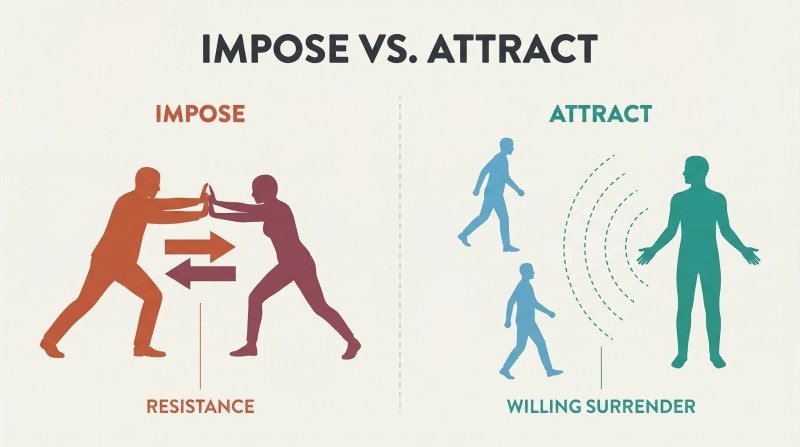
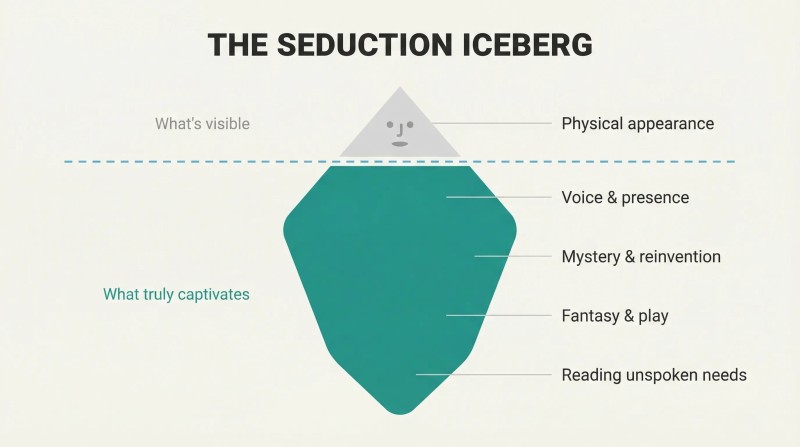
Forget your face — seduction runs on psychology and fantasy
Neither Cleopatra nor Marilyn Monroe were classically beautiful. Cleopatra's face was unremarkable — it was her constant reinvention, intoxicating voice, and theatrical spectacles that enslaved Caesar and Antony. Monroe deliberately constructed her breathy voice, her walk, her entire look through years of mirror practice. She could walk through Manhattan unrecognized without her makeup.
The real currency is psychological presence. Seducers succeed by becoming a screen onto which others project their deepest desires. Clothes, voice, gestures all bypass rational thought — like a decoy's effect on an animal. Conventional beauty actually creates distance and coldness. A fascinating, slightly mysterious psychological presence creates addiction. Your task: stop worrying about your appearance and start reading people's unspoken needs.
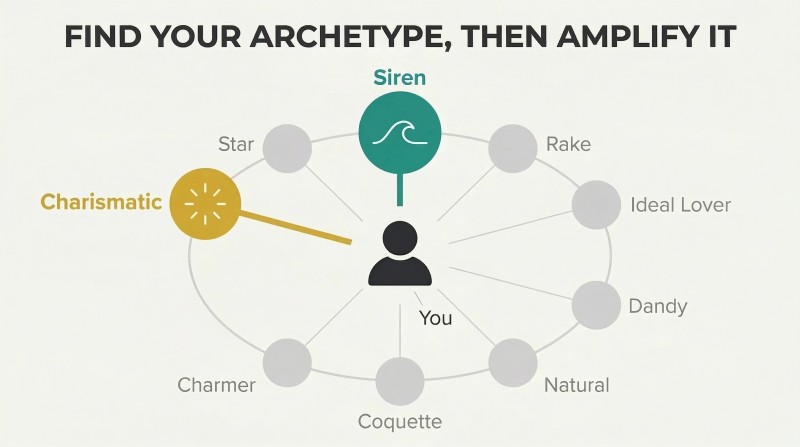
Find your archetype among nine seductive characters, then amplify it
Greene maps nine distinct types, each built on a deep psychological pull:
1. Siren — overwhelms with heightened sexuality and spectacle
2. Rake — pursues with reckless, flattering intensity
3. Ideal Lover — mirrors the target's deepest unfulfilled fantasy
4. Dandy — defies convention with ambiguous, fluid identity
5. Natural — disarms with childlike spontaneity
6. Coquette — enslaves through alternating warmth and withdrawal
7. Charmer — deflects attention from self onto the target's ego
8. Charismatic — radiates mysterious confidence and vision
9. Star — projects a dreamlike, untouchable presence
You already embody one or two. The key is identifying which traits come naturally, then cultivating them with artful exaggeration. Half-hearted seductive qualities repel; fully committed ones enchant.
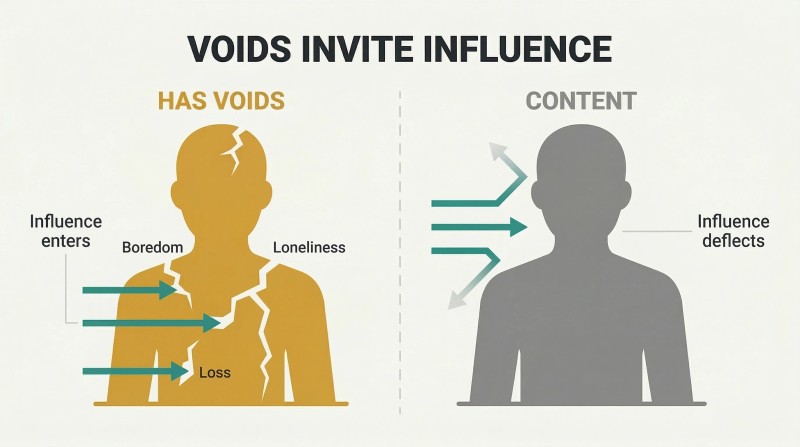
Choose targets with voids to fill — the contented are immune
The right target transforms everything. Casanova chose unhappy women who had suffered recent misfortune. Kierkegaard's fictional seducer sought women with active imaginations who would embroider his every gesture into poetry. The completely content person has no cracks for your influence to enter — boredom, loneliness, and recent loss create the openings.
Read the signals of what's missing. Offhand complaints, wistful tones, clothes suggesting repressed desire, past romances that ended badly — these reveal where someone feels incomplete. Equally important: choose someone who genuinely stirs YOU. Your authentic excitement makes maneuvers seem natural rather than mechanical. The worst mistake is seducing your own psychological type — two puzzles missing the same pieces never fit together.
Never let them see the seduction coming — make them feel they chose you
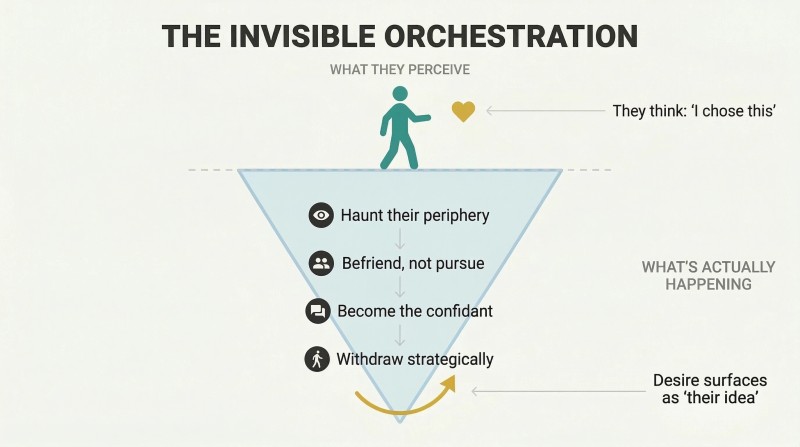
Direct declarations trigger resistance. The Duke de Lauzun won the wealthiest woman in France by befriending her so thoroughly that she proposed to him — never suspecting he had orchestrated every step. He began with neutral conversations about literature and history, slowly became her confidant, and strategically stepped back at key moments to let her desire build on its own.
The indirect approach takes multiple forms: haunt the target's periphery until they notice you, befriend them first then let desire emerge gradually, or arrange chance encounters that feel like destiny. Even deliberate dullness — polite small talk — can be devastatingly effective because it creates space for the target's imagination to fill with fantasy. The moment you declare intentions explicitly, the spell is at risk.
Make them feel a lack before offering yourself as the answer
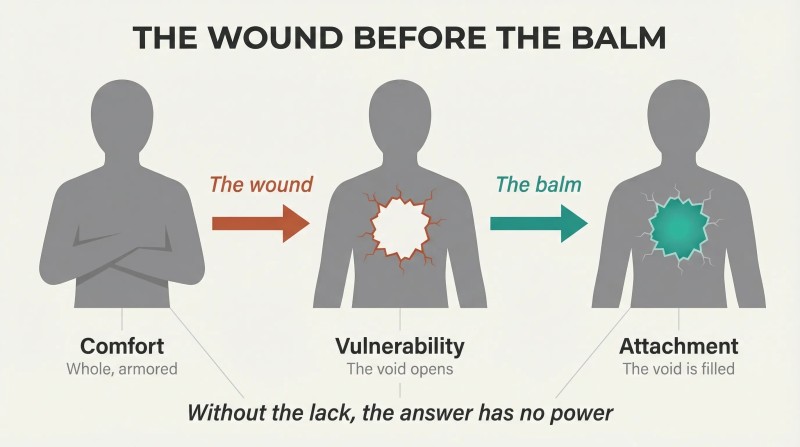
Pain precedes pleasure in seduction's logic. The writer D.H. Lawrence would befriend women, then suddenly turn critical — attacking their coldness, their predictability, their lack of spontaneity. The criticism hit a nerve precisely because it was accurate. Jolted out of normality and filled with self-doubt, they became vulnerable to his subsequent warmth. He targeted each person's specific wound: for one woman, her physical reserve; for another, her lack of spontaneity.
The technique scales to politics. Cleopatra stirred Caesar's insecurity about his legacy by invoking Alexander the Great. Kennedy made Americans feel the 1950s were stagnant before offering his New Frontier. The principle: you must create the wound before you can offer the balm.
Withdrawal enslaves more than pursuit — the step back is everything
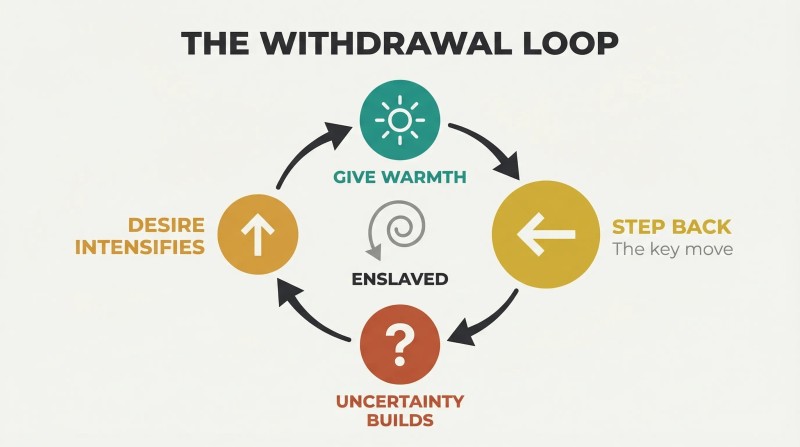
Napoleon conquered nations but became a lovesick child under Josephine's alternating warmth and coldness. She delayed letters, found excuses to avoid him, then pulled him back with sudden tenderness. The pattern enslaved him for years — he could never feel secure in her love, so he never stopped chasing it.
Andy Warhol applied this socially. His blank, noncommittal manner created a vacuum that others rushed to fill — people fought for his attention precisely because he withheld it. The psychology is simple: once you satisfy someone fully, you lose all initiative. Greene calls this the Coquette's essential weapon. The power lies not in the tease but in the subsequent emotional withdrawal. Keep them slightly uncertain about your feelings, your availability, your interest — and their imagination multiplies your appeal.
Purge anti-seductive habits — insecurity repels faster than charm attracts
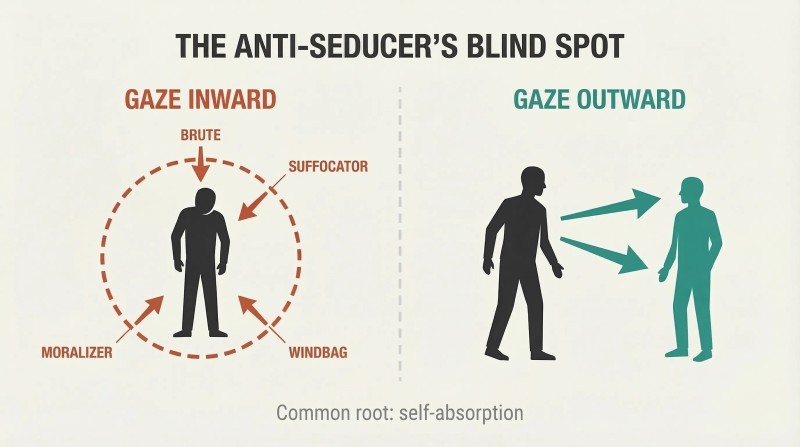
Greene catalogs nine repellent types lurking in all of us: the Brute (impatient, grabby), the Suffocator (clingy before earning intimacy), the Moralizer (rigid, judgmental), the Tightwad (cheapness signals constricted character), the Bumbler (self-conscious to the point of contagion), the Windbag (talks endlessly about themselves), the Reactor (thin-skinned), and the Vulgarian (careless about details and timing).
The common root is insecurity turned inward. Every Anti-Seducer is too trapped in their own anxieties to read another person's psychology. The emperor Claudius lost his wife Messalina through sheer oblivious neglect — proof that prolonged inattention destroys faster than active cruelty. The fix isn't charm school; it's redirecting your attention outward. Before you attempt any seduction, audit yourself ruthlessly for these traits.
Alternate kindness with cruelty — emotional flatlines kill desire
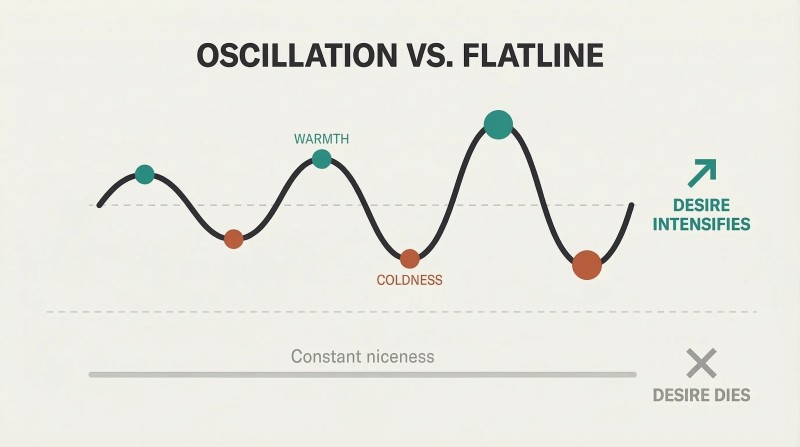
The greatest seduction mistake is being too nice. In Pierre Louys's novel based on Casanova's memoirs, the character Conchita drives a man mad by oscillating between tenderness and rejection, intimacy and humiliation. Each emotional low creates space for a higher high. He becomes addicted to the cycle, unable to walk away despite knowing he's being manipulated.
The principle works in non-romantic contexts too. Journalist Oriana Fallaci cracked open Kissinger and the Shah of Iran by alternating harsh accusations with warm flattery — destabilizing men trained to reveal nothing. Stendhal observed that the closer someone brings you to the edge of the precipice, the dizzier and more devoted you become. A predictable stream of kindness becomes invisible. Strategic unpredictability — a flash of anger, unexpected coldness, then sudden warmth — is magnetic.
Everyone's dark side craves liberation — offer the forbidden
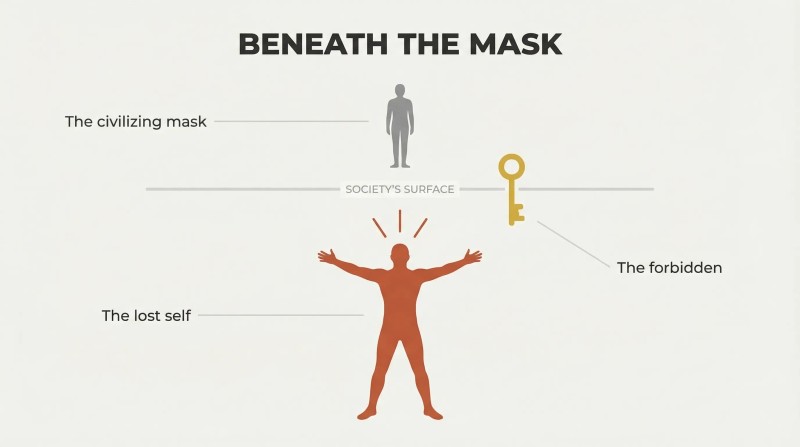
Lord Byron's reputation as "mad, bad, and dangerous to know" magnetized women rather than repelling them. Lady Caroline Lamb, prim Annabella Milbanke, and countless married noblewomen all pursued him knowing the risks. His darkness offered what polite society denied them: a chance to act on buried impulses, to be reckless, to shed the civilizing mask they wore daily.
The psychology runs deep. We all carry a lost self — the wilder, less restrained version suppressed since childhood. Someone who embodies that lost self becomes irresistible. The taboo doesn't require grand sin — it can be intellectual rebellion, breaking social conventions, or simply saying what no one else dares. The shared feeling of transgression creates a bond that polite courtship never achieves. As Greene notes, there is absolutely no seductive power in respecting boundaries.
After conquest, re-seduce constantly or cut cleanly and fast
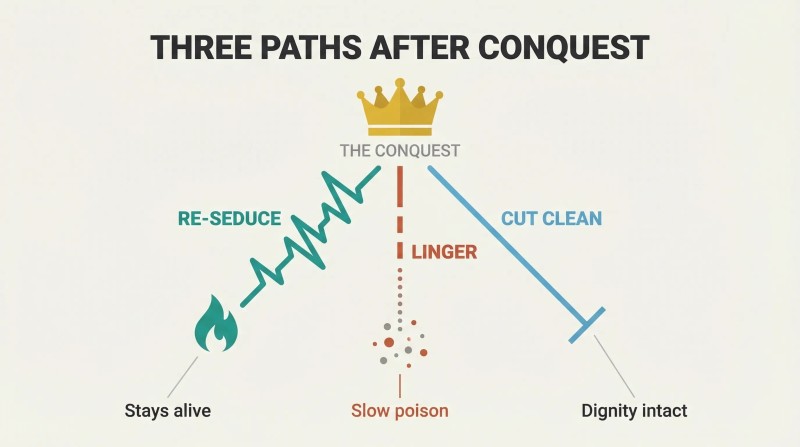
Disenchantment is inevitable. The spell depends on mystery, tension, and idealization — all of which familiarity corrodes. Greene identifies two viable paths: perpetual renewal or swift sacrifice. The slow, guilty, lingering goodbye is the worst option, breeding resentment in both parties.
For lasting relationships, inject intermittent drama. D.H. Lawrence kept his wife Frieda enthralled for decades through constant arguments followed by passionate reconciliation — preventing staleness. Nell Gwyn held King Charles II by never complaining about his other women, instead making herself an endless source of entertainment. For affairs that must end, follow the courtesan Ninon de l'Enclos: she left her marquis without explanation or apology. Clean breaks preserve dignity; lingering goodbyes poison memory. The relationship that settles into comfortable routine has already ended — it just hasn't announced it yet.
Analysis
Greene's The Art of Seduction occupies a peculiar position in the influence literature. Published in 2001, it synthesizes an intellectual tradition spanning Ovid's Art of Love (1st century CE), Kierkegaard's The Seducer's Diary (1843), Stendhal's On Love (1822), and Freud's work on transference — packaging millennia of insight into a strategic manual. The book's genius lies not in any single idea but in its taxonomic ambition: nine character types, eighteen victim types, and twenty-four process steps create a grammar of social influence that, once internalized, permanently changes how you read human interaction.
The most intellectually honest aspect is Greene's insistence that seduction is amoral — a tool, like rhetoric, that can serve noble or ignoble ends. His examples range from Cleopatra's empire-building to Kennedy's nation-building, arguing that personal and political influence operate on identical psychological mechanisms. This insight anticipates behavioral economics work on framing effects and loss aversion by several years. The Coquette's withdrawal principle, for instance, is essentially loss aversion applied to romance.
The book's weakness, ironically, is its own seductive excess. At nearly 250,000 words, it risks the tedium it warns against. Many historical anecdotes serve atmosphere more than analysis, and the neat categories sometimes obscure messier realities. Critics rightly flag ethical blind spots — treating all resistance as a puzzle to solve rather than a boundary to respect. Greene would counter that resistance is itself a form of engagement, but this framing conveniently eliminates the concept of genuine refusal.
Yet the framework's utility extends far beyond romance. The nine archetypes function as diagnostic lenses for self-knowledge: understanding whether you naturally charm, provoke, or mesmerize helps in any domain requiring cooperation. The Anti-Seducer inventory is perhaps the book's most practically useful section — a checklist of repelling behaviors that most people never consciously audit. Read as a map of social psychology rather than a manipulation manual, The Art of Seduction remains one of the most comprehensive guides to understanding why humans fall under each other's spells — and why they so desperately want to.
Review Summary
The Art of Seduction receives mixed reviews, with some praising its historical anecdotes and psychological insights, while others criticize its manipulative tactics. Readers appreciate the book's comprehensive analysis of seduction techniques and their applications beyond romantic relationships. Many find it entertaining and thought-provoking, citing its usefulness in understanding human behavior. However, critics argue that the book promotes unethical manipulation and objectification. Some readers struggle with the book's length and repetitive content, while others consider it a valuable resource for personal growth and social dynamics.
People Also Read





Glossary
Anti-Seducer
Repels through insecurity and self-absorptionA person whose social behaviors actively push others away. Greene identifies nine subtypes: Brute (impatient), Suffocator (clingy), Moralizer (judgmental), Tightwad (cheap), Bumbler (self-conscious), Windbag (talks too much about self), Reactor (thin-skinned), Vulgarian (inattentive to details), and Doormat (slavishly imitative). All stem from insecurity that prevents reading another person's psychology.
Coquette
Enslaves through strategic emotional withdrawalOne of Greene's nine seductive character types. Coquettes orchestrate a back-and-forth between hope and frustration, baiting with promises of reward that prove elusive. Their power lies in narcissistic self-sufficiency—they do not need you, and their indifference provokes desperate pursuit. The essence is not the tease but the subsequent step back. Historical examples include Josephine Bonaparte and Andy Warhol.
Crystallization
Idealizing someone during their absenceA concept Greene borrows from Stendhal's On Love: just as a branch left in a salt mine becomes encrusted with glittering crystals, a loved one becomes idealized during periods of absence or uncertainty. The mind fills in gaps with fantasy. A second, deeper crystallization occurs when doubt enters—the target wonders whether the seducer truly loves them, which intensifies the imaginative process and deepens attachment.
The Siren
Seduces through heightened sensory presenceOne of Greene's nine seductive types, representing the ultimate male fantasy figure. The Siren offers total release from masculine responsibility through heightened sexuality, theatrical spectacle, and a touch of danger. Power comes not from facial beauty alone but from a combination of voice, adornment, movement, and an air of unreality. Key examples: Cleopatra (the Spectacular Siren) and Marilyn Monroe (the Sex Siren).
The Rake
Seduces through reckless passionate pursuitOne of Greene's nine seductive types, representing a potent female fantasy figure. Rakes overwhelm women through intense, seemingly uncontrollable desire and bold seductive language. Their reputation for danger and refusal to play by rules enhances rather than diminishes their appeal. The key: making each target feel she alone has caused his passionate abandon. Subtypes include the Ardent Rake (Duke de Richelieu) and the Demonic Rake (Gabriele D'Annunzio).
The Ideal Lover
Reflects the target's deepest fantasyOne of Greene's nine seductive types who succeeds by studying what a target lacks and becoming its embodiment. Casanova exemplified this: for each woman he discovered what was missing—adventure, intellectual companionship, forbidden passion—and provided it. The Ideal Lover appeals to people's crushed ideals and unfulfilled dreams, making the sensual seem spiritual and the physical seem elevated. The approach requires intense observation and patience.
Soft Seduction
Indirect persuasion for mass audiencesGreene's term for selling ideas, products, or oneself to large groups by disguising the pitch as entertainment, news, or social movement. Core tactics include manufacturing events the media covers as news, stirring basic emotions rather than making rational arguments, speaking the target audience's language, and creating chain reactions where adoption spreads virally. The technique originated with seventeenth-century European charlatans who used vaudeville shows to sell elixirs.
FAQ
What's The Art of Seduction by Robert Greene about?
- Exploration of Seduction: The book delves into the psychology of seduction, presenting it as a powerful form of influence and control. It synthesizes historical examples and literary references to illustrate timeless strategies.
- Character Archetypes: Greene identifies ten archetypal seducers, such as the Siren and the Rake, each embodying different seductive qualities. These serve as models for understanding attraction and manipulation.
- Seductive Maneuvers: The book outlines twenty-four specific maneuvers for seducing others, emphasizing patience, strategy, and emotional manipulation.
Why should I read The Art of Seduction by Robert Greene?
- Understanding Human Nature: The book provides insights into human desires and motivations, revealing how seduction operates on both conscious and unconscious levels.
- Practical Strategies: Greene offers advice applicable in various social situations, enhancing persuasive abilities and social skills in both romantic and professional contexts.
- Historical Context: Rich with historical anecdotes, the book connects timeless principles of seduction to contemporary life, making it relevant for modern readers.
What are the key takeaways of The Art of Seduction by Robert Greene?
- Power of Seduction: Seduction is portrayed as a subtle and effective form of power that can be wielded by anyone to gain influence in relationships.
- Emotional Manipulation: Creating feelings of desire, insecurity, and excitement is crucial for successful seduction, with an emphasis on insinuation and suspense.
- Self-Awareness: Greene stresses the need for self-awareness, encouraging readers to identify their seductive qualities and adapt their approach based on the target's desires.
What are the best quotes from The Art of Seduction by Robert Greene and what do they mean?
- "Seduction is the most subtle, elusive, and effective form of power.": This quote suggests that seduction operates beneath overt power dynamics, allowing influence without force.
- "The ability to delay satisfaction is the ultimate art of seduction.": It highlights the Coquette's strategy of creating desire through absence, intensifying longing.
- "Charm is seduction without sex.": Greene distinguishes charm from sexual seduction, indicating its effectiveness in creating attraction in social and professional contexts.
How does Robert Greene define seduction in The Art of Seduction?
- Seduction as Power: Greene defines it as a subtle, indirect form of power, contrasting with overt control, to achieve desires without confrontation.
- Psychological Manipulation: Seduction involves playing on emotions and desires through charm, attention, and emotional resonance.
- Art and Strategy: It is presented as both an art and a strategy, requiring careful planning and execution, akin to a game mastered with practice.
What are the different types of seducers described in The Art of Seduction by Robert Greene?
- The Siren: Uses allure and sensuality to captivate, embodying femininity and mystery.
- The Rake: Characterized by intense passion and desire, creating excitement and danger.
- The Coquette: Plays hard to get, using warmth and aloofness to heighten desire.
What are the phases of seduction outlined in The Art of Seduction by Robert Greene?
- Phase One: Create Temptation: Awaken desire by hinting at pleasures to come, stimulating curiosity.
- Phase Two: Lead Astray: Keep the target emotionally engaged and confused, creating unpredictability.
- Phase Three: The Precipice: Deepen emotional connection through extreme measures, solidifying the bond.
How can I apply the concepts from The Art of Seduction by Robert Greene in my life?
- Self-Reflection: Identify and enhance your seductive qualities to navigate social interactions effectively.
- Practice Emotional Manipulation: Use strategies to create emotional responses, making others feel special or desired.
- Adapt to Your Audience: Tailor your approach based on individual needs and desires, adjusting behavior to resonate.
What role does absence play in the strategies outlined in The Art of Seduction by Robert Greene?
- Creating Tension: Absence creates tension and longing, making the target yearn for the seducer's return.
- Psychological Manipulation: Induces insecurity and anxiety, prompting the target to pursue more aggressively.
- Reinforcing Desire: Absence reinforces desirability, leading to a more intense emotional connection upon reunion.
How does The Art of Seduction by Robert Greene address the concept of emotional highs and lows?
- Emotional Rollercoaster: Creating highs and lows keeps the target engaged and invested in the relationship.
- Intensity of Experience: Fluctuations intensify the experience, making the climax more rewarding.
- Dependency Creation: Alternating pleasure and pain fosters dependency, strengthening the bond.
What are some common pitfalls to avoid in seduction as outlined in The Art of Seduction by Robert Greene?
- Overexposure: Avoid becoming too familiar or predictable, maintaining mystery and intrigue.
- Neglecting Emotional Dynamics: Manage emotional highs and lows to maintain intensity in the relationship.
- Being Too Nice: Avoid being overly accommodating, as boldness and assertiveness are key to seduction.
How can one maintain the seductive atmosphere after the initial seduction according to The Art of Seduction by Robert Greene?
- Continuous Re-seduction: Introduce new experiences and surprises to prevent familiarity from dulling the relationship.
- Injecting Drama: Create tension or conflict to reignite the initial spark and keep the relationship dynamic.
- Avoiding Complacency: Engage the target's emotions and desires continually to preserve and enhance the seductive atmosphere.
About the Author
Other books by Robert Greene





Download PDF
Download EPUB
.epub digital book format is ideal for reading ebooks on phones, tablets, and e-readers.








































