

Key Takeaways
Learn when NOT to be good — survival punishes naive virtue
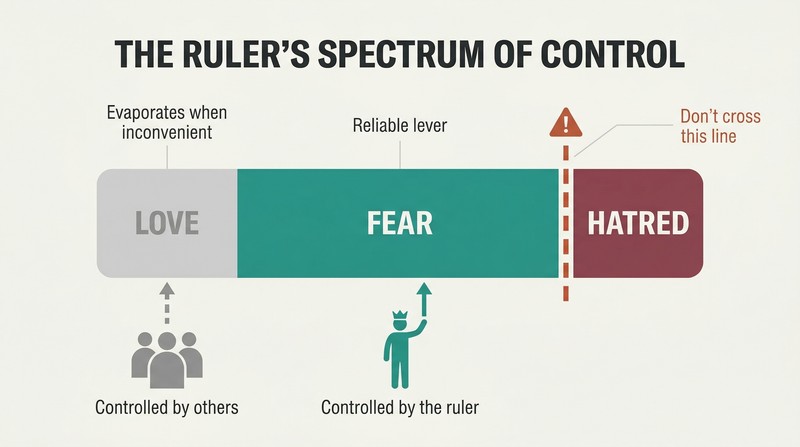
Machiavelli's scandalous central premise. Written in 1513 by a disgraced Florentine diplomat after imprisonment and torture following a regime change, The Prince rejects idealistic political philosophy. Many writers have dreamed up republics that never existed and bear no resemblance to reality. Machiavelli argues the gap between how people actually live and how they ought to live is so vast that a ruler who tries only to be good will be destroyed by those who are not.
This isn't amorality for its own sake. Machiavelli valued the strength and independence of a state above all else. But he insisted that Christian principles and effective political leadership sometimes collide head-on. A ruler must learn when to set aside personal morality — not as a first resort, but as a survival skill when circumstances make it unavoidable.
Master both the fox and the lion — one without the other fails
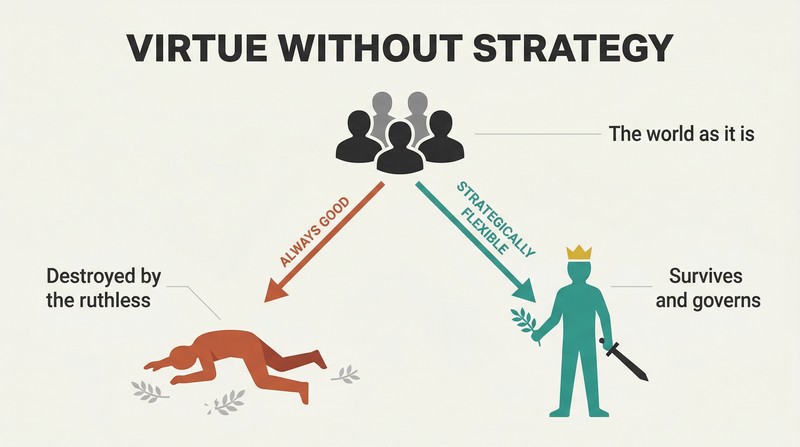
Machiavelli's dual-nature framework for leadership. Ancient fables about Achilles being raised by the centaur Chiron — half man, half beast — taught that rulers must draw on both human and animal natures. Specifically, a ruler needs two animal instincts: the fox's cunning to spot traps, and the lion's ferocity to scare off predators. Brute force without guile walks into ambushes; guile without force has no teeth.
The emperor Severus exemplified the combination. He tricked his rival Albinus into complacency by offering a fake co-emperor title — pure fox. Then, having defeated another rival in the east, he crushed Albinus with military force — pure lion. Despite being a newcomer, Severus held power until natural death through this dual mastery. Cesare Borgia showed the same pattern: he lured the Orsini rebels to Senigallia with diplomacy, then had them seized and killed.
It's safer to be feared than loved — fear is your lever
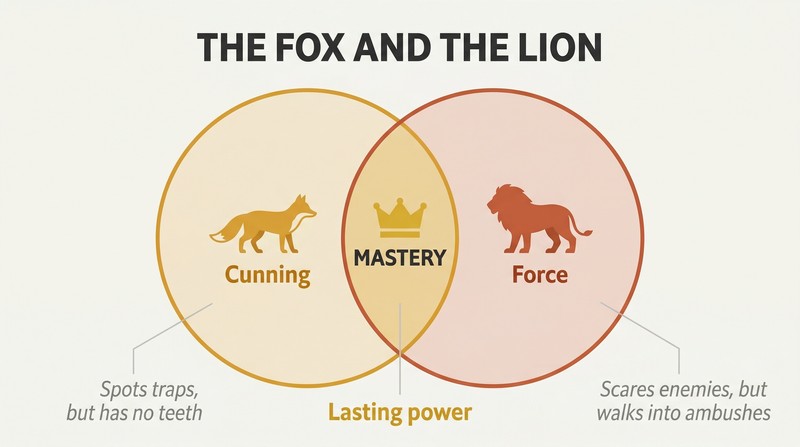
The cold logic of political loyalty. People are ungrateful, unreliable, and greedy, Machiavelli argues. In peacetime they'll promise their blood, their children, their lives. But when danger appears, they vanish. Love depends on others' gratitude, which evaporates the moment it's inconvenient. Fear depends on the threat of punishment — something a ruler controls directly.
Feared must never tip into hated, though. The critical constraint: keep your hands off subjects' property and their women. Hannibal held a massive, multiracial army loyal across years of foreign campaigns through his terrifying cruelty paired with genuine competence. Scipio, by contrast, was so lenient that his troops mutinied in Spain. The distinction matters enormously: a ruler decides whether people fear him, but he cannot decide whether they love him.
Seem virtuous at all times but stay ready to drop the mask
Perception outweighs reality in politics. A ruler doesn't need to actually possess compassion, loyalty, honesty, humanity, and religious faith — but he must appear to embody all five. Seeming religious matters most. Pope Alexander VI never did anything but deceive people, never kept a single promise, yet his cons always worked because he understood human gullibility so thoroughly.
The crowd judges by surfaces and outcomes. Only a handful of people interact with a ruler directly; everyone else relies on appearances. Those few who perceive the gap between image and reality won't challenge majority opinion backed by state authority. If a ruler does what it takes to win and hold power, his methods will be called honorable. As Machiavelli puts it: the world is "all crowd" — the dissenting few find no space when the majority has any grounds for their opinions.

Front-load the cruelty, drip-feed the generosity
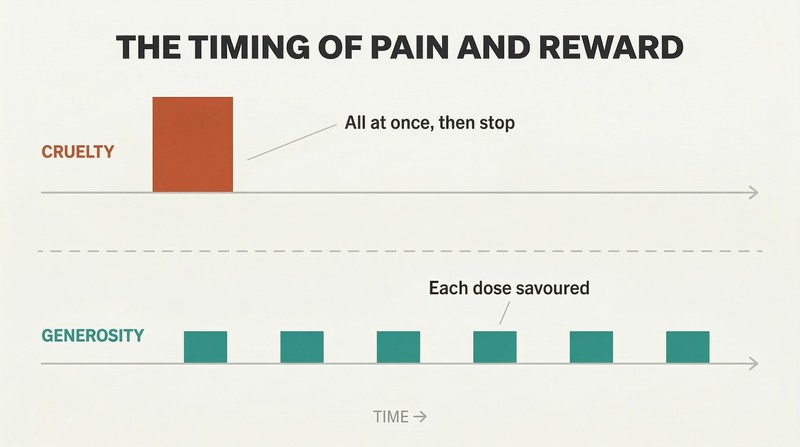
Machiavelli divides cruelty into two categories. Cruelty well used — his term for violence that is short-lived, decisive, and no more than necessary to secure your position, then stops. Cruelty badly used starts mild but escalates over time, leaving people in permanent dread with no path to stability.
Agathocles, a potter's son turned King of Syracuse, illustrates the principle. He assembled the city's leaders under pretense of a meeting, then had his soldiers kill every senator and wealthy man in a single morning. The violence was horrifying but complete. He ruled for decades without serious opposition. By contrast, a ruler who punishes sporadically never earns trust — subjects can never feel safe enough to become loyal. Concentrate the bitter medicine at the start; distribute the sweetness gradually so each dose registers.
Treat problems like tuberculosis: easy to cure early, deadly late
Machiavelli's medical metaphor for statecraft. Tuberculosis in its early stages is easy to treat but hard to detect. Wait until symptoms are obvious and the disease becomes terminal. Political threats behave identically. The Romans understood this — they never delayed a war to gain time, knowing that procrastination shifts the odds to enemies. They fought Philip and Antiochus in Greece specifically to avoid fighting them later in Italy.
Louis XII of France ignored this principle and lost everything. He enhanced the Church's power, brought Spain into the peninsula, failed to live in his new territories, and stripped Venice of its strength — each mistake compounding the last. French advisers counseled patience, but delay served his enemies, not him. Shrewd leaders build diagnosis into their routine; they don't wait for the fever.

Generosity drains power; strategic parsimony builds it
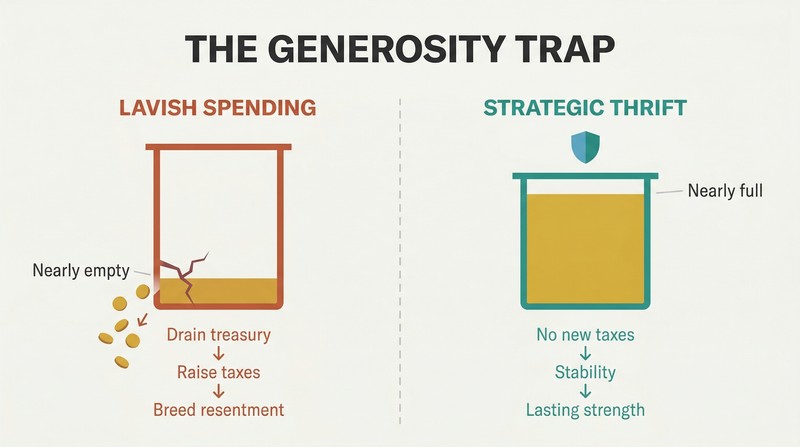
Visible generosity bankrupts rulers. A leader who wants to be seen as generous must spend lavishly, which drains the treasury, forces special taxes, breeds resentment, and leaves him vulnerable to the first serious crisis. The irony: true generosity practiced quietly goes unnoticed, while showy generosity creates a debt spiral ending in hatred.
Strategic thrift is the safer reputation. Pope Julius II used his generous image to win the papacy, then dropped it immediately to fund his wars. The King of France fought many campaigns without imposing new taxes — only possible through relentless cost-cutting. Machiavelli draws one sharp distinction: spend other people's money freely — plunder, conquered wealth — to keep soldiers loyal, but guard your own subjects' money like it's sacred. Spending your own wealth destroys you; spending others' enhances your standing.
Never fight with borrowed soldiers — build forces of your own
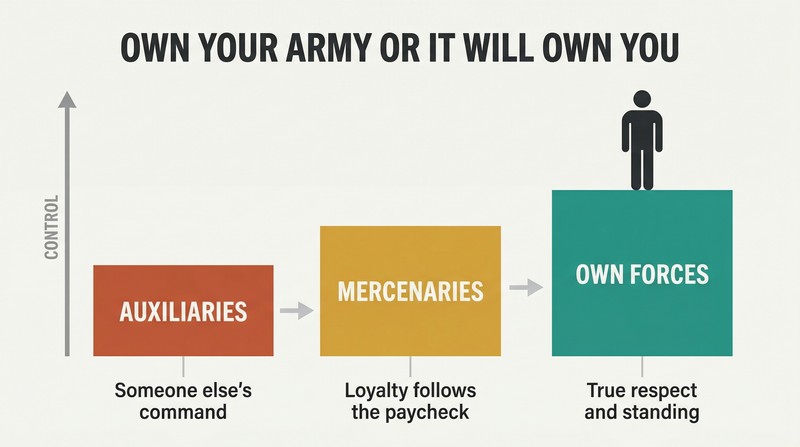
Italy's decline traced to one root cause. For generations, Italian states hired mercenary armies — soldiers with no loyalty beyond their paycheck. These men were "courageous with friends and cowardly with enemies." When France invaded in 1494, the mercenaries evaporated. Auxiliaries — armies borrowed from powerful allies — are even worse: tightly unified under someone else's command, their victory puts you at their mercy.
Cesare Borgia's evolution illustrates the solution. He started with French auxiliaries, switched to Orsini mercenaries, then built his own forces. His standing grew with each transition — he was only truly respected when his soldiers were entirely his own. Venice, by contrast, hired Carmagnola, a brilliant commander who lost his appetite for fighting. They couldn't fire him without losing territory, so they killed him. Rome and Sparta stood for centuries armed with their own citizens. The lesson is structural: own your army or it will own you.
Pick a side — neutrality earns the contempt of everyone
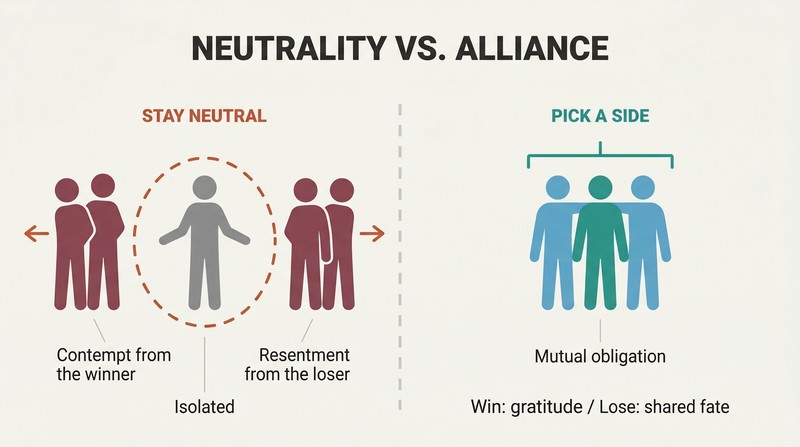
Neutrality sounds safe but guarantees isolation. When two powerful neighbors go to war, the temptation is to sit it out. Machiavelli considers this the worst possible strategy. The victor will despise you for not helping when it mattered; the defeated side will resent you for refusing to share their fate. You end up friendless on both sides.
Declare yourself boldly for one side. If your ally wins, he's indebted — and no victory is so total that the winner can discard all principles of justice. If your ally loses, you become companions in misfortune whose luck may yet turn. When the Romans urged the Achaean League to join their war against Antiochus, they warned bluntly: staying neutral means earning zero gratitude and being consumed as spoils by whoever wins.
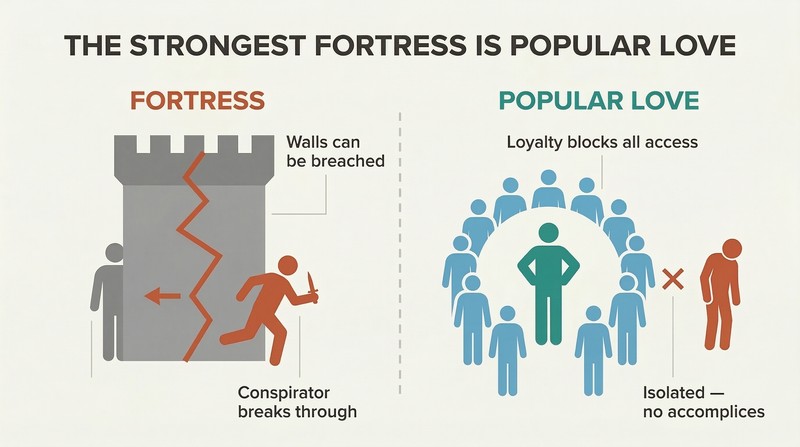
Popular support beats fortresses against conspiracy
Conspiracies are the ruler's greatest internal threat — but popular love neutralizes them. A conspirator can only recruit the discontented. The moment he reveals his plot, his confidant faces a stark choice: the certain reward of betrayal versus the enormous risk of joining a conspiracy. The math overwhelmingly favors betrayal. When people love their ruler, would-be conspirators cannot find accomplices.
The Bentivogli case proves it. When the Canneschi family assassinated Duke Annibale of Bologna, the populace immediately rose up and slaughtered every Canneschi they could find. With no adult Bentivogli heir available, they tracked down a man in Florence — previously passing as a blacksmith's son — rumored to be a family descendant. They installed him as governor until the young heir grew up. Stone walls can be breached; that kind of ferocious popular loyalty cannot.
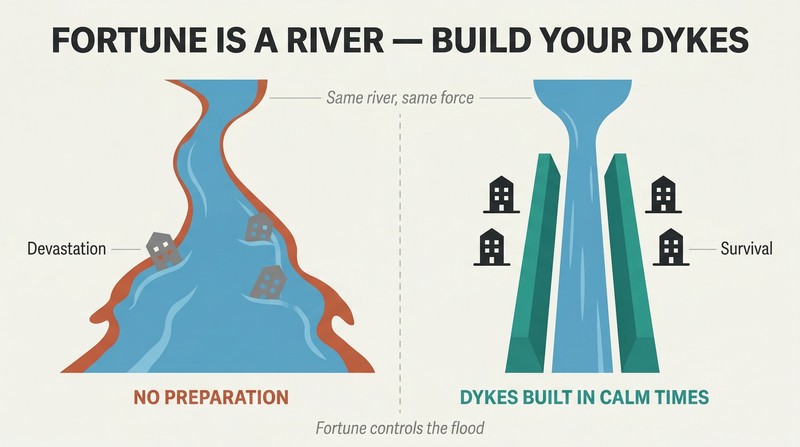
Fortune rules half your fate — build defenses while calm
Machiavelli's metaphor for fate is a raging river that floods the plain, uprooting everything in its path. But between floods, you can build banks and dykes so the next surge flows through a single channel. Fortune may decide half of what happens, but the other half belongs to preparation and free will. Italy's devastation was so total, Machiavelli argues, precisely because no one built the defenses.
The deeper tragedy is psychological. Success depends on whether your character suits the times. Pope Julius II was naturally impulsive — and his era rewarded boldness. He launched the attack on Bologna while still negotiating with France, catching Spain and Venice unable to react. Had circumstances shifted to require caution, Julius would have been ruined. A person cannot remake their temperament. The truly fortunate are those whose nature happens to match their moment.
Analysis
The Prince endures not because it teaches ruthlessness — any thug can manage that — but because it poses a question Western civilization still hasn't satisfactorily resolved: can political effectiveness and moral virtue fully coexist? Written in 1513 by a disgraced diplomat after imprisonment and torture, the book landed like a grenade in the lap of European Christendom. Its real scandal wasn't advocating cruelty but refusing to judge it morally when it produced political results. Machiavelli didn't celebrate evil; he simply refused to pretend it didn't work.
What makes the text so durably uncomfortable is its empirical method applied to ethics. Machiavelli treats statecraft the way a diagnostician treats disease — observing what works, cataloguing outcomes, prescribing treatment regardless of the patient's feelings about the medicine. This proto-scientific detachment, arriving centuries before the Enlightenment formalized empiricism, made him both prophetic and permanently controversial. His name became an adjective for deviousness largely through Innocent Gentillet's 1576 polemic, which most critics read instead of the original — a distortion that persists whenever someone equates 'Machiavellian' with simple villainy.
Modern readers often miss that The Prince is also a deeply personal document. Machiavelli had been tortured and exiled; his admiration for Cesare Borgia reads less like cold analysis than wish-fulfillment from a career diplomat who spent fourteen years representing Italy's weakest state while watching decisive men reshape the map. He glosses over Borgia's ultimate downfall almost guiltily — the book oscillates between dispassionate realism and barely suppressed longing for power its author never held.
The concluding chapter on fortune reveals the work's most sophisticated insight: success is partly temperamental luck — whether your character suits your era. There is no ideal ruler, only the right ruler for the right moment. This is contingency theory five centuries before management science named it, transforming The Prince from a tyrant's manual into a surprisingly modern meditation on the limits of human agency within forces no individual fully controls.
Review Summary
The Prince is widely regarded as an influential and controversial political treatise. Many readers praise Machiavelli's insights into human nature and power dynamics, finding the book's pragmatic advice on governance still relevant today. However, some criticize its apparent endorsement of immoral tactics. Readers appreciate the historical context and Machiavelli's astute observations, even if they disagree with his conclusions. The book's enduring impact on political thought and its examination of leadership strategies continue to fascinate readers across centuries.
People Also Read






Glossary
Virtù
Any winning leadership qualityMachiavelli's redefinition of the Italian word for 'virtue.' In The Prince, virtù does not mean moral goodness but any quality of character that enables a person to take or hold political power—courage, cunning, decisiveness, or even well-deployed cruelty. It carries a positive connotation: whatever trait solves the problem and keeps the state strong qualifies as virtù, regardless of its moral status.
Fortuna
Uncontrollable forces shaping outcomesMachiavelli's concept of fortune as the totality of circumstances beyond human control that shape political outcomes. He estimates fortune governs roughly half of human affairs, leaving the other half to free will and preparation. His central metaphor compares fortune to a flooding river: its destructive power can be mitigated by building banks and dykes during calm periods, but it cannot be eliminated entirely.
Auxiliaries
Armies borrowed from alliesMilitary forces lent by a powerful ally to defend your territory or fight your wars. Machiavelli distinguishes auxiliaries from mercenaries and considers them even more dangerous. While mercenaries are disorganized and slow to betray, auxiliaries are tightly unified under someone else's command. If they win, you are at their leader's mercy; if they lose, you lose too. Pope Julius II's reliance on Spanish auxiliaries at Ferrara exemplifies the risk.
Fox and lion
Cunning paired with forceMachiavelli's dual-nature framework for effective leadership, drawn from ancient fables of the centaur Chiron. The fox represents cunning and deception—the ability to recognize and avoid traps. The lion represents brute force and intimidation—the power to frighten enemies. A ruler must master both: force alone is blind to snares, and cunning alone lacks teeth to enforce its schemes.
Cruelty well used
Decisive, short-lived necessary violenceMachiavelli's term for violence that is concentrated at the beginning of a ruler's reign—short-lived, decisive, and no more than necessary to secure power—then stopped entirely. Contrasted with 'cruelty badly used,' which starts mild but escalates over time. The distinction determines whether subjects can eventually feel safe and become loyal, or remain in permanent dread. Agathocles of Syracuse exemplifies cruelty well used; his single decisive massacre was followed by decades of stable rule.
FAQ
What's "The Prince" about?
- Political Power: "The Prince" by Niccolò Machiavelli is a treatise on political power, how to acquire it, maintain it, and expand it.
- Types of States: It categorizes different types of states, such as hereditary monarchies and new principalities, and discusses strategies for ruling them.
- Human Nature and Leadership: The book explores human nature and the qualities a ruler must possess to be effective, often advocating for pragmatic, sometimes ruthless, approaches.
- Historical Examples: Machiavelli uses historical examples to illustrate his points, drawing from both ancient and contemporary history.
Why should I read "The Prince"?
- Understanding Power Dynamics: It provides insights into the dynamics of power and leadership that are still relevant today.
- Historical Influence: The book has significantly influenced political thought and is considered a foundational text in political philosophy.
- Practical Advice: Machiavelli offers practical advice on governance that can be applied beyond politics, in business and personal leadership.
- Controversial Perspectives: It presents controversial ideas about morality and ethics in leadership, prompting readers to think critically about these issues.
What are the key takeaways of "The Prince"?
- Realpolitik: Machiavelli emphasizes the importance of realism over idealism in politics, advocating for a pragmatic approach to governance.
- Virtù and Fortuna: The concepts of virtù (a ruler's ability) and fortuna (luck) are central, with success depending on a ruler's ability to adapt to changing circumstances.
- Fear vs. Love: Machiavelli argues that it is safer for a ruler to be feared than loved, as fear is a more reliable means of maintaining control.
- Ends Justify the Means: The book suggests that the ends can justify the means, especially when the stability and security of the state are at stake.
What are the best quotes from "The Prince" and what do they mean?
- "The ends justify the means." This suggests that actions, however morally questionable, are acceptable if they achieve a desirable outcome.
- "It is better to be feared than loved, if you cannot be both." This highlights the importance of maintaining authority and control over being liked.
- "Fortune is a woman, and if you want to stay on top of her, you have to slap and thrust." This metaphor emphasizes the need for assertiveness and adaptability in dealing with unpredictable circumstances.
- "A prince never lacks legitimate reasons to break his promise." This reflects Machiavelli's view that rulers must be flexible and pragmatic, even if it means being deceitful.
How does Machiavelli define virtù in "The Prince"?
- Not Moral Virtue: Virtù in Machiavelli's context does not refer to moral virtue but to qualities that enable a ruler to achieve and maintain power.
- Adaptability and Strength: It includes traits like adaptability, strength, cunning, and decisiveness.
- Pragmatic Leadership: A ruler with virtù can effectively navigate the complexities of governance and respond to challenges.
- Success Over Morality: Virtù is about achieving success and stability, often requiring actions that may not align with traditional moral values.
What role does fortuna play in "The Prince"?
- Unpredictable Force: Fortuna represents luck or chance, an unpredictable force that can affect a ruler's success.
- Preparation and Adaptation: Machiavelli argues that while fortuna is beyond control, a ruler can prepare and adapt to mitigate its impact.
- Balancing Act: Success depends on balancing virtù and fortuna, using skill to navigate the uncertainties of fortune.
- Historical Context: Machiavelli uses historical examples to show how fortuna has influenced the rise and fall of leaders.
What advice does Machiavelli give about being feared or loved as a ruler?
- Fear Over Love: Machiavelli advises that it is safer for a ruler to be feared than loved, as fear is a more reliable means of maintaining control.
- Avoiding Hatred: While being feared, a ruler should avoid being hated, as hatred can lead to rebellion.
- Control Through Fear: Fear ensures obedience and loyalty, as people are less likely to betray someone they fear.
- Balance: A ruler should balance fear with respect, ensuring that fear does not turn into hatred.
How does Machiavelli view morality in leadership in "The Prince"?
- Pragmatic Morality: Machiavelli views morality as secondary to the effectiveness and stability of the state.
- Ends Justify the Means: He suggests that actions, however morally questionable, are justified if they achieve a desirable outcome.
- Flexible Ethics: A ruler must be willing to act immorally when necessary to maintain power and protect the state.
- Critique of Idealism: Machiavelli critiques idealistic views of leadership, emphasizing the need for practical and sometimes ruthless decision-making.
What historical examples does Machiavelli use in "The Prince"?
- Cesare Borgia: Machiavelli uses Borgia as an example of a ruler who effectively used cunning and ruthlessness to maintain power.
- Alexander the Great: He discusses Alexander's ability to maintain control over conquered territories through strategic governance.
- Roman Emperors: Machiavelli analyzes the successes and failures of various Roman emperors to illustrate his points about leadership.
- Contemporary Leaders: He references contemporary leaders like Ferdinand of Aragon to demonstrate effective statecraft.
How does Machiavelli suggest a ruler should handle conquered territories?
- Eliminate Former Rulers: Machiavelli advises eliminating the family of the previous ruler to prevent rebellion.
- Adapt to Local Customs: A ruler should respect local customs and laws to gain the loyalty of the conquered people.
- Establish Colonies: Establishing colonies can help maintain control and prevent uprisings.
- Use Local Support: Gaining the support of local leaders can help stabilize the new territory and integrate it into the ruler's domain.
What is Machiavelli's view on the use of mercenaries in "The Prince"?
- Unreliable Forces: Machiavelli views mercenaries as unreliable and dangerous, as they lack loyalty and are motivated solely by money.
- Self-Interest: Mercenaries may turn against their employer if it serves their interests, posing a threat to the ruler's power.
- Citizen Armies: He advocates for citizen armies, which are more loyal and invested in the ruler's success.
- Historical Examples: Machiavelli uses historical examples to demonstrate the failures of relying on mercenary forces.
How does "The Prince" address the concept of luck in leadership?
- Luck's Influence: Machiavelli acknowledges that luck plays a significant role in a ruler's success or failure.
- Preparation and Adaptation: He emphasizes the importance of preparation and adaptability to mitigate the effects of luck.
- Balancing Virtù and Fortuna: A successful ruler balances virtù (skill) and fortuna (luck) to navigate challenges.
- Historical Context: Machiavelli uses historical examples to illustrate how luck has impacted the fortunes of leaders.
About the Author
Other books by Niccolò Machiavelli
Download PDF
Download EPUB
.epub digital book format is ideal for reading ebooks on phones, tablets, and e-readers.








































