


Key Takeaways
Your worst enemy isn't the competition; it lives inside your skull
Ego is unhealthy self-importance. Holiday strips the word of its Freudian baggage and defines it plainly: an inflated, irrational belief in your own significance, the petulant child that demands recognition far past any usefulness. It soothes fear and insecurity by whispering that you are special, that the rules bend for you. The catch is that comfort comes at a long-term cost.
The same traits that promise success can sabotage it. The drive that pushes talented people upward also makes them susceptible to delusion. Ego repels feedback, blinds us to opportunity, and severs the honest connection to reality that mastery requires. Holiday borrows the AA framing of ego as 'a conscious separation from' everything. The book is organized around three recurring phases where ego attacks: aspiration, success, and failure.
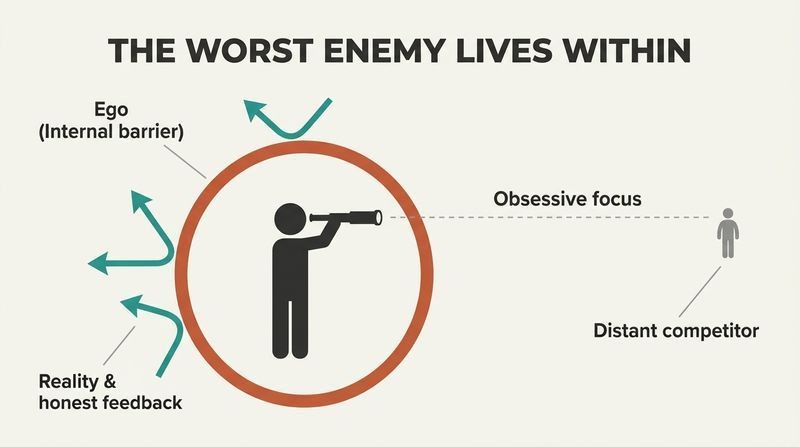
What's striking is how Holiday medicalizes ego, comparing it to alcoholism via CEO Harold Geneen: the egotist doesn't stumble or slur, he simply grows arrogant while mistaking that arrogance for confidence. This dovetails with research on the Dunning-Kruger effect, where incompetence breeds overconfidence precisely because it removes the capacity to recognize one's limits. The framing also echoes Stoic psychology, the book's intellectual spine. One useful tension: ego and healthy ambition share a border, and Holiday never fully resolves where drive ends and ego begins, leaving readers to police a line that even he admits is blurry.
Choose to do something real over being someone important
Fighter pilot John Boyd posed the defining question. Boyd revolutionized aerial combat and helped design the F-15 and F-16, yet never rose above colonel and died nearly forgotten with uncashed expense checks (which he treated as bribes) in a drawer. To each promising protege he offered a fork: you can be somebody (get promotions, good assignments, club membership, but compromise yourself) or do something (real work that matters, but no glory and powerful enemies).
Purpose makes the choice easy. When success is about your reputation and ease, every shiny title pulls you. When it's about accomplishing something larger than yourself, the distractions dissolve because they were never real choices. Boyd would write DUTY, HONOR, COUNTRY on a chalkboard, then cross them out and replace them with PRIDE, POWER, GREED, illustrating how institutions corrupt the values they claim to serve.
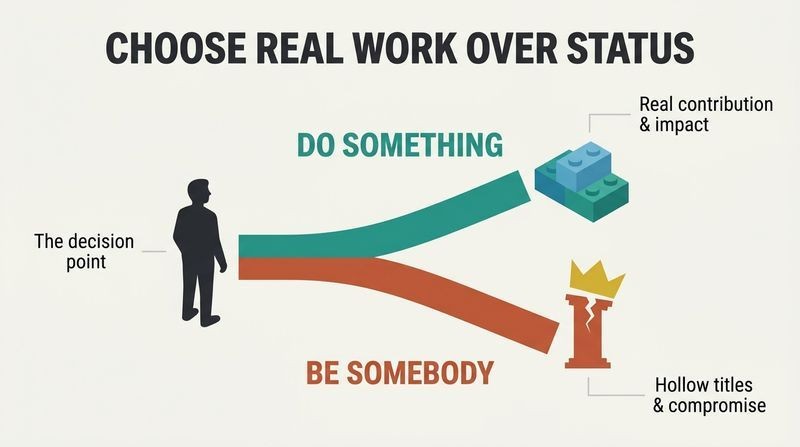
The to-be-or-to-do dichotomy resonates with Viktor Frankl's distinction between being driven by drives versus pulled by values, and with self-determination theory's finding that intrinsic motivation outperforms status-chasing for sustained achievement. Boyd's life is the steelman: his ideas outlived him precisely because he refused the careerism that would have diluted them. The honest counterpoint is survivorship comfort. Most people who sacrifice promotion for purity simply end up unrecognized and broke, full stop. Holiday's framing works best as an internal compass for decision-making, not a guarantee that integrity gets rewarded, which the book is admirably candid about elsewhere.
Talking about your goals tricks your brain into feeling done
Hype steals the energy that work requires. Author Upton Sinclair wrote a book describing his governorship in past tense before the election, then lost interest and was crushed at the polls. Holiday argues talk and doing draw from the same well. Research on goal visualization shows that after a point the mind confuses verbalizing progress with making it, and announcing intentions reduces the drive to follow through.
Silence is the discipline of the confident. Anyone can chatter; staying out of the conversation is rare and strong. Bo Jackson told only his girlfriend that he intended to win the Heisman and go first in the NFL draft. Writer Emily Gould spent a year tumbling, tweeting, and scrolling instead of finishing a novel she had a six-figure deal for, mistaking digital busywork for creative labor.
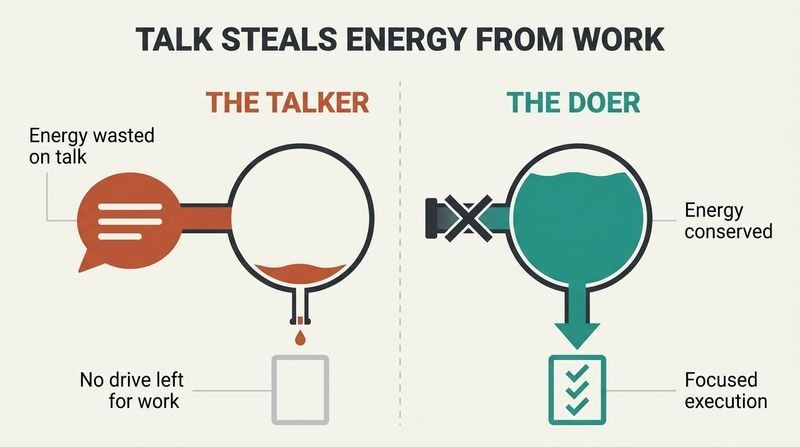
Holiday's claim has empirical teeth. Psychologist Peter Gollwitzer's studies found that announcing identity-relevant goals produces a premature sense of completeness that demotivates action, the very effect described here. The point lands harder in the social-media age, where performing ambition is frictionless and instantly rewarded with likes that simulate accomplishment. A fair nuance: some research suggests public commitment increases follow-through when accountability is real (think gym partners or stakes-based contracts). The distinction seems to be between bragging about outcomes versus committing to specific behaviors. Holiday targets the former, the dopamine hit of self-promotion that substitutes for the grind.
Stay a perpetual student, because thinking you've arrived stops growth
Mastery requires revising your self-assessment downward. When guitarist Kirk Hammett landed his dream job in Metallica, a band that would sell over 100 million albums, he immediately hired a teacher (Joe Satriani) because he knew he wasn't good enough yet. Many of his peers stormed out of Satriani's harsh lessons; Hammett endured two years of drilling and became one of metal's greats.
A student mindset caps the ego and demands honesty. MMA champion Frank Shamrock's plus-minus-equal system says every fighter needs someone better to learn from, someone lesser to teach, and an equal to test against, generating feedback from every angle. Epictetus noted you cannot learn what you think you already know. The hardest skill in life is actively soliciting harsh feedback precisely when your brain insists you're doing great.
This aligns tightly with Carol Dweck's growth mindset research and with Anders Ericsson's deliberate practice, which requires constant feedback at the edge of competence rather than comfortable repetition. The apprenticeship model Holiday praises also has deep historical roots, from medieval guilds to Robert Greene's Mastery. What deserves emphasis is the structural genius of Shamrock's formula: it engineers humility into a system rather than relying on willpower. One challenge worth raising: deference to a master can also calcify into dogma if the student never graduates to questioning. The healthiest version pairs studentship with eventual, earned independence of judgment.
Passion is overrated; purpose with boundaries beats burning enthusiasm
Unbridled zeal masks weakness. Holiday distinguishes passion (breathless, frantic, all-in enthusiasm) from purpose (deliberate, realistic, directed effort). Eleanor Roosevelt rejected the word passionate for herself, preferring reason and direction. Coach John Wooden, who won ten titles in twelve years, was described by Kareem Abdul-Jabbar as dispassionate, never passion's slave.
Passion produces motion without progress. The Segway's inventors, the Iraq War's architects, and arctic explorer Robert Falcon Scott all had fervent belief and ignored the objections that doomed them. Holiday's formula: purpose deemphasizes the self (I must accomplish X) while passion centers it (I am so passionate about X). The deliberate person hires professionals, asks what could go wrong, plans contingencies, starts small, locks in gains, and iterates, growing exponentially rather than burning out like spinning tires on asphalt.
This is Holiday's most counter-cultural argument, swimming against a TED-talk economy that sanctifies passion. It finds support in Cal Newport's So Good They Can't Ignore You, which similarly debunks the follow-your-passion mantra in favor of building rare skills. Angela Duckworth's grit research also distinguishes sustained, directed perseverance from fleeting enthusiasm. The danger Holiday names, what psychologists call goalodicy, where obsession with a goal blinds people to mortal risk, is well documented in the 1996 Everest disaster. A reasonable pushback: emotional intensity does fuel creativity and resilience for many. The book's real target is undisciplined passion divorced from execution, not caring deeply.
Clear the path for others and you control its direction
The canvas strategy turns servitude into strategy. In ancient Rome, an anteambulo cleared the way for a patron. Holiday reframes grunt work: instead of resenting it like the bitter poet Martial, find canvases for others to paint on. Help the people above you succeed and you absorb knowledge, build relationships, and bank favors. Benjamin Franklin wrote his famous Silence Dogood letters anonymously, slipping them under his brother's print-shop door and taking no credit, while learning how public opinion worked.
Greatness grows from grunt work. Bill Belichick, the four-time Super Bowl coach, started by volunteering to analyze game film for free, the task other coaches disdained, and let senior staff take credit for his insights. He learned to give feedback privately and self-effacingly. Trade short-term recognition for long-term mastery and indispensability.
The canvas strategy is essentially a power move disguised as humility, and Holiday is refreshingly honest that the path-clearer ultimately steers the path. It connects to Adam Grant's research on givers, who often outperform takers over long time horizons by accumulating goodwill and information. The framing also rehabilitates apprenticeship in a culture that disdains paying dues. A useful caveat: the strategy can shade into exploitation if the surrounding system never rewards the contributor, and Holiday's own examples (Franklin's brother beat him out of jealousy) hint at this. The discernment lies in choosing patrons and institutions worth investing your invisible labor in.
Restraint, not retaliation, is how the underestimated win
Jackie Robinson's greatness required swallowing his fury. Branch Rickey sought a player with the guts not to fight back. Robinson, who as a young man had been arrested for challenging police and court-martialed for refusing to move to the back of a bus, agreed. Over nine seasons he was hit by 72 pitches, spiked, and slurred, yet never threw a punch. He even posed for a friendly photo with a manager who had viciously taunted him, calling it one of the hardest things he ever did, because it served a larger plan.
Poor treatment degrades the giver, not the receiver. The up-and-coming must endure the abuses of the entrenched. Talent, degrees, and money don't exempt you. Holiday's counsel is unglamorous: take it, brush it off, work harder, ignore the noise, and refuse to let provocation derail your purpose.
Robinson's restraint is a masterclass in what psychologists call emotion regulation under chronic provocation, and modern research links such self-control to long-term goal attainment more reliably than raw talent. The Stoic principle underneath, that others' insults cannot harm your character unless you let them, runs from Marcus Aurelius to Viktor Frankl's insistence on the last human freedom: choosing one's response. The hard ethical edge here deserves naming: Holiday acknowledges Robinson shouldn't have had to endure this. Restraint as strategy assumes the sufferer carries the burden of injustice while changing a system from within, which is both pragmatically powerful and morally uncomfortable, a tension the book honors rather than hides.
Don't narrate your success into a destiny you planned all along
Stories rewrite messy reality into flattering myth. Coach Bill Walsh took the 49ers from the worst team in football to a Super Bowl in three years, yet refused to claim a timetable or call it destiny. Instead he installed a 'Standard of Performance,' obsessive attention to small details (no sitting on the practice field, tucked-in shirts, passing routes graded to the inch), trusting that if you handle the details, the score takes care of itself.
Believing the narrative breeds the fall. After their first title, the 49ers, intoxicated by their own specialness, lost 12 of 22 games until they returned to the standard. Jeff Bezos reminds himself there was no 'aha moment' for Amazon. Investor Paul Graham advises startups to start with deceptively small things and keep their identity small rather than chasing world-changing visions for headlines.
Holiday is describing hindsight bias and the narrative fallacy that Nassim Taleb and Daniel Kahneman dissect: humans compulsively impose coherent causal stories on outcomes that were largely contingent. The danger isn't vanity alone but epistemics, a false story corrupts your model of why you succeeded, so you can't repeat it. Walsh's process-over-outcome focus prefigures the systems-thinking of James Clear and the deliberate-practice literature. The subtle insight is that labels (genius, founder, visionary) become identity traps that put you at odds with the very behaviors that worked. Keeping identity small is cognitive hygiene as much as humility.
Run only your own race; envy diverts energy from purpose
Knowing what's enough immunizes you against envy. After the Civil War, Sherman and Grant could have anything. Sherman declined politics, said he had all the rank he wanted, and retired content. Grant, despite no aptitude for it, chased the presidency, presided over a corrupt administration, then lost everything to a Ponzi-scheme business partner, dying broke and racing throat cancer to finish his memoirs. He couldn't decide what actually mattered to him.
Ego rejects trade-offs and wants it all. The further you climb, the more successful people you meet who make you feel insignificant, an infinite cycle. Holiday invokes the Greek euthymia, tranquility, the sense of your own path and how to stay on it without being distracted by the intersecting roads of others. If you don't define how much money is enough, the default becomes more.
The Grant tragedy illustrates what behavioral economists call the hedonic treadmill and reference-group theory: satisfaction is relative to whoever we compare ourselves against, so unbounded comparison guarantees perpetual dissatisfaction. Seneca's euthymia anticipates modern findings that intrinsic goals (relationships, growth, contribution) produce more durable wellbeing than extrinsic ones (wealth, status, image). What elevates this beyond platitude is the operational test: knowing what you don't want and what your choices preclude, since strategies are often mutually exclusive. One cannot be an opera singer and a pop idol simultaneously. The discipline of saying no is the practical expression of self-knowledge the chapter demands.
Success breeds entitlement, control, and paranoia; police all three
Power amplifies the delusions that destroy it. Holiday names three diseases of success. Entitlement assumes this is mine, I earned it, and devalues others' time. Control insists everything be done its way, curdling into paralyzing perfectionism and pointless battles. Paranoia trusts no one and, in protecting itself, manufactures the enemies it fears. Beanie Babies creator Ty Warner bragged he could stamp his logo on manure and people would buy it, then nearly destroyed his company and almost went to jail.
The traits that built success can poison it. Persistence and risk-tolerance, partly irrational, feel vindicated by victory and harden into hubris. Seneca warned that he who indulges empty fears earns himself real ones. Xerxes literally ordered the sea whipped 300 lashes for wrecking his bridges, the absurd extreme of a leader who overestimated his own reach.
This maps onto a robust finding in social psychology: power reduces perspective-taking and empathy while increasing impulsivity, what Dacher Keltner calls the power paradox, where the very skills that earn influence erode once influence is attained. Holiday's three-headed diagnosis is clinically useful because each disease has a distinct antidote: entitlement needs gratitude, control needs delegation, paranoia needs trust. The Nixon tapes he references are a case study in how paranoia becomes self-fulfilling. A connection worth drawing: Jim Collins's research on corporate decline identifies hubris born of success as the literal first stage. Ego isn't just a personal flaw; it's a documented organizational failure mode.
Play for the name on the front, not the back of the jersey
The Disease of Me kills winning teams. Coach Pat Riley observed that teams begin with an Innocent Climb, watching out for each other, then after winning, egos swell and the Disease of Me sets in: players calculate their own importance and chests inflate. General George Marshall was the rare exception. He discouraged his own promotions, declined a field marshal title, and when offered command of the D-Day invasion, the role that would cement any general's place in history, told Roosevelt the decision was his, refusing to lobby. The job went to Eisenhower, who proved the right choice.
Confidence can wait; ego cannot. Ego needs honors to feel validated; confidence focuses on the task regardless of recognition. Marshall once declined to even look at his own finished official portrait. President Truman said Marshall never thought about himself.
Marshall embodies what organizational researchers call Level 5 Leadership in Jim Collins's terminology: a paradoxical blend of fierce professional will and personal humility that consistently outperforms charismatic, ego-driven leaders. Riley's Disease of Me is a folk version of the free-rider and credit-allocation problems that plague high-performing teams. Adam Grant's work on givers and the productivity of psychological safety reinforces the point that subsuming individual glory often maximizes collective output. The magnanimity Holiday praises (Marshall sparing a man who once banished him because the country still needed him) is strategic and moral at once. The challenge: such selflessness requires institutions that eventually recognize it, which not all do.
In failure, judge yourself by your scorecard, not the scoreboard
Define success internally so defeat can't destroy you. Belisarius, who saved Western civilization in multiple battles, was repeatedly suspected by the paranoid emperor he served, stripped of wealth, and (per legend) blinded, yet never complained, because doing his duty well was enough. The effort, not the reward, was the point. Marcus Aurelius wrote that tying your wellbeing to others' opinions is ambition, while tying it to your own actions is sanity.
Keep an inner scorecard. When the Patriots drafted Tom Brady 199th, one of the greatest picks ever, the front office focused not on luck but on the scouting failure that nearly cost them. Warren Buffett distinguishes the inner scorecard (your own highest standard) from the external one. Anyone can get lucky and win; the question is whether you became the best version of yourself.
The inner-scorecard concept is psychologically protective: research on contingent self-worth shows that people who anchor esteem to external validation (grades, money, applause) suffer greater anxiety and fragility than those anchored to internal standards and growth. Holiday weaves in John Wooden's redefinition of success as peace of mind from knowing you did your best, which prefigures self-determination theory's emphasis on autonomy and mastery over comparison. The Brady example is sharp because it shows the standard works even in victory, refusing to let a lucky win paper over a process flaw. The deeper move here is decoupling identity from outcome, the Stoic dichotomy of control rendered operational.
Treat every setback as alive time, not dead time
You choose whether wasted time becomes fuel. Robert Greene's distinction: dead time is passive waiting; alive time is learning and acting on every second. Jailed at 21 for burglary, Malcolm X copied the entire dictionary by hand and read voraciously, calling books his alma mater and saying he had never been so free. Francis Scott Key wrote the national anthem while detained on a ship; Viktor Frankl developed his psychology of meaning in concentration camps.
Don't make a bad situation worse by doubling down. Alexander Hamilton advised a friend in self-made trouble to have the courage to make a full stop rather than plunge deeper. When ego controls failure, people escalate: John DeLorean, having mismanaged his car company into collapse, tried to save it with a 60-million-dollar cocaine deal and got arrested. The only true failure is abandoning your principles.
The alive-time framing is a practical translation of the Stoic locus of control and resonates with post-traumatic growth research, which finds that adversity, processed deliberately, can yield heightened meaning and capability rather than mere recovery. Frankl's logotherapy, born in Auschwitz, is the canonical evidence. Holiday's escalation warning maps onto the sunk-cost fallacy and what economists call the gambler's ruin, where the fear of admitting loss drives catastrophically larger bets. DeLorean and Lance Armstrong are vivid case studies in threatened egotism, which psychologists identify as one of the most dangerous predictors of destructive behavior. The counsel to forgive rather than hate (the Streisand-effect chapter) extends this: bitterness is itself a form of dead time.
Analysis
Ego Is the Enemy is a Stoic manual disguised as a business book, structured around three states every ambitious person cycles through endlessly: aspiration, success, and failure. Ryan Holiday's thesis is deceptively simple and culturally subversive: the unhealthy belief in your own importance is the single force most likely to wreck what you build, maintain, and recover. Against a self-esteem culture that equates confidence with swagger and success with vision, Holiday argues that humility, restraint, and student-mindedness are not weaknesses but the operating system of durable achievement.
The book's method is historical pointillism. Rather than abstract argument, Holiday assembles paired portraits, Sherman against McClellan, Marshall against MacArthur, Belisarius against Justinian, Merkel against Putin, and lets contrast carry the lesson. This is its great strength (memorable, vivid, classically grounded) and its methodological weakness (selection bias). For every humble Marshall there is a Steve Jobs whose ego correlated with triumph, a problem Holiday addresses by reframing such figures as people who succeeded despite ego in their best moments, a claim that is plausible but hard to falsify.
Intellectually, the work sits at the confluence of Stoicism (Marcus Aurelius, Seneca, Epictetus), modern leadership research (Collins's Level 5 humility, Riley's Disease of Me), and recovery-movement psychology (ego as conscious separation). Its most original contribution is operational: the anteambulo or canvas strategy, the alive-time/dead-time choice, and the inner versus outer scorecard give readers concrete moves rather than mere exhortation.
The deepest value is its honesty about asymmetry. Holiday concedes that humility guarantees nothing, that good people fail and integrity goes unrewarded, that Belisarius was blinded for his service. This refusal of karmic comfort distinguishes the book from motivational pablum. Its final image, sweeping the floor daily because dust always returns, captures the anti-climactic truth: ego is never defeated, only managed, one swept moment at a time.
Review Summary
Ego Is the Enemy receives mixed reviews. Many praise its insights on humility and self-awareness, finding it thought-provoking and applicable to various life stages. Readers appreciate the historical anecdotes and practical advice for combating ego-driven behavior. However, some criticize the book for lacking depth, being repetitive, or projecting the author's opinions onto historical figures. Critics also note that the message may not resonate with everyone, particularly those already struggling with confidence. Despite divided opinions, many readers find value in the book's core message about the dangers of unchecked ego.
People Also Read



FAQ
What's "Ego Is the Enemy" about?
- Core Theme: "Ego Is the Enemy" by Ryan Holiday explores how ego can be a destructive force in our lives, hindering personal and professional growth.
- Structure: The book is divided into three parts: Aspire, Success, and Failure, each addressing how ego manifests in different stages of life.
- Historical Examples: Holiday uses historical figures and stories to illustrate how ego has led to the downfall of many and how humility and self-awareness can lead to success.
- Practical Advice: The book offers practical strategies to manage ego and cultivate humility, discipline, and resilience.
Why should I read "Ego Is the Enemy"?
- Self-Improvement: The book provides insights into how ego can sabotage personal and professional success and offers strategies to overcome it.
- Historical Lessons: It uses historical examples to show the consequences of unchecked ego, making it a compelling read for history enthusiasts.
- Practical Guidance: Holiday offers actionable advice for managing ego, making it useful for anyone looking to improve their leadership and interpersonal skills.
- Universal Relevance: The themes of ego, humility, and resilience are relevant to anyone, regardless of their career or life stage.
What are the key takeaways of "Ego Is the Enemy"?
- Ego as an Obstacle: Ego is a major barrier to personal and professional growth, often leading to failure and missed opportunities.
- Importance of Humility: Cultivating humility and self-awareness is crucial for long-term success and personal fulfillment.
- Learning from Failure: Failure is an opportunity for growth and learning, provided we can set aside our ego and reflect honestly.
- Continuous Improvement: Success requires ongoing learning and adaptation, and ego can blind us to the need for change.
How does Ryan Holiday define ego in "Ego Is the Enemy"?
- Unhealthy Belief: Ego is defined as an unhealthy belief in our own importance, characterized by arrogance and self-centered ambition.
- Distortion of Reality: It distorts our perception of reality, leading us to overestimate our abilities and underestimate challenges.
- Barrier to Success: Ego is a barrier to mastering a craft, building relationships, and achieving long-term success.
- Enemy of Growth: It prevents us from learning, adapting, and growing by making us resistant to feedback and change.
What are some strategies to manage ego according to "Ego Is the Enemy"?
- Stay a Student: Always be willing to learn and seek knowledge from others, regardless of your level of success.
- Focus on the Work: Prioritize the work itself over recognition or accolades, and let results speak for themselves.
- Practice Restraint: Cultivate self-control and avoid reacting impulsively to challenges or criticism.
- Embrace Humility: Regularly remind yourself of your limitations and the contributions of others to your success.
What are the best quotes from "Ego Is the Enemy" and what do they mean?
- "Ego is the enemy of what you want and of what you have." This quote highlights how ego can sabotage both our aspirations and our achievements.
- "The first principle is that you must not fool yourself—and you are the easiest person to fool." It emphasizes the importance of self-awareness and honesty in overcoming ego.
- "The performance artist Marina Abramović puts it directly: 'If you start believing in your greatness, it is the death of your creativity.'" This warns against the complacency and stagnation that can result from an inflated ego.
- "The orator Demosthenes once said that virtue begins with understanding and is fulfilled by courage." It underscores the need for self-awareness and the courage to act on that understanding.
How does Ryan Holiday use historical examples in "Ego Is the Enemy"?
- Illustrative Stories: Holiday uses stories of historical figures like Genghis Khan, Howard Hughes, and Jackie Robinson to illustrate the destructive power of ego.
- Lessons from History: These examples show how ego led to the downfall of many and how humility and self-awareness contributed to the success of others.
- Diverse Contexts: The book covers a wide range of contexts, from military leaders to business moguls, to demonstrate the universal impact of ego.
- Practical Insights: By analyzing these historical figures, Holiday provides practical insights into managing ego in our own lives.
What is the "Canvas Strategy" mentioned in "Ego Is the Enemy"?
- Concept Overview: The Canvas Strategy involves finding ways to help others succeed, thereby creating opportunities for yourself.
- Selflessness: It emphasizes selflessness and the importance of making others look good, which can lead to personal growth and success.
- Long-Term Benefits: By focusing on helping others, you build relationships and a reputation that can benefit you in the long run.
- Ego Reduction: This strategy helps reduce ego by shifting the focus from personal gain to collective success.
How does "Ego Is the Enemy" address the concept of failure?
- Inevitable Part of Life: The book acknowledges that failure is an inevitable part of life and a crucial learning opportunity.
- Ego's Role in Failure: Ego often exacerbates failure by preventing us from accepting responsibility and learning from our mistakes.
- Resilience and Growth: Holiday emphasizes the importance of resilience and using failure as a stepping stone to future success.
- Self-Reflection: The book encourages self-reflection and humility in the face of failure to facilitate personal growth.
What role does humility play in "Ego Is the Enemy"?
- Foundation for Success: Humility is presented as a foundation for long-term success and personal fulfillment.
- Openness to Learning: It allows us to remain open to learning and growth, even when we achieve success.
- Counter to Ego: Humility acts as a counterbalance to ego, helping us maintain perspective and avoid complacency.
- Building Relationships: It fosters better relationships by making us more empathetic and receptive to others' contributions.
How does Ryan Holiday suggest we deal with success in "Ego Is the Enemy"?
- Avoid Complacency: Success can lead to complacency and arrogance, so it's important to remain humble and focused on continuous improvement.
- Stay Grounded: Keep a realistic perspective on your achievements and remember the contributions of others to your success.
- Maintain Standards: Uphold high standards of performance and integrity, regardless of external validation or recognition.
- Prepare for Challenges: Success often brings new challenges, and maintaining humility and self-awareness can help navigate them effectively.
What is the significance of the "Alive Time or Dead Time" concept in "Ego Is the Enemy"?
- Time Utilization: The concept emphasizes the importance of how we use our time, especially during periods of adversity or inactivity.
- Alive Time: This is when we actively learn, grow, and make the most of our circumstances, regardless of external conditions.
- Dead Time: In contrast, dead time is when we passively wait or waste time, allowing ego to prevent us from making progress.
- Personal Growth: By choosing alive time, we can turn setbacks into opportunities for personal growth and development.
The Way, The Enemy, and The Key Series

About the Author
Other books by Ryan Holiday




Download PDF
Download EPUB
.epub digital book format is ideal for reading ebooks on phones, tablets, and e-readers.








































