


Key Takeaways
Every fortune begins as a thought someone refused to let die
Hill spent 25 years studying over 500 of America's wealthiest people — Carnegie, Edison, Rockefeller, Ford — and distilled their methods into 13 principles. His central discovery: riches begin as a state of mind, not a business plan or inheritance. Edwin C. Barnes arrived at Edison's laboratory on a freight train, penniless, carrying nothing but an obsessive desire to become Edison's business partner. He worked menial jobs for five years until his chance appeared — then sold the Edison Dictating Machine so successfully the slogan became "Made by Edison and Installed by Barnes."
Hill's distinction is surgical. A wish is passive; a burning desire is an all-consuming obsession that compels action. Marshal Field stood in the ashes of the 1871 Chicago Fire and declared he'd build the world's greatest store on that very spot — while every other merchant fled. He did. The gap between those who accumulate fortunes and those who don't is the intensity of desire.
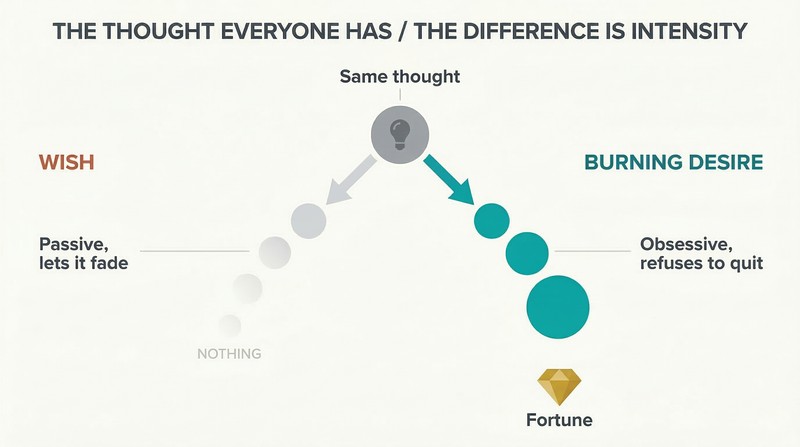
Write your exact financial goal and read it aloud with emotion daily
The Six-Step Success Formula is the book's most actionable framework:
1. Fix the exact amount of money you desire
2. Determine exactly what you'll give in return
3. Set a definite deadline
4. Create a definite plan and begin immediately
5. Write a clear statement combining all four elements
6. Read it aloud twice daily — morning and night — while seeing, feeling, and believing yourself already in possession of the money
This protocol works because the subconscious mind responds exclusively to thoughts delivered with strong emotion — faith, desire, love — and ignores cold, logical instructions. Hill warns that mechanically repeating a goal statement a million times is useless. You must visualize the money, feel it in your hands, and believe with total conviction each time you read your statement.
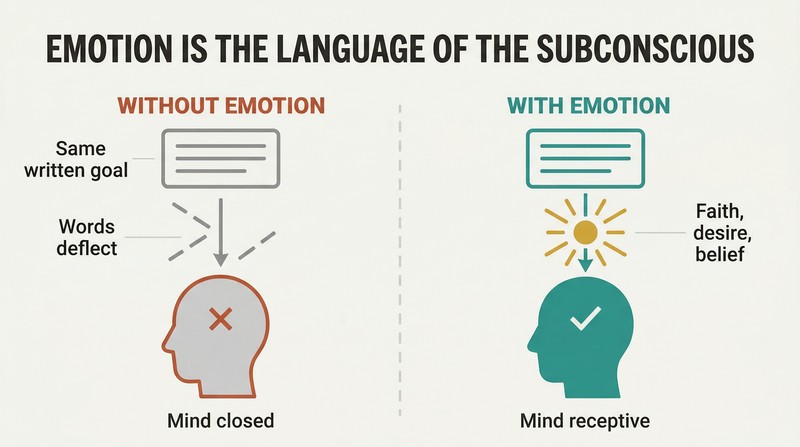
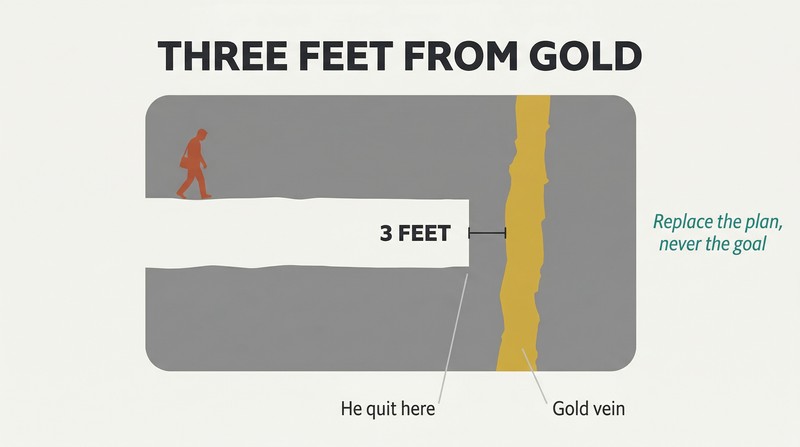
Never stop three feet from gold — rebuild the plan, not the dream
R. U. Darby's uncle struck gold in Colorado, raised money for mining equipment, and began pulling rich ore. Then the vein disappeared. After desperate drilling, they quit and sold everything to a junk dealer. That dealer hired a mining engineer who found the vein just three feet from where the Darbys stopped — and pulled millions from the mine.
Darby carried that lesson into insurance sales, becoming one of America's top producers. Edison failed 10,000 times before perfecting the light bulb. Hill's four steps to build persistence: a definite purpose backed by burning desire, a definite plan in continuous action, a mind closed tightly against negativity, and a supportive alliance of encouragers. When your plan fails, replace the plan — never the goal.
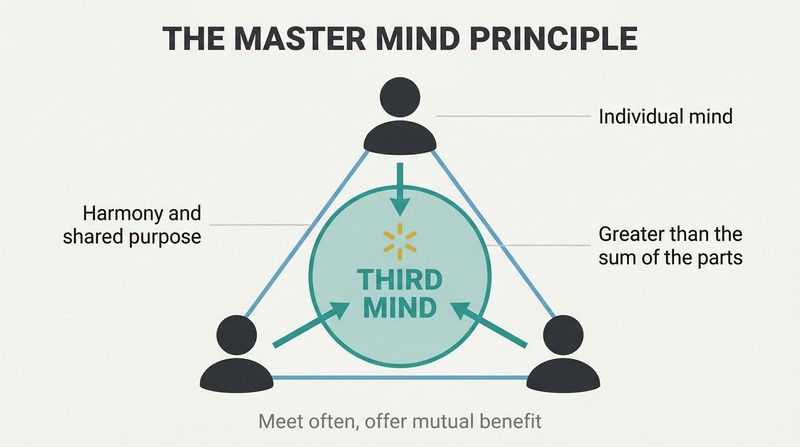
Build a Master Mind group — no great power exists without one
The Master Mind principle is Hill's term for coordinating knowledge and effort between two or more people in perfect harmony toward a definite purpose. Andrew Carnegie attributed his entire fortune to his group of roughly 50 specialists. Henry Ford leapt from poverty to extraordinary wealth after allying with Edison, Firestone, and Burbank. Hill even argues the American Revolution succeeded because Adams, Hancock, and Lee formed a Master Mind that grew into the Continental Congress.
The principle has two dimensions. Economically, you access knowledge and resources beyond one person's capacity. But Hill also claims coordinated minds produce an intangible "third mind" — a force greater than the sum of the parts. Select allies who share your purpose, meet at least twice weekly, maintain absolute harmony, and offer each member clear benefits for their cooperation.
Decide quickly, change slowly, and guard your plans
Hill's analysis of millionaires revealed a stark pattern: every one reached decisions promptly and changed them slowly. People who fail do the opposite — decide slowly and reverse course at the first resistance. Henry Ford's stubbornness about the Model T was called obstinacy, but it yielded a fortune before any change was needed.
Guard your decisions fiercely. Hill warns that relatives and acquaintances will eagerly volunteer opinions that undermine your resolve — share plans only with your Master Mind group. Keep your eyes and ears open, your mouth closed. The 56 signers of the Declaration of Independence demonstrated what decisive courage looks like: each signed knowing it meant death if the Revolution failed. Their decision, born from a Master Mind of Adams, Hancock, and Lee, created a nation.
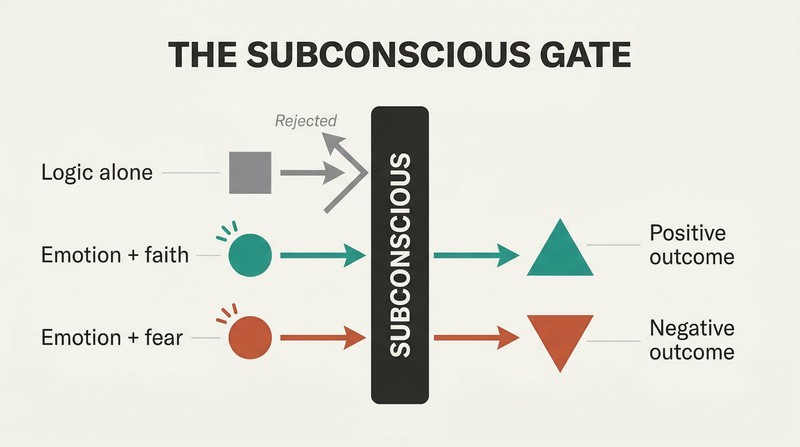
Your subconscious acts on emotionalized repetition, not logic
Autosuggestion is Hill's term for self-directed stimuli reaching the mind through the five senses — the only voluntary method for programming your subconscious. The subconscious responds to thoughts mixed with intense emotion and ignores detached, rational instructions. This is why the Six-Step Formula demands you feel possession of your goal, not just recite it.
The principle cuts both ways. Negative thoughts saturated with fear program the subconscious just as effectively as positive ones charged with faith. Hill demonstrated this with his son Blair, born without ears. By relentlessly planting the desire to hear — through bedtime stories, emotional conviction, and unwavering belief — Hill influenced Blair's subconscious so powerfully that the boy eventually developed functional hearing against all medical expectations.
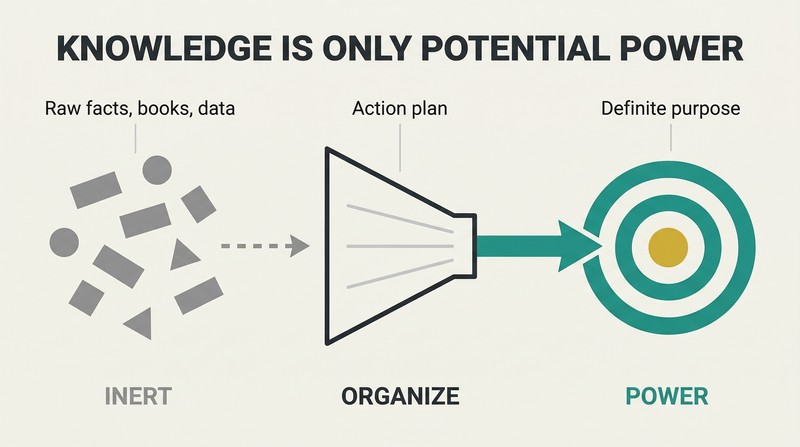
Organize knowledge into action plans — raw information is inert
Knowledge is only potential power. When a lawyer tried to prove Henry Ford ignorant in court, Ford replied that by pressing the right button on his desk, he could summon anyone to answer any question — so why clutter his mind with trivia? Carnegie admitted knowing nothing about the technical side of steelmaking; his Master Mind group held that expertise. Hill redefines education: it's not what you know, but your ability to organize knowledge and direct it toward a definite purpose.
Acquire specialized knowledge relevant to your chief aim, structure it into practical plans, and fill gaps through allies. Hill notes that continuing self-education impresses employers more than degrees because it signals initiative — the quality that separates leaders from followers. The person who stops learning after school is "forever hopelessly doomed to mediocrity."
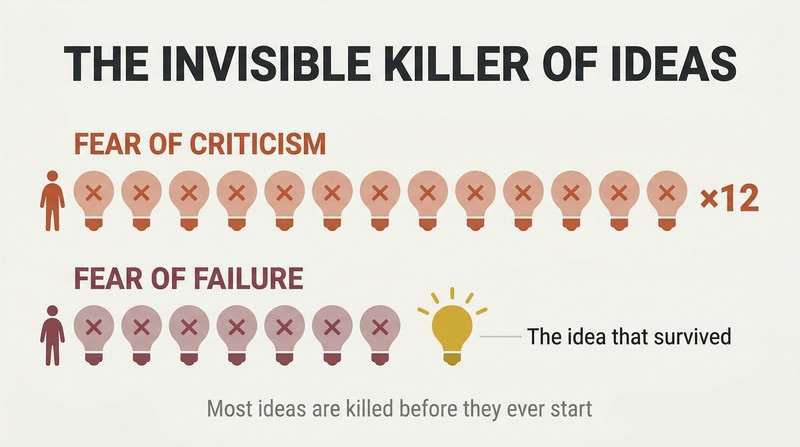
Fear of criticism kills more ideas than failure ever could
Of Hill's Six Basic Fears — poverty, criticism, ill health, loss of love, old age, and death — criticism is among the most destructive because it operates invisibly. It stops people from setting ambitious goals, starting businesses, or voicing honest opinions. Hill confesses that when Carnegie proposed his 20-year research project, his own mind flooded with fears: "Who are you to aim so high? People will think you're crazy."
Criticism destroys ideas at birth. Parents who chronically criticize create permanent inferiority complexes. Employees who fear ridicule never share their best thinking. Hill's prescription: decide not to worry about what others think, and recognize that most people project their own limitations onto you. Nurture every idea the moment it appears — every minute it lives gives it a better chance of surviving.
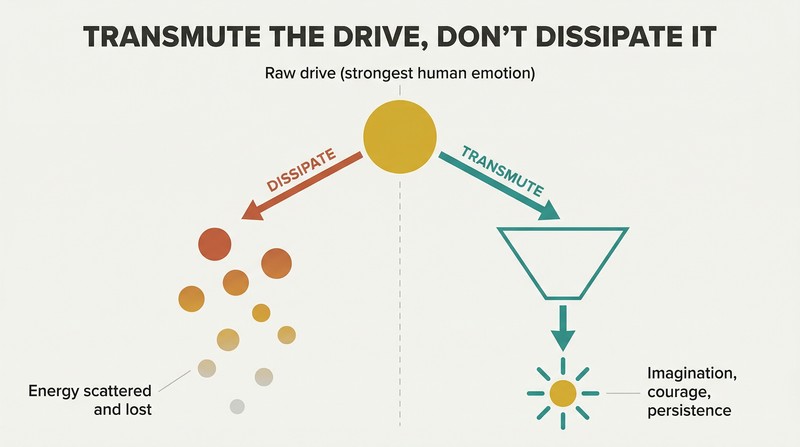
Redirect your most powerful biological drive into creative work
Sex transmutation — Hill's most provocative principle — means channeling sexual energy into creative endeavor, not suppressing it. Hill found that individuals of greatest achievement had highly developed sexual natures and learned to redirect that drive into imagination, courage, and persistence. His analysis of 25,000 people revealed most don't peak until after 40, largely because they spend earlier decades dissipating this energy rather than transmuting it.
The mechanism is practical. Of Hill's ten mind stimuli, sexual desire ranks first in intensity. Top salespeople unconsciously convert this energy into personal magnetism and enthusiasm. When the emotion of love combines with sexual energy, Hill calls the result the "eternal triangle of achievement-building genius" — the force he found behind nearly every creative masterwork and financial empire in history.
Rehearse greatness — Hill imagined nightly councils with Lincoln and Edison
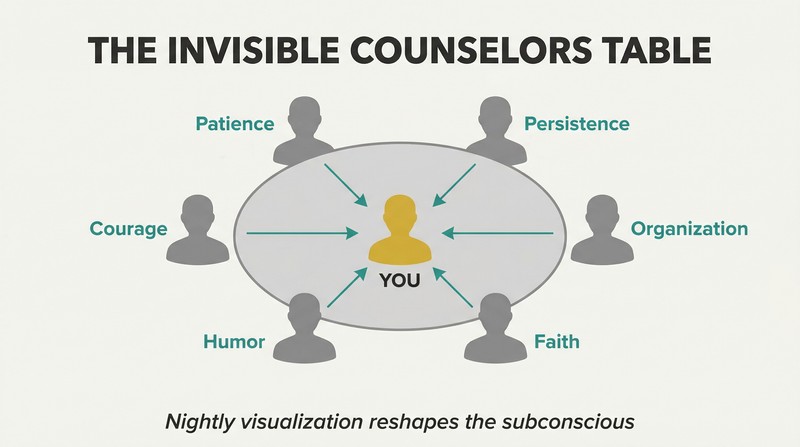
Hill's Invisible Counselors technique is the book's most unusual practice. Every night before sleep, he visualized nine admired figures — Emerson, Edison, Darwin, Lincoln, Napoleon, Ford, Carnegie, Paine, and Burbank — seated around an imaginary council table. He addressed each one aloud, requesting specific traits: Lincoln's patience and humor, Edison's faith and persistence, Carnegie's organizing ability. Over months, these figures developed personalities so vivid Hill temporarily stopped the practice.
The underlying mechanism is autosuggestion applied to character building. By repeatedly imagining himself among greatness, Hill reshaped his own thinking patterns and decision-making. He later expanded the council to over 50 members including Christ, Aristotle, and Socrates. The technique exploits a principle woven through the entire book: your subconscious cannot distinguish between a vividly imagined experience and a real one.
Analysis
Think and Grow Rich has sold over 100 million copies since 1937, making it arguably the founding document of the personal development industry. Every subsequent entry in the genre — from Norman Vincent Peale to Tony Robbins to Rhonda Byrne's The Secret — owes a structural debt to Hill's framework of desire, visualization, repetition, and accountability groups.
What makes the book endure is not its metaphysics but its behavioral architecture. Hill's Six-Step Success Formula anticipated by decades what psychologists Edwin Locke and Gary Latham would validate in goal-setting theory: specific, written goals with deadlines dramatically outperform vague intentions. The Master Mind principle predated formal research on collective intelligence and social capital networks. Autosuggestion foreshadowed cognitive-behavioral therapy's core insight that reinforced thoughts become beliefs, and beliefs drive behavior. Even the Invisible Counselors technique maps onto what modern psychology calls 'mental modeling' — the documented benefits of vividly imagining successful role models.
The book's weaknesses are real. Hill studied only the successful, making his framework a textbook case of survivorship bias — we never learn about thousands who held burning desires and still failed. His language about 'vibrations' and 'Infinite Intelligence 'reads as pseudoscience today, though it roughly maps onto concepts like the reticular activating system (the brain filter that amplifies what you focus on) and incubation effects in creative problem-solving. Hill himself went bankrupt multiple times despite teaching these principles, a biographical paradox his followers rarely acknowledge.
Yet the practical core remains remarkably sound: write down what you want, say it with conviction, surround yourself with aligned collaborators, decide fast, replace failed plans without abandoning the dream, and name your fears to defang them. Hill didn't discover immutable laws. He discovered how to make the pursuit of success systematic — and that system, stripped of its mystical packaging, still works.
Review Summary
Think and Grow Rich receives mixed reviews. Many praise it as a transformative self-help classic, emphasizing desire, belief, and persistence as keys to success. Supporters find its principles applicable beyond wealth accumulation. Critics argue it oversimplifies success, promotes pseudoscience, and blames poverty on the poor. Some find the dated gender views and American exceptionalism off-putting. While some readers consider it life-changing, others view it as repetitive and unrealistic. The book's enduring popularity and influence are widely acknowledged, despite its controversial aspects.
People Also Read






Glossary
Master Mind
Coordinated group creating shared powerHill's term for the coordination of knowledge and effort between two or more people working in perfect harmony toward a definite purpose. He claims the alliance produces an intangible 'third mind' greater than the sum of individual contributions. Carnegie attributed his entire fortune to his Master Mind group of approximately 50 specialists.
Autosuggestion
Self-directed subconscious programmingAll self-administered stimuli reaching the mind through the five senses. It is the voluntary method by which a person feeds instructions to the subconscious mind. Hill stresses that autosuggestion works only when thoughts are mixed with strong emotion—faith, desire, or love—rather than delivered as cold, logical statements. It is the bridge between conscious intention and subconscious belief.
Sex Transmutation
Redirecting sexual energy into creativityThe process of switching one's mental focus from thoughts of physical sexual expression to thoughts and actions of creative endeavor. Hill does not advocate suppression or celibacy but rather the conscious channeling of sexual energy—which he ranks as the most powerful of all human drives—into imagination, courage, willpower, and persistence, especially in business and artistic pursuits.
Creative Imagination
Faculty receiving original inspired ideasOne of two forms of imagination Hill describes. Through Creative Imagination, the human mind has direct communication with Infinite Intelligence and receives 'hunches,' 'inspirations,' and entirely new ideas not derived from prior experience. It functions only when the conscious mind is stimulated to high intensity through strong emotion. Contrasted with Synthetic Imagination, which merely rearranges existing concepts.
Infinite Intelligence
Universal source of knowledge and powerHill's nonsectarian term for God, Divine Power, or the Supreme Being operating throughout the universe. He conceives of it not only as a spiritual force but as a source of direct communication and intelligence accessible to any individual through the subconscious mind, particularly when thought is mixed with faith, desire, and strong emotion. Hill draws on Christian, Islamic, Hindu, and Confucian traditions to illustrate the concept.
Definite Chief Aim
One's primary written life purposeThe single, clearly defined goal around which a person organizes all thought, planning, and effort. Hill insists it must be written down, specific (including exact dollar amounts if financial), time-bound, and read aloud daily with emotional conviction. Also referred to as 'Definite Major Purpose.' Hill considers the lack of a Definite Chief Aim the primary cause of failure among the thousands of people he analyzed.
Six-Step Success Formula
Hill's goal-setting and visualization protocolA six-action framework for transmuting desire into wealth: (1) fix the exact amount desired, (2) determine what to give in return, (3) set a deadline, (4) create a plan and begin immediately, (5) write a clear statement combining all elements, and (6) read the statement aloud twice daily while visualizing and feeling possession of the goal. Derived from Andrew Carnegie's methods.
Invisible Counselors
Imagined advisory council techniqueHill's nightly visualization practice in which he imagined nine admired historical figures—including Emerson, Lincoln, Edison, Carnegie, and Napoleon—seated around a council table. He addressed each aloud, requesting specific character traits. The technique uses autosuggestion to reshape one's own character by repeatedly modeling the qualities of those one admires. Hill later expanded the council to over 50 members.
Sixth Sense
Intuitive access to higher knowledgeThe thirteenth and final step in Hill's philosophy, defined as the portion of the subconscious mind operating through Creative Imagination. Hill describes it as the medium of contact between the finite human mind and Infinite Intelligence, through which warnings of danger and notifications of opportunity arrive as hunches or flashes of insight. He states it develops only after mastering the other 12 principles, typically after age 40.
Synthetic Imagination
Faculty rearranging existing ideas into combinationsOne of two forms of imagination Hill describes. Synthetic Imagination creates nothing new; it works with existing concepts, experiences, education, and observations, arranging them into novel combinations. It is the faculty most commonly used by inventors and planners. Hill contrasts it with Creative Imagination, which receives entirely original ideas from sources outside one's own experience.
FAQ
What's Think and Grow Rich about?
- Success Principles: Think and Grow Rich by Napoleon Hill outlines 13 principles for achieving personal and financial success, derived from studying successful individuals.
- Desire and Faith: The book emphasizes the importance of a burning desire and unwavering faith in achieving goals, crucial for transforming thoughts into reality.
- Master Mind Principle: Hill introduces the concept of the Master Mind, a group of like-minded individuals supporting each other to harness collective knowledge and power.
Why should I read Think and Grow Rich?
- Timeless Wisdom: The principles are timeless and applicable to anyone seeking success, influencing millions since its 1937 publication.
- Practical Steps: Hill provides actionable steps for readers to implement in their lives, making it a valuable resource for personal development.
- Inspiration from Success Stories: The book includes anecdotes from successful individuals who applied Hill's principles, serving as motivation and proof of their effectiveness.
What are the key takeaways of Think and Grow Rich?
- Definiteness of Purpose: Having a clear and definite purpose is essential for success, as Hill states, "There is no hope of success for the person who does not have a central purpose."
- Persistence is Key: Persistence is crucial for overcoming obstacles, with Hill noting, "A quitter never wins—and a winner never quits."
- Power of the Subconscious: Influencing the subconscious mind through autosuggestion is vital for achieving goals, as Hill explains, "FAITH is a state of mind which may be induced by autosuggestion."
What are the best quotes from Think and Grow Rich and what do they mean?
- "Whatever the mind can conceive and believe, it can achieve.": This quote highlights the power of belief and visualization in achieving success.
- "Success requires no apologies, failure permits no alibis.": Hill stresses the importance of taking responsibility for one's actions, as excuses hinder progress.
- "Desire is the starting point of all achievement.": A strong desire is the foundation for success, making goal achievement significantly more challenging without it.
What is the Master Mind Principle in Think and Grow Rich?
- Collaboration for Success: The Master Mind Principle involves coordinating knowledge and effort among a group working towards a common goal.
- Psychic Energy: When minds harmonize, they create a third, invisible force that enhances collective power, leading to greater creativity.
- Economic Advantage: Pooling resources and knowledge allows for more effective planning and execution, a cornerstone for many successful entrepreneurs.
How does Think and Grow Rich define desire?
- Burning Desire: Hill defines desire as a "burning desire" that goes beyond mere wishing, essential for achieving specific goals.
- Transmutation of Desire: Desire must be transformed into actionable plans, with Hill stating, "A strong motive forces one to surmount many difficulties."
- Clarity in Goals: Being specific about desires is crucial, as Hill advises readers to "fix in your mind the exact amount of money you desire."
What role does faith play in Think and Grow Rich?
- Foundation of Success: Faith is described as the "head chemist of the mind," essential for turning desire into reality.
- Autosuggestion: Faith can be developed through autosuggestion, where individuals affirm their beliefs and desires to instill confidence.
- Overcoming Doubt: Faith counterbalances fear and doubt, enabling action despite uncertainties, as Hill states, "FAITH is the only known antidote for FAILURE."
How can I apply the principles of Think and Grow Rich in my life?
- Set Clear Goals: Define your major purpose or goal, write it down, and create a plan to achieve it, emphasizing a definite aim.
- Practice Autosuggestion: Use autosuggestion by repeating goals and affirmations daily to align your subconscious mind with your desires.
- Build a Master Mind Group: Surround yourself with like-minded individuals to share knowledge and resources, enhancing success chances.
How does Think and Grow Rich address the concept of sex transmutation?
- Harnessing Sexual Energy: Sex transmutation involves redirecting sexual energy into creative and productive endeavors.
- Creative Force: Sexual desire, when redirected, can enhance creativity and drive, with many successful individuals harnessing this energy.
- Balance and Control: Maintaining balance is crucial, as properly managed sexual energy can lead to significant achievements.
What are the Six Basic Fears discussed in Think and Grow Rich?
- Fear of Poverty: This fear paralyzes individuals, preventing action and leading to a cycle of negative thinking.
- Fear of Criticism: It stifles creativity and initiative, leading to a lack of self-confidence and ambition.
- Other Fears: Fear of ill health, loss of love, old age, and death create worry and anxiety, which must be confronted for success.
How does Think and Grow Rich define success?
- Personal Achievement: Success is the attainment of one's goals, whether financial, personal, or professional, and is subjective.
- Mindset and Attitude: A positive mental attitude is crucial, with Hill stating, "Your mind is your spiritual estate!"
- Service to Others: True success involves rendering service that benefits humanity, not just personal gain.
How does Think and Grow Rich suggest I develop specialized knowledge?
- Identify Your Needs: Determine the specific knowledge required for your goals, as specialized knowledge is essential for success.
- Utilize Resources: Use books, courses, and mentorship to acquire necessary knowledge, emphasizing that knowledge must be applied.
- Collaborate with Others: Form a Master Mind Group to gain insights and practical applications for your specialized knowledge.
About the Author
Other books by Napoleon Hill








Download PDF
Download EPUB
.epub digital book format is ideal for reading ebooks on phones, tablets, and e-readers.








































