

Key Takeaways
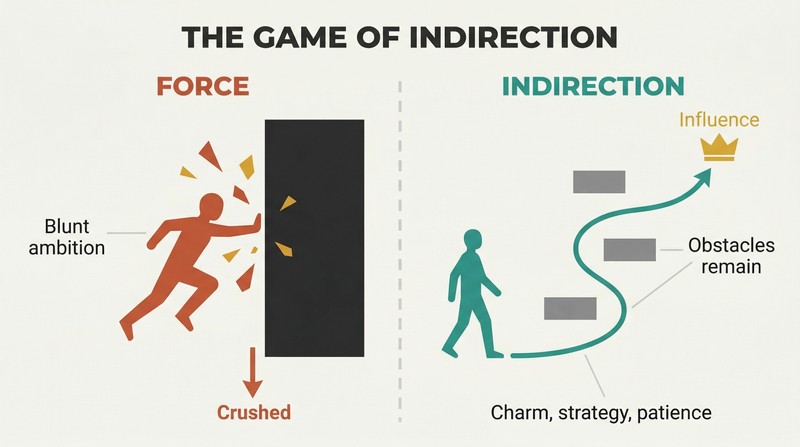
Power is a game of indirection — brute force gets you crushed
Greene's premise: modern life is a Renaissance court. Kings and queens exist in every workplace and social hierarchy — your CEO, your department head, your social circle's alpha. Like historical courtiers, you must navigate their egos while fending off rivals, all without appearing to scheme. As Machiavelli warned, anyone who tries to be good all the time will be ruined by the many who are not.
The 48 laws orbit this single insight. Direct confrontation, naked ambition, and blunt honesty are treated as amateur mistakes. The winning move is always indirect: charm instead of coercion, seduction instead of force, strategic retreat instead of reckless charge. Think of it as Machiavelli updated for the open-plan office — where everyone watches, and the knives must be invisible.
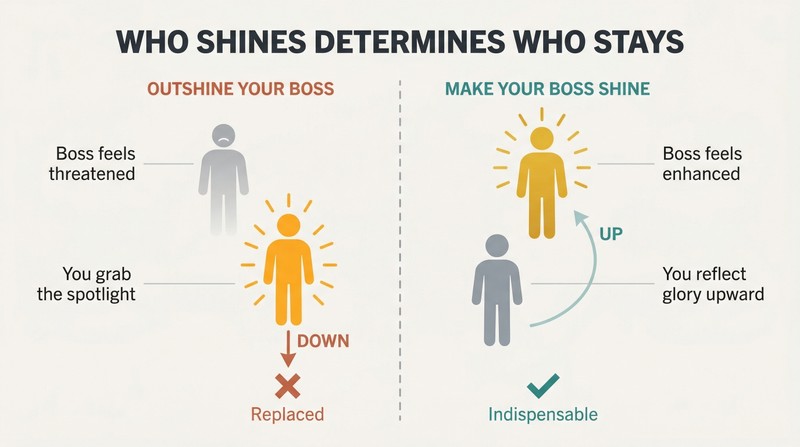
Make those above you feel brilliantly superior to you
Your instinct to impress is exactly wrong. When you display your talents to those above you, you don't win their admiration — you trigger their insecurity. Greene warns that even if your boss feigns appreciation, they will replace you with someone less intelligent, less attractive, less threatening at the first opportunity. The rule holds even when the master loves you: entire careers have been destroyed by favorites who took their status for granted.
The countermove is discreet flattery. If your ideas are more creative, ascribe them to your boss publicly. If you're more charismatic, mute your radiance in their presence. Make them the sun around which everyone revolves. This isn't weakness — it's strategic positioning. A master who feels enhanced by your presence will never let you go.
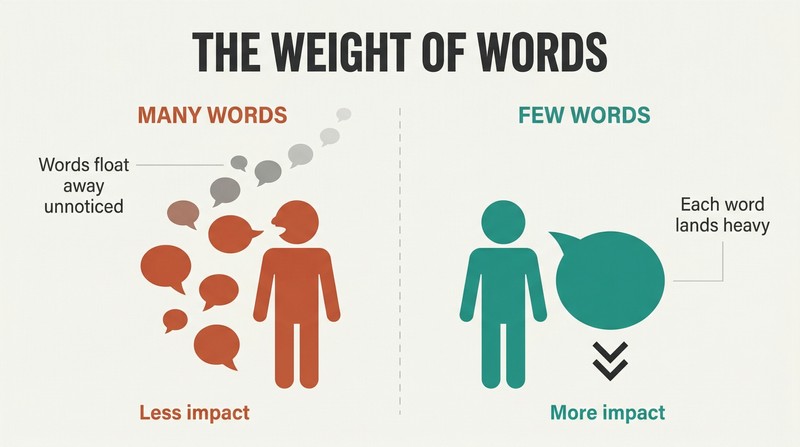
Talk less than you want to — silence is a power move
Silence is an offensive weapon. When you control what you reveal, people fill the void themselves — nervously talking, exposing weaknesses, and granting your few words disproportionate weight. Andy Warhol mastered this: his interviews were exercises in vagueness, and journalists would twist in circles decoding him. The less he explained his art, the more people discussed it — and the more valuable it became.
Loose lips can literally kill. In 1825, Russian rebel Kondraty Ryleyev survived a botched hanging when the rope broke — normally a sign of divine pardon. Instead of staying silent, he mocked Russia's incompetence. Czar Nicholas I was about to sign the pardon when he heard the remark, tore it up, and had Ryleyev hanged again successfully.
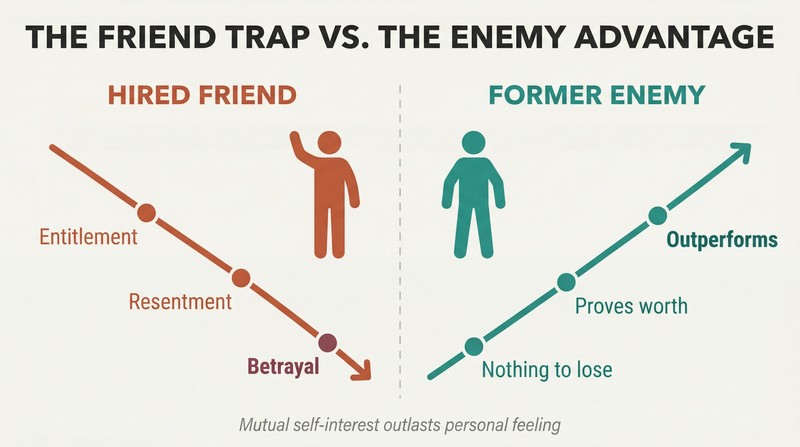
A former enemy with something to prove will outperform any friend
Friends hide their true feelings. They agree to avoid arguments, laugh too hard at your jokes, and praise work they secretly resent. When you hire a friend, your act of kindness can feel condescending — they wonder if they got the position on merit or favoritism. This breeds entitlement, then resentment, then betrayal.
Enemies make better allies. When Talleyrand decided to conspire against Napoleon, he chose his most hated enemy — Fouché, head of the secret police, a man who'd once tried to have him assassinated. Talleyrand knew Fouché would expect nothing, would work harder to prove his worth, and that their alliance would rest on cold mutual self-interest rather than personal feeling. The partnership worked brilliantly, generating momentum for opposition to the Emperor.
Frame every request around their gain, not your need
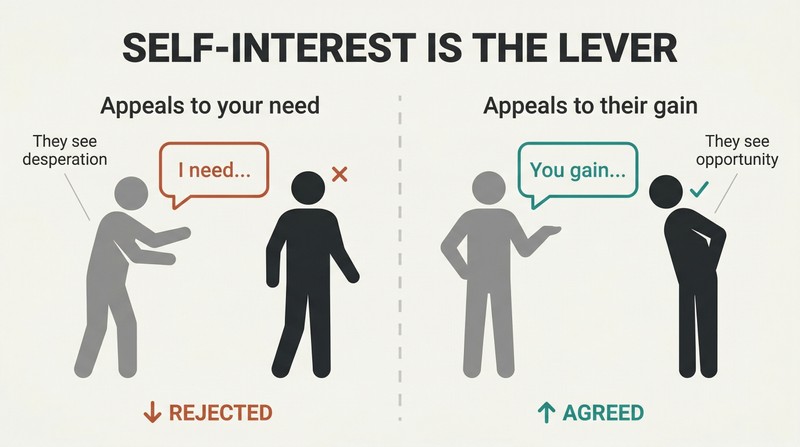
People don't care about your needs. When asking for help, most make the fatal mistake of reminding others of past favors or appealing to grand emotions like gratitude and loyalty. Even powerful people are locked inside their own desires, and if you make no appeal to their self-interest, they see you as desperate or a waste of time. Understand their psychology first: are they vain? Greedy? Insecure? Ambitious?
Position yourself as the answer to their needs. When Genghis Khan planned to level all Chinese cities for horse pasture, advisor Yelu Ch'u-Ts'ai didn't plead for mercy or culture — he told Khan he'd grow richer by taxing the population instead. Khan, who cared for nothing but warfare and practical results, instantly agreed. China was saved by an appeal to greed.
Use one sincere act to cover a dozen hidden moves
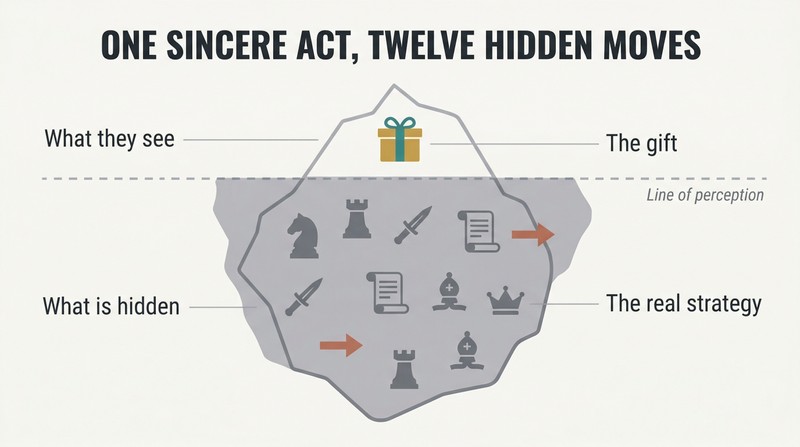
Honesty is a Trojan horse. The ancient Chinese called it "giving before you take" — an act of kindness, generosity, or confession that disarms suspicion and creates space for your real moves. Greene emphasizes that first impressions of honesty are nearly impossible to shake, giving you tremendous room to maneuver later. A single well-timed gift or confession turns the wariest person into a trusting child.
Duke Wu of Chêng demonstrated this lethally. Planning to conquer the kingdom of Hu, he first married his daughter to Hu's ruler. Then he publicly executed his own minister for suggesting an invasion of Hu — signaling the attack was unthinkable. Hu's ruler dropped all defenses. Weeks later, Chêng forces swept through Hu and took the country permanently.
Leave no wounded enemies — half-measures always backfire
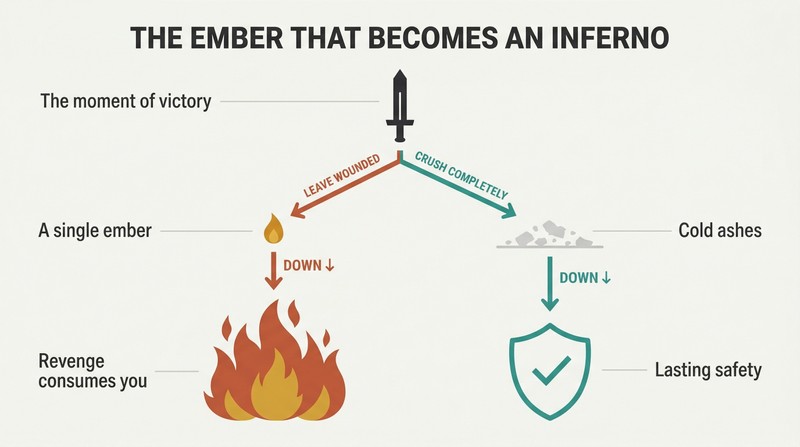
Half-victories breed full revenge. When you leave an enemy wounded but alive, you hand them time to recover, gather allies, and plot their return. In the 1930s, Chiang Kai-shek's larger army chased Mao Tse-tung's communists into the mountains, reducing them from 75,000 to fewer than 10,000 soldiers. By 1937, Chiang concluded they were no longer a threat and shifted focus to Japan.
That decision cost him everything. Within a decade, the communists recovered enough to rout Chiang's entire army, pursuing him until he fled to Taiwan. Chiang forgot the ancient wisdom; Mao did not. The lesson echoes Clausewitz: once a major victory is achieved, pursue relentlessly. Give your enemies no options, no hope, no room to regroup — or someday they will give you none.
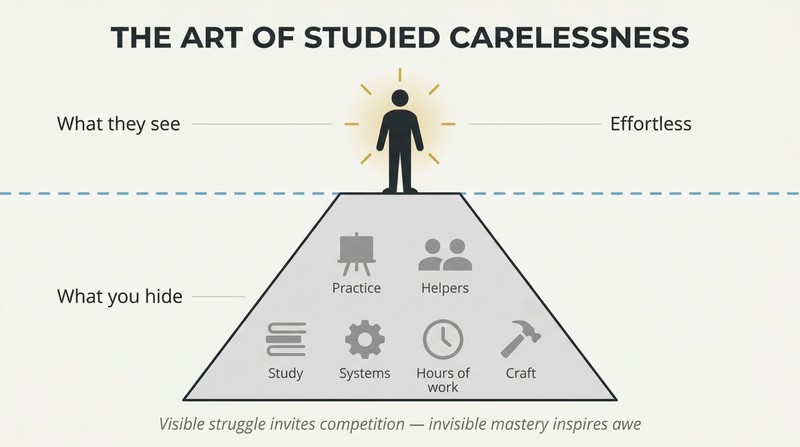
Hide your effort — what looks effortless appears godlike
Sprezzatura is the art of studied carelessness. Coined by Renaissance writer Baldassare Castiglione, it means making the difficult seem effortless — concealing all artistry so whatever you do appears natural and uncontrived. Greene argues this principle extends to all power: reveal your tricks and you become ordinary; keep your methods hidden and people assume you could do even more.
Peter Paul Rubens ran a secret factory of painters, each specializing in robes, backgrounds, or other elements. When important clients visited, he'd shoo the hired artists out and paint at breathtaking speed alone — leaving them marveling at superhuman productivity. The more mystery surrounds your actions, the more awesome your power seems. Visible struggle invites competition; invisible mastery inspires fear.
Let people choose — from options that all serve you
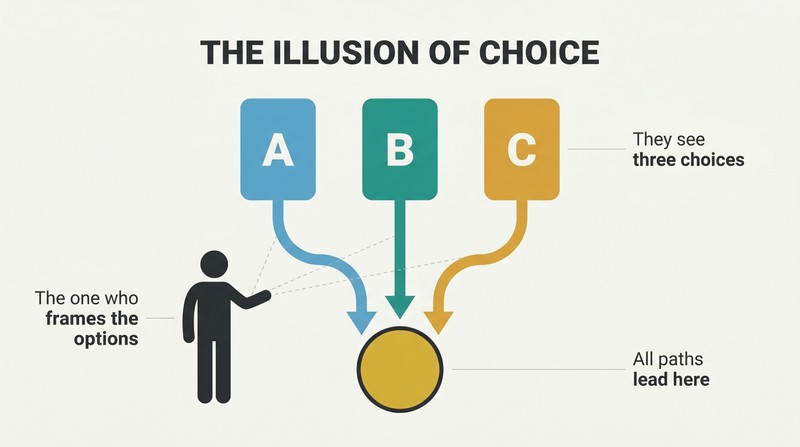
The illusion of choice is the deepest control. People who feel they're choosing freely never suspect manipulation. Greene identifies several techniques:
1. Color the Choices — present options framed so your preferred one looks best (Kissinger's method with Nixon)
2. Alter the Playing Field — Rockefeller bought railways instead of oil companies, controlling competitors' only transport route
3. Shrinking Options — raise your price each day the buyer hesitates
4. Horns of a Dilemma — force a choice between two options, both damaging to the opponent
The key is speed and subtlety. Deny victims time to find an escape. Whatever they choose, they move where you want them — and they credit themselves with the decision.
Victory is peak danger — know exactly when to stop
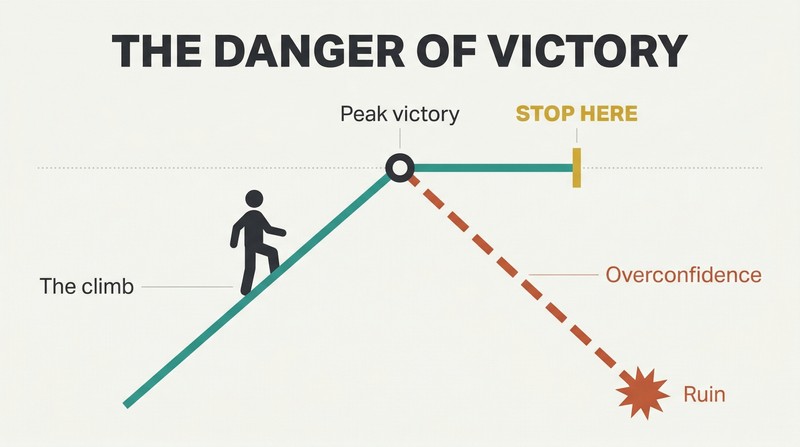
Success is intoxicating — and that's the trap. After a win, you repeat the pattern that worked even when circumstances have shifted. You become emotional, overconfident, and aggressive — pushing past the goal you aimed for, creating new enemies. Greene draws the parallel to Icarus, drunk on flight, soaring until the sun melted his wings.
The antidote is strategic restraint. Bad luck teaches patience and preparation; good luck teaches the wrong lesson — that your brilliance alone carries you. Philip of Macedon would demote generals immediately after great victories, fearing they'd become rivals. Cross-examination lawyers know the rule instinctively: always stop with a victory. What comes last sticks in the mind — end on the high note, not the overreach.
Be formless like water — a fixed position becomes a target
Rigidity is death in the power game. Powerful people often show immense creativity in their youth, then grow conservative — their identities harden, their habits congeal, and they become easy targets. Baron James Rothschild survived every political upheaval in 19th-century Paris by adapting to each regime, while aristocratic families clinging to the past were ruined one by one around him.
Formlessness has one iron rule: take nothing personally. A defensive reaction reveals your shape — your emotional triggers, your Achilles' heel. Make your face a mask, adapt to whatever container you're poured into, and opponents will exhaust themselves trying to pin you down. But Greene warns: this is a strategic tool, not passive resignation. You use formlessness to increase your power, not to drift with the current.

Analysis
Greene's The 48 Laws of Power occupies a singular position in the self-help canon: widely read, frequently banned from prisons, perpetually polarizing. Its intellectual DNA traces directly to Machiavelli's Prince, Sun Tzu's Art of War, and Baltasar Gracián's Art of Worldly Wisdom — three texts sharing Greene's conviction that understanding power as it operates matters more than moralizing about how it should operate.
The book's deepest contribution isn't any single law but the framework itself: that power dynamics follow observable, repeatable patterns across millennia. By drawing examples from Louis XIV to Mao Tse-tung, from Bismarck to Warhol, Greene makes the case that human nature — its vanity, insecurity, greed, and tribalism — is the true constant. Institutions evolve; emotional circuitry doesn't.
Critics attack the book as amoral, a how-to for sociopaths. This misses Greene's defensive rationale: even if you never deploy these laws offensively, recognizing them protects you from those who will. The 48 laws function less as commandments and more as a taxonomy of power moves you'll encounter in any hierarchy. Spotting a colleague who is 'playing a sucker to catch a sucker' or recognizing a gift designed to create obligation — this diagnostic value persists even for ethical readers.
What's intellectually honest about the book is its internal contradictions. 'Court attention at all costs' coexists with 'never appear too perfect.' 'Crush your enemy totally' sits beside 'in victory, learn when to stop.' These tensions aren't weaknesses — they reflect the contextual nature of power. The right move depends on timing, position, and the specific adversary you face. Greene's most sophisticated readers grasp this meta-lesson: the 48 laws aren't a checklist but a lens. The art lies not in rigid rule-following — the very formlessness his final law warns against — but in reading situations clearly and responding with strategic flexibility. The book ultimately teaches perception before prescription.
Review Summary
The 48 Laws of Power receives mixed reviews. Many praise its pragmatic insights into human behavior and power dynamics, finding it eye-opening and useful for understanding social interactions. Critics argue it promotes manipulative and unethical tactics. Some view it as a guide to recognizing and defending against power plays, while others see it as a manual for achieving success through ruthless means. The concise version is generally well-received, though some prefer the full edition for its detailed historical examples. Overall, readers find it thought-provoking, if controversial.
Glossary
Sprezzatura
Making difficulty look effortlessA concept coined by Baldassare Castiglione in The Book of the Courtier (1528) that Greene applies broadly to power. It means concealing all artistry and effort so that whatever you do appears uncontrived and natural. Greene argues that visible struggle diminishes awe, while apparent ease amplifies perceived ability, making others believe you possess even greater untapped reserves of power.
Strategy of the Crown
Self-belief that radiates outwardGreene's framework for acting as if destined for greatness, creating a self-fulfilling prophecy of power. Based on the principle that confident self-belief infects those around you, producing deference. Includes three tactical extensions: making bold demands (the Columbus Strategy), targeting the highest authority directly (David and Goliath Strategy), and giving gifts to superiors to signal equality.
Cat's-paw
Unknowing agent of dirty workA person outside your immediate circle who handles unpleasant, dangerous, or politically damaging tasks on your behalf — clearing opponents, spreading planted information, or undermining rivals — without realizing they're being used. Greene pairs this concept with the scapegoat; together they allow you to maintain a spotless public image while accomplishing necessary but ugly power moves through intermediaries.
Mirror Effect
Mirroring others to gain advantageGreene's framework of four strategic mirroring techniques: the Neutralizing Effect (copying enemy strategy to blind them), the Narcissus Effect (reflecting people's psyche to create affinity and control), the Moral Effect (giving someone a taste of their own medicine to teach a lesson), and the Hallucinatory Effect (creating a perfect copy of reality to deceive, as con artists do).
The Surrender Tactic
Yielding outwardly to plot inwardlyA strategy of choosing strategic submission over fighting when weaker, using the appearance of defeat to buy time, gather intelligence, lull the conqueror into complacency, and position for a devastating counterblow. Greene's primary example is King Goujian of Yue, who served in his conqueror's stables for three years before raising an army and conquering the kingdom of Wu.
Courtier's Dilemma
Civilized appearance masking strategic maneuveringGreene's central paradox: in modern life, as in the Renaissance court, you must appear decent, democratic, and fair — but playing by those rules too literally gets you crushed by those who don't. The resolution is indirection: seduction, charm, deception, and subtle strategy, all concealed behind a civilized façade. This tension between appearance and operation is the book's foundational framework.
FAQ
What's "The Concise 48 Laws of Power" about?
- Overview of the book: "The Concise 48 Laws of Power" by Robert Greene is a guide to understanding and mastering the dynamics of power. It distills historical examples and philosophical insights into 48 laws that can help individuals navigate social and professional environments.
- Purpose of the book: The book aims to equip readers with strategies to gain and maintain power, avoid pitfalls, and understand the power plays of others.
- Structure of the book: Each law is presented with historical anecdotes, interpretations, and keys to power, providing a comprehensive understanding of how each principle can be applied.
Why should I read "The Concise 48 Laws of Power"?
- Gain strategic insight: The book offers timeless strategies for gaining influence and understanding the behavior of others in power dynamics.
- Learn from history: It uses historical examples to illustrate each law, providing a rich context for understanding how power operates.
- Practical applications: The laws can be applied in various aspects of life, from personal relationships to professional settings, making it a versatile tool for self-improvement.
What are the key takeaways of "The Concise 48 Laws of Power"?
- Power dynamics: Understanding the subtle and overt ways power is exercised and maintained is crucial for navigating social hierarchies.
- Strategic thinking: The book emphasizes the importance of planning, adaptability, and foresight in achieving and maintaining power.
- Human nature: It provides insights into human behavior, highlighting the importance of understanding others' motivations and weaknesses.
What are the best quotes from "The Concise 48 Laws of Power" and what do they mean?
- "Never outshine the master": This quote emphasizes the importance of making those above you feel superior to avoid insecurity and potential backlash.
- "Court attention at all costs": It highlights the necessity of being visible and memorable to maintain influence and power.
- "Plan all the way to the end": This advises on the importance of foresight and planning to avoid unforeseen consequences and ensure success.
How can "The Concise 48 Laws of Power" be applied in everyday life?
- Professional settings: Use the laws to navigate office politics, gain influence, and advance your career by understanding power dynamics.
- Personal relationships: Apply the principles to manage relationships, avoid conflicts, and maintain a balance of power.
- Self-improvement: The book encourages self-awareness and strategic thinking, which can lead to personal growth and better decision-making.
What is the significance of "Never Outshine the Master" in "The Concise 48 Laws of Power"?
- Avoiding insecurity: The law advises against making superiors feel insecure by outshining them, which can lead to resentment and retaliation.
- Subtle flattery: It suggests using discreet flattery and making superiors appear more brilliant to gain their favor and protection.
- Strategic humility: By downplaying your talents, you can maintain control and avoid becoming a target of envy or competition.
How does "The Concise 48 Laws of Power" address the concept of reputation?
- Reputation as power: The book emphasizes that reputation is a cornerstone of power, as it can intimidate and influence others.
- Guarding reputation: It advises being vigilant in protecting your reputation from attacks and using it as a shield against adversaries.
- Destroying enemies' reputations: The book suggests strategically undermining opponents' reputations to weaken their influence and power.
What role does deception play in "The Concise 48 Laws of Power"?
- Strategic deception: The book highlights the importance of concealing intentions and using deception to gain an advantage over others.
- Creating illusions: It advises creating compelling spectacles and using symbols to distract and manipulate perceptions.
- Subtle manipulation: Deception is presented as a tool for influencing others without direct confrontation, allowing for more effective power plays.
How does "The Concise 48 Laws of Power" suggest dealing with enemies?
- Total annihilation: The book advises crushing enemies completely to prevent them from recovering and seeking revenge.
- Isolation tactics: It suggests isolating troublemakers to neutralize their influence and prevent them from rallying support.
- Turning enemies into allies: The book also explores the potential of using former enemies to your advantage by making them dependent on you.
What is the "Mirror Effect" in "The Concise 48 Laws of Power"?
- Reflecting actions: The Mirror Effect involves mimicking opponents' actions to confuse and unsettle them, making it difficult for them to predict your moves.
- Psychological manipulation: By reflecting others' desires and values, you can gain their trust and influence their behavior.
- Teaching lessons: The Mirror Effect can also be used to show others the consequences of their actions, making them aware of their own behavior.
How does "The Concise 48 Laws of Power" address the concept of change?
- Gradual change: The book advises against sudden, radical changes, as they can provoke resistance and backlash.
- Respecting tradition: It suggests making changes appear as gentle improvements on the past to gain acceptance and avoid alienating others.
- Timing and adaptation: Understanding the right moment for change and adapting to the spirit of the times is crucial for successful reform.
What is the importance of "Assume Formlessness" in "The Concise 48 Laws of Power"?
- Adaptability: The law emphasizes the importance of being adaptable and fluid, like water, to avoid being pinned down by opponents.
- Avoiding predictability: By remaining formless, you prevent others from anticipating your moves and gaining an advantage over you.
- Strategic flexibility: Formlessness allows you to respond to changing circumstances and maintain control over power dynamics.
About the Author
Other books by Robert Greene



Download PDF
Download EPUB
.epub digital book format is ideal for reading ebooks on phones, tablets, and e-readers.








































