


Plot Summary
Prologue
Lakota, Wisconsin, is a rural crossroads — a one-lane stone bridge, a tavern, and an Amish community whose poverty has passed down for generations. Thomas Kennedy,3 a veterinarian, fled here after his wife Angela3's death in Milwaukee, investigated and hounded by media before quitting his practice and disappearing into the sand counties.
On a September afternoon, seventeen-year-old Jasper Fisher8 hauls his dying mother Rachel7 to Thomas3 in a pickup. She has been laboring for days, her body wrecked by toxemia, but she has forbidden all hospitals.
Using lambing snares and veterinary instinct, Thomas3 delivers an eighteen-pound baby boy from a woman the community has already given up for dead. Rachel7 dies minutes after feeding her son. The child is named Gabriel,1 and the quiet life Thomas3 sought will never return.
Lullabies Across the River
Hannah Fisher's2 only daughter, Rachel,7 was excommunicated — streng meidung, absolute shunning — for bearing a child and refusing to name the father. Rachel7 moved across the river to an elderly neighbor's farmstead. Hannah2 was forbidden to speak to her or even acknowledge her existence.
But on freezing winter nights, Hannah2 dragged a kitchen chair through the snow, wrapped herself in a feather bed on the rise overlooking Rachel's7 house, and sang German lullabies until the lone lit window went dark. Josiah,6 her husband, knew. He pretended to sleep when she left their bed.
Years later, Rachel7 walked to the riverbank on a moonlit spring night and spoke to Hannah2 for the first time in years. Hannah2 was sobbing with joy when Josiah's6 footsteps arrived to lead her silently home. He later consented to the secret meetings — as long as no one else ever found out.
Goat Milk and Home Runs
After Rachel's7 death, her eldest son Jasper8 raised baby Gabriel1 alone, feeding him from a white Saanen doe that appeared one morning with a dripping udder — likely a gift from Hannah's2 herd across the river. Thomas3 began weekly Friday visits, bringing fish fries and groceries, careful never to bruise Jasper's8 pride.
Gabriel1 crawled at four months, walked at eight by leaning against a baby goat. Animals gravitated to him like iron to a lodestone: chickens roosted in his arms, shy sheep let him lie tangled in their wool.
By five, Gabriel1 stood five foot six and joined Thomas3 on veterinary calls. Local tavern owner Billy Walton4 signed him up for T-ball, where his swings sent baseballs over parking lots. At seven, his line drive shattered a fielder's hand. Moved up to play against twelve-year-olds, he hit fifty home runs in a season.
The Barn in Darkness
Thomas3 drove nine-year-old Gabriel1 home after a long day in Milwaukee to find Jasper's8 house dark, a pyramid of empty beer cans on the kitchen table. Jasper8 wasn't in his bed. Gabriel1 grabbed a flashlight and ran to the barn to collect eggs — and his screams cut through the rain.
Thomas3 found him backed against the wall, eyes shut, pointing into the darkness where Jasper's8 body hung from a beam by a greasy rope. Thomas3 drove Gabriel1 through a midnight rainstorm to Hannah2 and Josiah's6 farmhouse.
They took the boy in, settling him in Rachel's7 old bedroom with its cottonwood headboard. Hannah2 sang him the same German lullaby she once sang across the river, and Gabriel1 fell asleep with the flame of an oil lamp dancing across his face — an Amish child for the first time, though he didn't yet know it.
A Giraffe Among Pygmy Goats
Gabriel1 adopted Amish dress, attended Amish school, and sang hymns with a beautiful voice. But his body refused the community's devotion to humility. At ten he stood six foot six; at twelve, nearly seven feet and 255 pounds. Josiah6 raised doorframes, extended Gabriel's1 bed to ten feet, and rebuilt the staircase.
A cobbler made oversized boots with removable toe-stoppers so each pair could last two years. Gabriel1 lifted a three-hundred-pound ram on a dare, hoisted a year-old Belgian colt off the ground. He could block every volleyball shot without jumping.
The Amish children loved him, lining up for rides on his shoulders. But Josiah6 worried these spectacles bred pride, and tensions between husband and wife sharpened — Hannah2 defending the boy, Josiah6 defending their faith, both fearing the approaching pull of Rumspringa.
The Hay-Bale Hercules
Coach Trey Beathard5 — a recovering addict from Texas who'd lost everything before landing at Waushara High — was driving home when he saw something impossible in a distant field. An Amish boy was launching forty-pound hay bales twenty-five feet into the air with one arm.
The boy was Gabriel Fisher,1 now over eight feet tall and four hundred pounds during his Rumspringa. Paired with Chinua Ngobo,12 an adopted Burkinabè orphan who ran the forty in 4.23 seconds, the Fighting Hornets became unstoppable.
In a dramatic late-season game, trailing 20 – 14 with thirty-seven seconds left, Gabriel1 took a handoff at tailback and bulldozed sixty-seven yards for the winning score, carrying defenders on his back like barnacles on a hull. The Hornets won the state championship, and Gabriel1 committed to the University of Wisconsin.
Bella by the Lake
At Wisconsin, everything overwhelmed Gabriel1 — the campus, the classes, a roommate named Colt Bender19 who chewed tobacco and dragged him to house parties. At one such party, a tiny Mexican-American education major named Bella Alvarez10 pulled him onto the dance floor.
He accidentally punched through two ceiling tiles. They escaped outside, sat in the dewy grass by the lakeshore, and talked until dawn — about his Amish grandparents, his mother's death, Jasper's8 suicide. She cried and grabbed his arm. Neither wanted the sun to rise.
Before parting, Bella10 stood on a bench, cupped her hands over his enormous ears, pulled his face down to hers, and kissed him. Gabriel1 emailed Thomas3 that the kiss was all he could think about. On the field, he was equally transcendent — setting weight room records and overpowering all-conference defenders as a starting freshman.
A Flamingo's Knee
Sophomore year, Wisconsin was cruising undefeated, leading Ohio State 27 – 6 in the fourth quarter. On a counter play, Gabriel1 planted his right leg to change direction, and three Buckeyes — a combined thousand pounds — exploded into his thigh and knee. His leg bent backward, shattering the knee brace into scattered plastic.
The stadium went silent. An ambulance couldn't fit him; a helicopter was summoned. Emergency surgeons discovered a torn popliteal artery — his lower leg had been starved of blood for hours. They amputated above the knee.
At a tearful news conference, the lead surgeon announced the amputation, then noted that advances in prosthetic technology would enable Gabriel1 to walk again — well, as normal a life as an eight-foot-five-inch young man could manage. Billy Walton,4 watching alone from his empty tavern, felt his legs buckle beneath the bar.
From Heaven to Hell
Gabriel1 returned home with his amputated leg but couldn't live without electricity, internet, or his cell phone. Hannah,2 recognizing she couldn't provide what he needed, asked Thomas3 to take him in. Thomas3 modified his truck, helped Gabriel1 master a prosthetic leg, and hired him as a veterinary assistant.
Gabriel1 walked a mile a day, then longer, his cat Woolly Bugger striding beside him. But restlessness gnawed. A British wrestling promoter called with an offer: a hundred thousand dollars to train in London as Anakim, the Amish Giant.
Within months, Gabriel1 was a global sensation, wrestling in Amish costume, lifting opponents overhead in his signature finishing move, swinging his detachable prosthetic leg like a baseball bat against villains. The Amish heritage he'd left behind had become his most profitable costume. Millions watched. His grandmother could not.
Hannah's First Museum
While Josiah6 was away working, Thomas3 took Hannah2 to visit his mother's nursing home — Dorothy,11 deep in dementia, spoke German with Hannah2 and mistook her for Thomas's3 late wife. They drove south to Chicago. At the Art Institute, Hannah2 nearly froze on the steps, terrified that beauty might corrupt her soul.
She entered anyway. For two hours she was transported: she fell to her knees before Zurbarán's life-sized crucified Christ. She wept before Monet's luminous stacks of wheat. Afterward she took Thomas's3 hand. Over deep-dish pizza, she tasted oregano for the first time — her father had banned all spices except salt.
That evening at the United Center, thousands of fans wore fake Amish hats. When Gabriel1 entered carrying an angora ram in Amish costume, Hannah2 wept with pride. When a masked attacker tore off his prosthetic leg, she fled in horror.
The Letter Under the Door
That same night, Hannah2 returned home to discover her father Absalom's9 house engulfed in flames. She ran barefoot two miles to the nearest neighbors. Firefighters found his body in the bathtub, charred beyond recognition. Slid under Hannah's2 door was an envelope in his shaky script.
Inside, a confession: he had sexually abused his own granddaughter Rachel,7 fathering both Jasper8 and Gabriel.1 He had attempted the same with Hannah's2 sister Meg,14 thwarted only by their mother's intervention. Meg14 fled to Pennsylvania to escape him. He set himself on fire as penance.
Rachel's7 lifelong refusal to name her children's father — the silence that cost her excommunication, her community, her life — was finally explained. She had been shielding herself from an unspeakable truth. Hannah's2 childhood, built on a bedrock of piety, dissolved into a foundation of lies.
Hair Down, Kapp Off
Hannah2 shared Absalom's letter with her sister Meg,14 who admitted she had always suspected. Unable to learn whether Josiah6 had also known — he met her question with silence — Hannah2 called Thomas3 and asked him to take her in. As his truck pulled away, the wind blew off her kapp.
She left it on the seat, pulled the pins from her hair, and let it stream behind her. At Thomas's3 home, she bought English clothes at a thrift store, slept eleven hours straight, and devoured books from his mother's library — all of Austen in January, Hurston's Their Eyes Were Watching God in a single weeping night.
She and Thomas3 walked hand in hand through February thaws. She called this her second Rumspringa. But she told Thomas3 she would eventually return to Josiah.6 A pumpkin, her mother used to say, cannot be put back into its seed.
Blind in Barcelona
Gabriel1 woke in a Spanish hotel room unable to see. Doctors in London found a grapefruit-sized tumor engulfing his pituitary gland, its branches strangling both optic nerves. The cancer had spread to his spine, lungs, and liver. Nothing could be done.
Gabriel1 called Thomas3 from the tarmac at O'Hare, asking to come home. Back in Lakota, he grew too weak for daily walks but still loved sitting on the patio, feeling the sun and hearing birdsong.
Amish women — organized by Hannah's2 friend Abiah13 — arrived in rotating shifts to care for him around the clock, washing his body, singing hymns, reading aloud from his childhood animal stories. Then Coach Beathard,5 remembering Gabriel's1 anguished middle-of-the-night confession about Bella,10 searched the internet until dawn and found her in California.
Bella and Raphael at the Door
Hannah2 answered the door to find Bella Alvarez10 standing in the sunlight with a small suitcase and a toddler gripping her hand. The boy's name was Raphael.21 He was Gabriel's1 son, about two years old, a miniature version of his father — the same dark features, the face Hannah2 had also seen in Rachel.7
Gabriel1 ran his hands over Raphael's21 little body, kissed him again and again. For days, his need for morphine lessened. He and Bella10 lay together talking for hours about everything they had lost and made.
Some afternoons, Raphael21 napped in the crook of his father's giant arm, the boy's tiny body nested against a chest wide enough for three children. When the pain returned and the morphine resumed, Bella10 joined the Amish women in caring for Gabriel,1 seamlessly folded into a sisterhood of vigil.
Every Wing in the County
Just before dawn on an August morning, Gabriel1 began humming in his sleep — no recognizable melody, but musical, bright. Then came wings. Hundreds at first, then thousands: whip-poor-wills, owls, cranes, geese, cardinals, warblers. They sang in an orchestral wave, each voice finding its place.
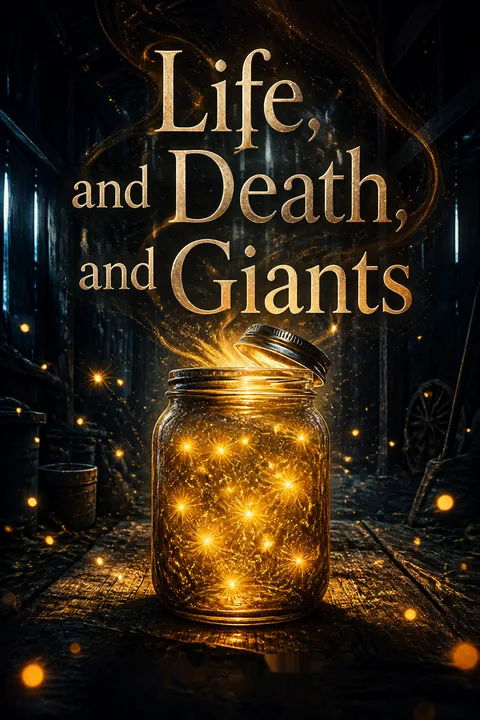
From the woods came deer, raccoons, otters, skunks. Josiah6 insisted they wheel Gabriel's1 bed outside. As the animal kingdom gathered, tens of thousands of fireflies descended, covering his body and bedframe in a blinding glow that forced everyone to close their eyes.
When the light rose and dispersed, Gabriel1 was gone. Thomas3 walked slowly through the grass collecting fallen feathers — pheasant, crane, owl, mallard — and laid the most beautiful across Gabriel's1 still chest. In reverent silence, the four of them watched the daylight arrive.
Catching Fireflies with Raphael
Gabriel1 was buried beside Rachel7 and Jasper8 in a small cemetery beneath white oaks. At the funeral — hidden in a meadow behind a sign reading Fisher Barn Raising — Billy's4 friend Charlie17 read Housman's poem for an athlete dying young, reclusive turkey farmer Oliver Edwards20 sang Amazing Grace in a voice like a church bell, and Billy4 told a joke that made even the Amish smile.
Hannah2 embraced Thomas3 in a farewell that made her arms quiver, pressed her face to his chest, then stepped back. She pinned up her hair, pulled on her kapp, and rode home with Josiah6 under a crescent moon. Bella10 bought Thomas's3 house and stayed in Lakota with Raphael.21
Thomas3 scattered his mother's ashes in Lake Michigan and drove twelve hundred miles to a cabin on the Missouri River in Montana. That first evening home, Hannah2 took Raphael21 outside to catch fireflies in a mason jar — just as Rachel7 had done as a girl, filling her bedroom with summer's captured glow.
Analysis
Life, and Death, and Giants interrogates a question most novels about faith avoid: what happens when the instruments of belief — obedience, community, silence — become the very mechanisms that enable abuse? Absalom Yoder9 is the novel's most devastating creation, not because he is a predator disguised as a patriarch, but because the Amish system of radical deference to male authority and communal silence provides him perfect camouflage. Rachel's7 excommunication for refusing to name her abuser is the cruelest structural irony: the community punishes the victim while the perpetrator delivers firewood to widows in the dark.
But Rindo refuses the easy binary of religion-as-oppression. Hannah's2 faith sustains her through losses that would destroy a lesser character, and the Amish women who organize Gabriel's1 end-of-life care demonstrate a communal ethic of embodied love that no secular institution matches. The novel insists that the same structures capable of sheltering monsters also shelter mercy — and that no human system, religious or otherwise, can fully account for both.
Gabriel1 functions as the novel's literal and figurative outsider, a body too large for any single world. His trajectory — Amish pasture to football stadium to wrestling ring to deathbed — mirrors America's compulsive cycle of discovering, consuming, and discarding extraordinary individuals. His wrestling persona reduces his heritage to costume and his disability to spectacle, yet Gabriel1 participates willingly, needing both the adulation and the paycheck. The firefly-lit death scene refuses realism in favor of something close to gospel: nature itself testifying to a life that moved through it with unusual grace.
The four narrators — Hannah's2 anguished faith, Thomas's3 secular tenderness, Billy's4 profane warmth, Trey's5 hard-won humility — form a composite moral vision in which no single perspective holds the complete truth. The Dickinson poems, passed secretly between women across generations, embody the novel's deepest conviction: that genuine understanding travels not through institutions but through hidden, fragile, and sometimes forbidden acts of inheritance.
People Also Read









Characters
Gabriel Fisher
The impossibly large boyBorn at eighteen pounds to a dying mother in the back of a pickup truck, Gabriel is the largest human being anyone has ever seen—and perhaps the gentlest. Animals gravitate to him as if magnetized; barn cats purr in his arms, nervous sheep let him lie among them, wild pigeons eat from his fingers. Raised first by his teenage brother Jasper8, then by Amish grandparents, then partly by the veterinarian who delivered him3, Gabriel inhabits a succession of worlds—none quite built to contain him. His psychological core is a restless tension between intimacy and spectacle: he craves the quiet of the pasture and the roar of adoring crowds in equal measure. He loves deeply but has never known a life where his body didn't invite staring, judgment, or worship. Every room he enters is too small.
Hannah Fisher
Gabriel's Amish grandmotherAn Amish grandmother whose quiet obedience conceals a soul in constant rebellion. Married young to the steady, taciturn Josiah6, she lost her firstborn son Caleb in infancy and her only surviving child, Rachel7, to excommunication. Hannah's faith is genuine but complicated—she secretly reads her dead mother's hidden book of Emily Dickinson poems by candlelight, guards forbidden relationships through the darkness, and measures her love against the demands of her church with unflinching honesty. She is physically small but tireless, her calloused hands equally at home kneading bread, euthanizing a beloved goat, or embroidering animals on a dish towel. Her central wound is helplessness before the suffering of those she loves—a helplessness that eventually forces her to question whether faith itself can survive what it asks of her.
Thomas Kennedy
The veterinarian who delivers GabrielA soft-spoken veterinarian who fled Milwaukee after his wife's death—a tragedy shrouded in suspicion and guilt that follows him like a shadow. Thomas chose Lakota for its invisibility: too poor for commerce, too remote for viral attention, ideal for a man who preferred animals to human company. Raised by a distant father and a brilliant, insomniac mother who was an English professor and proud atheist, Thomas grew up lonely, his Christmas gifts always designed for solo play—microscopes, telescopes, books. He became a healer of animals rather than people, and the boy he pulled from Rachel Fisher's7 dying body became the closest thing to a son he would ever have. His love expresses itself through sustained, practical devotion rather than dramatic gesture—modified trucks, weekly fish fries, carefully chosen books.
Billy Walton
Lakota's profane, warm barkeepThe garrulous, profane owner of Shaken, Not Stirred, Lakota's only tavern. A self-described alcoholic who drank his way through two marriages and barely survived a heart attack at forty-five, Billy found sobriety in AA and purpose in coaching Little League baseball. He is the novel's comic conscience—vulgar, tenderhearted, incapable of keeping his opinions to himself. Billy was the first to recognize Gabriel's1 athletic genius, sponsoring his T-ball team and fighting parents who demanded the enormous five-year-old be banned from play. His love of sports is a substitute for the fatherhood he botched; his two grown children barely speak to him. Beneath the wisecracks and bluster, Billy carries a freight train of regret he refuses to unpack in public.
Trey Beathard
The recovering Texas football coachA Texas-born football prodigy who won a conference championship at the college level before drugs, gambling, and escorts destroyed his career, marriage, and finances. Taken in by his aunt Birdy and her partner Mel18 at their Wisconsin horse farm, Beathard rebuilt himself through sobriety, French cooking, and coaching high school football. He recruits Gabriel1 and the supremely gifted Chinua Ngobo12 for a magical state championship season. His fatherly instincts drive him to write Gabriel1 a warning letter about fame's temptations—warnings born from devastating personal experience.
Josiah Fisher
Hannah's steadfast Amish husbandA man of few words, enormous physical strength, and unwavering faith. As a schoolboy he could hit a baseball a country mile. He married Hannah2, built their house with his own hands, and runs a carpentry business known for quality work and kept promises. Josiah embodies Amish stoicism—patient, enduring, resistant to change. He loves Hannah2 and Gabriel1 but expresses that love through obligation and restraint rather than warmth. His silence can feel like a gift or a cage, depending on what Hannah2 needs from him.
Rachel Fisher
Gabriel's beautiful, silent motherHannah2 and Josiah's6 only surviving daughter, beautiful beyond concealment even in plain Amish dress. Her faith was profound—she sought baptism at fourteen—yet she bore two children whose father she refused to name, choosing excommunication over disclosure. Rachel appears mostly through others' memories, a luminous absence whose silence and sacrifice drive the entire narrative. Her refusal to speak generates the novel's deepest mystery.
Jasper Fisher
Gabriel's devoted teenage brotherRachel's7 firstborn son, who raises baby Gabriel1 alone on a threadbare farmstead after their mother's death. Jasper is fierce in his devotion—feeding Gabriel1 goat's milk, never missing a chore—yet carries the weight of poverty, grief, and a grandfather who calls him Rachel's Bastard. He works Absalom's9 sawmill for cash and drinks at Billy's4 bar after dark.
Absalom Yoder
Hannah's strict patriarch fatherHannah's2 father, a strict Amish patriarch who runs a sawmill with obsessive precision. Known for midnight deliveries of firewood to the poor, Absalom presents himself as the most pious man in the district. He sheared his daughter Meg's14 hair for combing it during Bible reading and banned all spices from the kitchen. Beneath this zealous exterior, Absalom harbors a monstrous secret that drives the novel's central mystery.
Isabella 'Bella' Alvarez
Gabriel's college girlfriendA Mexican-American elementary education major from California's Central Valley—tiny, warm, and fearless. She teaches Gabriel1 to dance, eat sushi, and navigate the internet. She stands on a bench to kiss him. Their relationship represents Gabriel's1 deepest connection to someone his own age—intimate, joyful, and ultimately tested by his ambition and her devotion.
Dorothy Kennedy
Thomas's brilliant, fading motherA former English professor and proud atheist who published monographs on Emily Dickinson. Now in memory care, she drifts between lucidity and confusion, occasionally speaking German from her childhood in Dresden. She once told Gabriel1 he would save the world.
Chinua Ngobo
Lightning-fast adopted running backAn adopted orphan from Burkina Faso who runs the forty-yard dash in 4.23 seconds and plays running back for the Fighting Hornets. Shy and French-speaking, he requires the school's French teacher to translate the playbook before he learns the offense.
Abiah
Hannah's boisterous best friendHannah's2 closest friend, a strong Amish woman who milks cows, plows her own garden, and keeps everyone's secrets. She organizes round-the-clock care for Gabriel1 during his illness and serves as Hannah's2 confidante throughout her trials.
Meg
Hannah's exiled older sisterHannah's2 older sister, whose beauty and golden curls provoked Absalom's9 violent discipline. She married young and moved to Pennsylvania—a departure quietly arranged by their mother. She returns to Wisconsin only for funerals.
Charlotte Chesterfield
The atheist neighbor who shelters RachelAn elderly, pipe-smoking widow who takes in the excommunicated Rachel7, then wills her property and land to Rachel7 upon death—a secular act of grace that enables Rachel's7 independence across the river from her parents.
Stella Smithson
Billy's late-in-life loveThe widow of a man who froze to death walking home on New Year's Eve. She cooks a roast beef dinner for Billy4 after he changes her tire, beats him at cribbage, and becomes the steady, warm companion his younger self never deserved.
Charlie Mayfield
Billy's loyal best friendBilly's4 retired best friend and co-coach. He drives Gabriel1 to baseball games, endures Billy's4 late-night phone calls with weary grace, and mourns his wife Carol's death from cancer before reading Housman at Gabriel's1 funeral.
Mel and Birdy
Trey's horse-ranching auntsA lesbian couple who fled Texas homophobia in the 1970s to raise Arabian horses in Wisconsin. They take in the disgraced Trey Beathard5 and offer him unconditional acceptance, a guest bedroom overlooking the pasture, and lessons in cooking and courage.
Colt Bender
Gabriel's brash college roommateA Nebraska offensive lineman with barbed-wire tattoos around his throat. Colt drags Gabriel1 to parties, refuses to leave his side after the knee injury, and visits Lakota wearing cowboy boots to draw water from a hand pump with delighted fascination.
Oliver Edwards
The reclusive turkey farmerA near-hermit and the tallest man in the county before Gabriel1, Oliver barely speaks to anyone. He keeps his mother's cremains in a coffee can. He possesses a stunning singing voice that he reveals only once.
Raphael
Gabriel and Bella's toddler sonGabriel1 and Bella's10 son, about two years old when he arrives in Lakota—a miniature version of his father who becomes the bridge between the community's past and its future.
Plot Devices
Emily Dickinson's Poems
Hidden generational inheritanceHannah's2 mother secretly kept a coverless, string-bound book of Dickinson's poetry hidden in her cedar trunk, its pages stained by decades of cooking grease and garden soil. Margin notes in German reveal a woman larger and less meek than anyone knew—doubting, yearning, intellectually alive. Hannah2 discovers the book after her mother's death and reads it by candlelight when Josiah6 is away, each session an act of quiet rebellion. The poems become Hannah's2 parallel scripture, offering language for experiences her faith cannot name: insomnia, longing, doubt about divine justice. Thomas's3 mother, a literary scholar11, also published on Dickinson—a coincidence that quietly binds the English and Amish worlds through one poet's daring. The book passes through three generations of women, each finding herself within its soiled pages.
Gabriel's Prosthetic Leg
Symbol of loss turned weaponAfter his amputation, Gabriel1 receives a prosthetic leg that evolves from a clinical device into an extension of his identity. His temporary prosthesis enables rehabilitation; his permanent one lets him work again as Thomas's3 veterinary assistant; his wrestling prosthesis becomes a theatrical weapon—swung like a baseball bat against opponents, ripped off and reattached for dramatic effect. The leg embodies the novel's central question about Gabriel1: is his extraordinary body a gift to be used or a spectacle to be sold? Each version represents a different answer. Its theatrical removal during wrestling matches becomes a crowd-favorite ritual that transforms disability into performance, provoking both admiration and unease.
Streng Meidung (Strict Shunning)
Exile that drives the plotThe Amish practice of absolute shunning serves as the mechanism that separates Rachel7 from her family and drives Hannah's2 decades of covert defiance. Streng meidung requires a unanimous congregational vote and imposes total social and spiritual isolation: no eating, worshipping, trading, or speaking with the shunned person. Rachel's7 refusal to name her children's father triggers this maximum punishment, which forces Hannah2 into years of midnight vigils and secret river meetings. The shunning also functions as dramatic irony throughout the novel: the community enacts its harshest sentence to purify itself, yet the sin it punishes is not the one that was actually committed. Meidung provides the structural tension between communal obedience and individual conscience that animates every chapter.
The Mecan River
Boundary between two worldsThe shallow, winding river separating Hannah2 and Josiah's6 farm from Rachel's7 property functions as the novel's central geographic symbol. It is the boundary between the Amish world and everything outside it—Rachel's7 exile, Gabriel's1 English childhood, Thomas's3 veterinary practice. Hannah2 watches across it, sings across it, and eventually crosses it to meet Rachel7 in moonlit defiance. The river is also where Thomas3 first found Lakota, drawn by trout fishing, and where he fishes with Coach Beathard5 as Gabriel1 declines. It connects every major character and location: Jasper's8 farm borders it, Gabriel1 grew up beside it, and the cemetery where three generations rest lies near its banks. Its current runs through the novel as persistently as time itself.
Absalom's Confession Letter
Detonation of family mythologyA letter written in shaky script and slid under Hannah's2 door the night Absalom9 sets himself on fire. In it, the patriarch confesses to sexually abusing his granddaughter Rachel7, fathering both Jasper8 and Gabriel1, and pursuing his daughter Meg14. The letter retroactively reframes every major event in the novel: Rachel's7 refusal to name the father, Meg's14 early departure for Pennsylvania, Charlotte's15 rescue, Hannah's2 mother's hidden book of poems—each gains new, devastating meaning. The letter is the novel's structural keystone, the revelation toward which all mysteries converge. It also catalyzes Hannah's2 departure from Josiah6 and her temporary break from Amish life, transforming a woman who feared worldly beauty into one who demands it.
Download PDF
Download EPUB
.epub digital book format is ideal for reading ebooks on phones, tablets, and e-readers.








































