

Key Takeaways
Criticism boomerangs: it wounds pride and never changes behavior
Carnegie's foundational claim is that condemnation is worse than useless. It puts people on the defensive, forces them to justify themselves, and breeds lasting resentment.
He proves it with hardened criminals. Al Capone called himself a misunderstood public benefactor. The cop-killer "Two Gun" Crowley, writing as police shot into his apartment, described himself as having a kind heart that would harm no one. If men on death row refuse to blame themselves, ordinary people almost never will. Lincoln learned this after a mocking anonymous letter nearly forced him into a sword duel in 1842. From then on he stopped criticizing, even swallowing a furious letter to General Meade rather than mailing it. Understand people instead of judging them.
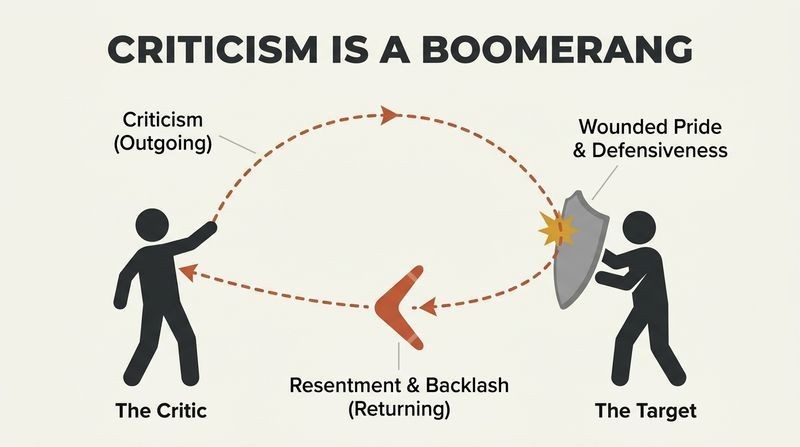
The insight anticipates modern psychology. B. F. Skinner's operant conditioning showed reinforcement outperforms punishment, and Carnegie cites him directly. Contemporary work on defensiveness and the "backfire effect" confirms that attacking someone's position often hardens it. Yet the claim deserves nuance: organizations need candid feedback, and radical-candor research suggests specific, timely correction can help when trust exists. Carnegie is really warning against the impulsive, ego-driven criticism that vents the critic's feelings rather than changing the recipient. The distinction between destructive condemnation and constructive feedback matters, and the book's blanket "never criticize" reads as deliberate overcorrection for a habit most people massively overuse.
Feed the universal hunger to feel important with honest praise
Carnegie argues the deepest human craving, what John Dewey called the desire to feel important and William James the craving to be appreciated, drives nearly all behavior. It separates humans from animals and built civilization.
Charles Schwab earned a million dollars a year not because he knew steel but because he could arouse enthusiasm. His method: hearty approbation, lavish praise, and zero fault-finding. Carnegie sharply distinguishes appreciation from flattery. Appreciation is sincere and comes from the heart; flattery is counterfeit, selfish, and spoken from the teeth out. He notes we starve those closest to us of appreciation, letting spouses and employees go years without a kind word while we would never let them go days without food.
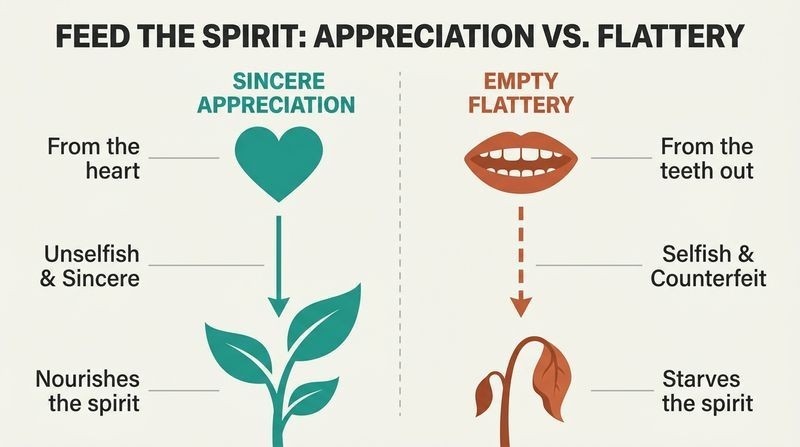
The appreciation-versus-flattery line is Carnegie's ethical firewall against manipulation, and it holds up. Research on "positivity resonance" and workplace recognition shows genuine appreciation boosts performance and wellbeing, while insincere praise is quickly detected and breeds distrust. The evolutionary framing is plausible: status-seeking is a documented human universal. One tension worth flagging: the boundary between sincere and insincere is not always clean, and a person determined to influence can rationalize flattery as "finding something to genuinely admire." The safeguard is Emerson's point, quoted by Carnegie, that everyone is your superior in some way, so honest admiration is nearly always available if you look.
Bait the hook to suit the fish, not yourself
The only way to influence anyone, Carnegie insists, is to talk about what they want and show them how to get it. He fishes with worms, not the strawberries and cream he personally prefers, because he thinks about the fish's appetite.
When his lecture hall's rent tripled, he did not argue. He listed the hotel's advantages and disadvantages on paper, showing the manager how insisting would cost more than it earned. The rent hike dropped from 300% to 50%. A boy who refused kindergarten was won over when parents demonstrated the finger-painting fun awaiting him. Barbara Anderson got interviews at eleven of twelve banks by writing what she could do for them, not what she wanted.
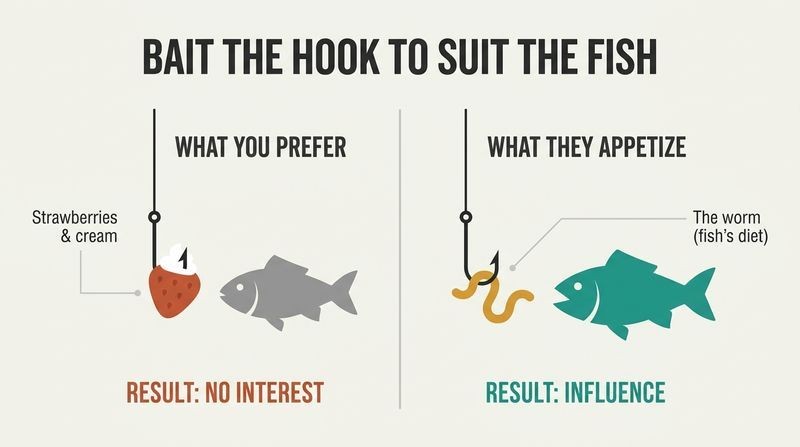
This is Carnegie's version of what negotiation scholars now call interest-based bargaining, popularized decades later by Fisher and Ury's "Getting to Yes." The move from positions to underlying interests is the same insight. It also prefigures consultative selling and modern marketing's benefit-driven copywriting. The deeper cognitive point is that humans are egocentrically anchored: we default to our own frame and must deliberately simulate another's. Carnegie stresses this is not manipulation because both parties should gain, echoing the win-win logic. The limitation: it assumes you can accurately infer what others want, which requires the very listening and empathy the book champions elsewhere, and people often misread others' true motives.
Grow genuinely curious about others; it outperforms trying to impress
Carnegie's counterintuitive social law: you make more friends in two months by becoming interested in others than in two years trying to make them interested in you. The proof is a dog, who earns love by radiating joy at your arrival, expecting nothing.
He cites the New York Telephone Company finding that "I" was the most-used word, appearing 3,900 times in 500 calls. People obsess over themselves. The magician Thurston succeeded partly by silently telling each audience "I love you." A banker unlocked an uncooperative executive by asking about his stamp-collecting son. Roosevelt memorized the names and interests of scullery maids. Remembering birthdays, greeting people warmly, and showing sincere concern win cooperation from even the busiest people.
Alfred Adler, quoted here, tied lack of interest in others to the greatest life difficulties, and modern relationship science agrees. Gottman's research on "bids" for connection shows that partners who turn toward each other's small overtures build durable bonds. The self-reference effect in memory explains why people light up when discussing themselves: self-related information is encoded more deeply. One caveat: Carnegie's framing risks sounding instrumental, as if curiosity is a tool for extraction. The dog example rescues it, because the dog wants nothing. The genuinely curious person is rewarded precisely because the interest is not a performance, a paradox that manipulative practitioners consistently fail to grasp.
A person's own name is the sweetest sound they know
Carnegie treats remembering names as a form of respect that quietly signals a person matters. Forgetting or mangling a name puts you at a disadvantage.
Jim Farley, who rose from a brickyard to Postmaster General, could call 50,000 people by their first name, and that skill helped put FDR in the White House. Andrew Carnegie learned the trick as a boy: he got neighborhood children to feed his rabbits by naming the bunnies after them. He later named a steel mill after the railroad president he wanted as a customer, and won the order. A salesman named a Greek immigrant by his full name and reduced him to grateful tears, because in fifteen years no one had bothered.
The claim is now empirically supported: neuroimaging shows hearing one's own name activates distinctive brain regions even under anesthesia, and the "cocktail party effect" demonstrates we detect our name amid noise. Names function as identity anchors, so acknowledging them affirms selfhood. Dale Carnegie's rabbit and steel-mill stories reveal the mechanism: linking others' identities to a shared enterprise converts strangers into stakeholders. A practical extension from memory research: names are hard to recall because they are arbitrary labels with no semantic hook, which is why Napoleon III's technique of repeating, spelling, and writing down names works. Effort, not talent, is the real variable.
You cannot win an argument, so refuse to have one
Carnegie's blunt verdict: even a won argument is lost, because you have bruised the other person's pride and they resent you. Nine times in ten, both parties leave more convinced they were right.
He learned it at a banquet when he corrected a man's misattributed Shakespeare quote and his own expert friend kicked him under the table, then privately confirmed Carnegie was right but the correction was foolish. A truck salesman, Patrick O'Haire, stopped scrapping with prospects who praised competitors and started agreeing with them, then quietly pivoting to his truck's merits, and became a star. A tax consultant dropped an hour-long fight, offered the inspector sincere admiration for his difficult job, and won a $9,000 ruling.
This aligns with cognitive-dissonance theory: when identity is threatened, people rationalize rather than update, so frontal assault entrenches beliefs. Political-science research on the backfire effect shows corrections can strengthen misperceptions. Carnegie's alternative, welcoming disagreement and looking for points of agreement, matches modern conflict-resolution and motivational-interviewing techniques, which avoid direct confrontation and let people talk themselves toward change. The steelman here is strong. The limitation: some contexts, science, law, engineering, genuinely require adversarial argument to surface truth. Carnegie's target is interpersonal persuasion, not epistemics. Winning a debate and changing a mind are simply different games with different rules.
Admit you may be wrong before telling anyone they are
Since Theodore Roosevelt figured he was right only 75% of the time and you cannot reliably beat even 55%, Carnegie asks why anyone flatly tells others they are wrong. Announcing "I'll prove it" is a challenge that arouses immediate opposition.
Instead, open with humility: "I may be wrong, I frequently am, let's examine the facts." Benjamin Franklin transformed from an argumentative youth into a diplomat by banning words like "certainly" and "undoubtedly," replacing them with "I conceive" and "it appears to me." A lumber salesman, facing a rejected shipment, stopped quoting grading rules and instead asked friendly questions about why boards failed. His cooperative curiosity thawed the inspector, who accepted the whole carload.
James Harvey Robinson, cited by Carnegie, nailed the mechanism: it is not the idea we defend but our threatened self-esteem, and the word "my" turns a belief into territory. This prefigures self-affirmation theory, which shows people accept threatening information more readily when their broader self-worth is secured. Franklin's linguistic softening is essentially hedging, now studied in pragmatics as face-saving. Carnegie's approach also mirrors intellectual-humility research linking the trait to better learning and relationships. The subtle risk: performative humility ("I may be wrong" said insincerely to disarm) is manipulation. The technique only builds trust when the speaker genuinely holds their beliefs loosely, which is a harder discipline than it sounds.
When wrong, condemn yourself faster and louder than critics can
Carnegie flips criticism inside out: beat others to the punch by voicing every derogatory thing they are about to say. It is far easier to swallow self-criticism than condemnation from someone else, and it disarms opponents instantly.
Caught letting his dog run unleashed after a policeman's warning, Carnegie immediately confessed full guilt with no excuses, and the officer, needing to feel important, softened into leniency. An artist named Warren pre-empted a fault-finding editor by declaring his own work inexcusable, and the editor ended up defending him and offering lunch and a new commission. Robert E. Lee took sole blame for Pickett's doomed charge at Gettysburg, telling beaten troops it was his fault alone, a rare act of leadership greatness.
This exploits a reliable social dynamic: once you occupy the self-blame position, the other person's only remaining move to feel generous is magnanimity. It resembles the psychology behind effective apologies, which research shows restore trust faster when they include clear acceptance of responsibility rather than deflection. There is also a status game: preemptive self-criticism signals confidence, because only the secure can afford to admit fault. Lee's example elevates the tactic into character. The nuance worth noting: chronic self-blame can shade into low self-worth or become its own manipulation. The healthy version, as Bruce Harvey's payroll-error story shows, pairs honest ownership with problem-solving, not groveling.
Get people nodding yes early to keep them saying yes
Carnegie borrows the Socratic method: never open on points of disagreement. Start by emphasizing everything you both want, and extract a string of "yes" responses before approaching the contested issue.
Professor Overstreet's psychology explains why. A genuine "no" mobilizes the whole organism into a posture of rejection that pride then demands you defend. A "yes" keeps people open and forward-moving, like a billiard ball hard to deflect once rolling. A bank teller kept a reluctant customer by agreeing the disputed information was optional, then asking whether he would want his money going to his next of kin (yes), and whether naming them would help (yes). The customer opened a trust account. A Westinghouse salesman used arithmetic questions to win a $35,000 order.
The "yes-set" is now a staple of sales and hypnotherapy training, and it echoes the consistency principle Robert Cialdini identifies as a core lever of influence: people strive to act consistently with prior commitments, even trivial ones. There is genuine cognitive grounding in that agreement builds momentum and reduces reactance. That said, the technique can feel formulaic, and modern audiences primed to recognize it may bristle at obvious question-funnels. The durable version is not scripted trickery but the underlying reframe: begin from common ground. Socrates changed the course of Western thought less by winning admissions than by making interlocutors feel they discovered conclusions themselves.
Let people own the idea and they will champion it
Nobody likes feeling sold or ordered. People trust ideas they discover themselves, so wise influencers plant seeds and let others reach the conclusion, taking the credit.
A sales manager, Adolph Seltz, revived a discouraged team by asking them what they expected from him, writing it up, then asking what he could expect from them; the commitments they volunteered energized sales. Eugene Wesson failed for years pushing finished sketches, then began bringing unfinished ones and asking buyers how to complete them, converting rejection into steady orders. Colonel House influenced President Wilson by casually planting ideas and letting Wilson trot them out as his own. An X-ray maker sold a hospital by asking the doctor to critique new equipment, letting him sell himself.
This is the participation effect, well documented in organizational psychology: people commit far more to decisions they helped shape, a finding formalized in Coch and French's classic studies on overcoming resistance to change. Self-determination theory adds depth, showing autonomy is a basic psychological need, so ideas that feel self-generated satisfy it while imposed ones frustrate it. The "IKEA effect" (valuing what we help build) extends the logic to ideas as well as furniture. Colonel House's willingness to forgo credit is the crux and the hardest part. Ego-driven leaders sabotage this technique constantly, needing recognition more than results, which is precisely why House's self-effacement made him so powerful.
Give someone a fine reputation and they will rise to it
Carnegie's leadership principle: if you want to improve a trait in someone, act as though they already possess it. Give them a reputation to live up to and they make prodigious efforts rather than disappoint you.
A service manager told a slipping mechanic he was known for outstanding work, and the man promptly returned to form. A teacher named Marie "the Dishwasher," a plain, cross-eyed servant, was told she held unseen treasures within; she began caring for herself, bloomed, and soon married. A Brooklyn teacher told the school's notorious troublemaker she was counting on him as a natural leader to make the class the best in the grade, and even a nine-year-old could not let her down.
This is a lay statement of the Pygmalion effect, empirically demonstrated by Rosenthal and Jacobson: teachers told certain students were "bloomers" saw those randomly chosen children actually improve, because expectations shaped behavior through subtle cues. Labeling theory in sociology runs the same track in both directions, which is why "give a dog a bad name" is so destructive. Positive labels work when they are credible and specific rather than empty flattery. The ethical edge: reputations imposed on others are a form of power, benevolent here but coercive in the wrong hands. The best version invites people into an identity they genuinely want, aligning expectation with their own aspirations.
Make the correction feel easy and the person eager to try
Carnegie closes on encouragement: tell someone a task is hard and they are hopeless at it, and you kill motivation; make the fault seem easy to fix and signal your faith in them, and they will practice till dawn.
A dance teacher who called a middle-aged beginner hopeless lost him; another who praised his natural rhythm and minimized his errors kept him improving. Clarence Jones turned around his son David, labeled brain-damaged and two grades behind, using timed flash cards, celebrating every reduction from 52 minutes toward 8; the boy made the honor roll and won a citywide science prize. Finally, frame requests around the other person's benefit, and use titles and authority, since Napoleon knew men are ruled by such "toys."
Encouragement that makes tasks feel achievable maps directly onto Bandura's self-efficacy theory: belief in one's capability is among the strongest predictors of persistence and performance. Carol Dweck's growth-mindset research refines it further, showing praise for effort and strategy (Jones celebrating each timed improvement) builds resilience, whereas praise for fixed ability can backfire. The flash-card story is a small masterpiece of scaffolding and incremental wins, the same mechanism behind gamification and deliberate practice. The title-giving tactic (Napoleon's medals) taps identity and status economics: symbolic rewards can motivate powerfully and cheaply. The caveat is sincerity again. Hollow encouragement and empty titles are detected fast and corrode the very trust they aim to build.
Analysis
Published in 1936 and shaped by fifteen years of adult-education classes, Carnegie's book is best understood not as theory but as crowdsourced field research. He tested principles on thousands of businesspeople, kept what worked, and discarded the rest, producing an empirical distillation of persuasion decades before social psychology formalized these findings. Its structure is disarmingly simple: roughly thirty numbered principles across four sections, each hammered home through repeated anecdote. That repetition is a teaching method, not padding; Carnegie explicitly designed the book to build habits, not transmit facts.
The intellectual core is a single premise about human nature: people are creatures of emotion, pride, and vanity, not logic, and the master key is the craving to feel important. Nearly every principle descends from this. Criticism fails because it attacks importance; appreciation, name-recall, listening, and letting others own ideas all supply it. This is remarkably consilient with later research, from Adler and James (whom Carnegie cites) to Cialdini's influence principles, Dweck's mindsets, Rosenthal's Pygmalion effect, and self-determination theory. Carnegie intuited much of modern social psychology through pattern recognition.
The enduring criticism is that the book is a manipulator's handbook, teaching instrumental warmth. Carnegie anticipates this with his relentless insistence on sincerity and his appreciation-versus-flattery firewall, but the defense is imperfect: a determined operator can mimic the forms while faking the substance, and the book offers no reliable way to police intent. The honest reading is that these techniques amplify whatever character wields them. In service of genuine care they build trust; in service of exploitation they become predatory charm.
What keeps the book alive at nearly a century is its behavioral realism. It refuses to moralize about how people ought to respond to logic and instead maps how they actually respond to ego. That descriptive accuracy, paired with immediately testable prescriptions, explains why each generation rediscovers it as if newly written.
Review Summary
How to Win Friends and Influence People receives mostly positive reviews, with an average rating of 4.49/5. Readers praise its timeless principles for improving social skills and relationships. Many find the historical anecdotes engaging and the advice practical. Some criticize the book for being outdated, repetitive, or potentially manipulative. Several reviewers note rereading the book multiple times and gaining new insights with each reading. Critics argue that some concepts are now common sense or may come across as insincere if not applied carefully.
People Also Read








FAQ
What is "How to Win Friends and Influence People" by Dale Carnegie about?
- Practical Guide to Human Relations: The book provides actionable principles for improving interpersonal skills, making friends, and positively influencing others in both personal and professional settings.
- Focus on Understanding Others: It emphasizes understanding people’s viewpoints, handling disagreements diplomatically, and building lasting relationships.
- Manual for Daily Use: Drawing from real-life examples and Carnegie’s courses, it serves as a handbook for immediate application in everyday interactions.
- Goal of Self-Improvement: The ultimate aim is to help readers develop self-confidence, communication skills, and leadership abilities.
Why should I read "How to Win Friends and Influence People" by Dale Carnegie?
- Timeless and Universal Principles: The book’s advice remains relevant across generations and cultures, addressing fundamental human behaviors and motivations.
- Enhances Relationships and Success: Applying its principles can lead to improved business, social, and family relationships, as well as greater career opportunities.
- Action-Oriented Learning: Readers are encouraged to actively practice and review the principles to form new, positive habits.
- Proven Results: Thousands have reported life-changing improvements by following Carnegie’s methods.
What are the key takeaways from "How to Win Friends and Influence People" by Dale Carnegie?
- Human Relations Over Technical Skills: Success is largely determined by interpersonal skills rather than technical expertise.
- Principles for Influence: The book outlines specific techniques for handling people, making them like you, and winning them to your way of thinking.
- Emphasis on Sincerity: Genuine appreciation, interest, and understanding are central to building rapport and influence.
- Continuous Practice: Mastery comes from regular application and self-reflection.
What are the fundamental techniques for handling people in "How to Win Friends and Influence People" by Dale Carnegie?
- Don’t Criticize or Condemn: Criticism often leads to resentment and defensiveness rather than change.
- Give Honest and Sincere Appreciation: People crave appreciation more than anything else; genuine praise motivates and inspires.
- Arouse Eager Want: Influence others by appealing to their desires and showing them how they benefit.
How does Dale Carnegie define the "big secret of dealing with people" in "How to Win Friends and Influence People"?
- Desire to Feel Important: The deepest human craving is to feel valued and appreciated.
- Sincere Appreciation vs. Flattery: Genuine appreciation is powerful, while insincere flattery can backfire.
- Motivating Others: Meeting this need for importance can transform relationships and inspire loyalty.
What are the key principles to make people like you in "How to Win Friends and Influence People" by Dale Carnegie?
- Show Genuine Interest: Focus on others rather than trying to get them interested in you.
- Smile Sincerely: A warm smile communicates friendliness and openness.
- Remember and Use Names: A person’s name is the sweetest sound to them; using it builds rapport.
- Be a Good Listener: Encourage others to talk about themselves and listen attentively.
- Talk in Terms of Their Interests: Discuss what matters to the other person to build connection.
- Make Others Feel Important: Do this sincerely to foster goodwill.
How does "How to Win Friends and Influence People" by Dale Carnegie suggest handling disagreements and arguments?
- Avoid Arguments: Arguments rarely change minds and often damage relationships.
- Respect Others’ Opinions: Never directly tell someone they’re wrong; acknowledge their viewpoint.
- Admit Mistakes Quickly: Owning up to errors disarms hostility and builds trust.
- Use Tact and Diplomacy: Approach disagreements with understanding and a desire to see the other’s perspective.
What is the importance of admitting mistakes according to "How to Win Friends and Influence People" by Dale Carnegie?
- Disarms Hostility: Quickly admitting you’re wrong stops arguments and encourages fairness.
- Builds Trust and Respect: Honesty and humility are appreciated and foster cooperation.
- Enables Problem-Solving: Acknowledging mistakes clears the air for constructive solutions.
What is the "yes, yes" technique in Dale Carnegie’s method, and why is it effective?
- Start with Agreement: Begin conversations with points the other person will agree with to create a positive momentum.
- Builds Openness: Multiple affirmations put the listener in a receptive state.
- Prevents Defensiveness: Avoids early rejection and resistance, making persuasion easier.
How does letting the other person do most of the talking help in influencing them, according to Dale Carnegie?
- Encourages Openness: People feel valued when they can express themselves fully.
- Reveals Motivations: Listening uncovers their needs and concerns, informing your approach.
- Reduces Resistance: Allowing others to talk lowers barriers and makes them more receptive to your ideas.
What role do sympathy and understanding play in winning people to your way of thinking in "How to Win Friends and Influence People" by Dale Carnegie?
- Softens Resistance: Genuine sympathy makes others more willing to listen and cooperate.
- Builds Emotional Connection: People respond positively when they feel understood.
- Reduces Friction: Seeing things from the other’s perspective increases your influence.
What are the best quotes from "How to Win Friends and Influence People" by Dale Carnegie and what do they mean?
- “If you want to gather honey, don’t kick over the beehive.” Don’t criticize others if you want their cooperation.
- “The deepest principle in human nature is the craving to be appreciated.” Sincere appreciation is a fundamental human need.
- “A man convinced against his will is of the same opinion still.” Arguments rarely change minds and often harm relationships.
- “He who can do this has the whole world with him. He who cannot walks a lonely way.” The ability to arouse eager want in others is key to influence.
About the Author
Other books by Dale Carnegie




Download PDF
Download EPUB
.epub digital book format is ideal for reading ebooks on phones, tablets, and e-readers.








































