

Key Takeaways
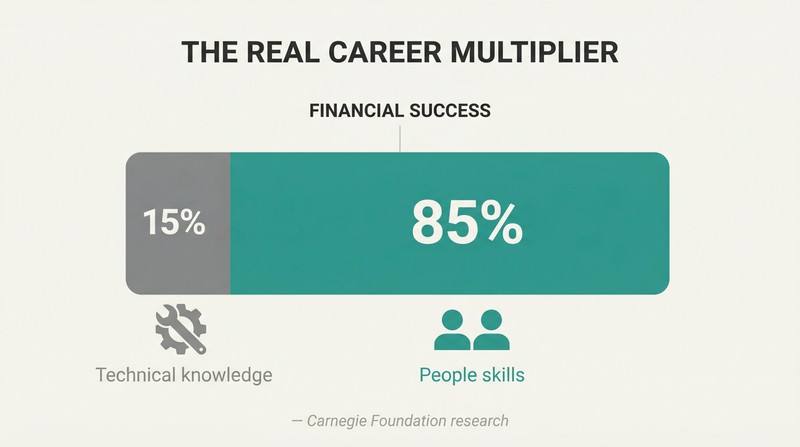
Technical skill is overrated — people skill is the real career multiplier
Carnegie Foundation research on engineers found that personality and leadership ability matter roughly six times more than technical knowledge for financial success. Charles Schwab became the first American executive paid over $1 million a year — not because he was a steel genius (many employees knew more about manufacturing) but because of his ability to inspire people. John D. Rockefeller said he'd pay more for the ability to deal with people "than for any other under the sun."
The real curriculum is missing. A University of Chicago survey found that after health, adults most wanted to learn how to get along with people. Yet when researchers looked for a practical textbook on the subject, none existed. Carnegie wrote this book to fill that gap — arguing that mastering human relations is the single highest-leverage skill in any career.
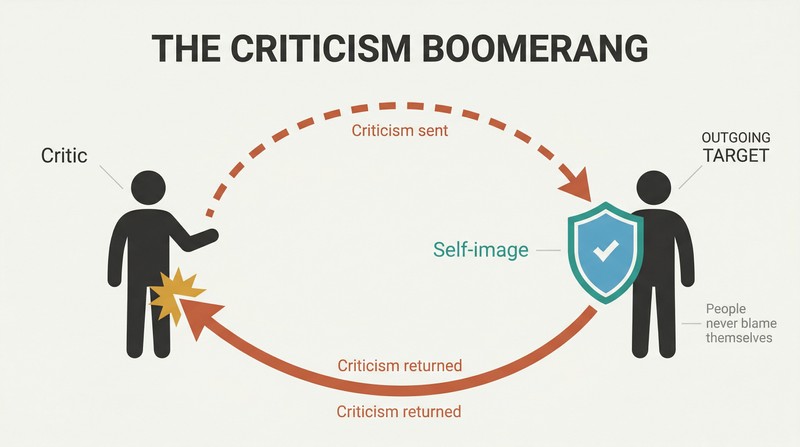
Criticism is a homing pigeon — it always flies back to you
Even criminals think they're heroes. "Two Gun" Crowley, while 150 policemen fired into his apartment, wrote: "Under my coat is a weary heart, but a kind one." Al Capone called himself a public benefactor. If hardened criminals won't accept blame, neither will your coworkers, children, or spouse. B.F. Skinner's research confirmed that animals rewarded for good behavior learn far faster than those punished — and the same applies to humans.
Lincoln learned this through a near-duel. After publishing an anonymous letter mocking a politician — which nearly led to a sword fight — Lincoln almost never criticized anyone again. When General Meade let Lee escape at Gettysburg, Lincoln wrote a furious rebuke, then never mailed it. He knew the letter would only make Meade defensive, not effective. When test pilot Bob Hoover's mechanic nearly killed three people by using jet fuel in a propeller plane, Hoover put his arm around the man and asked him to service his plane again tomorrow.
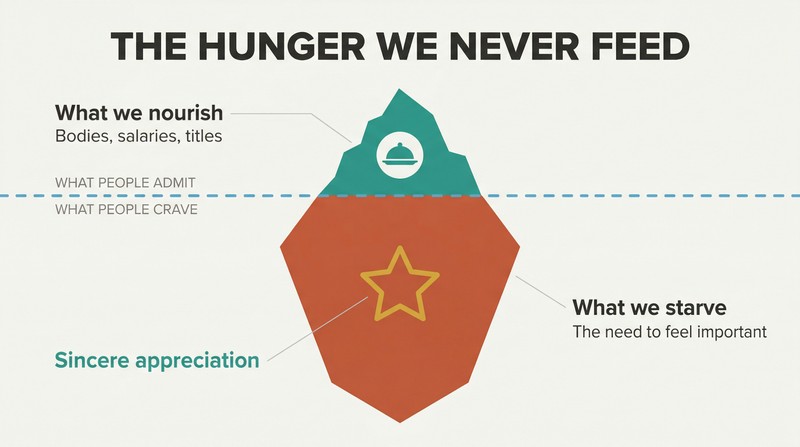
Feed the craving people never admit: the hunger to feel important
The deepest human urge. Philosopher John Dewey called it "the desire to be important" — the craving that drove Lincoln to study law from a barrel of old books, Dickens to write novels, and Rockefeller to amass millions. Carnegie argues this desire explains everything from why people join gangs to why some become invalids for attention. It separates humans from animals.
Appreciation is not flattery. Carnegie draws a sharp line: appreciation comes "from the heart out," flattery "from the teeth out." Charles Schwab attributed his record-breaking salary to being "hearty in his approbation and lavish in his praise." A study on runaway wives found the primary reason was lack of appreciation. Carnegie once went six days without eating and felt less deprived than people who go years without a sincere thank-you.
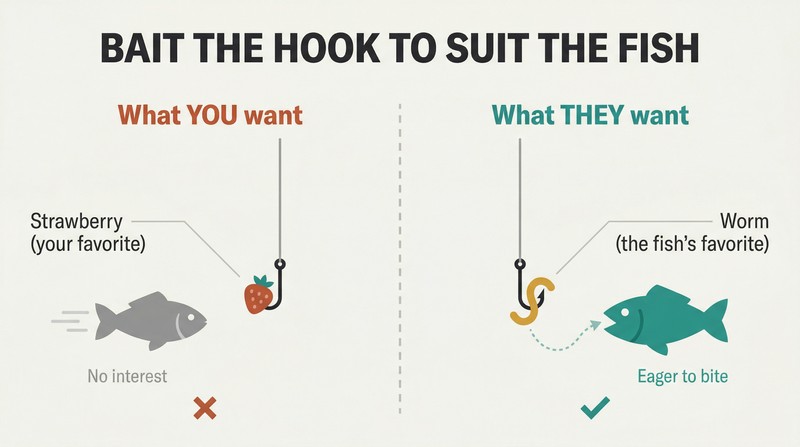
Bait the hook to suit the fish, not the fisherman
Talk about what they want. Carnegie loved strawberries, but when fishing, he baited with worms — because that's what fish wanted. Every negotiation follows the same logic. When his hotel tripled the rent on his lecture hall, Carnegie didn't complain. He listed advantages and disadvantages for the hotel manager: an empty ballroom versus cultured audiences providing free advertising. Result: a 50% increase instead of 300%.
This works on toddlers, too. Stan Novak's son threw a tantrum about kindergarten. Instead of threats, Novak started finger painting in the kitchen until Tim was begging to join. "You have to go to kindergarten first to learn that." The next morning, Tim sat waiting by the door before dawn. Before any conversation, ask one question: "How can I make this person want to do it?"
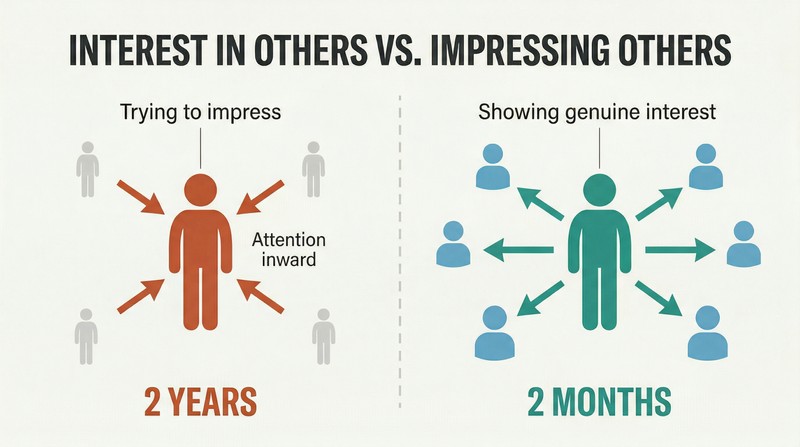
Genuine curiosity about others is the fastest friendship shortcut
Interest beats impression. Howard Thurston, history's greatest magician, told Carnegie his secret wasn't superior tricks — hundreds knew as much. Before every show, he said to himself: "I love my audience." Psychologist Alfred Adler warned that those not interested in fellow humans "have the greatest difficulties in life." Carnegie put this into practice by tracking friends' birthdays, studying visitors' interests beforehand, and remembering small details.
Small gestures outperform sales pitches. Salesman Edward Sykes nearly lost a drugstore account when the owner stopped ordering. But the soda clerk told the owner Sykes was the only salesman who even bothered saying hello to staff. The owner doubled his usual order. Theodore Roosevelt remembered White House servants by name and once called his valet's wife just to tell her about a bird outside her window.
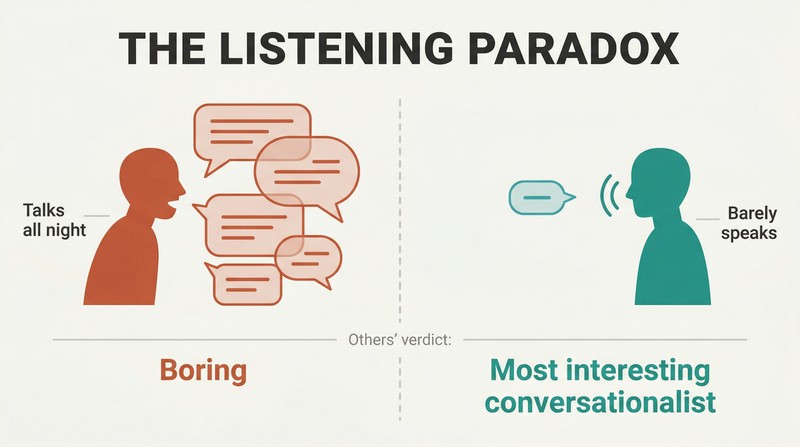
To be interesting, shut up and listen
Carnegie barely spoke at a dinner party, spending hours listening to a botanist describe exotic plants and indoor gardens. Afterward, the botanist called Carnegie "a most interesting conversationalist" — despite Carnegie having said almost nothing. Harvard president Charles Eliot called exclusive attention to the speaker the most flattering thing one can offer.
Listening solves what arguing can't. Lincoln once called an old friend to Washington, talked for hours about freeing the slaves, then sent him home without asking his opinion — he'd just needed a sympathetic ear. The New York Telephone Company's most combative customer — a man who filed lawsuits and wrote to newspapers — was won over by a representative who simply listened for nearly three hours across four visits. Once the man felt heard, his grievances evaporated.
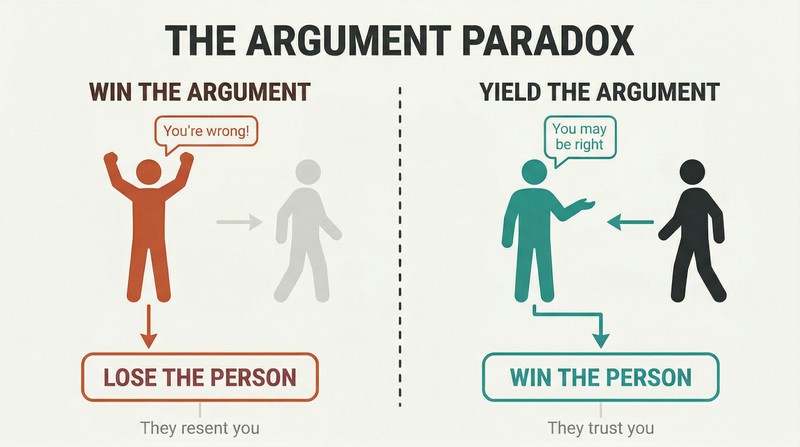
You can't win an argument — even when you win, you lose
Agreement sells, argument repels. Truck salesman Patrick O'Haire used to win every argument with buyers — then watch them buy from competitors. Once he started agreeing ("The Whose-It is a good truck — you'll never make a mistake"), buyers ran out of things to fight about and started listening. His sales skyrocketed at White Motor Company.
Ben Franklin's transformation proves the point. A blunt young Franklin was told: "Your opinions have a slap in them for everyone." He adopted softer language — "I conceive," "it appears to me" — and credited that shift for most of his influence over fifty years in public life. Carnegie's formula: say "I may be wrong. I frequently am. Let's examine the facts." Nobody objects to that, and it opens minds where force never could.
Admit fault fast and the other person will rush to defend you
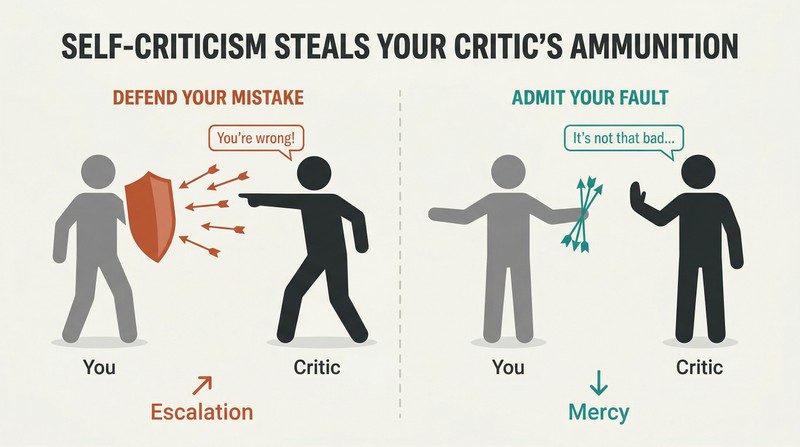
Self-criticism steals your critic's ammunition. When Carnegie was caught walking his dog off-leash a second time, he didn't wait for the lecture: "Officer, you've caught me red-handed. I'm guilty. I have no alibis." The policeman's only remaining move was mercy: "Well, a little dog like that isn't going to harm anybody." By condemning himself first, Carnegie left nothing to argue about.
This tactic works everywhere. An art director notorious for fault-finding was disarmed when the artist said, "I am at fault and there is absolutely no excuse." The director immediately defended the artist's work — then bought him lunch with a new commission. After Pickett's catastrophic charge at Gettysburg, Robert E. Lee rode out to meet his beaten troops alone: "All this has been my fault. I and I alone have lost this battle." Self-criticism takes all the fight out of the other person.
Suggest, don't sell — let people reach your conclusion themselves
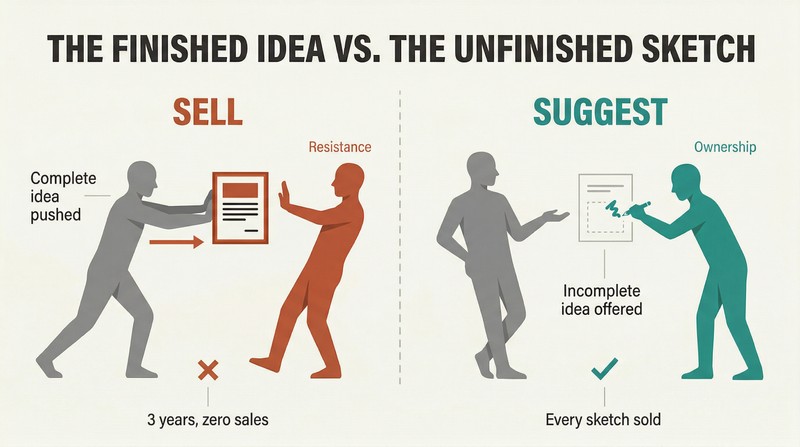
Let them draw the blueprint. Sketch salesman Eugene Wesson failed for three years with one buyer. Then he brought unfinished sketches and asked the buyer how to complete them. The buyer gave suggestions, the studio finished them to his specs, and every sketch sold. Scores of follow-up orders came — all drawn to the buyer's ideas. Wesson realized he'd spent years urging the man to buy what he thought the buyer ought to have.
Plant the seed, don't force the flower. Colonel Edward House influenced President Wilson by mentioning ideas casually, then watching Wilson present them at dinner as his own. House never corrected him — he wanted results, not credit. An X-ray manufacturer asked a hospital director to review imperfect equipment and suggest improvements. The doctor felt the purchase decision was entirely his own. He ordered it installed without anyone "selling" him.
Praise first, correct second — the sequence makes all the difference
Lincoln's letter to General Hooker is a masterclass in sequenced feedback. He needed to rebuke a general who'd undermined his predecessor and openly discussed dictatorship. But Lincoln opened with: "I believe you to be a brave and skillful soldier… You have confidence in yourself, which is a valuable if not an indispensable quality." Only after establishing genuine praise did he address "some things in regard to which I am not quite satisfied."
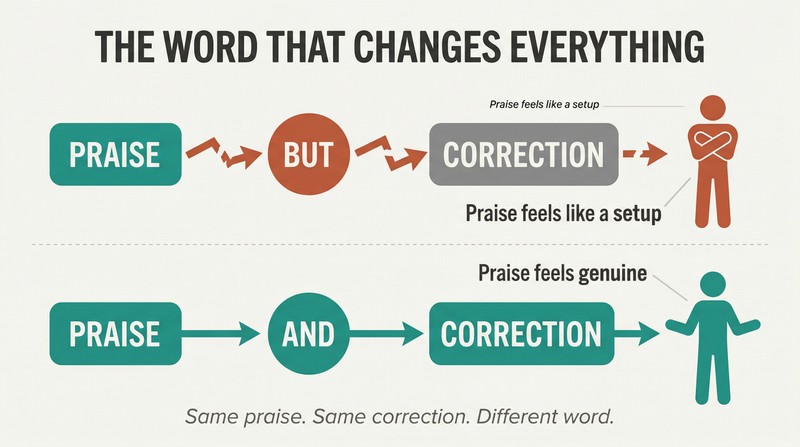
One word ruins praise: "but." Saying "We're proud of your grades, but your algebra needs work" makes the compliment feel like a trap. Carnegie's fix: replace "but" with "and." "We're proud of your grades, and by continuing the same effort, your algebra can match the rest." The second version calls attention to the problem without triggering defensiveness. Indirect correction works wonders with sensitive people.
Give people a shining reputation and watch them race to deserve it
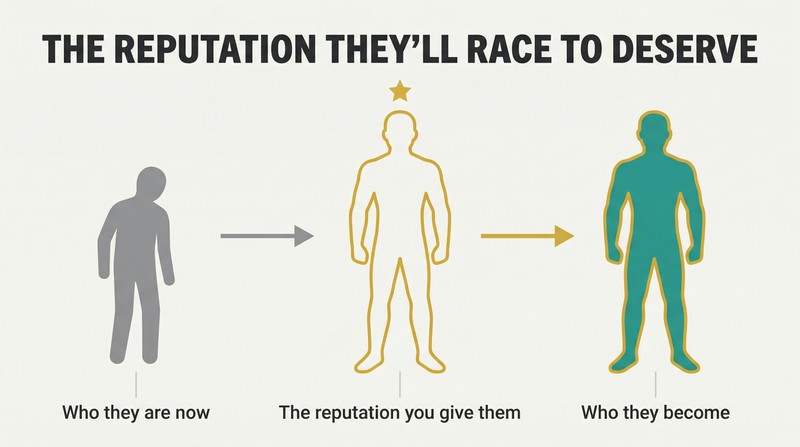
A single sentence transformed a life. Employer Georgette Leblanc told her dejected servant — known as "Marie the Dishwasher," cross-eyed and bandy-legged — "Marie, you do not know what treasures are within you." Marie began caring for her appearance, bloomed, and married within two months. Teacher Ruth Hopkins told Tommy, the school's most notorious troublemaker: "I understand you are a natural leader. I'm going to depend on you." He lived up to it completely.
Name the exact virtue you want repeated. Enrico Caruso's first teacher said he couldn't sing. His peasant mother praised him, told her she could see improvement, and went barefoot to pay for lessons — changing music history. When mechanic Bill's work declined, his manager said: "You have been an outstanding mechanic." Bill immediately returned to his former quality. Vague flattery is empty; specific praise creates a standard people feel compelled to honor.
Analysis
Carnegie's 1936 book is often dismissed as manipulative charm-school material, but this critique misses what makes it genuinely prescient. Decades before Robert Cialdini codified influence principles or Deci and Ryan formalized Self-Determination Theory, Carnegie identified three psychological needs that modern research confirms drive human behavior: autonomy (let people feel the idea is theirs), competence (praise specific improvement), and relatedness (show genuine interest). His 'desire to be important 'maps almost perfectly onto what social psychologists now call status-seeking behavior — the fundamental currency of human social life.
The book's deepest insight isn't any single technique but its meta-principle: you change others by changing yourself first. Every principle — don't criticize, listen, see their viewpoint — is really an instruction to override your own ego. Carnegie asks you to stop being the protagonist of every interaction. In an era of personal branding and self-promotion, this remains radical advice.
The limitations are real. Carnegie's world was overwhelmingly white, male, and American — his examples assume roughly equal social standing between interlocutors. The book says little about navigating power asymmetries where genuine appreciation might read as sycophancy, or where admitting fault could be weaponized against marginalized people. His advice also operates on a spectrum from sincere relationship-building to calculated impression management, and he doesn't always acknowledge the tension between the two.
Yet the book endures because its core observation is empirically sound: humans are emotional beings who crave importance, and the person who consistently satisfies that craving accumulates extraordinary social capital. Carnegie didn't discover this — he credits Confucius, Buddha, and Jesus — but he was the first to package ancient wisdom as a practical skill set for modern professionals. Nearly ninety years later, in a world of remote work, social media, and algorithmic feeds, the ability to make another person feel genuinely seen remains the scarcest and most valuable interpersonal skill available.
Review Summary
How to Win Friends and Influence People is a highly influential self-help book that has remained popular since its publication in 1936. While some readers find its advice manipulative or outdated, many praise its timeless wisdom on human interaction and communication. The book offers practical tips for building relationships, influencing others, and improving social skills. Critics argue it promotes insincerity, but supporters claim it teaches genuine interest in others. Despite mixed reviews, the book is widely regarded as a classic in personal development literature.
People Also Read








Glossary
The desire to be important
Core driver of human behaviorCarnegie's foundational concept, drawn from philosopher John Dewey, holding that the deepest urge in human nature is the craving to feel significant. Carnegie argues this desire explains everything from charitable giving to criminal behavior, and that satisfying it in others through sincere appreciation—not flattery—is the master key to influence and leadership.
Hearty in your approbation and lavish in your praise
Schwab's formula for appreciationA phrase Carnegie borrows from steel magnate Charles Schwab and repeats throughout the book as the gold standard for giving recognition. It means praising genuinely, enthusiastically, and generously—not with measured, careful compliments but with wholehearted acknowledgment of specific good qualities and achievements. Carnegie contrasts this with flattery, which is insincere and self-serving.
Yes, yes response
Getting early agreement momentumCarnegie's persuasion technique inspired by the Socratic method. The speaker begins by asking questions the other person must answer affirmatively, building psychological momentum toward agreement. Carnegie explains that when someone says 'no,' the entire neuromuscular system sets itself against acceptance, while successive 'yes' responses create a forward-moving, open posture that makes the listener far more receptive to the speaker's ultimate proposal.
A fine reputation to live up to
Praise-based behavior change techniqueCarnegie's leadership principle of attributing a positive trait to someone—even before they fully demonstrate it—so they feel compelled to act consistently with that identity. Rather than criticizing shortcomings, the leader names the specific virtue they want to cultivate, creating a self-fulfilling standard. Carnegie credits Shakespeare's advice: 'Assume a virtue, if you have it not.'
FAQ
What's How to Win Friends and Influence People about?
- Focus on Human Relations: The book emphasizes effective communication and interpersonal skills in both personal and professional settings.
- Timeless Principles: It outlines techniques for handling people, making friends, and influencing others positively, applicable across various situations.
- Personal Development: Encourages readers to improve social skills for greater success, highlighting the importance of understanding human nature.
Why should I read How to Win Friends and Influence People?
- Proven Success: With over ten million copies sold, it has helped countless individuals improve social interactions and achieve goals.
- Practical Advice: Offers actionable strategies that can be implemented immediately to enhance relationships.
- Universal Relevance: Concepts are applicable to anyone, fostering better communication in business, family, or social settings.
What are the key takeaways of How to Win Friends and Influence People?
- Avoid Criticism: Criticism leads to defensiveness and resentment, damaging connections.
- Show Genuine Interest: Becoming genuinely interested in others is vital for making friends.
- Remember Names: Using someone's name can significantly enhance rapport.
What are the best quotes from How to Win Friends and Influence People and what do they mean?
- "You can’t win an argument.": Highlights the futility of arguments, advocating for understanding over confrontation.
- "A man convinced against his will is of the same opinion still.": Suggests persuasion should come from understanding, not conflict.
- "The only way to get the best of an argument is to avoid it.": Encourages seeking harmony over winning disputes.
What specific methods does Dale Carnegie suggest for making friends?
- Be a Good Listener: Encourage others to talk about themselves to make them feel valued.
- Smile: A genuine smile creates a welcoming atmosphere and makes others feel comfortable.
- Talk in Terms of Their Interests: Discussing topics others are passionate about fosters connection.
How can I apply the principles from How to Win Friends and Influence People in my daily life?
- Practice Active Listening: Listen attentively to show respect and encourage open communication.
- Use Names Frequently: Remember and use people's names to enhance interactions.
- Show Appreciation: Express sincere appreciation for others' efforts to strengthen relationships.
What are some common mistakes people make in social interactions according to Dale Carnegie?
- Criticizing Others: Criticism leads to defensiveness; focus on positive reinforcement instead.
- Talking Too Much About Themselves: Dominating conversations can hinder connections; shift focus to others.
- Neglecting to Show Interest: Failing to understand others' interests leads to superficial relationships.
How does Dale Carnegie suggest handling complaints or difficult conversations?
- Listen and Empathize: Listen patiently to complaints to make others feel heard and valued.
- Avoid Arguments: Focus on finding common ground instead of engaging in arguments.
- Express Appreciation: Acknowledge feelings and express gratitude to turn negative interactions into constructive dialogues.
What role does self-improvement play in How to Win Friends and Influence People?
- Personal Growth: Improving interpersonal skills is essential for success.
- Habit Formation: Encourages forming positive habits in interactions for lasting changes.
- Empathy and Understanding: Developing empathy enhances personal and professional lives.
How can I measure my progress in applying Carnegie's principles?
- Keep a Journal: Document interactions to identify areas for improvement.
- Seek Feedback: Ask for feedback from friends, family, or colleagues on social interactions.
- Set Specific Goals: Establish clear goals for improving interpersonal skills and review them regularly.
What specific methods does Dale Carnegie suggest for influencing others?
- Avoid Direct Confrontation: Use subtlety to influence others by asking leading questions.
- Use the "Yes, Yes" Technique: Create a positive atmosphere by getting initial agreement.
- Empathy and Understanding: See things from others' perspectives to communicate effectively.
How can I improve my leadership skills using Carnegie's principles?
- Lead by Example: Demonstrate desired behaviors to set a standard for others.
- Encourage Participation: Involve team members in decision-making to foster ownership.
- Recognize Achievements: Acknowledge and celebrate team members' achievements to boost morale.
About the Author
Other books by Dale Carnegie




Download PDF
Download EPUB
.epub digital book format is ideal for reading ebooks on phones, tablets, and e-readers.








































