


Key Takeaways
Let your smile flood in slowly so it lands as genuinely yours
The delayed smile signals sincerity. Lowndes argues the reflexive grin, the one you flash at everyone who enters your sight line, reads as cheap and automatic. Her fix, which she calls the Flooding Smile, is to pause a half second, absorb the person's face, then let warmth spread across your features so it feels custom-made for them.
She backs this with a story about her friend Missy, a bubbly college giggler who took over her late father's corrugated box business. Her father's parting advice, drawn from a study, was that women who smiled a beat slower were perceived as more credible. Missy trained her lips to erupt later, and closed three new clients in a single dinner. The lag was under a second, yet it transformed how sincere she seemed.
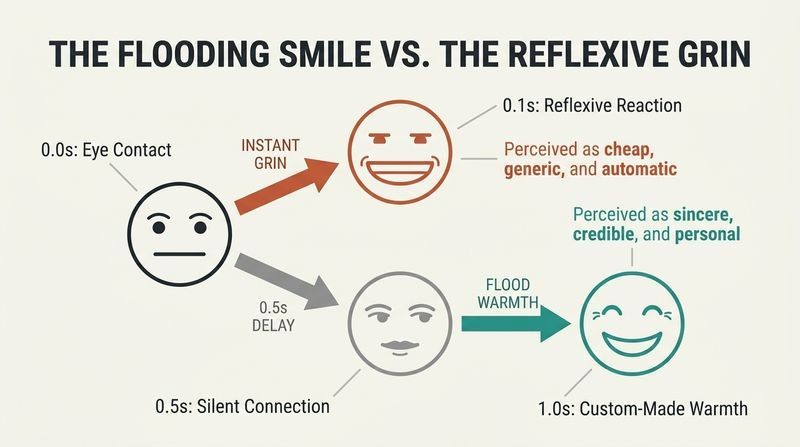
The insight aligns with research on the Duchenne smile, the genuine expression involving the eyes' orbicularis muscles that people unconsciously distinguish from social smiles. Timing adds another layer: psychologists studying facial mimicry find that slight delays can signal deliberation rather than reflex. There is tension worth noting, though. A slow smile builds gravitas but can also read as cold or calculating in warm, casual cultures where instant grins signal friendliness. The technique may serve a female CEO in negotiation better than a nurse greeting a frightened patient. Context governs whether measured warmth outperforms spontaneous warmth, a nuance the single prescription glosses over.
Glue your eyes to people, releasing the gaze reluctantly like taffy
Prolonged eye contact manufactures intimacy. Lowndes calls sustained gaze Sticky Eyes: keep looking even after the other person stops speaking, and when you must look away, do it slowly. She cites a Boston study where subjects were secretly told to count their partner's blinks, forcing intense eye contact. Those unwitting starers later reported significantly higher respect and fondness for their partners.
The physiological mechanism matters. Intense gaze raises heart rate and releases adrenaline-like compounds, the same arousal people feel when falling in love. A stronger version, Epoxy Eyes, means watching your target even when someone else is speaking, which reads as fascination or evaluation. Lowndes warns of limits: some men feel threatened or hostile when stared at too long by other men, and across cultures intense eye contact can read as intrusion or disrespect.
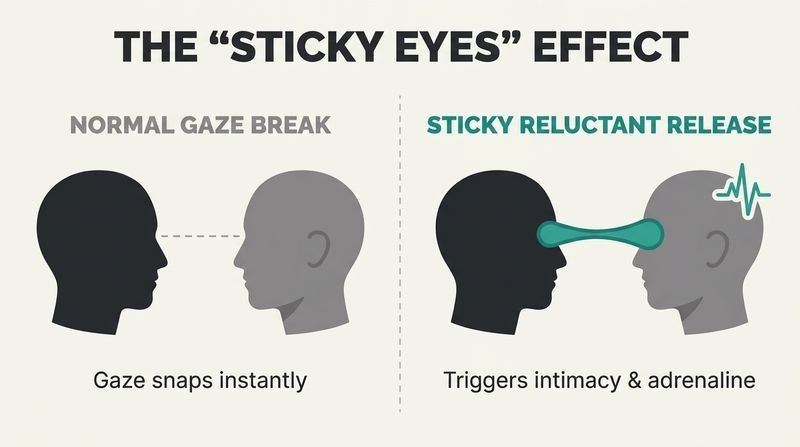
The arousal-misattribution effect underpins this. Dutton and Aron's famous 1974 shaky-bridge study showed people misread physiological arousal (fear) as romantic attraction. Sticky Eyes exploits the same wiring: the body's activation from being watched gets reinterpreted as interest. But the technique carries real risk of backfiring. Modern readers should weigh power dynamics and consent. Sustained gaze from a stranger can feel predatory rather than magnetic, especially given heightened awareness of harassment. Lowndes's own caveats about gender and culture deserve more weight than she gives them. The tool is potent precisely because it hijacks a threat-detection system, which cuts both ways.
Greet strangers as if reuniting with a beloved long-lost friend
Pretending affection generates real affection. Lowndes's Hello Old Friend technique asks you to silently imagine, at the moment of meeting, that this stranger is a cherished friend you lost track of years ago and have miraculously found again. You say nothing about it. But your eyebrows soften, your body opens, your toes point toward them, and the whole apparatus of warmth engages without conscious effort.
She pairs this with the Big-Baby Pivot: turning your full body toward a new acquaintance with the delighted attention you would give a toddler beaming up at you. Her friend Carla ignored courting men at a party until she mimicked the warm pivot she gave the host's five-year-old. Lowndes cites an Adelphi University study showing that volunteers told to act as if they liked strangers ended up genuinely liking them, and were liked back.
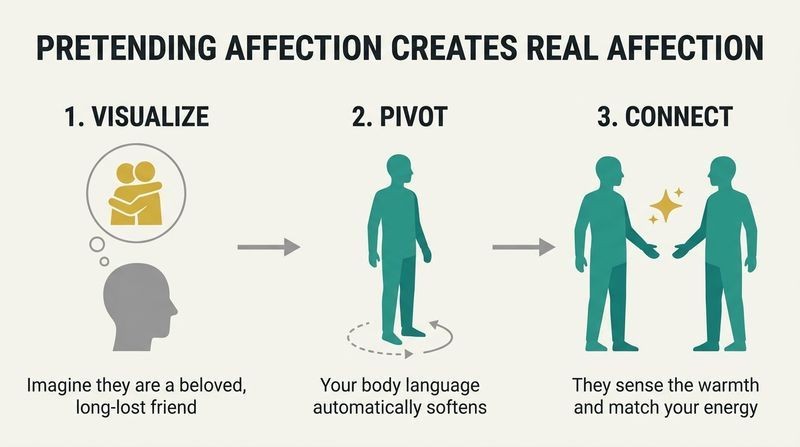
This is behavioral activation and self-perception theory in action. Daryl Bem's work suggests we infer our own attitudes partly by observing our behavior, so acting warm generates felt warmth. The facial-feedback hypothesis extends it: adopting the physical posture of affection can trigger the emotion. The Adelphi finding also echoes the reciprocity-of-liking principle, one of social psychology's most robust effects. One caveat: authenticity researchers like Brene Brown might argue that manufactured warmth risks emotional labor and burnout if sustained without genuine feeling. Yet Lowndes's cleverness is that the pretense is a primer, not a permanent mask. It bootstraps real connection rather than faking it indefinitely.
Never answer where you're from or what you do with one naked word
Give people something to grab. When asked where you are from or what you do, a one-word answer (Columbus, or accountant) leaves the asker stranded, mentally scrambling for a follow-up. Lowndes calls these dead-ends the Naked City and Naked Job. Instead, attach a hook: a fact, a story, a benefit that invites conversation.
She learned this the hard way when the head of a trade association said Columbus, Ohio, and Lowndes, the supposed conversation expert, froze in silence. Afterward she called the Columbus chamber of commerce and armed herself with morsels: it is called the most typically American city, corporations test products there, it has a historic German Village. For jobs, translate your title into human benefit. A hairdresser says I help women find the right style for their face rather than just hairdresser.
This maps onto conversational cooperation, specifically Grice's maxim of quantity: give enough information to sustain the exchange. The benefit-statement reframe also anticipates modern personal-branding and elevator-pitch coaching. What Lowndes intuited decades before it became standard networking advice is that identity labels are conversational cul-de-sacs while narratives are on-ramps. A subtle risk: over-rehearsed hooks can feel like marketing rather than mingling, and listeners increasingly detect scripted spontaneity. The strongest version tailors the hook to the specific asker, which requires reading the room rather than reciting a canned line. The principle endures even where the 1990s examples feel dated.
Keep the conversational spotlight aimed at them, not yourself
People adore those who make them the subject. Lowndes tells of a friend who raved about a man named Dan at a party, calling him the most fascinating person there, yet could not say what he did or where he lived. The reason: Dan asked about her the entire time. He later explained he learns more, and captivates more, by turning the light on the other person.
She offers concrete tools. The Swiveling Spotlight: imagine a giant beam between you, and keep it shining on the other person. Be a Word Detective: listen for stray references (a mention of plants, a dog, arthritis) that reveal what someone secretly wants to discuss, then pounce on that thread. Parroting: when stuck, simply repeat the last two or three words someone said, in a questioning tone, to keep them talking.
This is active listening formalized into repeatable moves, and it predates the current therapeutic-communication vogue. Parroting mirrors the reflective-listening techniques used in motivational interviewing and Rogerian counseling, where restating the client's words deepens disclosure. The word-detective habit resembles what salespeople call listening for the pain point. Neuroscience offers support: a Harvard study by Tamir and Mitchell found that self-disclosure activates the brain's reward circuitry, meaning people are literally rewarded for talking about themselves. The mild critique is manipulation optics. Used cynically, these tools extract without giving. Used sincerely, they are simply generosity of attention, arguably the rarest social currency in a distracted age.
Deliver bad news wearing the listener's emotion, not your own
Tone matters more than content. Lowndes recounts a neighbor cheerfully announcing rain would ruin her picnic, and a Greyhound clerk gleefully reporting her bus had just left. The information was neutral; the smiling delivery made her want revenge. Her technique, It's the Receiver's Ball, borrows from football: a quarterback throws with the receiver in mind. Match your facial and vocal tone to how the recipient will feel, not how you feel.
She adds Echo the Emo. When someone is upset, empathize hard with their emotion before dealing with facts. An L.L. Bean rep defused Lowndes's fury over torn trousers by naming the feelings: your friend must have been mortified, and you must have felt terrible after recommending us. By echoing the emotion rather than reciting policy, the rep dissolved the anger entirely.
This anticipates emotional-intelligence research popularized by Daniel Goleman and the affect-labeling findings of UCLA's Matthew Lieberman, whose fMRI work showed that naming an emotion dampens amygdala activation. When the L.L. Bean rep labeled the mortification, she was neurologically calming the customer, not just being polite. The football framing also aligns with audience-design theory in linguistics, where speakers tailor messages to listeners. The overlooked nuance is that mismatched cheerfulness often stems from nervousness or scripts, not callousness. Training frontline workers to read and mirror emotional state, rather than default to forced positivity, remains a live problem in customer service decades after Lowndes wrote this.
Speak a few insider words of any trade to instantly belong
A little jargon buys enormous credibility. Lowndes argues you do not need expertise to sound like an insider, just the right opening questions and hot-button issues. She calls the foreign languages of professions Jobbledygook. Ask a doctor their specialty and hospital affiliation, or an artist what medium they work in, and they assume you know their world.
Her boldest claim is Scramble Therapy: try an unfamiliar activity once, and you absorb 80 percent of the conversational value, the insider questions and vocabulary. She learned scuba lingo (wrecks versus reefs, bottom time, the bends) in a single three-hour resort dive. She likens it to litmus paper: one drop of acid turns it as pink as a whole vat. She also urges learning each field's burning concerns, the issues insiders obsess over that outsiders never suspect.
The 80 percent-from-one-exposure claim is exaggerated but points at something real: the Pareto-like front-loading of surface fluency. Linguists distinguish between productive competence (using a field deeply) and receptive competence (recognizing and prompting), and Lowndes targets the latter. This resembles the journalist's skill of rapidly interviewing across domains. The risk is the imposter tightrope. She wisely advises changing the subject fast, before your shallow knowledge is exposed, because faking depth invites humiliation. In an age of easy verification, the honest move is to signal genuine curiosity rather than feigned mastery. The tool works best as a door opener, not a costume.
Echo their exact words to signal you belong to their tribe
Shared vocabulary equals shared values. Lowndes cites a study where strangers told they were similar in beliefs liked each other far more than those told they were different, even though the labels were random. We gravitate toward those we perceive as like us. Her Echoing technique: use the speaker's precise nouns and verbs rather than your own synonyms. If she calls her mountain home a chalet, never call it a cabin.
Her friend Phil killed his chances of an invitation by calling a woman's chalet a cabin, a word he loved but she did not choose. Cat owners have cats, horse people own horses, fish folk keep fish. Using the wrong verb marks you as an outsider. She extends this to Potent Imaging: draw analogies from the listener's world (a gardener's seeds, a sailor's staying afloat) rather than your own.
This is linguistic accommodation theory, developed by Howard Giles, which shows that speakers who converge toward each other's speech patterns are rated as warmer and more competent. Echoing also taps the mere-similarity effect and in-group identification. Modern rapport research on lexical mirroring finds that matched language predicts negotiation success and even romantic pairing. The word-choice sensitivity Lowndes flags (chalet versus cabin) is genuinely astute, because word selection encodes class, region, and identity in ways people feel but rarely articulate. The mild caution: over-mirroring becomes mimicry, which reads as mockery or manipulation if too conspicuous. Subtlety is the whole game.
Praise people behind their backs so it returns as trusted gold
Indirect praise dodges the brownnosing suspicion. Direct compliments risk being read as flattery, guilt, or angling for something. Lowndes's fix, Grapevine Glory, is to praise someone to a person close to them, confident it will travel back within a day and land with more credibility because it seems unguarded. She quotes the 1732 line that a true friend speaks well of you behind your back.
She layers on related moves. Carrier Pigeon Kudos: when you hear something nice about someone, personally relay it to them, becoming the beloved bearer of good news. Implied Magnificence: embed a flattering assumption in an aside (you obviously read between the lines) so the praise seems to slip out accidentally. The Killer Compliment: give one specific, personal, credible compliment (your eyes are extraordinary) to a new acquaintance, but no more than once every six months.
Overheard praise carries weight because of attribution theory: we discount praise delivered to our face as strategically motivated, but praise not intended for our ears seems to reveal the speaker's true belief. This is the same logic behind why testimonials and third-party endorsements outperform self-promotion in marketing. The six-month rule on Killer Compliments shows Lowndes understands the economics of scarcity in praise; inflation devalues it. A cross-disciplinary parallel is Cialdini's work on liking and the potency of genuine, specific compliments. The ethical line is sincerity. Manufactured grapevine praise about qualities someone lacks eventually collapses, because reality audits reputation over time.
On the phone, exaggerate your warmth by 30 percent to survive the wires
Voice must carry what the body normally does. Lowndes learned this when her travel agent Rani seemed cold and snippy for years, until she met her in person and found her genuinely warm. The body language simply did not travel through the phone. She cites studies showing people lose about 30 percent of their vocal energy over the line, so you must consciously overcompensate.
Her Talking Gestures technique converts nods and smiles into audible words: uh-huh, I see, what a surprise. The Name Shower: use the person's name far more often than you would in person, since each utterance recreates the eye contact and touch the phone strips away. The Oh Wow, It's You: answer neutrally and professionally, then let warmth flood your voice only after you hear who is calling, so the caller feels the smile is reserved for them.
This intuits what media-richness theory formalized: the telephone is a leaner channel than face-to-face, stripping visual and gestural cues, so communicators must add compensating vocal signals. The 30 percent figure is folk-precise but directionally sound. In the video-call and voice-note era, the lesson generalizes: warmth does not transmit automatically across mediated channels, and flat affect that would read as calm in person reads as disinterest on a call. The Name Shower has empirical support, since hearing one's own name activates distinctive neural responses. One caution: overused, names sound like a telemarketer's script. The skill is calibration, spraying enough to warm without triggering the manipulation alarm.
Never confront anyone at a party, a meal, or a chance meeting
Certain settings are diplomatic sanctuaries. Lowndes identifies three safe havens where sophisticated players never do hard business or confront enemies: parties, dining tables, and accidental encounters. A mail-room worker who challenged her ad-agency boss about party costs at the Christmas bash, however valid her point, quietly torpedoed her own promotion prospects.
The dining table is the most sacred. Business lunches run long precisely because tough negotiation waits until coffee, and even then stays positive; controversy gets relegated to the conference table. Chance meetings are for chitchat: a salesman who ambushes a prospect in the supermarket checkout line with his pitch never gets his call returned, while the one who simply says a warm hello gets called back out of gratitude. The lesson: read the container before you pour in the content.
Anthropologically, this reflects the concept of framed interaction that Erving Goffman theorized: social settings carry implicit rules about permissible behavior, and violating the frame marks you as socially incompetent. The dining taboo has deep roots; commensality, eating together, is a bonding ritual across cultures, and injecting conflict pollutes it. There is a class dimension worth naming: these unwritten codes function partly as gatekeeping, distinguishing insiders who intuit them from outsiders who blunder. That is both the value and the injustice of Lowndes's framework. Learning the codes empowers the striver, but the existence of invisible codes also perpetuates the very glass ceilings she describes. Timing, not suppression, is the real skill.
Track the invisible scorecard: the lower-status person always defers
Every relationship has a fluctuating tally. Lowndes closes with the Great Scorecard in the Sky: between any two people hovers an invisible, constantly shifting score, and the person with the lower score must pay deference, offer to travel, pick up the check, respect the other's time. Miss this, and you are quietly disqualified.
Her friend Laura, who invented a health drink, blew a deal with a supermarket magnate by grilling him about shipping logistics and refrigerated trucks, when she should have been so grateful she would deliver the samples herself. Lowndes also insists on Let Em Savor the Favor: wait at least 24 hours before cashing in when someone grants you a favor, and Tit for Wait Tat: when someone owes you, delay collecting so the exchange feels like friendship rather than transaction. She tracks the fates of her cast, the graceless ones stalled, the graceful ones soared.
This is social-exchange theory rendered as street wisdom. Sociologist Peter Blau distinguished economic exchange (explicit, immediate) from social exchange (diffuse, trust-based), and Lowndes's favor-delay rules protect the latter's fragile magic; naming the debt too soon collapses social exchange into mere barter and destroys the relational bond. The status-deference point echoes primatology, where dominance hierarchies govern grooming and access. The uncomfortable truth is that status-tracking can curdle into obsequiousness or Machiavellian calculation. The healthiest reading treats the scorecard as a reminder toward graciousness and gratitude rather than a ledger of leverage. Her closing epigraph captures it best: the difference between walking in announcing here I am versus there you are.
Analysis
How to Talk to Anyone is a 1990s update of Dale Carnegie repackaged as 92 named micro-techniques. Lowndes's core thesis is that charisma is not innate but engineered from thousands of subliminal signals, and that Carnegie told us what to do (smile, show interest) without teaching how. Her contribution is granular tactics with sticky names, drawn from observing salespeople, politicians, performers, and executives.
The book's structure, an anthology of tricks rather than a unified theory, is both its strength and weakness. Readers get an actionable toolkit but no organizing principle beyond the recurring metaphor of big cats versus little cats in a social jungle. The unifying insight, buried in the epigraph, is the distinction between people who enter a room signaling here I am and those who signal there you are. Nearly every technique operationalizes the second posture: turning attention outward.
What holds up well is remarkable. Lowndes intuited findings that later research validated: affect labeling calms distress, self-disclosure is neurologically rewarding, linguistic accommodation builds rapport, overheard praise beats direct flattery. She was writing applied social psychology before it was fashionable.
What dates the book is tone and ethics. The relentless framing of interaction as winning, of people as targets and marks, sits uneasily with contemporary sensibilities around authenticity and consent. Techniques like Epoxy Eyes read differently in a post-harassment-awareness culture. The manipulation optics are real; used cynically, these are tools of extraction.
Yet the most generous reading rescues most of it. Attention, warmth, curiosity, and gratitude are genuine goods, and Lowndes's tricks are scaffolding for people too anxious or unpracticed to deploy them naturally. The tragedy she documents, the talented person who never learns why doors close, is real. Her remedy, that character is built from repeated small moves, remains sound. The book is best consumed as a menu, not a manifesto: adopt the generosity, skip the gamesmanship.
Review Summary
How to Talk to Anyone receives mixed reviews. Some readers find practical tips for improving social skills and communication, particularly in business settings. However, others criticize the book for promoting manipulative techniques and being overly focused on impressing others. Many reviewers note that while some advice is helpful, much of it is common sense or feels outdated. The book's anecdotes and writing style are polarizing, with some finding them engaging and others finding them irritating. Overall, opinions vary widely on the book's usefulness and sincerity.
People Also Read







FAQ
What's How to Talk to Anyone about?
- Communication Skills Focus: How to Talk to Anyone by Leil Lowndes is centered on enhancing communication skills for personal and professional success. It provides practical techniques to improve how you connect with others.
- Ninety-Two Techniques: The book offers 92 specific techniques that range from body language tips to conversation starters, all designed to help you engage and communicate effectively with anyone.
- Building Relationships: The ultimate aim is to help readers build better relationships, whether for networking, friendships, or romantic interests, by mastering the art of conversation.
Why should I read How to Talk to Anyone?
- Enhance Social Skills: If you struggle with social interactions or feel anxious in conversations, this book provides actionable strategies to improve your confidence and effectiveness in communication.
- Practical Techniques: Filled with practical advice that can be applied immediately in various social situations, it’s a valuable resource for anyone looking to enhance their interpersonal skills.
- Broaden Your Network: By learning how to engage with others more effectively, you can expand your personal and professional networks, leading to new opportunities and relationships.
What are the key takeaways of How to Talk to Anyone?
- First Impressions Matter: The book emphasizes that you only have ten seconds to make a positive impression, and your body language plays a crucial role in that.
- The Power of Smiles: Techniques like "The Flooding Smile" can make your interactions more genuine and engaging, helping you to connect with others on a deeper level.
- Active Listening: The importance of listening and responding appropriately is highlighted, with methods like "Parroting" to keep conversations flowing and engaging.
What are some specific techniques mentioned in How to Talk to Anyone?
- The Flooding Smile: This technique involves pausing before smiling to make your smile appear more genuine and personal, enhancing the connection with the other person.
- Sticky Eyes: This method encourages maintaining strong eye contact to create a sense of intimacy and respect during conversations, making the other person feel valued.
- The Big-Baby Pivot: When meeting someone new, this technique suggests turning your body fully towards them and giving them your undivided attention, making them feel special and important.
What are the best quotes from How to Talk to Anyone and what do they mean?
- "You only have ten seconds to show you're a somebody.": This quote underscores the importance of first impressions and how quickly people form judgments based on your appearance and body language.
- "People don't care how much you know until they know how much you care.": This emphasizes the need for genuine interest in others to build rapport and trust in relationships.
- "Call a spade a spade.": This quote encourages honesty and directness in communication, suggesting that using clear language fosters better understanding and connection.
How does How to Talk to Anyone address body language?
- Nonverbal Communication: The book highlights that over 80% of first impressions are based on body language rather than words, making it essential to be aware of your nonverbal cues.
- Posture and Presence: Techniques like "Hang by Your Teeth" encourage maintaining good posture to project confidence and approachability, which can significantly impact how others perceive you.
- Reading Others: The book teaches readers how to read body language cues from others, allowing for more effective and empathetic communication.
How can I improve my small talk skills using How to Talk to Anyone?
- Use Open-Ended Questions: The book suggests asking open-ended questions to encourage deeper conversations, allowing the other person to share more about themselves.
- Practice Active Listening: Focus on truly listening to what the other person is saying rather than thinking about your next response, showing genuine interest and building rapport.
- Be Mindful of Body Language: Pay attention to your body language and that of your conversation partner, as open and inviting body language can make small talk feel more comfortable and natural.
How does How to Talk to Anyone help with networking?
- Building Confidence: The techniques provided help readers feel more confident in social situations, making it easier to approach new people and engage in conversations.
- Creating Lasting Impressions: By mastering first impressions and small talk, readers can leave a positive impact on potential contacts, increasing the likelihood of future interactions.
- Effective Introductions: The book teaches how to introduce others in a way that fosters conversation, making networking events more productive and enjoyable.
How can I apply the techniques from How to Talk to Anyone in my daily life?
- Practice Regularly: Incorporate techniques like "The Big-Baby Pivot" and "The Flooding Smile" in everyday interactions to enhance your communication skills gradually.
- Be Observant: Use the "Hans's Horse Sense" technique to observe and respond to others' body language and verbal cues, allowing for more meaningful conversations.
- Prepare for Social Events: Before attending gatherings, familiarize yourself with current events or topics relevant to the attendees, ensuring you have engaging conversation starters ready.
What are some common mistakes to avoid according to How to Talk to Anyone?
- Using Clichés: The book advises against relying on clichés, as they can make you sound unoriginal and diminish your credibility in conversations.
- Neglecting the Other Person: Failing to show genuine interest in the other person can lead to disengagement; techniques like "Comm-YOU-nication" emphasize putting the other person first.
- Rushing to Share Similarities: The book cautions against quickly jumping in with "me too" responses, suggesting that allowing the other person to express themselves first can create a stronger connection.
How does How to Talk to Anyone address cultural differences in communication?
- Understanding Customs: The book advises readers to familiarize themselves with cultural customs and etiquette before interacting with people from different backgrounds to prevent misunderstandings.
- Adapting Communication Styles: It encourages adapting your communication style to fit the cultural context of the person you are speaking with, enhancing rapport and making interactions smoother.
- Avoiding Assumptions: The author stresses the importance of avoiding assumptions based on one's own cultural norms, promoting open-mindedness and curiosity about others' perspectives.
How can I apply the techniques from How to Talk to Anyone in a professional setting?
- Networking Events: Use the techniques to engage with new contacts at networking events, approaching individuals with confidence and using open body language.
- Client Interactions: Apply the principles of active listening and empathy when dealing with clients, showing genuine interest in their needs and concerns.
- Team Meetings: Implement the techniques during team meetings to foster collaboration and communication, encouraging participation by using inclusive language.
About the Author
Other books by Leil Lowndes






Download PDF
Download EPUB
.epub digital book format is ideal for reading ebooks on phones, tablets, and e-readers.








































