

Key Takeaways
You're probably worse at reading people than you think
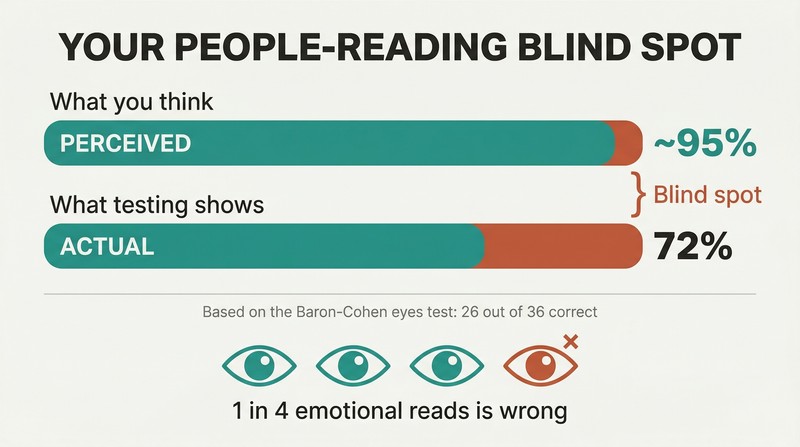
Confirmation bias flatters us. We remember the times we nailed someone's character and conveniently forget every misread. Simon Baron Cohen's social intelligence test — which asks you to identify emotions from photographs of people's eyes alone — finds an average score of just twenty-six out of thirty-six. That means roughly one in every four emotional reads is flat wrong, even before real-world complexity enters the picture.
The good news: people-reading is a trainable skill, not a mystical gift. This book layers multiple models — motivation psychology, body language, personality typology, lie detection, and rapid observation — arguing that no single lens captures a person, but stacking several gets you remarkably close. The first step is admitting your current radar has blind spots.
Your biggest blind spot in reading others is yourself
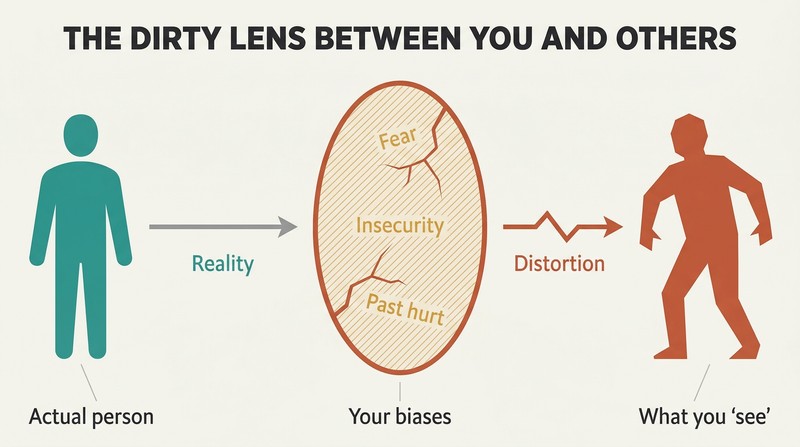
Your baggage corrupts your data. If you were recently betrayed, you'll see deception everywhere. If you're insecure about intelligence, you'll over-interpret a colleague's neutral remark as condescension. Unexamined fears, values, and assumptions act like a dirty lens — every observation you make passes through your own distortions before you can process it.
King offers a vivid example: a physically imposing interviewer with a deep voice and serious expression concludes that a female candidate is insecure because she's fidgeting and speaking quickly. In reality, he is what's making her nervous. Her behavior reflects his presence, not her character. Before you analyze anyone, audit your own emotional state, your biases, and the effect you may be having on the person.
Never interpret a single gesture — establish baselines and read clusters
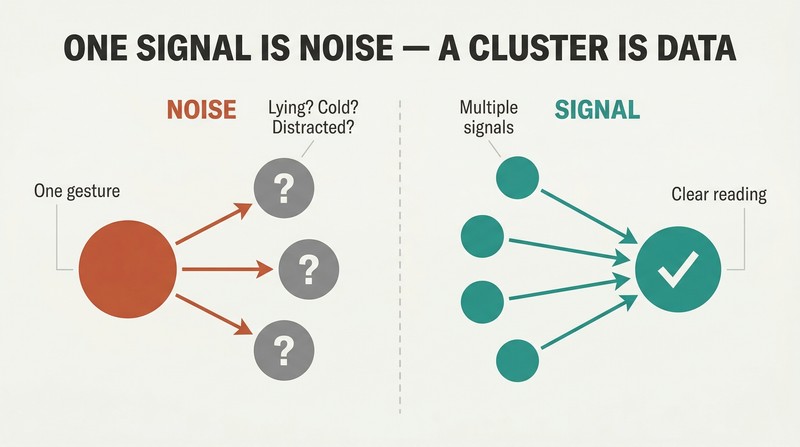
Context is everything. A person looking away while speaking might be lying — or their attention was caught by something on the wall. Someone crossing their arms might be defensive — or just cold. Cultural context matters too: sustained eye contact signals honesty in America but disrespect in Japan. One isolated signal is noise, not data.
The fix is twofold. First, establish a baseline — learn how someone normally behaves so deviations actually mean something. The guy who smiles and touches your arm is unremarkable if he does that with everyone. Second, read clusters: look for multiple signals pointing in the same direction. If someone wrings their hands, avoids eye contact, and repeatedly clears their throat while insisting "I'm fine," the cluster tells you more than any single gesture.
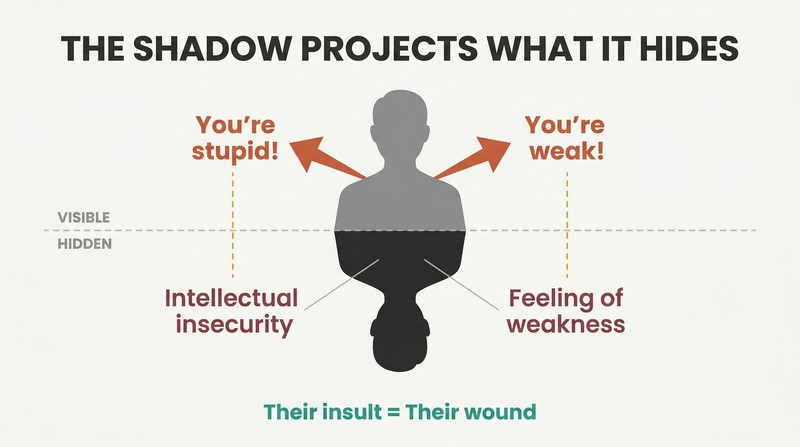
What people insult you with reveals their own hidden wound
Jung called it the shadow — the disowned parts of ourselves we hide from others and even from ourselves: our pettiness, rage, insecurity, vanity. But the shadow doesn't vanish. It leaks. The person who calls everyone "stupid" is often masking deep intellectual insecurity. The bully at school suppressed his feelings of weakness so aggressively that they explode outward as dominance.
Shadow projection — attributing your own unwanted traits to others — is the mechanism. Recognizing it is transformative. When someone insults you, ask: Is this about me, or is this the label they can't give themselves? King offers five diagnostic questions to spot the shadow: What are they portraying? What might they refuse to acknowledge? How does that drive what you see? How does it make you feel? How can you respond with compassion?
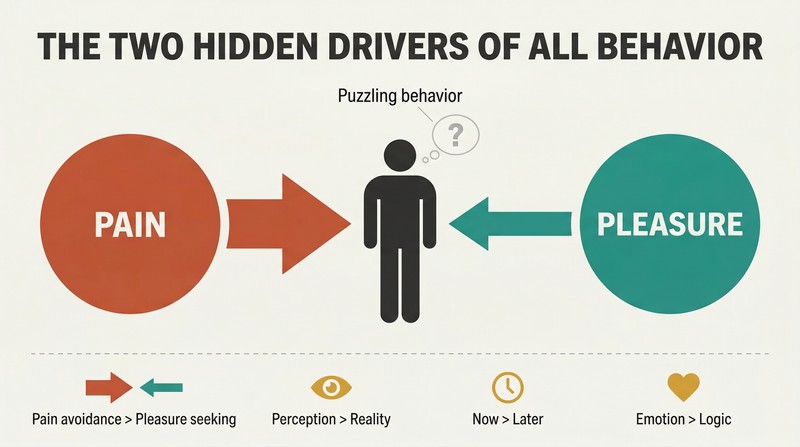
Trace any puzzling behavior to a pleasure sought or a pain avoided
Freud's pleasure principle is simple: humans move toward pleasure and away from pain. Every decision traces back to one or both. But the nuances make people more predictable:
1. People work harder to avoid pain than to gain pleasure — a wounded animal is more motivated than a mildly uncomfortable one
2. Perceptions outweigh reality — you won't eat grasshoppers because you imagine they're disgusting, even though they're actually tasty and nutritious
3. Immediacy dominates — the smoker craves a cigarette now and ignores cancer decades away
4. Emotion routinely overrides logic
A tired five-year-old who won't clean their room perceives your request as painful. Reframe tidying as a game or link it to a reward, and you've hacked their pleasure-pain calculus.
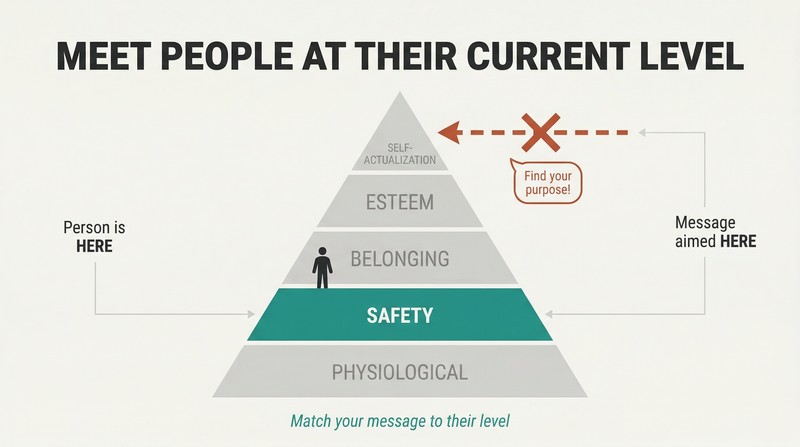
Don't talk purpose to someone still worried about safety
Maslow's hierarchy of needs maps five escalating levels: physiological survival, safety, love and belonging, self-esteem, and self-actualization. A person stuck at a lower level literally cannot care about higher ones — their motivation is consumed by the unmet need directly in front of them.
King illustrates this with a women's shelter counselor. When a woman first arrives fleeing domestic violence, she needs physical safety — handing her a self-love workbook would be worse than useless. Months later, with safety secured, she craves belonging and companionship. Only after recovery can she engage with meaning-making. The practical lesson: diagnose which Maslow level someone occupies, then match your communication to that level. Warren Buffett pursues philanthropy only because every lower need was met first.
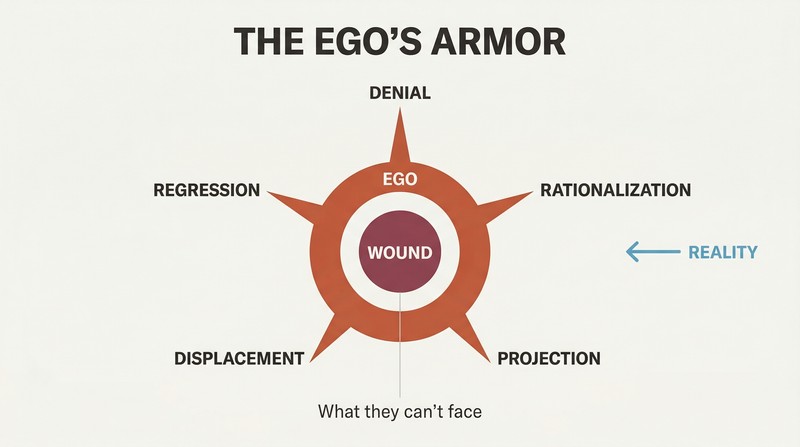
When someone bends reality, their ego is shielding a wound
The ego protects itself reflexively, often without the person knowing. King calls it a "giant porcupine" — sizable, sensitive, and heavily armored. When reality threatens self-image, defense mechanisms kick in:
1. Denial — claiming a negative fact simply isn't true
2. Rationalization — making excuses (Aesop's fox who declared unreachable grapes were sour anyway)
3. Projection — seeing your own flaws in others
4. Displacement — kicking the dog because you can't confront your boss
5. Regression — throwing a childlike tantrum under adult stress
King tells the story of Fred, a lifelong fan who refused to accept his pop idol's criminal conviction despite overwhelming evidence — because admitting the truth would shatter his own identity. Spotting a defense mechanism in real time tells you exactly what someone cannot face about themselves.
Comfortable bodies expand; threatened bodies fold inward
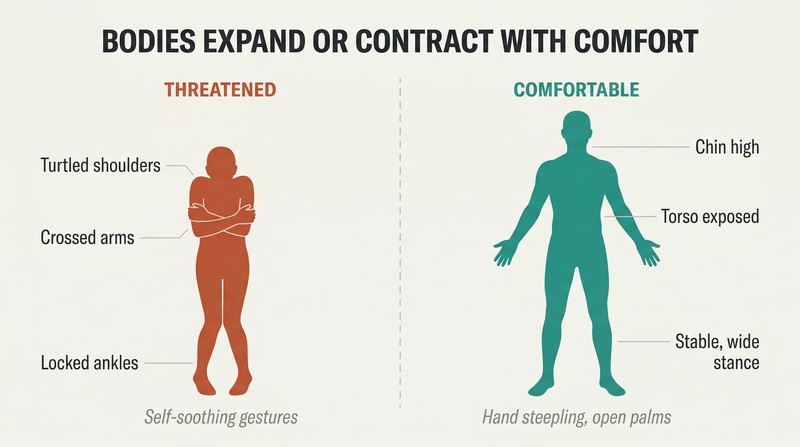
Ex-FBI agent Joe Navarro built his career reading nonverbal communication. The core principle is intuitive: bodies open up around what they like and close down around what threatens them. Arms spread wide, chin high, and torso exposed signal confidence. Crossed arms, turtled shoulders, and locked ankles signal fear or discomfort.
Watch for pacifying behaviors — unconscious self-soothing gestures like touching the neck, rubbing the temples, or playing with a necklace — which reveal real-time stress. Hand steepling signals poise; hand wringing signals doubt. Feet often point where the body unconsciously wants to go. In groups, watch where energy flows — the real decision-maker isn't always the one talking loudest. Notice who everyone instinctively defers to, and you've found the actual leader.
Catch liars through strategic questions, not body-language spotting
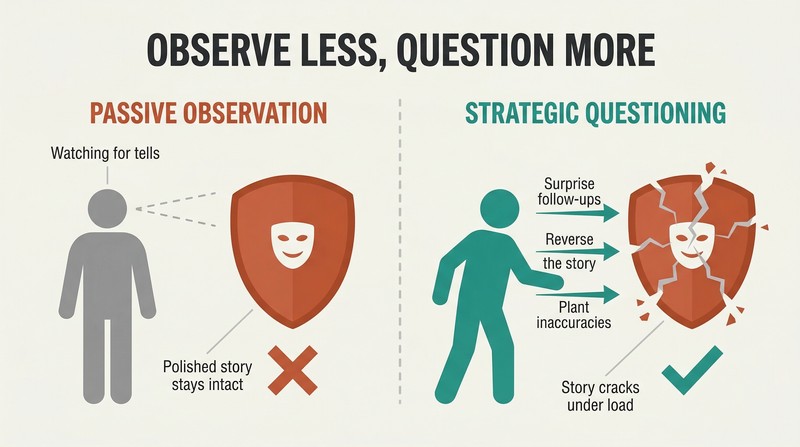
Passive observation fails spectacularly at lie detection. Roughly fifty in twenty thousand people can spot a liar more than eighty percent of the time — even trained professionals barely beat chance. The reason body-language "tells" disappoint: nervousness, stress, and deception all look similar.
The solution is conversational, not observational. Dr. Ray Bull's research shows the interviewer-interviewee relationship matters most. Withhold what you know — let liars spin their story uninterrupted, then probe gaps. Liars present polished narratives all at once but collapse under unexpected questions. Increase cognitive load: ask surprise follow-ups, request the story in reverse, or plant a small inaccuracy to see if they notice. Under cognitive overload, liars display less emotion in speech but leak more through their body — faster blinking, pupil dilation, and speech disturbances.
Trust your five-minute gut read, then verify deliberately
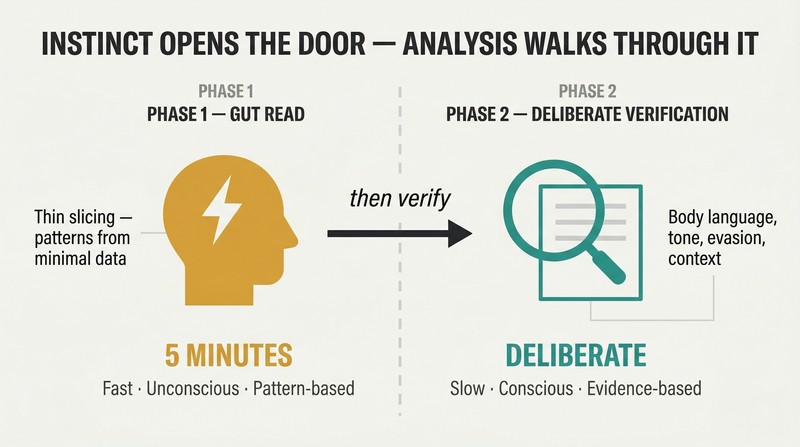
Thin slicing — finding patterns from minimal data — was first named by psychologists Ambady and Rosenthal in 1992. Relationship researcher John Gottman claimed ninety-five percent accuracy predicting whether a couple would stay together in fifteen years just from brief observation. His accuracy actually dropped to ninety percent with more time.
Snap judgments are largely unconscious, which makes them fast but vulnerable to bias. Sadness, for instance, lowers thin-slicing accuracy. The practical approach: notice your gut reaction in the first moments, then shift to deliberate observation. In one example, a job candidate got a "bad feeling" at an interview, returned with an open mind, noticed evasive body language, and eventually discovered a sexual harassment cover-up. Instinct opened the door; careful analysis walked through it.
Read someone's home, possessions, and word choice like body language
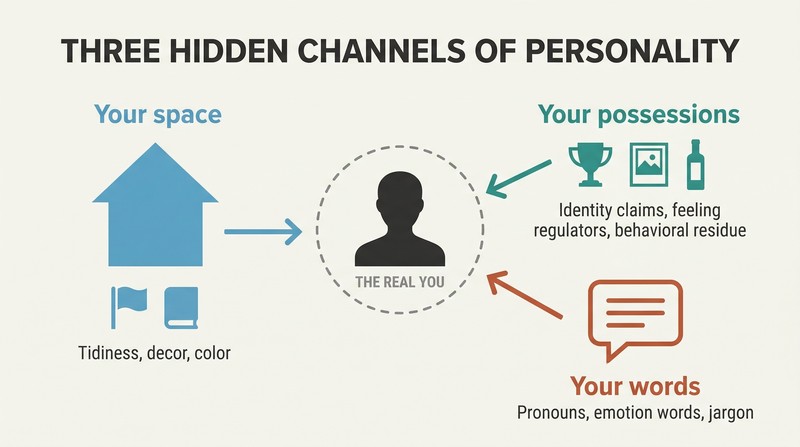
Your bedroom betrays your politics. Researcher Sam Gosling found that American conservatives' rooms tended to be neater with flags and sports memorabilia, while liberals' spaces had more books, art supplies, and color. He classified possessions into three types: identity claims (posters, awards), feeling regulators (inspirational quotes, photos of loved ones), and behavioral residue (empty bottles, unfinished books).
Word choice leaks personality too. More personal pronouns correlate with extroversion; negative emotion words signal neuroticism; excessive jargon suggests insecurity about intelligence. A 2010 study by Beck and colleagues found people display their real — not idealized — selves on social media. Even a handshake carries data: a 2011 study showed that shaking hands improved the accuracy of assessing someone's conscientiousness.
Analysis
King's 'Read People Like a Book' functions as a meta-framework — a toolkit of toolkits — rather than advancing a single original thesis. By synthesizing Jung's shadow, Freud's pleasure principle, Maslow's hierarchy, Ekman's microexpressions, Navarro's nonverbal communication, Big Five personality traits, MBTI, Keirsey temperaments, and the Enneagram, he gives readers a Swiss Army knife for social intelligence. The practical advantage: no single model captures human complexity, so layering frameworks compensates for each model's blind spots.
However, some of the book's foundational claims deserve scrutiny. The frequently cited 7-38-55 rule originates from Albert Mehrabian's 1967 study, which Mehrabian himself has repeatedly clarified applies only to the communication of feelings and attitudes when verbal and nonverbal channels are incongruent — not to all human communication. King presents it more broadly. Similarly, while Ekman's microexpression work is influential, subsequent meta-analyses and Lisa Feldman Barrett's constructionist model have challenged the universality of six discrete basic emotions, suggesting facial expressions may be more culturally constructed than Ekman proposed.
The most intellectually honest chapter is on lie detection, where King repeatedly emphasizes uncertainty and the dismal base rates of detection accuracy. This humility is rare in a genre that often oversells body-language hacks. His reframe — treating lie detection as a conversational strategy rather than a spotting exercise — aligns with contemporary forensic psychology and the work of researchers like Aldert Vrij.
What elevates the book above typical body-language guides is its insistence on self-knowledge as prerequisite. The recursive insight — that analyzing others inevitably surfaces our own projections — echoes the psychoanalytic concept of countertransference and phenomenological philosophy. King effectively argues that reading people is less about catching tells and more about becoming a patient, curious observer who holds multiple hypotheses simultaneously. The book's deepest value may be epistemological: every observation is a data point in a probabilistic model, never proof.
Review Summary
Read People Like a Book receives mixed reviews, with an average rating of 3.46/5. Many readers find it superficial and lacking depth, containing mostly common sense information. Some appreciate its insights on body language and psychology, while others criticize its stereotyping and lack of scientific basis. The book is described as easy to read but poorly formatted. Positive reviews highlight its usefulness for improving social intelligence, while negative reviews suggest it's best suited for those lacking social awareness or seeking manipulation tactics.
People Also Read









Glossary
Theory of mind
Modeling others' mental statesThe human ability to think about other people's cognitive and emotional realities—to construct a working model of what someone else might be thinking, feeling, or intending. King frames it as the foundational skill behind all people-reading, while noting that any such model is always a simplification of the real person.
Shadow
Disowned parts of personalityCarl Jung's concept describing all aspects of our nature that we have suppressed, ignored, or turned away from—our pettiness, fear, rage, vanity. The shadow still influences behavior unconsciously even though it is hidden from awareness. King uses it as a lens for understanding why people sometimes behave in ways that contradict their self-image.
Shadow projection
Attributing hidden flaws to othersA specific manifestation of the shadow in which a person unconsciously attributes their own disowned traits to someone else. For example, someone who feels intellectually inferior may constantly call others 'stupid.' King identifies this as a key signal: what people criticize most harshly in others often reveals what they cannot accept in themselves.
Microexpressions
Involuntary split-second facial expressionsTiny, involuntary contractions of facial muscle groups lasting as little as one-thirtieth of a second, identified by psychologist Paul Ekman. They correspond to six universal emotions (happiness, sadness, disgust, anger, fear, surprise) and are difficult to fake because they are controlled by the extrapyramidal motor system. Ekman found that 99% of untrained people cannot perceive them.
Pacifying behaviors
Self-soothing gestures under stressUnconscious physical gestures people make to calm themselves when feeling stressed, threatened, or insecure—as described by ex-FBI agent Joe Navarro. Examples include touching the neck, rubbing the temples, stroking hair, wringing hands, or puffing cheeks while exhaling. These behaviors are driven by the limbic brain and reveal real-time emotional distress.
Thin slicing
Accurate judgments from minimal dataA psychological concept coined by Ambady and Rosenthal (1992) describing the ability to find meaningful patterns using only very small amounts of data—'thin slices' of behavior. Studies suggest that assessments made within the first five minutes can be as accurate or more accurate than those made over longer periods, though they are susceptible to emotional bias.
Message clusters
Grouped body signals read holisticallyKing's framework for reading the human body as a unified communication system rather than interpreting isolated gestures. Instead of decoding a single crossed arm or furrowed brow, you look for clusters of signals—closing/opening, expanding/contracting, directing/retreating—that together communicate a coherent intention such as aggression, submission, deception, or openness.
Duper's delight
Liar's thrill from successful deceptionA term used in interrogation and behavioral science to describe the subtle emotional satisfaction or secret thrill that liars may experience when they believe they are successfully deceiving someone. It can occasionally leak through as an inappropriate micro-smile or hint of amusement during an otherwise serious conversation, providing a clue to deception.
Cognitive load
Mental effort sustaining a lieIn the context of lie detection, the extra mental processing required to fabricate and maintain a false narrative—remembering invented details, monitoring the listener's reactions, and suppressing genuine emotions simultaneously. King advocates deliberately increasing this load through surprise questions and strategic probing, causing liars to fumble details, display flat affect in speech, or leak stress through nonverbal cues like increased blinking.
FAQ
What's "Read People Like a Book" about?
- Understanding Human Behavior: The book by Patrick King focuses on analyzing, understanding, and predicting people's emotions, thoughts, intentions, and behaviors.
- Skill Development: It emphasizes that reading people is a skill that can be learned and mastered, similar to emotional intelligence or social awareness.
- Practical Applications: The book provides practical techniques for improving communication, detecting deception, and understanding motivations, which can be applied in personal and professional interactions.
Why should I read "Read People Like a Book"?
- Enhance Social Skills: The book offers insights into improving your ability to read and understand people, which can enhance your social interactions and relationships.
- Detect Deception: It provides techniques for identifying when someone is lying or manipulating, which can be valuable in both personal and professional settings.
- Self-Improvement: By understanding others better, you also gain insights into your own behaviors and motivations, leading to personal growth.
What are the key takeaways of "Read People Like a Book"?
- Motivation and Behavior: Understanding the motivations behind people's actions is crucial for predicting behavior.
- Non-Verbal Cues: Facial expressions and body language are powerful tools for reading people, but they must be considered in context.
- Personality Insights: Personality tests like the Big Five and MBTI can provide frameworks for understanding individual differences.
How does Patrick King suggest we analyze motivations in people?
- Pleasure and Pain Principle: People are motivated by the desire to seek pleasure and avoid pain, which can predict their behavior.
- Maslow's Hierarchy of Needs: Understanding where someone is on this hierarchy can reveal their current motivations and needs.
- Defense Mechanisms: Recognizing how people protect their ego can provide insights into their true motivations and fears.
What techniques does "Read People Like a Book" offer for reading body language?
- Microexpressions: These are quick, involuntary facial expressions that reveal true emotions, even when someone is trying to hide them.
- Body Language Clusters: Observing clusters of body language cues, rather than isolated gestures, provides a more accurate reading.
- Contextual Interpretation: Always consider the context and establish a baseline of normal behavior to accurately interpret body language.
How can personality tests help in understanding people according to Patrick King?
- Big Five Traits: These traits (openness, conscientiousness, extroversion, agreeableness, neuroticism) provide a framework for understanding personality.
- MBTI and Keirsey Temperaments: These tools categorize personality types, offering insights into how people perceive and interact with the world.
- Enneagram Types: This model focuses on motivations and fears, providing a deeper understanding of individual behavior patterns.
What are the challenges in detecting lies as discussed in "Read People Like a Book"?
- Unreliable Cues: Common beliefs about lying cues, like avoiding eye contact, are not always reliable indicators of deception.
- Conversational Techniques: Effective lie detection involves strategic questioning and observing inconsistencies in stories.
- Cognitive Load: Increasing cognitive load on a liar can lead to mistakes and reveal deception.
How does Patrick King recommend using observation to understand people quickly?
- Thin Slicing: This involves making quick judgments based on small amounts of information, which can be surprisingly accurate.
- Smart Observations: Focus on word choice, body language, and context to gather meaningful insights.
- Holistic Approach: Consider all available data, including non-verbal cues and environmental factors, for a comprehensive understanding.
What role do indirect questions play in analyzing people?
- Revealing Values: Indirect questions can uncover a person's values and priorities without them realizing it.
- Behavioral Insights: These questions focus on behaviors and preferences, providing concrete data for analysis.
- Avoiding Defensiveness: Indirect questions can bypass defenses, leading to more honest and revealing answers.
What are some practical applications of the techniques in "Read People Like a Book"?
- Improved Communication: By understanding others better, you can tailor your communication style to be more effective.
- Conflict Resolution: Recognizing motivations and emotions can help in resolving conflicts and building stronger relationships.
- Professional Success: These skills can enhance your ability to negotiate, lead, and collaborate in the workplace.
What are the best quotes from "Read People Like a Book" and what do they mean?
- "Reading and analyzing people is no doubt a valuable skill to have." This emphasizes the importance of understanding others for successful interactions.
- "The body doesn’t lie!" Highlights the significance of non-verbal cues in revealing true emotions and intentions.
- "Our goal in learning to fine-tune our capacity to analyze people is to make best guesses." Suggests that while we can never be certain, informed guesses can greatly improve our understanding of others.
How can "Read People Like a Book" help in personal growth?
- Self-Reflection: By learning to read others, you also gain insights into your own behaviors and motivations.
- Bias Awareness: The book encourages recognizing and overcoming personal biases for more accurate assessments.
- Emotional Intelligence: Developing these skills can enhance your emotional intelligence, leading to better relationships and personal fulfillment.
About the Author
Other books by Patrick King



Download PDF
Download EPUB
.epub digital book format is ideal for reading ebooks on phones, tablets, and e-readers.








































