

Key Takeaways
Your body finishes talking before your mouth begins
Lowndes opens with a jarring claim: over 80 percent of a first impression forms from how you look and move, not what you say. In a fast, overloaded world, people snap a mental photograph of you in the first ten seconds and treat it as data for a long time. Her caricaturist friend Bob captures personalities just by looking, reading confidence or shiftiness in posture and head tilt.
Her body-language fixes are precise. The Flooding Smile means pausing a half-second to look at someone, then letting a big warm smile bloom slowly so it feels earned and personal. Sticky Eyes means holding eye contact even through silences, unpeeling slowly. Hang by Your Teeth means imagining a circus bit lifting you into perfect posture through every doorway.
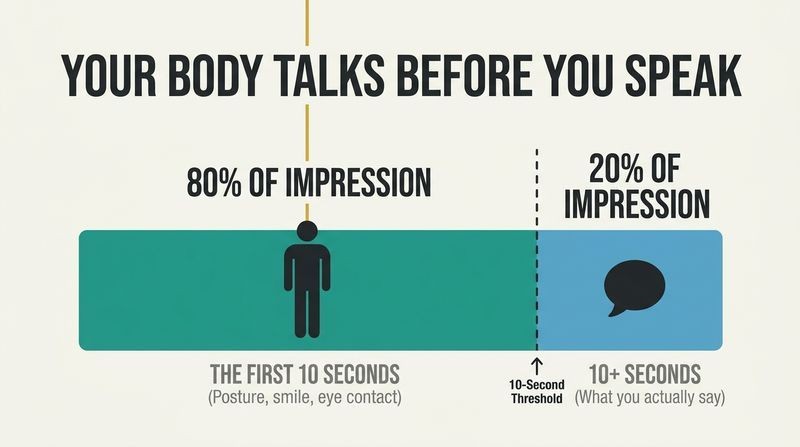
The 80 percent figure echoes Albert Mehrabian's often-misquoted research on nonverbal communication, and Lowndes overstates its universality, since content matters enormously in substantive exchanges. Still, the underlying insight is robust: thin-slicing research by Nalini Ambady shows strangers form remarkably stable, accurate judgments from mere seconds of exposure. What distinguishes Lowndes from generic advice is the delayed smile. A smile that arrives a beat late reads as discriminating rather than reflexive, which aligns with signaling theory: costly, selective signals carry more credibility than cheap, universal ones. The flashed grin says nothing; the withheld-then-flooding smile says you specifically earned it.
Small talk is melody, not lyrics: match their mood first
Lowndes reframes dreaded small talk as musical, not informational. Your opening words matter far less than your tone and energy. She calls this Prosaic with Passion: since most of your impression rides on delivery, nearly any banal remark works if delivered warmly. Linguist S.I. Hayakawa defused suspicious strangers in a 1943 train station using deliberately unoriginal remarks about the weather and their child, easing tension until they invited him to dinner.
The prerequisite is a Mood Match. Before speaking, take a quick voice-and-face sample of your listener to gauge whether they are buoyant, bored, or rushed, then briefly meet them there. She recounts brainy Mensans overwhelming her tired self in an elevator with intense explanations, mismatching her sluggish state and repelling her rather than connecting.
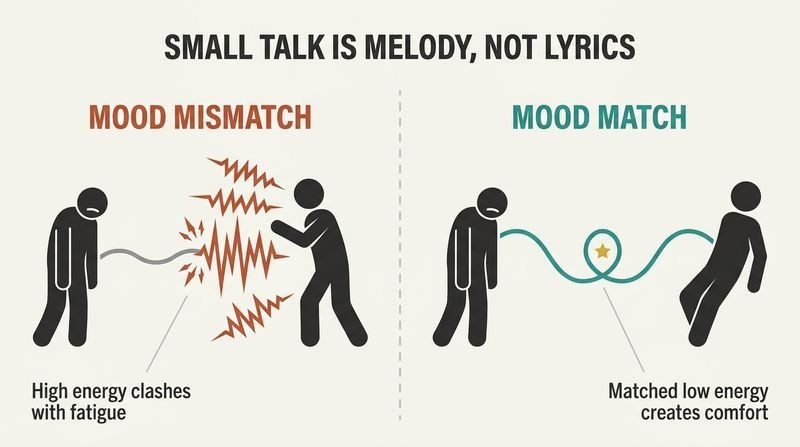
This maps neatly onto emotional attunement research and what therapists call pacing before leading: you sync with someone's state before nudging it. Communication accommodation theory formalizes the same instinct, showing that people who converge toward a partner's speech rate and tone are rated more likable and competent. The counterintuitive gift here is permission to be boring. Anxious conversationalists freeze because they hunt for wit; Lowndes frees them by proving warmth beats cleverness. The one limit worth flagging: chronically matching low energy can trap you in gloom, so attunement should be a brief bridge, not a permanent residence.
Never hand people a naked one-word answer to chew on
When asked where you are from or what you do, a bare Milwaukee or I'm an accountant leaves your partner stranded, silently scrambling for a follow-up. Lowndes calls the fix Never the Naked City and Never the Naked Job: attach a morsel of bait, a fun fact or vivid mini-story, that gives the other person something to grab. An attorney says not just lawyer but tells a young mother about a maternity-leave case she can relate to.
The same principle powers the Whatzit, any unusual pin, bag, or object you wear to invite strangers to approach and ask about it, and Never the Naked Introduction, where you introduce two people with a shared hook so conversation ignites itself. Even Thank you should never stand naked; always add the reason.
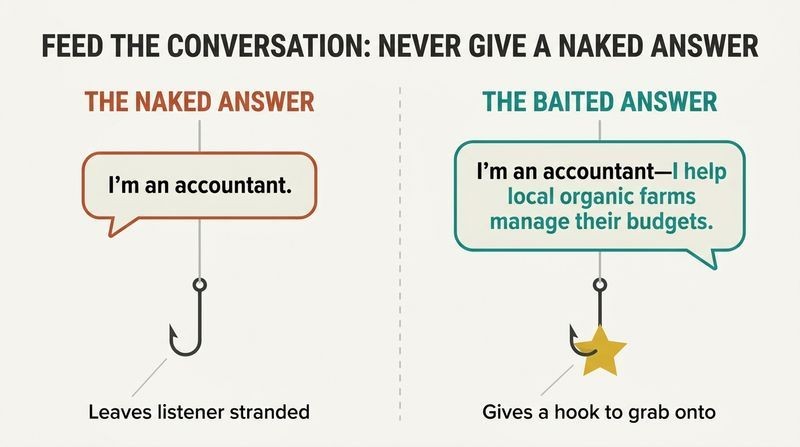
This is applied cooperative-conversation theory. Linguist Paul Grice described conversation as governed by a cooperative principle, and the naked answer violates it by giving too little for the exchange to continue. Lowndes essentially teaches users to lower the activation energy for the other person's next line, a courtesy that reads as social generosity. Sales and networking research supports it: self-disclosure with hooks accelerates rapport. A modest caution: bait can tip into performance if every answer becomes a rehearsed anecdote. The skill is calibration, offering enough thread to pull without turning a greeting into a monologue about your hometown's fifteen namesake cities.
Keep the spotlight on them, and never rush to say me too
Lowndes argues the most magnetic people talk least about themselves. Her Swiveling Spotlight metaphor: imagine a beam between you and a stranger; the longer you keep it shining on them, the more fascinating they find you. She met a globe-trotting adventurer, Dan, whom a friend adored despite learning almost nothing about him, because he kept asking about her.
Two tools sustain this. Parroting rescues you when your mind blanks: simply repeat the last two or three words your partner said as a question, lobbing the conversational ball back. Kill the Quick Me Too advises delaying revelation of shared interests, since the later you disclose that you also ski or share their hometown, the more impressed they are. Encore invites someone to retell a favorite story to a group, flattering them while freeing you to slip away.
This dovetails with a Harvard neuroscience finding by Tamir and Mitchell that disclosing about oneself activates the brain's reward circuitry like food or money, meaning letting others talk literally feels good to them, and they credit you for the pleasure. Parroting is a stripped-down version of Rogerian reflective listening used in therapy, though overused it can sound robotic, so it works best sparingly. The delayed me-too is subtler and shrewd: premature similarity-claiming can read as needy one-upmanship, whereas patient revelation signals abundance. The risk is manipulation creep; these tools build genuine connection only when curiosity about the other person is real, not performed.
Start sentences with you, drop cliches, upgrade fifty words
Lowndes calls it Comm-YOU-nication: open sentences with you because the brain instantly translates everything into how does this affect me. You will love this restaurant lands better than there is a good restaurant, because it does the listener's thinking for them and pushes their pride button. She notes psychiatric patients use I and me far more than well-adjusted people, so fewer I's signal poise.
Two companion moves elevate your register. Ditch cliches entirely around sharp people, since a tired phrase brands your imagination as impoverished. And build a Personal Thesaurus: she claims only about fifty fresh words separate a rich vocabulary from a mundane one. Replace great with glorious or ravishing until the upgraded words feel natural, like breaking in new shoes.
The you-framing anticipates modern behavioral-economics insights about egocentric framing and loss aversion, and marketers have long known benefit-led, second-person copy outperforms feature-led, first-person copy. The claim that fewer first-person pronouns signal mental health is more contested; James Pennebaker's text-analysis research actually links high I-usage to lower status and sometimes depression, which supports Lowndes, but I-usage also rises with honesty and self-focus during distress, so it is a noisy signal. The fifty-word vocabulary tip is delightfully concrete and achievable, though the deeper caution is authenticity: a borrowed word used incorrectly, as she warns, backfires worse than a plain one used well.
Learn a field's lingo once and you pass as an insider
Every profession and hobby has insider opening questions and burning issues outsiders never know. Lowndes prescribes Scramble Therapy: roughly once a month, do an activity totally outside your pattern (a scuba resort dive, a chess lecture, bowling) because a single exposure gives you about 80 percent of the lingo and the right questions, like a drop of acid turning litmus paper as pink as a whole vat.
Two shortcuts amplify this. Learn a little Jobbledygook, her word for the jargon of other trades, by asking a friend in that field for two or three opening questions. And Bare Their Hot Button, the industry's fixation the public misses (pharmacists hate drugstore, artists discuss medium). Reading trade magazines and unfamiliar newspaper sections stocks your conversational fuel indefinitely.
The 80-percent-from-one-exposure claim is intuitively overstated but captures a genuine phenomenon: expertise has a steep initial return curve, and knowing the shibboleths (the right question, the correct term) signals membership disproportionately to actual knowledge. Sociolinguists study exactly this, how in-group markers function as social passwords. There is an ethical edge here, since faking fluency can shade into deception, and Lowndes wisely advises exiting the topic quickly before you are exposed. The deeper, more durable value is curiosity as a discipline: deliberately sampling foreign worlds makes you a genuinely broader person, not merely a better faker, which is the real payoff of her scramble prescription.
Manufacture kinship by mirroring movement, words, and senses
People trust those who seem similar. Lowndes cites a study where strangers told they shared beliefs liked each other far more than those told they differed, though neither was true. Her techniques engineer that felt similarity.
Be a Copyclass: subtly match a person's movement style and pace, treating them as your dance instructor. Echoing: reuse their exact word choices (chalet not cabin, pharmacy not drugstore, boat owners' she not it), since hearing their vocabulary from your mouth builds subliminal rapport. Anatomically Correct Empathizers borrows from neurolinguistic programming: respond in the sense someone is using, so match I see with I see what you mean, that sounds good with I hear you, and a gut feeling with I grasp that. The Premature We plants intimacy by using we and us before you technically qualify as friends.
Mirroring has real empirical backing: Chartrand and Bargh's chameleon effect studies showed unconscious mimicry increases liking and smoothness, and it predicts negotiation success. Echoing aligns with lexical entrainment, the documented tendency of conversational partners to converge on shared terms. The NLP sensory-modality idea (visual, auditory, kinesthetic types) is the weakest leg; controlled research has largely failed to validate fixed representational systems as NLP claims. Lowndes hedges shrewdly by advising you match the sense of the moment rather than diagnose a person's permanent type, which sidesteps the debunked part and keeps the useful part: speaking in your listener's live imagery makes abstract ideas land.
Route praise through the grapevine to escape the flatterer's curse
Direct compliments now arouse suspicion of brownnosing, so Lowndes routes praise indirectly. Grapevine Glory: praise someone to their close associate, trusting it travels back within a day, arriving more credible because it was overheard, not delivered. Carrier Pigeon Kudos: relay compliments you hear others make, so you become the welcome bearer of good news.
For face-to-face praise, the Killer Compliment targets one specific, personal quality (your penetrating eyes, your air of honesty), delivered privately, credibly, and no more than once every six months per person. Timing matters too: the Knee-Jerk Wow demands instant praise the moment someone finishes a feat, even a white lie, because the euphoric performer craves immediate validation. And when praised, Boomerang it back rather than deflecting, thanking them for their perceptiveness.
The overheard-compliment principle is well supported. Research on the spontaneous trait transference and third-party credibility shows information reaching us indirectly feels less strategically motivated and thus more trustworthy, the same mechanism that makes testimonials outperform self-promotion. The six-month rationing of Killer Compliments is shrewd scarcity economics; frequent lavish praise devalues like inflated currency. The one genuinely uncomfortable prescription is the sanctioned white lie in the Knee-Jerk Wow. Deception research suggests such prosocial lies do preserve relationships short-term, but habitual dishonest praise erodes your feedback's value over time, so the technique works best for morale in low-stakes moments, not for domains where a person needs accurate correction to improve.
On the phone, translate every gesture into sound and pump it 30% louder
The phone amputates more than half your personality, your smiles, nods, and posture, and Lowndes claims studies show voices lose about 30 percent of their energy over the line. Her fix is Talking Gestures: verbalize what your face would show (I see, no kidding, what a surprise) and boost your whole delivery by roughly a third to compensate.
Other phone moves: shower the caller's name far more than you would in person, since it re-creates the eye contact and caress distance steals. Answer neutrally and professionally, then let warmth flood in only after you hear who it is (Oh Wow, It's You). Ask What Color Is Your Time, red, yellow, or green, to respect their availability before launching in. And update your outgoing voicemail message daily to seem conscientious and current.
The energy-loss figure is folklore-ish but directionally sound: telephony compresses vocal frequency range, stripping the overtones that convey warmth, so overcompensating is legitimately necessary, a fact broadcasters and voice actors know well. The name-showering advice needs a caveat modern readers will feel: repeated name use has become a recognizable salesperson tic that can read as manipulative, so restraint matters more now than in 1998. What ages best is the timing-permission question (is this a good moment), which respects autonomy and is echoed in modern consent-based communication norms. The daily voicemail tip is charmingly dated in a texting era but the underlying signal, evident conscientiousness, still transfers to email and status updates.
Work a room like a politician with a six-point battle plan
Politicians never drift into parties; they arrive with a checklist covering who, when, what, why, where, and how they will follow up. Lowndes translates this into tactics. Munching or Mingling: eat beforehand, because holding food and drink walls you off and people avoid approaching someone with a full mouth. Rubberneck the Room: pause dramatically in the doorway and slowly survey the scene before entering.
Be the Chooser, Not the Choosee: actively pick who you want to meet rather than waiting to be approached, finding subjective beauty by truly studying faces. Tracking means remembering the tiny details of people's lives (their trip, their kitten, their favorite wine) and referencing them later like breaking news, which makes them feel like the star of their own movie. The Business Card Dossier: scribble conversation notes on the back of each card for a personalized follow-up.
This section reframes socializing as deliberate practice rather than luck, which aligns with research on networking effectiveness: strategic networkers who follow up systematically outperform passive minglers in career outcomes. Tracking is the standout, and it is essentially applied CRM before consumer CRM existed; the political fundraiser scribbling Sancerre on a card is doing manual relationship management. Psychology supports the payoff, since being remembered specifically triggers a powerful mattering effect. The tension worth naming is instrumentality: treating parties as campaigns can hollow out genuine connection. The technique earns its keep only when the remembered detail reflects real attention, because people readily detect the difference between being tracked and being cared about.
The deadliest glass ceiling is your own invisible social fumbles
Beyond the glass ceilings over women and minorities, Lowndes describes a subtler one that only top communicators perceive, built from unspoken rules that quietly disqualify people who violate them. Big winners honor safe havens: parties are for pleasantries, dining tables are for positive brainstorming, and chance encounters are for chitchat, never for ambushing someone with business or confrontation.
Other unwritten laws: See No Bloopers means ignoring others' spilled drinks and social gaffes rather than noticing them. Let Em Savor the Favor means waiting at least a day before cashing in on a favor granted. Bare the WIIFM (what's in it for me) and WIIFY (what's in it for you) upfront rather than hiding an agenda. And mind the Great Scorecard in the Sky, the invisible tally where the lower-status party owes deference, or gets thrown out of the game permanently.
This closing framework is the book's most sociologically interesting, essentially a taxonomy of tacit status codes that Pierre Bourdieu would recognize as cultural capital, the unwritten competencies that gatekeep elite membership more effectively than explicit rules. Lowndes's insight that these penalties are silent and unappealable is precisely why they are so brutal: violators never learn why doors closed. The WIIFM transparency advice is the most modern and ethical, prefiguring today's radical-candor and psychological-safety literature. The Great Scorecard is more cynical, framing relationships as ledgers of deference, which reciprocity research partly supports but which risks describing transactional relationships while missing that the strongest bonds transcend scorekeeping entirely.
Analysis
Published in 1998, this book is a self-help anthology of 92 discrete techniques organized into nine thematic parts, deliberately positioned as an update to Dale Carnegie for a more cynical, saturated age. Lowndes's core wager is that Carnegie told readers what to do (smile, show interest) without the how, and that modern sophisticates see through unskilled sincerity. Her contribution is granular tactical specificity, each move named for instant recall in the moment of need.
The book's intellectual spine rests on two empirical claims: that success is roughly 85 percent communication skill and that first impressions are 80-plus percent nonverbal. Both are overstated versions of real research (thin-slicing, Mehrabian, communication accommodation theory), and a careful reader should treat the percentages as motivational rather than precise. The genuine strength lies elsewhere: Lowndes has reverse-engineered the micro-behaviors of socially fluent people into replicable drills, an unusually behaviorist approach for a relationships book.
Two tensions run through the work. First, the line between rapport-building and manipulation is thin, and many techniques (Premature We, engineered similarity, strategic praise routing) function whether or not the practitioner feels genuine warmth. The book's ethics depend on the user's intent, which it mostly assumes is benign. Second, some material has dated: NLP sensory typing has weak empirical support, daily voicemail advice is quaint, and aggressive name-dropping now reads as salesmanship.
What endures is the reframing of charisma as learnable craft rather than innate gift, and the anthropological sharpness of the final section on tacit status rules, which anticipates contemporary discussions of cultural capital and psychological safety. Read as a menu rather than a doctrine, adopting the handful of techniques that fit one's authentic style, the book delivers durable value. Read as a manipulation manual, it curdles. The determining variable, fittingly, is the reader's character, which Lowndes herself names as destiny in her closing pages.
Review Summary
How to Talk to Anyone receives mixed reviews. Some praise its practical tips for improving social skills and communication, especially in business settings. Critics argue many tips seem manipulative or obvious. The book's anecdotes and writing style are polarizing. Some find it helpful for boosting confidence and networking, while others feel it's outdated and promotes inauthentic behavior. Overall, readers appreciate some useful advice but caution against taking all 92 "tricks" at face value.
People Also Read








Glossary
The Flooding Smile
Delayed, warm, personalized smileA technique of not smiling instantly upon meeting someone. Instead you pause about a second to look at the person's face, then let a big warm smile slowly spread and spill into your eyes. The split-second delay convinces the recipient the smile is genuine and reserved specifically for them, rather than a reflexive grin given to everyone.
Sticky Eyes
Extended, slowly released eye contactMaintaining eye contact with a conversation partner as though your eyes are glued with warm taffy, holding the gaze even after they finish speaking and breaking away slowly and reluctantly. Studies Lowndes cites suggest sustained eye contact raises feelings of respect and affection and can trigger physiological arousal similar to attraction.
Big-Baby Pivot
Full-body turn toward someoneRewarding a new acquaintance the instant you are introduced by turning your entire body fully toward them and giving undivided, delighted attention, the way an adult naturally responds to a beaming toddler. The full pivot silently signals that you find the person very special and important.
Hello Old Friend
Imagine stranger is old friendA visualization trick where, upon meeting someone, you imagine they are a long-lost dear friend you are joyfully reunited with. Though you say nothing unusual aloud, the internal pretense softens your eyebrows, warms your posture, and radiates genuine congeniality, and it tends to become a self-fulfilling prophecy of actual liking.
Whatzit
Conversation-starting worn objectAny unusual pin, bag, tie, or accessory you deliberately wear or carry to give strangers an easy excuse to approach and ask what it is. The Whatzit removes the awkwardness of a cold approach by providing an instant, low-risk conversational opening for the person who wants to meet you.
Never the Naked City / Naked Job
Add bait to answersThe rule against giving bare one-word replies to where are you from or what do you do. Instead you flesh out the answer with an interesting fact, story, or hook that gives your conversation partner something specific to respond to, keeping the exchange alive rather than stalling it.
Swiveling Spotlight
Keep focus on othersImagining a giant spotlight between you and another person that shines on whoever is speaking. By keeping it aimed at the other person and saying little about yourself, you make them feel fascinating; Lowndes argues the longer you keep the light off yourself, the more interesting they find you.
Parroting
Repeat their last wordsWhen you don't know what to say next, simply repeat the last two or three words your partner said in a sympathetic, questioning tone. This lobs the conversational ball back into their court, prompts them to elaborate, and requires you only to keep listening.
Comm-YOU-nication
Begin sentences with youStarting as many sentences as possible with the word you, because the brain instantly filters everything through how it affects the self. Phrasing requests and statements around the listener (you will love this) pushes their pride button and spares them the mental step of translating your words into personal terms.
Scramble Therapy
Monthly try unfamiliar activityDeliberately participating once a month in an activity completely outside your normal routine, such as a resort scuba dive or chess lecture. Lowndes claims a single exposure delivers roughly 80 percent of the insider vocabulary and questions needed to converse credibly with enthusiasts of that pursuit.
Jobbledygook
Insider jargon of professionsLowndes's coined term for the specialized lingo of other people's trades and hobbies. Learning just a few insider opening questions in someone's field (by asking a friend who knows it) lets you sound like a knowledgeable insider and encourages professionals to open up to you.
Echoing
Reuse their exact wordsA rapport technique of listening for and repeating back a person's own arbitrary word choices, such as chalet instead of cabin or pharmacy instead of drugstore. Hearing their vocabulary from your mouth creates subliminal rapport and signals that you share their values, world, and group membership.
Anatomically Correct Empathizers
Match their sensory languageResponding in whichever sense (visual, auditory, or kinesthetic) a person is currently speaking through. If they say it looks good, you say I see; if it sounds good, you say I hear you; if they have a gut feeling, you say I grasp that. Drawn from neurolinguistic programming, it makes people feel you perceive the world as they do.
Premature We
Use we before intimacy existsDeliberately using the words we, us, and our with someone you have just met, skipping the normal conversational progression from cliches to facts to feelings. The intimate pronoun subconsciously signals that the two of you are already connected, fostering a sense of togetherness against the outside world.
Grapevine Glory
Praise someone behind their backComplimenting a person indirectly by praising them to someone close to them, trusting the compliment will travel back through the grapevine. An overheard compliment carries more credibility than a direct one because it escapes suspicion of self-serving flattery or brownnosing.
Killer Compliment
Specific, personal, rationed praisePraising one very specific and personal quality you notice in someone (your penetrating eyes, your air of honesty) rather than a generic or superficial trait. Rules: deliver it privately, keep it credible, and give each person no more than one every six months so it never seems insincere.
The Tombstone Game
Feed back their self-imageAsking a loved one or partner what they would want engraved on their tombstone, memorizing the quality they name, then weeks later feeding that exact quality back as a compliment. Because it matches how they most want to be seen, the praise lands with overwhelming impact.
Talking Gestures
Voice your facial expressionsOn the phone, verbalizing the smiles, nods, and gestures the other person cannot see (I see, no kidding, what a surprise) and amplifying your overall vocal energy by about 30 percent to compensate for the personality and warmth the telephone strips away.
What Color Is Your Time?
Ask about phone availabilityBeginning a phone call by asking whether the person's time is red (rushed, stop), yellow (busy, be quick), or green (free to talk). The device respects the listener's schedule and prevents you from pitching or launching into conversation at an inopportune moment that guarantees a negative response.
Rubberneck the Room
Pause and survey enteringStopping dramatically in the doorway upon arriving at a gathering and slowly surveying the entire scene before entering, the way film stars command attention. Beyond projecting stage presence, the pause lets you diagnose the room and select who you want to approach.
Tracking
Remember and reference life detailsKeeping mental or written note of the tiny details of people's lives (a trip, a pet, a favorite drink) and referencing them in later conversations like major news. Because everyone feels they are the star of their own movie, recalling their minutiae makes them feel important and creates powerful intimacy.
Eyeball Selling
Read body language, adjust pitchWatching a customer's or listener's involuntary body signals (head angle, crossed arms, nodding, reaching for objects) rather than fixating on your own script, then adjusting your message and pace accordingly. It includes actively opening a person's closed posture, since the body must open before the mind follows.
Safe Havens
Times when confrontation is forbiddenOccasions where unspoken social rules forbid business confrontation or agenda-pushing: parties are for pleasantries, dining tables are for positive discussion only, and chance encounters are for light chitchat. Violating a safe haven by ambushing someone brands you a poor communicator and often costs the relationship.
WIIFM / WIIFY
What's in it for me/youAcronyms for What's In It For Me and What's In It For You. Lowndes advises revealing both the benefit you seek and the benefit to the other person openly and upfront when requesting a meeting or favor, since a concealed agenda discovered later gets you labeled a manipulator.
The Great Scorecard in the Sky
Invisible tally of relationship deferenceThe metaphorical, constantly fluctuating tally hovering over any two people that tracks who currently owes whom deference. The lower-status party at any moment is expected to show respect (meeting at the other's office, picking up the tab). Failing to keep score gets you permanently disqualified from the relationship.
FAQ
What's "How to Talk to Anyone" about?
- Overview: "How to Talk to Anyone" by Leil Lowndes is a comprehensive guide offering 92 techniques to enhance communication skills and build successful relationships.
- Focus: It provides practical strategies for making a positive impression and effectively connecting with others in various social situations.
- Purpose: The book aims to help readers improve their social interactions in both personal and professional settings by understanding human behavior.
Why should I read "How to Talk to Anyone"?
- Enhance communication skills: The book offers practical techniques to improve your ability to engage with others, boosting confidence in social situations.
- Build stronger relationships: Applying the strategies can lead to more successful personal and professional connections.
- Gain a competitive edge: Effective communication is crucial for success, and the insights provided can offer an advantage in various life aspects.
What are the key takeaways of "How to Talk to Anyone"?
- First impressions matter: Emphasizes the importance of body language, eye contact, and a genuine smile in making a strong first impression.
- Active listening: Engaging in active listening and showing genuine interest can significantly enhance communication skills.
- Adaptability: Adjusting your communication style to match others' moods and interests can improve connection effectiveness.
How can I make a great first impression according to "How to Talk to Anyone"?
- Body language: Use open and confident body language, such as standing tall and maintaining eye contact, to convey approachability.
- Engage with a smile: A genuine smile can make you appear more friendly and approachable, setting a positive tone.
- Start with small talk: Begin with light, engaging topics to break the ice and establish a connection.
What is the "Flooding Smile" technique in "How to Talk to Anyone"?
- Definition: Involves delaying your smile for a moment when meeting someone, allowing it to gradually spread across your face.
- Purpose: Creates a more sincere and warm impression, making the other person feel special and valued.
- Application: Use in both personal and professional interactions to enhance likability and approachability.
How does "Echoing" help in communication according to "How to Talk to Anyone"?
- Mirroring language: Involves using the same words and phrases as your conversation partner to create a sense of similarity.
- Builds rapport: Makes the other person feel heard and understood, strengthening the connection.
- Enhances empathy: Helps tune into the other person's perspective, making responses more empathetic and relevant.
What is the "Big-Baby Pivot" technique in "How to Talk to Anyone"?
- Definition: Involves giving your full attention to someone when you first meet them, similar to responding to a child seeking attention.
- Purpose: Makes the other person feel important and valued, setting a positive tone for the interaction.
- Application: Use in initial meetings to create a strong connection and leave a lasting impression.
How can I make small talk more engaging according to "How to Talk to Anyone"?
- Match their mood: Align your energy level with the person you're speaking with to make them feel comfortable.
- Use open-ended questions: Encourage deeper conversation by asking questions that require more than a yes or no answer.
- Be a word detective: Listen for clues in the other person's words that reveal their interests and guide the conversation.
How does "How to Talk to Anyone" suggest handling difficult questions?
- Use the "Broken Record" technique: Calmly repeat your original response to a persistent questioner, maintaining the same tone and wording.
- Purpose: Helps stay composed and avoid being pressured into giving more information than comfortable.
- Effectiveness: Particularly useful in professional settings where maintaining control of the conversation is crucial.
What is the "Premature We" technique in "How to Talk to Anyone"?
- Create intimacy: Use the word "we" prematurely in conversations to create a sense of shared experience.
- Fosters connection: Establishes a bond by implying common goals or being on the same team.
- Effective in various settings: Can make the other person feel more connected in both personal and professional interactions.
How can I apply the "My Goof, Your Gain" technique from "How to Talk to Anyone"?
- Acknowledge mistakes: Take responsibility for any inconvenience caused by your mistake.
- Offer compensation: Go beyond fixing the error by offering something extra to turn a negative situation into a positive experience.
- Strengthen relationships: Handling mistakes gracefully can strengthen relationships and leave a lasting positive impression.
What are some of the best quotes from "How to Talk to Anyone" and what do they mean?
- "Your body is a twenty-four-hour broadcasting station": Highlights the importance of body language in communication.
- "People don't care how much you know until they know how much you care": Emphasizes showing genuine interest and empathy to build trust.
- "The world is a very different place than it was in 1936, and we need a new formula for success": Stresses the need for modern communication techniques to succeed in today's world.
About the Author
Other books by Leil Lowndes






Download PDF
Download EPUB
.epub digital book format is ideal for reading ebooks on phones, tablets, and e-readers.








































