


Key Takeaways
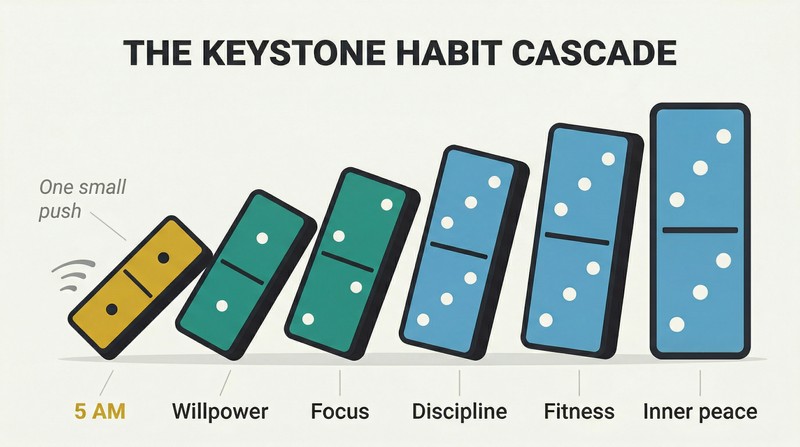
Waking at 5 AM is the single habit that multiplies all others
Sharma packages his system inside a fictional fable: a suicidal entrepreneur and a struggling artist meet an eccentric billionaire who mentors them across Mauritius, India, Rome, and South Africa. The core thesis is that waking at 5 AM functions as a "keystone habit" — one core behavior that lifts every other practice. The billionaire credits this single discipline with building his fortune, fitness, and inner peace over decades.
Why 5 AM works: Your willpower battery is fully charged after sleep. The world is silent, eliminating distractions that fragment your attention later. The neurobiology of early morning — reduced cortisol, elevated dopamine, natural Flow State access — provides cognitive advantages impossible to replicate at noon. Once automated, the habit frees up discipline for the next improvement, creating a cascade of self-mastery.
Split your Victory Hour: 20 minutes to Move, Reflect, Grow
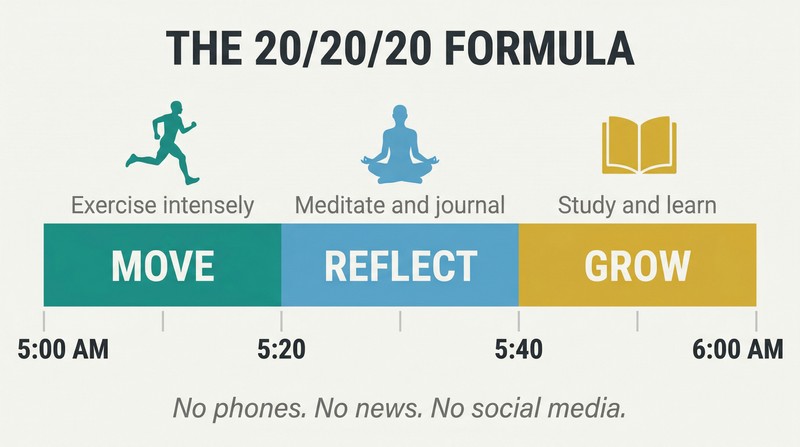
The 20/20/20 Formula is the operational blueprint for The Victory Hour (5 – 6 AM):
1. Move (5:00 – 5:20): Intense, sweaty exercise slashes cortisol, releases BDNF (which repairs brain cells and accelerates neural connections), and floods your system with dopamine and serotonin. By 5:20, you're neurochemically primed.
2. Reflect (5:20 – 5:40): Meditate, write in your Daily Diaries journal, draft a Pre-Performance Blueprint mapping your ideal day, and practice gratitude.
3. Grow (5:40 – 6:00): Study — read books, consume audiobooks, or watch educational content to deepen professional capability.
Customize, don't rigidify. You can extend any pocket. The critical principle is protecting this hour from digital intrusions — no phones, no news, no social feeds.
New habits need 66 days to lock in — expect three brutal phases
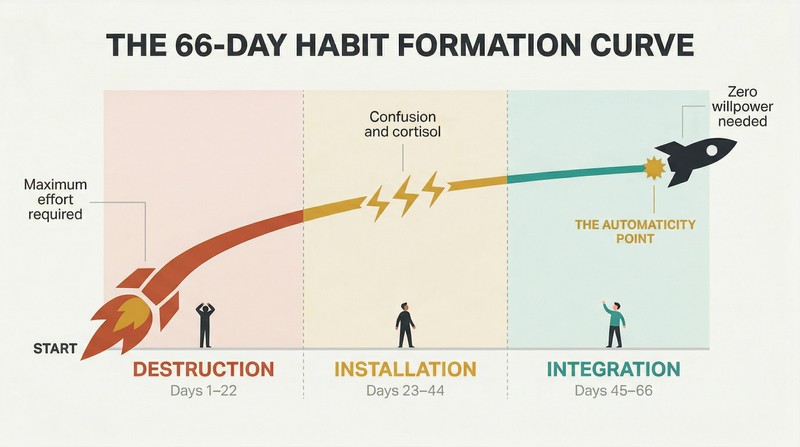
University College London research shows habits take approximately 66 days to automate — not the popular 21-day myth. Sharma calls this The 66 Day Minimum and maps three phases, each lasting roughly 22 days:
1. Destruction (days 1 – 22): Old neural patterns break down. Like a space shuttle burning most of its fuel in the first 60 seconds after liftoff, you need enormous energy to escape your former gravity.
2. Installation (days 23 – 44): New brain circuitry forms amid confusion and exhaustion. Cortisol spikes. You'll desperately want to quit.
3. Integration (days 45 – 66): The habit locks in and reaches The Automaticity Point — where rising at 5 AM requires zero willpower.
The freed willpower then redirects to your next improvement. This is how elite performers stack habit after habit over a lifetime.
Mindset is only 25% of mastery — purify your Heartset too
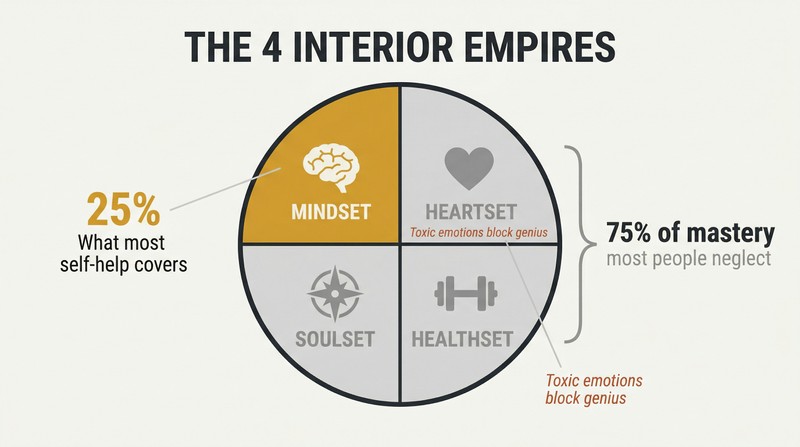
Most self-help addresses only positive thinking — beliefs, mental frameworks, psychology of possibility. Sharma argues this covers just one quarter of personal mastery. His framework, The 4 Interior Empires, requires developing all four dimensions during your Victory Hour:
1. Mindset: Your psychology and beliefs
2. Heartset: Your emotional life — unresolved anger, grief, or resentment sabotages even the strongest mental framework
3. Healthset: Your physical fitness and vitality
4. Soulset: Your spiritual connection to purpose and authentic self
The breakthrough insight: Toxic emotions layer over your gifts and block genius. Journaling about pain and resentment during the Reflect pocket dissolves emotional residue that keeps most people stuck — explaining why positive affirmations alone so rarely produce lasting transformation.
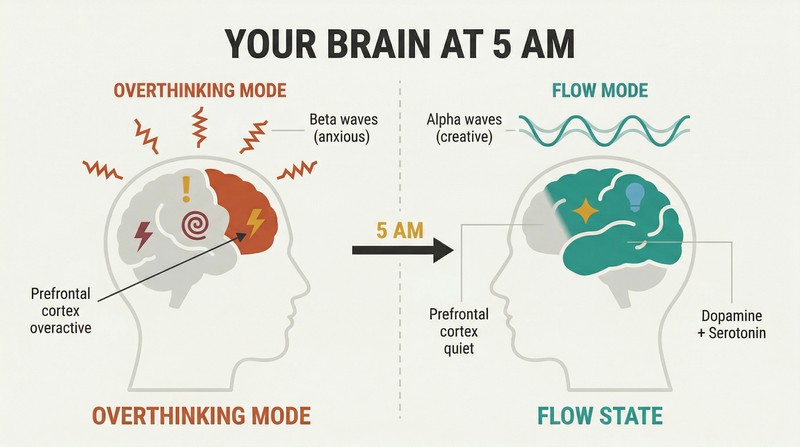
At 5 AM, your overthinking brain shuts off and creativity surges
Neuroscience explains the magic of pre-dawn solitude. When you're alone at 5 AM, away from stimulation, your prefrontal cortex — responsible for rational thinking and relentless worrying — temporarily shuts off. This phenomenon, called transient hypofrontality, shifts your brain waves from anxious beta into creative alpha, sometimes into theta state.
The neurochemical cocktail is equally potent. Dopamine (the fuel of drive) and serotonin (the chemical of happiness) flood your system naturally. Together, these shifts produce what psychologists call The Flow State — the peak mental condition where elite performers generate their finest work. Sharma argues this state becomes habitual and predictable with consistent early rising — a primary reason history's greatest creators, from Mozart to Hemingway, rose before dawn.
Protect your focus — every distraction leaves attention residue
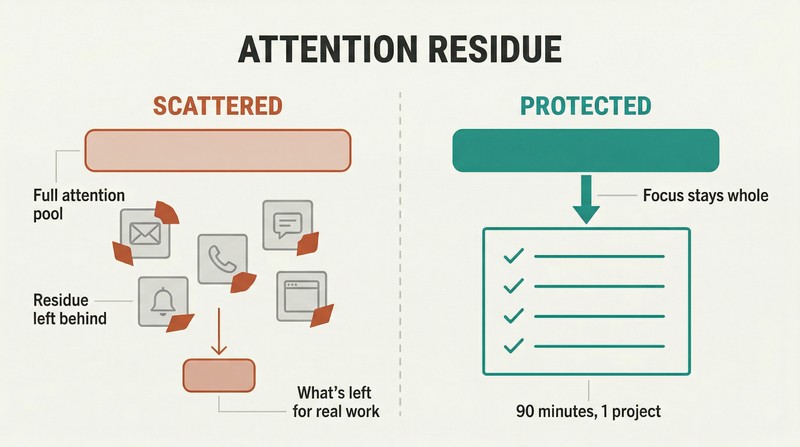
Every distraction costs more than you think. Princeton psychologist Eldar Shafir's concept of "cognitive bandwidth" explains that we wake with a limited pool of mental capacity. Business professor Sophie Leroy's research on "attention residue" shows that shifting between tasks deposits fragments of your focus on each diversion — making you measurably less productive at whatever you do next.
Sharma's tactical antidote is the 90/90/1 Rule: for 90 consecutive days, dedicate the first 90 minutes of your workday to your single most important project — in complete silence with all devices locked in another room. This generates what Sharma calls a Gargantuan Competitive Advantage because virtually nobody maintains this discipline. The broader principle: stop managing your time and start managing your focus.
Build willpower by deliberately choosing discomfort
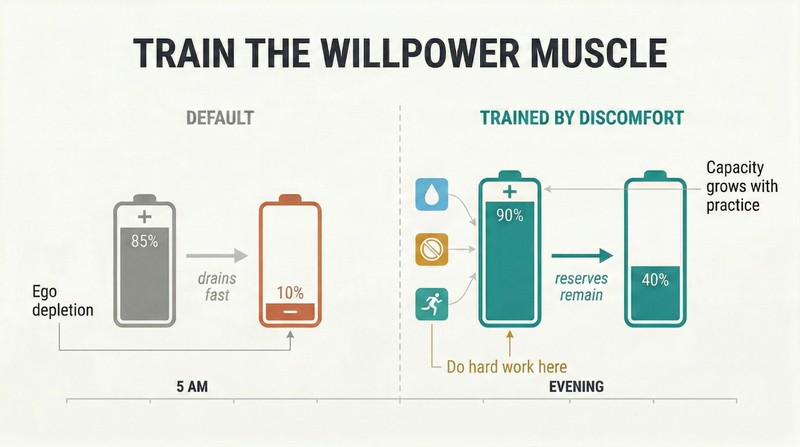
Willpower isn't a fixed trait — it's a muscle that strengthens with use and weakens when tired. Sharma prescribes "Strengthening Scenarios": voluntarily uncomfortable practices that expand your self-discipline. His billionaire character slept on the floor monthly, took cold showers daily, fasted twice a week, and ran in snow wearing minimal clothing.
The science confirms a critical caveat: willpower depletes throughout the day, a phenomenon called ego depletion. By evening, your discipline battery is nearly empty — which is why even powerful people make catastrophic late-night decisions. Research also shows that increasing self-control in one area elevates self-control in all areas, making early rising the perfect training ground. Do your hardest, highest-value work at 5 AM, when your reserves are full.
Pursue deep craft rigor — it's never been easier to stand out
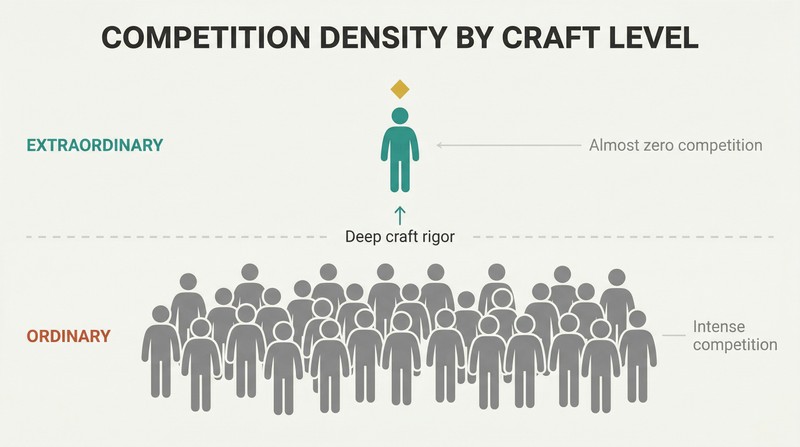
The world's best operate with what Sharma calls "granularity" — painstaking depth on details that ordinary performers skip. A Formula One pit crew vacuums every molecule of dirt from the pit bay because one speck in the engine could cost a race or a life. A Swiss hotel kitchen de-seeds lemon wedges. Vermeer spent years experimenting with light techniques to make his paintings appear three-dimensional.
Sharma contrasts this with "The Collective De-Professionalization of Business" — workers scrolling social media, making more errors than ever, producing mediocre output. The Challenger disaster was caused by a single O-ring seal valued at seventy cents. Because mastery has become so rare, those who commit to genuine craft excellence face almost zero competition at the top.
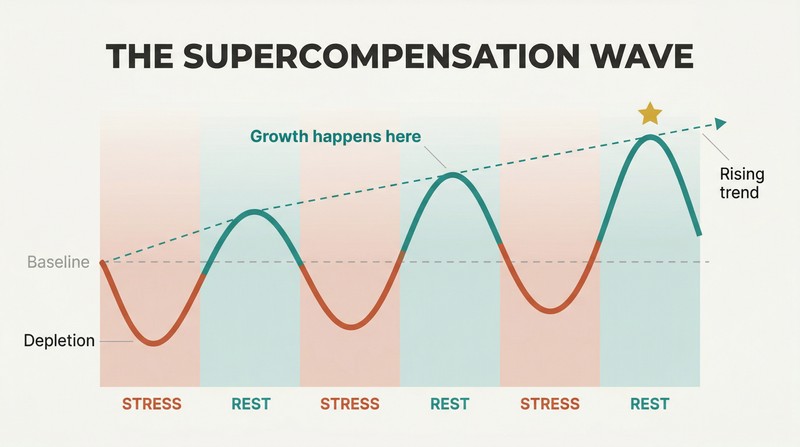
Growth happens when you rest, not when you grind harder
Elite performance pulses like a heartbeat — not a flatline of constant grinding. Sharma calls this The Twin Cycles of Elite Performance: alternating High Excellence Cycles with Deep Refueling Cycles. When scientists studied dominant Russian weightlifters, their advantage came from work-rest ratios, not raw training volume.
The mechanism is supercompensation — identical to how muscles grow by tearing during stress and rebuilding during rest. Sharma's billionaire character confesses he nearly burned out before learning this principle. His prescriptions: take at least two "Zero Device Days" weekly, vacation for extended periods quarterly, and cultivate genuine leisure. Einstein sailed. Dickens walked daily. Wozniak played polo. Fun isn't frivolous — it's where your best ideas incubate.
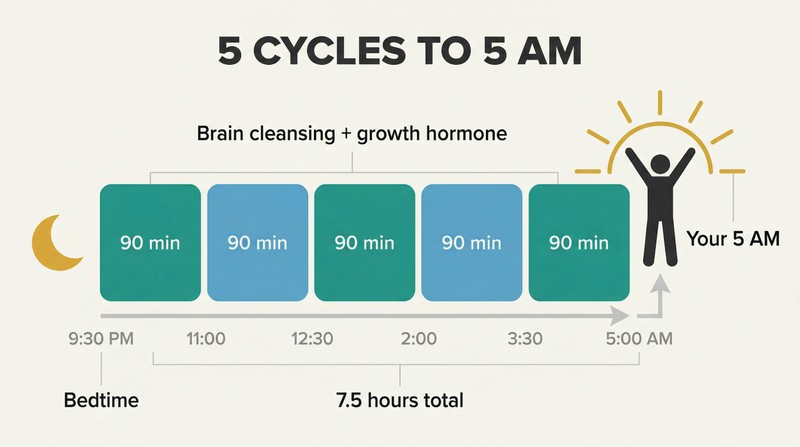
Protect 7.5 hours of sleep or your 5 AM routine self-destructs
Sleep is the invisible foundation of the entire 5 AM system. Rising early without proper rest simply produces an exhausted early riser. Optimal brain cleansing and hormone production require five complete 90-minute sleep cycles — totaling 7.5 hours. Since you're waking at 5 AM, bedtime becomes 9:30 PM.
Key sleep science from the book:
1. 75% of human growth hormone is produced during sleep
2. Neurons shrink by 60% during sleep so cerebral spinal fluid can wash the brain
3. Blue light from devices suppresses melatonin, disrupting circadian rhythm
4. Over-sleeping (9+ hours) also shortens lifespan
Sharma's practical hack: buy an old-school alarm clock, set it 30 minutes ahead to trick yourself into thinking you're sleeping later, and keep zero technology in the bedroom.
Analysis
The 5 AM Club represents Sharma's attempt to translate two decades of executive coaching into a mass-market system, wrapped in a fictional narrative that functions as a pedagogical Trojan horse. The strategy is deliberate: stories bypass intellectual resistance in ways bullet points cannot. Whether the vehicle succeeds is debatable — the narrative often feels like motivational padding — but the frameworks within it are surprisingly well-grounded.
The book's core strength is its synthesis of neuroscience and behavioral psychology into a single prescriptive morning routine. The concept of transient hypofrontality — the temporary quieting of the prefrontal cortex during early morning solitude — provides legitimate scientific grounding for what might otherwise be dismissed as motivational folklore. Similarly, the 66-day habit installation model draws on University College London research, offering a more evidence-based timeline than the pop-psychology 21-day myth that refuses to die.
Perhaps the most original contribution is the Four Interior Empires framework. By arguing that Mindset represents only 25% of personal mastery — and that unprocessed emotional trauma (Heartset) actively sabotages cognitive intentions — Sharma addresses a genuine blind spot in the self-help genre. This insight aligns with current trauma-informed psychology: positive thinking fails when your heart carries unresolved pain. It's a more nuanced position than most productivity books dare to take.
The book's weakness is proportional to its length. At nearly 97,000 words, Sharma takes approximately ten times more space than necessary to deliver his frameworks. The fictional narrative, while occasionally charming, frequently veers into repetitive inspirational speeches and an improbable love story that reads more as padding than pedagogy. The billionaire's quirks — random push-ups, yodeling, twerking — strain credulity.
Still, the 20/20/20 Formula stands as one of the more actionable morning routines in the productivity genre, precisely because it specifies what to do minute-by-minute rather than offering vague mandates to 'win the morning.'
Review Summary
The 5 AM Club received mixed reviews. While some readers found it inspiring and life-changing, many criticized its writing style, fictional narrative, and excessive length. Critics felt the core message of waking up early and establishing a productive morning routine could have been conveyed more concisely. Some appreciated the quotes and self-improvement concepts, but others found the advice unrealistic and lacking empathy. The book's format and characters were often described as poorly executed, with numerous readers expressing frustration at the convoluted storytelling approach.
People Also Read



Glossary
The 20/20/20 Formula
Three-pocket morning routine structureThe core morning routine of The 5 AM Club, dividing The Victory Hour (5–6 AM) into three equal segments: 20 minutes of intense exercise (Move), 20 minutes of meditation, journaling, and quiet contemplation (Reflect), and 20 minutes of learning through reading, audiobooks, or educational content (Grow). Designed to optimize neurobiology, emotional health, and professional capability before the day begins.
The Victory Hour
The 5–6 AM personal development windowThe sixty-minute block from 5 to 6 AM that Sharma designates for personal mastery work, free from all external distractions. During this protected time, members of The 5 AM Club run The 20/20/20 Formula to develop their four interior empires before the demands of the day begin. Called 'Victory' because it provides an early-morning win that sets up the rest of the day.
The 4 Interior Empires
Four dimensions of personal masterySharma's framework for holistic self-development, arguing that true mastery requires cultivating four inner dimensions equally: Mindset (psychology and beliefs), Heartset (emotional health and processing), Healthset (physical fitness and vitality), and Soulset (spiritual connection and purpose). Each represents 25% of the mastery equation, challenging the common focus on mindset alone.
Heartset
Your emotional life and healthOne of Sharma's four interior empires, referring to the quality of one's emotional world. Heartset encompasses unresolved anger, grief, resentment, and fear as well as positive emotions like gratitude and love. Sharma argues that toxic emotions from past traumas layer over natural gifts and block genius, making emotional purification through journaling and contemplation essential for peak performance.
The 66 Day Minimum
Time required for habit automationBased on University College London research, the principle that any new habit requires approximately 66 days to become automatic. Sharma structures this period into three 22-day phases: Destruction (old patterns break down), Installation (new neural pathways form amid confusion), and Integration (the habit locks in). Reaching the end of this process brings you to The Automaticity Point, where the behavior requires no willpower.
The Automaticity Point
When a habit becomes effortlessThe moment, typically around day 66, when a new habit has been sufficiently encoded in your neural pathways that it requires zero willpower to execute. At this point, performing the habit becomes easier than not performing it. The willpower previously used to maintain the habit is now freed up and can be redirected toward installing the next beneficial routine.
Transient Hypofrontality
Prefrontal cortex temporarily shuts downA neuroscience phenomenon where the prefrontal cortex—the brain region responsible for analytical thinking and constant worrying—temporarily deactivates during early morning solitude. This shifts brain waves from beta (anxious, analytical) to alpha or theta (creative, calm), while triggering production of dopamine and serotonin. Sharma argues this natural state, accessible before dawn, is a gateway to The Flow State.
Gargantuan Competitive Advantage (GCA)
Massive edge from rare-level commitmentSharma's term for the outsized advantage that comes from operating at a level of excellence so few others maintain. Because mastery and deep craft rigor have become rare in an age of distraction and superficiality, anyone who commits to world-class habits and obsessive attention to detail faces almost no competition at the top. Specific GCA-generating practices include The 5 AM routine, the 90/90/1 Rule, and granular attention to craft.
The Twin Cycles of Elite Performance
Oscillating intense work with deep restSharma's framework for sustainable peak performance, modeled after the pulse of a heartbeat. It alternates High Excellence Cycles (periods of intense, focused creative output) with Deep Refueling Cycles (genuine rest, recreation, and recovery). Based on research into elite athletes' work-rest ratios and the principle of supercompensation—where growth actually occurs during rest, not during exertion.
The 90/90/1 Rule
Ninety days of focused morning workA productivity tactic requiring that for 90 consecutive days, you dedicate the first 90 minutes of your workday exclusively to the one project that, when completed at world-class, will make you dominant in your field. During this block, all devices are removed from the workspace, and no interruptions are permitted. Designed to harness peak cognitive bandwidth on the single highest-value activity.
The 3 Step Success Formula
Awareness drives choices drives resultsA foundational learning model stating that better daily awareness leads to better daily choices, which leads to better daily results. Sharma uses this formula to explain why education and self-knowledge are prerequisites for achievement: without heightened awareness of your potential, your neurobiology, or your self-sabotaging patterns, you cannot make the improved decisions that produce improved outcomes.
Day Stacking
Compounding daily micro-wins into greatnessThe principle that an extraordinary life is built one excellent day at a time. By making small 1% improvements each day—in morning routines, thought patterns, skills, or relationships—the compound effect produces at least a 30% elevation in one month and 365% over a year. Sharma frames this as focusing monomaniacally on winning today rather than obsessing over distant future goals.
FAQ
What's "The 5 AM Club" about?
- Core Concept: "The 5 AM Club" by Robin S. Sharma is a self-help book that emphasizes the transformative power of waking up at 5 AM to enhance productivity, creativity, and life satisfaction.
- Narrative Style: The book is written as a story, following an entrepreneur and an artist who learn life-changing lessons from a billionaire mentor.
- Main Goal: It aims to help readers unlock their full potential by adopting the habits and mindsets of successful people.
Why should I read "The 5 AM Club"?
- Proven Success: The methods have been used by celebrated entrepreneurs, CEOs, and high achievers with extraordinary success.
- Comprehensive Framework: It provides a detailed framework for personal and professional growth, focusing on mindset, heartset, healthset, and soulset.
- Inspiration and Motivation: Through engaging storytelling and powerful quotes, it inspires readers to take control of their mornings and lives.
What are the key takeaways of "The 5 AM Club"?
- Own Your Morning: The central message is that owning your morning routine can elevate your entire life.
- The 20/20/20 Formula: This formula involves 20 minutes of exercise, 20 minutes of reflection, and 20 minutes of learning.
- Four Interior Empires: Emphasizes developing mindset, heartset, healthset, and soulset for achieving greatness.
What is the 20/20/20 Formula in "The 5 AM Club"?
- Exercise: The first 20 minutes should be dedicated to intense physical activity to boost energy and focus.
- Reflection: The next 20 minutes are for reflection, such as meditation or journaling, to gain clarity and set intentions.
- Learning: The final 20 minutes should be spent on learning, ensuring continuous personal and professional growth.
How does "The 5 AM Club" suggest improving productivity?
- Morning Routine: Advocates for a structured morning routine that includes exercise, reflection, and learning.
- Focus and Discipline: Emphasizes the importance of discipline and consistency in achieving extraordinary results.
- Avoiding Distractions: Advises minimizing distractions to maintain high levels of concentration and creativity.
What are the Four Interior Empires mentioned in "The 5 AM Club"?
- Mindset: Refers to your psychology and beliefs about your potential, crucial for success.
- Heartset: Involves your emotional life and processing negative emotions for joy and fulfillment.
- Healthset: Focuses on physical well-being and maintaining high energy levels.
- Soulset: Relates to spirituality and connection to your higher self for living with purpose.
How does "The 5 AM Club" address the concept of personal mastery?
- Daily Practice: Emphasizes the importance of daily practice in developing personal mastery.
- Four Interior Empires: Cultivating mindset, heartset, healthset, and soulset to achieve greatness.
- Continuous Improvement: Advocates for a mindset of continuous improvement and lifelong learning.
What are the "5 Assets of Genius" mentioned in "The 5 AM Club"?
- Mental Focus: The ability to concentrate deeply on important tasks without distraction.
- Physical Energy: Maintaining high levels of vitality through exercise and proper nutrition.
- Personal Willpower: Strengthening self-discipline to overcome challenges and temptations.
- Original Talent: Cultivating and leveraging one's unique skills and abilities.
- Daily Time: Managing time effectively to maximize productivity and impact.
What is the significance of the "Twin Cycles of Elite Performance" in "The 5 AM Club"?
- High Excellence Cycles (HEC): Periods of intense, focused work where maximum productivity is achieved.
- Deep Refueling Cycles (DRC): Times of rest and recovery to rejuvenate and sustain long-term performance.
- Balance for Longevity: Emphasizes balancing work and rest to maintain peak performance over a lifetime.
What are some of the best quotes from "The 5 AM Club" and what do they mean?
- "Own your morning. Elevate your life." Encapsulates the book's central message of transforming life by starting the day early and with intention.
- "All change is hard at first, messy in the middle and gorgeous at the end." Highlights the process of personal transformation and its challenges.
- "Small daily improvements over time lead to stunning results." Emphasizes the power of incremental progress and consistency.
How does "The 5 AM Club" address the concept of leadership?
- Servant Leadership: Promotes the idea that true leadership is about serving others and making a positive impact.
- Personal Mastery: Suggests that leading others effectively begins with mastering oneself.
- Inspiration by Example: Encourages readers to inspire others through their actions and lifestyle.
What is the role of "The Spellbinder" in "The 5 AM Club"?
- Mentor Figure: The Spellbinder is a motivational speaker who inspires the main characters to transform their lives.
- Catalyst for Change: His teachings serve as the catalyst for the characters' journey toward personal and professional growth.
- Symbol of Wisdom: Represents the wisdom and guidance needed to unlock one's potential and achieve greatness.
About the Author
Other books by Robin Sharma








Download PDF
Download EPUB
.epub digital book format is ideal for reading ebooks on phones, tablets, and e-readers.








































