


Key Takeaways
Sameness feels safe but quietly kills sexual passion
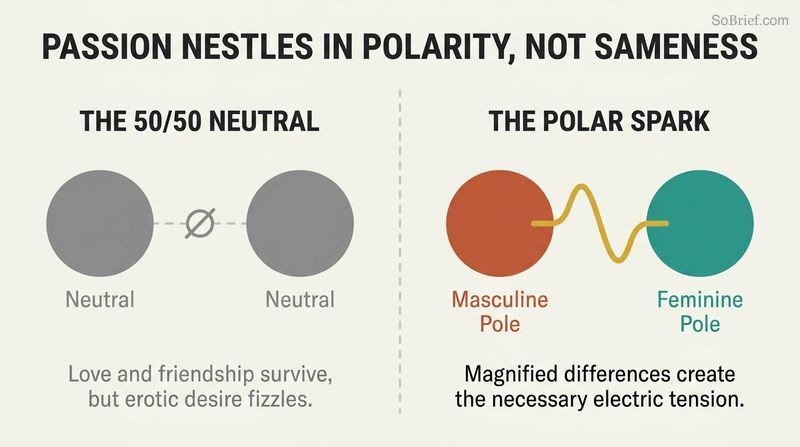
Passion arcs between poles, not equals. Deida argues sexual attraction works like magnetism or electricity: it flows only between a masculine pole and a feminine pole. When couples chase political and domestic sameness (the well-intentioned 50/50 balance of the modern era), bank accounts equalize while desire fizzles. Love and friendship can survive on sameness, but erotic charge cannot.
Polarity is independent of gender. He notes this applies equally to gay and straight couples: you need a ravisher and a ravishee, someone playing masculine and someone playing feminine, even if they swap roles daily. Two buddies who share everything and neutralize their differences may adore each other, yet find the sexual juice draining away. To keep passion, magnify differences in intimate moments rather than smoothing them out.
Deida writes squarely in the tradition of complementarity, echoing Jungian anima/animus and Taoist yin-yang. The polarity claim has intuitive pull and finds partial support in research on desire: psychologist Esther Perel argues eroticism thrives on distance, mystery, and otherness, while intimacy thrives on closeness, and the two are in tension. That convergence lends Deida credibility. The weaker link is his slide from 'polarity' to fixed 'masculine' and 'feminine' energies, which risks smuggling stereotype in through an energetic back door. His saving move is decoupling polarity from anatomy, framing it as roles anyone can play.
Identify your sexual essence and stop pretending it's balanced
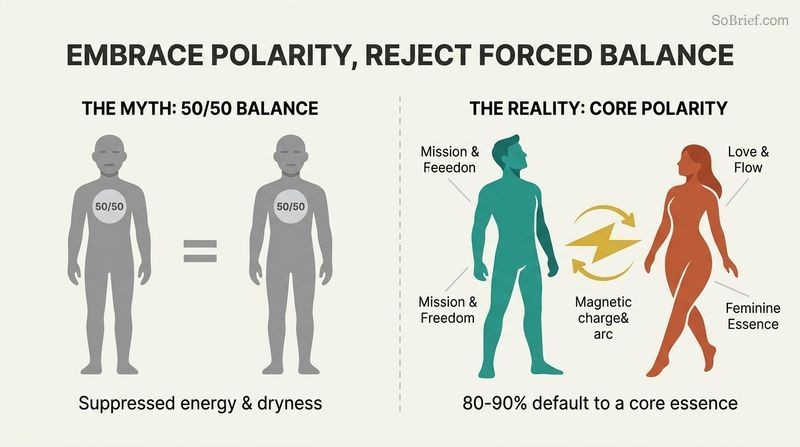
Three cores, roughly distributed. Deida claims about 80 to 90% of people have a decidedly masculine or feminine sexual essence, meaning a deep default orientation, while only around 10% are genuinely balanced. A masculine essence is driven by mission and freedom; a feminine essence is fulfilled by the flow of love. His diagnostic test: would you rather be pinned or do the pinning, watch the boxing match or the love story?
Suppression has costs. He warns that people who bury their true essence to fit modern work culture pay a price. Feminine-essence people running masculine energy all day can feel their radiance dry up; masculine-essence people forced into pure cooperation lose touch with purpose. The book is explicitly written for masculine-essence readers, of any gender or orientation, and their feminine partners.
The framing is deliberately essentialist, and that is its vulnerability. Contemporary gender scholarship treats such traits as largely socially constructed and context-dependent rather than as a fixed inner core. Deida partly inoculates himself by insisting essence is not tied to biological sex, letting a woman carry a masculine essence and a man a feminine one. Read charitably, 'essence' functions less as biology than as a self-knowledge prompt: what actually energizes you versus what you perform? That reframe is useful even for skeptics. The percentages, however, are asserted from workshop observation, not data, and should be held loosely.
Put your deepest purpose ahead of your relationship
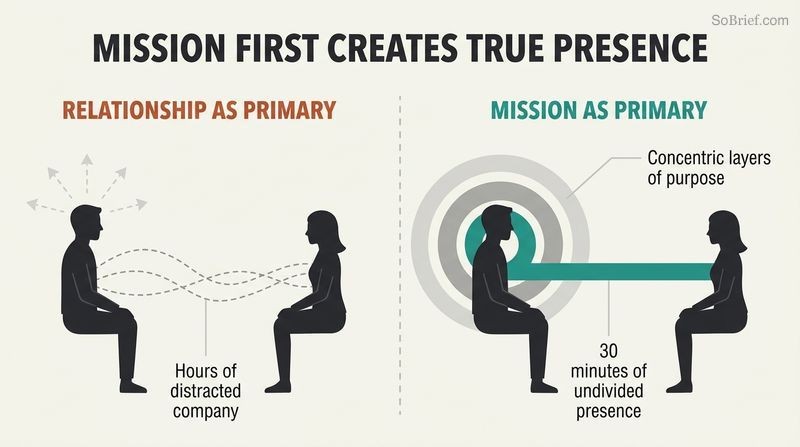
Mission is the masculine priority. Deida insists a masculine-essence man who prioritizes his relationship over his highest purpose weakens himself and shortchanges his partner, who then senses his divided, half-present attention. His counterintuitive claim: a woman is more fulfilled by thirty minutes of undivided, ravishing presence than hours of distracted company. Admitting you would choose your purpose over the perfect relationship, he says, actually relieves pressure.
Purpose unfolds in concentric layers. You rarely know your deepest purpose immediately. Life peels through outer purposes (often inherited from parents) toward the center. Signs you have completed a layer: sudden total disinterest, no regret, feeling unburdened and energized by quitting. When one layer dissolves, you may sit in not-knowing and wait for the next vision rather than filling the void with distraction.
This is the book's spine and its most bracing counsel: intimacy cannot be the point of a life without hollowing it out. Viktor Frankl's logotherapy converges here, arguing meaning precedes happiness and that pursuing happiness directly tends to fail. Self-determination theory similarly links wellbeing to autonomous, self-endorsed goals. The risk is obvious: 'purpose before relationship' can rationalize neglect, workaholism, and emotional unavailability dressed up as spiritual discipline. Deida's guardrail is that genuine purpose makes a man more present, not less, when he does show up. The distinction between purpose-driven presence and avoidant absence is the whole ballgame, and easily blurred.
Give your gift today; nothing in life ever gets completed
The someday myth traps men. Deida diagnoses a specific masculine error: believing that one day the work will be done, the woman will stop complaining, and real life can finally begin. It never ends. Most postponements, he argues, are disguised failures of creative discipline, not genuine constraints. His prescription is concrete: spend at least one hour a day doing what you were born to do, regardless of unfinished obligations, so you could die tonight knowing you held nothing back.
Grow by leaning past your edge. Your edge is where fear stops you short of your fullest gift. The practice is to lean just slightly beyond it constantly, neither stagnating in comfort nor recklessly overreaching. Honesty about your real edge, spoken aloud, makes you trustworthy to other men.
The one-hour-a-day rule is quietly powerful precisely because it is small and immediate, resembling behavioral activation in clinical psychology, where action precedes and generates motivation rather than waiting for it. The 'edge' concept maps neatly onto Vygotsky's zone of proximal development and Csikszentmihalyi's flow, both of which locate growth just beyond current capacity. Where Deida adds value is emotional: he frames fear not as an obstacle to eliminate but as the sharpest signpost of where you are alive. The caution: 'no excuses' rhetoric can shade into contempt for people facing genuine structural constraints, which the book underweights.
Her testing never stops, so stop hoping she'll get easier
Testing is a feature, not a bug. Deida reframes a partner's complaints, mood shifts, and challenges as tests of whether a man remains unshaken in his love and truth. He invokes Shiva, the Hindu image of imperturbable divine masculine consciousness, as what she most wants to feel. His signature scene: a man announces he made a million dollars, and she asks whether he remembered the milk. She is not deflating him out of cruelty; she is checking whether his happiness depends on her approval.
Pass by staying open and playful. If he collapses or gets defensive, he flunks and she cannot fully trust him. If he stays full, humorous, and loving, sweeping her up rather than arguing, the test dissolves into celebration, until the next one. The most loving partners test the most.
Stripped of its gendered packaging, this contains a durable insight from attachment and emotion research: bids and provocations often test felt security rather than communicate literal content. Gottman's work on 'turning toward' bids and repair attempts overlaps meaningfully. The reframe from 'she is attacking me' to 'she is checking whether I am solid' can defuse defensive spirals in any relationship. The obvious hazard is that 'it's just a test' becomes a license to dismiss legitimate grievances as mere provocation. A partner asking about money problems may genuinely need financial partnership, not a demonstration of imperturbable cosmic calm.
Hear her emotional words as weather, not as contracts
Feminine speech reports feeling, not fact. Deida distinguishes masculine speech (where a word is a binding commitment) from feminine speech (where words express the emotional weather of the moment). When she says she hates you or does not want to go to the movies, she is often voicing a passing feeling-wave, not a considered stance. This is not lying; truth for the feminine is whatever is felt right now, and it can change in five minutes.
Don't build plans on shifting words. His rule: do not take the literal content seriously unless love is flowing fully in the moment it is spoken, and even then expect change. The famous example: she begs you not to go to war, then watches you leave with pride, because she needed you to hold your course, not obey her plea.
This is the book's most provocative and most easily weaponized claim. The charitable reading resembles what communication scholars call the difference between report talk and rapport talk, or the gap between literal and affective meaning that anyone parsing an upset partner must navigate. The uncharitable reading verges on gaslighting: 'don't believe what she says' can justify overriding clearly stated boundaries and preferences. The essentialist attribution to 'the feminine' also fails empirically, since emotional expressiveness varies more within genders than between them. Best salvaged as a narrow point about emotional flooding, when nobody, of any gender, means their words literally.
When she's upset, offer love and praise, not diagnosis
Analysis backfires; presence works. Deida claims roughly 90% of a partner's emotional distress stems from feeling unloved, so interrogating the cause (Did I do something? Are you hormonal?) usually worsens it. Treat her, he says, like a flower needing water rather than an engine needing a carburetor adjustment. Give love directly through eyes, touch, and voice first; only after the mood dissolves address any practical issue that remains.
Praise grows the feminine. A parallel rule: the masculine grows through challenge, the feminine through praise. Telling a partner she looks sexy when she exercises motivates more than warning her about weight. He advises praising the very quality you want to magnify, even before it fully exists, five to ten times a day, arguing praise is literal food for feminine radiance while information and criticism are not.
The behavioral core is sound and testable: reassurance and warmth generally de-escalate emotional flooding better than problem-solving, a finding echoed in emotionally focused therapy, which prioritizes attunement over content resolution during high arousal. The 90% figure is rhetorical, not measured. The praise principle overlaps with basic behavioral reinforcement and appreciation research. The friction point is the asymmetry: casting one partner as needing praise and the other as needing challenge can infantilize and lock people into rigid roles. Many people of all genders need both. Deida would likely respond that these are essence tendencies, not universal prescriptions, but the risk of condescension is real.
Give clear direction so she can relax out of control
Never say 'whatever you want.' Deida argues that refusing to offer a decision is a friend's move, not a lover's, and it forces a feminine-essence partner to carry the masculine load herself, becoming sharp, tense, and distrustful. Even on trivial choices (which shoes, what restaurant), he says give a real opinion while affirming she is free to choose. The dramatic example: most women prefer a surprise weekend ('pack your bags, everything's handled') over being asked to plan their own birthday.
Direction means clarity, not bossiness. Financially and spiritually, she needs to feel your train is going somewhere so she can board it and relax into radiance. You need not earn more than her or do all the work; you need to be accountable, clear, and directed from your core. Ambiguity, sensed in your body and voice, forces her into defensive self-direction.
The insight that decision fatigue and unshared load breed resentment is well supported; sociologists document the exhausting 'mental load' that falls disproportionately on women in households, and Deida's remedy (a partner who proactively takes responsibility rather than deferring everything) actually aligns with that critique. Reframed as 'do not offload every decision onto your partner,' this is excellent relationship advice for anyone. The gendered packaging, casting one person as the perpetual director and the other as the surrenderer, is where modern egalitarian couples will balk. The underlying move, replacing chronic ambiguity with clear accountability, survives the critique intact.
Channel your dark sexual force through love, or it leaks out twisted
Suppressed desire goes underground. Deida argues that when a man disowns his aggressive, penetrating sexual energy, it does not disappear; it kinks like a blocked hose and reemerges as fantasy, obsession, or worse. The desire to ravish, to break through a partner's resistance into ecstatic surrender, is the sexual version of the same drive that breaks through opponents or intellectual barriers. The distinguishing line between ravishment and rape, he states plainly, is love.
Own the killer, too. A related dark capacity is fearlessness. A partner is turned off by a man who wants her to kill the cockroach or check the strange noise downstairs. She does not want a killer, but she wants to feel he could face death if love required it. This capacity to confront death, he argues, is what makes a man trustable and, ultimately, spiritually free.
Deida's Jungian instinct here is his strongest philosophical move: the shadow denied becomes destiny, echoing Jung's claim that unintegrated aggression returns in pathological form. Research on suppression supports the general mechanism, since actively suppressing thoughts and impulses often amplifies them (the ironic-process effect). The framing of 'ravishment versus rape distinguished by love' is where careful readers must insist on the harder line modern ethics draws: enthusiastic, ongoing consent, not the actor's felt love, is what separates the two. Deida gestures at mutual surrender, but the language flirts with danger. The integration of aggression is wise; the criterion for acting on it needs sharper boundaries than 'love.'
Relationship colors her whole life but is only part of yours
The primary asymmetry. Deida names this the central imbalance in polarized intimacy: for a feminine-essence woman, the relationship sits at the core of life and tints everything, so when love is flowing she feels good at work, in bed, everywhere. For a masculine-essence man, intimacy is one important domain among others; if his mission is blocked, no amount of love makes him feel at ease, and he may not even want intimacy until his purpose is back on track.
Support each other's true priority. Rather than faking equal investment or shaming her for caring 'too much,' he says honor the difference. Compare the hours you pour into your mission with the hours you serve her desire for love. He also prescribes restoration rituals: solitude and honest men's gatherings rebuild a man's purpose, while time celebrating with other women rekindles a woman's radiance.
This asymmetry is the book's boldest empirical wager and its most contestable. Attachment research finds that relationship quality strongly predicts wellbeing for people of all genders, and that men often benefit even more than women from partnership on health outcomes, complicating Deida's claim that a woman is 'lodged in the heart' while a man's partner is 'replaceable.' Read as a description of a subset of highly polarized couples, it may capture something real about differing centers of gravity. Read as universal biology, it overreaches. The practical residue, spend restorative time in same-essence company and honor differing priorities rather than resenting them, holds regardless.
Feel through her beauty to the source it only promises
Desire is a doorway, not a destination. Deida's spiritual climax reframes all attraction as a stepped-down version of a deeper hunger: union of consciousness with its own source. A woman, or any object of craving, promises fulfillment she cannot ultimately deliver; you have gotten what you wanted before and it was never enough, never lasting. The mistake is stopping at the form. The practice is to feel your desire fully, then feel through it, using its momentum like a slingshot toward the boundless.
Same move, sexually and spiritually. He connects this to non-ejaculatory sexual practice and to living with an open heart amid pain: the willingness to dissolve, to surrender the separate self in love rather than grasping for release. Whether facing death, orgasm, or a partner's rage, the superior man's deepest desire is to be utterly released into love.
Here Deida reveals his lineage in nondual traditions (Advaita Vedanta, tantra, and his association with integral theorist Ken Wilber), where craving is not repressed but transmuted, treated as misdirected longing for the absolute. This resonates with Buddhist teaching that tanha (craving) points beyond its objects, and with the hedonic-adaptation research showing acquired pleasures reliably fade, the 'never as good as hoped' phenomenon. The elegance is turning ordinary lust into contemplative fuel rather than shame. The blind spot is that treating a partner primarily as a doorway to one's own transcendence can quietly instrumentalize her, the very objectification the practice claims to move beyond. Reverence and use sit uncomfortably close.
Analysis
The Way of the Superior Man is a spiritual self-help manifesto structured as roughly forty short aphoristic chapters, each pairing a bold claim with a body practice. Its intellectual DNA blends Jungian depth psychology, Hindu and tantric nondualism, Ken Wilber's integral theory, and 1990s men's-movement mythopoetics. The organizing engine is a two-part thesis: passion requires sexual polarity, and a masculine-essence life requires purpose above intimacy.
Deida's most defensible move is his cultural diagnosis. He observes that the well-intentioned drive toward gender sameness, real progress in rights and equality, produced an unintended casualty in the bedroom: neutralized desire. This anticipates Esther Perel's later mainstream articulation that intimacy and eroticism pull in opposite directions. His concept of 'the edge,' living just beyond fear, is a genuinely useful synthesis of flow theory and behavioral activation.
The book's central liability is essentialism. Deida repeatedly attributes stable, contrasting 'masculine' and 'feminine' energies to a deep core, then supports the distribution with workshop intuition rather than data. His partial defense, decoupling essence from biological sex so anyone can hold either, blunts but does not eliminate the problem, because the trait clusters themselves reproduce stereotype. The most ethically fraught passages, 'don't believe what she says,' the ravishment discourse, and 'her complaint is content-free,' are salvageable as narrow points about emotional flooding and felt security, but are dangerously overbroad as written, capable of rationalizing dismissiveness or coercion.
What endures, once the gender scaffolding is treated as metaphor rather than biology, is a coherent spiritual psychology: face fear as information, refuse the myth of eventual completion, integrate rather than suppress the shadow, transmute craving into contemplative fuel, and take radical responsibility. Read as poetry and provocation rather than prescription, it retains real force. Read literally as a manual for how women work, it is reductive. The wisdom and the hazard live in the same sentences.
Review Summary
The Way of the Superior Man receives mixed reviews. Many readers praise it as insightful and transformative, offering valuable advice on masculinity, relationships, and personal growth. They appreciate Deida's understanding of masculine and feminine energies. However, critics argue the book promotes outdated gender stereotypes, oversimplifies complex issues, and lacks scientific backing. Some find Deida's writing style pretentious and his ideas misogynistic. Despite controversy, many readers recommend it as a thought-provoking guide for men seeking to improve their relationships and find purpose.
People Also Read










FAQ
What's "The Way of the Superior Man" about?
- Core Themes: The book explores the challenges men face in relationships, work, and sexual desire, offering guidance on living a life of integrity and authenticity.
- Masculine and Feminine Dynamics: It delves into the dynamics between masculine and feminine energies, emphasizing the importance of understanding these differences for personal and relational growth.
- Spiritual Growth: The book provides insights into how men can grow spiritually while navigating the complexities of modern life.
- Practical Advice: It offers practical advice and exercises to help men live a more fulfilled and purposeful life.
Why should I read "The Way of the Superior Man"?
- Personal Development: It provides a roadmap for men seeking to improve themselves and their relationships.
- Understanding Relationships: The book offers deep insights into the dynamics of male-female relationships, helping men understand their partners better.
- Spiritual Insights: It combines spiritual wisdom with practical advice, making it a unique guide for those interested in spiritual growth.
- Empowerment: Readers are encouraged to embrace their true masculine essence and live a life of purpose and freedom.
What are the key takeaways of "The Way of the Superior Man"?
- Purpose Over Relationship: A man's highest purpose should come before his relationship, as this alignment brings fulfillment and strength.
- Embrace Masculine Energy: Men should embrace their masculine energy and use it to navigate life's challenges with integrity and love.
- Understanding Feminine Energy: Recognizing and appreciating the feminine energy in women and the world is crucial for balanced relationships.
- Continuous Growth: The book emphasizes the importance of continuous personal and spiritual growth for a fulfilling life.
How does David Deida define a "Superior Man"?
- Living with Purpose: A superior man lives with a clear sense of purpose and aligns his life around it.
- Emotional and Spiritual Depth: He is emotionally and spiritually deep, able to connect with his partner and the world meaningfully.
- Balance of Heart and Spine: He embodies both strength and sensitivity, balancing masculine assertiveness with emotional openness.
- Commitment to Growth: He is committed to personal and spiritual growth, constantly seeking to improve himself and his relationships.
What are the best quotes from "The Way of the Superior Man" and what do they mean?
- "Stop hoping for a completion of anything in life." This quote emphasizes living in the present and embracing life's ongoing challenges.
- "Your purpose must come before your relationship." It highlights the importance of prioritizing one's life mission over personal relationships for true fulfillment.
- "A superior man is free in feeling and action, even amidst great pain and hurt." This suggests that true strength lies in maintaining openness and love, even in difficult times.
- "The feminine is abundant." It reflects the idea that feminine energy is ever-present and should be embraced rather than resisted.
How does "The Way of the Superior Man" address sexual desire?
- Energy Circulation: The book advises men to circulate sexual energy throughout their bodies rather than focusing solely on ejaculation.
- Beyond Physical Desire: It encourages men to see sexual desire as a pathway to deeper spiritual and emotional connection.
- Ravishment with Love: Men are urged to embrace their dark desires with love, transforming them into acts of deep connection and intimacy.
- Balancing Desire and Purpose: The book teaches men to balance their sexual desires with their life purpose, ensuring neither is neglected.
What advice does David Deida give for handling women's emotions?
- Embrace Her Emotions: Men should embrace and love their partner's emotions rather than trying to fix or avoid them.
- Emotional Presence: Being present and open during emotional storms is crucial for building trust and intimacy.
- Understanding Feminine Expression: Recognize that women's words often reflect their feelings rather than literal truths.
- Transformative Love: Use love and humor to transform emotional tension into deeper connection and understanding.
How does "The Way of the Superior Man" suggest men deal with work and career?
- Align with Purpose: Men should align their careers with their deepest purpose to feel fulfilled and energized.
- Avoiding Mediocrity: The book warns against settling for mediocrity and encourages men to push beyond their comfort zones.
- Balancing Work and Life: It emphasizes the importance of balancing work with personal growth and relationships.
- Continuous Improvement: Men are encouraged to continuously seek growth and challenge in their professional lives.
What role does spiritual growth play in "The Way of the Superior Man"?
- Integration of Spirit and Life: The book integrates spiritual growth with everyday life, encouraging men to live with consciousness and love.
- Facing Fears: Spiritual growth involves facing fears and embracing the unknown with courage and openness.
- Beyond Ego: Men are urged to move beyond ego-driven desires and connect with their deeper spiritual essence.
- Daily Practice: Regular spiritual practices are recommended to maintain alignment with one's true purpose and essence.
How does David Deida suggest men handle challenges in relationships?
- Embrace Challenges: Men should see relationship challenges as opportunities for growth and deeper connection.
- Lead with Love: Leading with love and presence can transform conflicts into moments of intimacy and understanding.
- Understanding Dynamics: Recognizing the dynamics of masculine and feminine energies helps in navigating relationship challenges.
- Commitment to Growth: A commitment to personal and relational growth is essential for overcoming challenges and deepening intimacy.
What exercises or practices does "The Way of the Superior Man" recommend?
- Breathing Techniques: The book suggests breathing exercises to circulate energy and maintain presence.
- Emotional Presence Practices: Practices to enhance emotional presence and connection with one's partner are recommended.
- Purpose Alignment: Exercises to help men align their lives with their deepest purpose are included.
- Spiritual Practices: Regular meditation and contemplation are advised to deepen spiritual awareness and connection.
How does "The Way of the Superior Man" redefine masculinity?
- Beyond Stereotypes: The book moves beyond traditional stereotypes of masculinity, advocating for a balance of strength and sensitivity.
- Emotional Openness: It encourages men to be emotionally open and vulnerable, seeing this as a strength rather than a weakness.
- Purpose-Driven Life: True masculinity is defined by living a purpose-driven life, aligned with one's deepest truths.
- Integration of Love and Power: The integration of love and power is seen as the hallmark of a superior man, capable of deep connection and impactful action.
About the Author
Other books by David Deida








Download PDF
Download EPUB
.epub digital book format is ideal for reading ebooks on phones, tablets, and e-readers.








































