
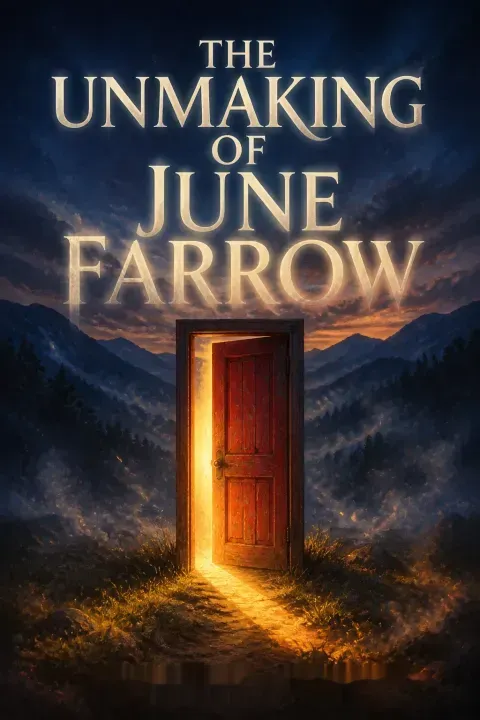


Plot Summary
Last of the Farrows
June Farrow1 stands on a hill as Malachi Rhodes plays fiddle over her grandmother Margaret's3 freshly filled grave. She is the last living Farrow1 in Jasper, North Carolina, a town that has always watched her, waiting for the inherited madness to surface.
After the burial, she spots a man's silhouette in the church window, and later that night, on her own porch, the orange glow of a cigarette in the dark. The figure vanishes when she blinks. Birdie5 presses the family's locket watch into June's1 palm, the heirloom found in her basket when she was abandoned as an infant.
Alone in the hallway mirror, June1 traces the birthmark on her neck and records the sightings in her secret journal. She has always known the curse would claim her, and she intends for it to end with her.
The novel opens at an ending, positioning June as a woman defined by absence and inevitability. The funeral is both ritual and release, freeing her from caretaking but also removing the last buffer against her feared fate. The phantom sightings introduce the central ambiguity: are these hallucinations or glimpses of another time? June's resignation to her doom is a survival mechanism, a preemptive grieving that will be shattered when she learns the truth about her inheritance.
Gran's Last Photograph
Days later, sorting the piled mail, June1 discovers an envelope addressed in Margaret's3 handwriting, postmarked just before her death. Inside is a single black-and-white photograph from 1911, inscribed with the names Nathaniel Rutherford8 and wife.
The woman standing beside the minister8 is a precise match for June's missing mother, Susanna.7 June1 retrieves her old investigation folder on Susanna's7 disappearance and compares the images side by side. The resemblance is absolute.
She has no explanation for how her mother7 could appear in a photograph taken decades before her birth. The discovery drags her back into the obsession she thought she had buried, planting a seed that will grow into an unthinkable possibility: that Susanna7 did not vanish, but slipped into the past.
The photograph functions as a posthumous summons, a carefully timed clue from a grandmother who knew far more than she ever disclosed. June's immediate pivot to investigative mode reveals her core drive: she has spent her life trying to understand the mother who abandoned her. The image collapses the distance between generations, suggesting that June's origins are more tangled than simple abandonment.
The Daughter Who Died Twice
June1 unleashes her old research instincts. At the courthouse, Ida12 finds a 1911 marriage license for Nathaniel Rutherford8 and a woman named Susanna Farrow.7 The church's digitized baptism log lists a daughter, June Rutherford,1 born March 14, 1912, and died October 2, 1912. The death date matches the exact day June1 was found as an infant on Market Street.
At the cemetery, she kneels before three graves: Nathaniel,8 Susanna,7 and a tiny headstone for a child who shares her name.1 The birth month aligns with the spring birthday Mason10 once chose for her. The coincidences are too precise to dismiss. Her mind reels, grasping for any rational explanation, but a wild theory begins to form: what if she was born in another century?
The convergence of names and dates creates a vertiginous doubling of identity. June stands at her own grave, a living contradiction. The scene literalizes the novel's central conceit: that selfhood can be split across time. This is the point where passive curiosity transforms into existential crisis, as June must either accept that she is losing her mind or that reality is far stranger than she believed.
Birdie Breaks Her Silence
When Birdie5 returns to find the house papered with June's1 research, her composure cracks. She admits the truth: the Farrow women are not mad; they can cross time through a red door. June's1 episodes, the voices and visions, are fragments of another life bleeding through. Birdie5 produces an old envelope addressed to a farmhouse on Hayward Gap Road.
Inside rests a pressed bluebell and two words in Susanna's7 handwriting: Trust me. Birdie5 explains she has kept this secret for decades, bound by a promise she cannot break. Her only instruction: the next time June1 sees the red door, she must open it. The rest is for June1 to discover alone.
Birdie's revelation is a pressure release, converting years of silent complicity into urgent guidance. She is the keeper of the plan, her love expressed through strategic withholding. The bluebell is a fragile organic key, a message carried across time from mother to daughter, or perhaps from one version of June to another. The two-word plea becomes the novel's thesis: surrender to the impossible.
The Door in the Field
Driving back from the abandoned farmhouse, June1 spots it: a crimson door standing alone among wild grasses. She stops the truck, her heart hammering. She can still flee or she can listen to Birdie.5 She walks toward it, touches the brass knob, and pulls.
On the other side, the same field is transformed: the road is smoothly paved, the farmhouse whole, the air filled with the scent of fresh tar. She steps through and the door vanishes behind her. A woman on a nearby porch screams at the sight of her. A truck from another era rumbles past. With nowhere else to go, June1 walks toward the smoking chimney of the living farm on Hayward Gap Road.
The crossing is rendered with visceral immediacy, the door both mundane object and numinous portal. June's decision to step through is an act of surrender, a leap into the very madness she has feared. The vanishing door immediately transforms the journey from investigation into survival, stranding her in a past that is at once foreign and intimately familiar, as if she has been here all along.
Eamon Knows Her Name
At the farm, a dark-haired man2 emerges from the barn. He freezes when he sees her, then strides forward and seizes her wrist. His name is Eamon Stone,2 and he speaks her name with wrenching familiarity. He pushes up her sleeve, searching for a burn scar that isn't there. His expression shifts from hope to devastation: this June1 is not his wife.
He hides her from a passing deputy, then takes her to Esther Farrow's4 flower farm. Esther,4 her great-great-grandmother, explains the rules: the locket sets the year, each Farrow gets three crossings, and a version of June1 lived here for five years, married Eamon,2 had a child named Annie,6 and vanished a year ago without a trace.
Eamon's body check is a devastating act of verification, his hands searching for proof of a shared history that this June does not possess. His anger masks grief, his coldness a defense against hope. June is thrust into the shell of her future self, forced to inhabit a life she doesn't remember but is undeniably hers. The rules establish the parameters of the magic while deepening the central tragedy: love and loss are intertwined with every crossing.
A Mother Without Memories
June1 meets little Annie,6 Eamon's2 four-year-old, who watches her from behind a curtain with solemn brown eyes. The child does not speak to her. Margaret,3 a bright-faced teenager who will one day become June's Gran,3 comes daily to help and keep watch.
As June1 works the neglected garden and helps in the tobacco fields, flashes of memory begin surfacing: meeting Eamon2 by a pond, the horse Callie's name, a wedding beneath a willow tree. But simultaneously, details from her 2023 life start erasing themselves, like the name of her neighbor or a lullaby Gran3 once sang. June1 records the fading memories on scraps of paper, terrified of losing herself entirely.
The dual erosion of identity is the novel's most poignant paradox: June gains a family at the cost of her original self. Annie is a mirror and a stranger, her silence a rebuke that June must earn the right to break. The garden work becomes a meditation on rooting, while the memory loss introduces a ticking clock. She cannot remain in two worlds; one life must be chosen.
The Sheriff's Interrogation
Sheriff Caleb Rutherford,9 Nathaniel's8 son and June's1 half-brother, pulls over Esther's4 truck and takes June1 to the station. In a cramped room, he plays a recording of her earlier statement from the 1950 investigation. On the tape, June's1 voice describes leaving the Midsummer Faire separately from Eamon,2 but today she claimed they went home together.
Caleb9 then produces a blue shoe found in a field and reads a witness statement from Mimi Granger,11 who saw June1 running through the pasture that night covered in blood, carrying Annie.6 June1 stumbles, trapped between two versions of herself. Eamon2 bursts in and retrieves her, his fury barely contained. The noose is tightening.
The interrogation weaponizes June's fractured identity against her. The recording is a ghost of her future self, testimony she cannot remember giving. This scene crystallizes the legal and psychological peril of her situation: she is literally incapable of telling a consistent story. Caleb, driven by filial duty and unresolved trauma, becomes a relentless antagonist who is also, unwittingly, targeting his own sister.
Sins of Nathaniel Rutherford
After the interrogation, Esther4 tells June1 the full history. Susanna7 crossed time, met Nathaniel,8 and became pregnant. Nathaniel,8 convinced she was demonic, offered Esther4 money to poison the unborn child.1 Esther4 refused and sent Susanna7 back to the future. But Susanna7 returned, gave birth to June,1 and lived in terror of Nathaniel8 until she faked the baby's death and sent her through the door to 1989.
Nathaniel8 was told his daughter died in her sleep. He later drowned Susanna7 and buried her under an oak tree, staging it as suicide. He raised Caleb9 alone. When the older June1 arrived in 1946, Nathaniel8 recognized her and began stalking her, calling her a demon sent to torment him.
This backstory transforms the novel's moral landscape. Nathaniel is not a mere obstacle but a genuine monster, his crimes spanning decades. Susanna's seeming abandonment is recast as the ultimate maternal sacrifice. The revelation deepens Caleb's tragedy: he was raised by his mother's murderer, taught to venerate a monster. The symmetry is cruel and complete: both of Nathaniel's children were marked for death by him.
Dancing with Ghosts
To deflect suspicion, June1 and Eamon2 attend the Midsummer Faire together on the anniversary of Nathaniel's8 death. The tent glows over the river bridge, garlands of Esther's4 flowers hanging overhead. Eamon2 leads June1 onto the dance floor, his hand settling at her waist with the ease of years of practice. She feels the memory of their first dance flickering.
He nearly kisses her but pulls away, his voice thick with anguish. Caleb9 corners her afterward, promising she will pay. That night, June1 dreams of their wedding night, the sensations bleeding into waking. She wakes with his phantom touch on her skin. The emotional wall between the two Junes1 collapses, and she can no longer pretend she doesn't love him.
The Faire sequence operates on multiple registers: public performance of normalcy, private reclamation of intimacy, and escalating threat. The dance is a body memory, their muscles recalling a choreography their minds cannot. Eamon's withdrawal is a survival reflex, protecting himself from another abandonment. The dream that follows is a full-scale invasion of identity, making it impossible for June to maintain the fiction that she is separate from the woman who loved him.
The Rock in Her Hand
After a grueling day smoking the blight from the tobacco fields, June1 stands in the barn with Eamon.2 She asks him directly if he murdered Nathaniel.8 He meets her eyes and answers: he did not kill him. She did. The memory crashes over her in a wave. On the night of the 1950 Faire, Nathaniel8 intercepted her and Annie6 at the river.
He seized her, ranting scripture, and shoved her beneath the water, baptizing her into death. She found a rock, swung it, and kept swinging until he stopped moving. Annie6 watched it all. June1 ran home, blood-soaked. Eamon2 burned their clothes and dragged the body toward the falls to stage a drowning, but it caught on a fallen tree and was discovered.
The delayed memory is a mercy and a horror. June's self-defense is primal and justified, yet the revelation carries the weight of a daughter witnessing her mother commit violence. Eamon's role is not that of killer but of protector, his love expressed in the grim labor of covering up a necessary death. This is the moment the mystery reaches its solution, but also the moment June fully integrates her two selves: she is both the woman who fled and the woman who fought.
The Loophole
Connecting the stolen list of years and her fading memories, June1 interrogates Margaret.3 The teenager finally confesses: the older June1 came to her with a desperate plan before she vanished. She deliberately crossed back to 2022, a time where she already lived, which should have erased her. Instead, it created a loophole that began merging the two timelines into one thread.
The goal was to end the fraying permanently, ensuring Annie6 would never see the red door. Margaret3 was instructed to deliver the photograph and the locket at the precise moment, guiding her younger self1 to 1951. If June1 chose to stay, the curse would break. The plan required absolute trust across generations.
The revelation recasts the novel as a multigenerational conspiracy of love. June is both the bomb and the bomb disposal unit. The plan is elegant in its audacity: sacrifice one June to save all future Farrows. Margaret's role is achingly poignant, a teenager entrusted with a mission that will define her entire life. The time loop is not a trap but a gift, allowing June to choose her life rather than having it chosen by fate or fear.
Choosing the Cage
Caleb9 arrives at the flower farm with a warrant, brandishing the Faire photograph that proves June1 lied about the shoes. As Eamon2 raises his rifle, the red door materializes among the dahlias. June1 sees it and makes her choice. She walks toward Caleb9 and holds out her wrists for the handcuffs. Eamon2 screams for her to go through the door, but she refuses.
She will not run again and abandon him or Annie.6 In the police car, she tells Caleb9 the full truth: she is his half-sister June Rutherford,1 Nathaniel8 murdered their mother7 and buried her beneath the oak tree, and she killed Nathaniel8 in self-defense. Caleb9 weeps, then throws the keys at June's1 feet and scatters the evidence out the window.
The third-act choice crystallizes June's arc from fear to agency. The door appears as temptation, offering the clean escape she once would have taken. Refusing it is an act of self-possession: she will not be the woman who left. Her confession to Caleb is an unburdening of generations of secrets, and Caleb's release is a moment of grace that breaks the cycle of violence. The truth sets them both free.
The Long Fade
Susanna's7 remains are exhumed from beneath the oak tree and given a proper burial, her name finally added to the Farrow plot. June1 stays in 1951. She remarries Eamon2 under the willow tree, wearing the same lace dress. As predicted, her memories of 2023 begin their slow retreat: Mason's10 face blurs, the house on Bishop Street becomes a foreign concept, even Birdie's5 voice dims.
June1 writes everything down in a new notebook, an archive of a vanishing life. The red door appears a few more times, then never again. Annie6 grows up never seeing it. The Farrow curse, at long last, is broken. And in 1966, Margaret3 gives birth to Susanna,7 beginning the cycle anew.
The ending is a quiet triumph wrapped in elegy. June's victory is not flashy but domestic: a life of ordinary seasons, love, and labor. The fading memories are a necessary grief, the price of choosing. The notebook becomes a relic of a parallel self, a love letter to the people she must forget. The cycle continues but transformed: Susanna will be born into a world where the curse has already been broken, and Birdie, grown old, will be sent back to raise June, a grandmotherly figure who was once a daughter. Time becomes a circle of care.
Analysis
Adrienne Young's novel is a meditation on inheritance and choice, wrapped in the gossamer logic of time travel. The Farrow women do not merely pass down a locket; they transmit trauma, resilience, and a curse that is both supernatural and deeply psychological. The red door functions as a metaphor for the thresholds every woman must cross: between girlhood and motherhood, between the life expected and the life desired. June's1 journey is fundamentally about learning that self-erasure is not the same as self-sacrifice. Her initial resolve to end the bloodline is a form of suicide by omission, a refusal to invest in a future she has been taught will only bring pain. By stepping through the door, she discovers that the curse is not madness but a kind of radical empathy, the ability to exist in multiple times is also the ability to hold multiple loves simultaneously. The novel's structure mirrors its theme: time is a fraying rope, and love is the knot that stops the unraveling. The plan June1 sets in motion requires her to trust herself across decades, to believe that the woman she will become can save the woman she used to be. It is a quiet, domestic epic that argues the most courageous act is not dying for someone, but living for them.
Review Summary
The Unmaking of June Farrow garnered mostly positive reviews, with readers praising its captivating plot, atmospheric writing, and blend of magical realism, mystery, and romance. Many found the time travel elements intriguing, though some felt confused by the complex rules. The character development and emotional depth were highly praised. Some critics noted pacing issues and a lack of explanation for the curse. Overall, readers found it an immersive, thought-provoking experience that left a lasting impression, with many comparing it favorably to other time-travel stories.
People Also Read




Characters
June Farrow
Time-crossed flower farmerJune is the last of the Farrow women in 2023, raised by her grandmother Margaret3 after her mother Susanna7 disappeared when June was an infant. She has spent her life preparing for the family madness to claim her mind as it did her mother and grandmother. Practical and fiercely self-reliant, she refuses to marry or have children, determined to end the cursed bloodline. She runs the family flower farm in Jasper, North Carolina, alongside her childhood friend Mason10. Beneath her stoic exterior, she yearns for the love and family she has forbidden herself. Her journey forces her to choose between the life she built and the one she was destined for.
Eamon Stone
Grieving farmer husbandA tobacco farmer in 1951, originally from Ireland. He is June's1 husband from a timeline she has not yet lived, a quiet man of few words and deep feeling. His anger at June's1 disappearance masks profound grief. He is a devoted father to their daughter Annie6 and works tirelessly to keep the failing farm alive. His love for June1 is absolute, though he struggles to reconcile the woman before him with the wife1 he lost.
Margaret Farrow (Gran)
Grandmother and secret keeperJune's1 grandmother, who raised her in the 20th and 21st centuries. As a spirited teenager in 1951, she knows the truth about the Farrow door and becomes June's1 most trusted co-conspirator. Her entire life is shaped by the promise she makes to the older June1, and she carries the secret across decades, setting the events in motion that will ultimately save her great-granddaughter6.
Esther Farrow
Matriarch of the pastJune's1 great-great-grandmother, the formidable matriarch of the Farrow family in 1951. She is the keeper of the family's history and the rules of time crossing. Sharp, pragmatic, and secretly tender, she has witnessed the curse devastate her daughter and granddaughter, and she will do whatever is necessary to protect the women in her care.
Birdie Forester
Gran's confidante and guardianGran's3 oldest friend and a constant presence in June's1 2023 life. She moves into the Farrow house to help care for Margaret3 in her final years. Birdie is bound by a decades-old promise, holding secrets she cannot share until the precise moment. Her gentleness belies a fierce determination to see the plan through.
Annie Stone
June's forgotten daughterEamon2 and June's1 young daughter in 1951. She is quiet, observant, and cautious around strangers. Having witnessed the traumatic events at the river, she carries a gravity beyond her years. Her existence is the catalyst for June's1 determination to break the curse and ensure no future Farrow woman must face the fraying.
Susanna Farrow
Lost mother and sacrificeJune's1 mother, a woman caught between two worlds. She crossed time and fell deeply in love with Nathaniel Rutherford8, but his obsession turned dangerous. To save her infant daughter, she faked June's1 death and sent her through the door to the future. Her life ended in tragedy at the hands of the man she once loved8.
Nathaniel Rutherford
Obsessive minister fatherThe charismatic minister of Jasper's Presbyterian church, and June1 and Caleb's9 father. Tormented by his own failings, he became convinced that Susanna7 and later June1 were demonic forces sent to test his faith. His spiritual obsession curdled into violence, making him the family's hidden monster.
Caleb Rutherford
Sheriff and vengeful half-brotherNathaniel's8 son and June's1 half-brother. As sheriff, he pursues his father's murder with dogged intensity, unaware that the suspect is his own sister1. He was shaped by a cruel and hypocritical father, and his investigation is driven by a need for resolution he doesn't fully understand. He is both antagonist and victim.
Mason Caldwell
Loyal best friendJune's1 childhood best friend and the manager of the Adeline River Flower Farm. He has loved June1 quietly for years, accepting her boundaries while always remaining her anchor. When June1 disappears, he is left to search and grieve, never knowing where she went or why she never came back.
Mimi Granger
Terrified eyewitnessAn elderly woman who lives along the river road. She saw June1 running through her field on the night of the murder, covered in blood, and her testimony becomes a critical piece of Caleb's9 case against June1.
Ida Pickney
Helpful courthouse clerkThe Farrows' neighbor in 2023, who works at the county courthouse. She assists June1 in pulling marriage and birth records, unwittingly helping to unravel the mystery of Susanna's7 past.
Plot Devices
The Locket Watch
Time-coordinate keyA gold locket containing a watch face with four hands. By setting the hands to a four-digit year, the wearer can direct the red door to that specific time. Passed down through Farrow women, it is the essential tool for navigating crossings. Each person can use it only three times before the door ceases to appear.
The Red Door
Time portalA physical door with chipped red paint and a brass knob that appears intermittently to Farrow women. When opened, it leads to the year set on the locket. It cannot open to a time where the traveler already exists. Crossing through it frays the mind, causing visions and memory loss as two timelines compete for dominance.
The 1911 Photograph
Catalyst clue and evidenceA photograph of Nathaniel Rutherford8 and his wife Susanna7, mailed by Gran3 after her death. The woman looks identical to June's mother7, launching the investigation. It later resurfaces as damning evidence in the murder case, as a similar photograph from the 1950 Faire proves June1 wore the shoes she denied owning.
The Pressed Bluebell
Loving directiveAn old envelope containing a single pressed bluebell flower and the words 'Trust me' in Susanna's7 handwriting. Held by Birdie5 for decades, it is the token that convinces June1 to follow the breadcrumbs. The flower is a fragile sign that the plan is in motion, a message of hope carried across time.
June's Notebooks
Memory anchorJune1 keeps a journal to document her hallucinations in 2023, and later uses a second one in 1951 to record her fading memories of her original life. These notebooks become a tangible link to the self she is losing, a written archive of people and moments being erased from her mind as the timelines merge.
FAQ
Basic Details
What is The Unmaking of June Farrow about?
- A woman's dual existence: The story follows June Farrow, the last of a cursed line of women, as she grapples with her family's history and the ability to exist in two different timelines.
- Time-traveling mystery: June discovers a mysterious red door that allows her to travel to 1951, where she finds herself married to a man named Eamon and mother to a daughter, Annie.
- A choice between lives: June must navigate her dual existence, torn between her life in 2023 and the life she has in 1951, ultimately having to choose which timeline to live in.
Why should I read The Unmaking of June Farrow?
- Unique time-travel concept: The novel offers a fresh take on time travel, focusing on the emotional and psychological impact of living in two different eras.
- Intriguing family mystery: The Farrow family's curse and the secrets surrounding their past create a compelling mystery that keeps readers engaged.
- Emotional depth and character development: The story explores themes of love, loss, and identity through well-developed characters, making it a deeply moving read.
What is the background of The Unmaking of June Farrow?
- Rural North Carolina setting: The story is set in the fictional town of Jasper, North Carolina, a rural community nestled in the Blue Ridge Mountains, which adds to the atmosphere and sense of isolation.
- Historical context of the 1950s: The 1951 timeline provides a glimpse into the social and cultural norms of the time, including the lingering effects of Jim Crow laws and the role of the church in small-town life.
- Family curse and folklore: The Farrow family's history is steeped in local lore and rumors of madness, creating a sense of unease and mystery that permeates the narrative.
What are the most memorable quotes in The Unmaking of June Farrow?
- "I'm not sick, honey. I'm just in two places at once.": This quote, spoken by June's grandmother, encapsulates the core concept of the Farrow women's unique ability and the confusion it causes.
- "It's always been we.": Mason's unwavering loyalty and love for June is captured in this quote, highlighting the deep bond between them.
- "You may have ruined my life, June. But first, you gave me one.": Eamon's complex feelings for June are expressed in this quote, revealing the depth of their connection despite the circumstances.
What writing style, narrative choices, and literary techniques does Adrienne Young use?
- Dual timelines and shifting perspectives: The narrative alternates between June's experiences in 2023 and 1951, creating a sense of disorientation and highlighting the complexities of her dual existence.
- Atmospheric and evocative prose: Young's writing style is rich in sensory details, immersing the reader in the settings of both timelines and enhancing the emotional impact of the story.
- Foreshadowing and symbolism: The novel employs subtle foreshadowing and recurring symbols, such as the red door and the locket watch, to create a sense of unease and build suspense.
Hidden Details & Subtle Connections
What are some minor details that add significant meaning?
- The broken radio: The recurring static-muffled notes of Billie Holiday's "I'll Be Seeing You" on June's broken radio foreshadow the merging of timelines and the presence of the past in her present.
- The missing numbers on the locket: The absence of the numbers ten and eleven, and the zero in place of twelve on the locket watch, foreshadow the disruption of time and the merging of timelines.
- The names of the streets: The names of the streets in Jasper, such as Rutherford Street, hint at the town's history and the sinister tales that are connected to June's family.
What are some subtle foreshadowing and callbacks?
- The description of the church window: The description of the church window as a sharp black shadow foreshadows the sinister nature of Nathaniel Rutherford and his connection to the church.
- The mention of Longview Falls: The repeated mention of Longview Falls foreshadows the tragic fate of Susanna Rutherford and the possibility of June meeting a similar end.
- The recurring image of the horse: The chestnut horse that June sees repeatedly is a callback to her past life with Eamon, hinting at the connection that she has yet to fully remember.
What are some unexpected character connections?
- June and Nathaniel Rutherford: The revelation that June's mother was married to Nathaniel Rutherford, the murdered minister, creates a complex and unexpected connection between June and the town's dark history.
- June and Annie Bird: The reveal that Birdie's full name is Annie Bird and that she is the same Annie who is June's daughter in 1951 creates a complex and emotional connection between the two characters.
- June and Caleb Rutherford: The reveal that Caleb is June's half-brother adds a layer of complexity to their interactions and highlights the intertwined nature of their family histories.
Who are the most significant supporting characters?
- Birdie Forester: As June's grandmother's best friend, Birdie is a constant presence in June's life, offering support and guidance while also holding onto secrets about the Farrow women.
- Mason Caldwell: June's childhood friend and confidant, Mason provides a sense of stability and normalcy in her life, and his unwavering loyalty is a source of comfort.
- Dr. Jennings: As the family doctor, Dr. Jennings is a key figure in understanding the Farrow women's mental health, and his attempts to help June provide a scientific perspective on her experiences.
Psychological, Emotional, & Relational Analysis
What are some unspoken motivations of the characters?
- Esther's protectiveness: Esther's actions are driven by a desire to protect her family from the curse, even if it means keeping secrets and making difficult choices.
- Eamon's fear of loss: Eamon's actions are motivated by his fear of losing June again, which leads him to be both protective and controlling.
- Caleb's need for justice: Caleb's pursuit of the truth about his father's death is driven by a need for justice and a desire to understand his family's dark history.
What psychological complexities do the characters exhibit?
- June's identity crisis: June struggles with her identity as she navigates her dual existence, torn between her past and present selves.
- Eamon's internal conflict: Eamon grapples with his love for June and his fear of losing her, leading to a complex mix of protectiveness and anger.
- Caleb's obsession: Caleb's obsession with his father's murder and his need for revenge reveal a deep-seated psychological trauma.
What are the major emotional turning points?
- June's discovery of the photograph: The discovery of the photograph of her mother with Nathaniel Rutherford is a major turning point, setting her on a path to uncover her family's secrets.
- June's crossing through the red door: June's first crossing through the red door is a major emotional turning point, forcing her to confront the reality of her dual existence.
- June's decision to stay in 1951: June's final decision to stay in 1951 is a major emotional turning point, marking her acceptance of her fate and her commitment to her family.
How do relationship dynamics evolve?
- June and Eamon's relationship: June and Eamon's relationship evolves from one of confusion and distrust to one of deep love and understanding, as they navigate the complexities of their shared history.
- June and Margaret's relationship: June and Margaret's relationship evolves from one of curiosity and affection to one of shared understanding and a deep bond, as they navigate their family's history together.
- June and Caleb's relationship: June and Caleb's relationship evolves from one of suspicion and animosity to one of reluctant understanding, as they both grapple with the truth about their shared past.
Interpretation & Debate
Which parts of the story remain ambiguous or open-ended?
- The exact nature of the Farrow curse: The exact nature of the Farrow curse and its origins remain ambiguous, leaving room for interpretation and debate.
- The true extent of June's memories: The extent to which June remembers her past life in 2023 and her life in 1951 is left somewhat open-ended, allowing readers to speculate about the impact of her choices.
- The future of Jasper: The future of Jasper and the fate of the characters after June's final crossing are left open-ended, allowing readers to imagine the long-term consequences of her actions.
What are some debatable, controversial scenes or moments in The Unmaking of June Farrow?
- June's decision to stay in 1951: June's decision to stay in 1951 and abandon her life in 2023 is a controversial moment, raising questions about her responsibility to her past and her future.
- Eamon's actions towards Caleb: Eamon's violent reaction to Caleb's presence at the farm is a controversial moment, highlighting the complex nature of his character and his willingness to protect his family at all costs.
- The portrayal of Nathaniel Rutherford: The portrayal of Nathaniel Rutherford as both a beloved minister and a sinister figure is a controversial element, challenging readers to grapple with the complexities of good and evil.
The Unmaking of June Farrow Ending Explained: How It Ends & What It Means
- June chooses her family: June's final decision to stay in 1951 signifies her choice to prioritize her love for Eamon and Annie over her past life, embracing the family she has built.
- The merging of timelines: The merging of timelines represents June's attempt to break the Farrow curse, ensuring that her daughter will not suffer the same fate.
- A bittersweet ending: The ending is bittersweet, as June must sacrifice her memories of her past life to secure a future for her family, highlighting the complex nature of choice and sacrifice.
About the Author





Download PDF
Download EPUB
.epub digital book format is ideal for reading ebooks on phones, tablets, and e-readers.








































