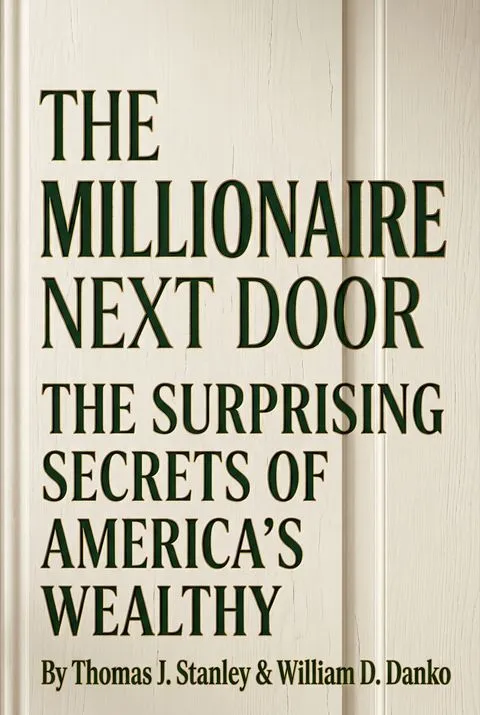


Key Takeaways
Wealth is what you keep, not the income you flaunt
The great confusion of American life. Stanley and Danko spent two decades surveying millionaires and found most people conflate high income with wealth. If you earn $250,000 and spend $250,000, you are not wealthy, you are merely living high. Wealth is accumulated net worth: assets minus liabilities.
The numbers are stark. The typical American household has a net worth under $15,000 excluding home equity, and could survive perhaps a month or two without a paycheck. Meanwhile the millionaire next door quietly banks 15 to 20 percent of income every year. Roughly 80 to 85 percent of millionaires are self-made, built in a single generation without lottery windfalls or inheritances. The odds of getting rich through a windfall are lower than one in four thousand. Discipline, not luck, does it.
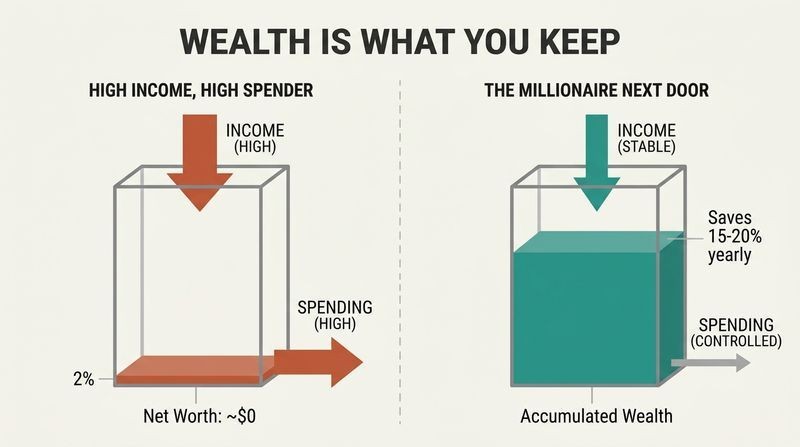
What's striking is how this reframe predates the modern FIRE (Financial Independence) movement by decades, yet says the same thing: your savings rate, not your salary, determines your trajectory. Behavioral economists would add lifestyle inflation, the tendency to let spending rise with every raise, as the silent thief here. The book's contrarian punch is that visible affluence often signals its opposite. One caveat worth noting: the 1990s data reflect a particular era of pensions and home appreciation. The core principle survives, but the specific dollar thresholds and the ease of one-generation wealth-building deserve updating for today's costs of housing and education.
Multiply your age by income, divide by ten: that's your target
A yardstick for wealth. The authors offer a blunt formula: your expected net worth equals your age times your pretax annual income, divided by ten. A 50-year-old earning $100,000 should be worth about $500,000. Double that figure and you are a Prodigious Accumulator of Wealth (PAW). Half or less and you are an Under Accumulator of Wealth (UAW).
Occupation and income mislead. Consider two men earning nearly identical incomes near $92,000. Bubba, a mobile-home dealer, had accumulated $1.1 million. James, an attorney with seven years of college, had $226,000. The lawyer's upper-middle-class role, the imported car, the country club, the tailored suits, demanded consumption that devoured his advantage. PAWs typically hold at least four times the wealth of UAWs in the same income and age bracket.
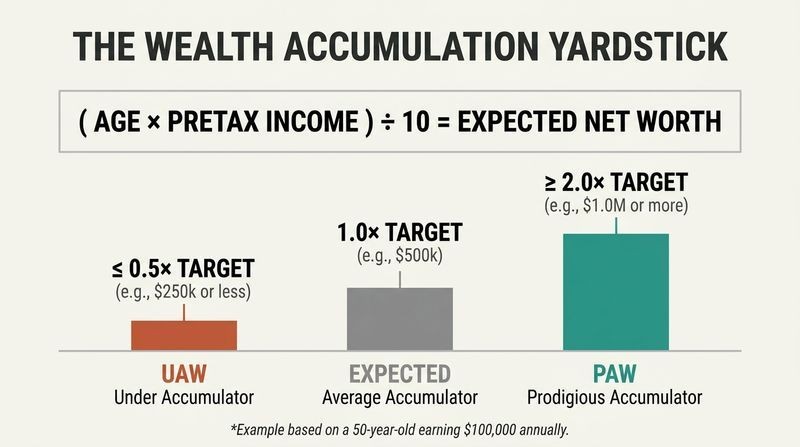
The equation is a rough heuristic, not gospel, and the authors know it. It penalizes the young unfairly (a 28-year-old high earner who just cleared student debt looks like a failure) and flatters the old. But as a diagnostic mirror it is brilliant, converting a vague anxiety (am I doing okay?) into a testable number. It anticipates what psychologists call reference-group theory: James the attorney is broke precisely because his peers set his spending baseline. The deeper lesson is that professional prestige and wealth are often inversely correlated, because status occupations carry status-maintenance costs that quietly bleed the balance sheet.
Big hat, no cattle: looking rich is the enemy of being rich
A Texan's phrase for the whole problem. A diesel-engine rebuilder worth millions wore jeans and drove a ten-year-old car; his British partners mistook him for a truck driver. He owned no big hats but plenty of cattle. His opposite is the trust officer who spends more on a single suit than most millionaires ever have.
Frugality is the cornerstone. Half the millionaires surveyed never paid more than $399 for a suit, $235 for a watch, or $140 for shoes. Many carry Sears and JCPenney cards, not Neiman Marcus. When the authors served vintage Bordeaux and pate to a room of decamillionaires, one asked for scotch and Budweiser and the group ate only the crackers. The wealthy get more pleasure from owning appreciating assets than from displaying consumption.
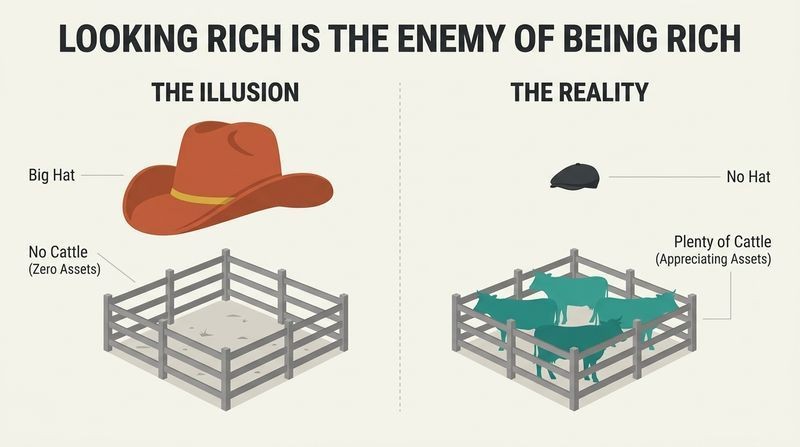
This is the book's most quoted and most durable idea, and it maps neatly onto Thorstein Veblen's century-old concept of conspicuous consumption, spending designed to signal status. Stanley's insight is that the truly wealthy have opted out of the signaling game entirely, which is itself a luxury: they no longer need external validation. Modern research on the hedonic treadmill supports them, material purchases deliver fleeting satisfaction. The nuance worth raising: frugality can curdle into miserliness, and the book occasionally reads as if any pleasure spending is a moral failing. Some consumption buys genuine time, health, and joy that appreciate in their own way.
You cannot out-earn bad financial defense; budget or stay broke
Offense generates income, defense builds wealth. The authors describe two skills. Great offense means earning far above average. Great defense means controlling spending through budgeting and planning. High earners who play only offense end up like Sharon, a health specialist earning $220,000 with a net worth of just $370,000, far below what her income should produce.
Budgeting is not beneath the wealthy. For every 100 millionaires who do not budget, roughly 120 do. Mrs. Rule, an auctioneer earning around $90,000, sits at her kitchen table planning expenditures and is worth over $2 million. The nonbudgeters simply invert the order: they pay themselves first, investing 15 percent or more off the top before spending a dime. The authors compare wealth to fitness: everyone knows what to do, few have the discipline to do it.
The pay-yourself-first mechanism the book describes is what behavioral economists now call automatic enrollment and precommitment, and it is arguably the single most powerful finding in personal finance. Richard Thaler's Save More Tomorrow program built an entire retirement-policy revolution on it. By making saving the default and consumption the residual, you sidestep willpower entirely. The kitchen-table budgeting may feel dated in an era of apps, but the principle holds: what gets measured gets managed. The fitness analogy is apt and slightly uncomfortable, because it locates the problem not in knowledge but in follow-through, which no book can supply on the reader's behalf.
The rich pay little tax because they rarely sell what appreciates
Minimize realized income, maximize unrealized wealth. Income tax is most households' single largest expense, and it falls only on income you realize, not on wealth that quietly appreciates without generating cash. The typical millionaire realizes less than 7 percent of net worth as taxable income each year. The average household realizes close to 90 percent of its net worth annually and pays over 10 percent of its wealth in tax.
A study in contrasts. An IRS analysis found business owners realized barely 1 percent of their assets' value as income. Ross Perot, worth billions, paid an effective rate lower than the average worker by holding municipals, sheltered real estate, and unappreciated stock he never sold. The lesson: buy assets that grow untaxed, and resist the urge to convert them to spendable cash.
This is the mechanism behind the modern buy-borrow-die strategy that critics of wealth inequality now scrutinize intensely. The book presents it as prudent personal finance, which it is, but it also inadvertently documents how the tax code privileges capital over labor, unrealized gains escape taxation until sale, and often forever via the stepped-up basis at death. There is genuine tension here the authors do not fully engage: what is individually rational aggregates into a system where wage earners shoulder disproportionate burdens. For the individual reader the actionable core is sound: tax-deferred and tax-advantaged accounts, low portfolio turnover, and patience compound faster than trading.
Cash gifts to grown children shrink the wealth they build
Economic Outpatient Care backfires. The authors coin this term for the substantial gifts affluent parents give adult children: down payments, tuition, mortgage help, annual checks. The pattern is counterintuitive but consistent: the more dollars children receive, the fewer they accumulate. In eight of ten occupations studied, gift receivers held less net worth than non-receivers. Accountants who received gifts had just 57 percent of the wealth of those who did not.
Consider Mary and Lamar. They live in a fine home, belong to a country club, and drive luxury cars on a $60,000 income, propped up by her mother's yearly $15,000 and periodic stock gifts they sell to buy new cars. They have never budgeted, never invested, and anxiously await an inheritance. Subsidy became a treadmill of dependency, not a launchpad.
This may be the book's most socially provocative claim, and it aligns with self-determination theory in psychology: autonomy and competence are core drivers of motivation, and unearned support can undermine both. The exceptions are illuminating, teachers and professors who received gifts actually accumulated more, suggesting that gifts harm only when paired with a consumption culture, not thrift. The book's framing risks overreach: correlation is not causation, and parents may subsidize the children who were already struggling. Still, the practical wisdom (fund education and business capital, not lifestyle) echoes the fishing proverb and modern debates over whether inheritance builds or erodes character.
Boring businesses in dull industries mint quiet millionaires
The self-employed dominate. Business owners and self-employed professionals make up under 20 percent of workers but roughly two-thirds of millionaires; the self-employed are four times likelier to be millionaires than employees. Yet the type of business barely predicts wealth. Character does.
Dull-normal is the sweet spot. The millionaires the authors met were welding contractors, pest controllers, mobile-home park owners, rice farmers, auctioneers, and paving contractors, unglamorous fields that attract little competition and rarely collapse overnight. One entrepreneur reframed risk entirely: an employee with a single paycheck is the truly exposed one; a business owner with hundreds of customers has hundreds of income streams. Owners reduce perceived risk with beliefs like I control my destiny and I get wiser facing adversity daily. Courage, the authors stress, is acting despite fear, not the absence of it.
The dull-normal thesis presages Warren Buffett's preference for predictable, unglamorous cash-generating businesses over exciting ones, and Peter Thiel's inverse point that monopoly-like niches (little competition) protect margins. The redefinition of risk is genuinely useful: diversification of income sources, not just assets, is underappreciated. But survivorship bias lurks heavily here. The book profiles winners; it acknowledges that the average sole proprietorship nets only about $6,200 and a quarter make no profit at all. Most who go it alone do not get rich. The honest takeaway is not quit your job but that ownership plus frugality plus a defensible niche is a proven, if difficult, path.
Buy cars by the pound and spend your hours planning, not shopping
Millionaires buy value, not badges. Most drive American-made vehicles and joke that they buy cars by the pound, favoring full-sized sedans that cost five or six dollars per pound over foreign luxury models running fifteen to twenty. The typical millionaire paid about $24,800 for his most recent car, barely above the average new-car buyer, and over a third bought used. Two of three foreign-luxury buyers are not millionaires at all.
Time allocation reveals everything. Dr. South spent sixty hours haggling for a discounted $65,000 Porsche while putting only $5,700 into his pension. Dr. North bought a three-year-old Mercedes in a few hours and devoted his spare time to studying investments he understood. PAWs invest in categories they know deeply and rarely trade; over 40 percent made no stock trades in the prior year.
The buy-by-the-pound heuristic is a charming proxy for rejecting brand premiums, and it connects to research on depreciation: a new car loses much of its value in the first three years, so used buyers let the original owner absorb that loss. The North versus South contrast doubles as a lesson in opportunity cost, the sixty hours saved chasing a car discount could compound for decades if redirected to portfolio study. The invest-in-what-you-know principle echoes Peter Lynch, though it carries a hazard Lynch also flagged: familiarity can breed overconcentration. The wiser modern synthesis pairs the book's low-turnover discipline with broad, low-cost index diversification.
Raise children who can fish, and never advertise your wealth to them
Strengthen the strong, do not weaken the weak. The authors warn that many affluent parents unwittingly cripple their least capable children with the largest subsidies, breeding lifelong dependence. Dr. North's rules for wealthy parents include: never tell children the family is rich, teach discipline and frugality by living it, and delay any inheritance until children are mature adults with their own established lifestyles.
Independence is the real gift. Contrast two sisters: Sarah defied her father, received nothing, and became a self-made millionaire executive; her favored sister Alice was subsidized into helplessness and died having spent it all. The most productive heirs often receive nothing, which is partly why they are productive. Emphasize what children achieve, not what they own, and tell them plainly that health, integrity, and reputation outrank money.
This connects to a growing body of work on affluenza and the paradox of privilege, where researchers like Suniya Luthar document elevated distress among children of the wealthy. The mechanism the book identifies (unearned money erodes the struggle that builds competence) resonates with Nassim Taleb's antifragility, systems and people that are shielded from all stressors grow weaker, not stronger. The advice to hide wealth is debatable, though; financial-literacy advocates argue transparency and modeling of good money habits beat secrecy. The reconciliation is probably that what matters is not hiding numbers but never letting children mistake the parents' balance sheet for their own entitlement.
Sell portable intellect, because they can seize a business but not a mind
Why the wealthy steer children toward professions. Fewer than one in five millionaire business owners hands the company to their kids. Having beaten long odds themselves, they know how fragile businesses are, exposed to competition, consumer whims, regulation, and fixed assets that cannot flee a bad market. A refugee entrepreneur put it memorably: they can take your business, but they cannot take your intellect.
Portability and reliability of professions. Physicians, dentists, attorneys, and accountants carry their earning power anywhere, and their firms are far likelier to be profitable than the average small business. Around 87 percent of physicians' offices and 95 percent of dentists' offices turn a profit, versus roughly a third of coal-mining operations. The catch: professionals start earning late and adopt high-consumption lifestyles early, which is why high income so seldom converts into accumulated wealth.
The intellect-as-portable-capital argument is prescient in a knowledge economy where human capital increasingly dominates physical capital, and it echoes Gary Becker's Nobel-winning work on human capital as the most robust asset a person can hold. Yet the book contains its own rebuttal: the same professionals it praises for career security are its cautionary UAWs, drowning in status spending. This is the central irony of the whole work, the credential that guarantees a high income also imposes the social pressures that prevent wealth. The resolution the authors keep circling back to is that no occupation saves you; only the gap between what you earn and what you spend does.
Analysis
The Millionaire Next Door endures because it inverts a cultural intuition with data rather than sermon. Stanley and Danko, marketing academics who spent decades profiling the affluent for financial institutions, discovered that the visible signals of wealth (luxury cars, tailored suits, prestigious addresses) correlate negatively with actual net worth. Their achievement is diagnostic: they operationalized a fuzzy anxiety into a formula and a taxonomy (PAW versus UAW) that lets any reader locate themselves. The book is best understood as a work of applied behavioral economics avant la lettre, anticipating lifestyle inflation, the hedonic treadmill, precommitment saving, and reference-group spending years before those frameworks entered popular finance.
Its weaknesses are equally instructive. The methodology skews toward survivors and toward a specific historical window: the 1990s, with its defined-benefit pensions, cheaper housing relative to income, and pre-internet business landscape. The one-generation wealth path it celebrates is harder now, with education, healthcare, and housing consuming larger income shares. The wealth equation flatters the old and punishes the young. And the near-moralization of frugality can blur the line between prudent accumulation and joyless hoarding; the book rarely asks what the money is finally for.
Still, its spine is close to timeless. Wealth is a stock, not a flow. Consumption signaling is a wealth-destroying game the secure decline to play. Defense (spending control) beats offense (income) because it is fully within one's control. Unearned money can corrode the competence it means to enable. And self-employment plus thrift plus a defensible niche remains a genuine, if punishing, ladder. Read today, the book functions less as a how-to than as a mirror and a values clarification exercise: it forces the reader to distinguish the appearance of a good life from its financial substance, and to decide, deliberately, which one they are actually buying.
Review Summary
The Millionaire Next Door explores the habits of America's wealthy, revealing that most millionaires live frugally, save diligently, and accumulate wealth slowly over time. The book emphasizes living below one's means, budgeting, and prioritizing financial independence over displays of status. While praised for its insights into wealth-building, some readers found it repetitive and outdated. Critics noted a lack of diversity in examples and questioned the relevance of some data. Overall, the book challenged common perceptions of millionaires and offered practical advice for accumulating wealth.
People Also Read







Glossary
PAW (Prodigious Accumulator of Wealth)
Builds far above income expectationsA person whose net worth is at least double what the authors' wealth equation predicts for their age and income. PAWs are elite savers and investors who typically hold four or more times the wealth of peers with identical incomes, achieved through frugality, budgeting, and disciplined investing rather than higher earnings.
UAW (Under Accumulator of Wealth)
Earns well, saves poorlyA person whose net worth is half or less of what the wealth equation predicts for their age and income. UAWs often have high incomes but little to show for them, spending on status goods, living above their means, and confusing a large paycheck with actual wealth.
Wealth Equation
Age times income divided tenThe authors' rule of thumb for expected net worth: multiply your age by your total annual pretax income (excluding inheritances), then divide by ten. The result is what someone in your age and income bracket should have accumulated. Double it to qualify as a PAW; half or less marks a UAW.
Economic Outpatient Care (EOC)
Ongoing gifts to adult childrenSubstantial financial gifts and subsidies that affluent parents give grown children and grandchildren, such as down payments, mortgage payments, tuition, and annual cash. The authors found that, in most occupations, recipients accumulate less wealth than non-recipients, because subsidies fund consumption and breed dependence rather than launching independence.
Big Hat No Cattle
Looks rich, isn'tA Texan expression the authors adopt for people who display the trappings of wealth (expensive clothes, cars, homes) while possessing little actual net worth. Its inverse describes the true millionaire next door: modest outward appearance concealing substantial accumulated assets.
Go-to-hell fund
Years of savings without workingAccumulated wealth sufficient to let a household live comfortably for ten or more years without earning any income. The typical millionaire in the study, with a $1.6 million net worth, could sustain their lifestyle for over twelve years, giving them financial and psychological freedom.
Dull-normal businesses
Unglamorous, profitable niche industriesThe authors' label for the mundane, low-prestige industries (welding, pest control, paving, auctioneering, mobile-home parks) that disproportionately produce millionaires. Such businesses attract little competition and enjoy steady demand, allowing frugal owners to accumulate wealth despite unexciting reputations.
FAQ
What's The Millionaire Next Door about?
- Focus on Wealth Accumulation: The book examines the habits and characteristics of America's wealthy, emphasizing that wealth is more about saving and investing than high income.
- Self-Made Millionaires: It reveals that 80-85% of millionaires are self-made, challenging the stereotype that wealth is primarily inherited.
- Frugality and Lifestyle Choices: The authors highlight the importance of living below one's means and prioritizing financial independence over social status.
Why should I read The Millionaire Next Door?
- Practical Financial Insights: The book offers actionable advice on building wealth through disciplined saving and investing.
- Debunking Myths: It challenges common myths about wealth, such as the belief that all wealthy people live extravagantly.
- Real-Life Case Studies: Numerous case studies illustrate the behaviors and mindsets of millionaires, making the concepts relatable.
What are the key takeaways of The Millionaire Next Door?
- Live Below Your Means: Millionaires prioritize frugality, allowing them to save and invest effectively.
- Efficient Resource Allocation: They allocate time and money towards activities that build wealth, such as investment planning.
- Financial Independence Over Status: The book emphasizes that financial independence is more important than displaying high social status.
What are the best quotes from The Millionaire Next Door and what do they mean?
- "Wealth is what you accumulate, not what you spend.": True wealth is measured by net worth and savings, not income or material possessions.
- "The typical millionaire lives in a modest home.": This challenges the stereotype that millionaires live in luxury, highlighting their focus on financial security.
- "Most millionaires are first-generation rich.": It emphasizes that wealth is often built through hard work and discipline, not inheritance.
What is the Economic Outpatient Care concept in The Millionaire Next Door?
- Definition of Economic Outpatient Care: It refers to financial support affluent parents provide to adult children, which can hinder their financial independence.
- Impact on Wealth Accumulation: Such support can prevent children from developing the skills needed to build their own wealth.
- Encouraging Self-Sufficiency: The authors advocate for teaching financial independence to foster long-term success.
How do millionaires allocate their time, energy, and money according to The Millionaire Next Door?
- Time Allocation for Planning: Millionaires spend more time planning their financial futures, averaging about 100 hours a year on investment planning.
- Efficient Resource Management: They focus on activities that enhance wealth, such as prioritizing investments over luxury purchases.
- Goal-Oriented Behavior: Millionaires have clearly defined financial goals and actively work towards them.
What are the characteristics of the Prodigious Accumulator of Wealth (PAW) versus the Under Accumulator of Wealth (UAW)?
- PAW Characteristics: PAWs accumulate wealth significantly above the expected level for their income and age, living frugally and investing wisely.
- UAW Characteristics: UAWs earn high incomes but fail to accumulate wealth, often living beyond their means.
- Behavioral Differences: PAWs efficiently allocate resources towards wealth-building, while UAWs focus on high-consumption lifestyles.
How does The Millionaire Next Door define wealth?
- Wealth Definition: Wealth is defined as net worth, the total value of assets minus liabilities.
- Threshold for Wealth: The book sets the threshold for being considered wealthy at a net worth of $1 million or more.
- Focus on Accumulation: Emphasis is on accumulating appreciable assets like investments and real estate.
What is the significance of frugality in The Millionaire Next Door?
- Frugality as a Wealth-Building Tool: Frugality is a cornerstone of wealth accumulation, allowing for substantial net worth building.
- Cultural Attitudes Towards Spending: The book argues that societal norms often glorify high consumption, but true wealth is built through disciplined spending.
- Long-Term Financial Security: A frugal lifestyle ensures long-term financial security and independence.
How do millionaires view their occupations and income according to The Millionaire Next Door?
- Occupation and Wealth Correlation: Many millionaires are self-employed or business owners, correlating with higher wealth accumulation.
- Income as a Means, Not an End: They view income as a tool for financial independence, focusing on saving and investing.
- Job Satisfaction and Financial Goals: Many find satisfaction in work that aligns with their financial goals, leading to better outcomes.
What role does education play in becoming a millionaire according to The Millionaire Next Door?
- Higher Education Correlates with Wealth: Many millionaires have advanced degrees, often leading to higher earning potential.
- Financial Literacy: Education contributes to better financial literacy, enabling informed investment and savings decisions.
- Encouragement of Professional Careers: The authors advocate for professional careers, which often lead to financial stability and wealth.
What are the common characteristics of millionaires as outlined in The Millionaire Next Door?
- Discipline and Hard Work: Millionaires exhibit a strong work ethic and disciplined financial habits.
- Modest Lifestyles: They live below their means, avoiding high-consumption lifestyles.
- Long-Term Planning: Focus on long-term financial goals and strategic decision-making for sustained wealth.
About the Author

Download PDF
Download EPUB
.epub digital book format is ideal for reading ebooks on phones, tablets, and e-readers.








































