
Plot Summary
Storms and Secrets Collide
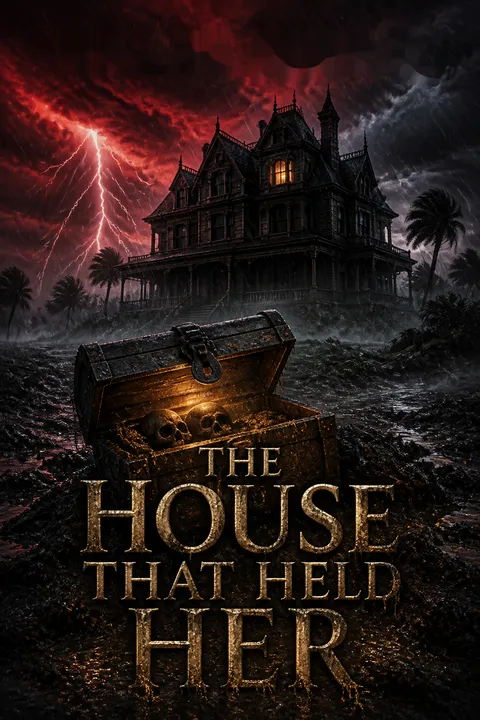
Margot, newly arrived in Florida, faces a literal and emotional storm as her husband Nate leaves her alone to face Hurricane Barbara. Their marriage, already strained by Margot's guilt over a child's death in her care, is further battered by the move and the unfinished, haunted feeling of Hawthorn Manor. As the storm rages, Margot's sense of isolation and regret intensifies, setting the stage for the secrets the house will soon reveal.
The Map Beneath the Floor
In the aftermath of the hurricane, Margot discovers a loose floorboard and, beneath it, a film canister containing a hand-drawn map of Mount Dora with a mysterious "X" by the lake. The find ignites a sense of purpose she's been missing, distracting her from her crumbling marriage and unresolved guilt. The map's promise of a secret or treasure becomes a lifeline, drawing her deeper into the house's history and her own need for redemption.
Shadows of Hawthorn Manor
Margot explores the storm-damaged estate, meeting Walter, the steadfast caretaker, and Phyllis, a brash neighbor with ties to the Hawthorns. The manor's grandeur is marred by decay and secrets, and Margot's questions about the Hawthorn family are met with evasions and warnings. The house's atmosphere grows heavier, mirroring Margot's internal fractures and hinting at the darkness lurking beneath its surface.
Townsfolk and Hidden Histories
Margot visits the Mount Dora Historical Museum, meeting Paula, the unofficial town historian, and Dr. Whitfield, who both share fragments of the Hawthorn family's tragic story. The town's collective memory is selective, glossing over the abrupt disappearance of George Hawthorn after his wife Cecilia's death. Margot senses a conspiracy of silence, as if the town itself is complicit in keeping the manor's secrets buried.
The Lake's Ominous Pull
Driven by the map, Margot enlists Donny, a boatman, to reach the "X" by the lake. Her search is interrupted by a near-fatal encounter with an alligator, underscoring the peril of her quest. The failed dig leaves her shaken and humiliated, but the brush with death only deepens her obsession. The lake, both beautiful and menacing, becomes a symbol of the secrets that threaten to consume her.
Guilt, Grief, and Ghosts
Alone in the house, Margot is tormented by memories of Lila, the child she failed to protect, and by the growing distance from Nate. The house amplifies her sense of failure and loss, and she begins to experience unsettling sensations—sounds, shadows, and the feeling of being watched. The boundaries between guilt, grief, and possible supernatural presence blur, leaving Margot unsure of her own sanity.
The Hunt for Answers
Despite warnings from Walter and her own near-death, Margot returns to the lake, this time successfully unearthing a heavy, locked chest. The thrill of discovery is tempered by injury and secrecy, as she hides the chest in her bedroom and searches for the key. The house's puzzles become a metaphor for her own need to confront the past and reclaim agency, even as the danger escalates.
Puzzles in the Walls
Margot's search leads her to a hidden passage behind a bookshelf, where she finds a key and clues to the Hawthorn family's history. The house's architecture mirrors George Hawthorn's obsession with puzzles and secrets, and Margot's discovery of the key is both a triumph and a prelude to horror. The sense of being watched intensifies, and the house's true nature begins to emerge.
The Chest of Skulls
Opening the chest, Margot is confronted with sixteen human skulls, some old, some disturbingly fresh. The shock and revulsion are overwhelming, and she is forced to confront the possibility that the house is not just haunted by memories, but by real, violent crimes. Her desperate attempt to alert the police is met with disbelief, and the evidence vanishes, leaving her isolated and doubting her own mind.
Disbelief and Isolation
The police, led by Chief Miller, find the chest empty and subtly question Margot's mental health. Even Walter, her one ally, cannot fully believe her. Margot's sense of reality unravels as she is left alone with her terror and the knowledge that someone is manipulating events to make her doubt herself. The house's power to erase and rewrite the past becomes a weapon against her.
Hauntings and Hallucinations
Margot experiences increasingly vivid and terrifying visions—blood, bodies, and a presence in the house. She questions whether she is suffering from mold-induced hallucinations or if the house is truly haunted. The psychological toll mounts, and her isolation deepens as she is unable to trust her senses or those around her.
The Town's Web of Silence
Margot's investigation into the Hawthorn family and the town's missing persons cases is met with resistance and fear. Paula, the historian, abruptly shuts down when Margot asks about disappearances, and the town's collective denial becomes another barrier. The sense of a larger, more sinister conspiracy grows, implicating not just individuals but the entire community in the house's legacy of violence.
Sixteen Years, Sixteen Skulls
Margot connects the sixteen skulls to sixteen years since Cecilia's death, and to a series of disappearances in the town. The realization that the violence is cyclical, tied to the house and its history, brings a new urgency to her quest. The house is not just a passive witness but an active participant in the perpetuation of trauma.
The Child Who Disappeared
Margot investigates the case of Michael Lark, a boy who vanished years ago, only to find his mother, Penny, in a state of denial so profound she claims never to have had a son. The encounter is harrowing, culminating in Penny's self-harm and a warning that "they" are always watching. The cost of silence and complicity is made painfully clear.
Breaking and Entering
Margot's relentless pursuit of the truth leads her to break into Penny's house, where she is confronted by the full weight of trauma and the threat of violence. The boundaries between victim and perpetrator, sanity and madness, blur as Margot is forced to confront the consequences of her actions and the depth of the town's secrets.
The Cost of Curiosity
Penny Lark is found dead, and Margot becomes the prime suspect due to her recent visit and the town's eagerness to find a scapegoat. The police interrogation is hostile, and Margot is forced to rely on her best friend Shannon, a lawyer, to defend her. The town's need to preserve its image outweighs the pursuit of truth, and Margot's isolation becomes nearly complete.
The Truth About the Bugs
With Shannon's help, Margot tracks down Marty Hughes, a childhood friend of the Hawthorns, who reveals the dark history of the "Bugs"—a group of children bound by secrets, abuse, and tragedy. The deaths of Amelia and Dorothy Hawthorn, and the subsequent pact of silence, are revealed as the origin of the house's curse. The legacy of violence is generational, and the house is both a witness and a participant.
The Old House's Confession
Marty's account implicates not just George Hawthorn but also Chief Miller in the cover-up of multiple deaths. The house's history is one of complicity, silence, and the transformation of victims into perpetrators. The boundaries between protector and monster, friend and accomplice, are blurred, and Margot is forced to confront the possibility that the evil in the house is not supernatural but all too human.
The Police and the Pact
Margot and Shannon confront Chief Miller, who is forced to admit his role in covering up George's crimes. The police, far from being protectors, are revealed as enablers of the house's legacy of violence. The confrontation is tense and dangerous, and Margot realizes that justice will not come from the authorities but from her own actions.
The Final Puzzle Unlocked
Margot and Shannon decode a final puzzle left by George—a book cipher referencing Poe's "The Gold-Bug"—which leads them to a hidden room and the chest of skulls. The house's architecture is revealed as a map of trauma, with secret passages and peepholes used to surveil and control. The final confrontation with the house's secrets is both physical and psychological.
The Monster in the Walls
Margot discovers that Walter, the caretaker, is in fact George Hawthorn, who faked his disappearance and has been living in the walls, orchestrating the cycle of violence. The revelation is devastating, as every act of kindness and protection is recast as manipulation and predation. The house's power is revealed to be not supernatural, but the result of human evil and the failure of those who should have intervened.
The Last Descent
Margot, with Nate's unexpected return, is forced into a final, desperate confrontation with George in the house's secret passages and flooded tunnels. The chase is both literal and symbolic, as Margot must navigate the labyrinth of trauma and violence that the house represents. The struggle is brutal, and the cost of survival is high.
The End of the Curse
In a climactic struggle on the staircase, Margot and Nate together manage to kill George, ending the Hawthorn line's legacy of violence. The manner of his death—falling and breaking his neck—mirrors the deaths that began the cycle, bringing a grim symmetry and closure. The house, once a prison, is finally freed from its curse.
A New Legacy Begins
One year later, Margot and Nate have transformed Hawthorn Manor into "Cece's House," a refuge for children in need. The house's history of violence is replaced by a new legacy of care and protection. The ghosts of the past are acknowledged but no longer rule the present. Margot, Nate, and Shannon find purpose and healing in their work, and the house that once held them captive now holds hope.
Analysis
Ellis Hart's The House That Held Her is a masterful exploration of the ways trauma, guilt, and silence can haunt not just individuals, but entire communities. By reimagining the haunted house as a psychological mirror, Hart transforms familiar gothic tropes into a nuanced meditation on the legacy of violence and the cost of complicity. The novel's central question—what is the cost of keeping the dead quiet?—is answered through a narrative that refuses easy resolutions or clear villains. Instead, the house becomes a crucible in which the characters' deepest fears and failures are exposed, forcing them to confront the past in order to break the cycle of harm. The use of puzzles and ciphers is not just a plot device, but a metaphor for the work of healing—painstaking, nonlinear, and often requiring the help of others. The novel's ultimate message is one of hope: that even the most haunted places can be reclaimed, that silence can be broken, and that new legacies can be built from the ruins of the old. In a world where the temptation to look away from suffering is strong, The House That Held Her is a powerful reminder that facing the darkness is the first step toward the light.
Review Summary
People Also Read


Characters
Margot Bennett
Margot is the emotional core of the novel—a former child protective services worker whose guilt over the death of a child in her care drives her to seek purpose and absolution. Her move to Florida and the purchase of Hawthorn Manor are attempts to escape her past, but the house's secrets force her to confront her deepest fears and failures. Margot's relationships—with Nate, with the children she could not save, and with the house itself—are marked by longing, regret, and a fierce determination to uncover the truth. Her psychological journey is one of moving from self-doubt and isolation to agency and healing, as she transforms from a passive victim of circumstance to an active force for justice and change.
Nate Bennett
Nate is Margot's husband, whose own secrets and failures mirror and amplify Margot's struggles. Laid off and hiding his gambling addiction, Nate's decision to move to Florida and his lies about their financial situation set the stage for the unraveling of their marriage. His absence during the hurricane and his later entanglement in the house's mysteries reveal a man desperate to reclaim control and dignity. Nate's journey is one of reckoning—with his own weaknesses, with the consequences of his actions, and ultimately with the need to protect and support Margot. His redemption comes not from heroics, but from honesty and the willingness to face the truth.
George Hawthorn / Walter
George is the original owner of Hawthorn Manor, a man whose childhood trauma and loss curdle into violence and obsession. His transformation from victim to perpetrator is the novel's central tragedy, as he becomes both the architect and prisoner of the house's cycle of violence. Living in the walls as Walter, he manipulates, surveils, and ultimately murders to appease the ghost of his wife and his own need for control. George's psychological complexity lies in his capacity for both love and horror, his longing for connection twisted by the legacy of abuse. He is both a cautionary tale and a symbol of the dangers of unacknowledged trauma.
Chief Andrew Miller
Chief Miller is both a childhood friend of George and the town's chief of police. His role is one of complicity—covering up George's crimes out of loyalty, fear, and a desire to protect the town's image. Miller's psychological struggle is between duty and friendship, and his failure to act enables the perpetuation of violence. He represents the dangers of silence and the moral cost of prioritizing stability over justice. His eventual attempt to do the right thing comes too late, and he is both a victim and an enabler of the house's curse.
Shannon Morgan
Shannon is Margot's best friend and legal defender, whose pragmatism and loyalty provide a counterpoint to Margot's emotional turmoil. As a lawyer, she brings clarity and action to the chaos, and her willingness to risk her own safety for Margot's sake is a testament to the power of friendship. Shannon's presence is a lifeline for Margot, and her own journey is one of moving from skepticism to belief, from outsider to co-conspirator in the quest for truth.
Cecilia Hawthorn
Cecilia, though dead before the novel begins, is a constant presence—both as a ghost and as the object of George's obsession. Her inability to have children, her tragic death, and her role as the house's original intended caretaker are central to the house's mythology. Cecilia represents both the unattainable ideal and the cost of unfulfilled dreams, her memory weaponized by George to justify his violence. She is both victim and catalyst, her absence shaping the lives of all who come after.
Marty Hughes
Marty is one of the original "Bugs," childhood friend to George, Cecilia, and Miller. His knowledge of the past and his decision to leave Mount Dora mark him as both a survivor and a coward. Marty's role is to provide the missing pieces of the house's history, and his guilt over his own silence is a mirror to the town's collective complicity. He is a reminder that survival often comes at the cost of truth.
Paula Hastings
Paula is the unofficial keeper of Mount Dora's history, whose knowledge is both a resource and a barrier. Her reluctance to share the full truth reflects the town's investment in forgetting, and her evasions are both protective and complicit. Paula represents the power of narrative—what is remembered, what is erased, and who gets to decide.
Phyllis Brendamore
Phyllis is a brash, eccentric figure whose claims of intimacy with the Hawthorns are both a source of information and confusion. Her own traumas and desires are projected onto the house, and her son Patrick's later involvement complicates the narrative. Phyllis embodies the town's tendency to mythologize and distort the past, and her presence is both comic and tragic.
Patrick Brendamore
Patrick, believing himself to be George's illegitimate son, becomes a rival to Nate and a victim of the house's violence. His longing for belonging and recognition mirrors the novel's themes of inheritance and exclusion. Patrick's fate is a cautionary tale about the dangers of seeking identity in the wrong places, and his death is both senseless and inevitable in the context of the house's curse.
Plot Devices
The Haunted House as Psychological Mirror
Hawthorn Manor is not just a setting but a character—a repository of secrets, violence, and longing. Its architecture, with hidden rooms, peepholes, and secret passages, mirrors the psychological labyrinths of its inhabitants. The house's ability to erase evidence, to gaslight and isolate, is a metaphor for the ways trauma is hidden and perpetuated. The haunted house trope is used not for supernatural scares, but to explore the real horrors of abuse, complicity, and the failure to confront the past.
The Unreliable Narrator and Gaslighting
Margot's experiences of hallucinations, missing evidence, and disbelief from others create a sense of unreality that mirrors the effects of trauma and gaslighting. The novel uses this device to keep both Margot and the reader off-balance, blurring the line between psychological and supernatural horror. The erasure of the skulls, the shifting of blame, and the town's collective denial are all forms of narrative control that reinforce the central themes.
The Puzzle and the Cipher
The use of maps, ciphers, and hidden rooms is both a literal and symbolic device. The puzzles left by George are a way of controlling the narrative, of keeping the truth just out of reach. The final cipher, referencing Poe's "The Gold-Bug," is a meta-commentary on the act of reading and interpretation, forcing Margot (and the reader) to piece together the truth from fragments. The puzzle structure also mirrors the process of trauma recovery—uncovering, confronting, and integrating the past.
Cyclical Violence and Ritual
The novel's structure is built around cycles—of violence, of haunting, of silence and complicity. The annual recurrence of Cecilia's "hauntings" and the ritual of offering skulls are both literal and metaphorical representations of the ways trauma is perpetuated across generations. The breaking of the cycle requires both confrontation and sacrifice, and the novel's resolution is as much about breaking patterns as solving mysteries.
Multiperspectivity and Shifting Timelines
The use of flashbacks, confessions, and shifting points of view allows the novel to layer its mysteries and reveal the interconnectedness of its characters. The past is never truly past, and the present is haunted by the unresolved stories of those who came before. This structure reinforces the theme that healing requires not just individual action, but collective reckoning.
Download PDF
Download EPUB
.epub digital book format is ideal for reading ebooks on phones, tablets, and e-readers.








































