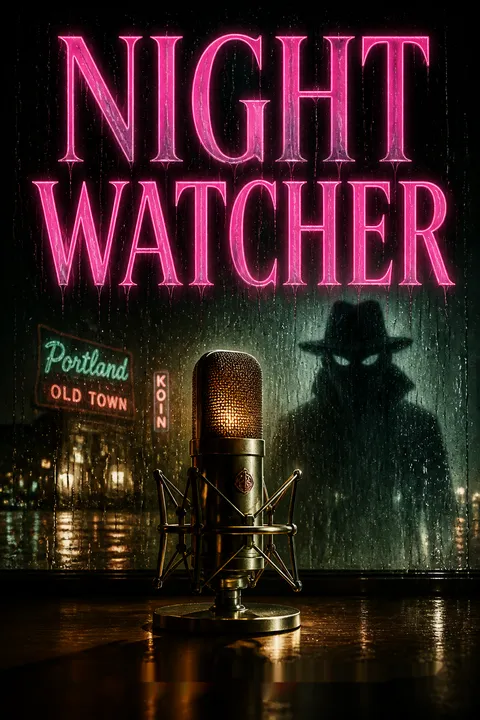

Plot Summary
The Hiding Man Emerges
In the dead of night, a masked man known only as the Hiding Man commits his first murder, relishing the terror he inflicts. He pens a taunting poem and sends it to the police, signaling the start of a killing spree that will haunt Portland for years. His mask, stitched and inhuman, becomes his true face, and his victims' fear is his sustenance. The city is left reeling, the police baffled, and the Hiding Man's legend is born. This is not just a killer, but a monster who thrives on being unseen, always lurking, always watching, and always one step ahead.
Night Watch: Twenty Years Later
Two decades after the Hiding Man's first murder, Nola Strate hosts Night Watch, a late-night radio show about the paranormal, a legacy from her father, Chick. She's haunted by her own past—her babysitter was one of the Hiding Man's victims. Nola's life is a blend of skepticism and fear, her nights filled with chilling stories and the ever-present sense that evil is never far away. Her relationships are tinged with the trauma of survival, and her city, though changed, still holds shadows that refuse to fade.
Echoes of Trauma
Nola's childhood trauma lingers: she witnessed her babysitter's murder and saw the Hiding Man's mask up close. Her father, Chick, and Detective Jack De Lacey, both tried to protect her, but the scars remain. Nola's adult life is shaped by vigilance and anxiety, her sense of safety always fragile. The past is never truly past, and the city's collective memory of the Hiding Man's reign of terror is a wound that never closes, especially for those who survived.
Signs and Shadows
Nola begins to notice unsettling signs: a boot print in her home, a figure watching from the street, and a sense of being followed. Her paranoia grows as she confides in her friend Harvey, who tries to reassure her. The line between imagination and reality blurs, and Nola's instincts—honed by years of fear—warn her that something is wrong. The city's rainy gloom becomes a backdrop for her growing dread, and the sense that the Hiding Man's shadow has returned is impossible to shake.
The Stalker Returns
During a live Night Watch broadcast, Nola receives a call from a terrified woman, Felicity, who believes she's being haunted. The call escalates into real-time horror as Felicity describes a masked man outside her window. Her screams are broadcast live, and the line goes dead. Nola is shaken to her core, convinced the Hiding Man has returned. The trauma of her childhood resurfaces, and the city is once again gripped by fear as news breaks of Felicity's murder, her throat slit in the Hiding Man's signature style.
The Night of Blood
A flashback reveals the night Nola's babysitter, Mia, was murdered. Young Nola witnesses the horror: Mia's body, the message "I'LL BE WATCHING" scrawled in blood, and the Hiding Man's mask at the bottom of the stairs. She narrowly escapes, calling 911 as the killer stalks her. The police arrive too late, and the trauma imprints itself on Nola's psyche. The city is left with more questions than answers, and the Hiding Man's legend grows.
Survivor's Guilt
Nola struggles with survivor's guilt, haunted by the knowledge that she lived while others died. Her relationship with her father is strained by secrets and absence, and her adult life is marked by hypervigilance. The police investigation stalls, the killer vanishes, and the city moves on—but Nola cannot. The sense of unfinished business, of evil unpunished, shapes her every decision and relationship.
Unsolved and Unhealed
Despite Detective Jack De Lacey's efforts, the Hiding Man is never caught. The murders stop, but the lack of closure leaves wounds open. Nola's family moves, trying to escape the past, but the trauma follows. The city's collective memory fades, but for Nola and the other survivors, the fear never truly dissipates. The Hiding Man becomes a ghost story, but the pain he caused is all too real.
The Past Resurfaces
Felicity's murder reignites the city's fear. The details match the Hiding Man's MO: stalking, paranoia, a slit throat, and no evidence left behind. Nola is convinced the killer is back, but the police are skeptical, considering domestic motives. As Nola investigates, she discovers connections between the victims and realizes the killer is watching her, manipulating her sense of safety. The past is no longer dormant—it's hunting again.
A Killer's Signature
A second woman, Mary, is murdered in the same fashion as Felicity. Nola, desperate for answers, connects with Mary before her death, only to find herself implicated when Mary's ID is found in her home. The police suspect a copycat or a return of the original killer. Nola's father, Chick, becomes a suspect due to circumstantial evidence and his past affairs with victims. The web of suspicion tightens, and Nola is forced to confront the possibility that evil may be closer than she ever imagined.
The Masked Watcher
Nola's paranoia peaks as she realizes her home security cameras have been manipulated. She and Harvey are attacked in her home; Harvey is left gravely injured, and Nola's name is carved into his leg. The killer is taunting her, using technology and psychological warfare to isolate and terrify. Nola's investigation leads her to suspect someone with access to security systems—a watcher hiding in plain sight.
The Copycat Theory
Detective Jack De Lacey, under pressure, focuses on Chick as the prime suspect, uncovering his affairs with two victims and missing evidence boxes. Anonymous tips and planted evidence point to Chick, but Nola is unconvinced. She uncovers a pattern of manipulation and framing, realizing the true killer is orchestrating events to incriminate her father. The city's fear escalates as the killer's methods become more brazen and personal.
The Evidence Vanishes
Key evidence disappears, and Nola receives a childhood drawing of the Hiding Man in her mailbox—a message from the killer. As the police close in on Chick, Nola races to uncover the truth, connecting the killer to security company vans and a history of stalking. The killer's identity remains elusive, but his presence is undeniable. The sense of being watched intensifies, and Nola knows she is the next target.
The Web Tightens
The killer, revealed as Eddie Moor, manipulates technology and people to frame Chick and terrorize Nola. He exploits his position at a security company to monitor and control his victims. As the police prepare to arrest Chick, Nola realizes the true danger and returns home, only to find herself trapped and hunted. The killer's obsession with Nola and her father drives him to orchestrate a final, deadly confrontation.
The Wrong Suspect
Jack and the police, misled by planted evidence and anonymous tips, focus their investigation on Chick. Nola, injured and alone, must rely on her wits and courage to survive. The killer's plan to stage her death as a suicide is foiled by Nola's resilience. In a brutal struggle, she unmasks her attacker, revealing the true face of the Hiding Man—a man she encountered at her father's book signing, hiding in plain sight.
The True Face Revealed
Nola fights for her life, using every ounce of strength and resourcefulness. She manages to disarm and kill the Hiding Man, ending his reign of terror. The police arrive in time to save her, and the truth is finally uncovered. The killer's history of abuse, manipulation, and obsession is revealed, and the city can begin to heal. Nola, though wounded, emerges as a survivor, her courage and determination breaking the cycle of fear.
The Final Confrontation
In the aftermath, Nola and her father confront their shared trauma and secrets. Chick is exonerated, and the true story of the Hiding Man is brought to light. The victims are honored, and the city begins to recover. Nola's relationships, especially with Harvey and her father, are strengthened by honesty and forgiveness. The legacy of the Hiding Man is transformed from one of terror to one of resilience and hope.
Night Watchers Endure
Nola returns to Night Watch, embracing her role as a storyteller and survivor. The show's anniversary is marked by reflection and gratitude, honoring the victims and the strength of those who endured. Nola's journey from fear to empowerment inspires her listeners, and the city moves forward, forever changed but unbroken. The night may be full of watchers, but so is the dawn.
Analysis
Night Watcher is a modern thriller that interrogates the nature of fear, trauma, and the search for truth in a world where evil often hides in plain sight. Daphne Woolsoncroft crafts a narrative that is as much about the psychological aftermath of violence as it is about the hunt for a killer. The novel explores how trauma lingers, shaping identity and relationships, and how the past is never truly past. Through Nola's journey, the story examines the tension between vigilance and paranoia, the dangers of isolation, and the redemptive power of community and agency. The use of technology as both a tool for safety and a weapon for manipulation reflects contemporary anxieties about surveillance and privacy. The novel's ultimate message is one of resilience: that facing the darkness—both within and without—is the only way to reclaim power and move forward. Night Watcher is a testament to the enduring strength of survivors, the necessity of confronting uncomfortable truths, and the hope that even in the darkest night, there are watchers who protect as well as those who prey.
Review Summary
Night Watcher by Daphne Woolsoncroft receives mostly positive reviews (3.75/5 average), with readers praising its atmospheric tension and suspenseful pacing. Many found it genuinely scary and gripping, calling it a standout debut thriller. The story follows Nola Strate, a late-night radio host who believes a serial killer from her childhood has returned. Reviewers appreciated the creepy Portland setting and strong narration. Common criticisms included a predictable or underwhelming ending, weak detective character development, and occasionally slow pacing. Several readers noted inconsistencies and editing issues, though most found it compulsively readable.
People Also Read



Characters
Nola Strate
Nola is the emotional core of the story—a woman shaped by childhood trauma, survivor's guilt, and a relentless need for answers. As the daughter of Chick Strate and the host of Night Watch, she straddles the worlds of skepticism and belief, always alert to danger. Her relationships are marked by both intimacy and distance, a result of her early exposure to violence and loss. Nola's psychological journey is one of reclaiming agency: she moves from being a passive victim to an active investigator and, ultimately, a survivor who confronts her deepest fears. Her connection to her father is fraught with secrets and longing, and her bond with Harvey offers both vulnerability and hope. Nola's arc is a testament to resilience, the enduring impact of trauma, and the power of facing the darkness head-on.
Chick Strate
Chick is a complex figure: a charismatic radio host, a loving but often absent father, and a man burdened by guilt and secrets. His affairs with two of the Hiding Man's victims and his emotional distance from Nola create a web of suspicion and pain. Chick's psychological makeup is marked by a need for validation, a fear of vulnerability, and a tendency to compartmentalize. As the story unfolds, he becomes both a suspect and a victim—framed by the real killer and forced to confront the consequences of his actions. His relationship with Nola is central to the narrative, moving from estrangement to reconciliation as they face the truth together. Chick's journey is one of reckoning, humility, and the possibility of redemption.
Detective Jack De Lacey
Jack is the story's conscience—a detective haunted by the unsolved Hiding Man case and his own professional failures. His friendship with Chick complicates his objectivity, and his pursuit of justice is marked by both empathy and frustration. Jack's psychological struggle is between duty and loyalty, skepticism and belief. He is methodical, principled, and deeply affected by the suffering of victims and survivors. As the investigation intensifies, Jack must confront his own biases and the limitations of the system he serves. His arc is one of growth, humility, and the recognition that justice is rarely simple.
Harvey Stephens
Harvey is Nola's steadfast companion and eventual romantic partner. His easygoing nature and humor provide a counterbalance to Nola's anxiety, and his willingness to believe and support her is a source of strength. Harvey's own brush with death at the hands of the killer deepens his bond with Nola and underscores the story's themes of vulnerability and trust. Psychologically, Harvey is grounded, compassionate, and resilient, offering Nola a safe harbor in the storm. His development from friend to lover is organic and healing, symbolizing hope after trauma.
The Hiding Man / Eddie Moor
Eddie Moor, the Hiding Man, is a chilling antagonist—intelligent, patient, and utterly remorseless. His psychological profile is marked by a need for control, a history of abuse, and a talent for blending into the background. Eddie's obsession with watching, stalking, and instilling fear is both personal and pathological. He manipulates technology, exploits his position at a security company, and frames others to evade capture. His mask is both literal and symbolic—a barrier between his monstrous acts and the world. Eddie's ultimate goal is not just murder, but the destruction of his victims' sense of safety and self. His downfall comes from underestimating Nola's resilience and the power of truth.
Felicity Morton
Felicity is the first new victim, her terror broadcast live on Night Watch. Her psychological unraveling—marked by paranoia, isolation, and a desperate search for help—mirrors Nola's own fears. Felicity's death reignites the city's trauma and propels Nola into action. She is both a symbol of vulnerability and a reminder of the stakes involved in confronting evil.
Mary Clairemont
Mary is a survivor of the original Hiding Man killings, having witnessed a murder as a child. Her attempt to connect with Nola and share information makes her a target. Mary's psychological journey is one of seeking closure and understanding, only to be silenced by the very evil she hoped to expose. Her fate underscores the killer's reach and the dangers of looking too closely at the darkness.
Donna Strate
Donna is Nola's mother and Chick's ex-wife, shaped by betrayal and loss. Her psychological landscape is one of vigilance, skepticism, and fierce love for her daughter. Donna's relationship with Chick is marked by unresolved pain, but her support for Nola is unwavering. She represents the cost of secrets and the importance of family in the face of trauma.
Luther Crow
Luther is Nola's reclusive neighbor, initially a figure of suspicion but ultimately a source of support. His presence challenges assumptions about who is watching and why. Luther's psychological role is to remind Nola—and the reader—that not all watchers are threats, and that help can come from unexpected places.
Cynthia Stephens
Cynthia, Harvey's mother, is a minor but important character who embodies compassion and concern. Her psychological presence is grounding, offering both Nola and Harvey a sense of belonging and care. Cynthia's connections to the victims and the community highlight the ripple effects of violence and the importance of support networks.
Plot Devices
Dual Timelines and Flashbacks
The narrative structure alternates between Nola's present-day investigation and flashbacks to her childhood trauma, creating a layered understanding of fear and survival. This device deepens the emotional stakes and allows the reader to experience the lingering effects of violence. The unresolved past is not just backstory—it is an active force shaping the present, blurring the line between memory and current danger.
Unreliable Perception and Paranoia
Nola's heightened vigilance and the manipulation of her security cameras create a sense of uncertainty. The killer exploits technology to gaslight and isolate her, making her—and the reader—question what is real. This device amplifies suspense and mirrors the psychological impact of stalking and trauma.
Red Herrings and Misdirection
The story employs classic thriller misdirection: Chick is framed through planted evidence, missing boxes, and anonymous tips. The police and even Nola are led to suspect the wrong person, heightening tension and exploring themes of trust and betrayal. The true killer's manipulation of the investigation is both a plot engine and a commentary on the fallibility of systems and relationships.
Symbolism of the Mask
The Hiding Man's mask is a central symbol—representing both the killer's desire to be unseen and the universal fear of the unknown. The mask's stitched features evoke horror and dehumanization, while its removal in the climax signifies the power of truth and the reclamation of agency by survivors.
Survivor's Agency and Final Girl Trope
Nola's journey from passive survivor to active investigator and fighter subverts the traditional "final girl" trope. Her agency, resourcefulness, and willingness to confront her fears are central to the story's resolution. The narrative structure builds toward her final confrontation with the killer, emphasizing empowerment over helplessness.
Community and Isolation
The story explores the tension between isolation (Nola's fear, the killer's manipulation) and community (Harvey, Luther, Donna, Cynthia). The plot device of the radio show creates a network of listeners and stories, highlighting both the dangers and the strengths of being watched and watching others.
Download PDF
Download EPUB
.epub digital book format is ideal for reading ebooks on phones, tablets, and e-readers.








































