

Key Takeaways
You are not the rational captain of your mind; emotions steer first
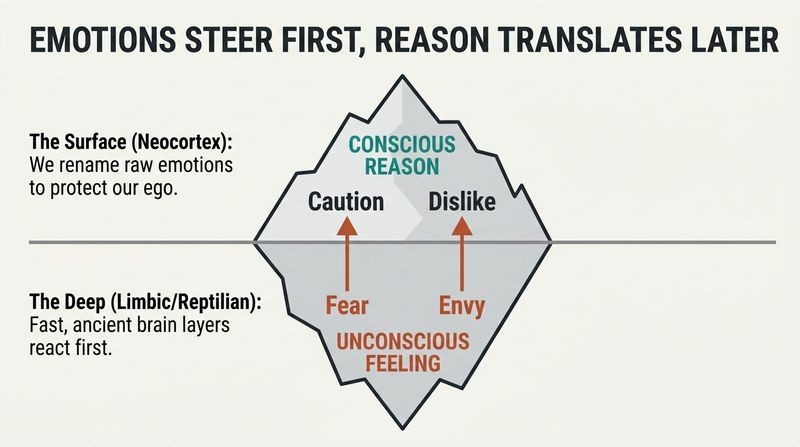
Feeling precedes thought. Greene argues the brain evolved in three layers: a reptilian core for automatic responses, a limbic mammalian brain for emotion, and a neocortex for language and reason. Because emotions are processed separately from thought, we routinely mistranslate them. We feel envy but call it dislike; we feel fear but call it caution. This gap creates a second Emotional Self that operates beneath awareness.
Rationality is a skill, not a birthright. Irrational people repeat the same conflicts and unfinished projects, then blame circumstances. Rational people admit their own biases and subtract emotion through introspection. The antidote is a three-step discipline: recognize your biases (confirmation, conviction, superiority), notice inflaming triggers (sudden gains, rising pressure, childhood wounds), and lengthen your reaction time before acting.
This mirrors Kahneman's System 1 and System 2, but Greene grounds it in evolutionary neuroscience rather than cognitive economics. The claim that reason evolved separately from emotion is somewhat dated; Antonio Damasio's work shows emotion is actually required for good decisions, and patients with damaged emotional centers become paralyzed by trivial choices. Greene's real contribution is practical: he treats rationality as a trainable muscle, not a fixed trait. The suggestion to write the angry email but never send it is deceptively powerful. Feeling superior to bias, he warns, is itself the surest sign of bias, a nicely recursive trap worth remembering.
Turn your attention outward: empathy is a tool you're neglecting
We all sit on a narcissism spectrum. Everyone builds a self-image to soothe insecurity. Deep narcissists lack this inner thermostat, so any slight sends them into rage or victimhood; they treat others as instruments and demand constant attention. Functional narcissists (most of us) have a stable self and can occasionally focus outward. Healthy narcissists redirect their sensitivity toward people and work.
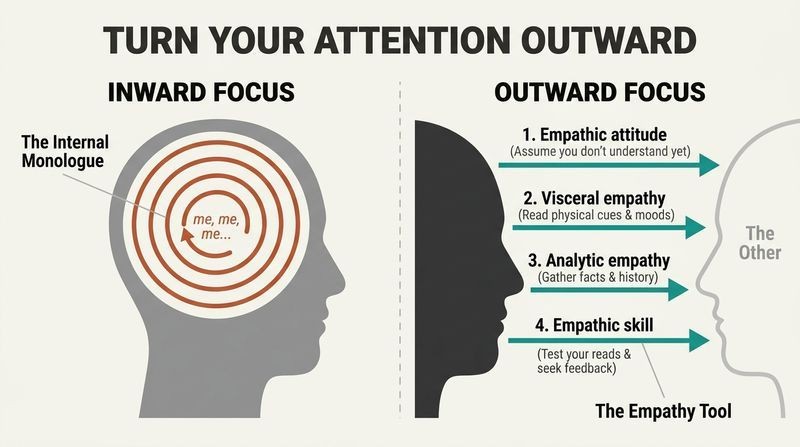
Empathy has four components. Greene frames it as a cultivable instrument:
1. The empathic attitude (assume you do not understand someone yet)
2. Visceral empathy (read moods through tone and body before words)
3. Analytic empathy (gather facts about their history and values)
4. The empathic skill (seek feedback to test your reads)
Stop the interior monologue, attune to shifting moods, and an invisible world of nonverbal signals opens up.
Greene's spectrum reframes narcissism as a matter of degree rather than a diagnosis, which is both humane and useful. It aligns with attachment theory: the self-esteem thermostat resembles what psychologists call a secure internal working model built in early caregiving. His insistence that empathy is a discipline, not a gift, counters the romantic idea that some people are simply born warm. One caution: Greene notes that manipulators can mimic empathic attunement to find weaknesses, which reveals a limit of empathy as pure virtue. The same skill that bonds can exploit. This ambivalence, empathy as both connection and weapon, is what makes his treatment more honest than most self-help.
People leak their true feelings through cues they cannot control
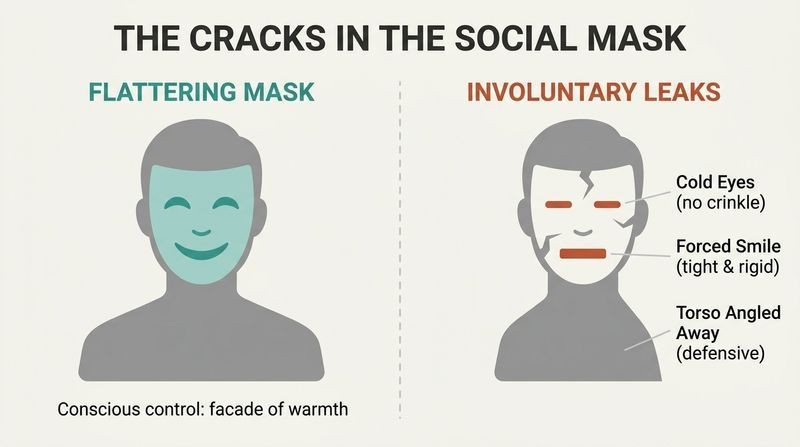
Everyone is an actor wearing a flattering mask. From childhood we learn to present the front that wins approval, concealing envy, hostility, and insecurity. If you take appearances at face value, you get blindsided. But the mask has cracks: microexpressions lasting under a second, forced smiles that never reach the eyes, a torso that turns away mid-conversation.
Learn to decode three signal categories. Greene groups the important cues:
1. Like versus dislike (genuine smiles crinkle the eyes and lift the cheeks; poisonous praise without warmth signals envy)
2. Dominance versus submission (chronic lateness, interrupting, the tight ironic smile)
3. Deception (over-animation and vehemence, tension leaking in a still body while the mouth performs)
Establish someone's baseline demeanor first, then watch for deviations. Meanwhile, manage your own impressions like a method actor.
The science here is contested. Paul Ekman's microexpression research inspired popular shows, but replication studies question how reliably untrained observers detect deception; base rates of lying are low and false positives high. Greene wisely advises watching for patterns and combinations rather than single tells, which hedges against overconfidence. The deeper insight is sociological, echoing Erving Goffman's dramaturgy: social life is a theatrical performance, and refusing to play merely marginalizes you. What distinguishes Greene is the dual mandate. Read others as a detective, yet stage-manage your own front deliberately. Cynical? Perhaps. But anyone who has been ambushed by a smiling colleague's betrayal understands the practical value.
People never do something just once; character reveals itself in patterns
Character is destiny, stamped early. The Greek root of character means an engraving tool, and Greene uses it literally: daily habits and childhood experiences carve grooves that compel repeated behavior. Judge people by their track record, not their charm, reputation, or promises. Someone who abandoned work under stress once will do it again.
Measure the strength of character. Strong character has a tensile quality like good metal: it bends under pressure but holds shape, absorbs criticism, and learns. Weak character neutralizes every other gift, because it cannot be taught. Test people with a good-natured joke, an open-ended assignment, or minor criticism, and watch the response. Greene catalogs toxic types to avoid, including the Hyperperfectionist who cannot delegate, the Drama Magnet who enmeshes you in crises, and the Big Talker who never finishes anything.
Greene's determinism is bracing but overstated. Personality psychology finds traits fairly stable in adulthood, yet longitudinal studies also show meaningful change, and his own prescription (transmute weaknesses into strengths through new habits) contradicts the fatalism of character is destiny. The tension is productive: patterns predict behavior, but awareness can interrupt them. His toxic-type taxonomy resembles clinical personality clustering, though it risks becoming a tool for lazy labeling rather than careful observation. The genuinely useful heuristic is behavioral: watch what people repeatedly do across contexts, especially under adversity, because a single impressive moment tells you almost nothing about who someone reliably is.
Strategic absence makes people crave you; too much presence suffocates
Desire lives in the chase, not the capture. Greene calls this the grass-is-always-greener syndrome. The mind is wired to want what it lacks: every prohibition sparks the forbidden thought (induction), complacency was evolutionarily dangerous so we default to discontent, and imagination feels almost as real as experience. The moment we possess something, attention drifts elsewhere.
Objectify yourself to become desirable. He offers three levers:
1. Know when to withdraw (add a touch of coldness and ambiguity, then physical absence, creating an emptiness people rush to fill)
2. Create rivalries of desire (people want what others already want, so signal that you are sought after)
3. Use induction (associate yourself with the slightly forbidden, unconventional, or unattainable)
Greene criticizes the modern habit of total self-exposure online, arguing it leaves no room for fantasy and renders interest paper-thin.
This chapter reads as seduction strategy but rests on solid psychology: scarcity heuristics (Cialdini) and the endowment effect's inverse both confirm that unattainability inflates perceived value. Rene Girard's theory of mimetic desire deepens Greene's point about rivalries: humans largely want things because others want them, which explains bidding wars, luxury brands, and love triangles alike. The ethical worry is manipulation, engineering artificial mystery rather than being genuinely interesting. Greene's closing turn partly redeems this: the wiser path is to covet a deeper relationship with your own reality rather than endlessly chasing the distant. The strategist and the sage sit uneasily in the same chapter.
Climb the mountain: distance from the present reveals what panic hides
Time is the great revealer. At the base of a mountain in dense forest you see only what is before you. Climb, and the landscape clarifies. Greene argues we live perpetually at the base, seduced by the loudest, most immediate stimuli, which is why we fall for get-rich-quick schemes and overreact to daily news. Wisdom usually arrives too late, in hindsight.
Manufacture the farsighted perspective now. Detach from the heat of the moment, dig into root causes, widen the context, and game out consequences to several degrees. Greene names four traps of shortsightedness: unintended consequences (assuming A simply leads to B), tactical hell (fighting circular ego battles that lose sight of goals), ticker tape fever (addiction to minute-by-minute updates), and lost in trivia (drowning in detail without priorities). Winning through actions beats winning arguments.
The mountain metaphor captures what behavioral economists call construal-level theory: psychological distance shifts thinking from concrete to abstract, improving judgment. Greene's ticker tape fever anticipated the attention economy with uncanny precision; the dopamine-driven refresh loop he describes is now engineered into every app. His antidote, deliberately slowing down and waiting a day or two, echoes Stoic and contemplative traditions and modern advice on deep work. One nuance he underplays: some domains genuinely reward fast reaction (emergency medicine, trading floors, combat). The skill is discerning when the moment demands immediacy versus patience, and most modern anxieties, he rightly notes, fall into the second category.
Lower resistance by confirming what people already believe about themselves
People defend three self-images. Greene's Law of Defensiveness rests on a near-universal self-opinion: I act of my own free will, I am intelligent in my own way, and I am basically a good person. Challenge any of these and resistance hardens. Confirm them and minds open.
Persuade by validation, not argument. Five strategies: become a deep listener (people are undiscovered countries), infect people with a warm mood, confirm their autonomy so any action feels like their choice, ally with their insecurities through strategic flattery aimed at qualities they are uncertain about, and use judo on the stubborn by moving with their resistance rather than against it. Disraeli's trick captures it: let a person win the argument, and you win their heart. Small gifts bind better than lavish ones, which feel like bribery.
Greene channels Dale Carnegie and Robert Cialdini here, but with a sharper edge about the ego's fragility. The insight that people crave autonomy above all is well supported by self-determination theory (Deci and Ryan), which finds autonomy a basic psychological need; coercion reliably backfires. His reverse-psychology judo aligns with motivational interviewing, a clinical technique where rolling with resistance outperforms confrontation in changing behavior. The uncomfortable question is sincerity. Greene concedes flattery works best when partly genuine, which suggests the real skill is cultivating authentic curiosity about people rather than faking it. Manipulation and warmth blur; the difference often lies in whether you also serve the other person's interest.
Everyone hides a Shadow; the loudest virtue conceals its opposite
Repressed traits leak out sideways. Borrowing Jung's term, Greene describes the Shadow as everything we deny about ourselves: aggression, envy, forbidden desires. It surfaces through contradictory behavior (the moralist caught in scandal), emotional outbursts, vehement denial, and projection (accusing others of the very impulse we harbor). Behind intense hatred often lurks unpalatable envy.
Emphatic traits sit on their inverse. When someone lays a trait on too thick, suspect the opposite beneath. The Tough Guy conceals softness, the Saint hides a hunger for power, the Passive-Aggressive Charmer masks hostility with excessive niceness. The healthier path is to integrate your own Shadow: study your outbursts and projections, revisit childhood traits drummed out of you, mine dreams, then assert yourself more, offend when justice demands it, and channel dark energy into creative work. Authentic people who own their Shadow draw others powerfully.
This is Jungian psychology repackaged, and Greene is faithful to the source. The clinical caution is that projection and reaction formation, while real defense mechanisms in psychoanalytic theory, are hard to falsify; almost any behavior can be read as its own opposite, which risks unfalsifiable armchair diagnosis. Still, the integrated-human ideal has empirical cousins. Research on emotional suppression shows it raises physiological stress and paradoxically increases intrusive thoughts, supporting Greene's claim that repression costs energy and eventually erupts. The advice to consciously express rather than bury darker impulses resonates with acceptance-based therapies. Owning your capacity for aggression, rather than pretending sainthood, tends to make people both more honest and less dangerous.
Envy hides behind praise; detect it before it sabotages you
No one admits to envy, which makes it lethal. Unlike anger, envy is felt shamefully and disguised instantly. Greene teaches decoding it three ways: through signs, through envier types, and through triggers. Watch for poisonous praise (compliments that leave you uneasy), backbiting, and the push-pull of a friend who alternates warmth with pointed, unearned criticism. A too-direct look held a half-second too long, followed by a strained smile, is envy's tell.
Certain types and moments invite attacks. Levelers cannot tolerate excellence, Status Fiends reduce everything to money, Insecure Masters fire talented subordinates. Sudden changes in your status trigger envy most, especially among peers and aging colleagues. Deflect it with self-deprecating humor and by not flaunting gifts. Better still, transform your own comparing instinct: practice Mitfreude (Nietzsche's word for actively feeling joy at others' success) rather than schadenfreude.
Greene's analysis of envy as socially camouflaged is astute and underdiscussed. Evolutionary psychologists argue envy evolved as a status-monitoring alarm, useful for our ancestors but corrosive in an age of curated social feeds. His observation that social media manufactures low-grade chronic envy, an idealized highlight reel triggering constant comparison, is now backed by studies linking heavy platform use to declines in well-being. The Mitfreude prescription is genuinely original as self-help; deliberately cultivating vicarious joy is harder than it sounds and resembles the Buddhist practice of mudita (sympathetic joy). One limit: constant vigilance for envy could tip into paranoia, seeing malice in ordinary human pettiness that is better simply tolerated.
Tie your sense of greatness to real work, or grandiosity destroys you
Grandiosity distorts scale. Greene compares the mind to a sculptor facing marble. Grandiosity is a psychological disease that shrinks the block, making the task seem easy and the self seem godlike. A little success inflames it: we forget the role of luck, imagine a golden touch, and lose contact with reality. Modern life amplifies it through the decline of religion, disrespect for expertise, technology's illusion of instant mastery, and social media's simulated adoration.
Channel the energy into practical grandiosity. Rather than fantasizing about accolades, concentrate deeply on a single achievable project, maintain a dialogue with reality by seeking hard feedback, and seek calibrated challenges just above your skill level. Grandiose leaders betray themselves through six illusions, including I am destined and I have the golden touch. Croesus, told by the oracle to know thyself, ignored it, overreached, and lost everything.
Greene's diagnosis lands in an era of founder worship and personal branding. His distinction between fantastical and practical grandiosity maps neatly onto the psychology of flow (Csikszentmihalyi), where challenges calibrated just beyond current skill produce both peak performance and deep satisfaction, precisely the calibrated challenge he prescribes. The research on hubris in leadership supports him: studies of CEO overconfidence link it to value-destroying acquisitions and accounting risks. What Greene adds is the developmental origin, tracing grandiosity to childhood pampering that skipped the humbling recognition of one's smallness. The prescription (anchor esteem in achievement and feedback rather than attention) is sound, though harder than ever when platforms reward performance over substance.
Find your calling by mining childhood fascinations, not chasing money
Aimlessness breeds a distinctive pain. Without direction, Greene argues, we drift into chronic boredom, insecurity, free-floating anxiety, and low-grade depression. Because humans lack instinct to guide us, we need a manufactured compass: a sense of purpose drawn from our radical uniqueness (our DNA, brain wiring, and unrepeatable experiences).
Recover your primal inclinations. The signs were clearest in early childhood, moments of visceral fascination with certain subjects or activities that arose without prompting. Reconnect to that voice before parents and culture drowned it out. Practical strategies include building a ladder of descending goals to tame anxiety, absorbing energy from purposeful people, and using critics as fuel. Beware false purposes that offer transcendence cheaply: pleasure, cults and causes, money and status, attention, and cynicism (which Nietzsche called preferring the void as purpose to being void of purpose).
Greene's advice to excavate childhood fascination echoes the Japanese concept of ikigai and Aristotle's telos, the idea that flourishing comes from actualizing one's distinctive nature. His warning against pursuing money directly is counterintuitive but empirically defensible: research on intrinsic versus extrinsic motivation finds that money-focused goals correlate with lower well-being, and mastery-focused work more reliably produces both excellence and, eventually, income. The weakness is survivorship bias. For every person who followed a calling to greatness, many pursued a passion into financial ruin, a reality Greene's framework underweights. His hedge (adapt existing skills rather than making drastic leaps) is the pragmatic corrective. Purpose, in his telling, is less discovered than deliberately constructed.
Keeping death in view sharpens purpose and dissolves petty divisions
Death denial makes us deathlike. Greene argues that repressing mortality only intensifies our underlying anxiety, driving us to narrow our lives, avoid risk, and numb ourselves with addictions and distractions. Paradoxically, confronting death makes us more alive. Life is movement, connection, and diversity; death is stillness and separation. Denying death makes us rigid and isolated in advance.
Practice a philosophy of life through death. Make the awareness visceral by imagining your last day, treat mortality as a continual deadline that concentrates energy, and see the mortality in everyone. During London's 1665 plague, Defoe observed sectarian differences dissolving as shared vulnerability bred sudden empathy. Embrace pain and fate as teachers, and open the mind to the Sublime, whatever is too vast to grasp: the night sky, the open sea, the mystery of other creatures' perception. The awareness equalizes and connects us all.
This closing law is pure memento mori, the Stoic and Montaignean tradition Greene quotes directly. Modern Terror Management Theory offers striking empirical support: experiments show that reminding people of death intensifies defense of their worldview and in-group, yet other studies find that sustained, reflective mortality awareness (rather than fleeting fear) increases gratitude, intrinsic goals, and prosocial behavior. Greene sides with the reflective version. The plague example resonates now, as collective crises briefly collapse social divisions before old tribalism returns. His concept of the Sublime borrows from Burke and Kant, reframing awe as an antidote to the ego's pettiness. It is a fitting capstone: all the strategic manipulation of earlier laws yields to something quieter and humbler.
Analysis
Robert Greene's project is unusual: a strategist's field guide dressed as evolutionary psychology. Where most self-help flatters the reader, Greene assumes everyone, including the reader, is driven by unconscious forces (envy, narcissism, aggression, grandiosity) that we are desperate to deny. The eighteen laws share one spine: beneath the polite social surface runs a primitive current shaped over five million years of evolution, and mastery means seeing that current clearly in others while taming it in yourself.
The book's intellectual lineage is eclectic and largely nineteenth and twentieth century: Jung supplies the Shadow, anima, and animus; Freud supplies repression and projection; Nietzsche, Schopenhauer, and Montaigne supply the aphoristic worldview. Greene's originality lies less in the ideas than in their synthesis into actionable observation and their translation into contemporary terms, especially his prescient diagnoses of social media as an envy engine, an attention economy, and a grandiosity amplifier.
The method has real limits. Much rests on psychoanalytic concepts that are hard to falsify; the claim that emphatic traits always mask their opposite can explain any behavior after the fact. His character determinism sits awkwardly beside his insistence that we can reshape ourselves. And the microexpression-based lie detection oversells contested science.
Yet the book's core is durable because it is behavioral rather than mystical: judge by patterns not words, lengthen your reaction time, confirm people's self-opinion, anchor esteem in real achievement, and keep mortality in view. These converge with independent research in cognitive science, self-determination theory, and flow. Greene's darker gift is refusing the comforting fiction that good intentions suffice. His most humane move is structural: he ends not with a manipulation tactic but with death, empathy, and the Sublime, quietly subordinating the strategist to the sage.
Review Summary
The Concise Laws of Human Nature receives mostly positive reviews, with readers praising its insights into human behavior and psychology. Many find it thought-provoking and valuable for understanding themselves and others. Some appreciate the concise format, while others prefer the full version with historical examples. Criticisms include its length and potential for manipulation. Readers describe it as challenging but rewarding, offering practical advice for navigating relationships and social dynamics. Overall, it's considered a must-read for those interested in human nature and self-improvement.
People Also Read









Glossary
The Emotional Self
Unconscious feelings driving behaviorGreene's name for the part of the mind, rooted in the older limbic brain, that generates moods and emotions beneath conscious awareness and pushes us toward irrational decisions. Because emotion is processed separately from language and reason, we mistranslate what we feel and act on it without knowing. Rationality is the trained ability to counteract this second self.
Deep narcissist
Person lacking stable self-imageSomeone who never developed a coherit internal sense of self-worth, so they depend entirely on external attention and validation. Any slight triggers rage or victimhood; they treat others as instruments and cannot self-soothe. Greene contrasts them with functional narcissists (most people) and healthy narcissists who redirect attention outward into empathy and work.
The Shadow
Repressed dark side of personalityA term Greene borrows from Carl Jung for the collection of insecurities, aggressive impulses, and forbidden desires a person denies and hides. Because concealing it drains energy, the Shadow leaks out through contradictory behavior, outbursts, denial, and projection. Greene urges integrating rather than repressing it to become more authentic and creative.
Grass-is-always-greener syndrome
Craving what you lackGreene's label for the human tendency to lose interest in what we possess and desire the distant or forbidden. He attributes it to three brain quirks: induction (every prohibition sparks the forbidden thought), an evolutionary bias against complacency, and imagination feeling nearly as vivid as reality. It underlies covetousness and can be exploited to make oneself an object of desire.
The farsighted perspective
Manufactured long-term viewA deliberate mental discipline for approximating the clarity that time normally provides only in hindsight. Facing a problem, you detach from the emotional heat, dig into root causes, widen the context, and game out consequences several steps ahead. Greene likens it to climbing a mountain to see the whole landscape rather than staying trapped in the forest of the present moment.
Self-opinion
Three universal self-beliefs to confirmGreene's term for how people perceive their own worthiness, resting on three near-universal beliefs: I act of my own free will, I am intelligent in my own way, and I am a good person. Challenging any of these hardens resistance; confirming them lowers defenses and opens people to influence.
Mitfreude
Actively joying with othersA word from Nietzsche meaning joying-with, the opposite of schadenfreude. Rather than merely congratulating someone on good fortune, you actively try to feel their joy as a form of empathy. Greene recommends it as a way to transform the envious comparing instinct into a bonding emotion that also expands your own capacity for happiness.
Practical grandiosity
Ambition channeled into real workGreene's constructive alternative to fantastical grandiosity (inflated self-importance based on fantasy and attention). It channels our innate drive to feel significant into deep focus on achievable projects, continual feedback from reality, and calibrated challenges just above one's skill level, producing genuine accomplishment rather than delusion.
The Sublime
Awe at the ungraspableFrom a Latin root meaning up to the threshold, Greene uses it for anything too vast, dark, or mysterious for words or concepts, such as death, infinite space, or alien forms of perception. Confronting the Sublime produces fear mixed with awe, shrinking the ego and jolting us out of complacency and daily pettiness.
False purposes
Cheap substitutes for real meaningExternal sources of direction people adopt to feel transcendent with minimal effort, in contrast to a genuine calling that comes from within. Greene lists five: the pursuit of pleasure, causes and cults, money and status, attention, and cynicism (which Nietzsche described as preferring the void as purpose to being void of purpose).
FAQ
What's The Concise Laws of Human Nature about?
- Understanding Human Behavior: The book delves into the motivations and behaviors that drive human actions, highlighting the role of emotions in decision-making.
- 18 Laws of Human Nature: It introduces 18 laws, such as the Law of Irrationality and the Law of Narcissism, to help readers understand and navigate social interactions.
- Self-Improvement Focus: Robert Greene offers strategies for mastering oneself and understanding others, aiming to transform negative patterns into positive outcomes.
Why should I read The Concise Laws of Human Nature?
- Practical Insights: The book provides valuable insights into human behavior, useful for both personal and professional relationships.
- Self-Awareness Development: It encourages readers to develop self-awareness and empathy, leading to improved interactions and decision-making.
- Timeless Wisdom: Greene's exploration is rooted in historical and psychological perspectives, offering wisdom applicable to modern life.
What are the key takeaways of The Concise Laws of Human Nature?
- Master Your Emotions: Understanding and controlling emotional responses is crucial for rational decision-making and avoiding self-sabotage.
- Empathy Over Narcissism: Transforming self-love into empathy fosters deeper connections and better understanding of others' motivations.
- Recognize Masks: People often hide their true feelings; learning to see through these masks helps in accurately assessing character.
What are the best quotes from The Concise Laws of Human Nature and what do they mean?
- Self-Awareness Quote: “Man will only become better when you make him see what he is like.” This emphasizes the importance of self-awareness in personal growth.
- Mindset Power Quote: “The greatest discovery of my generation is the fact that human beings can alter their lives by altering their attitudes of mind.” It highlights the power of mindset in shaping reality.
- Complexity of People Quote: “People are rarely who they seem to be.” This serves as a reminder to look beyond appearances to understand human nature.
What is the Law of Irrationality in The Concise Laws of Human Nature?
- Emotional Dominance: This law states that emotions often dominate decision-making, leading to irrational choices.
- Cultivating Rationality: Greene suggests recognizing emotional biases and learning to counteract them to cultivate rationality.
- Awareness is Key: By becoming aware of irrational tendencies, one can make more informed decisions and avoid negative patterns.
How does The Concise Laws of Human Nature define narcissism?
- Spectrum of Narcissism: Narcissism is presented as a spectrum, with deep narcissists being self-absorbed and functional narcissists having a healthier self-image.
- Self-Absorption Impact: Self-absorption can hinder empathy and connection, leading to toxic relationships.
- Transforming Narcissism: Transforming self-love into empathy fosters better relationships and understanding.
What strategies does The Concise Laws of Human Nature suggest for dealing with difficult people?
- Recognize Their Masks: Understanding that people often wear masks can help reveal their true intentions and motivations.
- Empathy and Validation: Validating others' feelings can lower defenses and make them more receptive to influence.
- Maintain Distance: With toxic individuals, maintaining emotional distance can protect your well-being.
What is the significance of the Law of Self-sabotage in The Concise Laws of Human Nature?
- Attitude Shapes Reality: This law highlights how attitudes can lead to self-destructive behaviors and missed opportunities.
- Changing Perspective: Altering attitudes and perceptions can change circumstances and create positive outcomes.
- Empowerment Through Awareness: Recognizing self-sabotaging patterns empowers individuals to take control and make conscious choices.
How does The Concise Laws of Human Nature address the concept of empathy?
- Empathy as a Tool: The book emphasizes empathy as a powerful tool for understanding others and building connections.
- Transforming Self-Love: Greene encourages transforming self-absorption into empathy to enhance social interactions.
- Empathy Development: Practical exercises and strategies are provided to cultivate empathy and improve social skills.
What are the different types of aggressive personalities discussed in The Concise Laws of Human Nature?
- Chronic Aggressors: These individuals use aggression to assert control, often exhibiting manipulative behaviors.
- Passive Aggressors: They express aggression indirectly, making it difficult to confront them directly.
- The Shadow Enabler: This aggressor exploits others' weaknesses, leading to toxic dynamics in relationships.
How does The Concise Laws of Human Nature define the concept of the "Shadow"?
- Unacknowledged Aspects: The "Shadow" refers to suppressed parts of our personality due to societal norms or insecurities.
- Integration for Authenticity: Integrating the Shadow into our conscious self leads to authenticity and power.
- Impact on Relationships: Failing to recognize the Shadow can lead to projecting insecurities onto others, causing conflicts.
How can I apply the lessons from The Concise Laws of Human Nature in my daily life?
- Practice Self-Reflection: Regularly assess your behaviors and motivations to identify patterns and areas for improvement.
- Observe Others: Pay attention to others' behaviors and motivations to enhance interpersonal skills.
- Embrace Vulnerability: Acknowledge insecurities and suppressed traits to foster authenticity and stronger connections.
About the Author
Other books by Robert Greene









Download PDF
Download EPUB
.epub digital book format is ideal for reading ebooks on phones, tablets, and e-readers.








































