

Key Takeaways
Don't fight for your destiny — choose it from infinite existing versions
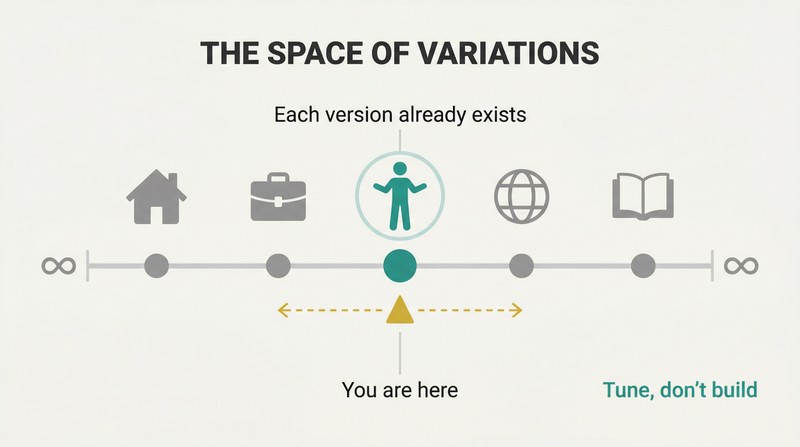
Transurfing's radical premise. The space of variations — Zeland's foundational concept — is an infinite information field containing every possible version of every possible event. Each sector holds a "script" (what happens) and "decorations" (how the world appears). Your life traces a path through this field along what Zeland calls a life track — a chain of sectors with roughly similar quality. When your thoughts and attitudes shift, you shift tracks.
The book opens with a dream allegory in which a mysterious Overseer poses a riddle: "Everyone can acquire the freedom to choose anything they want. How do you get this freedom?" The answer isn't to build your ideal life from scratch — it already exists as a sector in the space of variations. The task is to tune your thought energy to its frequency, the way you'd change a radio station.
Pendulums — born from group thought — feed on your energy and steer your fate
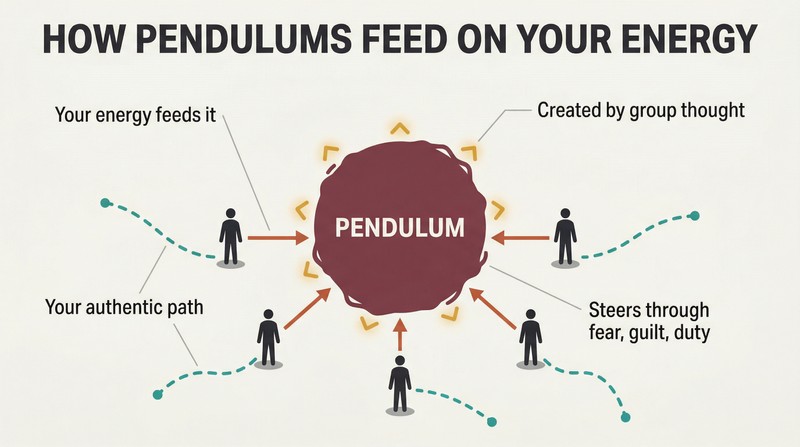
A pendulum is an energy-information structure created when a group of people starts thinking in the same direction — a corporation, political party, religion, media outlet, or social movement. Their combined thought energy merges into a self-governing entity that feeds on adherent energy and fights rival pendulums for followers. It manipulates through fear, guilt, duty, and ambition.
The defining trait: a pendulum doesn't care about any individual adherent's welfare. Napoleon was a pendulum's favorite yet counted only a few happy days in his entire life. Most dangerously, pendulums drag adherents away from life tracks where authentic happiness waits, replacing personal goals with the pendulum's survival needs. People join armies, master wrong professions, enter wrong relationships — all seduced by a pendulum's advertising.
What you actively hate or fear will follow you everywhere
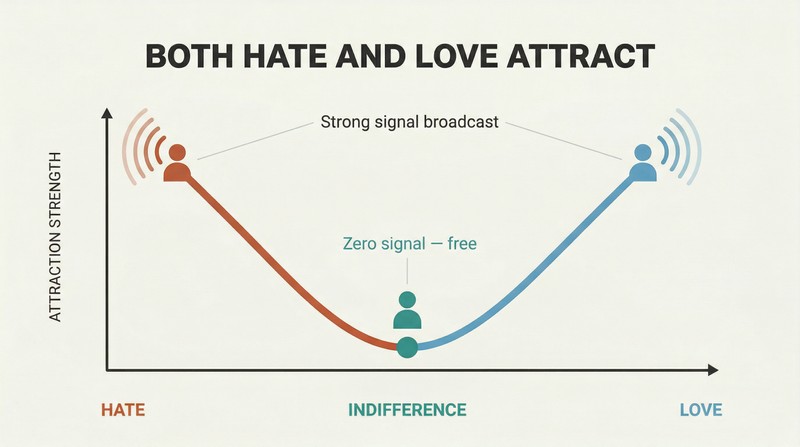
The anti-pattern at Transurfing's heart. Whether you love or hate something, both fix your thought energy on its frequency, pinning you to life tracks where it exists in abundance. Zeland uses a vivid analogy: imagine a man who despises apples. On the physical plane, he avoids them. On the energy plane, he's greedily stuffing his mouth with apples, choking on them, filling his pockets — because his thoughts are consumed by them.
The mechanism is emotional charge, not content. Fearing poverty, despising your neighbors, or dreading bad weather all radiate energy at those exact frequencies. The only escape isn't suppressing feelings — it's genuinely losing interest. Once a subject carries zero emotional charge, you stop broadcasting on its channel and drift naturally toward different tracks.
Ignore what provokes you — emptiness defeats a pendulum, resistance feeds it
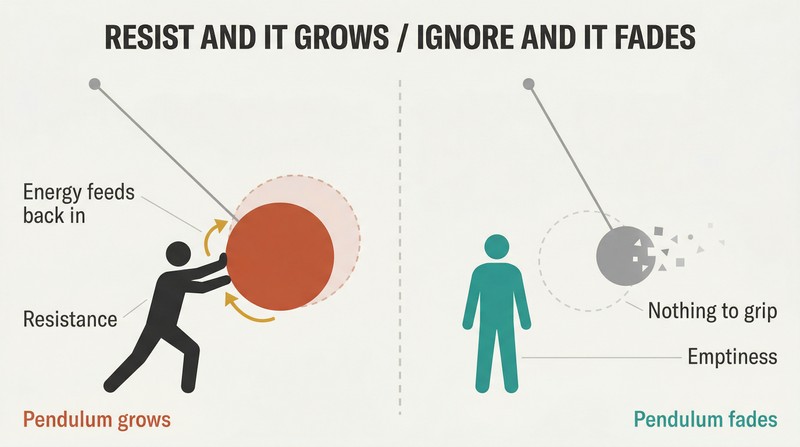
Zeland borrows from aikido. The defender doesn't block an attacker but steps aside, briefly walks with the attacker's momentum, then releases him into empty space. The same principle applies to pendulums. Fighting one feeds it energy. Building a mental wall against it still tunes your energy to its frequency. The Transurfing technique called "fall through" means offering the pendulum nothing to grip — being empty.
In practice: when your boss aggressively demands unreasonable work, agree first. Let his impulse exhaust itself. Then gently redirect the conversation toward alternatives. The pendulum swings through you and finds nothing to catch. Like a barking dog chasing you — if you ignore it completely, without fear or hostility, it loses interest and finds another target.
Savor every scrap of good news — it's a thread to fortunate life tracks
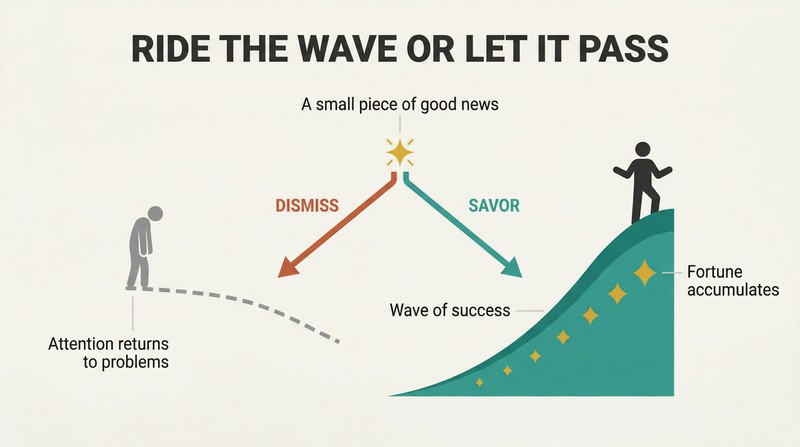
Fortune accumulates like misfortune. In the space of variations, favorable life tracks cluster together in what Zeland calls the wave of success. Unlike pendulums, this wave doesn't feed on your energy — it simply carries you if you let it. It arrives as a small stroke of luck or a piece of good news.
Most people fumble it immediately. A pendulum hooks their attention back to problems, and the wave passes without returning. The technique: when something good happens, don't dismiss it. Savor the feeling. Talk about it. Build on it mentally. This tunes your radiation to the wave's parameters, pulling you onto increasingly fortunate tracks. The wave was always there; you just need to stop chasing it away by reflexively turning your attention back to what's wrong.
Importance is the only real obstacle — deflate it and the wall collapses
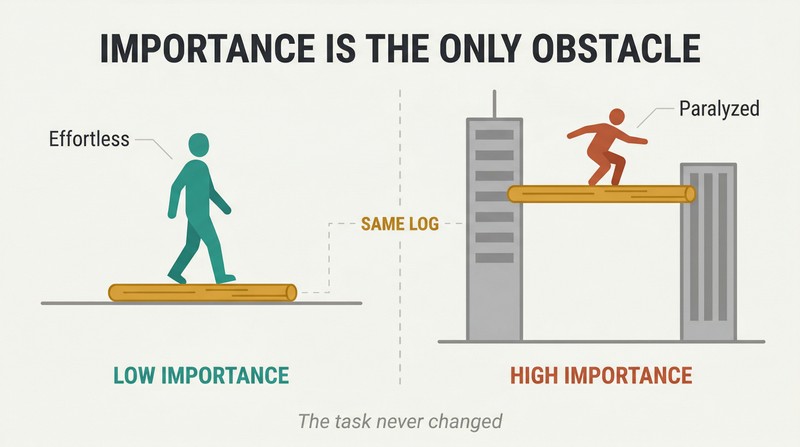
Excess potential explained. When you attribute excessive significance to anything — your career, a relationship, an exam — you create what Zeland calls excess potential: an irregularity in the energy field. Nature responds with balancing forces that work to eliminate this imbalance, almost always against your intention. Worship your new car obsessively, and balancing forces will arrange for someone to scratch it.
Two forms of importance exist:
1. Inner importance: "I am an important person" or "I do important work"
2. Outer importance: "This event is critical" or "I must have this"
Walking on a log on the ground is effortless. The same log between two skyscrapers becomes terrifying — not because the log changed, but because outer importance skyrocketed. Reduce importance, and balancing forces stand down.
Refuse guilt — it's the puppet string that makes you easiest to control
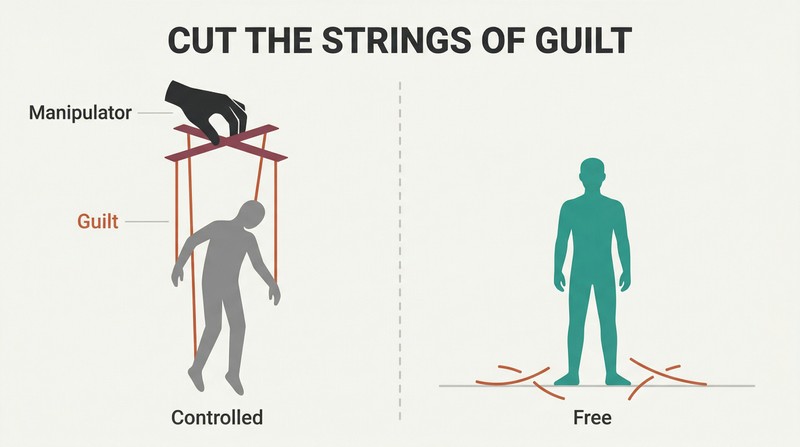
Guilt generates the rawest excess potential. Nature doesn't recognize "good" or "bad" — only imbalance. When you carry guilt, your subconscious accepts punishment as deserved and writes punishment scripts into your life: accidents, losses, conflicts. Meanwhile, shameless people face fewer consequences because they generate no guilt-potential for balancing forces to act on.
Manipulators exploit this ruthlessly with the formula: "You should do what I say because you're guilty." The escape isn't squeezing guilt out through struggle — it's choosing to live by your own credo without justifying yourself. You can ask forgiveness once to release the potential, but never carry guilt as a permanent identity. Genuine courage, Zeland argues, is simply the absence of guilt in the subconscious.
Chase your true goal, not money — wealth arrives as a side effect
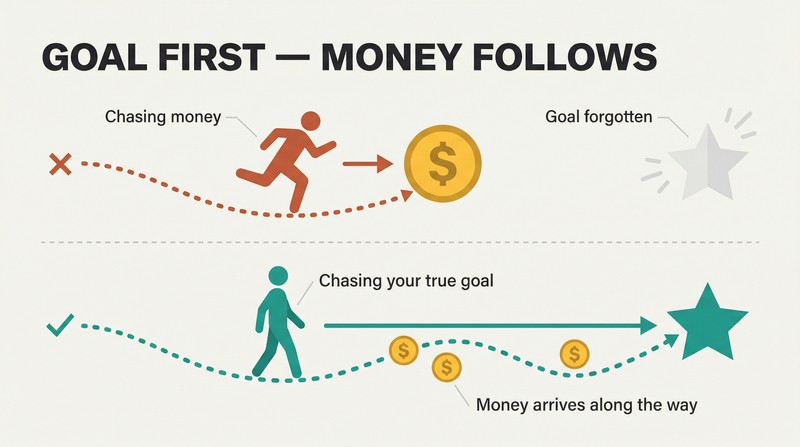
Pendulums created the money myth. By making cash seem like the prerequisite for everything, pendulums replace your authentic purpose with an artificial substitute. People spend their lives earning for someone else's structure, never reaching their own destination. Zeland's claim: every person who became wealthy focused on their goal — not on accumulating money.
The man who wants to travel the world should think about traveling, not the bank account required. Money is a "complementary attribute" that appears on the path toward an authentic goal. If you've replaced your dream with a savings target, the pendulum has already won. Don't hoard money fearfully — stagnant accumulation creates excess potential. Don't spend it with regret — that radiates scarcity. Treat money with calm attention and let it flow.
Small negative reactions spiral you toward catastrophic life tracks
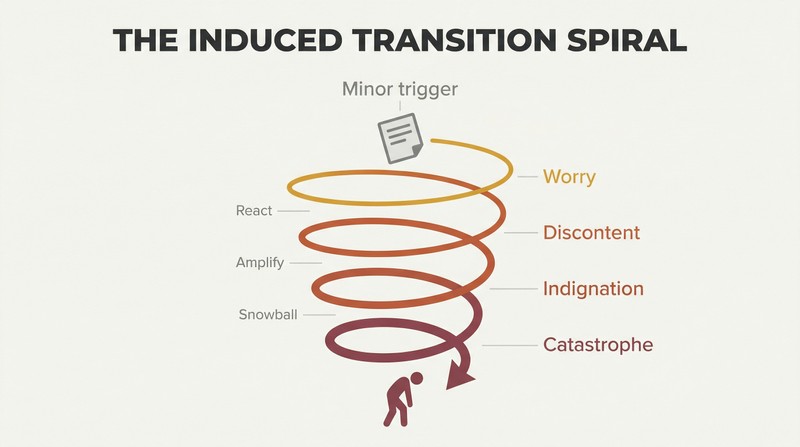
Induced transition is Zeland's term for the slow-then-sudden spiral into increasingly negative life tracks. It begins with a small emotional response to a destructive pendulum — alarming economic news, a rumor about layoffs. You express worry. Others join. The pendulum swings harder. Your radiation shifts. You move from casual observer to anxious participant to actual victim.
The financial ruin pattern is textbook. Temporary money trouble triggers discontent, which triggers indignation, which feeds the pendulum, which produces worse news, which compounds anxiety, which builds excess potential, which activates balancing forces — snowball effect. Each emotional reaction tightens the spiral. The only defense: don't grab the spiral's first thread. Not by avoiding bad news, but by deliberately choosing not to react emotionally to it.
Steer gently along life's current — the optimal path already exists
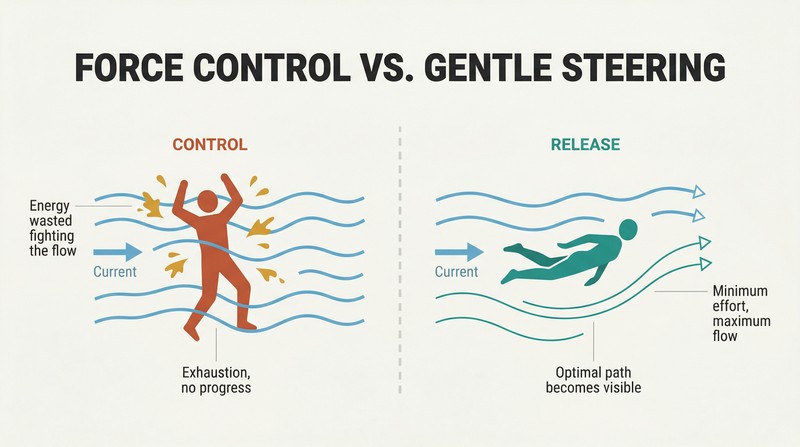
Cause-and-effect chains form natural streams in the space of variations — paths of least energy expenditure that already contain optimal solutions. The mind's critical error isn't poor reasoning; it's trying to control the flow itself rather than steering gently within it. Like a man thrashing in a river versus floating with smooth, intentional strokes.
The "rent yourself out" technique applies here. Perform your role impeccably but as a detached observer, not an emotionally entangled participant. When facing decisions, choose the simplest path. When others suggest alternatives, don't reflexively reject them. Let situations resolve without forced interference. Most problems, Zeland argues, are created by the mind's insistence on control. Release the grip, and solutions that were always nearby become visible.
If you have to convince yourself to say yes, your soul is saying no
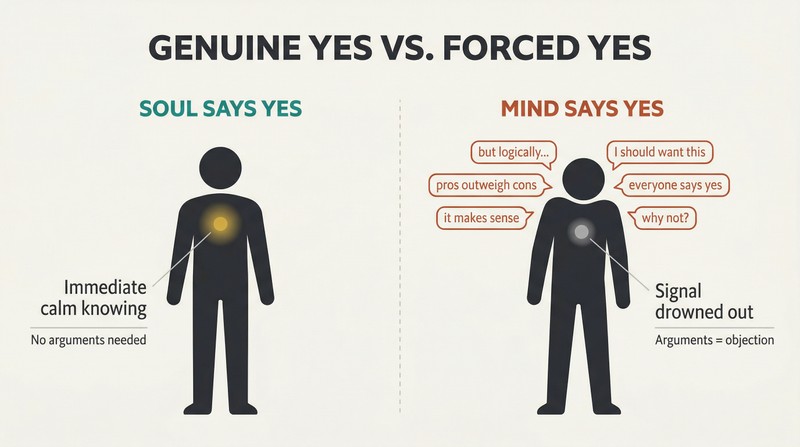
The mind thinks in labels and logic. The soul — Zeland's term for the subconscious — doesn't think at all. It feels. When the mind's chatter quiets, the soul's signal breaks through as what Zeland calls "the rustling of the morning stars ": wordless intuitive knowledge. It manifests as vague feelings of comfort or discomfort before a decision.
The practical formula is disarmingly simple. Before committing to a choice, pause the internal monologue. Ask: "Do I feel good or bad about this?" If the answer requires building a logical case to convince yourself — if you need arguments to justify saying yes — your soul is objecting. Also watch for spontaneous phrases from others — things people say without thinking. When someone casually advises you, their soul may be channeling information your mind is too busy to hear.
Analysis
Reality Transurfing occupies a fascinating position in the personal development canon — a Russian metaphysical system that predates The Secret by several years while avoiding its most embarrassing oversimplifications. Where Rhonda Byrne reduces manifestation to 'think positive and the universe delivers,' Zeland's model is architecturally richer: thoughts don't magically attract outcomes — they shift you between pre-existing life tracks in an infinite informational field. The distinction preserves causality and human agency while granting consciousness a steering role.
The book's most enduring contribution is the pendulum framework — essentially a theory of memetic parasitism articulated two decades before that language entered mainstream discourse. Social media algorithms, political movements, corporate cultures, and even wellness communities all function precisely as Zeland's pendulums: self-perpetuating structures that recruit attention, feed on emotional reactivity, and redirect individual purpose toward collective perpetuation. In an attention economy where every app competes for your emotional engagement, the pendulum lens feels almost prophetic.
The concept of 'excess potential 'and 'importance 'maps neatly onto both ancient Stoicism — specifically apatheia and the dichotomy of control — and modern performance psychology research on the paradox of effort. The harder you grip an outcome, the more cortisol floods your system, the worse you perform. Zeland's 'balancing forces 'are metaphysical language for what psychologists observe as self-sabotage under pressure.
Where the model weakens is in its unfalsifiability. The space of variations, life tracks, and balancing forces resist empirical testing. Every outcome can be retroactively explained: success proves you reduced importance; failure proves you didn't. Zeland concedes this — 'the important thing is the practical result' — but the framework risks functioning as sophisticated confirmation bias.
Still, Transurfing's core prescription — reduce emotional reactivity, question whether your goals are genuinely yours, stop controlling and start steering — is arguably more actionable than most manifestation literature. The book's quiet radicalism lies in its refusal to ask you to change who you are. It asks you to stop letting invisible structures choose for you.
Review Summary
Reality Transurfing 1 by Vadim Zeland presents a unique perspective on shaping reality through mental techniques. Reviews are mixed, with some praising its potentially life-changing insights and others criticizing its repetitive nature and lack of scientific basis. Many readers find value in its approach to positive thinking and energy management, while others view it as rehashed self-help concepts. The book's ideas about parallel realities and quantum physics intrigue some, but others find them far-fetched. Overall, readers appreciate the book's alternative viewpoint on personal growth and reality perception.
People Also Read






Glossary
Space of Variations
Infinite field of all possibilitiesAn infinite information field that contains data about every possible variation of every possible event—past, present, and future. Each point holds a specific variation consisting of a script (what happens) and decorations (how things appear). It serves as a template or coordinate system for the movement of matter through space and time. All possible destinies already exist within it.
Life track
Chain of similar-quality life sectorsA sequence of sectors in the space of variations that share roughly similar scripts and decorations, forming a relatively homogeneous line of life experience. A person's life moves along one track until a shift in thought energy parameters causes a transfer to a different track with different circumstances and outcomes. Tracks close together differ slightly; distant tracks differ dramatically.
Pendulum
Energy parasite from group thoughtAn energy-based information structure created when a group of people think in the same direction, causing their thought energy to merge into a single flow. Once formed, a pendulum becomes self-governing—it feeds on adherent energy, establishes rules, attracts new followers, competes with rival pendulums, and manipulates members through emotions like fear, guilt, and duty. Examples include governments, corporations, religions, media outlets, and social movements.
Excess potential
Energy imbalance from inflated significanceAn irregularity in the energy field created when a person attributes excessive significance to an object, event, or evaluation. It arises only when the evaluation carries great personal importance and distorts reality relative to its actual energy-level significance. Excess potential summons balancing forces that work to eliminate it, typically producing results opposite to the person's intention.
Balancing forces
Forces eliminating energy irregularitiesForces that arise in response to excess potential, working to restore equilibrium in the energy field. They are indifferent to human desires and often eliminate potential by the most efficient path available—which frequently means working against the person who created the imbalance rather than changing the external world to match their wishes. They explain why trying too hard often backfires.
Importance (inner and outer)
Excess significance creating energy potentialThe most common form of excess potential. Inner importance is overestimating one's own virtues, flaws, or the significance of one's work ('I am an important person'). Outer importance is attributing excessive value to external objects or events ('This must happen or my life is ruined'). Both forms generate excess potential that summons balancing forces against the person who created them.
Induced transition
Spiral into negative life tracksThe process by which a person is gradually drawn onto increasingly negative life tracks through escalating emotional responses to a destructive pendulum. It begins with a small negative stimulus, builds through repeated engagement and emotional amplification, and accelerates like a funnel until the person shifts from observer to victim. Applies to financial ruin, epidemic panic, conflict escalation, and other cascading negative patterns.
Wave of success
Cluster of fortunate life tracksA static accumulation of favorable life tracks in the space of variations. Unlike pendulums, it requires no energy from the person and takes none. It appears as a stroke of luck or good news. If the person savors this positive energy and tunes their radiation to its parameters—rather than letting destructive pendulums redirect attention—they can ride the wave to increasingly fortunate circumstances.
Fall through
Letting a pendulum hit emptinessA technique for escaping a pendulum's influence by becoming 'empty' to it—neither fighting it nor defending against it, but allowing its energy to pass through without engaging. Modeled on the aikido principle where the defender steps aside rather than blocking, causing the attacker's force to land on nothing. The pendulum finds no grip and moves on to other targets.
Rent yourself out
Act as detached observer-performerA Transurfing technique where a person performs actions and fulfills duties impeccably while maintaining the inner stance of a detached observer rather than an emotionally invested participant. The person gives their hands and mind to the task but not their heart, avoiding the creation of excess potential while still meeting all responsibilities. Used in work, problem-solving, and conflict situations.
The Rustling of the Morning Stars
Soul's wordless intuitive voiceZeland's poetic term for the intuitive knowledge that emerges from the subconscious (the 'soul') when the conscious mind's internal chatter quiets down. It manifests as wordless feelings of inner comfort or discomfort, vague premonitions, or sudden knowing without logical basis. It represents the soul's direct connection to the information field, bypassing the mind's analytical categories and labels.
The Overseer
Inner awareness monitoring importance levelsThe practitioner's inner observer—a background awareness that monitors one's own thoughts, emotional reactions, and importance levels in real time. Not a split personality but a cultivated self-observational habit. The Overseer's job is to notice when pendulums have captured attention, when importance has inflated, or when the mind is fighting the flow of variations rather than steering gently within it.
Flow of variations
Cause-and-effect streams through information spaceThe movement of cause-and-effect chains through the space of variations, forming natural streams that follow paths of least energy expenditure. These streams already contain optimal solutions to problems. Rather than forcing outcomes through willpower, Transurfing recommends steering gently along these streams—observing more than controlling, choosing simplicity over complexity, and allowing situations to resolve through their natural optimal paths.
FAQ
What's Reality Transurfing 1: The Space of Variations about?
- Core Concept of Transurfing: Introduces Transurfing, a method to manage destiny by choosing desired life paths rather than struggling for them.
- Space of Variations: Proposes that all possible life scenarios exist in a "space of variations," allowing individuals to select their preferred reality.
- Rejecting Traditional Self-Improvement: Emphasizes returning to one's true self to achieve happiness, rather than changing oneself.
Why should I read Reality Transurfing 1?
- Practical Tools Provided: Offers practical tools and insights for real-life changes without strenuous exercises or meditations.
- Unique Perspective on Reality: Challenges conventional beliefs about fate, encouraging readers to take control of their lives.
- Empowerment Through Choice: Teaches readers to make conscious choices aligned with their true desires for a fulfilling life.
What are the key takeaways of Reality Transurfing 1?
- You Create Your Reality: Individuals can create their reality by choosing thoughts and beliefs that influence life experiences.
- Pendulums and Energy: Describes "pendulums" as energy structures formed by collective thoughts that can manipulate individuals.
- Balance and Excess Potential: Highlights the importance of maintaining balance and avoiding excess potential to prevent problems.
What is the Model of Variations in Reality Transurfing 1?
- Theoretical Framework: Posits that all possible life scenarios exist simultaneously in an informational field.
- Choosing Your Path: Suggests focusing on specific thoughts and intentions to navigate to desired life tracks.
- Infinite Possibilities: Emphasizes limitless variations available, allowing shifts in experiences by changing focus and energy.
How do pendulums affect our lives according to Reality Transurfing 1?
- Energy Structures: Pendulums are energy structures formed by collective thoughts, influencing individuals' actions.
- Manipulation of Energy: They feed on adherents' energy, often leading individuals to act against their interests.
- Breaking Free: Provides strategies to recognize and break free from destructive pendulums, reclaiming energy and choices.
What is the concept of "excess potential" in Reality Transurfing 1?
- Definition: Excess potential is the energy created by attributing too much importance to something, causing imbalance.
- Consequences: Triggers balancing forces that manifest as problems or obstacles, contrary to desires.
- Management: Advises reducing importance to minimize excess potential and its negative effects.
How does Vadim Zeland suggest we deal with negative emotions in Reality Transurfing 1?
- Awareness of Emotions: Emphasizes recognizing emotions stemming from excess potential.
- Letting Go: Advises letting go of negative emotions to maintain balance.
- Positive Energy: Redirects focus towards positive energy and intentions for favorable outcomes.
What is the "flow of variations" mentioned in Reality Transurfing 1?
- Definition: Refers to the continuous stream of potential life paths and outcomes available at any moment.
- Navigating the Flow: Aligning with this flow and reducing resistance allows access to desired outcomes.
- Optimal Solutions: Contains optimal solutions to problems, realized by stopping excess potential and allowing life to unfold.
What role do "guiding signs" play in Reality Transurfing 1?
- Indications of Change: Guiding signs signal potential changes or turns in the flow of variations.
- Interpreting Signs: Reflect inner state and guide towards favorable life tracks.
- Awareness and Action: Being aware of signs and acting accordingly helps navigate life effectively.
How can I apply the principles of Reality Transurfing 1 in my daily life?
- Conscious Choice: Choose thoughts and focus on true desires rather than what to avoid.
- Awareness of Pendulums: Be mindful of pendulums influencing thoughts and actions; practice detachment.
- Positive Visualization: Engage in positive visualization and gratitude to align energy with desired life tracks.
What does the author mean by "you are perfect as you are" in Reality Transurfing 1?
- Acceptance of Self: Emphasizes accepting oneself as they are for happiness.
- Inner Truth: Suggests fulfillment comes from returning to one's authentic self.
- Empowerment: Recognizing inherent perfection empowers choices aligned with true desires and values.
What are the best quotes from Reality Transurfing 1 and what do they mean?
- "You get what you choose.": Emphasizes that choices shape reality; conscious selection of thoughts and desires manifests life.
- "Dreams don’t come true.": Challenges belief that wishing makes things happen; highlights need for active choice and alignment.
- "You are free to choose any destiny you like.": Reinforces personal empowerment, indicating freedom to select life path from infinite possibilities.
Трансерфинг реальности Series

About the Author
Other books by Vadim Zeland





Download PDF
Download EPUB
.epub digital book format is ideal for reading ebooks on phones, tablets, and e-readers.








































