

Key Takeaways
Your starting line never fixes your finish line, but inherited money can
Origins inform, actions decide. The letters open by rejecting the idea that birth determines outcome. Rockefeller describes starting as a bookkeeper earning five dollars a week, with high school books bought by kind neighbors, then building an oil empire through persistence. He cites a Massachusetts study claiming none of seventeen wealthy men's children died rich, and a bar joke about a 'self-made millionaire' who inherited twenty million and had one left.
Wealth handed down breeds incompetence. He deliberately hid his fortune from his children and drilled frugality and self-reliance into them, because handing someone money is the fastest way to corrupt them. Poor strivers develop creativity out of urgent necessity; pampered heirs pray for success instead of building it. Character, he argues, outvalues any inheritance.
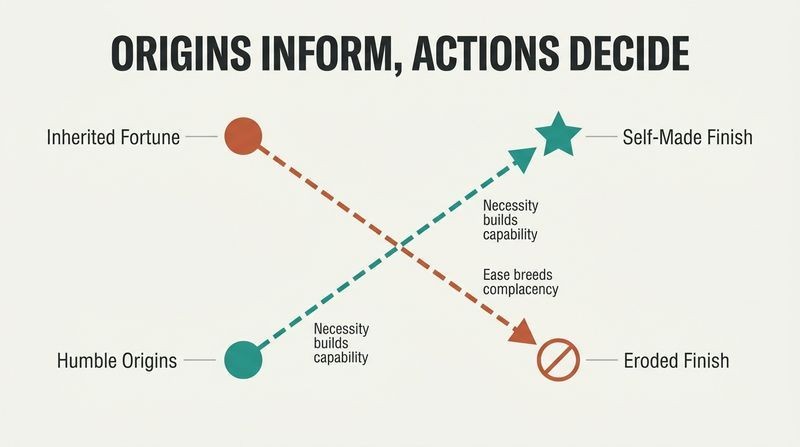
The claim echoes modern findings on 'shirtsleeves to shirtsleeves in three generations,' the observed tendency of family fortunes to evaporate by the grandchildren. Economists studying intergenerational mobility complicate the optimism, though: parental status remains one of the strongest predictors of a child's income across societies. Rockefeller concedes early advantage 'helps' while insisting it doesn't guarantee victory, a defensible middle position. What's striking is the parenting paradox he embodies: a man who concentrated unprecedented wealth simultaneously preached that wealth ruins heirs. That tension foreshadows the modern 'die with zero' and 'give while living' philosophies of affluent families wrestling with the same fear.
Engineer your luck through planning instead of waiting for fortune
Luck is the remnant of design. Borrowing a phrase he attributes to harvester magnate McCormick, Rockefeller insists fortune is manufactured, not gifted. His credo: do not live by God-given luck, live by planning luck. He illustrates with his conquest of oil refining, where falling prices were bankrupting refiners. Rather than lament, he planned, choosing Cleveland as his first battlefield and striking the strongest rival, Clark Payne, first, paying 400,000 dollars he admits was inflated.
A good plan has two prerequisites. Know your goal (what you want to become) and know your resources (money, status, relationships, ability). Within months twenty-two competitors fell under Standard Oil. Later, betting his own money on the smelly Lima oil field when directors balked proved the same point: vision plus preparation looks like luck to outsiders.
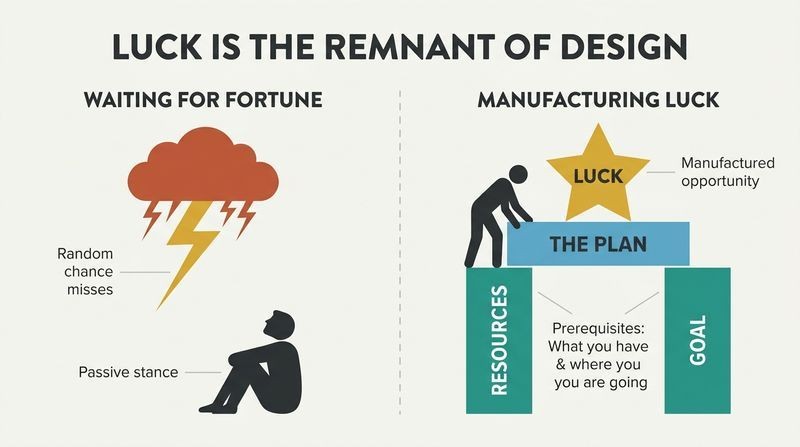
This anticipates the psychology of 'planned serendipity.' Research by Richard Wiseman on lucky people found they aren't supernaturally blessed; they create, notice, and act on chance opportunities because of openness and initiative. Rockefeller's insight that striking the strongest competitor first is also sound game theory: neutralizing the credible threat collapses the rest. A fair challenge: survivorship bias lurks here. Countless planners executed flawlessly and still lost to timing or capital they couldn't control. The honest reframe is that planning shifts probability, not certainty, a nuance the letters mostly respect with the phrase 'a good plan will affect luck.'
Decide work is play and your career becomes heaven
Attitude builds your own heaven or hell. Rockefeller retells a fable of a man in a luxurious afterlife who, denied any work, declares he'd rather be in hell, only to learn he already is. The lesson: losing work means losing happiness. His sharper image is three stonemasons asked what they're doing. One says he's chiseling stone and counting minutes until he goes home. The second says he's earning wages to feed his family. The third proudly says he's making a work of art.
Same labor, opposite lives. The man who assigns meaning feels fulfilled regardless of the task's size; the man who treats work as punishment feels exhausted before he starts. Rockefeller frames his own bookkeeping start not as drudgery but as fascination, and income as merely the by-product of work done well.
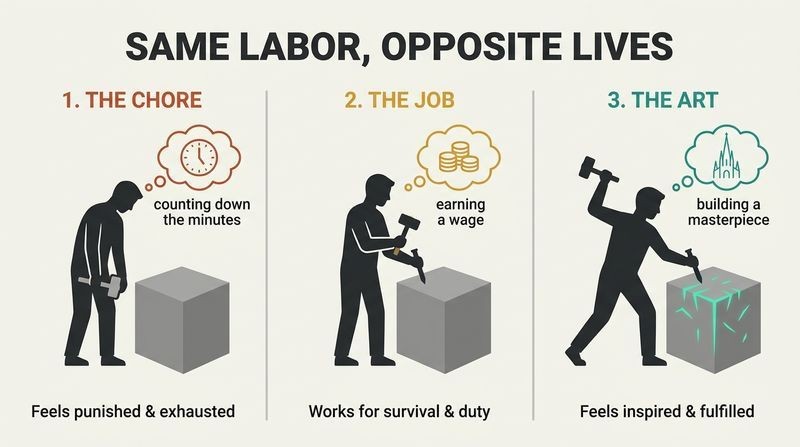
The stonemason parable maps almost perfectly onto Amy Wrzesniewski's organizational research distinguishing a 'job' (paycheck), a 'career' (advancement), and a 'calling' (meaning). Her studies found calling-oriented workers report higher satisfaction and even better health, independent of actual occupation, exactly the third mason. The deeper claim, that meaning is chosen rather than found in the task, aligns with Viktor Frankl's logotherapy. A useful caveat: this framing can be weaponized by employers to extract unpaid passion, the 'do what you love' trap that masks exploitation. Rockefeller's version stays personal and self-directed, which is where it holds up best.
An ordinary plan executed beats a brilliant plan abandoned
Action settles what thought cannot. Rockefeller hammers that knowledge without execution is empty talk. Even a flawed plan, actually carried out, beats a superb plan dropped halfway, because the first keeps moving. He warns against waiting for perfect conditions: those who wait for everything to be 100 percent safe and profitable never leave home, since near-perfection is the most life offers.
Habits are ropes you spin daily. He describes habit as a cord woven thread by thread until it's too thick to break, leading either to the peak or the trough. The proactive person ignites action through determination; the passive person hunts for excuses to procrastinate until a task becomes impossible. His prescription: kill words like 'tomorrow' and 'next week,' which mean 'never,' and eat the elephant one bite at a time.
This is a 19th-century articulation of what behavioral scientists now call the action-bias antidote and the planning fallacy. The 'ordinary plan executed' principle matches lean startup and 'bias toward action' doctrines in modern entrepreneurship, where shipping an imperfect product beats polishing a perfect one in private. The rope-of-habit metaphor predates but parallels Charles Duhigg's habit-loop work. One tension worth flagging: Rockefeller elsewhere praises patient deliberation ('let me wait before talking'). The reconciliation is that he separates strategic thinking from chronic procrastination, decide carefully, then execute relentlessly, a distinction many self-help books blur.
Spiritual bankruptcy, not financial loss, is the only fatal failure
Failure is fuel unless it becomes habit. After his son lost a million dollars, Rockefeller wrote that failure brands no one incompetent. He recalls his own first venture buying beans, ruined by frost and dishonest suppliers who added sand and straw, yet he advertised aggressively and turned a profit that year. His formula: Dream plus Failure plus Challenge equals Success.
The mind is the last thing you can lose. He invokes Edison, who reframed 10,000 failed experiments as 10,000 methods that don't work, and Lincoln, who lost election after election before the presidency, plus the stuttering Greek orator Demosthenes who lost his inheritance in court yet became history's remembered name. The danger is letting fear of failure become your motive, which Rockefeller calls a path to laziness and the true catastrophe: declaring mental bankruptcy.
The distinction between losing money and losing morale prefigures Carol Dweck's growth-versus-fixed mindset research: treating setbacks as information rather than verdicts predicts persistence and recovery. Edison's reframe is a textbook example of cognitive reappraisal, now a validated emotion-regulation technique in clinical psychology. The Lincoln 'list of failures' is partly mythologized (popular versions exaggerate the count), so readers should take it as motivational shorthand rather than biography. The strongest, least cliched idea here is that avoidance of failure, not failure itself, corrodes ability, because it quietly shrinks the range of opportunities a person will even attempt.
Faith is the father of success and confidence sets your ceiling
Belief, not hope, moves mountains. Rockefeller distinguishes faith from wishful hope: hope cannot win victories, but the attitude of 'I can do it' generates the abilities, skills, and energy that actually solve problems. He flatly rejects the cliche that failure is the mother of success, declaring instead that faith is its father. As a poor boy he was certain he'd become the richest man alive, and that conviction generated the plans to get there.
You become what you think you are. People who quietly believe they're second-tier sabotage themselves, producing 'true' inferior actions that others then mirror back. He pairs this with the size of thoughts: an average-talented optimist outperforms a brilliant pessimist, because concentration and self-belief account for roughly 95 percent of ability. Never, he warns, sell yourself cheaply.
Modern psychology gives this teeth through Albert Bandura's concept of self-efficacy, the belief in one's capacity to execute, which robustly predicts performance and persistence across domains. Robert Rosenthal's Pygmalion experiments confirm the social-mirror claim: expectations others hold (and we hold of ourselves) measurably shape outcomes. The caution is the line where confidence curdles into the Dunning-Kruger overconfidence trap or toxic positivity that ignores real risk. Rockefeller partly inoculates against this by insisting belief must generate concrete plans, not mere affirmation. The 'I can do it better' habit he describes is essentially deliberate practice's mental precondition: you must believe improvement is possible to pursue it.
Treat greed as honest aspiration; you have no right to stay poor
Greed renamed is the engine of achievement. Rockefeller embraces the 'greedy' label, arguing no society is built without it and that the subtext of greed, 'I want more,' drives politicians, parents, and businessmen alike. A business-school teacher's line that greed is good changed his destiny. He prefers the blunt word 'greed' to the polite 'ambition' because it forces honesty about motive.
Money is misread by the pious poor. He corrects a struggling gardener who quotes 'money is the root of all evil,' noting the verse condemns the love of money, not money itself. Money used to help family, friends, and society becomes a source of happiness and dignity. His rule: let money be your slave, never your master. Earning wealth through noble means, he insists, contributes more to mankind than virtuous poverty.
This is the most provocative and dated thread, reading like a Gilded Age precursor to Gordon Gekko's 'greed is good' speech. Adam Smith's invisible hand offers the steelman: self-interest, channeled through competition, can produce broad benefit. But behavioral economics and the 2008 crisis complicate unbounded acquisitiveness, showing greed unconstrained by ethics generates systemic harm, which Rockefeller's own monopolistic record illustrates. His semantic move, relabeling greed as aspiration, is psychologically shrewd: naming a drive honestly can reduce shame-driven self-sabotage. The 'love of money' biblical correction is exegetically accurate. The weakest point is treating wealth accumulation as near-automatic proof of social contribution, a claim antitrust history flatly disputes.
There is no free lunch; charity that breeds dependence cripples
Free food domesticates the wild. Rockefeller tells of an old man who captured fierce wild boars not by force but by leaving free grain, then slowly building a fence around the feeding spot until the animals, hooked on something for nothing, walked into the trap. The moral: feed a creature for free and you steal its wits, then its freedom. The same happens to humans.
Give a man crutches and you disable him. He argues that handing out money destroys the motivation to be thrifty and diligent, and that denying a person's dignity removes their destiny. His preferred aid is teaching the skill of fishing rather than giving fish. He caps it with a king's quest to distill all wisdom into one sentence: there is no free lunch in the world.
This 'teach to fish' philosophy anticipates fierce modern debates in development economics. The dependency critique has real evidence (poorly designed aid can distort local markets and incentives), but the counter-evidence is now substantial: Banerjee and Duflo's randomized trials and the success of unconditional cash transfers like GiveDirectly show recipients often invest, not idle. The wild-boar parable conveniently ignores structural poverty, where the issue is absent opportunity, not absent willpower. Rockefeller himself blurs this when he elsewhere says the poor are 'deprived of opportunities,' not lazy. The durable kernel is that aid should build capability and preserve dignity, a principle most contemporary philanthropy endorses.
Borrow boldly and accept risk, because safety first never builds wealth
Debt is a tool, not a lifeboat. Rockefeller reframes borrowing as creating luck rather than escaping crisis. Buying and selling for a hundred-dollar profit beats a one-dollar margin, so he mortgaged his business to expand in Cleveland and built shocking results. The discipline that made it safe was honesty: he treated contracts as sacred, never defaulted, and won banker Stillman's instant backing after a refinery fire because his character was collateral.
Higher risk, higher return. Breaking from his timid partner Clark, he auctioned their company and bid up to 72,500 dollars, more than he thought it was worth, to win freedom and become Cleveland's largest refiner at twenty-one. His rule for risk without ruin: plan boldly, implement carefully. Standing still guarantees regression; you must choose between caution and reward.
The leverage logic is sound corporate finance: debt amplifies returns on equity when returns exceed borrowing costs. But the framing omits the symmetry, leverage equally amplifies losses, the lesson buried in every financial crisis from 1929 to 2008. Rockefeller's saving discipline is the honesty-as-collateral insight, which maps onto modern relationship banking and reputation economics: trust lowers transaction costs and unlocks capital. His maxim 'plan boldly, implement carefully' captures the asymmetry venture investors prize: cap the downside, leave the upside open. The blind spot is survivorship again, his confident bets are remembered precisely because they paid; the equally bold who went bankrupt wrote no letters.
Compete to win decisively, but only through ethical means
Don't meet competition, end it. Rockefeller describes destroying rivals like Benson, whose pipeline threatened him, by flooding tank manufacturers with orders so Benson couldn't store oil, then slashing transport prices to poach his customers. Yet he refused his lieutenant's plan to sabotage Benson physically, insisting on losing gloriously rather than winning by deceit, because unethical tactics destroy dignity and end your luck early. 'Hell is full of good people,' he warns: excessive kindness in business is a losing strategy.
Patience is a competitive weapon. When a new partner's family name displaced his from the company title, he swallowed the insult, worked harder, and three years later forced the man out and restored his name. Only by enduring what others cannot, he says, can you do what others cannot.
The combination is more sophisticated than pure ruthlessness. Game theory shows that a reputation for fair dealing sustains the repeated cooperation that long-term profit requires, exactly Rockefeller's claim that dirty tricks 'cannot be a reliable corporate strategy.' His tank-monopoly tactic, though, is textbook predatory anticompetitive behavior, the very conduct that got Standard Oil broken up in 1911, so his ethical self-portrait should be read skeptically against the historical record. The patience insight aligns with research on emotional regulation and delayed gratification (the marshmallow studies' descendants): the capacity to absorb provocation without reactive decisions is a measurable predictor of negotiation success and long-term outcomes.
Lead by stating purpose and refusing blame, not by issuing commands
Confess your purpose to win loyalty. Calling himself a teleologist, Rockefeller sets explicit goals before every meeting and openly tells subordinates his motives and expectations. Transparency signals trust, and trust earns emotional loyalty, which he calls the beginning of willing service. He contrasts this with command-and-control leaders who, like a doomed monarch, underestimate people and drain their energy.
Banish blame and excuses. His rule at Standard Oil was that no one blames anyone for any reason; instead, the question is always 'What are my responsibilities?' and 'What can make this better?' He notes that in dialogue the listener, not the speaker, holds the power, and that giving 100 percent attention lowers defenses and surfaces truth. He also leads from strength: he reused the talented alcoholic Archibald, hunting each person's best ability rather than their flaws.
This anticipates a great deal of modern management science. Stating purpose openly maps onto Simon Sinek's 'start with why' and to research showing transformational leaders who communicate vision generate higher discretionary effort. The no-blame culture parallels Amy Edmondson's 'psychological safety,' the strongest predictor of team performance in Google's Project Aristotle, where people who feel safe to admit error outperform. 'The listener holds the power' is validated by active-listening research in negotiation and therapy. The strength-based staffing echoes Gallup's strengths movement. The one caution: 'treat subordinates as fools' to avoid their misreading your motives sits awkwardly beside the respect ethic, a residue of the era's paternalism.
Your diamonds are buried in your own backyard, not abroad
Stop searching far for what's near. Rockefeller retells the Acres of Diamonds parable of Al Hafid, a contented, wealthy Persian who, after a monk describes the riches a diamond mine could bring, sells his farm to hunt diamonds across the world, spends everything, and drowns himself in despair as a beggar. The man who bought his farm later found, in the stream on that very land, the diamonds of Golconda, history's greatest mine. The seeds of success, Rockefeller tells a young man begging for capital, are already beside you; what you lack is not money but self-belief.
Play the humble fool. He pairs this with strategic humility: pretending not to know invites teaching, and hiding cleverness disarms rivals. Hardship, not textbooks, forges real ability, so he started his own son on small tasks.
The Al Hafid story comes from Russell Conwell's famous 'Acres of Diamonds' lecture, delivered thousands of times in the same era, a cultural touchstone Rockefeller folds in seamlessly. Its message, that opportunity hides in the familiar, anticipates the modern entrepreneurial maxim to 'solve your own problem' and the research finding that domain expertise (your own backyard) breeds more viable ventures than chasing distant hype. The 'play the fool' counsel resonates with Nassim Taleb's praise of strategic underestimation and with negotiation tactics of feigned ignorance to extract information. The tension: humility as performance can shade into manipulation. Read charitably, it's a corrective to the ego that blinds smart people to learning.
Analysis
This book is not history; it is a compilation, translated and edited, of letters attributed to John D. Rockefeller, written in a voice too aphoristic and self-aware to be taken as documentary. Read correctly, it belongs to the wisdom-literature genre, closer to Marcus Aurelius repurposed for capitalism than to a verified archive. Its structure (38 standalone letters) makes it an anthology of maxims rather than a cumulative argument, which means its power lies in repetition: the same handful of convictions, restated through different Standard Oil war stories, until they harden into worldview.
The worldview is a coherent and uncompromising meritocratic individualism. Destiny is self-authored; luck is engineered; failure is data; confidence is causal; wealth is a moral duty rather than a guilty privilege. What gives the letters their charge is their refusal of comfortable pieties: greed is honestly named, kindness is treated as a competitive liability, and charity is attacked as a generator of dependence. These are genuinely contrarian positions, and they remain useful precisely because they puncture sentimentality.
Yet the book must be read against its protagonist's record. The same tactics it frames as legitimate competition (engrossing supplies, predatory pricing, secret rail rebates) were judged illegal monopolization, and Standard Oil was dissolved in 1911. The letters' self-portrait as an ethical, conscience-driven dealer sits in tension with that history. The reader's task is to extract the transferable psychology (action bias, self-efficacy, planned luck, strength-based leadership, purpose-driven management) while discounting the self-justifying gloss on anticompetitive conduct.
What survives scrutiny best is the leadership material in the later letters, which uncannily anticipates psychological safety, transformational leadership, and strengths-based management decades early. What dates worst is the social Darwinism and the dismissal of structural poverty. The honest verdict: a flawed narrator delivering a surprising number of durable truths, valuable as provocation and self-discipline manual, dangerous as economic ethics.
Review Summary
The 38 Letters from J.D. Rockefeller to His Son receives overwhelmingly positive reviews, with readers praising its wisdom, insights, and timeless advice. Many find it inspiring and plan to reread it multiple times. Reviewers appreciate Rockefeller's concise writing style and the book's historical value. Several readers recommend it as a must-read for business and life lessons. Some criticize the translation quality, noting it may not be Rockefeller's original letters. Despite this, most readers find the content valuable and applicable to modern life, with many highlighting specific lessons that resonated with them.
People Also Read








FAQ
What's "The 38 Letters from J.D. Rockefeller to His Son" about?
- Collection of Letters: The book is a compilation of 38 letters written by J.D. Rockefeller to his son, offering insights into his perspectives, ideology, and wisdom.
- Guidance and Advice: These letters serve as a guide for his son, providing advice on various aspects of life, business, and personal development.
- Themes of Success: The letters cover themes such as perseverance, planning, competition, and the importance of self-belief in achieving success.
- Historical Context: Written in the late 19th and early 20th centuries, the letters also reflect the historical and economic context of Rockefeller's time.
Why should I read "The 38 Letters from J.D. Rockefeller to His Son"?
- Timeless Wisdom: The book offers timeless advice on personal and professional success from one of the most successful businessmen in history.
- Practical Insights: Readers can gain practical insights into entrepreneurship, leadership, and strategic thinking.
- Inspirational Content: The letters are filled with motivational content that encourages readers to pursue their goals with determination and resilience.
- Historical Perspective: It provides a historical perspective on the business practices and philosophies of the late 19th and early 20th centuries.
What are the key takeaways of "The 38 Letters from J.D. Rockefeller to His Son"?
- Perseverance and Hard Work: Success is achieved through perseverance and hard work, regardless of one's starting point.
- Planning and Strategy: Luck is not random; it is the result of careful planning and strategic thinking.
- Self-Belief: Believing in oneself is crucial for overcoming challenges and achieving success.
- Value of Failure: Failure is a stepping stone to success, as long as it does not become a habit.
What are the best quotes from "The 38 Letters from J.D. Rockefeller to His Son" and what do they mean?
- "Starting points do not determine your end point": This quote emphasizes that one's origins do not dictate their destiny; actions and efforts do.
- "Luck depends on planning": It highlights the idea that luck is not a matter of chance but a result of strategic planning and preparation.
- "The greatest reward for our hard work is not what we get, but what we will become": This underscores the importance of personal growth and development over material gains.
- "There is no free lunch in the world": A reminder that success requires effort and that nothing valuable comes without hard work.
How does J.D. Rockefeller define success in his letters?
- Action-Oriented: Success is defined by taking action and implementing ideas rather than just having them.
- Self-Reliance: It involves being self-reliant and not depending on others for one's achievements.
- Continuous Improvement: Success is a continuous process of setting and achieving goals, always striving for better.
- Moral Integrity: Maintaining moral integrity and honesty is crucial in the pursuit of success.
What advice does J.D. Rockefeller give about handling failure?
- Learning Opportunity: View failure as a learning opportunity and a chance to improve.
- Avoiding Habitual Failure: Ensure that failure does not become a habit by learning from mistakes and moving forward.
- Optimism in Adversity: Maintain an optimistic outlook, seeing opportunities even in difficult situations.
- Resilience: Develop resilience to bounce back from setbacks and continue pursuing goals.
How does J.D. Rockefeller emphasize the importance of planning in his letters?
- Strategic Planning: He stresses the importance of strategic planning in achieving success and creating opportunities.
- Designing Luck: Planning is seen as a way to design one's luck and influence outcomes.
- Visionary Thinking: Encourages thinking ahead and anticipating challenges and opportunities.
- Resource Management: Effective planning involves understanding and managing available resources to achieve goals.
What role does self-belief play in J.D. Rockefeller's philosophy?
- Foundation of Success: Self-belief is considered the foundation of success, driving individuals to pursue their goals.
- Confidence and Action: Confidence in one's abilities leads to decisive action and better decision-making.
- Overcoming Doubt: Self-belief helps overcome doubt and fear, enabling individuals to take risks and seize opportunities.
- Inspiring Others: A strong sense of self-belief can inspire and motivate others to follow and support one's vision.
How does J.D. Rockefeller view competition and its role in business?
- Healthy Competition: Competition is seen as a vital part of business that drives innovation and improvement.
- Strategic Advantage: Understanding and leveraging competition can provide a strategic advantage.
- Determination to Win: Emphasizes the importance of determination and resilience in overcoming competitors.
- Ethical Conduct: Advocates for ethical conduct in competition, avoiding unscrupulous methods.
What lessons does J.D. Rockefeller impart about wealth and responsibility?
- Wealth as Responsibility: Wealth is viewed as a responsibility to benefit society and contribute positively.
- Avoiding Greed: Warns against the dangers of greed and the importance of using wealth wisely.
- Philanthropy: Encourages using wealth for philanthropic purposes to improve the lives of others.
- Moral Obligation: Wealth comes with a moral obligation to act ethically and responsibly.
How does J.D. Rockefeller address the concept of leadership in his letters?
- Leading by Example: Leadership involves setting an example and inspiring others through actions.
- Empowering Others: Effective leaders empower their subordinates and trust them to take responsibility.
- Clear Purpose: Leaders should have a clear purpose and communicate it effectively to their team.
- Adaptability: Emphasizes the importance of adaptability and strategic thinking in leadership.
What is J.D. Rockefeller's perspective on personal growth and development?
- Continuous Learning: Advocates for continuous learning and self-improvement as key to personal growth.
- Embracing Challenges: Encourages embracing challenges as opportunities for growth and development.
- Self-Reflection: Stresses the importance of self-reflection and understanding one's strengths and weaknesses.
- Setting Goals: Personal growth is achieved through setting and pursuing meaningful goals.
Download PDF
Download EPUB
.epub digital book format is ideal for reading ebooks on phones, tablets, and e-readers.








































