

Key Takeaways
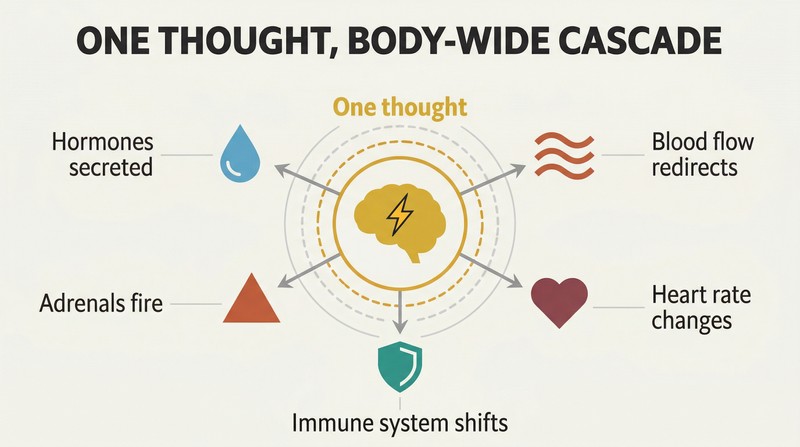
A single thought triggers a chemical cascade across your entire body
Every thought alters your chemistry. Dispenza opens the book with a striking demonstration: have any thought — angry, joyful, arousing — and your pancreas secretes new hormones, your adrenals fire, your immune system recalibrates, your heart rate shifts, and blood flow redirects to your capillaries. All before you lift a finger. Behind the scenes, some 100,000 chemical reactions occur every second in each of your 70 – 100 trillion cells, orchestrated by an intelligence you never consciously direct.
The implication is staggering. If one stray thought produces this much physiological change, imagine what decades of habitual thinking patterns are doing. The same neural pathways you fire daily — about worry, inadequacy, or resentment — are sculpting your biology one chemical cascade at a time. Thoughts don't just reflect your state; they manufacture it.
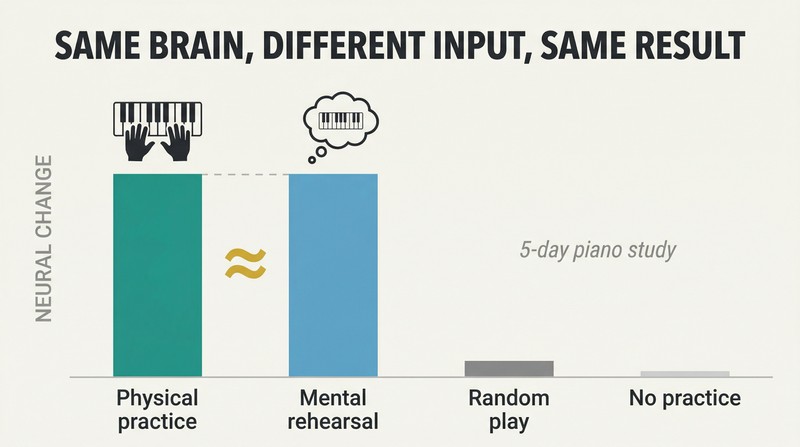
Mental rehearsal rewires the brain as effectively as physical practice
The piano study is the proof. In a five-day experiment, one group physically practiced piano exercises two hours daily, while another only mentally rehearsed the same exercises — no keyboard. Brain scans revealed the mental rehearsal group developed nearly identical neural changes in the same brain region as the physical practice group. A third group that played randomly showed almost no change; the control group showed none.
Imagined effort strengthens the body. In a separate study, participants who mentally rehearsed finger-strengthening exercises for four weeks gained 22% finger strength — versus 30% for the physical group and zero for controls. Dispenza argues this is the mechanism behind spontaneous healing: if focused thought alone can grow muscle, it can reshape attitudes, dissolve habits, and restore health.
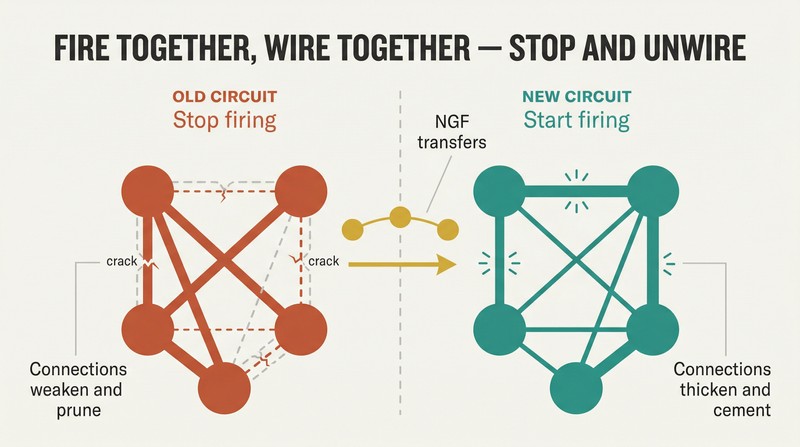
Neurons that fire together wire together — stop firing and they unwire
Hebbian learning is the brain's wiring law. When neurons repeatedly fire simultaneously, they release neural growth factor (NGF) — a chemical fertilizer that cements their connections. Practice anger daily, and those circuits thicken. The stronger the repetition, the more NGF gets produced, the more hardwired the pattern becomes. This is how any habit, skill, or emotional tendency moves from conscious effort to autopilot.
The corollary is your escape hatch. When you stop activating old circuits, they weaken and prune away. NGF gets recycled from abandoned neural networks to newly forming ones — a literal shuffle of building materials. Each time you interrupt a habitual thought loop and fire a new pattern instead, you're simultaneously dismantling the old self and constructing the new one. The brain accommodates your free will by erasing old footprints and laying new ones.
You're chemically addicted to your own emotional states
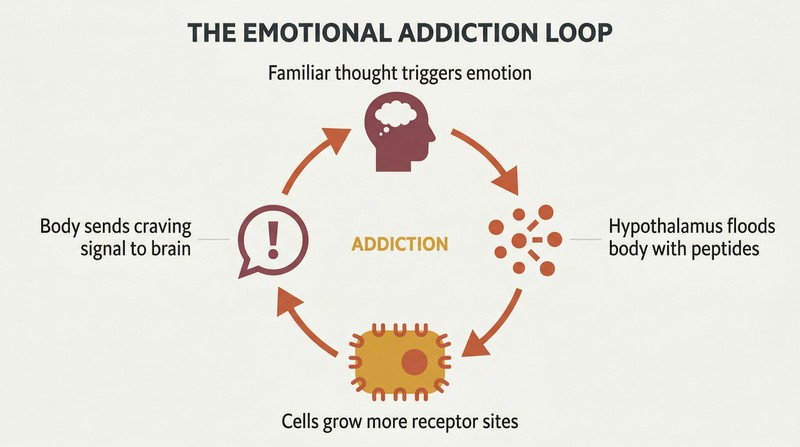
Your cells crave familiar chemicals. Every emotion triggers specific peptides from the hypothalamus that travel to cells throughout the body. Over years of repetitive anger, victimhood, or anxiety, cells up-regulate — growing additional receptor sites for those specific chemicals. The body then sends signals to the brain demanding its fix, triggering the thoughts that produce more of the same chemistry. The nagging voice in your head urging you back toward old patterns is your body doing the thinking.
Relationships supply the cocktail. People stay in toxic relationships not from love but from neurochemical dependency. Breakup heartache may literally be chemical withdrawal. And when people leave one dysfunctional partner, they frequently find another who produces the same emotional chemistry — because their cells are still placing the same order.
Chronic stress is survival mode slowly cannibalizing your body
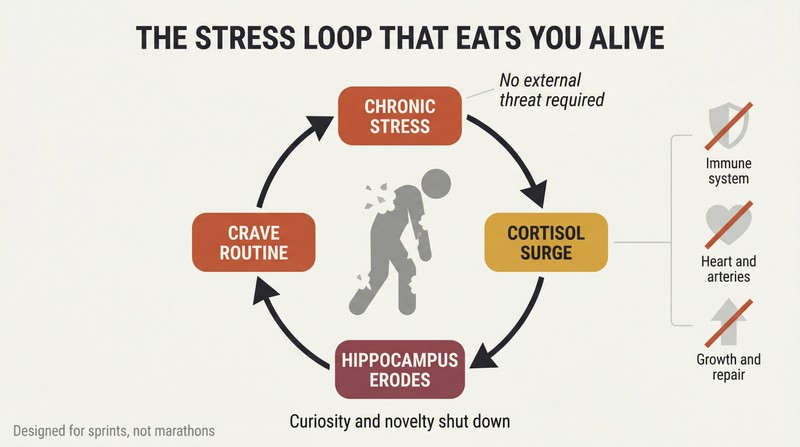
Survival mode was designed for sprints. Fight-or-flight evolved to escape predators — a burst of adrenaline, diverted blood flow, heightened senses. But when that system runs chronically from daily worries about deadlines and finances, the body cannibalizes itself. Cortisol degenerates neurons in the hippocampus, the immune system shuts down, blood pressure stays elevated and damages artery walls, and growth-and-repair processes go offline. An estimated 90% of doctor visits are stress-related.
The cruelest feedback loop: stress chemicals damage the hippocampus — the brain structure that drives curiosity and novelty-seeking. Without it functioning well, we crave routine instead of adventure, locking us deeper into survival. We can even trigger the full stress response without any external stressor — just by thinking about a future worry or a past trauma.
By your mid-thirties, feelings hijack thinking entirely
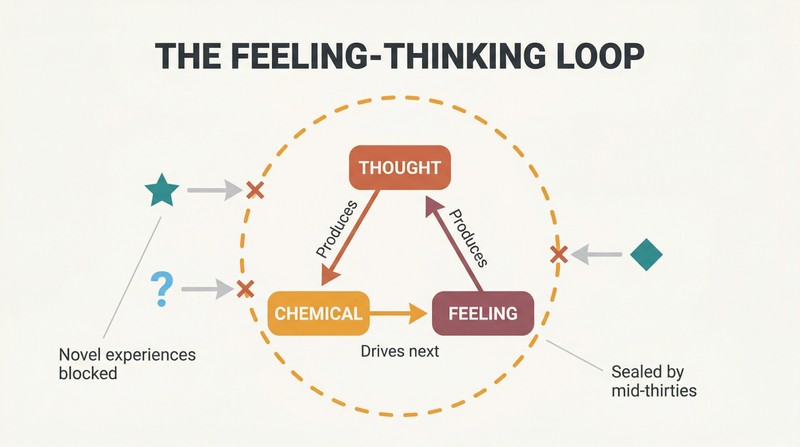
The feedback loop closes. By our late twenties to mid-thirties, we've sampled enough of life's emotional palette that we can predict how most situations will feel. The cycle becomes self-reinforcing: thoughts produce chemicals, chemicals produce feelings, feelings drive the next round of thoughts. We begin choosing — or avoiding — experiences based solely on whether we can forecast the accompanying emotion.
The unknown becomes the enemy. Novel experiences might produce unfamiliar feelings, so they trigger survival mechanisms. We avoid the new and cling to the predictable — same job, same arguments, same routine. Dispenza argues this is when mortgages, family obligations, and neurochemistry conspire to trap people in a perpetual present that's really just a biochemical replay of the past. Creating a different future requires producing emotions you haven't felt yet.
Wake up your frontal lobe — it's the CEO napping while you run on autopilot
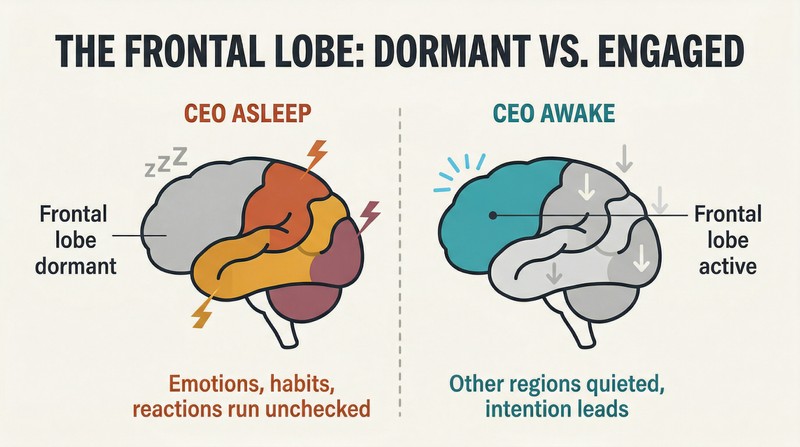
Evolution gave humans an oversized CEO. The frontal lobe comprises 30 – 40% of the human neocortex — versus 3.5% in cats and 11 – 17% in chimpanzees. It's the seat of intention, free will, impulse control, and creative thought. When activated, it literally turns down electrical activity in other brain regions — silencing emotional centers, sensory processing, and motor circuits so you can hold a single thought without distraction.
When it's dormant, you're on autopilot. Dispenza draws a provocative parallel: lobotomy patients who lost frontal lobe function became routine-obsessed, unable to learn, emotionally volatile, and incapable of follow-through. He argues that emotionally addicted people exhibit strikingly similar traits — not from surgery, but from chronically failing to engage the one brain region designed to override survival programming.
Make your inner vision more real than the external world
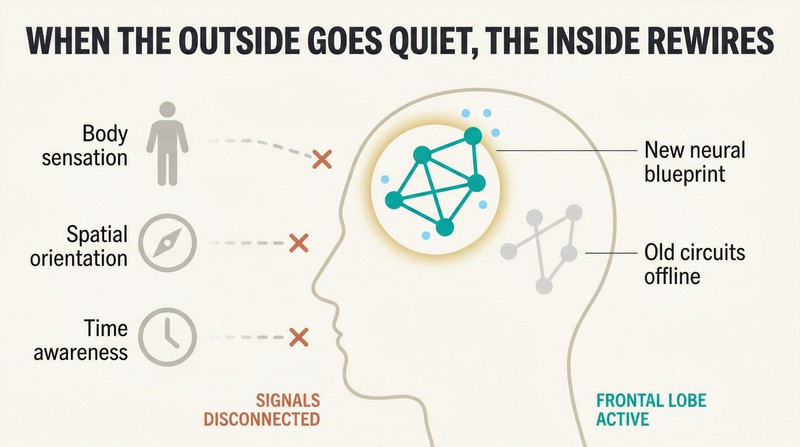
Healers shared one practice. Studying people who achieved spontaneous remissions, Dispenza found they all entered extended periods of such intense inner focus that they lost awareness of body, surroundings, and time. Functional brain scans confirm this: during deep concentration, circuits for physical sensation, spatial orientation, and temporal awareness go quiet. The old personality — with all its hardwired associations — effectively goes offline.
New patterns install without resistance. Dispenza describes this state as becoming "a no-body, a no-thing, in no-time." When nothing competes with the internal vision, the brain forges new neural connections unimpeded by familiar circuits. This isn't mysticism — it's the frontal lobe doing what it evolved to do: making thought the dominant reality so the brain can record a new blueprint ahead of actual experience.
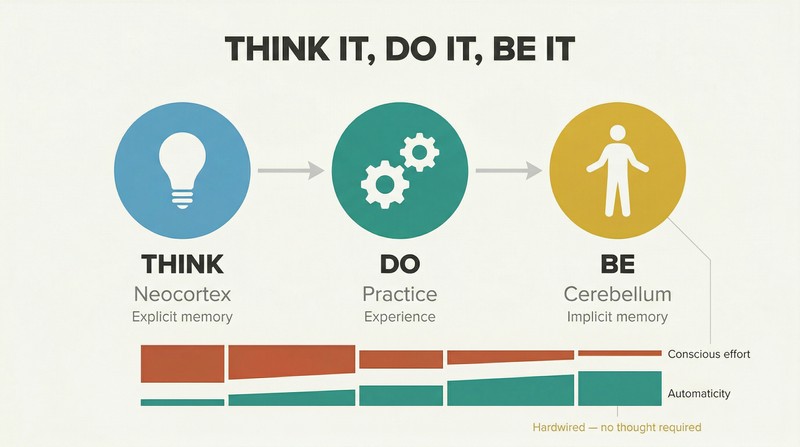
Think it, do it, be it — the only sequence that rewires permanently
Three stages map to the brain's memory systems.
1. Thinking = learning new knowledge, stored as explicit memory in the neocortex
2. Doing = applying that knowledge through new behavior to create experiences
3. Being = when the pattern becomes so automatic it transfers to the cerebellum as implicit memory — no conscious thought required
Masters describe peak performance as "thoughtless." Brain scans of expert archers show neocortical activity ceases when they align with the bull's-eye — the cerebellum has taken over. The same principle applies to emotional states. Dispenza's goal is making evolved attitudes — compassion, confidence, joy — as implicit as tying your shoes. Once hardwired to the cerebellum, your new self can't be easily hijacked by the environment or old chemical cravings.
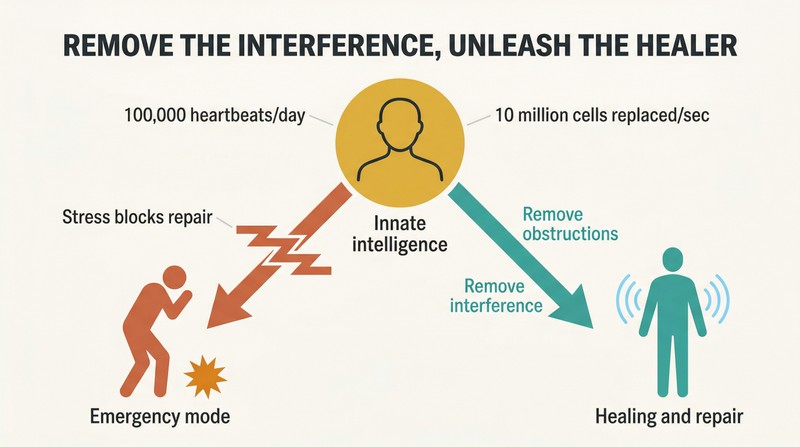
The intelligence running your 100 trillion cells can heal you — let it
Dispenza is his own proof. At 23, he shattered six vertebrae in a triathlon accident — his T-8 vertebra was 60% collapsed with bone fragments pressing against his spinal cord. Four surgeons recommended Harrington rod surgery; without it, they estimated greater than 50% chance of permanent paralysis. He refused. Using three daily visualization sessions, raw-food nutrition, and a self-designed incline board protocol, he was walking at nine and a half weeks and treating patients at ten. No body cast, no deformity, no paralysis.
The same force that manages your heartbeat over 100,000 times daily and replaces 10 million cells every second already knows how to heal tissue. Chronic stress and emotional addiction divert this intelligence from repair to emergency response. Remove the interference, and the body does what it was designed to do.
Analysis
Dispenza's 2007 work occupies a peculiar position in the neuroscience-adjacent self-help canon — it arrived just before the neuroplasticity research explosion (Doidge's The Brain That Changes Itself published the same year) and predated the mainstream mindfulness revolution by nearly a decade. Its strongest contributions are genuinely prescient: the neurochemistry of emotional addiction, the Hebbian mechanism of habit formation and dissolution, and the stress-disease cascade are explained with more biological specificity than most popularizations manage.
The emotional addiction framework is Dispenza's most original contribution. His mechanism — cells up-regulating receptor sites for familiar stress peptides until the body literally demands its chemical fix — provides a biological explanation for why insight-based therapy often fails to produce lasting behavioral change. The implication is radical: you cannot think your way out of a state your body is chemically enforcing. You must interrupt the chemistry itself through sustained cognitive practice that starves old circuits while building new ones.
Where Dispenza's framework falters is in its epistemological boundary management. He moves seamlessly from peer-reviewed neuroplasticity research to chiropractic innate intelligence philosophy to Ramtha's School of Enlightenment teachings to quantum consciousness speculation — without clearly marking where evidence ends and metaphysics begins. His spontaneous healing case studies, while compelling narratively, lack the controlled methodology that would satisfy clinical skeptics.
The book also suffers structurally: roughly 60% is neuroscience education that, while necessary for building the reader's model, delays the actionable content until the final chapters. A reader seeking the practical methodology must wade through extensive anatomy lessons about dendrites, the homunculus, and the autonomic nervous system.
Yet the synthesis is genuinely valuable. By connecting Hebbian learning, hypothalamic peptide production, frontal lobe function, and the explicit-to-implicit memory conversion into one coherent model, Dispenza gives readers something rare: a mechanistic explanation for why change feels impossible and a biologically grounded protocol for making it happen anyway. The thinking-doing-being progression remains one of the clearest frameworks for understanding the journey from intellectual insight to embodied transformation.
Review Summary
Evolve Your Brain receives mixed reviews. Many praise its scientific approach to neuroplasticity and potential for personal transformation. Readers find it insightful for understanding brain function and habits. However, some criticize its length, repetitiveness, and dense scientific content. The book's emphasis on meditation and visualization techniques is appreciated by some but questioned by others. Critics argue it borders on pseudoscience, while supporters view it as life-changing. Overall, it's seen as thought-provoking but potentially challenging for casual readers.
People Also Read






Glossary
Hebbian learning
fire together, wire togetherDonald Hebb's theory that when neurons repeatedly fire simultaneously, their synaptic connections strengthen through chemical changes called long-term potentiation. Dispenza extends the principle to its corollary: neurons that no longer fire together no longer wire together—explaining how interrupting habitual thought patterns causes old neural circuits to weaken and prune away. Central to this process is the release of neural growth factor (NGF), which cements active connections and can be recycled from abandoned ones.
Neuroplasticity
brain's ability to rewire itselfThe brain's capacity to form new synaptic connections, modify existing ones, and reorganize its structure throughout life in response to learning, experience, and focused attention. Dispenza uses this concept to challenge the older scientific view that the adult brain is essentially fixed, arguing instead that deliberate mental practice can reshape neural architecture at any age.
Neural growth factor (NGF)
chemical fertilizer for neural connectionsA neurotrophic chemical released when neurons repeatedly fire together. NGF travels in the opposite direction of nerve transmission—from the receiving neuron back to the sending neuron—causing new dendrite branches to sprout and strengthening synaptic bonds. Dispenza emphasizes that NGF can be recycled from pruned old circuits to cement newly forming ones during the change process.
Semantic memory
intellectual knowledge without experienceKnowledge stored in the brain as factual, philosophical data that has not been personally experienced through the senses. Examples include memorized phone numbers, textbook definitions, and lecture material. In Dispenza's framework, semantic memory represents the 'thinking' stage of learning—necessary but insufficient for lasting change, since it lacks the emotional and sensory reinforcement that creates long-term neural connections.
Episodic memory
experiential memory with emotional signaturesMemories formed through personal experiences involving the five senses, tied to specific people, places, things, times, and events. Because they carry emotional and sensory associations, episodic memories are stored long-term more readily than semantic memory. Dispenza considers them the 'doing' stage of learning, where the body becomes involved and feelings chemically seal the memory into the brain's architecture.
State of being
self-sustaining thinking-feeling feedback loopDispenza's term for when the cycle between thoughts and feelings becomes chemically self-reinforcing: thoughts produce peptides that create feelings, feelings signal the brain to generate matching thoughts, and the body maintains a stable chemical baseline. Any persistent emotional condition—insecurity, anger, joy—can become a state of being that defines a person's baseline identity and resists change.
Mental rehearsal
focused cognitive practice of new selfDispenza's core technique: mentally envisioning and rehearsing a new behavior, attitude, or identity with such focused concentration that the brain forms the same neural circuits as if the experience were physically occurring. Requires using the frontal lobe to quiet sensory, motor, and emotional brain centers, and holding the new ideal until it becomes more real than the external environment. Research shows this process produces measurable physical changes in the brain and body.
Box of the personality
neural boundaries of habitual identityDispenza's metaphor for the limited set of hardwired neural networks that define a person's habitual thoughts, feelings, and behaviors. The boundaries of the box are familiar feelings—we resist experiences whose emotional outcomes we cannot predict. Thinking 'inside the box' means firing only established patterns; thinking 'outside' requires activating unfamiliar neural combinations through the frontal lobe.
Dual-brain processing
novel right hemisphere, routine leftBased on Elkhonon Goldberg's model, this describes how the brain's two neocortical hemispheres handle learning: novel or unfamiliar information is initially processed predominantly in the right hemisphere, then transfers to the left hemisphere as it becomes familiar and routine. Brain scans show corresponding blood flow shifts during learning tasks, supporting the idea that humans are structurally wired to convert unknowns into knowns.
Innate intelligence
body's self-organizing healing forceA concept from chiropractic philosophy that Dispenza adopts as foundational: the subconscious intelligence that manages all automatic bodily functions—heartbeat, digestion, cell reproduction, immune response, DNA repair—without conscious direction. Dispenza argues this intelligence already possesses the capacity to heal the body from disease, but chronic stress and emotional addiction divert its resources from repair to emergency survival response.
Priming
unconscious triggers activating automatic behaviorsAs Dispenza uses it: the process by which environmental stimuli unconsciously activate implicit memory patterns and automatic behavioral responses without conscious awareness. A brief sensory cue can roll out an entire cascade of associated thoughts, feelings, and actions. Dispenza argues that mental rehearsal can function as deliberate self-priming—preloading the brain with evolved responses so they fire automatically instead of survival-based reactions.
FAQ
What's Evolve Your Brain: The Science of Changing Your Mind about?
- Focus on Change: The book explores the connection between thoughts, consciousness, and the brain's physical structure, emphasizing how changing our mindset can lead to significant life and health changes.
- Neuroscience and Personal Growth: It combines scientific research with practical advice on harnessing the brain's power to create a new self, discussing neuroplasticity and how it can be used to our advantage.
- Mind-Body Connection: Dr. Joe Dispenza illustrates how our thoughts and emotions influence our physical health, arguing that by changing our thoughts, we can change our reality.
Why should I read Evolve Your Brain?
- Empowerment Through Knowledge: The book provides insights into how our brain works and how we can take control of our thoughts and emotions, empowering readers to make positive changes.
- Practical Techniques: Dr. Dispenza offers practical methods, such as mental rehearsal, to help readers break free from negative patterns and create a more fulfilling life.
- Scientific Backing: Grounded in scientific research, the book is credible and informative, with methods based on real neurological principles.
What are the key takeaways of Evolve Your Brain?
- Neuroplasticity is Key: The brain's ability to change and adapt is central to personal transformation, allowing readers to rewire their brains for better outcomes.
- Mind Over Matter: Our thoughts can influence our physical reality, and by changing our mindset, we can alter our experiences and health outcomes.
- Mental Rehearsal: This technique is crucial for creating new neural pathways, allowing individuals to visualize and practice desired behaviors and attitudes.
What are the best quotes from Evolve Your Brain and what do they mean?
- "Thoughts are the primary cause of our reality.": This quote underscores the book's central theme that our thoughts shape our experiences, emphasizing the power of mindset.
- "Neurons that fire together, wire together.": It encapsulates the principle of Hebbian learning, highlighting the importance of repetition in forming lasting memories and habits.
- "The power that made the body, heals the body.": Reflects the belief in an innate intelligence within us that can facilitate healing and transformation through consciousness.
How does Joe Dispenza define neuroplasticity in Evolve Your Brain?
- Ability to Rewire: Neuroplasticity refers to the brain's ability to reorganize itself by forming new neural connections throughout life, allowing for learning and adaptation.
- Changing Old Patterns: By consciously focusing on new thoughts and experiences, we can break free from old, limiting patterns and create healthier mental frameworks.
- Practical Application: The book provides methods for harnessing neuroplasticity, such as mental rehearsal and mindfulness, to facilitate personal growth and healing.
How does Evolve Your Brain explain the mind-body connection?
- Thoughts Affect Physiology: The book discusses how our thoughts and emotions can trigger physiological responses, influencing physical health and well-being.
- Chemical Responses: Every thought produces chemicals in the brain that affect our feelings and bodily functions, which can either promote health or contribute to disease.
- Healing Through Awareness: By becoming aware of this connection, individuals can manage their thoughts and emotions to promote healing and health.
What methods does Joe Dispenza suggest for changing one’s mind in Evolve Your Brain?
- Mental Rehearsal: Visualizing desired outcomes and experiences can help rewire the brain and create new neural pathways.
- Mindfulness and Awareness: Cultivating awareness of thoughts and emotions allows interruption of negative patterns and replacement with positive ones.
- Emotional Intelligence: Understanding and managing emotions can lead to healthier responses and behaviors, facilitating personal growth.
How does Evolve Your Brain address emotional addiction?
- Understanding Emotional Patterns: Many individuals become addicted to their emotional states, often repeating negative patterns that affect health and well-being.
- Breaking the Cycle: The book provides insights into recognizing and breaking free from these emotional addictions by changing thought patterns and fostering new emotional responses.
- Empowerment through Change: Addressing emotional addiction allows readers to reclaim their power and create a more balanced emotional state, leading to improved health and happiness.
What is the significance of the frontal lobe in Evolve Your Brain?
- Control Center: The frontal lobe is responsible for higher cognitive functions, including decision-making, impulse control, and planning, playing a crucial role in regulating behavior and emotions.
- Facilitates Change: Activating the frontal lobe allows breaking free from emotional addictions and habitual patterns, enabling conscious choice of responses.
- Connection to Intent: It is essential for setting goals and aligning actions with desired outcomes, influencing personality development.
How does mental rehearsal work according to Evolve Your Brain?
- Visualization Technique: Mental rehearsal involves visualizing oneself performing a desired action or behavior, helping to create new neural pathways in the brain.
- Mind-Body Connection: The brain does not differentiate between actual experiences and vividly imagined ones, so mental rehearsal can lead to real changes in behavior and emotional responses.
- Practice Makes Perfect: Repeatedly engaging in mental rehearsal strengthens neural connections associated with new behavior, making it easier to perform in real-life situations.
How can I apply the concepts from Evolve Your Brain in my daily life?
- Practice Mindfulness: Incorporate mindfulness techniques to become more aware of thoughts and emotions, allowing conscious choices about responses.
- Engage in Mental Rehearsal: Use visualization techniques to mentally rehearse desired outcomes, helping to create new neural pathways and reinforce positive behaviors.
- Set Intentions: Begin each day by setting clear intentions for how you want to think, feel, and act, aligning consciousness with goals for personal transformation.
What are the challenges in changing one’s mindset as discussed in Evolve Your Brain?
- Resistance to Change: The body often resists change due to established neural pathways and emotional addictions, making it difficult to adopt new behaviors or attitudes.
- Emotional Attachments: Emotional attachments to past experiences can hinder the ability to move forward, requiring conscious effort and mental rehearsal to overcome.
- Need for Consistency: Consistency in practicing new thoughts and behaviors is crucial, as without regular reinforcement, it is easy to revert to old habits and ways of thinking.
About the Author
Other books by Joe Dispenza

Download PDF
Download EPUB
.epub digital book format is ideal for reading ebooks on phones, tablets, and e-readers.








































