


Key Takeaways
Stop chasing goals; choose the reality where you already have them
Zeland's core claim: reality is a mirror of your inner state, and struggling to force outcomes usually backfires. He posits a space of variations, an infinite field storing every possible version of every event. Your thoughts act like a frequency that tunes you into one sector or another, and that sector materializes as your life.
The practical upshot inverts ordinary self-help. Instead of pushing harder against the world (his phrase: trying to break through a closed door), you shift onto a life track where the door is already open. The goal is not reached through brute effort; it realizes itself once your radiation matches it. This sounds fantastical, but Zeland frames it as a controllable technique, not mysticism, promising astonishment for those who actually test it.
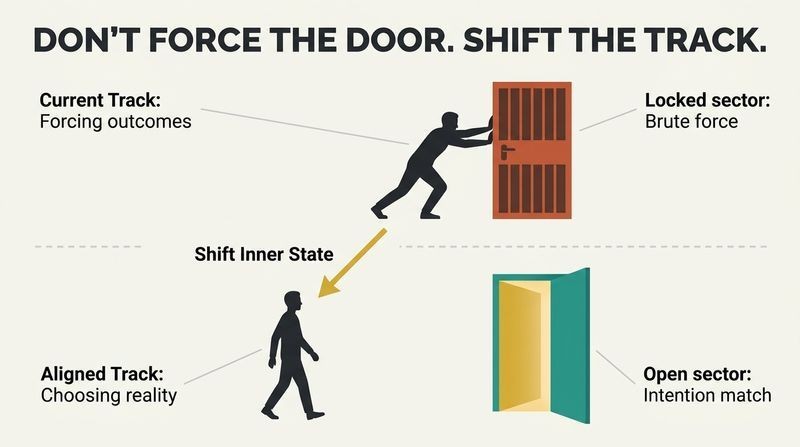
What's striking is how Zeland anticipates the reader's eye-roll and leans in. The space of variations echoes the many-worlds interpretation of quantum mechanics and Platonic realms of forms, though Zeland offers no falsifiable mechanism. Skeptics will note this is unfalsifiable by design: successes confirm it, failures mean you did it wrong. Yet the psychological core is defensible. Cognitive science shows attention shapes perception, and self-fulfilling prophecy is well documented. Stripped of metaphysics, the actionable residue resembles what performance psychologists call outcome versus process orientation, and what acceptance-based therapies teach: relentless grasping often sabotages the very thing grasped for.
Desire aims at the goal; intention aims at the doing
Zeland's pivotal distinction: desire fixates on the object you want, while intention fixates on the act of getting it. Desire alone accomplishes nothing. His example: wanting to lift your arm does not lift it, and even deciding to lift it does not lift it. Something wordless beyond decision actually contracts the muscle. That something is intention, which he defines as the determination to have and to act.
He splits intention in two:
1. Internal intention: acting on the world directly through your own effort (I insist that...).
2. External intention: allowing the world to realize your goal on its own (It turns out that...).
Desire also creates excess potential, an energy imbalance that summons balancing forces which often deliver the opposite of what you crave.
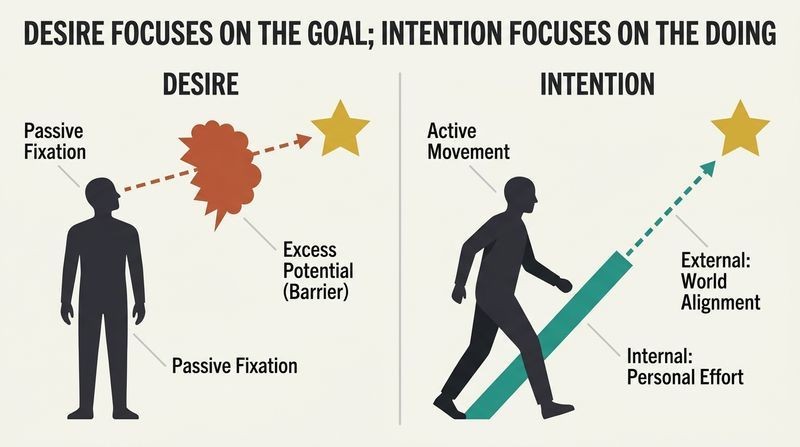
The desire-versus-intention split maps neatly onto a real cognitive divide. Neuroscience distinguishes wanting (motivational drive, dopaminergic) from doing (motor execution), and Zeland intuits that a wish and an action are separated by an unbridgeable-seeming gap he simply names intention. His warning that intense desire breeds counterforce parallels ironic process theory, Daniel Wegner's finding that trying hard not to think of something guarantees you will. It also rhymes with Taoist wu wei, effortless action, and with the sports maxim that gripping the club too tightly ruins the swing. The weakness: external intention is defined largely by what it is not, remaining deliberately elusive.
Your worst fears come true because soul and mind finally agree
Zeland's most useful insight into why bad things cluster. He assigns feelings to the soul (the unconscious, which knows and senses) and thoughts to the mind (the conscious, which reasons and wills). External intention activates only when soul and mind unite. The tragedy: people most easily achieve unity in the negative. The mind fears something, the soul fears it too, they agree completely, and external intention dutifully delivers the dreaded sector.
This explains the folk observation that when it rains, it pours. A depressed, fearful radiation transfers you onto tracks where misfortune compounds. The fix is not to suppress fear but to build genuine unity around positive aims, which is far harder because minds doubt and souls hesitate. Agreement on what you want is rare; agreement on what you dread is automatic.
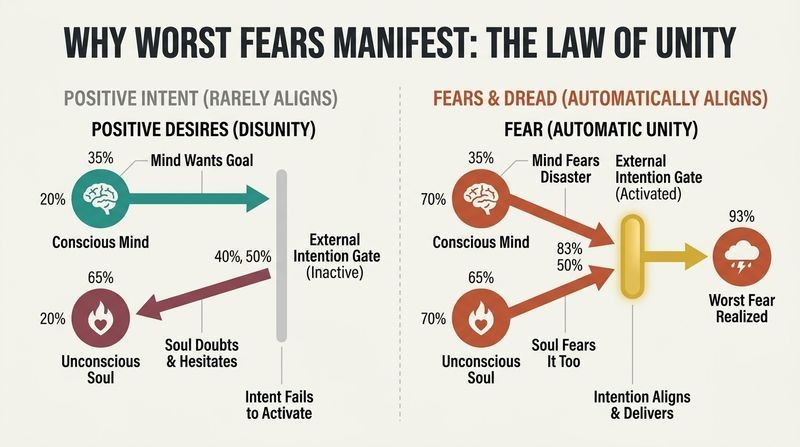
This is Zeland's sharpest psychological observation dressed in metaphysical clothing. Research on catastrophizing and depressive rumination supports the mechanism: negative expectation narrows behavior, erodes performance, and elicits confirming outcomes. The asymmetry he names, that dread unifies more readily than hope, tracks negativity bias, the finding that threats grip attention harder than rewards. Where he overreaches is causation: correlation between mood and misfortune need not run soul-outward. Depression impairs sleep, judgment, and health, producing real setbacks without any cosmic sector-switching. Still, the reframe is clinically useful. Naming the unity of fear as the enemy gives a person a concrete target to disrupt.
You wear invisible slides that project your insecurities onto everyone
A slide is Zeland's term for a distorted mental image you carry that exists only in your head, not in others'. Convinced you are ugly, you filter every glance through that filter: a friendly smile becomes a smirk, a compliment becomes mockery. Worse, the slide reshapes your behavior (awkward gestures, vanished confidence), so it eventually materializes. Slides also drive projection, where you accuse others of the very flaws you hide from yourself.
Importance is the film that holds a slide together. The painter Toulouse-Lautrec, crippled young, tormented himself over his body until he stopped caring; the moment importance dissolved, the slide vanished and fortune, including romantic success, arrived. The remedy is not fighting flaws (which magnifies them) but redirecting attention: build a positive slide of yourself and replay it until it becomes real.
Zeland's slide concept is essentially a cognitive schema plus the spotlight effect, the documented tendency to overestimate how much others notice our flaws. His clinical instinct is sound: fighting an intrusive self-image strengthens it, a core finding behind acceptance and commitment therapy. The projection mechanism restates a Freudian defense with practical teeth. His prescription, replacing rather than resisting, aligns with self-affirmation research, though psychologists caution that hollow positive affirmations can backfire for people with low self-esteem, sometimes worsening mood. Zeland partly preempts this by insisting the positive slide be played consciously as a game and paired with realistic, attainable substitute traits rather than grandiose fantasy.
Visualize the journey unfolding, not the trophy sitting still
Most visualization fails, Zeland argues, because people picture the finished goal, a static trophy, which is pure desire and moves nothing. Worse, if you vividly imagine a house without establishing that it is yours, you simply encounter that house more often, as someone else's. He ranks visualization: idle daydreams are useless; watching a mental film of your wish is better but leaves you a spectator; actually living inside the scene as a participant is what tunes your radiation.
The key upgrade is visualizing the process of approach, like a mother who each day imagines her child a little more grown, not instantly adult. He adds transfer chains: distant goals must be reached stage by stage (you cannot enter graduate school without a degree), so visualize only the current link, never leap to a track you cannot yet occupy.
Here Zeland converges with rigorous findings. UCLA's Shelley Taylor showed that students who visualized the process of studying outperformed those who visualized the outcome of acing the exam; outcome fantasy reduced effort and results. Gabriele Oettingen's decades of research reached the same verdict: positive outcome fantasies drain energy, while her WOOP method pairs the wish with obstacles and action. Zeland's transfer chain restates the value of proximal subgoals in Bandura's self-efficacy work. The metaphysical packaging obscures a genuinely evidence-backed correction to the naive law of attraction, which treats vivid wanting as sufficient. Process beats trophy across the empirical literature.
Nameless energy structures hijack your goals to feed on your worry
Pendulums are Zeland's name for self-sustaining informational-energy structures born whenever many people think and act alike: corporations, religions, fashions, ideologies, fan cultures. A pendulum has no concern for your well-being; it exists to harvest your energy, which you surrender through irritation, fear, rivalry, and outrage. It swings hardest when it can provoke your reaction.
Pendulums thrive on two levers: importance and unawareness. They flatter you with the rule do as I do, showcasing stars so you exhaust yourself imitating them. Their defense is emptiness: if you keep importance at zero, the pendulum's provocations find nothing to grip and fall through you like clay dummies. He reframes the German soldier who becomes a monster at war then a kind neighbor at home: ordinary people captured by a pendulum stop being conscious of their acts.
Pendulum is a striking reframe of what other thinkers call memes (Dawkins), egregores (occult tradition), or Moloch (the coordination-trap metaphor in modern rationalist writing). The core sociological claim, that institutions develop self-perpetuating interests divorced from members' welfare, is uncontroversial in organizational theory. Zeland's emotional-hijacking account anticipates outrage-driven engagement economics: social media platforms literally monetize the irritation he describes. The prescription, strategic non-reactivity, resembles Stoic apatheia and mindfulness detachment. The overreach is treating pendulums as quasi-conscious predators rather than emergent dynamics, which can slide into a paranoid worldview where all obligation is enemy manipulation, potentially corroding healthy commitment and cooperation.
Wake up inside your own life the way lucid dreamers wake in dreams
Zeland uses lucid dreaming as a training model. In dreams anything is possible because the soul freely roams the space of variations and intention instantly chooses scripts; a stalker vanishes the instant you decide to swap roles. Reality obeys the same laws, only slowed by the inertness of matter. The skill to cultivate is awareness: installing an inner Watcher who constantly asks, is this actually happening, am I asleep or awake.
Most people sleepwalk through waking life, absorbed in the game like an actor who forgets he is on stage. The move is to become a performing viewer: keep playing your role, but watch it from the auditorium, detached and clear-headed. When a colleague dumps a problem on you, do not get dragged in; treat it as a light comedy rather than a tragedy, and it resolves easily.
The lucid-dreaming bridge is more than metaphor. Stephen LaBerge's Stanford research verified lucid dreaming as a real, trainable state using eye-signal experiments, and reality-testing (Zeland's is this happening) is the standard induction technique. His waking application, detached participation, is essentially metacognition and the observing self central to mindfulness-based cognitive therapy, shown to reduce reactivity and rumination. The comedy-versus-tragedy reframe is cognitive reappraisal, one of the most robustly effective emotion-regulation strategies in psychology. Zeland does flag a danger in lucid dreaming that reads as superstitious (souls failing to return), but the underlying prescription, raise awareness to reclaim authorship of your responses, is sturdy and practical.
Let yourself be worthy, or you will never let the prize in
Zeland argues most people fail before starting because they cannot let themselves have. A homeless man will sit at a Christmas feast if invited, but he cannot imagine owning that feast, so external intention gives him nothing. If you want wealth but feel discomfort entering an expensive shop, you are not ready to receive. The determination to have is knowing, not merely believing, that you are worthy and that the choice is yours.
His vivid, provocative example: Russia's post-Soviet oligarchs. Many intelligent people stood near the same privatized riches, but only those who simply allowed themselves to grab, free of guilt or feelings of inferiority, walked away billionaires. The fix is expanding your comfort zone gradually through slides, browsing luxury calmly as an owner rather than a beggar, until the unreal becomes ordinary.
The comfort-zone claim connects to well-established constructs: self-efficacy (Bandura) and the notion of an internal financial thermostat popularized in behavioral money literature. Clinical work on impostor syndrome confirms that felt unworthiness sabotages people who are objectively qualified. Zeland's browse-as-an-owner exercise resembles graded exposure, the gold-standard treatment for anxiety, gradually normalizing a feared context. The oligarch example is bracingly amoral and worth scrutiny: it conflates psychological readiness with proximity to political power and outright theft, understating structural luck and corruption. Readiness may be necessary but is plainly not sufficient. Still, the psychological point survives: opportunity ignored for lack of felt permission is a genuine and common failure mode.
Stop copying stars; your soul owns a sector no one else can fill
Zeland insists everyone possesses a unique essence he calls fraile, the individual frequency signature of a soul, and each soul has its own star sector in the space of variations where its gifts shine. The disaster is imitation. Teenagers plastering idols on their walls, aspiring singers mimicking a famous voice, are chasing a mirage, tuning into someone else's sector where they can only ever be a parody.
Stars became stars precisely by breaking the do as I do rule and expressing their own oddities. Many celebrities violate conventional standards (odd features, imperfect voices) yet captivate, because their mind is set on their soul's fraile. The move is to turn the mind toward the soul, love yourself first, and let your peculiar, supposedly useless qualities point to your door. The clown may become a great comedian.
Fraile is Zeland's most romantic idea, and it lands in a culture drowning in comparison. His warning against imitation echoes differentiation research in creativity: originality, not technical replication, drives breakout success, and audiences reward distinctiveness over polished conformity. The observation that charisma often coexists with imperfect features aligns with studies showing that averageness reads as pleasant but memorability and appeal come from distinctive, non-average traits. His reframe of useless quirks as career keys anticipates strengths-based coaching and the ikigai notion of vocation. The caveat: sheer self-belief without deliberate skill acquisition rarely suffices, and survivorship bias inflates the stories of rule-breakers who happened to win.
Test any goal against your soul's discomfort, its unmistakable no
How do you tell your true goal from one a pendulum implanted? Zeland gives markers of a false, borrowed goal: it feels like obligation and forcing, it seduces you with prestige and inaccessibility, it makes you want to prove something, it is pushed by others, and it serves someone else's benefit. Your real goal turns life into a celebration now, on the journey, not only at the finish.
His decision tool is the emotional state of the soul. After your mind picks a goal, stop reasoning and notice the feeling. Comfort is ambiguous (the soul may simply have no answer), but discomfort, a heavy, oppressive, dread-tinged sensation beneath your mind's optimistic arguments, is a reliable no. Distinguish this from mere shyness (is all this really for me), which slides can dissolve. Genuine discomfort never dissolves.
Zeland is describing interoception and affective forecasting, the use of gut feeling as decision data. Antonio Damasio's somatic marker hypothesis provides a neurological backbone: patients with damaged emotional processing make disastrous decisions despite intact logic, suggesting bodily affect is indispensable to good choice. His asymmetry, that the no is trustworthy while the yes is ambiguous, is psychologically shrewd; aversion signals tend to be clearer than approach signals. The framework's risk is that anxiety can masquerade as the soul's veto, causing avoidance of worthwhile but frightening goals. Zeland partly guards against this by separating dissolvable shyness from persistent discomfort, a useful diagnostic that mirrors exposure-therapy logic.
Accept defeat in advance to strip a goal of crippling importance
Zeland's counterintuitive move for purifying intention: to want without desperate wanting, deliberately accept possible failure before you begin. Run the losing scenario once, arrange a backup plan, confirm life continues if it fails, then stop revisiting it. This dissolves excess potential, the energy imbalance that importance creates and that balancing forces punish.
He warns against the popular advice to think only of success, calling it another false stereotype. You cannot fool your mind into pure optimism; the doubt hides in the basement and leaks out. Better to disarm importance entirely. He illustrates with practical guardrails: do not quit your job before securing the next, do not burn bridges, keep a safety net. Then walk toward the goal as casually as fetching mail from the mailbox, moving your feet without insisting.
This is arguably Zeland's most immediately usable technique, and it has strong external validation. Stoic premeditatio malorum, the deliberate rehearsal of worst cases, and Tim Ferriss's fear-setting exercise both prescribe exactly this: naming the downside defuses its paralyzing grip. Psychologically, accepting a bad outcome reduces the perceived stakes, lowering the arousal that degrades performance under pressure (the Yerkes-Dodson curve). His attack on relentless positive thinking aligns with defensive pessimism research by Julie Norem, showing that for anxious high performers, imagining what could go wrong improves outcomes over forced optimism. The mailbox image captures the paradox well: outcomes improve precisely when you stop treating them as emergencies.
When choosing, silence the mind, then read your soul's first flinch
Zeland turns his whole system into a mundane drill: buying clothes. Do not agonize or over-analyze; wander like a museum visitor with only a loose aim (a coat, say), letting the soul, closer to who you truly are, spot the right item. Your real item waits patiently; it may be in the tenth shop, not the third. The decisive test comes at the moment of yes or no.
During analysis your mind is essentially asleep, weighing pros and cons and eavesdropping on others' opinions. So the instant a decision forms, wake up and catch the feeling. His clean rule: if you have to persuade yourself, it belongs to someone else. A genuine fit needs no argument. The same method extends to any personal choice, and it trains the larger skill of hearing what he calls the rustling of the morning stars, the soul's faint voice.
Ending an esoteric book with a shopping example is a smart pedagogical choice: it makes an abstract system testable this afternoon. The if you must persuade yourself, it is not yours heuristic is genuinely portable and echoes Derek Sivers's hell yes or no rule and Kahneman's caution that fluent, effortless preference often signals better fit than labored justification. Research on unconscious thought suggests that for complex choices, distraction can yield more satisfying decisions than exhaustive deliberation, lending support to Zeland's step-back approach. The limitation is domain-dependence: intuition excels where you have rich experience (clothes, aesthetics) but misleads in unfamiliar, statistically driven domains where deliberate analysis outperforms the gut.
Analysis
Reality Transurfing 2 sits in an unusual genre: a Russian metaphysical self-help system that reads like engineering documentation for the soul. Zeland, a former quantum physicist, builds an elaborate cosmology (the space of variations, pendulums, external intention) and then, crucially, cashes it out in concrete drills. The book's difficulty for a summarizer is that its practical wisdom is welded to unfalsifiable metaphysics; separating the two without gutting the author's voice requires care.
Stripped to its operational core, Transurfing is a coherent and often prescient psychology of non-attachment. Its four load-bearing moves are: lower importance (excess potential invites balancing forces), raise awareness (the Watcher, detached participation), distinguish process visualization from outcome fantasy, and align soul with mind (feeling with thought) around what you genuinely want. Remarkably, each has independent empirical support Zeland could not have cited in 2008 or did not: Oettingen on the sabotage of positive fantasy, Norem on defensive pessimism, Damasio on somatic markers, LaBerge on lucid dreaming, exposure therapy on comfort-zone expansion. The book essentially reinvents acceptance-based, mindfulness-adjacent psychology through an idiosyncratic vocabulary.
Its liabilities are equally clear. The framework is unfalsifiable and self-sealing: success confirms the method, failure means insufficient purity of intention or a borrowed goal. The pendulum concept, powerful as social critique, can curdle into a worldview where all duty and cooperation look like predation, and the oligarch example reveals a troubling amorality, mistaking readiness to have for the whole story while eliding luck, power, and theft. The insistence that money is never a goal and altruism springs only from the mind (never the soul) is philosophically contestable.
Still, as a manual for reducing the grasping anxiety that sabotages performance, Transurfing is unexpectedly practical. Read as metaphor rather than physics, it delivers a rare thing: a permission structure to want boldly while holding outcomes lightly.
Review Summary
Reality Transurfing 2 receives mostly positive reviews, with readers praising its transformative ideas and practical techniques for personal growth. Many find it thought-provoking and life-changing, appreciating the author's unique approach to manifestation and goal-setting. Some readers note the book's esoteric nature and repetitive content, while others value its depth and originality. The book is seen as a continuation of the first volume, expanding on concepts like inner intention, goal visualization, and aligning with one's true desires.
Glossary
Space of variations
Field storing all possible eventsZeland's hypothesized informational field containing every possible version of every event, past, present, and future, arranged as sectors. Each sector holds a script and decorations. Human thought, at a given frequency, tunes into and materializes a particular sector, turning potential into physical reality. It functions as the metaphysical backdrop that makes reality selectable rather than merely buildable.
External intention
Determination to have; choosing realityThe force that realizes Transurfing by moving your material realization along sectors of the space of variations, so the goal realizes itself. Unlike willful effort, it allows the world to open on its own (It turns out that...). It activates only when soul and mind unite, and Zeland calls it the key to choosing rather than changing reality.
Internal intention
Determination to act directlyOrdinary willpower: the determination to act on the world through your own effort within a single life track (I insist that...). It follows known physical laws, requires struggle, and is what most people rely on. Effective but limited, it cannot choose a life track the way external intention can; it can only push within the one you occupy.
Pendulums
Energy-harvesting collective structuresSelf-sustaining informational-energy structures that arise when many people think and act alike, such as corporations, religions, fashions, and fan cultures. A pendulum feeds on adherents' energy, released through irritation, fear, and rivalry, and imposes false goals via the rule do as I do. It swings by provoking reactions and is defeated by non-reactivity and zero importance.
Slide
Distorted self-image in your headA distorted mental representation that exists only in your mind, not in others', built on importance. Negative slides (I am ugly) filter perception and reshape behavior until they materialize, and drive projection onto others. Positive slides, replayed consciously as a lived scene, tune your radiation toward desired traits and gradually expand your comfort zone into reality.
Fraile
A soul's unique frequency signatureZeland's term for the individual essence or frequency characteristic of a person's soul, comprehended wordlessly rather than described. Each fraile has its own unique star sector in the space of variations where the person's gifts flourish. Setting the mind on the soul's fraile, rather than imitating others, unlocks hidden virtues and authentic charm.
Excess potential / Importance
Energy imbalance summoning counterforceImportance is exaggerated significance attached to a goal, flaw, or event; it creates excess potential, a localized energy imbalance in the surrounding field. Balancing forces then act to eliminate the imbalance, often delivering the opposite of what was desired. Lowering importance, including by accepting defeat in advance, is central to Transurfing practice.
Transfer chain
Stage-by-stage path to goalsThe ordered sequence of connected stages (links) required to reach a distant goal, since each stage enables the next (no graduate program without a degree). Zeland advises visualizing only the current link, not leaping ahead to a track you cannot yet occupy, so material realization can catch up gradually along the flow of variations.
The Watcher
Inner observer maintaining awarenessAn inner observer you keep active in the background to monitor whether you are asleep or aware, participant or spectator. The Watcher enables detached participation (a performing viewer), catches pendulum provocations, retrieves intuition, and is the practical instrument for waking up in real life the way one wakes up inside a lucid dream.
Rustling of the morning stars
The soul's faint intuitive voiceZeland's poetic name for the soul's quiet signals: wordless intuition, premonition, and emotional comfort or discomfort that surface when the mind's loud internal monologue pauses. Learning to notice this faint voice, especially the soul's unmistakable discomfort, provides a reliable criterion for choosing true goals over borrowed ones.
Determination to have
Knowing you are worthyThe receptive half of intention: the calm, doubt-free knowledge that you are worthy of a goal and that the choice is simply yours to make, as ordinary as collecting mail. Distinct from effortful striving, it is cultivated by expanding the comfort zone so the desired feels normal rather than awe-inspiring or inaccessible.
FAQ
What is Reality Transurfing 2: A Rustle of Morning Stars by Vadim Zeland about?
- Reality creation through Transurfing: The book presents Transurfing as a method for consciously shaping your reality, where goals are realized with minimal force by aligning with the natural flow of life.
- Space of variations: It introduces the concept of a "space of variations," an infinite field containing all possible life scripts, where thoughts and intentions can materialize specific outcomes.
- Soul and mind unity: The narrative emphasizes the importance of harmonizing the soul (intuition, feeling) and mind (logic, will) to access external intention, the force behind effortless manifestation.
- Blend of metaphysics and practice: Readers are offered both philosophical insights and practical tools for intention, awareness, and visualization to choose and realize their desired life paths.
Why should I read Reality Transurfing 2: A Rustle of Morning Stars by Vadim Zeland?
- Unlock dormant potential: The book reveals how to awaken and use inner powers that are typically dormant, enabling conscious reality creation.
- New perspective on dreams and reality: It offers a unique interpretation of dreams as journeys in the space of variations, showing how thoughts and intentions shape life events.
- Practical manifestation tools: Readers learn actionable methods such as visualization, creating positive slides, and managing importance to manifest desires effectively.
- Avoid common pitfalls: The book explains why desires often fail, how to avoid excess potentials, and provides a roadmap for aligning internal and external intention.
What are the key takeaways from Reality Transurfing 2: A Rustle of Morning Stars by Vadim Zeland?
- Unity of soul and mind: True power and manifestation arise from the agreement between soul and mind, enabling access to external intention.
- Pendulums and individuality: Societal "pendulums" manipulate thoughts and behavior, often leading people away from their authentic goals and happiness.
- Importance of awareness and detachment: Maintaining awareness and reducing importance are crucial for avoiding negative life tracks and manifesting desires.
- Practical methods for change: Techniques like creating positive slides, visualizing the process, and testing emotional comfort help readers consciously choose and realize their life paths.
What are the best quotes from Reality Transurfing 2: A Rustle of Morning Stars by Vadim Zeland and what do they mean?
- "The world is a mirror reflecting your attitude towards it." This highlights the book’s core idea that your inner state shapes your external reality.
- "Let go of importance, and the world will open its doors to you." This quote emphasizes the need to reduce internal and external importance to allow effortless manifestation.
- "The soul knows, the mind thinks." It underlines the distinction between intuitive knowing and logical reasoning, advocating for their unity.
- "Pendulums feed on your energy." This warns against giving emotional energy to societal structures that manipulate and drain you.
What is the "space of variations" in Reality Transurfing 2: A Rustle of Morning Stars by Vadim Zeland?
- Infinite field of possibilities: The space of variations is described as an infinite field containing all possible scripts and outcomes for every event and life path.
- Materialization through attention: By focusing thoughts and intentions, individuals can "select" and materialize specific sectors from this space into their reality.
- Basis for manifestation: This concept underpins the book’s approach to reality creation, suggesting that life is not fixed but can be consciously navigated.
- Dreams and reality connection: The space of variations explains both the mechanism of dreams and the process of manifesting desires in waking life.
What are "pendulums" in Reality Transurfing 2: A Rustle of Morning Stars by Vadim Zeland and how do they affect us?
- Energy-information structures: Pendulums are collective energy structures formed by shared thoughts and actions, existing independently and seeking to sustain themselves.
- Manipulation and conformity: They manipulate people’s thoughts and behaviors, imposing false goals, stereotypes, and societal norms to maintain control.
- Loss of individuality: Feeding pendulums with emotional energy, especially importance or negativity, causes individuals to lose touch with their authentic desires and become puppets of external influences.
- Breaking free: Awareness and detachment are essential for escaping pendulum control and reclaiming personal freedom.
How does Vadim Zeland define and differentiate desire, internal intention, and external intention in Reality Transurfing 2: A Rustle of Morning Stars?
- Desire as passive longing: Desire is mental energy focused on the goal, often creating excess potential and imbalance, which can hinder manifestation.
- Internal intention as willpower: Internal intention is the determination to act and move towards the goal, relying on effort and direct influence but limited by resistance.
- External intention as effortless realization: External intention is the powerful force that allows goals to manifest naturally when soul and mind are united, free from struggle and doubt.
- Key distinction: Internal intention pushes and insists, while external intention allows and chooses, making mastery of external intention central to Transurfing.
What is the "unity of soul and mind" in Reality Transurfing 2: A Rustle of Morning Stars by Vadim Zeland and why is it important?
- Definition of unity: Unity occurs when the soul’s feelings and the mind’s intentions are in agreement, creating the conditions for external intention to operate.
- Overcoming internal conflict: The mind often suppresses the soul’s desires due to societal conditioning, leading to dissatisfaction and blocked manifestation.
- Path to happiness and success: Achieving unity allows for effortless realization of authentic goals, transforming life into a celebration and unlocking true potential.
- Practical approach: Listening to the soul’s emotional comfort and aligning the mind’s intentions accordingly is key to achieving this unity.
What are "slides" in Reality Transurfing 2: A Rustle of Morning Stars by Vadim Zeland and how do they affect reality?
- Mental visualizations: Slides are personalized mental images or affirmations that set the parameters of your mental energy to align with a desired life track.
- Positive vs. negative slides: Positive slides expand your comfort zone and attract favorable outcomes, while negative slides, often fueled by excess importance, reinforce undesirable situations.
- Creation and reinforcement: Effective slides focus on specific, emotionally resonant images or feelings, and should be played regularly to tune your mental state.
- Role in manifestation: Slides help dissolve negative importance and facilitate the materialization of desires by aligning with external intention.
How does Vadim Zeland’s Reality Transurfing 2: A Rustle of Morning Stars explain dreams and lucid dreaming?
- Dreams as soul’s journey: Dreams are seen as the soul traveling through the space of variations, experiencing real but virtual sectors not always realized in waking life.
- Lucid dreaming as conscious control: Lucid dreams occur when the mind becomes aware during sleep, allowing conscious influence over the dream script and illustrating the power of intention.
- Risks of lucid dreaming: The book warns that lucid dreaming can be risky if the soul becomes lost in realized sectors, potentially explaining mysterious disappearances.
- Parallel to manifestation: The mechanism of dreams mirrors the process of manifesting reality, though materialization in waking life is slowed by inertia.
How does Vadim Zeland recommend visualizing goals and manifesting desires in Reality Transurfing 2: A Rustle of Morning Stars?
- Visualize the process: Focus on mentally imagining the steps and growth towards your goal, not just the end result, to activate intention and accelerate manifestation.
- Use transfer chains: Break down distant goals into achievable stages and visualize the realization of the current stage to avoid frustration and wasted energy.
- Active participation: Visualization should be an active, lived experience rather than passive daydreaming, integrating the goal into your comfort zone.
- Persistence and patience: Systematic and persistent visualization, combined with trust in the flow of variations and external intention, is essential for success.
What practical advice does Vadim Zeland offer in Reality Transurfing 2: A Rustle of Morning Stars for choosing your path and overcoming obstacles?
- Test emotional comfort: Use your soul’s emotional response as a guide when considering different paths; true goals bring comfort and joy, while false ones cause discomfort or obligation.
- Lower importance and stay flexible: Avoid elevating importance or forcing outcomes, as this creates resistance and invites obstacles; maintain alternatives and backup plans.
- Act without desperation: Begin working calmly and consistently without waiting for perfect conditions or forcing inspiration, allowing external intention to guide you.
- View failures positively: Treat setbacks as natural milestones, meeting them with curiosity and trust that external intention is leading you to the best outcome.
Трансерфинг реальности Series
About the Author
Other books by Vadim Zeland






Download PDF
Download EPUB
.epub digital book format is ideal for reading ebooks on phones, tablets, and e-readers.








































