

Key Takeaways
Your body can't tell a vivid memory from reality happening now
Thought becomes chemistry. Dispenza's central claim is that the body responds identically to a real experience and to an imagined one held with enough focus and feeling. His proof: Anna Willems, a Dutch psychotherapist who lost her husband to suicide, then relived the trauma dozens of times daily. Her body, unable to distinguish memory from event, stayed in survival mode until she developed paralysis, autoimmune disease, and esophageal cancer.
The mechanism runs both ways. If rehearsing the past sickens you, rehearsing an elevated future can heal you. Anna meditated twice daily for years, refusing to rise until she felt love for a life that, by all external measures, was miserable. Her cancer and paralysis eventually vanished. The premise: emotions are chemical residue of experience, and the body obeys them.
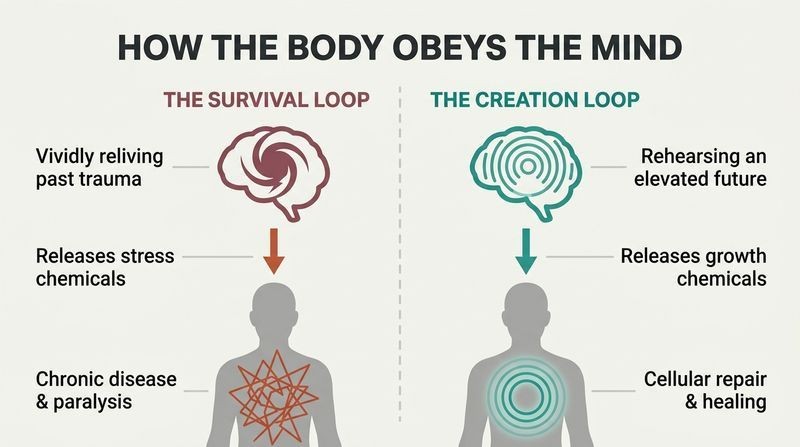
The core mechanism echoes established science. Mental rehearsal genuinely reshapes neural circuitry, as shown in motor-imagery studies where imagined piano practice built the same brain maps as physical practice. The nocebo effect confirms that expectation of harm can cause it. Where Dispenza reaches beyond consensus is attributing tumor remission to meditation alone. Spontaneous remissions are documented but rare, and single case histories cannot isolate cause. A steelman: chronic stress demonstrably suppresses immunity via cortisol, so reducing it plausibly aids healing. The leap from plausible contributor to sole cause is the book's recurring interpretive gamble, worth holding with curiosity rather than certainty.
You can get addicted to the emotions that are ruining your life
Stress hormones are a drug. When a threat appears, the sympathetic nervous system floods the body with adrenaline and cortisol, sharpening senses and shunting blood to muscles. This is adaptive for short bursts. The problem: humans trigger it by thought alone, replaying grievances and forecasting catastrophes, so the emergency never ends.
The rush becomes a craving. Dispenza argues people grow chemically hooked on their own stress chemistry, then unconsciously use the people and circumstances in their lives to justify feeling angry, victimized, or afraid, just to get the familiar hit. You might use your boss to reaffirm judgment, your ex to reaffirm resentment. Chronic activation eventually flips from adaptive to maladaptive, down-regulating healthy genes and, he claims, opening the door to disease.
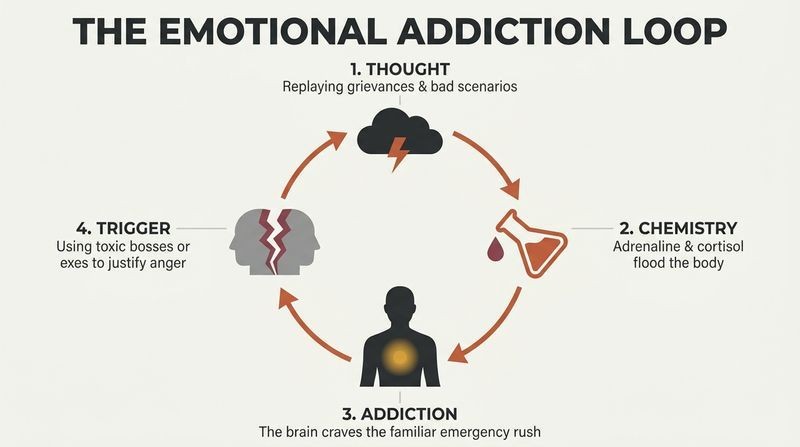
The addiction framing is rhetorically powerful and partly supported by neuroscience. The brain's reward and stress systems do share dopaminergic pathways, and trauma can create compulsive rumination loops resembling craving. Robert Sapolsky's work on zebras and ulcers, which Dispenza cites, established that prolonged glucocorticoid exposure damages the body. The useful reframe here is agency: naming a pattern as addiction implies it can be broken through deliberate practice rather than endured as fixed personality. A caution: labeling all persistent negative emotion as chemical addiction risks minimizing genuine grief, clinical depression, or circumstances that warrant anger and action rather than internal recalibration.
By your mid-thirties, 95% of you runs on autopilot programs
Personality becomes hardwired. Dispenza claims that by adulthood, roughly 95% of who you are is a memorized set of automatic behaviors, emotional reactions, and beliefs, leaving only 5% under conscious control. The body has literally become the mind, running yesterday on repeat.
Your future is a rerun of your past. He walks through a typical morning: check the phone, same coffee, same commute, same reactions to the same coworkers. Each repeated thought-choice-behavior-emotion loop fuses individual steps into one automatic program, so tomorrow's timeline can be lifted straight from today's. The takeaway: unless you interrupt the loop, your biology drags you toward a predictable future. Breaking it requires becoming so conscious of your unconscious that no unwanted thought or feeling slips by unnoticed.
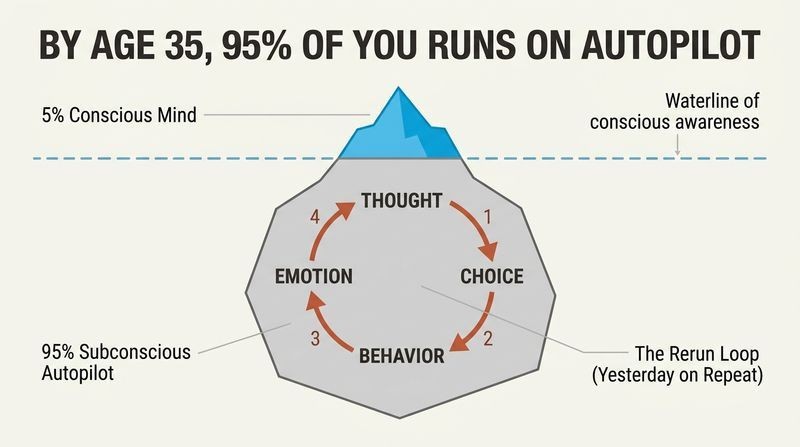
The 95% figure is a popularized estimate rather than a precise measurement, and cognitive scientists debate exactly how much behavior is automatic. Still, the underlying insight is robust: habit researchers like Wendy Wood find roughly 43% of daily actions are performed habitually in the same context, and dual-process theory (Kahneman's System 1 and System 2) confirms most cognition is fast and unconscious. Dispenza's contribution is emotional, not just behavioral, habit. The prescription, metacognitive self-monitoring, aligns with mindfulness-based cognitive therapy, which trains people to observe automatic thoughts without obeying them. The practical difficulty is that willpower to observe is itself depletable, which is why environment and routine matter.
Find the present moment and your past and future stop existing
The eternal now is the doorway. To create anything new, Dispenza argues, you must transcend your identity, environment, and time itself, settling into what he calls the generous present moment. Most people never arrive because their attention is siphoned into memories (the past) or to-do lists (the future), leaving no energy to create.
Meditation is the training ground. In practice this means repeatedly noticing when the body craves a familiar emotion or anticipates a known outcome, then returning attention to the present. Each return breaks an energetic bond to your past-present reality. When you stop firing the same neural circuits, they weaken and prune apart. His workshops measured participants reaching meditative states 18% faster and cutting high-stress brain waves by an average of 124% over four days.
The present-moment emphasis places Dispenza in a long lineage from Buddhist vipassana to Eckhart Tolle, and the neuroscience of attention supports the practice: default mode network activity, associated with mind-wandering and self-referential rumination, quiets during focused meditation. The framing of past and future as energy drains is a vivid reframe of attention economics. The percentage claims deserve scrutiny, since a 124% reduction is a statistically awkward phrasing that likely reflects relative change in a small sample rather than a population-level effect. The experiential core, that repeatedly redirecting attention rewires habitual circuits, is well established in contemplative neuroscience regardless of the specific numbers.
Pair a clear intention with an elevated emotion to rewrite your genes
Two ingredients change your biology. Dispenza's formula for transformation: a specific intention (the electrical charge, a coherent brain) married to an elevated emotion like gratitude or joy (the magnetic charge, a coherent heart). Thinking alone fails because if you feel fear while affirming abundance, the body still believes the past.
Genes are switches, not fate. Through epigenetics, the study of how environment turns genes on or off without altering DNA itself, he argues emotions signal genes directly. In a 2016 Tacoma study of 117 people, four days of sustained elevated emotion (nine to ten minutes, three times daily) raised immunoglobulin A, a key immune protein, by an average of 49.5%. A 2017 Tampa study measured significant changes in eight genes involved in repair, neurogenesis, and antioxidant defense.
Epigenetics is real and among the most exciting frontiers in biology; DNA methylation and histone modification genuinely respond to stress, diet, and behavior. Studies from Herbert Benson and later teams have found meditation alters expression of inflammation-related genes. Dispenza's specific figures come from his own workshop research, which lacks the controls and peer scrutiny of independent replication, so effect sizes should be held loosely. The conceptual advance for lay readers is liberation from genetic determinism: having a predisposition is not a sentence. The overreach risk is implying near-total voluntary control over gene expression, which current science does not support. Directional truth, uncertain magnitude.
To enter the quantum field, become no body, no one, no thing
Empty yourself to access possibility. Dispenza describes the quantum or unified field as an invisible realm of energy and information beyond space and time, where all potential futures already exist. You cannot enter it as your identity. You must dissolve into pure awareness: no body, no one, no thing, no where, in no time.
Then tune, don't chase. Once present in this field, you select a potential future and match its frequency by generating the emotion you would feel if it were already real. When your energy vibrates in harmony with that possibility, it is drawn to you, no résumé or hustle required. His son Jace, jobless and broke after traveling, defined his ideal job's conditions and feelings, meditated daily, and stumbled into exactly that role through a chance surf-shop encounter.
This is where the book asks the most of a skeptical reader. Quantum mechanics does feature observer effects and nonlocal entanglement (Aspect's experiments confirmed Bell's inequalities), but physicists broadly reject applying wavefunction collapse to human intention and life outcomes; the scales and mechanisms do not transfer. Dispenza uses quantum language metaphorically to describe a psychological state of open, egoless receptivity. Stripped of the physics claims, the practical kernel resembles well-documented phenomena: priming, the reticular activating system tuning perception toward goals, and reduced anxiety improving opportunity recognition. Jace's story is compelling narrative but classic survivorship selection. The mindset shift may work even if the mechanism is misdescribed.
Your heart has 40,000 neurons and generates the body's strongest field
The heart thinks. Neurocardiology research, pioneered by J. Andrew Armour, found the heart contains roughly 40,000 neurons forming a functional brain of its own, communicating with the head-brain along nerves that run mostly upward (about 90% ascending). The heart's magnetic field is thousands of times stronger than the brain's and measurable feet away from the body.
Coherence is a trainable skill. Heart coherence means beating in a smooth, ordered rhythm, produced by sustaining elevated emotions like appreciation and compassion. Measured through heart rate variability (the variation in intervals between beats), coherence pulls the whole nervous system into balance, sharpens intuition, and, Dispenza notes with HeartMath Institute, triggers a cascade of over 1,400 beneficial biochemical changes. Stress does the reverse, dumping roughly 1,200 stress chemicals.
The heart's intrinsic nervous system and its electromagnetic field are legitimate findings, and HeartMath's heart rate variability biofeedback has peer-reviewed support for reducing stress and improving emotional regulation. HRV is a genuine biomarker of autonomic flexibility and predicts health outcomes. The interpretive stretch is treating the heart's magnetic field as a channel for transmitting intention to other people, which remains unproven. The practical value stands independently: slow, rhythmic breathing paired with positive emotion reliably shifts the autonomic nervous system toward the parasympathetic state associated with recovery. Athletes, soldiers, and clinicians use these techniques for composure under pressure. Skill, not mysticism, drives most of the measurable benefit.
Program your future like a TV ad programs you into fear
Advertisers hijack the suggestible mind. Dispenza dissects a shingles drug commercial: it shocks you with a grotesque rash, changing your emotional state, which opens the door between conscious and subconscious mind. Then it repeats scary statistics while you are suggestible, installing fear. Suggestibility is simply the ability to accept information without analyzing it, and it peaks at night when melatonin slows brain waves.
Turn the same tool to your advantage. His workshops use a kaleidoscope video to induce a trance state (alpha and theta brain waves) with eyes open, then have students watch a Mind Movie: personalized images of their desired future set to a beloved song, overlaid with affirmations. This programs the subconscious with an unlimited future the way commercials program lack, creating what he calls memories of the future.
The advertising analysis is sharp media literacy and independently valuable. Emotional arousal genuinely increases suggestibility and memory encoding, a principle exploited by propaganda and marketing alike. Using imagery and music to consolidate goals has partial support: elite athletes use vivid multisensory visualization, and music powerfully cues emotional and autobiographical memory via limbic activation. The concept of memories of the future connects to prospection research showing the brain simulates future scenarios using the same machinery as recall. The weaker link is assuming subconscious programming reliably manifests external circumstances. What it more defensibly does is shift attention, motivation, and pattern recognition toward the goal, which is not nothing.
Walk as your future self so the elevated state survives past your cushion
Meditation gains evaporate on contact with life. Dispenza noticed the problem himself: you finish a sitting meditation feeling open and empowered, then the commute, the emails, and the rude driver drag you back into old programs within minutes. The energy you raised stays on the cushion.
Embodiment closes the gap. His walking meditation trains you to carry the new state into motion. Stand with eyes closed, generate elevated emotions, then open your eyes and walk while staying in that state, deliberately altering your stride, posture, and expression to match your future self. The point is not to get wealth or health but to become the person for whom those are already real. Practiced daily, walking like a confident, grateful person becomes a new automatic habit.
This addresses the most common failure of contemplative practice: state-to-trait transfer. Insights in meditation rarely stick because context-dependent memory ties them to the meditation setting. Deliberately practicing the new state while moving and in varied contexts is sound behavioral psychology, resembling exposure generalization and embodied cognition research showing posture and movement feed back into emotional state (power-posing debates aside, facial and postural feedback effects have some support). The emphasis on becoming rather than getting is a mature reframe that sidesteps the trap of outcome-attachment. It also quietly resolves a tension in manifestation literature by locating change in identity and behavior rather than passive wishing.
Squeeze the breath up your spine to activate your pineal gland
A physical technique for altered states. Dispenza teaches a breath: inhale slowly while contracting the perineum and abdominal muscles, following the breath up the spine to the crown, then hold and squeeze. Mechanically, this raises pressure in the cerebrospinal fluid, which he says compresses tiny calcite crystals in the pineal gland, creating a piezoelectric effect (pressure converted to electric charge) that turns the gland into an antenna.
Melatonin gets upgraded. Once activated, he claims the pineal gland transmutes melatonin into powerful metabolites: benzodiazepine-like compounds that calm the analytical mind, potent antioxidants (pinolines), and even DMT, the hallucinogen found in ayahuasca. The result is vivid inner experiences that feel more real than waking life. Brain scans at his events recorded gamma energy up to 260 standard deviations above normal.
The pineal gland does contain calcite microcrystals with piezoelectric properties (Baconnier's 2002 study is real), and the gland does synthesize melatonin from serotonin via methylation. Whether breath-induced cerebrospinal pressure meaningfully activates these crystals to produce endogenous DMT surges is speculative and not established in mainstream neuroscience; DMT's natural role in the human brain remains debated. The extreme standard-deviation figures come from in-house EEG and are hard to evaluate without published methodology, since such values could reflect measurement artifacts or muscle tension from the breathing itself. That said, breath retention and intense focus genuinely alter consciousness through CO2 and arousal changes, a real if less exotic explanation.
Small trained groups cut regional violence by over 70%, studies claim
Coherence may be contagious. Dispenza cites more than 50 peace-gathering projects and 23 peer-reviewed studies suggesting that groups of meditators focused on peace reduce nearby crime, war deaths, and terrorism by an average exceeding 70%. A 1983 Jerusalem project reportedly cut war deaths in Lebanon by 76% on high-participation days; a Washington D.C. study in 1993 tracked falling violent crime.
We are electromagnetically linked. The premise rests on the Earth's magnetic field carrying biologically relevant information and the heart's field influencing others nonlocally. In his own workshops, sensors recorded 17 people's hearts entering coherence simultaneously during the same meditation. This birthed Project Coherence, global synchronized meditations, one drawing over 43,000 online participants, aimed at raising the planet's collective frequency.
The peace studies originate largely from Transcendental Meditation-affiliated researchers, and independent scientists have criticized them for selective time windows, confounding variables, and publication bias; the claimed Maharishi Effect has not achieved mainstream acceptance despite passing some peer review. The Global Consciousness Project's random-number-generator anomalies around 9/11 are provocative but statistically contested. What is more defensible: emotional states are socially contagious through mirror neurons, facial mimicry, and behavioral synchrony, well documented at interpersonal scale. Whether that scales to nonlocal magnetic influence over crime rates is a vast extrapolation. Readers can embrace the invitation to collective calm as prosocial practice while remaining agnostic about the geophysical mechanism.
Demonstrate peace, don't just feel it, or the old self returns
Feeling is not enough. Dispenza's closing charge notes that in many peace-gathering studies, once the meditators stopped, violence returned to baseline. Internal states alone are fragile. Real change requires moving from thinking to doing: embodying peace when provoked, choosing not to react with the reflexive anger, fear, or aggression that thousands of years of survival wiring makes feel natural.
Each act of restraint rewires you. When you refuse to fire the neural circuits of resentment and instead activate those of care and patience, you stop conditioning the body to the past. Repeated, this becomes a subconscious program, so demonstrated peace becomes second nature. He frames this as an evolutionary jump: humans acting as one coherent organism rather than a cancer at war with itself.
The insistence that transformation must be behaviorally enacted, not merely felt, is the book's most grounded and ethically serious note. It aligns with virtue ethics from Aristotle, who argued we become just by doing just acts, and with cognitive-behavioral therapy, where new behavior precedes and drives new feeling. The observation that meditation benefits decay without ongoing practice is honest and counters the fantasy of one-time enlightenment. Framing emotional reactivity as an evolutionary default to be consciously overridden connects to modern work on emotion regulation and impulse inhibition in the prefrontal cortex. The species-level utopian vision is aspirational, but the individual prescription, respond rather than react, is immediately actionable and testable.
Analysis
Becoming Supernatural is a self-help and popular-spirituality hybrid that dresses contemplative practice in the vocabulary of neuroscience, epigenetics, and quantum physics. Structurally it alternates teaching chapters, each ending with a guided meditation, with case-study chapters designed to make the abstract feel achievable. Dispenza, a chiropractor and workshop entrepreneur, writes for readers hungry for agency over their health and destiny, and he is unusually explicit that he no longer courts scientific skeptics.
The book's genuine strength is its integrative ambition and its practical scaffolding. Its four load-bearing claims map onto real science of varying solidity. Mental rehearsal reshaping neural circuitry is well established. Chronic stress harming the body via cortisol is textbook. Epigenetic responsiveness to behavior and emotion is a legitimate and thrilling frontier. Heart rate variability biofeedback has peer-reviewed clinical support. On these, Dispenza is directionally sound even when his specific effect sizes, drawn largely from unpublished in-house workshop data, invite skepticism.
The difficulty in summarizing the book fairly is separating this defensible core from three layers of overreach: the metaphorical misuse of quantum mechanics to explain manifestation, the disputed Maharishi-Effect peace studies, and the speculative claim that breathwork triggers endogenous DMT for interdimensional travel. These are not fatal to the practical program but they are epistemically expensive, and a careful reader must hold mechanism and outcome separately.
What survives scrutiny is a coherent behavioral protocol: interrupt automatic stress loops, cultivate elevated emotion deliberately and daily, embody the change in movement and conduct, and practice relentlessly because gains decay. That protocol overlaps substantially with mindfulness-based cognitive therapy, positive psychology, and virtue ethics. The most intellectually honest reading treats the metaphysics as motivating narrative and the discipline as the active ingredient. The healing case studies are inspiring but uncontrolled, illustrating possibility rather than proving causation. Read as invitation, not evidence, the book delivers real tools wrapped in contested cosmology.
Review Summary
Unfortunately there are no reviews or ratings available for Becoming Supernatural in the provided information. The book review section shows null values for the overall rating, number of reviews, and reader reviews. Without any actual review content, I'm unable to provide a meaningful summary of reader opinions or reactions to the book.
People Also Read




FAQ
What's Becoming Supernatural about?
- Exploring Human Potential: Becoming Supernatural by Joe Dispenza explores the extraordinary capabilities of the human mind and body, combining scientific research with practical exercises to help individuals transcend their limitations.
- Mind-Body Connection: The book emphasizes the connection between thoughts, emotions, and physical health, illustrating how mental states can influence biology and lead to profound life changes.
- Quantum Field: Dispenza introduces the concept of the quantum field, a realm of infinite possibilities accessible through focused intention and elevated emotions, allowing for the creation of new experiences and realities.
Why should I read Becoming Supernatural?
- Transformative Insights: The book offers groundbreaking insights into the mind-body connection, teaching readers how to harness it for personal transformation and overcome past traumas and health issues.
- Scientific Backing: Dispenza integrates scientific research from fields like quantum physics, neuroscience, and epigenetics, making the concepts both accessible and credible.
- Practical Exercises: It includes various meditations and exercises designed to help readers apply the concepts in their daily lives, empowering them to take control of their health and well-being.
What are the key takeaways of Becoming Supernatural?
- Power of Intention: Our intentions can shape our reality; by focusing on clear intentions and combining them with elevated emotions, we can manifest desired outcomes.
- Energy Centers: The book discusses the seven energy centers (chakras) in the body and their influence on physical and emotional health, emphasizing the importance of balancing these centers.
- Living in the Present: Dispenza stresses the importance of being present and accessing the quantum field to create new possibilities, letting go of past identities and future anxieties.
What are the best quotes from Becoming Supernatural and what do they mean?
- “The moment you change your energy, you change your life.”: This quote highlights that our emotional and energetic states directly influence our experiences and outcomes.
- “You are not in fact beholden to your genes.”: Dispenza emphasizes the power to change genetic expression through thoughts and emotions, challenging the notion of fixed biology.
- “When you are truly present, you are in the quantum.”: This underscores the significance of mindfulness and being in the moment, allowing access to the infinite possibilities of the quantum field.
How does Becoming Supernatural address the mind-body connection?
- Thoughts Influence Biology: Dispenza illustrates that thoughts and emotions can directly affect physical health, altering biological processes and improving well-being.
- Neuroplasticity: The book discusses neuroplasticity, the brain's ability to reorganize itself by forming new neural connections, allowing changes in thought patterns and emotional states.
- Meditation Practices: Dispenza provides meditation techniques aimed at reconditioning the body to a new mind, helping individuals break free from past conditioning.
What is the quantum field according to Becoming Supernatural?
- Invisible Energy Field: The quantum field is described as an invisible field of energy and information beyond space and time, containing all possibilities and potentials.
- Connection to Consciousness: Consciousness interacts with the quantum field, allowing us to manifest intentions and create new experiences.
- Collapse of Possibilities: Focusing attention on a specific potential in the quantum field collapses that potential into reality, similar to how particles manifest when observed.
What meditation techniques are recommended in Becoming Supernatural?
- Blessing of the Energy Centers: This meditation focuses on activating and balancing the body’s energy centers (chakras) to promote healing and coherence.
- Reconditioning the Body to a New Mind: Combines breathwork with visualization to liberate stored energy and signal new genes for health and vitality.
- Tuning In to New Potentials: Encourages focusing on a specific potential to manifest, combining intention with elevated emotions to draw that experience into reality.
How does Joe Dispenza define elevated emotions in Becoming Supernatural?
- Higher Frequency: Elevated emotions like love, gratitude, and joy have a higher frequency than negative emotions, significantly influencing energy and well-being.
- Magnetic Charge: These emotions serve as a magnetic charge that attracts desired experiences from the quantum field, essential for manifesting intentions.
- Connection to Heart Coherence: Elevated emotions contribute to heart coherence, where the heart and brain work harmoniously, enhancing connection with the quantum field.
What role do the energy centers play in Becoming Supernatural?
- Chakra System: Energy centers, or chakras, are key points in the body influencing physical and emotional health, each corresponding to specific emotions and functions.
- Balancing Energy: Activating and balancing these centers promotes healing and personal growth, involving cultivating elevated emotions and directing energy to each center.
- Mind-Body Connection: Linked to the mind-body connection, influencing thoughts and feelings, working with these centers can change internal states and improve health.
What is the Blessing of the Energy Centers in Becoming Supernatural?
- Energy Center Focus: A meditative practice focusing on and blessing each of the body’s energy centers (chakras) to promote healing and balance.
- Enhancing Coherence: Aims to create coherence between the heart and brain, leading to improved emotional and physical health.
- Practical Application: Dispenza provides a step-by-step guide for this meditation, making it accessible for daily practice.
How does Joe Dispenza define heart coherence in Becoming Supernatural?
- Synchronization of Heart and Brain: Heart coherence is a state where the heart and brain are in sync, improving emotional regulation and cognitive function.
- Electromagnetic Field: A coherent heart generates a strong electromagnetic field, influencing others and the environment, promoting connection and unity.
- Health Benefits: Linked to reduced stress, improved immune function, and enhanced overall well-being.
What is Project Coherence in Becoming Supernatural?
- Collective Meditation Initiative: Project Coherence brings individuals together to meditate with the intention of creating a more peaceful and coherent world.
- Measurable Effects: Research shows collective meditative efforts can significantly reduce violence and crime, demonstrating the power of group consciousness.
- Global Impact: Aims to harness collective energy to influence global consciousness and promote positive societal change.
About the Author
Other books by Joe Dispenza

Download PDF
Download EPUB
.epub digital book format is ideal for reading ebooks on phones, tablets, and e-readers.








































