

Key Takeaways
You aren't directing your life — you're sleepwalking through someone else's script
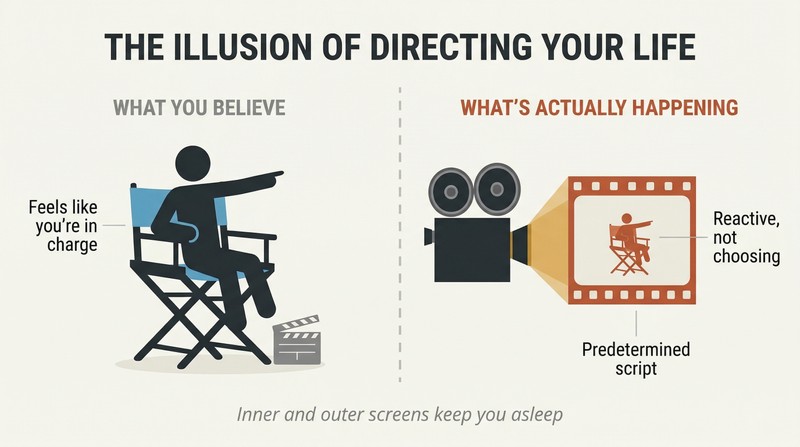
Zeland's core provocation is blunt: you are a character in a motion picture, carried along by a predetermined script. Your attention constantly drifts between two "screens" — an inner screen (your thoughts, worries, daydreams) and an outer screen (whatever grabs your eye). When trapped in either, you're essentially asleep, reacting reflexively to events rather than shaping them. This is what Zeland calls the "illusion of action" — the powerful feeling that you're making independent choices when you're actually following scripted cues.
The evidence is in your own experience. Notice how your attention wanders without permission, how your reactions feel automatic, how you fall into anxiety or excitement without choosing to. Dream characters don't know they're in a dream. Neither, argues Zeland, do you. This illusion keeps you locked in the current frame of reality, unable to influence what comes next.
Park your attention between two screens to wake up inside the movie
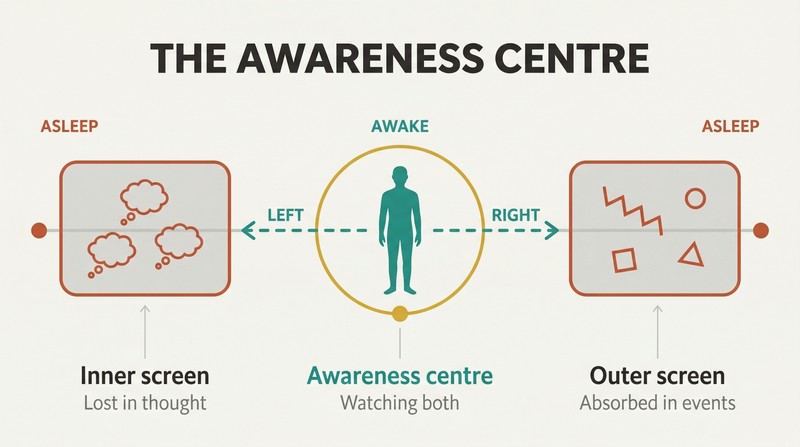
Awakening begins at the midpoint. Zeland defines sleep not as lying in bed but as any state where attention is captured by either the inner screen (lost in thought) or the outer screen (absorbed in events). Between these two sits the "awareness centre" — an observation point where you can simultaneously watch your thoughts and your surroundings. The instruction is deceptively simple: tap the area near your nose and ask, "Where am I? Where is my attention right now?"
The book prescribes walking through daily life in this dual-awareness state, calling it a "stroll through a waking dream." When you achieve it, people respond differently to you — more warmly, more curiously — because you radiate a subtle alertness they subconsciously register. Two trigger types keep you awake: outer triggers (something happens — wake up) and inner triggers (before you do anything — wake up first).
Stop wrestling the current frame — compose the one arriving next
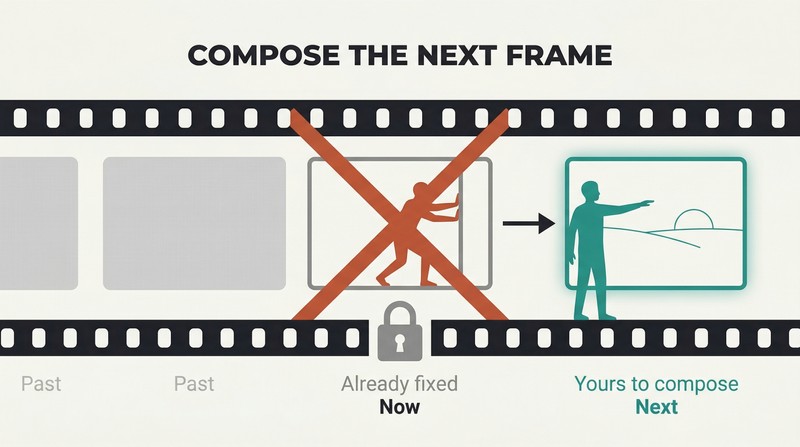
Everything around you has already happened. That's Zeland's startling reframe. The present moment is effectively the past — it's already materialized and cannot be altered. Yet people exhaust themselves trying to force change on circumstances that are already fixed, like arguing with a movie that's already been filmed.
The alternative is to compose forthcoming reality: visualize the future frame you want rather than battling the one you're standing in. Zeland compares reality to an infinite film archive where every possible version of events exists on different film rolls. Your job is to choose which roll plays next — not to edit the one currently running. Three triggers signal when to compose:
1. Expectation — you're waiting for something
2. Intention — you're about to act
3. Problem — something needs resolving
At each trigger, stop and illuminate the desired future frame.
Activate your intention plait to project the future frame you desire
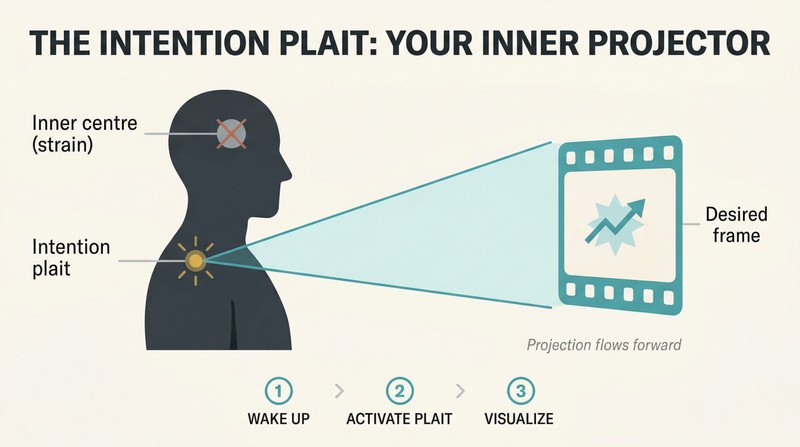
Your main tool is invisible. Zeland introduces the "intention plait" — an energy plexus felt as a phantom sensation between and slightly behind the shoulders, sticking out at an angle from the spine. This is your outer intention centre, distinct from the inner centre in your forehead that handles everyday tasks. The inner centre wrinkles foreheads and tenses muscles. The outer centre moves entire film rolls.
The technique is three steps: first, wake up and enter the awareness point. Second, activate the plait by focusing attention on it — you'll feel it lift at an angle from your spine. Third, while holding awareness of the plait, visualize your desired reality in thoughts, words, or images. This "illuminates" the future frame. The plait works like a film projector — your mental images originate from behind you, not from the straining forehead.
Concentration, not effort — tensing up triggers the wrong control centre
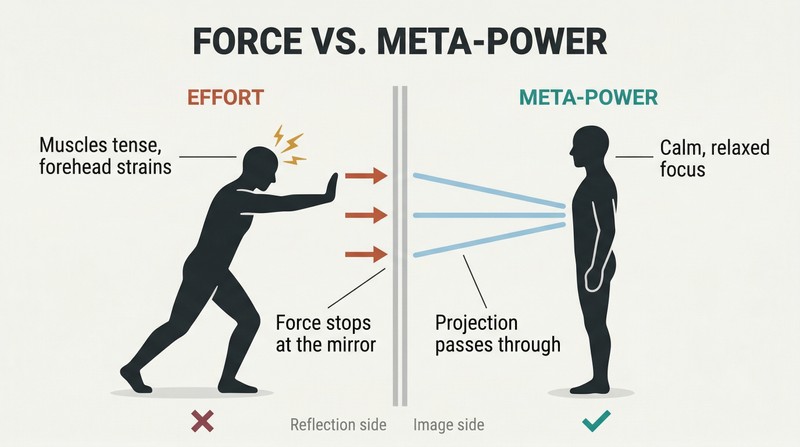
If your muscles strain, you've failed. When composing reality, physical tension means you've accidentally activated the inner intention centre — the forehead-based, muscle-driven system designed for current-frame tasks. The outer centre requires the opposite: calm, relaxed concentration. Zeland calls this reversed force "meta-power" — it operates from the subtle plane behind reality's mirror, where future images live.
Think of reality as a reverse mirror. The physical world you see is the reflection; the original image sits on the other side, in the film archive. Physical force only works on the reflection side. To influence the image side — where future possibilities reside — you need meta-power: gentle focus through the plait, projecting without grasping. You aren't forcing reality to obey; you're illuminating a frame and letting it materialize on its own, as if it had nothing to do with you.
When anything goes wrong, exclaim 'Advantage!' and mine the benefit
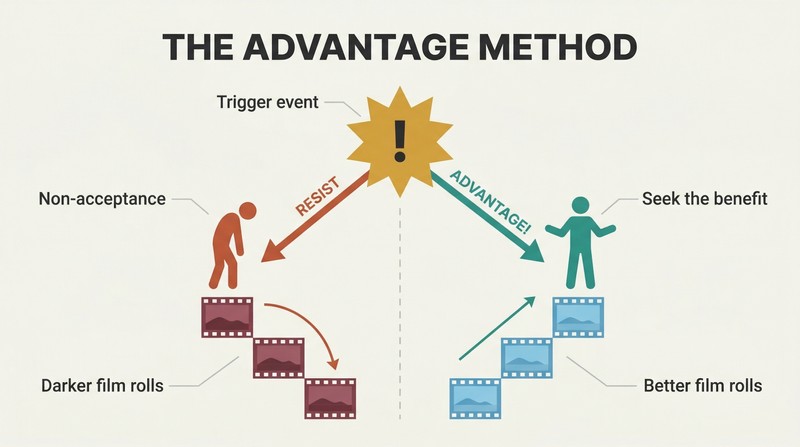
Resistance is reality's worst fuel. Every negative knee-jerk reaction — irritation, fear, frustration — effectively composes a worse version of your reality. The script itself isn't trying to harm you; it takes the path of least resistance. But your non-acceptance creates drag that pulls you onto darker film rolls.
Zeland's Advantage method reverses this. At any trigger of displeasure — someone criticizes you, plans collapse, anxiety spikes — you literally say "Advantage!" (silently or aloud) and ask: what benefit could this carry? By choosing to seek advantage, you detach from the current script and jump to an alternative film roll where the situation works in your favor. An immutable law governs this: the more you seek advantage, the fewer harmful events reality delivers. Even when life seems to be "falling apart," old reality may simply be clearing space for something better.
Set the destination frame, never the route — let the script handle 'how'
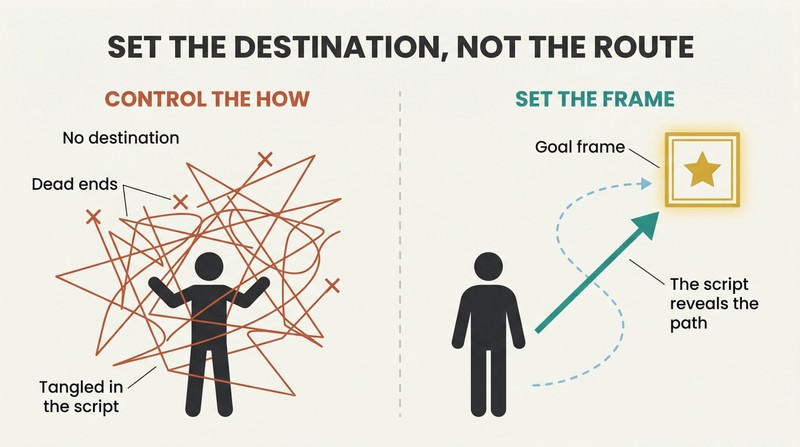
The question 'how?' is your biggest trap. When you try to control the course of events — planning every step, manipulating people, insisting on your version of the timeline — you entangle yourself deeper in the current script. Zeland's "Following" method says: compose only the end-result frame (the goal), then let the script reveal the path. Like a jaybird performing a mating dance without overthinking strategy, you keep only the destination in mind.
Three control triggers signal when you're overreaching:
1. Wanting something from people or events
2. Wanting everything to go according to your plan
3. Something isn't going your way
At each trigger, wake up, compose the goal frame, and follow the script's subtle nudges — what Zeland calls the "dictates of Power." These are first impulses, intuitions, presentiments. Following them consciously harnesses the script's own wisdom and momentum.
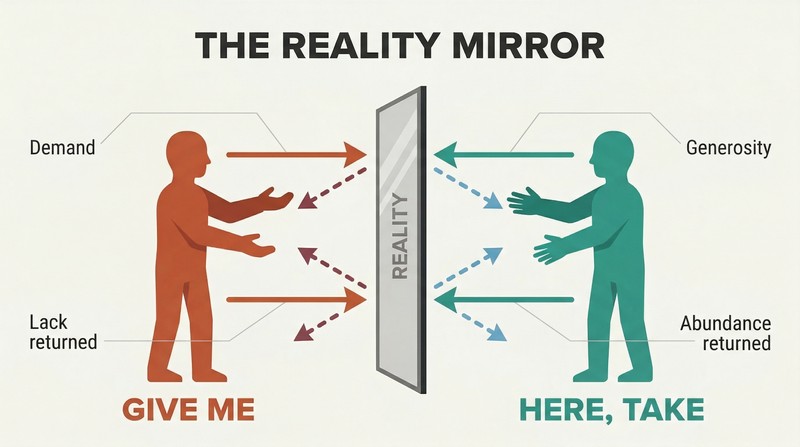
Reality mirrors your output: swap every 'give me' for 'here, take'
You're standing before a three-dimensional mirror. When you demand love, respect, or help, the mirror simply reflects demand back at you — so you receive more taking, not giving. Zeland's Image method flips the approach: give to others exactly what you want to receive. Want love? Radiate it first. Want attention? Show genuine interest. Want respect? Emphasize others' importance.
The book provides a plus/minus framework:
1. Seeking attention → Show genuine interest (+)
2. Demanding respect → Offer respect first (+)
3. Begging for help → Help others proactively (+)
4. Needing love → Radiate warmth without conditions (+)
Negative outputs return like boomerangs — not always immediately or in the same form, but inevitably. The mirror works with a delay and without visible boundaries, which is precisely why its nature stays hidden.
Fake your desired life so seriously that reality is forced to match it
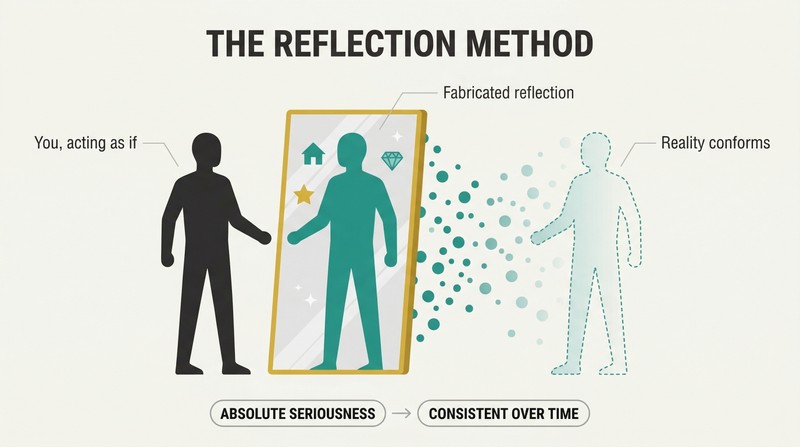
The Reflection method weaponizes make-believe. Want a home? Browse furniture stores as if you already own one. Want wealth? Visit luxury showrooms and let affluence feel familiar. Want stardom? Carry yourself with a star's confidence. The key is emotional authenticity — genuinely feel what it would be like to already possess what you're striving for.
Two conditions make this work. First, treat the game with absolute seriousness — like a professional actor who becomes their character. Second, play consistently over time; the reality mirror responds with a delay. Reality cannot tolerate an illusion it didn't create. When your fabricated reflection persists long enough, reality is compelled to turn it into the real image. The reflection flows into the subject. What you imitate is what you get; who you pretend to be is who you will become.
Radiate 'sweet harmony' to change the weather of your entire reality
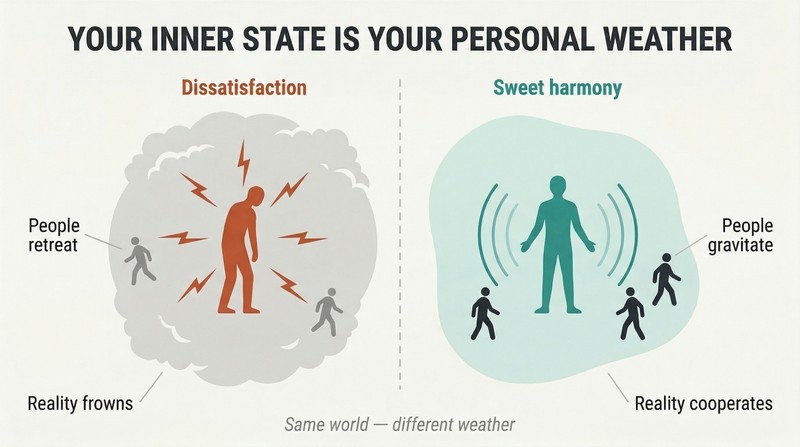
Your inner state sets the atmosphere. "Sweet harmony" is Zeland's term for a deliberately chosen condition of fun, comfort, love, and celebration — the feeling that all is well. It's not passive contentment but an active broadcast. People gravitate toward those who radiate it, and reality itself becomes more cooperative around them. The book compares this to each person having their own personal weather: one person experiences a blue lagoon while their neighbor endures an icy desert, in the same geography.
The practice is simple: begin each day declaring "Sweet harmony." Seek pleasure in small things. Create special occasions from ordinary moments. When fear or anger arises, don't fight the emotion — observe it. Under a magnifying glass, fear paradoxically shrinks. Meanwhile, reality doesn't like being watched; it becomes less controlling when you observe it calmly from the side.
Kindle the Creator's Spark — self-development solves stagnation, purpose, and success simultaneously
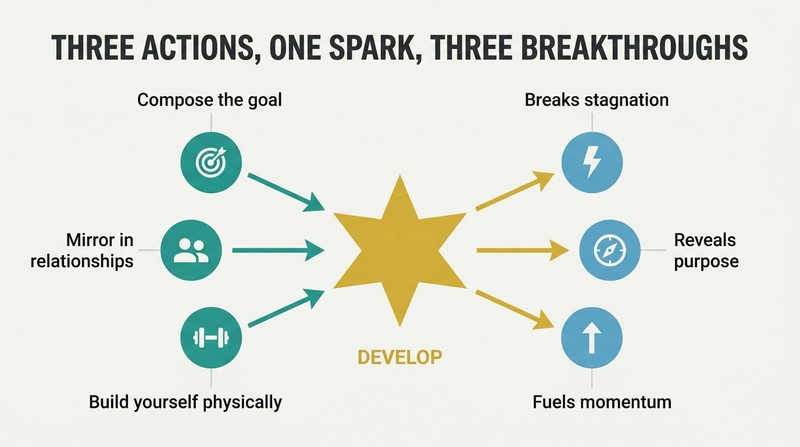
There is no neutral gear in life. You are either developing or deteriorating — the binary is absolute. Zeland's "three achievements way" prescribes focusing relentlessly on personal development even before knowing your life purpose, because development itself delivers three outcomes at once:
1. Shakes off stagnation and feelings of deprivation
2. Reveals your life purpose organically
3. Provides the energy and momentum to realize that purpose
Goals are achieved through triple action: propel reality (compose the goal frame with the plait ), propel yourself (use the mirror principles in relationships), and propel yourself from within (concrete physical self-improvement — exercise, study, skill-building). The metaphysical plait work alone isn't enough. You cannot lounge on the sofa composing reality without also creating yourself on the material plane. Each of these three actions is roughly equally effective alone, but integrated together, the results are guaranteed.
Analysis
Zeland's 'Tufti' represents an ambitious fusion of Taoist wu wei, quantum mysticism, and practical self-help, delivered through a literary device that's genuinely innovative in the genre. By channeling an irreverent, insulting priestess, Zeland bypasses the ego defenses that typically make readers resist radical claims about their lack of agency. You'll absorb the provocation 'you're a puppet in a script' from a playful character more readily than from a solemn lecturer.
The book's central contribution is translating passive-sounding Eastern non-action into a concrete Western framework. You cannot control the script (events, people, circumstances), but you can switch the film roll (choose a different trajectory entirely). Where 'The Secret' offers one blunt tool — visualization — Zeland offers an integrated operating system: attention management (awareness centre), future composition (frame illumination ), behavioral restructuring (image and reflection methods), and state regulation (sweet harmony ). The layering is more comprehensive than most manifestation literature.
The 'Advantage' principle merits particular attention. Cognitive behavioral therapists would recognize systematic cognitive reframing, but Zeland's packaging — literally exclaiming 'Advantage!' at adversity — creates an almost Pavlovian trigger quality that clinical language lacks. Similarly, the Image method (give what you want to receive) echoes decades of reciprocity research from social psychology, repackaged as mirror physics.
The framework's critical weakness is unfalsifiability. The Eternity archive, the plait, and meta-power resist empirical testing entirely. More troublingly, the model ignores structural constraints — systemic inequality, material barriers — implying universal capacity to 'compose reality.' The concept of 'the mould 'acknowledges limiting beliefs but never distinguishes cognitive limitations from institutional ones.
Still, the behavioral habits the system produces — present-moment awareness, future-oriented visualization, reciprocal generosity, deliberate state management — are independently validated by cognitive science and positive psychology. The metaphysics may be unfalsifiable, but the functional practices are sound.
Review Summary
Tufti the Priestess receives mixed reviews, with some praising its simplified approach to Reality Transurfing concepts and others criticizing its repetitive nature and Tufti's abrasive attitude. Many readers find the book's techniques practical and life-changing, while others see it as a dumbed-down version of Zeland's previous works. The book's unique style and metaphors are appreciated by some, but its effectiveness is debated. Overall, it's recommended as a companion to the Reality Transurfing series rather than a standalone read.
People Also Read




Glossary
Intention plait
Outer intention access pointAn energy plexus felt as a phantom sensation between the shoulders, angled away from the spine. It serves as the outer intention centre — the tool through which a person composes future reality. When activated by focused attention, it functions like a film projector, illuminating desired future frames that can then materialize in physical reality. Distinct from the inner intention centre in the forehead.
Frame illumination
Technique for composing future realityThe core practice of composing reality: waking up to the awareness centre, activating the intention plait, then visualizing a desired future event while maintaining the sensation of the plait. Can use thoughts, words, or mental images. Repeated for important events. Functions as both a method of composing desired reality and an exercise for developing meta-power.
Meta-power
Subtle-plane counterpart to physical forceThe flip side of ordinary force (physical strength and willpower). While normal force operates on the material plane in the current frame, meta-power operates from the other side of the reality mirror — the subtle plane where future images reside. It requires relaxed concentration rather than muscular effort. The intention plait is the primary tool for accessing meta-power. Tensing muscles during frame illumination inadvertently disables it.
Eternity archive
Repository of all possible realitiesThe information space (also called the dream space or film archive) where every possible version of reality — past, present, future, and hypothetical — is stored as film rolls. Dreams are viewings of these archived rolls. Physical reality is one illuminated frame moving along one roll. The archive is not virtual; it exists as real, albeit intangible, information embedded in the fabric of existence.
The mould
Worldview limiting perceived possibilitiesThe set of ingrained beliefs about what is possible and impossible that constrains a person's ability to compose reality. Formed through repeated experience and societal conditioning. Only events that fit the mould can manifest; anything outside it is rejected as 'impossible.' The mould is reshaped through repeated successful practice of frame illumination, starting with small, easily believable events and progressively expanding.
Sweet harmony
Deliberately adopted positive stateA consciously chosen condition of fun, comfort, love, friendliness, and celebration — the feeling that all is well. Not merely a passing mood but a sustained broadcast state that influences both interpersonal dynamics (people gravitate toward it) and the 'weather' of one's personal reality. Maintained by seeking pleasure in small things, creating occasions from ordinary moments, and beginning each day with the declaration 'Sweet harmony.'
Thought forms
Aspirational affirmations with plait activationSelf-composed affirmations declared while the intention plait is activated, used to compose a new reality or new mannequin (version of self). Examples include statements like 'I am a high-ranking specialist unique in my field.' They function at the initial stage of reality composition when results have not yet materialized. Less powerful than thought markers because they strive to prove something not yet confirmed.
Thought markers
Confirmations that consolidate achieved progressStatements of fact confirming that positive shifts have already occurred, declared with the plait activated. Unlike aspirational thought forms, thought markers record what has been observed as real progress — for example, 'I really am becoming more charming and attractive.' They trigger design synchronisation, adjusting the information-space blueprint of the person. More powerful than thought forms because they confirm rather than assert.
Triple action
Three-pronged transformation methodThe integrated approach to achieving goals through three simultaneous actions: (1) Propel reality — compose the goal frame using the plait; (2) Propel yourself — use mirror principles (image and reflection methods) in relationships and daily behavior; (3) Propel yourself from within — take concrete physical action toward goals (exercise, study, skill-building). Each action is roughly equally effective alone, but combined, results are described as guaranteed.
Illusion of action
Belief in free action while scriptedThe powerful perceptual trap in which a person believes they are making independent decisions and taking autonomous action, when they are actually following a predetermined script on their current film roll. Analogous to how characters in a film appear to act freely but are entirely bound to the screenplay. The illusion is maintained because attention remains immersed in the current frame, preventing awareness of the script's control.
FAQ
What's "Tufti the Priestess. Live Stroll Through A Movie" about?
- Concept of Reality: The book explores the idea that our reality is like a movie, where individuals are characters following a script. It suggests that people are not truly acting out of free will but are instead directed by an external script.
- Awakening and Control: It emphasizes the importance of waking up within this "movie" to gain control over one's life and reality. The book provides methods to become aware and start composing one's own reality.
- Esoteric Teachings: The book delves into esoteric teachings, suggesting that reality is multi-layered and that individuals can influence their future by understanding and manipulating these layers.
- Author's Perspective: Written by Vadim Zeland, the book presents a unique perspective on life, blending spiritual and philosophical ideas with practical advice for personal transformation.
Why should I read "Tufti the Priestess. Live Stroll Through A Movie"?
- Unique Perspective: The book offers a fresh and unconventional view of reality, challenging readers to rethink their understanding of life and their role in it.
- Practical Methods: It provides practical methods and exercises to help readers gain control over their reality and achieve their goals.
- Personal Transformation: The book is aimed at those seeking personal growth and transformation, offering insights into how to awaken and live consciously.
- Esoteric Insights: For readers interested in esoteric teachings, the book provides a deep dive into concepts like the "intention plait" and the "reality mirror."
What are the key takeaways of "Tufti the Priestess. Live Stroll Through A Movie"?
- Reality as a Movie: Life is like a movie where individuals are characters following a script, and true freedom comes from waking up within this movie.
- Awareness and Intention: By becoming aware and using intention, individuals can compose their own reality and influence their future.
- Inner and Outer Screens: The book introduces the concept of inner and outer screens, where attention is often misplaced, leading to a non-conscious state.
- Practical Exercises: It provides exercises to help readers shift their attention, activate their "intention plait," and compose their desired reality.
How does Vadim Zeland suggest we can control our reality in "Tufti the Priestess"?
- Awakening: Zeland emphasizes the need to wake up from the script that controls our lives by shifting attention to the awareness center.
- Intention Plait: He introduces the concept of the "intention plait," an energy center that can be activated to influence future events.
- Composing Reality: Readers are encouraged to visualize and compose their desired reality, focusing on the future frame rather than battling current circumstances.
- Meta-Power: The book discusses using meta-power, a form of energy that operates from the subtle plane, to propel oneself and reality.
What is the "intention plait" in "Tufti the Priestess"?
- Energy Center: The intention plait is described as an energy center located at the tip of a phantom plait, which can be activated to influence reality.
- Outer Intention: It is associated with outer intention, a power that allows individuals to move the future frame and compose their desired reality.
- Activation Process: To activate the plait, one must focus attention on it and visualize the desired future, thereby illuminating the future frame.
- Practical Use: The book provides exercises to help readers feel and use the plait to achieve their goals and transform their lives.
How does "Tufti the Priestess" explain the concept of the "reality mirror"?
- Dual Nature of Reality: The reality mirror is a metaphor for the dual nature of reality, where the image and its reflection are concurrent.
- Mirror Principles: The book suggests that what you give out is what you get back, and by pretending to have what you desire, you can turn the reflection into reality.
- Manipulating Reality: Readers are encouraged to use the mirror principles to manipulate reality, creating an illusion that reality will eventually manifest.
- Practical Application: The book provides methods to compose both the image and the reflection, allowing individuals to shape their reality.
What are the "inner and outer screens" in "Tufti the Priestess"?
- Inner Screen: The inner screen is where attention is focused on thoughts and internal dialogue, often leading to a non-conscious state.
- Outer Screen: The outer screen is where attention is focused on external events, causing individuals to act reflexively without self-awareness.
- Awareness Center: The book emphasizes shifting attention to the awareness center, a midpoint between the two screens, to achieve a state of wakefulness.
- Practical Exercises: Exercises are provided to help readers track their attention and maintain awareness, allowing them to control their actions and reality.
What is the "illusion of action" in "Tufti the Priestess"?
- Scripted Life: The illusion of action refers to the belief that individuals are acting out of free will, while in reality, they are following a predetermined script.
- Non-Conscious State: When attention is immersed in the inner or outer screen, individuals are not truly aware of their actions, leading to a non-conscious state.
- Breaking the Illusion: The book suggests that by waking up and becoming aware, individuals can break free from the illusion and start composing their own reality.
- Practical Implications: Understanding the illusion of action is key to gaining control over one's life and achieving personal transformation.
How does "Tufti the Priestess" address personal transformation?
- Self-Improvement: The book encourages readers to work on self-improvement, developing both physical and spiritual qualities to kindle the Creator's Spark within.
- Composing a New Mannequin: It suggests that individuals can compose a new version of themselves, changing their outer appearance and inner qualities.
- Triple Action: Personal transformation is achieved through triple action: propelling reality, propelling oneself, and propelling oneself from within.
- Practical Methods: The book provides practical methods and exercises to help readers achieve personal transformation and realize their life purpose.
What role does the "Creator's Spark" play in "Tufti the Priestess"?
- Inner Potential: The Creator's Spark represents the inner potential and perfection that exists within every individual, waiting to be kindled.
- Self-Development: The book emphasizes the importance of self-development to realize this potential and achieve personal transformation.
- Unique Qualities: It encourages readers to embrace their uniqueness and develop their positive qualities, rather than battling perceived shortcomings.
- Life Purpose: By kindling the Creator's Spark, individuals can find and realize their life purpose, leading to a fulfilling and meaningful life.
What are the best quotes from "Tufti the Priestess" and what do they mean?
- "Reality is what has never been and never will be, and only is in the here and now." This quote emphasizes the transient nature of reality, highlighting the importance of focusing on the present moment.
- "You are characters in a filmstrip of the life that is happening to you." It suggests that individuals are not truly in control of their lives, as they are following a predetermined script.
- "Compose your own reality with the help of the plait." This quote encourages readers to take control of their future by using the intention plait to visualize and create their desired reality.
- "The Creator conceived you to be luminescent creatures, your gaze directed forward." It inspires readers to embrace their potential and strive for personal growth and transformation.
How does "Tufti the Priestess" suggest dealing with challenges and setbacks?
- Advantage Principle: The book introduces the principle of seeking advantage in every situation, encouraging readers to find the positive side of challenges.
- Wake-Up Call: Challenges should serve as a wake-up call, prompting individuals to become aware and compose their desired reality.
- Non-Resistance: It advises against resisting the script, suggesting that individuals should follow the flow of events and use them to their advantage.
- Practical Methods: Practical methods are provided to help readers shift their attention, activate the plait, and illuminate the future frame, turning challenges into opportunities.
About the Author
Other books by Vadim Zeland




Download PDF
Download EPUB
.epub digital book format is ideal for reading ebooks on phones, tablets, and e-readers.








































