


Key Takeaways
The Devil owns 98 of 100 people through one quiet habit: drifting
Hill's framing is a courtroom. He claims to interrogate the Devil and forces a confession: the Devil controls 98 percent of humanity, not through fire and pitchforks but through drifting. A drifter is anyone who lets circumstances, other people, and borrowed opinions do his thinking. He accepts whatever life hands him, holds views that aren't his own, and never reaches a decision.
The number wasn't invented. Across decades of research, Hill analyzed more than 25,000 people branded failures and over 500 successes, and found only about 2 in 100 carried a definite aim. The Devil, he says, is negative energy that occupies the unused space of a passive mind. The one person beyond his reach is the one who insists on thinking for himself.
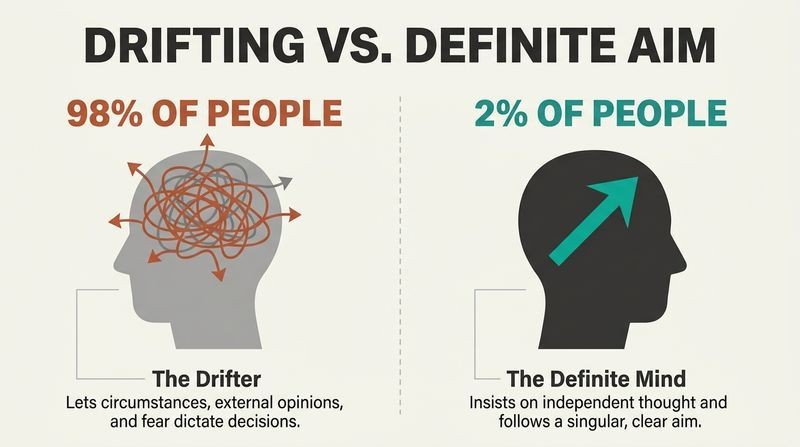
What's striking is how cleanly this prefigures modern psychology. Drifting resembles what Daniel Kahneman calls living on System 1 autopilot, and what Martin Seligman documented as learned helplessness, the surrender that follows when people feel events are beyond their control. Paulo Freire's critique of the "banking model" of education echoes Hill's claim that passivity is trained into us. The literary device, interrogating evil to expose it, borrows from C.S. Lewis's Screwtape Letters. The 98 percent figure is rhetorically powerful but methodologically loose, more an organizing metaphor than a verified statistic. Still, the core diagnosis lands: most unhappiness is outsourced thinking.
Two selves live inside you: one driven by fear, one by faith
Hill's breakdown gave him the discovery. After a journalist partner was murdered by gangsters in 1926, Hill fled into hiding, paralyzed by fear, ashamed that the man teaching success principles couldn't apply them. One night, circling a schoolhouse in West Virginia, an inner command broke the spell. He calls this the "other self," a faith-driven entity that recognizes no limitation, as opposed to the fear-driven self that had enslaved him.
Acting on faith produced results. Penniless, he borrowed fifty dollars, checked into the finest hotel in Philadelphia to starve out his inferiority complex, and mentally scanned 300 acquaintances until the name Albert Pelton surfaced. Pelton agreed to publish his books before even reading them. Hill's claim: the other self guides but never does the work for you.
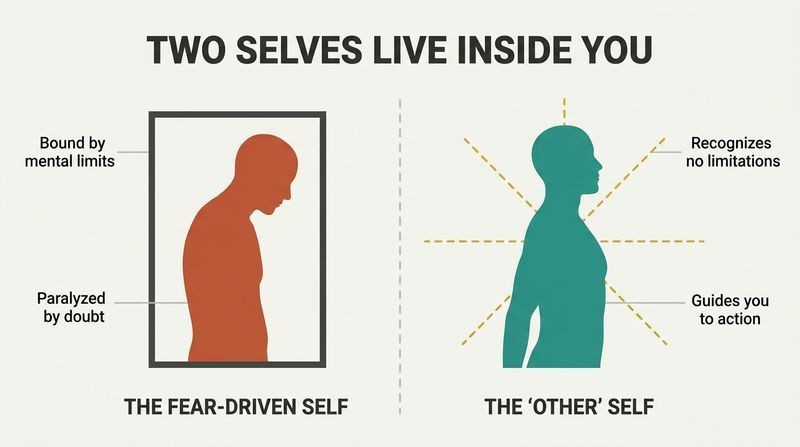
The two-self model anticipates Internal Family Systems therapy and the dual-process framing of modern cognitive science. Hill's "faith entity" maps loosely onto states of flow and self-efficacy, Albert Bandura's finding that belief in one's capability independently predicts performance. The advice to behave as the confident person before feeling confident foreshadows "act as if" techniques and embodied-cognition research showing posture and behavior shape emotion. The shakier element is causation: borrowing money and renting a luxury suite while broke is survivorship-tinted advice. For every Hill rescued by audacity, others compound ruin. The principle holds better as a stance toward fear than as a financial strategy.
Fear is the Devil's master weapon, and six fears do most of the work
Name the fear to defang it. The Devil confesses that fear is his single most effective device for occupying minds, and that six fears do the heavy lifting:
1. Fear of poverty
2. Fear of criticism
3. Fear of ill health
4. Fear of loss of love
5. Fear of old age
6. Fear of death
Poverty and death are his favorites. He plants them so deftly that victims believe the fear is their own invention. Crucially, fear of something that doesn't exist serves him as well as fear of something real, because any fear expands the mental territory he occupies. The fear of criticism, Hill notes, is the exact weapon that kept this very book unpublished for over seventy years.
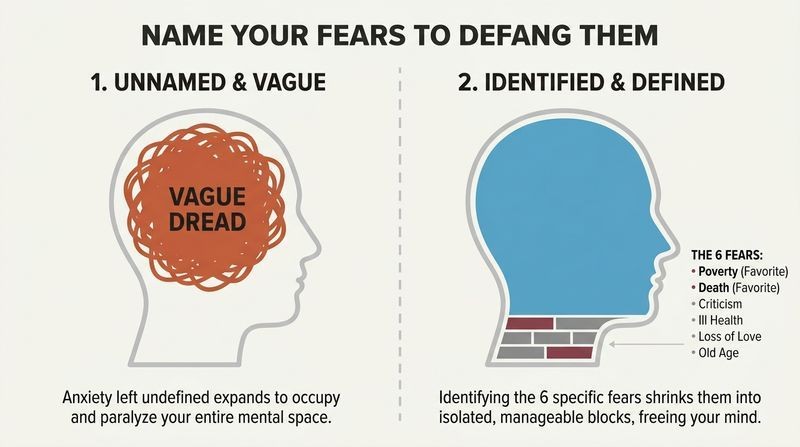
Hill's instinct that fear of imagined threats is as paralyzing as fear of real ones is well supported. The amygdala fires identically to vivid imagined and actual danger, which is why anxiety disorders persist absent any threat. Naming a fear precisely, as the six-fear taxonomy invites, mirrors the clinical technique of affect labeling, shown in UCLA neuroimaging studies to reduce amygdala activation. The fear of criticism deserves special weight: social rejection lights up the same neural regions as physical pain. Hill's observation that this fear muzzles courageous ideas is sociologically sharp, anticipating later work on conformity and the spiral of silence.
Repeated thoughts harden into permanent habits through hypnotic rhythm
Habits become whirlpools. Hill's coined law, "hypnotic rhythm," is nature's mechanism for making any repeated thought or action permanent. He compares it to learning music: notes memorized and repeated eventually fuse into automatic melody. Once a habit reaches the stage of rhythm, it behaves like an object caught in a whirlpool, circling endlessly, unable to escape.
The law is neutral. It cements poverty-thinking and prosperity-thinking with equal indifference. A mind that dwells on fear attracts more of it; a mind demanding opulence attracts its equivalent. This is why both success and failure compound and "misery loves company." The escape route is to break a drifting habit before rhythm makes it permanent, because there is a point beyond which the victim, like a fly in a web, can no longer free himself.
Hill intuited neuroplasticity decades before neuroscience confirmed it. Hebbian theory, "neurons that fire together wire together," is essentially hypnotic rhythm in physiological language; repeated activation literally thickens neural pathways. Charles Duhigg's habit loop and James Clear's compounding habits restate the same compounding dynamic. The "point of no return" claim is overstated, addiction and behavior-change research show even deeply grooved habits can be rewired, though with escalating difficulty, which is closer to the truth than Hill's permanence. The deeper insight, that character is simply crystallized repetition rather than fixed essence, remains one of the book's most empowering reframes.
Definiteness of purpose slams the door the Devil enters through
The master key. Of seven principles for reclaiming your mind, Hill ranks definiteness of purpose first. A definite aim, pursued as a daily policy, closes the mind so tightly that drifting cannot begin. The Devil admits he cannot bribe or frighten anyone who is genuinely definite, because his promises only work on minds that haven't decided what they want.
Definiteness beats brilliance. A weak plan applied with relentless definiteness usually outperforms a superior plan applied loosely. The definite person treats every setback as a cue to swap plans, never to change the purpose. Hill even redefines prayer: the only prayer that works is definiteness of purpose backed by faith in its attainment, demanding rather than begging. Indecision, he warns, is the worst of human ailments.
This is the book's most actionable claim and the best supported. Locke and Latham's goal-setting theory, built on hundreds of studies, confirms that specific, challenging goals dramatically outperform vague "do your best" intentions. Peter Gollwitzer's implementation-intention research shows that defining exactly what, when, and how can double goal attainment. Hill's "weak plan executed beats strong plan drifting" anticipates the bias-toward-action ethos of modern entrepreneurship and lean startups. The Japanese concept of ikigai captures the same fusion of clarity and purpose. One nuance Hill underplays: definiteness can curdle into rigidity. The strongest performers pair fixed purpose with flexible plans, which is precisely his swap-the-plan distinction.
Every defeat plants the seed of an equal benefit, if you don't quit
Failure is a state of mind. Hill draws a hard line between temporary defeat, a signal to re-arm with a new plan, and failure, which becomes real only when you accept it as permanent. The Devil thrives on the gap: he induces people to fail, knowing fewer than one in ten thousand keeps trying after two or three defeats.
The three-feet-from-gold lesson. Hill's famous example: a prospector named Darby hit a rich vein, watched it seem to run dry, and sold his claim for scrap. The buyer brought in an engineer and struck the same vein just three feet from where Darby quit. Darby learned, rebuilt, and made a fortune in insurance. Every adversity carries not the flower of success but its seed, which germinates only in the hands of someone who refuses to quit.
The defeat-versus-failure distinction is a precursor to Angela Duckworth's grit research and Carol Dweck's growth mindset, both showing that interpreting setbacks as informative rather than verdict-like predicts long-term achievement. "Seed of equivalent benefit" anticipates post-traumatic growth, the documented phenomenon where many trauma survivors report increased strength and purpose, and Nassim Taleb's antifragility, systems that gain from disorder. The Stoics said it first: the obstacle becomes the way. The honest caveat is survivorship bias, which Hill never addresses. Persistence sometimes just deepens a hole. Wisdom lies in distinguishing a vein three feet down from genuinely barren rock, a judgment the parable assumes away.
Master three appetites first: food, sex, and loose opinions
Self-mastery is concrete, not abstract. Hill's second principle, self-discipline, begins with three specific appetites:
1. The desire for food (overeating poisons the body and dulls the brain)
2. The desire for sex (uncontrolled, it depletes creative energy and breeds drifting)
3. The desire to express loosely organized opinions (guessing instead of seeking facts, and broadcasting your plans)
Transmute, don't suppress. Hill insists sex energy is among the most powerful human forces and should be redirected into one's work, not killed; dammed, it simply breaks out elsewhere. The habit of uninvited opinions, meanwhile, creates enemies and hands rivals your plans, which is why he urges keeping counsel and learning to listen. He ties accurate thinking directly to controlled sex emotion, calling them the two most important human capacities.
The appetite trio is unusually behavioral for a 1938 inspirational text, and parts hold up. The gut-brain axis and research on diet's effect on cognition vindicate the food claim, if not Hill's lurid "body sewer" physiology. The discipline-of-speech advice anticipates findings that announcing goals publicly can reduce follow-through by granting a premature sense of completion (Peter Gollwitzer's identity-goal studies). The sex-transmutation idea, borrowed from his earlier work, overreaches into pseudoscience, yet its kernel, that arousal and drive can be channeled into productive output, loosely parallels research on sublimation and the broaden-and-build effects of high-energy states. Temperance as the gateway virtue is pure Aristotle and Stoicism.
You absorb the thinking of whoever you live and work beside
Environment is contagious. Hill's principle of environmental influence holds that you unconsciously adopt the dominant thought-habits of your closest associates, ranked by impact: your spouse and home, then your work colleagues, then close friends. Casual acquaintances barely register. Choose your intimates, he urges, with the same care you choose your food.
Build a Master Mind. The most powerful environment is one you engineer: a Master Mind, the harmonious coordination of two or more minds working toward a definite end. Hill credits his own escape from drifting to combining minds daily with his wife. The companion principle is caution: non-drifters never let people attach to them on the newcomer's terms, admitting only those who bring genuine benefit. Drifters, by contrast, accept whoever drifts into their orbit.
Network science has caught up emphatically. Christakis and Fowler's analysis of the Framingham data showed obesity, smoking cessation, and even happiness spread measurably through social ties, up to three degrees of separation, validating Hill's contagion claim with hard data. Jim Rohn's popular maxim that you are the average of the five people you spend the most time with is the same idea repackaged. The Master Mind concept anticipates modern research on collective intelligence and high-performing teams. The harder edge, ruthlessly pruning relationships that don't "benefit" you, risks transactional coldness, and Hill's own annotator flags this tension. Caring relationships also build resilience that pure utility-screening would discard.
Schools and churches mass-produce drifters by teaching fear and memorization
The Devil's best recruiters. In the book's most controversial claim, the Devil names schools and churches his most useful allies. Religious instructors, he says, implant the fear of hell in children before they can reason, weakening independent thought for life. Schools harm not by what they teach but by what they neglect: they reward cramming facts and chasing credits while never teaching students how to use their own minds or be definite about anything.
A radical redesign. Hill, through the Devil, proposes reversing the model: let students lead and teachers serve as guides, teach learning by doing, teach budgeting of time, the law of compensation, the difference between defeat and failure, and above all the habit of choosing a definite purpose. Bring working professionals in to teach their trades directly. This is why Hill's wife begged him not to publish.
Hill's critique converges with a serious tradition: John Taylor Gatto's argument that compulsory schooling trains compliance, Ken Robinson's case that schools kill creativity, and Freire's "banking" model where students are passive deposit accounts. The observation that engaged kindergartners become disengaged teenagers after a decade of being graded for conformity is empirically echoed in motivation research showing intrinsic curiosity declines through the school years. The anti-religion framing is deliberately provocative and conflates fear-based instruction with faith itself, a distinction the annotator restores. The strongest takeaway is constructive, not destructive: a curriculum organized around self-knowledge, decision-making, and applied practice would address documented gaps in financial and life literacy.
Flattery is the hook that turns proud people into drifters
The bait that works on the strong. The Devil calls flattery one of his deadliest instruments because it exploits two near-universal weaknesses: vanity in women and egotism in men. Tell a man he has a powerful physique or a great business mind and he purrs; the expert flatterer who feeds a person his own ego can lead him anywhere. Roughly two in a hundred, the Devil claims, hold their egotism under enough control to be immune.
Non-drifters refuse the hook. Hill compares the non-drifter to a fish that steals the bait but won't take the hook; he enjoys praise without being steered by it. Wherever someone pauses to feed on flattery, the Devil moves in to build another drifter. The defense is self-awareness: recognizing when admiration is being used to bypass your judgment.
Robert Cialdini's research on the "liking" principle confirms flattery's potency: studies show praise works even when recipients know it is insincere and the flatterer has an ulterior motive. Sycophancy is a documented vector for manipulation in everfrom confidence scams to corporate decay, where leaders surrounded by yes-men lose contact with reality. Hill's framing of vanity as a controllable rather than fixed trait is useful; it locates the defense not in being immune to praise but in metabolizing it without surrendering judgment. The gendered split (vanity for women, egotism for men) is a dated artifact, and the book's own annotations concede both sexes fall to both.
Analysis
Outwitting the Devil is best read as a philosophical dialogue in the lineage of Plato and C.S. Lewis, with Hill casting himself as prosecutor and the Devil as a hostile witness compelled to confess. The conceit lets Hill say things he could not say in his own voice in 1938: that organized religion and public schooling, by trafficking in fear and rote memorization, manufacture passive minds. Hill's wife and family found the material so incendiary they suppressed it for over seventy years, until its 2011 release positioned it as a Depression-era message for a post-2008 audience.
Stripped of its theatrical framing, the book is a tight system. Drifting is the disease, hypnotic rhythm is the mechanism that makes it terminal, and seven principles, anchored by definiteness of purpose, are the cure. The intellectual architecture is more coherent than the supernatural packaging suggests, and it anticipates an astonishing amount of later science: goal-setting theory, neuroplasticity, social contagion, post-traumatic growth, and the dual-process model of mind.
The book's weaknesses are also instructive. The 98 percent figure, the deterministic "point of no return" of habit, and the survivorship logic of the persistence parables all reflect a worldview that prizes inspiration over rigor. Hill's autobiographical credibility is genuinely complicated; the imagined-interview device he used elsewhere blurs fact and fable. Yet the central provocation endures and grows more relevant in an attention economy engineered to think for us. The Devil here is not metaphysical evil but the abdication of mental sovereignty, the daily choice to let algorithms, crowds, and inherited fears occupy the unused rooms of the mind. Hill's enduring claim, that your only real limitation is the one you permit in your own thinking, is half motivational cliche and half hard truth about agency. The reader is appointed judge, jury, and defense, and told that losing the case costs only one's life.
Review Summary
Outwitting the Devil receives mostly positive reviews, with readers praising its thought-provoking insights on personal development and success. Many find the interview format with the Devil engaging and the principles outlined valuable. Critics argue the book is repetitive, outdated, and lacks scientific backing. Some readers appreciate its timeless wisdom, while others find it simplistic or offensive. The book's controversial nature and Hill's background add intrigue, with opinions divided on its relevance and effectiveness as a self-help guide.
People Also Read








FAQ
What's "Outwitting the Devil" about?
- Overview: "Outwitting the Devil" by Napoleon Hill is a self-help book that explores the concept of overcoming personal fears and obstacles to achieve success. It presents a fictional interview with the Devil, who reveals how he manipulates people into failure.
- Purpose: The book aims to provide readers with insights into breaking free from habits and attitudes that prevent success, ultimately leading to happiness and prosperity.
- Historical Context: Written in 1938 but published in 2011, the book was initially withheld due to its controversial content, which Hill's family feared might provoke negative reactions.
- Philosophical Approach: Hill uses the dialogue with the Devil to discuss the principles of personal achievement and the importance of self-determination.
Why should I read "Outwitting the Devil"?
- Timeless Wisdom: The book offers timeless insights into human behavior and the psychological barriers to success, making it relevant even decades after it was written.
- Practical Advice: It provides practical strategies for overcoming fear, indecision, and other obstacles that hinder personal and professional growth.
- Self-Improvement: Readers can learn how to harness their inner potential and develop a mindset geared towards success and fulfillment.
- Unique Perspective: The fictional interview format offers a unique and engaging way to explore deep philosophical and psychological concepts.
What are the key takeaways of "Outwitting the Devil"?
- Definiteness of Purpose: Having a clear and definite purpose is crucial for success and helps prevent drifting through life without direction.
- Mastery Over Self: Self-discipline and control over one's thoughts and actions are essential to overcoming the Devil's influence.
- Learning from Adversity: Every failure or adversity carries the seed of an equivalent advantage, offering opportunities for growth and learning.
- Environmental Influence: The people and environment one surrounds themselves with significantly impact their success and mindset.
How does Napoleon Hill define "drifting" in the book?
- Lack of Purpose: Drifting is described as living without a clear purpose or direction, allowing external circumstances to dictate one's life.
- Influence of Environment: Drifters are easily influenced by their environment and the people around them, often adopting negative thought patterns.
- Consequences: Drifting leads to a lack of self-determination and makes individuals susceptible to the Devil's control, resulting in failure and unhappiness.
- Breaking Free: To stop drifting, one must develop definiteness of purpose and take control of their thoughts and actions.
What is "hypnotic rhythm" according to "Outwitting the Devil"?
- Natural Law: Hypnotic rhythm is a natural law that solidifies habits and thought patterns, making them permanent over time.
- Positive or Negative: It can work for or against an individual, depending on whether their dominant thoughts are positive or negative.
- Role in Success: Understanding and harnessing hypnotic rhythm can help individuals establish positive habits that lead to success.
- Breaking Negative Patterns: To break free from negative hypnotic rhythms, one must consciously change their thought habits and environment.
What role does fear play in "Outwitting the Devil"?
- Tool of Control: Fear is depicted as one of the Devil's primary tools for controlling individuals and preventing them from achieving success.
- Types of Fear: The book identifies six major fears: poverty, criticism, ill health, loss of love, old age, and death.
- Overcoming Fear: By developing self-confidence and faith in oneself, individuals can overcome fear and take control of their lives.
- Impact on Success: Fear leads to indecision and inaction, which are major barriers to personal and professional growth.
How does Napoleon Hill suggest one can "outwit the Devil"?
- Definiteness of Purpose: Establish a clear and definite purpose in life to guide decisions and actions.
- Self-Discipline: Cultivate self-discipline to control thoughts and actions, resisting negative influences.
- Positive Environment: Surround oneself with positive influences and people who support one's goals and aspirations.
- Continuous Learning: Embrace failure as a learning opportunity and continuously seek knowledge and self-improvement.
What are some of the best quotes from "Outwitting the Devil" and what do they mean?
- "Fear is the tool of a man-made devil." This quote emphasizes that fear is a self-imposed barrier that can be overcome with self-confidence and faith.
- "Your only limitation is the one which you set up in your own mind!" It highlights the power of mindset in determining one's success or failure.
- "Every adversity brings with it the seed of an equivalent advantage." This suggests that challenges and failures can lead to growth and new opportunities if approached with the right mindset.
- "Definiteness of purpose is the starting point from which one may establish his own environment." It underscores the importance of having a clear goal to shape one's life and surroundings.
How does "Outwitting the Devil" relate to "Think and Grow Rich"?
- Continuation of Themes: Both books explore the principles of success and personal achievement, with "Outwitting the Devil" delving deeper into the psychological barriers to success.
- Focus on Mindset: While "Think and Grow Rich" focuses on the power of positive thinking and goal setting, "Outwitting the Devil" addresses the negative forces that can derail one's progress.
- Practical Application: "Outwitting the Devil" provides practical advice on overcoming fear and indecision, complementing the success strategies outlined in "Think and Grow Rich."
- Philosophical Depth: The fictional interview format allows Hill to explore philosophical and spiritual concepts in greater depth than in his previous work.
What is the significance of the "interview with the Devil" format?
- Engaging Narrative: The fictional dialogue format makes complex philosophical and psychological concepts more accessible and engaging for readers.
- Personification of Evil: By personifying the Devil, Hill can explore the nature of evil and its influence on human behavior in a relatable way.
- Contrast of Ideas: The interview allows for a direct contrast between positive and negative thought patterns, highlighting the choices individuals have in shaping their lives.
- Moral Lessons: The format serves as a vehicle for delivering moral and ethical lessons about personal responsibility and the power of choice.
How can "Outwitting the Devil" help in personal development?
- Self-Awareness: The book encourages readers to examine their own thought patterns and identify areas where they may be drifting or influenced by fear.
- Goal Setting: It emphasizes the importance of setting clear, definite goals and creating a plan to achieve them.
- Overcoming Obstacles: Readers learn strategies for overcoming common obstacles such as fear, indecision, and negative influences.
- Empowerment: By understanding the principles outlined in the book, individuals can take control of their lives and work towards their fullest potential.
What impact did "Outwitting the Devil" have upon its release?
- Delayed Publication: Written in 1938, the book was not published until 2011 due to concerns about its controversial content.
- Relevance to Modern Times: Upon release, the book resonated with readers facing economic and personal challenges, offering timeless wisdom and practical advice.
- Expanded Audience: The book reached a new generation of readers, expanding Napoleon Hill's influence and legacy in the self-help genre.
- Critical Acclaim: It received praise for its unique format and insightful exploration of human behavior, solidifying Hill's status as a pioneer in personal development literature.
About the Author
Other books by Napoleon Hill









Download PDF
Download EPUB
.epub digital book format is ideal for reading ebooks on phones, tablets, and e-readers.








































