

Key Takeaways
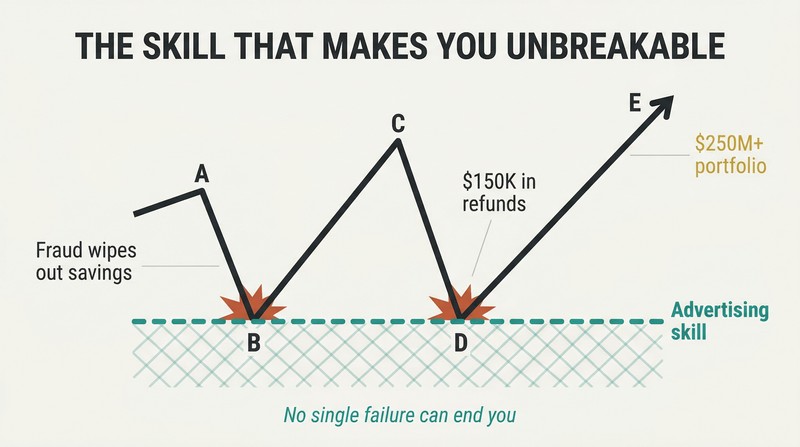
Advertising skill gives you unlimited second chances in business
Hormozi lost everything — twice — before thirty. First, a fraudulent partner stole his life savings. Then, $150,000 in refunds nearly bankrupted him again. Each time, his ability to generate leads resurrected him. During his second crisis, a phone call meant to cancel a gym launch turned into a $6,000 sale of his advertising system. That single pivot collected $60,000 in one day and spawned a business that hit $6.82M in its first year and $25.9M the next.
The thesis of this book is simple. Hormozi's portfolio now generates $250M+ annually and 20,000+ leads per day, with a lifetime advertising return of 36:1. The ability to get strangers interested in your stuff is, as he puts it, a "get out of jail free card with no expiration date." Master it, and no single failure can end you.
Every ad you'll ever run uses one of just four methods
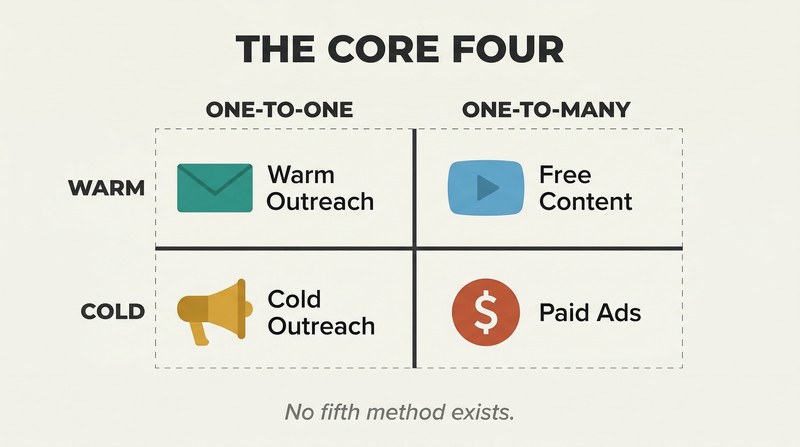
Hormozi reduces all advertising to a 2×2 matrix. You either reach people who know you (warm) or strangers (cold), and you communicate privately (one-to-one) or publicly (one-to-many). These four combinations produce the Core Four:
1. Warm Outreach: personal messages to your existing contacts
2. Post Free Content: public value that grows your audience
3. Cold Outreach: private messages to targeted strangers
4. Paid Ads: paying platforms to show your offer to strangers
No fifth method exists. If you're not getting enough leads, you're not doing one or more of these with enough skill or volume. Hormozi built his gyms on content and paid ads, Gym Launch on paid ads and cold outreach, and Acquisition.com entirely on free content.
Solve one narrow problem free to reveal the bigger paid one
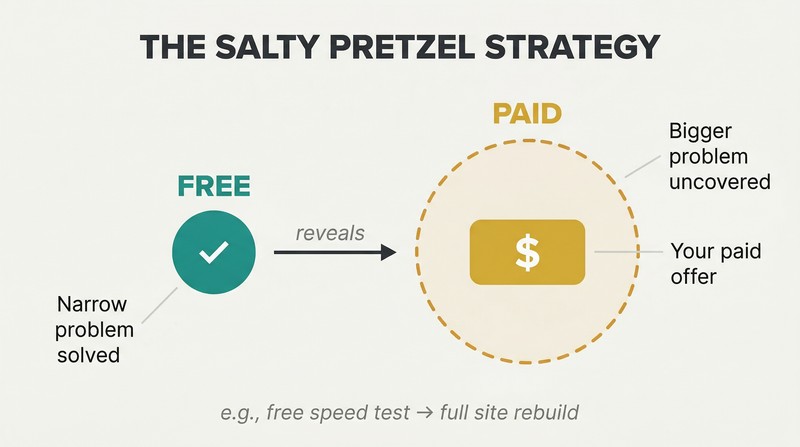
Think salty pretzels at a bar. They solve hunger for free, then create thirst you satisfy with a paid drink. A lead magnet works identically: it's a complete solution to a narrow problem that, once solved, reveals a bigger problem your paid offer addresses. Hormozi's webinar flopped — zero sales from 80 leads. But when he swapped it for a free case study walking through a real gym launch with actual ad spend and revenue numbers, Leila's appointment calendar filled overnight.
Three types of lead magnets work best. You can reveal a hidden problem (free website speed test), offer a sample or trial of your service, or give one step of a multi-step process. The key: make it so good people would pay for it, then give it away. Hormozi's math shows lead magnets can cut customer acquisition costs by 3×.
Commit to 100 daily advertising actions before you tweak a thing
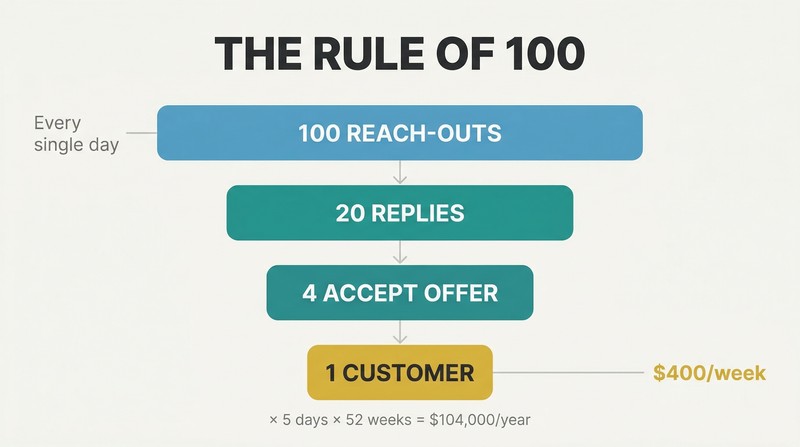
Hormozi distributed 300 flyers and got zero leads. His mentor tested with 5,000 — and ran 5,000 per day for a month. Most entrepreneurs aren't doing half of what's required; they're doing a tiny fraction. The Rule of 100 prescribes 100 primary advertising actions every day for 100 consecutive days:
1. Warm or cold outreach: 100 messages per day
2. Content creation: 100 minutes per day, releasing at least one piece
3. Paid ads: 100 minutes per day making ads plus a committed daily budget
Volume makes the math inevitable. Hormozi's warm outreach benchmarks: 100 reach-outs yield ~20 replies, ~4 accept your free offer, and ~1 becomes a paying customer. At 500 weekly reach-outs with a $400 product, that's $104,000/year — twice the U.S. median household income.
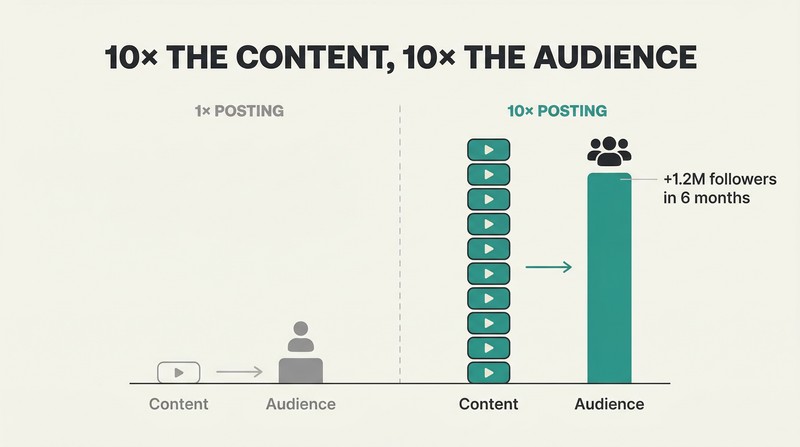
Post ten times more content to grow your audience ten times faster
Hormozi dismissed content creation for years. Then he watched Kylie Jenner, Huda Kattan, Conor McGregor, and Dwayne Johnson build billion-dollar businesses on audience rather than ad budgets. He paid $120,000 for four calls with an influencer whose advice was brutally simple: "You posted once today. I posted three times. You just gotta do more."
The results were proportional. Over six months of 10× content output, Hormozi added 1.2 million followers — ten times faster growth from ten times the volume. He also discovered that 78% of paying customers had consumed at least two long-form content pieces before booking a call. When his paid ads accidentally shut off for two weeks, the business still made $500,000 per week from the warm audience alone.
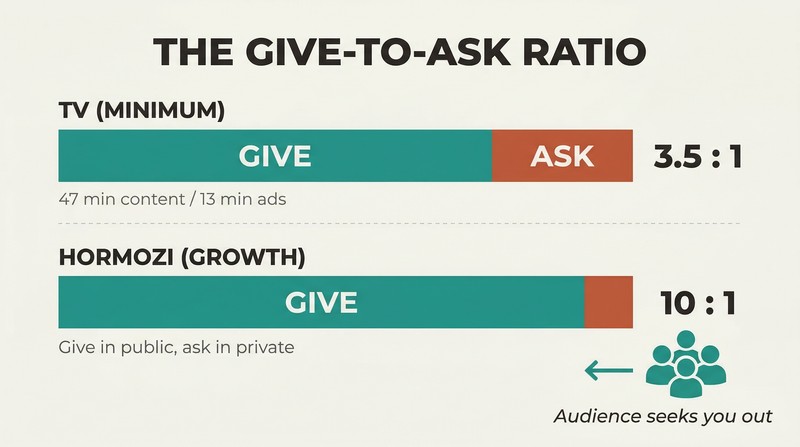
Give so much free value that your audience begs to pay you
Television runs a 3.5:1 give-to-ask ratio — 47 minutes of content per 13 minutes of ads. That's the minimum for a mature platform maximizing revenue, not growing. Hormozi's strategy goes further: give in public, ask in private. Let the audience self-select when they're ready to buy. People become uncomfortable receiving without reciprocating, so they'll seek you out — visiting your website, sending DMs, asking how they can pay.
When you do ask, keep the ratio high. Integrated asks weave brief promotions into long-form content (e.g., 1.5 minutes of ads in a 60-minute podcast). Intermittent asks make one promotional post for every ten value posts. Hormozi's golden rule: give away your secrets, sell the implementation. Your free stuff builds or destroys your reputation — 99% of people won't buy, but they will tell others.
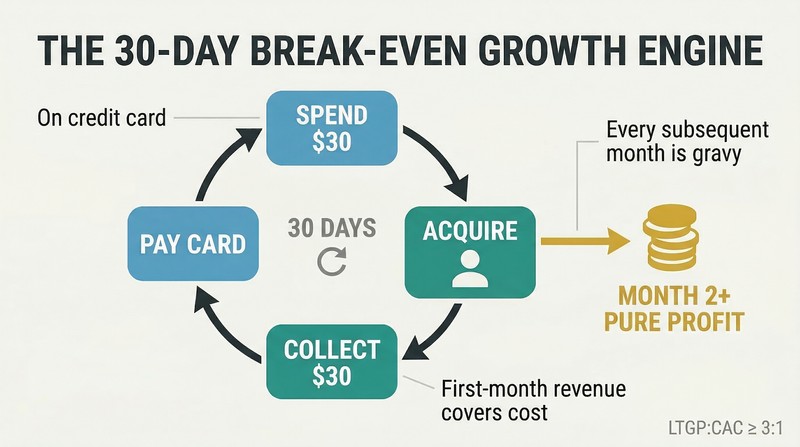
Break even on customer acquisition in 30 days to scale forever
Most businesses are profitable over a customer's lifetime but bleed cash upfront. Client Financed Acquisition means structuring offers so first-month revenue covers acquisition and fulfillment costs. Example: a $15/month membership with $5 delivery costs earns $10/month. With a $30 acquisition cost, break-even takes three months. But add a $100 upsell that 1 in 5 buy, and you average $30 gross profit in month one — exactly covering your cost.
This unlocks a credit-card-powered growth loop. Spend $30, acquire a customer, collect $30 within 30 days, pay off the card, repeat. Every subsequent month's revenue is pure gravy. Hormozi used this mechanism to scale every company past $1M/month within twelve months, without outside funding. Your LTGP-to-CAC ratio should be at least 3:1; below that, every portfolio company he's seen struggles to scale.
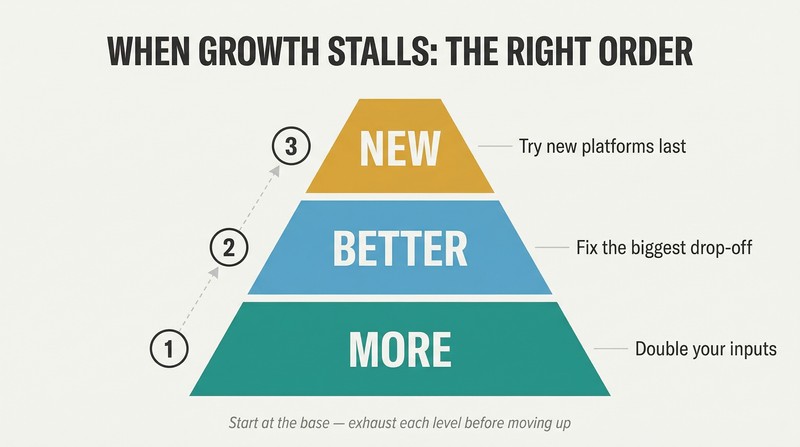
When growth stalls: More first, Better second, New third
An entrepreneur told Hormozi he'd "saturated" the chiropractor market with $30,000/month on a single platform. A competitor in the same niche spent $30,000 per week across four platforms. Hormozi calls this the Size of the Pie Fallacy — mistaking your tiny advertising slice for the entire available market.
The More-Better-New framework fixes this. First, do more of what already works — double inputs to roughly double outputs. Second, find the constraint (the step where the most leads drop off) and test one improvement per week per platform. Log every result. Third, only after exhausting more and better, try new placements, new platforms, or a new Core Four method entirely. The order matters: new placements → new platforms → new Core Four activity. Most entrepreneurs jump to "new" when they simply haven't done enough of what works.
Referrals compound exponentially when they outpace customer churn
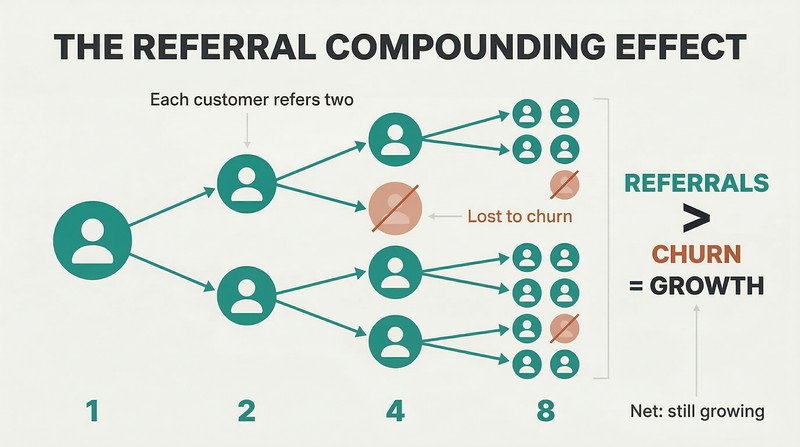
Unlike paid ads where doubling spend roughly doubles leads, referrals multiply. One customer brings two, who bring four, who bring eight. But this only works if your monthly referral rate exceeds your monthly churn rate. That's the referral growth equation — and it's how PayPal reached 100 million users and Dropbox 39×'d in fifteen months with two-sided referral incentives.
The hard truth: if customers aren't referring, your product isn't good enough. Hormozi's six drivers of referral-worthy goodwill: sell better-fit customers, set expectations you can exceed, replicate what your top performers do, deliver faster wins, continuously reduce customer effort, and always have something compelling to sell next. Then ask for referrals at purchase, offer two-sided incentives, and run referral events. Hormozi's Gym Launch generated $500,000/week from word of mouth alone.
Recruit lead getters to build a machine that runs without you
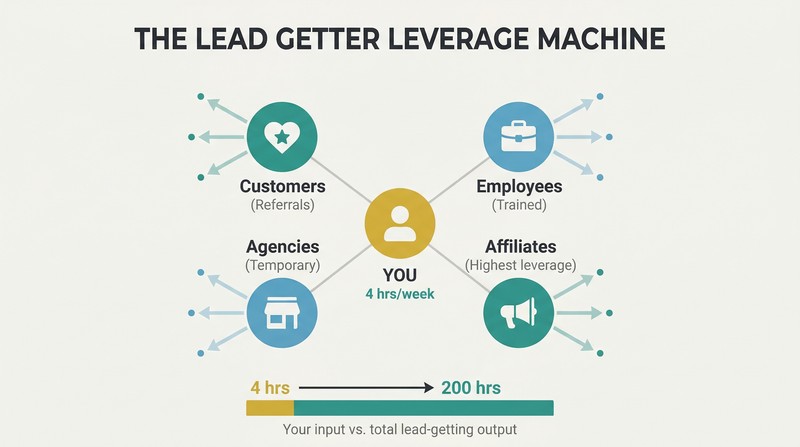
Hormozi defines four types of lead getters — people who advertise your stuff for you: customers (referrals), employees, agencies, and affiliates. Each multiplies your reach beyond what one person can do. The leverage math: trade 40 hours of doing for 4 hours of managing. Repeat across multiple employees, and 200 hours of lead-getting costs you 4 hours of leadership.
Affiliates offer the highest compounding leverage. Hormozi's supplement company Prestige Labs grew through 4,000+ gym affiliates — zero paid ads, zero sales team. His software ALAN scaled to $1.7M/month within six months using three tiers of affiliates. Train employees using the 3Ds method: Document the checklist, Demonstrate it in front of them, have them Duplicate it in front of you. Use agencies to learn new platforms fast — set a six-month deadline, absorb their skills, then bring it in-house.
Analysis
$100M Leads succeeds because it reduces the anxiety-inducing world of marketing to a manageable taxonomy. Hormozi's Core Four framework is essentially a 2×2 matrix (warm/cold × private/public) that proves there are no secret fifth channels hiding behind guru paywalls. This alone saves entrepreneurs years of chasing shiny objects.
The book's most contrarian insight isn't a tactic — it's a diagnosis. Hormozi argues that most businesses don't have a strategy problem; they have a volume problem. His 300-flyers-versus-5,000-per-day anecdote crystallizes what marketing literature calls the exposure threshold effect — most campaigns fail not because the message is wrong but because insufficient impressions prevent statistical learning. The Rule of 100 is crude but effective precisely because it forces the volume that makes pattern recognition possible.
Client Financed Acquisition is arguably the book's most sophisticated concept, though Hormozi presents it simply. It's working capital optimization for people who've never taken a finance course — structuring first-purchase economics so customer acquisition becomes self-funding. This echoes Amazon's flywheel but at the small-business scale.
Where the book has blind spots: it assumes product-market fit exists and merely needs amplification. Hormozi briefly acknowledges your product must generate referrals, but the treatment is lopsided toward distribution over product development. A reader with genuinely poor product-market fit could burn significant resources following this playbook before discovering the real bottleneck.
The lead getters section — particularly affiliates — represents Hormozi's most distinctive contribution. While most marketing books stop at 'here's how to run ads,' his framework for building distribution layers (affiliates recruiting affiliates recruiting customers) borrows from network economics and franchise models. It's the closest thing in modern business writing to building what Buffett would call a distribution moat. The question isn't whether these methods work — they demonstrably do — but whether readers will sustain the volume long enough to discover which combination works for them.
Review Summary
"$100M Leads" receives overwhelmingly positive reviews, with readers praising its actionable advice and comprehensive coverage of lead generation strategies. Many consider it one of the best business books they've read, citing its practical tips, frameworks, and real-world examples. Reviewers appreciate Hormozi's straightforward writing style and the book's focus on implementable tactics. While a few critics find the content basic or the author's tone arrogant, the majority of readers report significant value and potential for business growth from applying the book's principles.
People Also Read




Glossary
Engaged Lead
Person showing interest in your offerA person who has demonstrated interest in what you sell, distinct from a plain 'lead' (anyone you can contact). Engaged leads are the true output of advertising. They've given contact information on a website, followed you on social media, replied to outreach, or otherwise signaled they have the problem you solve and the money to spend.
Core Four
Four ways to advertise anythingHormozi's framework for the only four advertising methods available to any business: Warm Outreach (one-to-one to people who know you), Post Free Content (one-to-many to people who know you), Cold Outreach (one-to-one to strangers), and Paid Ads (one-to-many to strangers). All lead-generation activity is a variation of one of these four.
Lead Magnet
Free offer that attracts buyersA complete solution to a narrow problem, offered for free or at low cost, that reveals a larger problem solved by your paid core offer. Three types: reveal a hidden problem (diagnosis), offer a sample or trial of your service, or provide one step of a multi-step solution. Effective lead magnets should be valuable enough to charge for but are given away to generate engaged leads.
Lead Getter
Person who advertises for youAny person or entity that lets others know about your stuff on your behalf, giving you leverage. Four types: customers who refer, employees you train to advertise, agencies you hire temporarily to learn from, and affiliates—independent businesses that promote your offer to their own audiences in exchange for compensation.
Client Financed Acquisition
Break even within thirty daysA business model design where revenue from a new customer covers the cost of acquiring and fulfilling them within the first 30 days. This allows entrepreneurs to use credit cards to fund customer acquisition, pay off the balance monthly, and recycle cash to acquire more customers indefinitely—without outside funding. Achieved through upsells, bundles, or higher upfront pricing.
Rule of 100
100 daily actions for 100 daysHormozi's commitment framework: perform 100 primary advertising actions every day for 100 consecutive days. For outreach, that's 100 messages. For content, 100 minutes of creation. For paid ads, 100 minutes of ad work plus a committed daily budget. The principle: sufficient volume over sufficient time guarantees engaged leads.
More Better New
Scaling framework in priority orderA three-step framework for increasing lead flow when growth stalls. First, do More of what already works (increase volume). Second, make it Better by finding the constraint—the step with the biggest lead drop-off—and testing one improvement per week. Third, try New placements, platforms, or Core Four methods only after exhausting more and better. Order matters.
LTGP
Lifetime gross profit per customerLifetime Gross Profit: all money a customer ever spends minus all costs to deliver what they bought. Hormozi uses LTGP instead of the more common 'lifetime value' (LTV) because gross profit is the actual cash available to cover advertising, payroll, rent, and all other business expenses. A healthy business maintains at least a 3:1 ratio of LTGP to CAC.
Content Unit
Smallest hook-retain-reward pieceThe smallest amount of material needed to hook attention (give a reason to notice), retain attention (keep them consuming via lists, steps, or stories that embed unresolved questions), and reward attention (satisfy the reason they started consuming). Can be as brief as a single meme or tweet. Longer content is simply multiple content units linked together.
Value Equation
Four-variable formula for perceived valueHormozi's framework from $100M Offers defining how prospects perceive value. Value increases with Dream Outcome (what they want) and Perceived Likelihood of Achievement (belief it will work for them), and decreases with Time Delay (how long to get results) and Effort & Sacrifice (what they must endure or give up). Used throughout for offers, ads, and lead magnets.
Open to Goal
Work until outcome is achievedAn advanced version of the Rule of 100 where instead of committing to a fixed number of daily actions, you commit to working until you hit a specific outcome—no matter how long it takes. Borrowed from a gym chain that let sales managers set their own schedules provided they signed five new members per day. Shifts focus from inputs to results.
Size of the Pie Fallacy
Mistaking your slice for everythingThe cognitive error of assuming the tiny slice of the market you currently advertise to represents the entire available market. Hormozi observed entrepreneurs claiming market saturation while spending $30K/month on one platform in a $15 billion industry. The fallacy keeps businesses small because owners stop advertising before reaching a fraction of potential customers.
Whisper-Tease-Shout
Three-phase product launch methodA launch framework for activating affiliates or audiences. Whisper phase: hint at the product, build curiosity, show behind-the-scenes work (starting months out). Tease phase: reveal the product, share value elements, set a public launch date (starting ~30 days out). Shout phase: heavy calls to action with scarcity, urgency, and bonuses (final 3 days). Each phase increases frequency and specificity.
FAQ
What's "100M Leads: How to Get Strangers To Want To Buy Your Stuff" about?
- Lead Generation Focus: The book by Alex Hormozi is centered on strategies for generating leads and converting strangers into customers.
- Business Growth: It provides insights into scaling businesses by creating compelling offers that attract and retain customers.
- Practical Advice: The book includes real-world examples and actionable steps for entrepreneurs to implement in their marketing strategies.
- Value Creation: Emphasizes the importance of creating value-driven offers that differentiate from competitors.
Why should I read "100M Leads" by Alex Hormozi?
- Proven Strategies: The book offers tested methods from Hormozi's own experiences in scaling businesses.
- Comprehensive Guide: It covers a wide range of topics from creating offers to enhancing them with bonuses and guarantees.
- Actionable Insights: Readers receive practical advice that can be immediately applied to their business strategies.
- Entrepreneurial Growth: It is particularly useful for entrepreneurs looking to expand their customer base and increase profitability.
What are the key takeaways of "100M Leads"?
- Grand Slam Offer: Learn how to create an offer that stands out and is incomparable to competitors.
- Value Equation: Understand the components that drive value and how to leverage them in your offers.
- Scarcity and Urgency: Discover how to use these psychological triggers to increase demand for your products or services.
- Bonuses and Guarantees: Learn how to enhance your offers with additional incentives and risk-reversal strategies.
How does Alex Hormozi define a "Grand Slam Offer"?
- Unique Proposition: A Grand Slam Offer is one that cannot be easily compared to any other product or service.
- Value-Driven: It combines an attractive promotion, unmatchable value, premium pricing, and a strong guarantee.
- Market Differentiation: The offer allows you to sell in a "category of one," making price comparisons irrelevant.
- Customer Attraction: It increases response rates, conversion rates, and allows for premium pricing.
What is the "Value Equation" in "100M Leads"?
- Four Drivers of Value: The equation includes Dream Outcome, Perceived Likelihood of Achievement, Time Delay, and Effort & Sacrifice.
- Increase and Decrease: The goal is to increase the Dream Outcome and Likelihood of Achievement while decreasing Time Delay and Effort & Sacrifice.
- Perception is Key: The perceived value by the customer is what ultimately drives their purchasing decision.
- Infinite Value: If you can reduce the bottom part of the equation (Time Delay and Effort & Sacrifice) to zero, the value becomes infinite.
How can scarcity and urgency enhance an offer according to "100M Leads"?
- Scarcity: Limiting the supply of a product or service increases its perceived value and urgency to purchase.
- Urgency: Setting a deadline for an offer encourages quicker decision-making from potential customers.
- Psychological Triggers: Both scarcity and urgency tap into the fear of missing out, driving more immediate sales.
- Strategic Use: These elements should be used ethically and strategically to maintain credibility and trust.
What role do bonuses play in enhancing offers in "100M Leads"?
- Value Addition: Bonuses increase the perceived value of the main offer without reducing its price.
- Overcoming Objections: They can address specific customer objections or concerns, making the offer more appealing.
- Stacking Value: Presenting bonuses as part of a package can make the offer seem like an unbeatable deal.
- Strategic Presentation: Bonuses should be named and presented in a way that highlights their value and relevance to the customer.
How does Alex Hormozi suggest using guarantees in "100M Leads"?
- Risk Reversal: Guarantees remove the perceived risk for the customer, making it easier for them to say yes.
- Types of Guarantees: The book discusses unconditional, conditional, anti-guarantees, and implied guarantees.
- Creative Guarantees: Unique and creative guarantees can significantly boost conversion rates.
- Stacking Guarantees: Combining different types of guarantees can further enhance the attractiveness of an offer.
What are some of the best quotes from "100M Leads" and what do they mean?
- "Desire is a contract you make with yourself to be unhappy until you get what you want." This quote highlights the human tendency to want what we don't have, which can be leveraged in marketing.
- "The longer you delay the ask, the bigger the ask you can make." This emphasizes the importance of building anticipation and demand before making a sales pitch.
- "Those who give the most, get the most." This underscores the value of providing free or discounted offers to build trust and generate demand.
- "Price is what you pay. Value is what you get." A reminder that customers are more concerned with the value they receive than the price they pay.
How does "100M Leads" address the concept of market selection?
- Starving Crowd: The book emphasizes the importance of choosing a market with high demand and unmet needs.
- Market Indicators: Look for markets with massive pain, purchasing power, easy targeting, and growth potential.
- Avoiding Bad Markets: Selling to a shrinking or saturated market can hinder business growth.
- Niche Commitment: Once a market is chosen, commit to it and focus on creating a Grand Slam Offer for that audience.
What is the "Sales to Fulfillment Continuum" in "100M Leads"?
- Balance of Effort: The continuum represents the balance between ease of sales and ease of fulfillment.
- Demand First: Hormozi advises generating demand first, then optimizing fulfillment processes.
- Over-Deliver Initially: Start by over-delivering to create cash flow, then streamline operations for efficiency.
- Finding the Sweet Spot: The goal is to find a balance where the offer is easy to sell and fulfill.
How does "100M Leads" suggest naming offers for maximum impact?
- MAGIC Formula: Use the formula to create names that are Magnetic, Announce the Avatar, Give a Goal, Indicate a Time Interval, and Complete with a Container Word.
- Avoid Fatigue: Regularly refresh offer names to prevent market fatigue and maintain interest.
- Attention-Grabbing: A well-named offer can significantly increase response rates and engagement.
- Testing and Iteration: Continuously test different names to find the most effective ones for your audience.
About the Author

Download PDF
Download EPUB
.epub digital book format is ideal for reading ebooks on phones, tablets, and e-readers.








































