


Key Takeaways
The Devil admits he owns 98% of people through one lazy habit
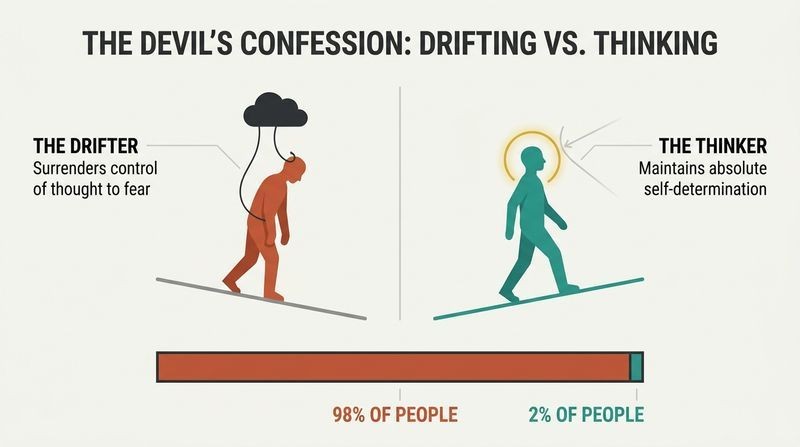
The book's central conceit. Hill frames his philosophy as a courtroom-style interrogation in which he forces a confession from "His Majesty the Devil," who is not a horned beast but negative energy that lives in the unused portions of human minds. The Devil boasts he controls 98 out of every 100 people, capturing them through a single mechanism: fear that leads to passive, thoughtless living.
Hill wrote this in 1938, the year after Think and Grow Rich, but his wife hid it for fear of religious backlash. It stayed locked away 72 years. The Devil confesses he cannot touch anyone who thinks for themselves. His entire empire rests on people surrendering the one thing they fully control, their own thoughts.
What's striking is Hill's rhetorical gamble: personifying self-sabotage as an external villain, then stripping that villain of supernatural power. The Devil is revealed as a psychological pattern, not a metaphysical enemy. This anticipates modern cognitive behavioral therapy, which treats intrusive negative thoughts as habits to be observed and redirected rather than obeyed. The 98% figure is unfalsifiable bravado, yet it echoes real research on learned helplessness. Framing your worst tendencies as a defeatable adversary can be motivating, though critics note it also risks externalizing responsibility, the very "victim mentality" Hill elsewhere condemns.
Two selves fight inside you: one runs on fear, one on faith
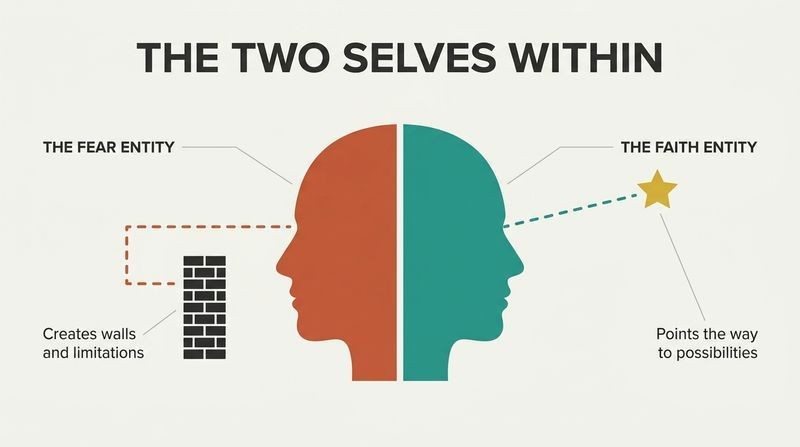
Hill's origin story. After years of business failures and a terrifying stretch hiding from gangsters who murdered his newspaper partner, Hill collapsed into paralysis and self-contempt. Walking around a schoolhouse one night, repeating "there is a way out," he experienced what he called the awakening of his "other self." A calm, commanding inner voice ordered him to drive to Philadelphia with fifty borrowed dollars and check into the most expensive hotel, acting as if he already had the money.
He called these dueling inner forces the fear entity and the faith entity. The fear entity had driven him like a slave for over a year. The faith entity, once in charge, recognized no limitations and no such word as impossible. It guided rather than rescued: it would not do the work, only point the way.
The "other self" resembles what psychologist Daniel Kahneman and others describe as distinct mental systems, and what Steven Pressfield later called Resistance versus the muse. Hill's insistence that the faith entity "guides but does not do your work" is important nuance: this is not magical thinking but a shift in framing that unlocks persistence. The luxury-hotel gambit is essentially behavioral priming, dressing and acting into a new identity, which research on embodied cognition partially supports. The weakness is survivorship bias. Hill's faith paid off; countless confident bettors go bankrupt. Faith without competence is just expensive optimism.
Drifting is letting circumstances think for you instead of your own mind
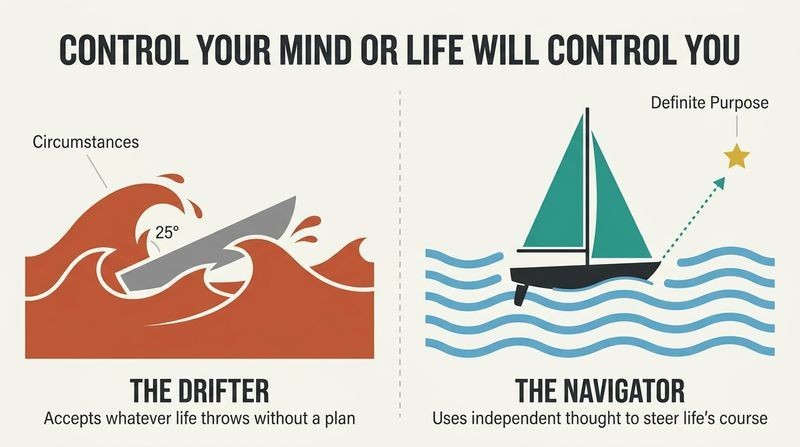
Define the enemy. The Devil's cleverest trick is inducing people to "drift," which Hill defines as accepting whatever life throws at you without protest, plan, or independent thought. A drifter has plenty of opinions, but none are truly his own. He goes through school with no aim, takes the first job available, marries without purpose, and reverses any decision at the first opposition.
Hill offers a vivid checklist of the drifter: no major purpose, no self-confidence, spends everything he earns, chronically ailing, blames others, starts many things and finishes none, and works harder to avoid thinking than most people work to earn a living. The non-drifter is the mirror image: definite plans, direct answers, a go-giver who runs the biggest business in town. The single difference between them is the free choice to use one's own mind.
Drifting maps neatly onto what modern psychology calls an external locus of control, the belief that outside forces, not your choices, run your life. Decades of research link an internal locus to higher achievement, health, and resilience. Hill's drifter also prefigures Barry Schwartz's work on passive default-taking and the human tendency toward the path of least resistance. The bracing claim is that indecision itself is the disease, not any particular wrong choice. One caveat: Hill underrates structural constraints. Poverty, discrimination, and illness genuinely limit options, and not every "drifter" is simply mentally lazy. Still, the core insight, that abdicating decisions is itself a decision, remains sharp.
Repeated thoughts harden into permanent habits you can no longer escape
The trap that locks drifters in. Hill's most original concept is "hypnotic rhythm," a natural law he compares to gravity. Nature takes any thought or action repeated often enough and makes it permanent, like an object caught in a whirlpool that can no longer float free. He compares it to learning music: notes repeated until melody and rhythm become automatic.
The danger is that rhythm works both ways and operates automatically. Left unmanaged, it cements fear, poverty, and negativity into a fixed personality. Consciously directed, the same law fixes courage, opulence, and definiteness of purpose just as firmly. Poverty, Hill says, is contagious because nature permanently fixes the thought-habits of those who accept it as unavoidable. The window to break a drifting habit closes over time, after which the victim, like a fly in a spider's web, only entangles himself further with every struggle.
Strip away the 1938 mysticism and hypnotic rhythm is a remarkably accurate intuition of neuroplasticity. "Neurons that fire together wire together," as Donald Hebb put it in 1949, more than a decade after Hill wrote this. Habits do carve physical pathways, and the basal ganglia automate repeated behaviors, as Charles Duhigg popularized. Hill's warning that habits become harder to break with time aligns with evidence that neuroplasticity, though lifelong, diminishes and that entrenched patterns require greater effort to overwrite. Where he overstates: no scientific "point of no return" exists. People rewire deeply grooved habits at any age, which is more hopeful than his spider-web metaphor suggests.
Every defeat hands you the seed of an equal or greater benefit
Adversity as disguised instruction. Hill repeats this as a law with no exceptions: every failure, setback, and hardship carries within it the seed of an equivalent advantage. Not the full flower, only the seed, which may not sprout unless you look for it. He learned it firsthand: his months of terrified hiding and his stint of poverty were, he says, the most profitable experiences of his life because they forced him to test whether his philosophy actually worked.
He ties this to Emerson's law of compensation, that every loss is balanced by a gain elsewhere. The Great Depression, he argues, was more blessing than curse because it shattered people's habits and forced them to turn inward for solutions. There is something worse than being forced to work, he notes: being forced not to work. Every great leader he studied met stubborn defeat before arriving.
This is classic post-traumatic growth, a concept researchers Tedeschi and Calhoun formalized in the 1990s, showing many people report increased strength and meaning after crisis. It also echoes Stoic amor fati and Nietzsche's "what does not kill me." The actionable core is the search: benefit is latent, not automatic, so the reader must actively mine defeat for its lesson. The honest caveat, which trauma research confirms, is that adversity does not reliably ennoble. Chronic hardship often crushes rather than builds. Hill's rule works best as a forward-looking reframing strategy, not as a literal cosmic guarantee that suffering always pays dividends.
Definiteness of purpose is the one shield the Devil cannot pierce
The master antidote. Of Hill's seven principles for reclaiming your mind, definiteness of purpose comes first because it slams the door on drifting. The Devil confesses he is helpless against anyone who decides exactly what they want, forms a plan, and refuses to accept permanent defeat. Even a weak plan pursued with definiteness tends to beat a brilliant plan applied indefinitely, because the definite person treats every failed plan as a cue to substitute a new one while never changing the purpose.
Hill redefines faith itself as definiteness of purpose backed by belief in attaining it. This, he says, is the only prayer worth relying on. Begging prayers fail because they carry fear of not being answered. Prayer with definite intent and expectancy sets natural laws in motion. Ninety-eight percent of people, he claims, forfeit this birthright simply by never deciding what they want.
Modern goal-setting science strongly backs the mechanism. Locke and Latham's research shows specific, challenging goals dramatically outperform vague "do your best" intentions. Gabriele Oettingen's work on mental contrasting and implementation intentions refines it further: pairing a definite goal with concrete if-then plans measurably boosts follow-through. Hill's insistence that a mediocre plan beats an unexecuted great one anticipates the startup mantra that execution trumps ideas. The subtle point worth flagging is his claim that you keep the purpose fixed while swapping tactics freely, a distinction between strategic persistence and tactical flexibility that many people invert, stubbornly clinging to failing methods while abandoning their real goals.
Conquer three appetites first: overeating, unchecked sex, and loose opinions
Self-discipline made concrete. Mastery over self, the second principle, begins with three specific appetites. First, food: Hill argues most people poison themselves through overeating and bad combinations, dulling the brain and, in his blunt telling, clogging the body's sewer system until clear thinking becomes impossible. Second, sex: rather than suppress it, he advocates transmutation, redirecting sexual energy into work and creative drive, claiming highly sexed people who channel that force make the great leaders. Third, the appetite to broadcast loosely formed opinions.
This third one is his most contrarian. Volunteering uninvited opinions, he says, springs from vanity, hands your ideas away to rivals, forfeits the chance to learn by listening, and creates enemies. Wise people keep their plans to themselves. He warns against the writer of unsolicited letters, a habit easily updated to compulsive social media posting, calling it a gateway to the broader habit of drifting.
The food claims are dated pseudoscience, "auto-intoxication" was debunked, though the underlying point that diet affects cognition has since been vindicated by gut-brain axis research. Sexual transmutation echoes Freud's sublimation and finds loose support in studies linking impulse regulation to achievement. The opinion insight is the sleeper hit here. It aligns with research on the "mere urgency" of self-expression and Adam Grant's finding that strong opinions weakly held outperform loud certainty. In an era of performative posting, Hill's advice to guard your plans and listen more reads as startlingly current. Discretion, he suggests, is not shyness but strategic self-command.
Schools drill memorization and churches sell fear, neither teaches thinking
Hill's most dangerous chapter. This is the section his wife feared would get him blacklisted. The Devil confesses that schools and churches are his most useful allies, not his enemies. Schools, he charges, force children to cram and memorize facts and chase credits while never teaching them how to use their own minds, how to be definite, or how to convert knowledge into a living. Enthusiastic first-graders become disengaged teenagers who fear that making an error invites ridicule, so they stop participating.
Religion earns sharper fire: by planting the fear of hell in children before they can reason, it breaks their capacity for independent thought and starts them drifting. Hill is careful to separate this from faith itself, which he reveres. His proposed fixes: let students lead and teachers guide, learn by doing, bring in working professionals, and teach definiteness of purpose, habit, sex, nutrition, and the difference between defeat and failure.
Hill's critique lands in the same tradition as John Dewey's progressive education and later Ken Robinson's viral argument that schools kill creativity. Research on intrinsic motivation by Deci and Ryan supports his instinct that fear and extrinsic reward crowd out genuine learning. His "teaching to the test" complaint predates standardized-testing debates by decades. The attack on religion is where he is most vulnerable and least fair: he lumps all faith traditions together and ignores the enormous moral and communal goods religion provides, a point his own annotator gently pushes back on. Still, his core distinction, between inheriting beliefs by fear and reasoning to them freely, is a defensible educational principle regardless of one's theology.
Pick your inner circle as carefully as you choose your food
Environment and the Master Mind. The most powerful part of your environment, Hill argues, is the minds you associate with closely, because hypnotic rhythm forces you to absorb the dominant thoughts of the people around you. A spouse, a business partner, and close friends shape your mental habits far more than casual acquaintances. His prescription is bracing: you owe no one a duty that forces you to live inside a negative environment, and you should remove influences that breed negative thought-habits.
His constructive tool is the "Master Mind," a deliberately chosen alliance of minds working in harmony toward a definite purpose. Hill credits his own recovery partly to "Master Minding" daily with his wife, combining two brains into one force. He observed that only 2 of every 100 people have a definite aim, and that the successful surround themselves with people who think and act in terms of success.
This is arguably Hill's most empirically robust claim. Nicholas Christakis and James Fowler's research on social contagion shows obesity, smoking, happiness, and even loneliness spread measurably through social networks. Jim Rohn's famous line that you are the average of the five people you spend the most time with is essentially this principle compressed. The cognitive science of the "extended mind" and collective intelligence supports the Master Mind idea that combined minds generate capabilities no individual holds. The uncomfortable edge is Hill's near-transactional advice to prune negative relationships, including family. Read charitably it means guarding your mental inputs; read cynically it justifies discarding people, a tension he never fully resolves.
Failure is not real until you accept it as permanent
Reframing the finish line. Hill draws a hard line between temporary defeat and failure. Temporary defeat is an event, a signal to re-arm with a new plan. Failure is a state of mind, and it becomes real only when the individual accepts a circumstance as permanent. The Devil admits he takes people over only after they quit, and that most people quit within two or three attempts, which is precisely why he induces failure so eagerly. Not one in ten thousand keeps trying after failing a few times.
Hill illustrates with R. U. Darby, a gold prospector who abandoned his claim when the vein seemed to run out, sold his equipment to a junkman, and learned too late that gold lay just three feet from where he stopped digging. Darby's lesson, Hill notes, later built him an insurance fortune. Success, in Hill's telling, usually sits one short step beyond the point where people surrender.
The three-feet-from-gold parable is Hill's most enduring image, and the psychology is sound. Angela Duckworth's research on grit shows sustained perseverance predicts achievement better than talent or IQ. Carol Dweck's growth mindset work directly parallels Hill's defeat-versus-failure distinction: seeing setbacks as informative rather than final is what separates those who persist. Where nuance is needed: sometimes quitting is the intelligent move, and "never give up" can trap people in sunk-cost fallacies, digging for gold that genuinely is not there. The wiser reading of Hill is not blind persistence but refusing to let a single defeat rewrite your self-concept, keeping the purpose fixed while judging each plan on its merits.
Analysis
Outwitting the Devil is best understood as Napoleon Hill's shadow companion to Think and Grow Rich: where the earlier book prescribed success principles, this one performs a psychological autopsy on why people fail to apply them, including Hill himself. Written in 1938 and suppressed for 72 years, its literary device, a forced confession extracted from a captured Devil, is both its genius and its liability. The frame lets Hill voice heresies about schools, churches, and human passivity that he could not state plainly, while giving readers a vivid antagonist to defeat. It also dates badly in places, blending genuine psychological insight with pseudoscience (auto-intoxication), political commentary, and metaphysical claims presented as natural law.
Stripped to its architecture, the book advances one thesis: freedom is the disciplined use of your own mind, and its enemy is drifting, the abdication of thought to circumstance and habit. Everything else, the seven principles, hypnotic rhythm, definiteness of purpose, follows from this. What makes Hill prescient is how consistently his 1938 intuitions anticipate later science: hypnotic rhythm foreshadows Hebbian neuroplasticity and habit loops; definiteness of purpose maps onto Locke and Latham's goal-setting theory; the drifter embodies an external locus of control; the Master Mind predicts social-contagion research; the defeat-versus-failure distinction is Dweck's growth mindset in embryo.
The book's limitations are real. Hill underweights structural constraints on choice, treats his 98% statistic as fact, over-generalizes about religion, and occasionally slides from empowering reframing into blaming victims for their misfortune. His near-transactional advice on pruning relationships sits uneasily beside his ethics of service. Yet the central provocation endures and has arguably grown more relevant in an age of algorithmic distraction and performative opinion: the one thing you fully own is your attention and your decisions, and surrendering them by default is the most consequential choice most people never realize they are making.
Review Summary
Readers generally praise Outwitting the Devil™ as a thought-provoking and inspiring self-help book. Many find it life-changing, offering clarity and applicable solutions to personal challenges. The book's unique approach and timeless principles are highly appreciated. Some readers, however, feel uncomfortable with the devil interview format or find the writing style tedious. Despite mixed opinions on delivery, most reviewers acknowledge the book's powerful insights and its potential to spark self-reflection and personal growth.
People Also Read








About the Author
Other books by Napoleon Hill







Download PDF
Download EPUB
.epub digital book format is ideal for reading ebooks on phones, tablets, and e-readers.








































