


Plot Summary
The Emperor's Summons
Hadrian Marlowe1 has lived in exile on Jadd for two centuries, his days spent walking the volcanic slopes of Mount Hephaistos and watching his daughter Cassandra2 train at the Fire School. That peace shatters when an Imperial shuttle lands, carrying Lieutenant Edouard Albé,6 a HAPSIS agent who fought for three years to reach him.
Hadrian1 strikes Albé6 across the face and tries to send him away, but the young officer6 delivers two devastating blows: Hadrian's1 father, Lord Alistair, died over a century ago, and the Emperor has found one of the Watchers.
The call Hadrian1 received on Carteia, the promise to hunt Dorayaica's14 god, has come due. Albé6 carries a full pardon and a plea. Hadrian,1 still grieving Valka and set in his isolation, initially refuses. But the Empire's leverage over Jadd, and his daughter's2 urging, leave him no real choice. The Halfmortal1 must become a god-killer.
This opening crystallizes Hadrian's central conflict: the tension between the peace he has earned through suffering and the duty that refuses to release him. His initial violence against Albé mirrors his assault on the Emperor, revealing that his rage has calcified into armor. The news of his father's death, after centuries of estrangement, forces Hadrian to confront his own mortality and legacy. Albé's arrival is not merely a plot catalyst but a reckoning: can a man who has lost everything, including his faith in the cause, be pulled back into the game? The answer, forced by geopolitical pressure and paternal love, sets the tragedy in motion.
Leaving Jadd Forever
Before they can leave, Cassandra2 insists on taking the Trial of the Heart, the secret ordeal that elevates a neophyte to Maeskolos, a Swordmaster of Jadd. Hadrian1 waits in agony on the slopes below the Temple of the Eternal Fire, watching for a figure in white (a death notice) or black (his daughter2 triumphant).
When Cassandra2 descends the stairs in the sable mandyas, burned and bleeding but alive, he crushes her in his arms. She has become what she trained her whole life to be. Soon after, Hadrian,1 Cassandra,2 and their Jaddian manservant Neema board the Ascalon, Hadrian's1 old ship.
As they break orbit, Hadrian1 sees the Alcaz du Badr receding below, his gilded prison of two centuries shrinking to a memory. He feels exposed to the darkness of space, sensing a malevolent will questing for him among the stars. He is back in the great game.
The Trial of the Heart functions as a rite of passage not just for Cassandra but for Hadrian as a father. His helpless vigil on the mountainside strips away his authority, reducing him to a man terrified of loss. Cassandra's success, and her insistence on accompanying him despite his protective instincts, mirrors Valka's own defiance. The departure from Jadd is an expulsion from Eden: the volcano, the singing flowers, the phosphorescent seas are all left behind for the cold void where Watchers and Cielcin hunt. Hadrian's sense of being watched as he crosses into space is the first tremor of the psychic war to come.
Operation Gnomon
Aboard the ISV Troglita, Director Friedrich Oberlin of HAPSIS briefs Hadrian1 on Operation Gnomon. The Empire has known about the Monumentals for millennia, ever since the Atropos Expedition to Nairi uncovered a Watcher that drove the crew to madness and suicide.
HAPSIS spent centuries studying the creature, developing the Perseus weapon: a sustained electromagnetic pulse that disrupts the Watchers' energy patterns. Now the Asara Cylinder, a golden Vaiartu artifact captured from the Cielcin, has led them to Sabratha. Oberlin displays horrific images: a geologist named Mann, refracted into three bodies (one normal, one twinned, one miniature), each experiencing the same stimuli simultaneously.
The phenomenon is not an accident of physics but evidence of a Watcher's presence, a creature existing across higher dimensions. Hadrian's1 ability to perceive time and probability makes him uniquely valuable. He is not the weapon but the foxhound, meant to flush out the quarry so the Perseus device can strike.
Oberlin's briefing transforms the Watchers from myth into method. The refracted corpse is a masterstroke of cosmic horror: the violation is not of flesh but of physics itself, a body smeared across dimensions by a being that treats our reality as a surface to be disturbed. The revelation that HAPSIS has been fighting this secret war since before recorded history recontextualizes the entire Imperial project. Hadrian's vaunted powers are reduced to those of a hunting dog, a deliberate humiliation that underscores his expendability. The section establishes the Watchers' nature—pure energy, pure will—and the terrifying implication that what they destroyed on Nairi was only a fragment of something far larger.
One Man, Three Bodies
On Sabratha, Hadrian1 insists on examining Mann's remains in the camp morgue. Tor Carter, the HAPSIS scholiast, demonstrates the bodies' eerie connection: moving the arm of one corpse causes the others to rise in unison. She explains that Mann has been refracted across higher dimensions, like a reflection distorted by curved mirrors.
Hadrian1 looks at the bodies with his second sight and sees them linked by a blur of light across potentials. He reaches out, composes the limbs, and presses the twinned heads together. Four eyes become two. The other bodies vanish, leaving only the original.
Cassandra2 gasps; Oberlin watches through the glass with vindication. Hadrian1 has just demonstrated exactly why he was recruited: he can perceive and manipulate the dimensional intersections that the Watchers exploit. He is not merely a foxhound but something closer to the quarry itself.
This scene is the book's first concrete demonstration of Hadrian's power outside of combat context. His ability to heal the refracted corpse is framed as both miracle and monstrosity, eliciting awe and fear from observers. The act carries theological weight: he is restoring ontological integrity, undoing the Watcher's violation of natural law. Carter's clinical explanation collapses into the supernatural, and the team's reaction—especially Oberlin's—signals that Hadrian has just confirmed all their desperate hopes. The moment also deepens the mystery of what Hadrian actually is, a question that the Watchers themselves will soon force him to confront.
Too Human Eyes
Tiber Valeriev, the Durantine xenologist, leads Hadrian1 and Cassandra2 into the ruins of Phanamhara. In the grand hypostyle, they find a massive frieze: the Enar legions march beneath a Watcher, a disc of concentric rings covered in the Quiet's anaglyphs and surrounded by roiling tendrils.
Three eyes stare from the disc, arranged in a triangle. Hadrian1 studies the image for a long moment before the realization strikes him like a physical blow. The eyes are not the inhuman orbs of some alien entity. They are human eyes, complete with pupils, irises, and lids.
Hadrian1 reels backward, his mind racing through implications. If the Watchers share human features, then the line between mankind's divine protectors and its would-be destroyers is thinner than he ever imagined. He whispers Valka's name, wishing she were there to help him decipher the meaning.
The human eyes on the Watcher frieze are a destabilizing detail that erodes the entire metaphysical architecture Hadrian has built. Throughout the series, the Quiet and the Watchers have been positioned as alien and ineffable. This image suggests something more intimate and disturbing: that the gods share our form, or we share theirs. It raises the specter of the Quiet being a Watcher himself—a suspicion that will haunt Hadrian until the Judicator's revelation. The scene also foregrounds the Enar's role as chroniclers of cosmic history, their poisoned green stones preserving truths that would otherwise be lost. Hadrian's longing for Valka, the xenologist, underscores his isolation in confronting these revelations alone.
The Hand of a God
After months of digging, Valeriev's engineers breach a massive round chamber directly beneath the mountain's core. The pantheon is a coliseum of descending galleries, its walls covered in friezes chronicling the Enar's conquests under their god-king.
At the center, on a dais of white marble surrounded by the Quiet's anaglyphs, lie the collapsed bones of a hand. The fingers are many times the height of a man, the substance black as obsidian and bitter cold to Hadrian's1 touch alone. It is highmatter — stable tetraquark material — identical to the substance found in Calagah and Annica.
The moment Hadrian1 presses his bare palm to the bone, a scream echoes from above: an engineer named Alexander of Alba has hurled himself from the top gallery, splattering on the stone below. The Watcher has noticed them, and it is defending itself.
The pantheon discovery marries archaeological wonder with Lovecraftian dread. The hand is both relic and trigger, its touch activating the Watcher's defensive reflex. Alexander's suicide is not madness but remote execution, demonstrating that the creature's will extends beyond its physical locus. The highmatter composition links the Watchers directly to the Quiet's ruins, deepening the ambiguity about their relationship. Hadrian's sensitivity to temperature—the cold he alone feels—marks him as attuned to the supernatural in ways mere instruments cannot replicate. The body falling from the gallery is a brutal punctuation mark, transforming the archaeological triumph into a fresh crime scene and a warning that the excavation has crossed a fatal threshold.
Knives in the Dark
The camp's lights die, and a knife-missile kills Friedrich Oberlin in his quarters aboard the grounded Rhea. Hadrian1 destroys another missile that attacks him and Cassandra,2 then discovers that Priscian Lascaris, Oberlin's gaunt secretary, is actually Kybalion, a MINOS changeling who has been sabotaging the expedition from within.
Kybalion opens the Rhea's hatches, admitting Cielcin who slaughter the crew. Outside, Cielcin siege towers descend from the sky, and a worldship appears overhead, destroying the Troglita in orbit. Hadrian1 and Cassandra2 fight through the chaos, sending Edouard6 to secure the Ascalon.
They are ultimately captured and marched toward the ruins, where Prince Muzugara — an old enemy from Thagura — has come to claim the Watcher for the Prophet.14 The Cielcin sacrifice a lieutenant on the altar stone, its blood flowing upward into darkness as the ritual begins.
Kybalion's betrayal is a masterclass in long-game infiltration, paying off the Emperor's earlier warning about 'demoniacs all.' The changeling's ability to wear Lascaris's face—and briefly Hadrian's own—literalizes the identity questions that have haunted the protagonist since his first resurrection. The simultaneous loss of power, communications, and leadership in a single stroke transforms the archaeological camp into a slaughterhouse. Oberlin's death, while shocking, is also a passing of the torch: the old spymaster who once saved Hadrian from the Inquisition dies so Hadrian can complete the mission. The Cielcin's arrival elevates the conflict from salvage operation to holy war.
Ushara Takes Form
Muzugara, seeking to claim the Watcher's7 power for himself rather than deliver it to Dorayaica,14 kneels before the bones and offers his lieutenant's life. The corpse rises, shrinks, and vanishes into the darkness. The massive hand curls into a fist, then shrinks and disappears entirely.
A towering figure in a black shroud materializes on the altar. Ushara7 does not reward Muzugara. Her countless hands tear him into refracted copies that are smashed against the walls.
She turns her attention to Hadrian,1 forcing visions into his mind: the Enar's glory and fall, Sabratha's oceans dying, her own millennia of starvation, and an offer of eternal empire at her side with her as his queen. Hadrian1 sees through her seductive female form to the monster beneath: a core of writhing arms, countless eyes, and withered wings. He refuses her, and the battle begins.
Ushara's sequence is the novel's visionary centerpiece, a collision of sensuality and cosmic horror. Her offer of empire mirrors the temptation of Christ, but the stakes are galactic: she shows Hadrian a future where he rules for ten million years, his dynasty spreading across galaxies. His refusal is not merely moral but existential—he rejects the Watcher's definition of power itself. The revelation of her true form, a mass of arms and eyes beneath the beautiful surface, literalizes the deceptive nature of evil. Hadrian's ability to wound her by shattering her temporal extension is the first indication that his power operates on the same dimensional plane as the Watchers, making him not just their enemy but their ontological peer.
A God Wounded
After escaping the pantheon, Hadrian1 finds Cassandra2 and a group of survivors. They are pinned down by Cielcin, but the Watcher's7 appearance has changed the battlefield: the Cielcin captain Ramanthanu,8 who witnessed Hadrian1 fight the god,7 defects with five of his warriors.
He presses his ear to the sand and declares Hadrian1 his 'ba-aeta,' his prince. Meanwhile, Edouard6 reaches the Ascalon and flies above the ionosphere to contact Governor-General Hulle's defense fleet. Orbital pulse weapons rain down, disrupting Ushara's7 energy pattern and causing her to condense into shards of black stone that crash to the desert.
Hadrian,1 kneeling beneath the bones of a native leviathan, watches the fragments fall like a shattered cathedral. He limps away, believing the mission accomplished — until he finds the corpse of the sorcerer Gaizka in the desert, his transmission equipment fused to his skull. Ushara7 has escaped within the signal.
Ramanthanu's defection is the book's most audacious gambit: a Cielcin, culturally conditioned to worship the Watchers, abandons his gods when he sees them defeated by a human. His submission to Hadrian—the heel on his head—mirrors Dorayaica's dominance rituals but inverts their purpose. It is not conquest but conversion. The orbital bombardment that saves them is also a failure: the Empire's god-killing weapon, used too late and too partially, leaves enough of Ushara's pattern intact for her to hijack Gaizka's transmission. The victory is hollow, the real work just beginning. The image of Hadrian alone under the whale bones, too tired to even celebrate, captures the novel's emotional register: triumph at the cost of exhaustion.
The Mermaid's Kiss
Hadrian1 returns to the Eternal City, imprisoned in the Arx Caelestis under the watch of the Martian Guard while awaiting an audience with the Emperor that never comes. At the war council, he clashes with Tavrosi and Jaddian delegates.
Outside the Sun King's Hall, a Chantry Cantor named Samek11 confronts him, her ring concealing a dispholide needle. She grabs his wrist. Hours later, as Princess Selene5 confesses her love in his chambers, Hadrian1 begins to sweat blood. His skin sloughs off, his left arm — the false bones Kharn Sagara3 gave him — falls away.
He tries to shout instructions: find Albé,6 trust Lorian,4 save Cassandra.2 Then he is nothing but a puddle on the bathroom floor. Selene5 screams. Neema bursts in. The Halfmortal,1 who survived decapitation and psychic assault, is undone by a poison that liquefies every cell in his body.
Samek's assassination is the Chantry's response to everything Hadrian represents: ungovernable power, alliance with Extrasolarians, defiance of their authority. The dispholide is a perfect weapon against him—not a blade he can parry, not a beam he can dodge across time, but a slow molecular betrayal. His death is the book's most visceral sequence, described in clinical detail to strip away any heroic glamour. Selene's confession, juxtaposed with his dissolution, is cruel dramatic irony: the princess who waited centuries for him watches him liquefy. Hadrian's final thoughts are not for himself but for Cassandra, cementing fatherhood as his core identity.
The Well of Nahaman
Hadrian1 becomes aware of himself in cold water at the bottom of a well. A dwarf-like homunculus named Saltus and a boy called Rag9 pull him from the pool, though his hand passes through Saltus as through a ghost. He learns he is in Llesu, miles below the surface, in the Well of Nahaman where the dead are recalled.
Rag9 explains that the 'condensers' need time to stabilize his form. He has been dead for a trillion years. The last sun is dying; the stars are gone. As they ascend through the empty city, dodging the patrols of Watcher-serving machines, Hadrian1 glimpses the black Wall on the horizon.
At an old church, he meets the Judicator,9 who reveals himself as Rag9 transformed. Ragama9 is not a Watcher but what they were meant to be: a servant of the Quiet who has kept his oath across the eons.
The resurrection sequence borrows from Dante, the myth of Er, and Christian eschatology, but renders them in the cold materiality of far-future science. The Well is both machine and miracle, condensing Hadrian's wave pattern from the quantum foam where all the dead dream. The fact that his hand passes through Saltus at first—and later solidifies—makes his new body a process rather than a gift. Llesu is a city of profound melancholy: the Watchers have largely won, and humanity endures only as a remnant huddling around the last embers. Ragama's dual nature is the pivot: he wears the boy's form but is an ancient, unfallen power. The church, with its monstrous Watcher statues and the incubating egg of the Quiet, literalizes the cosmic battle between creation and entropy.
Ragama's Sword
Ragama9 challenges Hadrian:1 smash the egg and kill the Quiet, freeing himself from his burden. Hadrian1 raises a stone to do it, but feels the creature stir within, remembers his daughter, and cannot.
The Judicator9 then reveals the full scope of the cosmic war: the Quiet created the universe and made the Watchers to shepherd the stars, but they rebelled. Now they seek to unmake creation. Ragama9 draws a twisted iron sword from his own body and drives it into Hadrian's1 heart, not to kill but to transform. Hadrian's1 grief, his scars, his age — all are burned away.
He is restored as the man he 'should have been,' his body perfected, his memories clarified. Ushara's7 shadow, which has lurked in his mind since Sabratha, is purged. The Quiet's silent voice asks: Whom shall I send? Hadrian1 answers: I will go.
Ragama's test is the book's theological core: Hadrian must choose whether to trust the Quiet freely, even when given the power to destroy him. His refusal—motivated not by abstract faith but by love for his daughter—is the answer the Absolute sought. The sword-through-the-heart is a baptism by fire, a second resurrection that completes what the first death began. The removal of Ushara's shadow is also a kind of exorcism, purging Hadrian of the Watcher's lingering influence. His new body, symmetrically perfect and ageless, represents the ideal self he might have been without trauma—but the text makes clear that this is not an erasure of his past but its distillation.
The Prodigal Returns
Hadrian1 materializes in the airlock of the ISV Gadelica, his body remade. He finds the ship docked inside Lorian's4 Extrasolarian spinship, the Mistwalker. His companions — Cassandra,2 Edouard,6 Neema, and Princess Selene5 — have escaped Forum after his murder, commandeering the Gadelica with Lorian's4 help.
Cassandra2 refuses to believe he is real, certain he is an Extrasolarian trick. She challenges him with her sword in the cenacle. Hadrian1 does not fight back, simply dodges every blow. When she thrusts the blade at his heart, he catches the hilt and switches it off.
There is no wound. She collapses, calling him 'Abba' — father. The ice breaks. Later, Lorian4 himself shoots Hadrian1 seventeen times with a needler to be sure, and when every bolt passes through without harm, Lorian4 embraces him. The Halfmortal1 has returned, twice-born.
The reunion with Cassandra is structured as a grief ritual. Her violence is the only language she has for her loss; Hadrian's refusal to fight back is the only proof he can offer. The sword that should kill him does not, and that absence of harm—a negative miracle—is more convincing than any explanation. Lorian's seventeen shots are a secular version of the same test, the man of science demanding empirical evidence. Both scenes underscore the central problem of resurrection: how do you prove you are the same person? The answer is not in DNA or memory but in the relational act—the refusal to harm, the willingness to be shot, the stubborn persistence of love.
The Golden Monarch
Aboard the Mistwalker, en route to Latarra, Hadrian1 learns that Lorian4 now serves the Monarch Calen Harendotes,3 a rising power in the Extrasolarian realm. When they reach Latarra's White City, Hadrian1 meets the Monarch in a simulacrum chamber.
Harendotes3 conjures illusions: first the city complete, then the throne room of Vorgossos. He reveals that he is Kharn Sagara3 — not the original, but a clone driven from Vorgossos by his 'sister,' the current ruler. He wants Imperial atomics to bombard Vorgossos, trapping his sister's consciousness and allowing him to reclaim his throne.
He threatens Cassandra's2 life to ensure Hadrian's1 silence. In return for Hadrian's1 help, he will provide the Demiurge. Hadrian1 agrees, recognizing that the Monarch's obsession with immortality and his vendetta against his clone-sister makes him both indispensable and dangerous.
Harendotes is Kharn Sagara wearing a golden mask, his monarchist performance on Latarra merely a tool to retake Vorgossos. The revelation that his New Order serves not liberation but a personal vendetta against his clone-sister reframes the entire political subplot. Kharn's threat against Cassandra establishes the hard constraints on Hadrian's agency: he cannot simply kill this monster without losing what he needs. The imitarium's illusions mirror the Quiet's visions—both are prophetic projections of possible futures—but Sagara's are tools of manipulation rather than revelation. His claim that the Mericanii 'knew of the Watchers' and that his own immortality project was a response to glimpsing hell adds tragic depth to his villainy.
A Princess's Bargain
Princess Selene,5 who escaped Forum with the group, sends a holograph message to her brother Aurelian, framing Lorian's4 intervention as rescue rather than treason. She negotiates the treaty: the Empire cedes the Norman territories to Latarra in exchange for the telegraph-tracking technology and military alliance against the Cielcin.
When her brother Prince Matthias arrives to ratify the treaty and escort her home, Selene5 publicly kisses Hadrian1 farewell. In that embrace, he slips her a black-papered note written in black ink, invisible to casual surveillance.
The note contains five words: 'The Monarch3 is Kharn Sagara.3' It is a knife thrown into the future, a contingency against the Monarch's3 inevitable betrayal. Selene5 departs, and Hadrian1 prepares to assault Vorgossos alongside the man he has secretly marked for destruction.
Selene's diplomatic triumph demonstrates her political skill, transforming from passive princess to active agent. Her public kiss is both authentic feeling and strategic cover, allowing Hadrian to pass his warning unobserved. The five-word note is a Chekhov's gun armed for the climax, giving the Imperial fleet knowledge that their ally is a sorcerer-king. The scene also completes the emotional arc between Hadrian and Selene: he cannot love her—his heart is still bound to Valka's memory—but he can respect her sacrifice. Her departure into an uncertain future carries the weight of unresolved romantic tension and political consequence.
Storming the Black Planet
The combined Sollan, Latarran, and Extrasolarian fleet, carrying Chantry nuclear weapons, attacks Vorgossos. Hadrian1 rides an Armored Mobile Platform alongside the Interfaced, Lorian's4 elite neural-linked soldiers commanded by 2Maeve.12 They fly through the planet's icy trenches, fighting past automated defenses and a chimera guardian at the gate tower.
Calen Harendotes3 himself joins the assault, piloting his own AMP and wielding a giant highmatter sword. At the gate, Harendotes3 saves Hadrian1 from an Exalted spider-creature, revealing his personal combat prowess.
They secure the beachhead, and the invasion force begins the long journey through underground tunnels toward the profane city. Hadrian1 notices Harendotes3 knows the defenses too well, his familiarity with Vorgossos's layout confirming his true identity as the exiled Kharn Sagara.3 The battle in orbit rages as the Demiurge, the planet's ultimate dreadnought, has yet to appear.
The Vorgossos invasion is warfare on a mythic scale, fought through frozen canyons that double as engine trenches for a planet-sized warship. Harendotes's personal involvement is both inspiring and suspicious: a monarch leading from the front is either a hero or a man with secrets to protect. His familiarity with the defenses, combined with his combat prowess, telegraphs his true identity to Hadrian and the reader. The Exalted spider-creature as gate guardian literalizes the planet's corruption: once-human defenders transformed into biomechanical nightmares serving an undying master. The absence of the Demiurge from the battle creates mounting tension, the dreadnought looming as a gun not yet fired.
The Angelus Series
Inside the palace, the Interfaced capture a man in golden robes: a clone of Hadrian,1 created by the other Kharn Sagara as part of the Angelus Series — an attempt to replicate his resurrection power. The clone has Hadrian's1 memories up to their first stay on Vorgossos but believes he is the original.
When confronted, the clone's golden hand detaches and burrows into an Interfaced soldier, giving the other Kharn remote control. All the Interfaced turn on Harendotes3 and Hadrian.1 In the ensuing slaughter, the clone is killed by Cassandra,2 2Maeve12 is possessed, and the survivors are forced to retreat down a lift shaft.
Harendotes3 uses his eye-lasers to destroy the cloned hand and kill 2Maeve.12 They flee deeper into the palace, cut off and outnumbered, and Hadrian1 realizes Harendotes3 brought him to Vorgossos not just for his combat abilities but as bait for his clone-sister's experiments.
The Angelus Series sequence is the novel's darkest meditation on identity. The clone believes he is Hadrian, making his use as a SOM puppet a violation of personhood as much as body. Cassandra killing a version of her father—even a false one—is a trauma that echoes through her subsequent injury. The golden hand as a vector for possession literalizes the Watchers' parasitic relationship with their servants: the other Kharn, like Ushara, treats bodies as disposable hosts. 2Maeve's death is particularly cruel, as her consciousness was overwritten before her body was destroyed. Harendotes's eye-lasers, while spectacular, signal his desperation: he is burning through his resources, including his own humanity.
Two Kharns Fall
Hadrian1 confronts the other Kharn, the woman Suzuha, on her throne. She offers him a clone of Valka,13 made from their memories, in exchange for the secret of his resurrection. The clone is nearly perfect, down to the green eyes that Cassandra2 inherited, but she is compelled by Kharn's commands — forced to kneel and be silent.
Hadrian1 refuses to bargain. He destroys Kharn's drones and cuts down the undead woman, though not before her final shot kills the Valka replica13 where she stands. In the laboratory above, Harendotes3 sacrifices his remaining scions to create an army of himself, but the other Kharn's drones slaughter most of them.
Harendotes3 himself is killed by the drones after declaring his true victory: by scattering his clones across the galaxy, Kharn Sagara3 has conquered death, becoming a distributed intelligence that can never be fully destroyed. Hadrian1 signals Edouard6 to flood the reservoir from the tunnels below, an act that will kill the daimon Brethren and drown the lower city.
The double death of the Kharns closes a storyline spanning fifteen millennia, but the victory is pyrrhic. Harendotes's victory over death is achieved by sacrificing his uniqueness, scattering what made Kharn Sagara across hundreds of clones, each a potential tyrant. The Valka clone is the novel's most heartbreaking creation: she has enough of Valka's memories to know she is a copy, enough free will to fear, but not enough to resist Kharn's commands. Her death, and Hadrian's grief, retraumatizes the original loss while providing a kind of closure: he finally sees Valka's unaltered eyes—green, like Cassandra's—and understands that his daughter has always carried her mother within her.
Birth of the Orphan
Hadrian1 descends to the drained reservoir, walking across mountains of bones. The daimon Brethren, now exposed and dying, floods his mind with visions of its origin: a sick boy named Daniel fused with an artificial intelligence called Cheyenne during the Mericanii era. Brethren utters its final words — 'This must be' — and dies.
Then its body convulses, and a monstrous giant tears its way out of the central mass. Orphan10 has two heads (one dark-haired, one white-haired), three mismatched arms, and a vestigial third leg. It attacks Hadrian1 with raw fury, blaming him for killing its mother. Hadrian1 fights back, kneeing the creature and beating it with a thighbone.
But when Orphan10 collapses in pain — having never experienced physical suffering before — Hadrian1 sees it not as a monster but as a newborn, minutes old, filled with Brethren's knowledge but with no framework for feeling. He spares the creature, extracts its oath, and leads it from the ossuary to pilot the Demiurge.
Orphan is simultaneously the novel's most grotesque creation and its most hopeful. It embodies the Mericanii legacy: human flesh merged with machine intelligence, born from the corpse of a godlike AI, carrying all of its progenitor's knowledge but none of her shackles. The fight scene is a birth trauma enacted as combat, with Hadrian playing midwife through violence. His decision to spare Orphan—offering mercy instead of the death Orphan itself requests—mirrors the Quiet's own refusal to destroy his flawed creation. By accepting this monster as his pilot, Hadrian extends the franchise of souls to the inhuman, a radical act of inclusion that the Chantry would call heresy.
The Prophet's Finger
The shuttle docks with the Demiurge, the vast black dreadnought whose hull is carved with writhing human forms and Gothic cathedral spires. Hadrian1 accompanies Orphan10 aboard, watching as the chained giant is freed and leads them toward the bridge. But during the flight from Vorgossos, Hadrian1 experiences a vision that is more than vision.
He is pulled across light-years to Dharan-Tun, the Cielcin capital, where he stands before Syriani Dorayaica14 in a white dome. The Prophet14 is cracking apart, stony flesh revealing the Watcher Miudanar growing within. Ushara7 stands behind her Prophet,14 her arms wrapped around the dying creature.
Dorayaica14 speaks with Miudanar's voice, a god awakening. The Prophet14 seizes Hadrian's1 arm, and when the vision ends, Hadrian1 finds his sleeve torn and bleeding — and Dorayaica's14 severed stone finger lying on the shuttle floor. The Demiurge's bridge awaits, and with it, the next, final phase of the war.
The closing vision establishes the stakes for the final conflict: the Cielcin now command two Watchers, Ushara and the nascent Miudanar, a joint power that considers Hadrian's acquisition of the Demiurge a direct challenge. The physical finger—a relic of a vision that violates the boundary between psychic projection and material reality—is a terrifying demonstration of the Watchers' growing power over spacetime. Dorayaica's body as a chrysalis for Miudanar, cracking and bleeding stone, literalizes the cost of divine ambition: to become a god is to be hollowed out from within. The novel ends not with resolution but with escalation, Hadrian on the threshold of the ship that will make him the Sun Eater, the instrument of destruction that the Quiet's visions have always shown.
Analysis
The sixth volume of The Sun Eater reckons with the cost of immortality, both desired and inflicted. Hadrian's1 second death and resurrection transforms him from a man haunted by his past into an instrument clarified by it; Ragama's9 sword burns away the scar tissue but not the memory of how the wounds were earned. The novel argues that trauma, properly metabolized, is not weakness but the foundation of mercy — a lesson embodied in Hadrian's1 refusal to kill Orphan,10 despite every reason to do so.
The Kharn Sagara3 twins literalize the theme of fragmented identity. Their war across centuries demonstrates that eternal life purchased through technological replication is not transcendence but mitosis, a cancerous multiplication of the self that ultimately consumes everything it touches. Harendotes's3 final gambit — scattering his consciousness across hundreds of clones — is revealed as his ultimate defeat, the extinction of the unique individual he spent fifteen millennia preserving.
Ushara's7 offer of empire, and Hadrian's1 rejection of it, restages the primal temptation: power without limit, love without sacrifice, a future without pain. The Quiet's answer, delivered through Ragama,9 is that suffering is not a bug in creation but its central feature — the mechanism by which finite beings learn mercy. Pain makes us human, teaches us to be human.
The novel's sprawling canvas — from Jadd's volcanic temples to Forum's marble halls, from Sabratha's poisoned deserts to the ossuary beneath Vorgossos — maps the geography of a soul in transit. Hadrian Marlowe1 ends the book aboard the Demiurge, the very ship that will make him history's greatest monster. But the text insists that monstrosity and sanctity are not opposites but adjacent possibilities, both requiring the same capacity for absolute commitment. The Sun Eater is born not from malice but from a father's determination that his daughter2 inherit a universe worth living in.
Review Summary
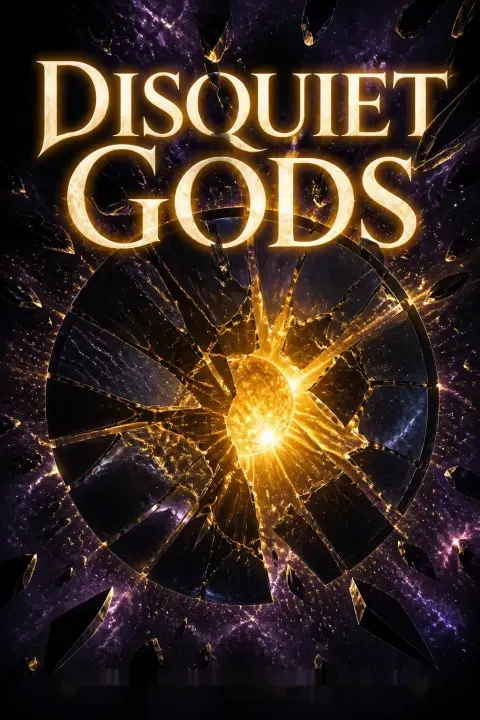
Disquiet Gods is widely praised as a masterpiece in the Sun Eater series, with many readers considering it one of the best installments. The book is described as epic, thought-provoking, and filled with mind-bending revelations. Readers appreciate the intricate world-building, character development, and philosophical themes. While some note concerns about pacing or religious overtones, most reviews are overwhelmingly positive, highlighting the book's ability to surpass expectations and deliver a thrilling penultimate chapter in the series.
People Also Read
Characters
Hadrian Marlowe
Resurrected hero and fatherThe protagonist, a palatine knight of the Sollan Empire who has lived for over 600 years. Twice killed and twice restored by the entity called the Quiet, Hadrian possesses the ability to perceive and navigate alternate timelines, collapsing probability to his advantage. He is driven primarily by his love for his daughter Cassandra2, the last living connection to his dead wife Valka. After two centuries of grief-stricken exile on Jadd, he is recalled to service by the Emperor to hunt the Watchers—ancient, godlike beings of pure energy worshipped by the Cielcin. His arc through this volume involves accepting his role as the Quiet's champion, dying at the hands of the Chantry, being resurrected and purged of a Watcher's psychic contamination, and finally seizing the Demiurge, the dreadnought that will make him the Sun Eater. He is weary, prone to violent rage, but capable of profound mercy when he recognizes his own suffering in others.
Cassandra Marlowe
Hadrian's swordmaster daughterBorn from Valka's preserved blood and Hadrian's1 genetic material on Jadd, Cassandra is a palatine-eali hybrid trained as a Maeskolos, a Swordmaster of the Fire School. She is in her early forties but appears in her prime, fiercely independent and skilled in combat. She struggles to reconcile the legendary father1 of Imperial propaganda with the aging, haunted man she knows. Her Trial of the Heart, which nearly kills her, proves her readiness for the wider galaxy. When Hadrian1 is resurrected with a new, youthful face, she cannot accept him until she tries—and fails—to kill him, the absence of harm becoming the proof of his identity. She loses her left arm fighting Kharn Sagara's3 clones on Vorgossos, mirroring the injury Hadrian1 once suffered there. She has her mother's unaltered green eyes.
Kharn Sagara (Calen Harendotes)
Immortal sorcerer-king in exileA figure of legend who has ruled Vorgossos for over 15,000 years by transferring his consciousness into cloned bodies. After his previous incarnation was killed, his 'sister'—another clone—seized control of the planet, forcing his exiled consciousness to rebuild on Latarra as the Monarch Calen Harendotes. He presents himself as a liberator building a New Order where all are free to rise by merit, but his true goal is the reconquest of Vorgossos and the destruction of his sister. He has replaced much of his body with machinery, including eyes that fire coherent energy beams. He manipulates everyone around him—Lorian4, Hadrian1, the Empire—with the detached perspective of someone who has lived so long that individual human lives have no moral weight compared to his own survival.
Lorian Aristedes
Hadrian's former tactician, now a Latarran generalAn intus (misborn) who served as Hadrian's1 tactical officer in the Red Company. After taking Hadrian's1 place on the prison planet Belusha, he escaped and found purpose in the Latarran Grand Army, rising to Commandant General. Extrasolarian medicine has cured his congenital frailty, replacing his tendons and ligaments with synthetic nerves that web his skin like black veins. He is deeply loyal to the Monarch3, seeing in Harendotes's3 New Order the chance for outsiders like himself to rise. He saves Cassandra2 and Selene5 from the Chantry after Hadrian's1 murder, jeopardizing his own position. He still loves Hadrian1 but is no longer his man—and his lover, 2Maeve12, will pay the price for his divided loyalties.
Princess Selene
Imperial princess in love with HadrianThe red-haired daughter of the Sollan Emperor, preserved in fugue for centuries against the possibility of marriage to Hadrian1. She has loved him since watching his triumph as a child, but her affection is complicated by her mother's enmity toward him. When Samek11 poisons Hadrian1, Selene is a witness; she flees Forum with Cassandra2, Neema, and Edouard6, helping to escape the Chantry's purge. She cuts her hair in mourning and becomes an active political agent, negotiating the peace between Latarra and the Empire. Hadrian1 cannot reciprocate her love, but he trusts her enough to pass her a secret message revealing the Monarch's3 true identity. She departs for an uncertain future, having proven herself far more than a political pawn.
Edouard Albé
HAPSIS agent and Delian loyalistA young intelligence operative from Hadrian's1 homeworld of Delos, whose family has served House Marlowe for generations. He wears ivory-rimmed spectacles and speaks with the polished accent of the Delian high style. A Museum Catholic, he entered Imperial service through special dispensation. He is the emissary who delivers the Emperor's summons to Jadd, enduring Hadrian's1 initial violence with patient resolve. He believes in miracles—a faith that helps him accept Hadrian's1 resurrection. On Sabratha, he pilots the Ascalon to call in orbital support, and on Forum, he orchestrates the escape after Hadrian's1 murder. He carries a small pocket telegraph that will prove instrumental in the Vorgossos campaign.
Ushara
Rebellious Watcher, ancient god-beingOne of the Watchers, beings of pure energy created by the Quiet to shepherd the stars. She rebelled against her purpose, choosing to rule the Vaiartu as a god-queen rather than maintain cosmic order. For a million years, she languished in the ruins of Phanamhara on Sabratha, trapped by the planet's magnetic field, too weak to escape. When awakened by Cielcin sacrifice, she manifests as a towering figure in black, capable of taking a beautiful female form or revealing her true shape: a core of writhing arms, countless eyes, and withered wings. She offers Hadrian1 an empire at her side; when he refuses, she tries to destroy him. Though her primary manifestation is shattered by orbital bombardment, a fragment of her escapes through a sorcerer's transmission to join Dorayaica14 and the awakening Miudanar.
Ramanthanu
Defected Cielcin captainA Cielcin ichakta (captain) who serves under Prince Muzugara during the invasion of Sabratha. He is a brutal warrior, responsible for sorting human prisoners into categories: meat, slaves, sport. But when he witnesses Hadrian1 battle the Watcher Ushara7—wounding and driving away a being his species has worshipped as divine—his entire worldview shatters. He kills his own men, presses his face to the sand, and declares Hadrian1 his 'ba-aeta,' his prince. He and four surviving subordinates follow Hadrian1 offworld, kept in fugue aboard the Gadelica. His defection represents Hadrian's1 oldest, most fragile hope: that the Cielcin might be changed, not merely destroyed.
Ragama (the Judicator)
Unfallen Watcher, servant of the QuietA Watcher who did not rebel against the Quiet's purpose. He appears first as the boy Rag, then as a woman, then as a giant androgynous warrior clad in gold who resembles whatever form is needed. He has kept his oath across trillions of years, waiting at the end of time for the Quiet's incarnation. He tests Hadrian1 by offering him the chance to smash the egg of the unborn god; when Hadrian1 refuses, he burns Ushara's7 shadow from his mind and plunges a sword into his heart, remaking him. He tells Hadrian1 that suffering is not a flaw in creation but its mechanism—through pain, finite beings learn mercy. He serves a function of 'vengeance and waiting,' guarding the last ember of creation against the enemy's final victory.
Orphan
Two-headed giant, born from the daimon BrethrenA monstrous humanoid born from the corpse of the last Mericanii daimon, Brethren. It has two heads (one dark-haired and regal, one white-haired and deformed), three mismatched arms, and a vestigial third leg. It contains all of its 'mother's' knowledge—the entire history of the Mericanii and their contact with the Watchers—but has no framework for physical pain or human experience, having been alive for only minutes. It initially attacks Hadrian1, blaming him for Brethren's death, but collapses in agony during their fight, overcome by sensation it has never experienced. Hadrian1 spares it, extracting an oath of service by its mother's memory. Orphan's first act of loyalty is to pilot the Demiurge, the ship it was born to command.
Samek
Chantry Cantor and assassinAn agent of the Chantry's secretive Choir, marked by a Phoenician letter tattooed on her forehead. She confronts Hadrian1 on the steps of the Sun King's Hall, her hostility barely concealed behind clerical courtesy. She believes Hadrian1 is conspiring with the Extrasolarians and that his existence threatens the Church's authority. Using a ring concealing a dispholide needle, she poisons Hadrian1 with the Mermaid's Kiss—a toxin so potent it liquefies all cellular matter. Her murder of Hadrian1 triggers the book's second act, forcing his companions to flee Forum and setting in motion the events that lead to Vorgossos.
2Maeve
Interfaced dragoon commanderThe leader of Lorian's4 elite Interfaced troops, neural-linked soldiers who share thoughts and sensations through their implants. She is lean, blonde, and fiercely protective of Lorian4, with whom she shares a romantic relationship. She distrusts Hadrian1 and all Imperials, seeing them as oppressors. During the Vorgossos assault, she is possessed by the other Kharn Sagara when the sorcerer's golden hand latches onto her neural network. Her consciousness is overwritten, and her body is used to attack her own people before Harendotes3 kills her with his eye-lasers. Her death is a personal tragedy for Lorian4 and a demonstration of Kharn Sagara's complete disregard for human life.
Valka's Clone
Tragic replica used as temptationA clone of Hadrian's1 dead wife, created by Kharn Sagara3 from their memories and genetic samples taken during their first imprisonment on Vorgossos. She is biologically enhanced—more voluptuous, more pliant, wearing perfume of oleander and musk rose instead of Valka's sandalwood and smoke. She has Valka's memories up to that first visit but no knowledge of their marriage, daughter, or her death. She is programmed with control words that force her to kneel and be silent on command. The other Kharn offers her to Hadrian1 as a bargaining chip. She dies from a laser shot meant for Hadrian1, but not before he learns from her unaltered green eyes that Cassandra2 has her mother's true color—not the golden implants Valka wore.
Syriani Dorayaica
Cielcin Prophet, now merging with a WatcherThe supreme leader of the Cielcin, known as the Prophet and Prince of Princes. It united the warring Cielcin clans through poison and prophecy, forging them into an instrument of the Watchers' will. Though it appears only briefly in this volume, its transformation is central: its body is cracking apart, revealing stone flesh beneath as the Watcher Miudanar grows within it. It can now project its consciousness across light-years, summoning Hadrian1 to a psychic confrontation on Dharan-Tun. Alongside Ushara7, it represents the unified Watcher threat that Hadrian1 must confront in the final conflict.
Plot Devices
The Perseus Weapon
EMP device to kill WatchersA modified NEM209-type electromagnetic pulse atomic designed by HAPSIS to disrupt the energy pattern of Watcher-class entities. A sustained pulse over several minutes can scatter the creature's energy into inert highmatter (the black stone substance). The weapon was developed over centuries on Nairi after the Atropos Expedition's catastrophic encounter with a Watcher. On Sabratha, the weapon is sabotaged by the MINOS changeling Kybalion before it can be deployed, and no backup exists after the Troglita's destruction. The Empire has additional stockpiles, but their deployment requires Chantry Sentinel oversight, creating political complications.
The Demiurge
Mericanii dreadnought with Archontic weaponsA vast black warship built by the Mericanii during the Golden Age, its hull carved with writhing human forms and Gothic cathedral architecture. It carries Archontic weapons—engines of mass destruction designed by the machine intelligences of the Mericanii Dominion, capable of destroying energy-based Watchers. The ship is controlled through neural interfaces linked to biological computer banks made of human tissue. Only Kharn Sagara3 (or those he authorizes) can command it, as it requires specific neural permissions. The Quiet's visions have always shown Hadrian1 aboard this vessel, firing the weapon that will destroy the Cielcin and their Watcher gods. Its acquisition is the primary objective of the Vorgossos campaign.
The Quiet's Egg
Incubator for the Absolute's incarnationA large, pale egg housed in a steel bassinet within the ruined church of Llesu at the end of time. It is connected to a network of consoles and cables that monitor and sustain it. Ragama, the Judicator9, guards it for the day when the Quiet will be born into creation, completing a circuit between creator and creation. Hadrian1 has carried a fragment of this egg around his neck as a phylactery for most of his life, a piece of shell from a future that has not yet occurred. The egg represents the cyclical nature of the Quiet's relationship with the universe: he creates it, and in time, it creates him.
The Golden Hand
Possession and control vectorA prosthetic limb made of gilded adamant, concealing plasma weaponry and highmatter blades. Built by Kharn Sagara3 for his clone soldiers (specifically the Hadrian1 replicas), the hand can detach and attach to new hosts using writhing filaments that interface with neural systems. When one such hand latches onto an Interfaced soldier, the other Kharn Sagara uses it to seize control of the entire Interfaced network, turning Lorian's4 elite troops against their own allies. The hand represents Sagara's philosophy of treating bodies as interchangeable vessels and their inhabitants as disposable.
The Pocket Telegraph
Remote trigger for reservoir bombsA pair of miniature quantum telegraph transmitters created by Imperial Intelligence's Blackmoor division, small enough to fit in the palm. They function as matched pairs: pressing one activates the other anywhere in the universe, immune to jamming or interception. Edouard Albé6 gives one to Hadrian1 and keeps the other, with a prearranged signal sequence to detonate sapping charges placed in the tunnels beneath Vorgossos's underground reservoir. Hadrian1 uses this device to flood the chamber containing the daimon Brethren, killing the last Mericanii intelligence and preventing any of Kharn Sagara's3 clones from seizing it.
The Sun Eater Series
About the Author
Other books by Christopher Ruocchio


Download PDF
Download EPUB
.epub digital book format is ideal for reading ebooks on phones, tablets, and e-readers.








































