
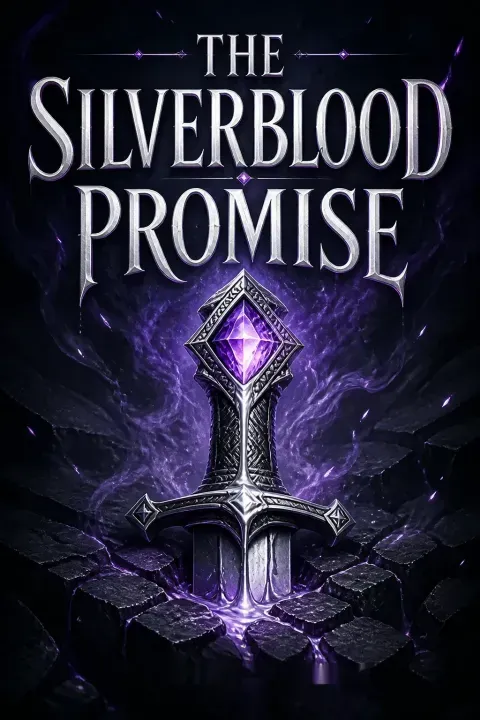


Plot Summary
Blood Promise Exile
Lukan Gardova,1 drinking gin over rummijake in a Torlaine tavern, narrowly escapes a brawl after exposing a cheating nobleman. Outside, his old mentor Shafia8 corners him with devastating news: his father Conrad has been stabbed to death in his Parva estate. The study was ransacked, but nothing valuable was stolen.
Shafia8 found Conrad clutching a scrap of paper scrawled in his own blood, reading 'Lukan, Saphrona, Zandrusa.' Staggered by guilt over their seven-year estrangement following his expulsion from the Academy for a fatal duel, Lukan1 swears a silverblood promise on his mother's ring. He will travel to the distant city of Saphrona, find this mysterious Zandrusa,5 and uncover who murdered his father and why.
This inciting incident binds a classic murder mystery to a redemption arc. Lukan's self-loathing over killing Giorgio Castori and his subsequent social exile is the unresolved wound driving him. The blood note creates an unbreakable, almost supernatural summons from beyond the grave, transforming Conrad's scholarship from an obsession Lukan resented into a final, cryptic inheritance. The silverblood promise is not just a vow; it is Lukan choosing purpose over self-pity, shifting his identity from a wandering gambler into a man with a deadly, filial mission.
Flea in the Flea Market
Arriving in the overwhelming heat and chaos of Saphrona, Lukan1 spends hours in the Plaza of Silver and Spice asking for Zandrusa.5 No one recognizes the name. A young pickpocket named Flea2 tries to lift his purse; he catches her wrist, noting her defiant glare and the stump of her missing finger. Rather than hand her to the guards, he asks his question again.
Flea2 claims she knows a blind beggar named Obassa14 who might help. Despite his suspicion, Lukan1 follows her to the Blue Oyster taverna. Obassa,14 sharp and cryptic, sees straight through Lukan's1 fake aliases. He reveals that Zandrusa is the birth name of Saïda Jelassi,5 a merchant prince scheduled to be fed to a monster for murder.
Flea's introduction energizes the narrative with a cynical, street-smart counterpoint to Lukan's brooding nobility. Her missing finger is a silent, brutal testament to her world's dangers, while her fearless bargaining reveals a survivor's instinct. Lukan's mercy in not turning her in is his first uncalculated kindness in years, planting the seeds of a deep, parental bond. Obassa, the 'blind beggar' who sees everything, introduces the theme of hidden identities and secret histories, hinting that Zandrusa's public execution is a cover for foul play.
Gargantua Spares the Prince
Lukan1 and Flea2 attend the Bone Pit execution. Three prisoners are chained around a stone platform as the colossal blind worm Gargantua rises from the darkness. The Constanza twins, a pair of gleamers, project a sorcerous cage to keep the creature contained. The terrified youth and the sobbing customs official flinch, but Zandrusa5 stands defiant, staring into the creature's gaping maw without flinching.
The worm sniffs each prisoner, then twists at the last second and devours the screaming customs official instead, swallowing him whole. Zandrusa5 has survived, but she has only ten days before she faces the monster again. Lukan1 realizes he must infiltrate the city's most secure prison to speak with her.
The Bone Pit functions as a grotesque theocratic machine, masking mob bloodlust behind religious ritual. Zandrusa's absolute refusal to show fear is a profound act of dignity that challenges the crowd's thirst for suffering. Her survival is simultaneously a miracle and a curse; a temporary reprieve that tightens the narrative clock into an urgent countdown. This public spectacle also lets Lukan glimpse the city's tangible political and sorcerous powers, making his solo quest feel acutely impossible and raising the stakes from personal vendetta to systemic injustice.
The Scrivener's Torture Game
To breach the Ebon Hand, Lukan1 needs the Scrivener,6 the city's master forger. He visits Salazar's gambling house, ordering a coded drink to signal his intent. Juro, the Scrivener's6 aide, explains the test: Lukan1 must play the pyramid. This Phaeron artifact forces players to touch illuminated panels; a gold glow means safety, a blue triggers an illusion of pure agony.
Lukan1 endures a centipede bursting from his arm and crippling frostbite without breaking. He uses psychological manipulation to goad an opponent, a brutal corsair, into disqualifying violence. A third illusion involving insectoid stomach parasites finally knocks him unconscious. The Scrivener,6 intrigued by his resilience rather than his failure, grants him an audience.
The pyramid sequence externalizes Lukan's internal state: the constant, suffocating pressure of guilt and self-hatred that feels like flesh-rending pain, but is not technically 'real.' His decision to antagonize fellow players rather than just endure reveals his strategic mind and his willingness to absorb psychic damage to outlast others. The fact that the Scrivener accepts him not for winning, but for surviving, suggests her test measures character as much as stamina, seeking someone who can walk through fire and still stand upright.
Inquisitor's Disguise
The Scrivener6 crafts a perfect forgery: a letter from the Prime Inquisitor himself, authorizing an interrogation. Donning the black and silver uniform, Lukan1 bluffs past guards and rows to the Ebon Hand. Inside, the zealous Lieutenant Rafaela questions his accent, but the forged seal holds. In the damp, rat-infested cell, Zandrusa5 recognizes Lukan1 immediately from his father's descriptions.
She confesses her innocence: she found Lord Saviola dead, his corpse unnaturally cold with frost on his clothes despite the summer heat. She believes rival merchant prince Lord Murillo framed her. Crucially, she reveals she holds a Phaeron casket from Conrad, meant for Lukan1 alone, locked in a bank vault that only she can access.
This scene shifts Lukan's entire mission. He moves from hunting a potential killer to defending a grieving friend who embodies his father's secret life. The revelation of the frost transforms a simple stabbing into a supernatural mystery, introducing the unseen hand of the Faceless through its chilling signature. Zandrusa's calm, sad dignity in the face of death, and her maternal warmth recalling Conrad's letters, gives Lukan the paternal approval he craved but never received directly. The casket becomes a physical link to a father he never truly knew.
Varga's Bribe and the Sea Exit
As Lukan1 tries to leave, Captain Varga,12 the corpulent coward commanding the Hand, begs a 'favor' to recommend his thieving nephew to the Inquisition. When Lukan1 stumbles over fake names, Varga12 tries to pull a bell rope. Lukan1 knocks him out, but Varga's12 old servant flees, raising the alarm.
Trapped on the tower's fifth floor with guards battering down the door, Lukan1 opens a rear window and stares at the black sea fifty feet below. With no other option, he pushes himself off the ledge, plunges into the freezing water, dodges lion sharks, and swims to the waiting rowboat. The terrified boy rows him to safety in the dark.
This sequence is a masterclass in tension mechanics. Varga represents the banality of institutional evil: a pathetic, nepotistic bureaucrat whose greed is just as dangerous as any zealot. Lukan's improvisation under pressure highlights his reflexes, but the real victory is psychological: overcoming the lizard-brain terror of the leap. The jump off the Ebon Hand is a baptismal death and rebirth, shedding the 'Inquisitor' identity and emerging a fugitive, but one armed with the truth.
Dead Scholar's Journal
Lukan1 attends Lady Valdezar's ball to find Lord Saviola's physician, Doctor Vassilis.11 The nervous, sweating Vassilis11 initially refuses to talk, but later accosts Lukan1 in the gardens, terrified. He urges Lukan1 to meet him at the Collegium at midnight, promising to reveal the truth. When Lukan,1 Flea,2 and guard Hector arrive, they find Vassilis11 at his desk, throat professionally slit.
Searching the clutter, Flea2 triggers a hidden lever, revealing a secret compartment containing Vassilis's11 journal. In meticulous handwriting, the doctor confirms the frost on Saviola's body and admits he was threatened into lying by three masked intruders. He identifies the cause of death not as a blade, but as sorcery.
The journal functions as a ghostly testimony. Doctor Vassilis is a tragic figure: a healer whose cowardice doomed an innocent woman, seeking redemption through truth, only to be silenced permanently. His murder tightens the noose of the conspiracy. The moment Flea finds the hidden lever is a beautiful beat of validation for her, shifting her from a tagalong to an active, crucial contributor. It solidifies the found-family dynamic: her street instincts are just as vital as Lukan's aristocratic fencing.
Catacombs Cathedrals
Juro interrogates the captured mercenary Topaz, learning of a mausoleum entrance to the catacombs. Lukan1 and Flea2 follow Lord Marquetta4 and the mercenaries deep underground at midnight. Hiding in a bone-strewn chamber, they witness an unholy convocation. Marquetta4 addresses Prime Inquisitor Fierro and Pontifex Barbosa, revealing he masterminded Saviola's murder to frame Zandrusa,5 removing her as a political obstacle.
He then presents the stolen Sandino Blade to the mythic Faceless,9 who manifest through a sorcerous portal. When Marquetta4 casually has Magellis (Zandrusa's5 steward and his own spy) murdered for knowing too much, the true scope of his ruthlessness becomes chillingly clear.
The catacombs serve as the spiritual underbelly of Saphrona's political corruption. Marquetta's unmasking here is a classic 'villain gloating' scene, but elevated by the terrifying, mute presence of the Faceless. Their silent power instantly dwarfs the squabbling human conspirators. Magellis's execution is the final proof that Marquetta consumes his own pawns, illustrating a narcissistic amoral void behind the rhetoric of 'Saphrona's glory.' Lukan realizes he is not fighting a greedy merchant, but a revolutionary willing to use apocalyptic forces.
The Wolf and the Gate
The Faceless9 detect Lukan1 and Flea's2 presence. One of them conjures a spectral crimson wolf that pursues them through the labyrinthine tunnels. Realizing they cannot outrun the glowing construct, Lukan1 sends Flea2 ahead with the vital conspiracy information while he distracts the beast.
Cornered in a skull-lined chamber, Lukan1 accidentally triggers an ancient Phaeron floor-plate; iron bars crash down just as the wolf lunges, bending the metal but holding firm. Before Lukan1 can escape, guards of the Twice-Crowned King,10 the city's secret underworld ruler, pour in from a hidden passage, having tripped their own silent alarm. They bind and blindfold Lukan,1 dragging him into the depths.
This is a crucial sacrificial moment in Lukan's arc. Choosing to face the wolf so Flea can escape is a radical departure from the self-centered cynic at the book's start. The accidental gate represents a stroke of luck that is actually a residual mystery of the Phaeron, saving him not by grace, but by ancient engineering. His capture by the King's men is a brutal narrative pivot; just as he escapes the supernatural, he falls into the political, deepening the city's layered web of threats and raising the stakes to a physical imprisonment far below the city.
Twice-Crowned King's Mercy
Lukan1 is dragged before the Twice-Crowned King,10 the conjoined twins the Scorpion and the Snake. From their decadent throne surrounded by drugged courtiers and hanging cages, they dispense a twisted form of justice. They watch a starving prisoner plead for his life, then sentence him to the Long Swim, a doomed dash through the flooded, monster-infested Black Maze.
Lukan,1 bruised and terrified, kneels before them. Sneered at by the Snake and toyed with by the Scorpion, Lukan1 blurts out that he knows who really stole the Sandino Blade. This audacious claim buys him a private audience and a stay of execution, but imprisons him in the deepest dungeon.
The Court of Midnight is a grotesque parody of the surface world's politics. Where Marquetta uses laws and codes, the King uses flesh and spectacle. The conjoined twins are a literal, physical manifestation of 'one body politic' that cannot agree with itself; the cruel Snake versus the sensual Scorpion. Lukan's lie-turned-desperate-truth about the Sandino Blade shows his adaptability, realizing that information is the only currency that buys life in this particular court, even if it reveals his hand to a potential new enemy who rules the shadows.
Rings of Last Resort
A new prisoner is thrown into Lukan's1 cell: Ashra Seramis,3 the legendary thief known as Lady Midnight,3 who supposedly stole the Sandino Blade. Lukan1 offers his help fighting the guards in exchange for her skills. She initially refuses, then relents, revealing her secret: a Phaeron ring she previously swallowed and has now vomited up.
When guards come to take Ashra3 to the Long Swim, Lukan1 ambushes them from the shadows. Ashra3 activates the ring, which opens a shimmering golden portal on the back wall of the cell. The two step through, enduring a bone-shattering flash of cold, and tumble into an abandoned cellar guarded by Ashra's3 grizzled old soldier friend, Alphonse.13
Ashra's method of hiding her ring is viscerally effective, emphasizing the extreme sacrifices required to maintain one's freedom in this dystopian city. The escape sequence is a perfect reversal of their helplessness within the cell. Their alliance is based on a pragmatic exchange, but the shared trauma of the freezing portal and the shared enemy in Marquetta and the King who framed her quickly forge a bond of mutual respect, deepening the novel's theme of found community against institutional rot.
Ceremony of Blood
Lukan,1 Ashra,3 and Flea2 watch the Grand Restoration from a bell tower alongside the entire city. As the Pontifex hands the ceremonial Silver Spear to the Zar-Ghosan ambassador, she suddenly stiffens. Her body moves with jerky, unnatural precision and she drives the spear through the old Duke's throat, then slashes his two sons.
Chaos engulfs the plaza. Mobs retaliate against the Zar-Ghosan quarter, setting homes and shops ablaze. Lukan1 realizes in horror that Marquetta4 did not just kill a ruler; he possessed the foreign ambassador to frame her people, ethnically purge the city, and start a war, removing every obstacle to his dictatorial power. Ashra's3 home district burns.
This is the ultimate escalation of the conspiracy. The possession of the ambassador is a violation of sovereignty more profound than mere assassination; it weaponizes the victim's own body against her will, making her a symbol of 'inherent' treachery. This event transforms the novel from a personal mystery into a geopolitical catastrophe. For Ashra, watching the Zar-Ghosan quarter burn is a visceral call to action that finally aligns her fully with Lukan's cause, moving her from reluctant survivor to committed avenger rooted in heritage.
Diamond's Wager
As Lukan1 despairs in a tavern, Delphina Delastro,7 the mercenary known as Diamond, corners him, holding Flea2 hostage. However, instead of killing him for disrupting her contract, she demands his help: her nephew Topaz was captured in the safe house raid, and she wants him back. Desperate, Lukan1 counter-offers not just coin, but the real Sandino Blade.
He reasons that if the Faceless9 want the blade's purple crystal, possessing it gives him leverage to stop the murders. Delastro,7 furious at Marquetta4 for dragging her crew into a coup involving dark magic without disclosure, agrees to a trade. She will hijack the transport and deliver the blade to him. Flea2 is released.
Delastro's maternal instinct for her nephew humanizes the antagonist. Her willingness to betray Marquetta is not born of a sudden moral awakening, but of a mercenary's code: the client lied about the scope of the job (apocalyptic sorcery), voiding the contract. This scene shows Lukan maturing politically, operating not just with a blade, but with negotiation, leveraging family debts and business logic to turn adversaries into temporary allies. It is a cynical deal that gives the heroes their only fighting chance.
Pontifex's Silk and Steel
The Sandino Blade is locked inside a Phaeron puzzle chest that only Marquetta4 can open, except the Pontifex once learned the secret code. Ashra3 arranges to infiltrate the Pontifex's opulent villa by posing as a new courtesan from the Golden Lily brothel, cashing in a long-standing favor.
As the lecherous Pontifex lounges in silk sheets awaiting his 'steel beneath the silk,' Ashra3 straddles him and presses a stiletto to his throat. She denounces his hypocrisy, reminding him of the starving children he bleeds for temple donations. Terrified of both her blade and Marquetta's4 reprisal, the Pontifex cracks and whispers the color sequence: Blue, Red, Orange, Green.
This scene is a deeply satisfying inversion of power dynamics. Barbosa represents institutional religious corruption, using the Lady's name to fleece the poor while indulging every vice. Ashra's intimate threat, using the tools of his own lust against him, is a form of karmic justice. Her denunciation reveals her personal class consciousness and loyalty to the Splinters. The scene also operates as a classic heist sequence, where the 'treasure' is not a physical object, but a sequence of trivia locked inside a coward's brain.
Stealing the Blade
As the sun sets and the Zar-Ghosan quarter burns, Delastro's7 mercenaries escort the Phaeron chest up Quill Lover's Lane. She fends off a rioting mob of thirty looters before meeting Lukan1 and Ashra.3 Ashra3 presses the colored panels on the chest in the sequence the Pontifex provided.
After a tense moment of hesitation over a 'light green' versus a 'dark green' panel, the chest clicks open with a soft chime. Inside rests the tarnished Sandino Blade. When Lukan1 touches the purple crystal in the pommel, he suffers a terrifying psychic flash: a vision of a black tower, a shattering gem, and a vast, implacable presence. The Faceless9 are not just waiting; they are inside the crystal.
The successful heist is a procedural triumph, validating the risky alliances of the previous sections. The moment Lukan touches the crystal and feels the vast, ancient presence hints that the Faceless operate on a scale of existence incomprehensible to humans. The vision provides a subtle lore dump, hinting at the origin of the Grey Lands and the Phaeron's destruction, while reframing the 'trade' as something far more dangerous than a simple exchange of goods. They are wielding an object of immense, possibly genocidal, cosmic power.
The Faceless Pact Reforged
Flea2 infiltrates the ducal palace by clinging to the underside of the carriage roof, her hands coated in alchemical adhesive. Ashra's ring, activated by Flea2 inside a storage closet, portals herself and Lukan1 directly into the great hall.
Lukan1 steps onto the polished floor just as Marquetta4 lifts the lid of the empty chest. Lukan1 holds up the blade, facing the three silent, armored Faceless.9 As Marquetta4 screams for them to kill the thief, the Wolf advances.
Lukan1 feels an icy presence scraping his mind, sifting his memories, searching for his desire. He offers them the crystal in exchange for proof of their pact with Marquetta.4 The Wolf takes a black oval stone, presses it to its helm, and fills it with flaming golden memories of the conspiracy.
This is the climax of the thematic arc. The Faceless are not mindless monsters; they are bound by strict rules of engagement. Lukan's courage lies not in swinging a sword, but in standing his ground and trusting the obscure historical texts he absorbed from his hated father. In this moment, all his father's 'worthless' scholarship pays off, becoming the weapon that saves the city. The transaction replaces violence with commerce, justice with evidence, and Lukan breathes a new, non-lethal outcome into the story, proving intellect can shatter steel.
Marquetta's Fall
With the deal struck, the Faceless9 turn on Marquetta's4 terrified allies without hesitation. The Kraken garrotes the Pontifex with a tentacle of shadow; the Wolf skewers Fierro with a crimson crystalline blade. They hurl Marquetta4 against a pillar, leaving him broken but alive. As the palace guards finally breach the barred doors, Lukan1 activates the memory stone.
It projects the Faceless's9 records of Marquetta's4 treasonous commands in a shimmering prism of golden light for all to see, including his orders to kill the Duke. The Lord Chancellor Artemio,15 still bound but alive, confirms the truth. Marquetta4 is seized and dragged to the Ebon Hand, his coup shattered by proof that cannot be disputed.
The denouement is a satisfying rush of structural collapse. The Faceless clean house with an efficiency that highlights how utterly disposable the scheming humans were to them. The 'recorded memory' is a brilliant sci-fi/fantasy mechanism for the whodunit genre, allowing the truth to be revealed without a tedious confession. Marquetta's survival is important; death would be an escape, but the novel condemns him to face the institutional justice he perverted, likely ending in the same Bone Pit he manipulated with such arrogance.
Key to the Next Horizon
Days later, Zandrusa5 reunites with Lukan1 in her liberated villa, her new steward attending them. The Phaeron casket Conrad left behind is finally brought forward. Lukan1 presses his thumb to it, his heart pounding. It unlocks, revealing not gold or cryptic scrolls, but a simple iron key bearing the seal of the Blackfire Bank in distant Korslakov.
Whatever his father deemed so vital to protect and pass on remains hidden inside that northern vault, a revelation that reframes the quiet scholar as a man of grand adventures. After a last bottle of Parvan Red, Lukan1 meets Flea2 and the reclusive Ashra3 at the docks. They board the Sunfish together, sailing into the unknown.
The key is a perfectly engineered sequel hook that also serves a thematic purpose. Conrad did not leave his son a solution, but a question, a commitment to continue the journey. It reframes 'The Silverblood Promise' from a single vow of vengeance into an ongoing mission of discovery. The trio boarding the ship at the end solidifies the novel's core argument: that family is not just the one you are born into, but the one you gather through trust, shared scars, and the choice to keep sailing together into the unknown.
Analysis
The Silverblood Promise is a study in legacy as burden and beacon. Lukan Gardova1 arrives in Saphrona carrying the ghost of a father he barely knew and the shame of a duel he never meant to fight. The novel frames his journey not as a hero's quest but as a slow excavation of self-worth, where each act of courage strips away layers of self-loathing to reveal the principled man his father's letters described. The blood note is a literal manifestation of this paradox: the old man's death is what finally forces the son to live with purpose.
Saphrona itself is a masterclass in corrupt fantasy city-building. It is not simply decadent; it is systematically cruel, built on the back of a theocratic execution-pit where monsters dispense lottery justice. The novel weaponizes its setting, making bureaucratic rot and sensationalized violence the primary obstacles Lukan1 must navigate. The conspiracy plot, which swerves from a simple murder frame-up to a geopolitical coup, reflects the terrifying banality of historical fascism: Marquetta's4 war is not driven by madness, but by a cold, nostalgic narcissism that considers a multicultural peace an offense against 'glory.'
The introduction of the Faceless9 elevates the story from political thriller to cosmic horror. They are the ultimate unreachable Other, operating under a rigid, if alien, moral framework. By trading with them rather than fighting them, Lukan1 achieves a victory that is uniquely his own. He weaponizes intellectual curiosity, using his father's 'useless' history against an enemy of mythic proportion. Finally, the departure for Korslakov is not an escape, but an acceptance of the open-ended narrative. The bloody promise is kept, but a new one — a promise of curiosity, found family, and the pursuit of a father's secret truth — takes its place. The silver is tarnished, but the blood remembers.
Review Summary
The Silverblood Promise is a thrilling fantasy debut by James Logan, receiving widespread praise for its engaging characters, intricate plot, and vivid world-building. Readers particularly enjoyed the dynamic between the protagonist Lukan and the street urchin Flea. The story blends elements of mystery, heists, and magic in a richly detailed city setting. While some found certain plot points predictable, most reviewers were captivated by the fast-paced narrative and Logan's skillful prose. Many compared it favorably to works by Scott Lynch and Brandon Sanderson, eagerly anticipating future installments in the series.
People Also Read
Characters
Lukan Gardova
Disgraced nobleman turned investigatorThe disinherited scion of a faded Parvan noble house, Lukan wanders the Old Empire as a gambler and duelist, haunted by the fatal academy duel that branded him a murderer. Snarky and self-destructive, he masks profound guilt with a sardonic wit and cheap gin. His emotional core is an unresolved oedipal struggle: he craved his distant father's approval, yet resented his obsession with Phaeron relics over his own son. Conrad's murder rips open this wound, transforming Lukan's aimless drifting into a razor-sharp mission. His arc is a slow burn from cynical self-preservation to selfless bravery, culminating in his realization that negotiating with the cosmic Faceless9 requires the scholarly wisdom he once mocked, thereby integrating his father's legacy into his own identity.
Flea
Fierce urchin and loyal shadowAn eleven-year-old pickpocket with chopped dark hair, olive skin, and the stump of a missing finger on her left hand. Hardened by the Splinters slums, she possesses a street-smart cynicism far beyond her years. She initially latches onto Lukan1 for coin, but his trust in her creates a powerful surrogate father-daughter bond. Her sharp eyes, stealth, and absolute refusal to be sidelined make her an invaluable operative. She worships the myth of Lady Midnight3, yet her real emotional foundation is the loss of her brother Matteo and a terror of abandonment. In a world that treats her as disposable, Lukan's1 promise to keep her safe gives her not just security, but a moral compass and a family.
Ashra Seramis
Legendary thief in hidingKnown as Lady Midnight, Ashra is the finest thief in Saphrona, a mythic figure who can supposedly walk through walls (a rumor born from her secret Phaeron rings). Light brown skin, pale green eyes, and a sharp, lean frame mark her Zar-Ghosan heritage and a life of ceaseless vigilance. Her stoic exterior masks deep trauma: she watched her father be murdered and sank into poverty with her crippled mother. Framed for the theft of the Sandino Blade, she is driven by a cold, methodical fury against injustice. Her alliance with Lukan1 is purely transactional at first, but witnessing the fiery purge of the Zar-Ghosan quarter reignites her political rage, transforming her from a survivalist into a willing hero of the people.
Lord Marquetta
Silken conspirator and usurperThe leader of the Gilded Council, an old-blood merchant prince with white hair, a ducktail beard, and an avuncular charm that disguises a genocidal narcissism. Marquetta views decades of peace with Zar-Ghosa as a rot eroding Saphrona's 'glory.' His political genius lies not in brute force, but in patience and framing; he uses the Faceless9 to commit sorcerous assassinations that harness xenophobic prejudice against his rivals. He is a consummate manipulator who plays friend and foe alike, but his fatal flaw is his aristocratic hubris: he cannot conceive that a disgraced gambler1, a street urchin2, and a thief3 might unravel a conspiracy woven with mythic creatures.
Zandrusa Jelassi
Imprisoned reformer princeBorn Zandrusa, a Zar-Ghosan immigrant turned smuggler turned legitimate merchant prince. She used her immense wealth to push for labor reforms, becoming a symbol of progressive multiculturalism that threatened the Old Blood families. Her dignity in the face of Gargantua reveals an ironclad stoicism. A close friend of Conrad Gardova, she acts as a spiritual aunt to Lukan1, revealing through memory that his father was not a cold scholar, but a loving, proud man. Her freedom represents the restoration of justice, and her gift of the casket is the ultimate paternal blessing, bridging the gap between Lukan1 and his father's secret life.
The Scrivener
Master forger and spymasterAn older woman with piercing eyes, silver hair, and a merciless crispness of speech. She runs a network of spies and crafts impossibly perfect documents from a shadowy position within the Kindred. Purely pragmatic, she aids Lukan1 out of old loyalty to Zandrusa5 and a professional hatred of sloppy work. She views Lukan1 as a reckless liability, yet her repeated assistance betrays a grudging admiration for his stubborn willpower. Her tidy, sterile worldview is shattered when Lukan's1 'recklessness' uncovers a conspiracy so vast it burns her safe house down, proving that some chaos is too big to be filed away neatly.
Delphina Delastro
Diamond-hard mercenary leaderA veteran of the Talassian Wars and commander of the Seven Jewels, a crew who take aliases like Garnet and Topaz. Scarred, grey-streaked, and brutally pragmatic, she operates on a strict mercenary's code. Marquetta's4 hidden use of the supernatural Faceless9 voided their contract in her eyes, as he failed to disclose the true scope of the job. Her willingness to betray him is not about morality, but risk management and maternal instinct: her nephew Topaz is the one soft spot in her armored heart. She represents a cold, ethical middle ground between Lukan's1 chaotic heroism and Marquetta's4 unrestrained evil.
Shafia
Loyal steward and spymasterLukan's1 childhood combat tutor and Conrad's estate steward. A former Parvan spy, she possesses a sharp, no-nonsense Talassian pragmatism. She acts as the bridge between Lukan's1 reckless present and his abandoned duty. Delivering the news of Conrad's death, she simultaneously gives Lukan1 the quest and the kingdom, promising to hold his estate together until he returns. She embodies the unwavering maternal discipline that Lukan1 lacked after his mother died, pushing him toward Saphrona not with sentiment, but with the sharp-edged truth of his father's final moments.
The Faceless
Mythic sorcerous entitiesArmored, helm-wearing beings from another world who travel through luminescent portals and command devastating sorcery. They never speak aloud, communicating via intrusive psychic imagery. Named for their animal-shaped pauldrons (the Wolf, the Viper, the Kraken), they operate under a strict, inscrutable mercantile code regarding the purple Phaeron crystals they collect. They are not inherently evil, but are cosmic lawyers of violent neutrality; they will kill for a client, but will just as readily renegotiate the contract with the client's enemy. Their existence validates the 'crackpot' historical texts Conrad studied, implying the Phaeron's fall was intertwined with these crystals.
Twice-Crowned King
Sovereign of the criminal underworldA conjoined pair of male twins, the Scorpion and the Snake, ruling from a decadent subterranean throne. The Scorpion is sensual, witty, and capricious, while the Snake is rasping, cruel, and avaricious. They represent the absolute, grotesque fusion of law and desire in the underworld. They demand absolute loyalty and punish transgressions with the 'Long Swim' through a monster-infested maze. Threatened by the myth of Lady Midnight's3 independence, they tried to corrupt Ashra3 into servitude and, failing that, sought to destroy her legend entirely.
Doctor Benito Vassilis
Cowardly physician turned martyrA cynical, shimmer-addicted academic doctor who attended Lord Saviola's corpse. He discovered the supernatural frost and stiffness proving sorcerous murder, but was terrified into silence by Delastro7. His secret journal, full of dry wit and self-loathing, becomes the key item that validates Zandrusa's5 innocence, at the cost of his own slit throat.
Captain Varga
Corrupt commander of the HandThe obese, spineless warden of the Ebon Hand prison, who lives in luxurious quarters surrounded by lemon cakes while prisoners rot below. His attempt to bribe Lukan1 into nepotism exposes his complete lack of professional integrity. His suspicion and Lukan's1 panicked assault lead directly to the novel's most literal cliffhanger.
Alphonse
Ashra's grizzled guardianAn ex-soldier with a wooden leg and a crossbow named Old Berta, who acts as Ashra's3 foster father and handler. He provides safe houses and cynical, protective advice, urging flight over foolish heroism. His grumbling, paternal loyalty is the stable anchor that allows Ashra3 to take the wild risks of a master thief.
Obassa
Blind Zar-Ghosan spyA middle-aged beggar with milky-white eyes who carves wood outside a taverna. His blindness is a ruse; he is a spymaster for Zar-Ghosa, paying urchins for information. He knows the true identity of Zandrusa5, acting as the initial Rosetta Stone for Lukan's1 quest, trading wisdom for stories.
Artemio
Principled Lord ChancellorThe nervous but morally incorruptible administrator of the Duke's court. Marquetta4 abducts him to witness the Faceless9 meeting, but he refuses to join the conspiracy. Bound and gagged during the climax, his eyewitness testimony corroborates the Faceless's9 memory stone, providing political legitimacy to Lukan's1 impossible story.
Plot Devices
The Blood Note
Inciting quest clueA crumpled piece of paper recovered from Conrad Gardova's dead hand. Written in his own cooling blood, it reads 'Lukan1, Saphrona, Zandrusa5.' This physical relic of his father's pain serves as Lukan's1 sole map, launching him across the continent. The note's raw, visceral nature bypasses Lukan's1 cynicism, embedding a desperate paternal urgency into the quest. It is the tangible anchor for the silverblood promise, a constant reminder that his father's final thought was of the son he was estranged from.
The Bone Pit
Execution by monsterA Phaeron-engineered amphitheater where condemned prisoners face the blind giant worm, Gargantua. Held back by gleamer sorcery, the creature selects victims based on sensory vibrations. It represents the theocratic state's perversion of justice: a lottery of death framed as a 'trial by the Lady.' Zandrusa's5 survival within its walls creates a ticking clock, forcing Lukan1 to act before the ten-day cycle resets and the fickle monster changes its mind.
The Pyramid Game
Phaeron pain-testerA sleek black Phaeron pyramid used in Salazar's gambling house. On each tiered row, one segment triggers an extreme illusion of physical pain without causing real bodily harm. It mercilessly strips players of their composure and pride. The game serves as the Scrivener's6 sadistic vetting process, testing Lukan's1 tolerance for psychological distress. Surviving the centipede and frostbite illusions proves Lukan1 can keep his wits when his nervous system screams otherwise.
The Sandino Blade
Faceless contract paymentAn old ceremonial dagger with a tarnished silver hilt and a rusted blade, seemingly worthless. The true value lies in the rough-cut purple crystal embedded in its pommel. This crystal is a fragment of the massive gem that destroyed the Phaeron civilization, and its purplish-black energy is the only currency the Faceless9 accept for their sorcerous services. Touching the crystal inflicts psychic visions of a black tower and a shattering world. The theft, trade, and recovery of this blade forms the central spine of the conspiracy.
Rings of Last Resort
Portal-summoning escape toolsA pair of translucent signet rings bearing a Phaeron glyph. When one ring's teardrop symbol glows gold and is activated, the twin ring opens a matching golden portal at the user's location. The transition is disorienting and brutally cold. Requiring a full day to recharge after use, the rings represent the last-ditch escape mechanism that built the myth of Lady Midnight3 walking through walls. Ashra's3 willingness to reveal and share this ultimate secret makes the infiltration of the palace and the confrontation with the Faceless9 logistically possible.
The Last Legacy Series
Download PDF
Download EPUB
.epub digital book format is ideal for reading ebooks on phones, tablets, and e-readers.








































