
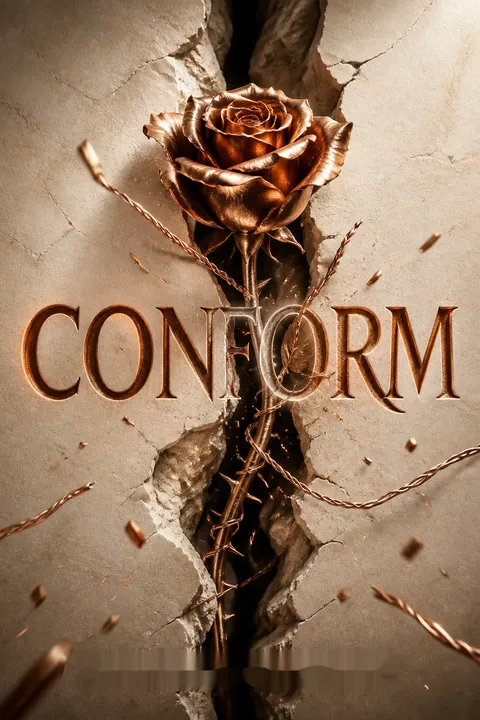


Plot Summary
The Stranger in Blue
Emeline1 works alone underground in the Archives, her job to delete ancient art on the Illum's orders. She is twenty-seven, marked since birth by heterochromia — one blue eye, one brown — a visual defect that got her cast from her Elite birth family into the Minor Defect population. That morning, her chip declared her approved for procreation, meaning she will be matched with an Elite male to breed.
Then a stranger appears in her doorway. Hal2 wears the dark blue of a Major Defect — the lowest caste, supposedly monstrous. But he asks about art with genuine curiosity, calls her mismatched gaze striking, and leaves her reeling. She invites him to come back. He says he might. Nobody has visited her office in ten years.
Her Mate Rules the City
Two stylists called the Starlings8 scrub, wax, and paint Emeline1 until she becomes someone the Elite might accept. A contact lens covers her blue eye, making both brown. Dressed in liquid gold, she enters a garden restaurant suspended in the clouds and meets her proposed Mate. Collin3 is devastatingly handsome, disarmingly kind, and unlike any Elite she was taught to expect.
He apologizes for her birth family's cruelty. He does not flinch at her status. Then he reveals why: he is not Elite at all. He is the youngest member of the Illum — the ruling body that controls the entire city. He offers a full public Courting with cohabitation, the best contract possible, and warns that the Elite will be watching everything.
Collin Kisses Emeline, Then Flight
Their second date unfolds inside a glass sphere floating above the clouds, where intimate alcoves drift like lanterns. Collin3 feeds her chocolate, breaks etiquette rules for her pleasure, and lets slip that the Press — controlled by the Illum — publishes whatever suits them.
When her sheer gown slips, he adjusts it without touching her skin, his restraint trembling. On the landing afterward, Emeline's1 birth family arrives uninvited. Collin3 dismisses them with cold authority, telling them they will regret their unkindness.
Then, with every Elite in the Sphere watching, he cups her face and kisses her — gentle at first, then deeper when she pulls him closer. He breaks away abruptly, whispering for her forgiveness. The photo appears in the Press the next morning, perfectly timed.
Alone in Enemy Blue
Someone impersonating the Illum sends Emeline1 a gown in Major Defect blue — a color that marks the wearer as trash. Collin3 cancels the dinner with her birth family for work, leaving her to face them alone in the most humiliating color imaginable. Her birth father Vincent7 views her defect as a stain on centuries of genetic perfection.
Over wine, he casually mentions the Elimination Act — a petition to murder every Defect in the city. When Emeline1 asks if he would have her killed, he answers there is nothing he would not do for the Greater Good. She snaps, shoves back from the table hard enough to shatter glasses, and snarls that his genes created her. She storms out, clawing at the metal collar of the dress, unable to breathe.
Barefoot Through the Storm
Emeline1 hits the Pod's emergency button and plummets to the surface. Rain-soaked and panicking, she tears off her heels and runs barefoot through High Town in blue silk — ten kilometers of pavement punishing her feet until her legs collapse. Hal2 materializes from the dark. He carries her upstairs, holds her through the panic attack, and stays when curfew locks them both inside.
In the quiet, he confesses his history: born to two Major Defects, deemed genetically Elite by the Illum's own chip, his parents murdered by the Elite Force the night they took him. He had cut the chip from his own wrist and faked his death to live underground. When sleep finally claims Emeline,1 Hal's2 arm stays wound around her waist.
Collin's Other Face
Gregory,5 Emeline's1 irreverent middle birth brother, retrieves her the next morning. In the Pod he tells her what no one else has: Collin3 is not merely an administrator. He is the Illum's Enforcer — the one they dispatch to carry out punishments and judgments. At Collin's3 private quarters, Emeline1 meets Nora,4 Collin's3 twin sister, who greets her warmth and mismatched eyes without flinching.
Nora4 offers friendship freely, something Emeline1 has been forbidden since the Academy took her childhood friend Alice. Collin3 examines the mysterious blue dress, insists he did not send it, and promises to find who did. He tells Emeline1 that if someone hurts her, he takes it personally. The words carry the weight of both protection and threat.
Violet's Bruised Warning
Emeline1 returns to the Starlings to find Violet's8 face swollen purple, a cut reopened on her lip. Rose9 blames Emeline1 directly — after she mentioned the uprising to Collin3 during tea, someone had interrogated the Starlings with violence.
The Enforcer's shadow falls across everything. Yet Violet,8 undeterred, whispers that a rebellion is gathering momentum. She describes a figure called the Reaper who has been raiding Illum buildings and killing Elite.
Violet8 asks the question that lodges beneath Emeline's1 ribs: is she content being Collin's3 vessel, or does she want power? Meanwhile, the Illum release the Press photo of Collin3 kissing Emeline1 — timed to distract from the uprising. Emeline1 begins to understand she occupies a square on everyone's game board.
Blood on the Ballroom Floor
At a formal Elite dinner, Tabitha10 — the Illum's ageless leader — appears via hologram to announce they have captured a rebel sympathizer, the same man who once whistled a warning at Emeline1 near the Pods. Tabitha10 publicly credits Emeline1 for helping identify him. Then Collin,3 standing at the head of the table with lethal calm, orders the man's elimination.
No one touches the prisoner. His MIND chip activates a hemotoxin: blood trickles from his ears, his eyes turn red, and he crumples dead on the tile. Emeline1 watches, frozen, as the Elite resume eating around the body. The blood stains the hem of her beaded gown. She tells Collin3 she wishes he had not chosen her. He does not argue.
Screams Behind Stone Walls
On her day off, Emeline1 sees eight Elite Force soldiers enter the Sanctuary across the street — the compound where Minor mothers live with young offspring. The steel doors open for the first time in her memory. Soldiers begin dragging small children out while mothers scream and claw at green armor.
One woman breaks free, clutches her son to her chest, and tells him she loves him before a soldier strikes her unconscious with his rifle. Emeline1 runs toward the horror but is turned back at gunpoint. The offspring vanish into Pods headed for the Academy. When Violet8 later asks which side she is on, Emeline1 no longer hesitates. She tells the Starlings she wants power. Violet8 smiles and instructs her to gain Collin's3 trust.
Beneath the Bridge
Emeline1 swings herself off the bridge above the river, clings to a narrow ledge she cannot swim above, and a woman named Bri14 pulls her into the Underworld — then knocks her unconscious.
She wakes surrounded by rebels: the towering Kane,13 the red-haired Barrett,12 the calm-voiced Gerald,15 and Bri14 herself, all armed and suspicious of the Illum's Mate. Then Hal2 walks in. His friends already know about her; he had declared her off-limits. She delivers intelligence — the Illum plan to ambush the tunnels in two days, and the river entrance she used is circled on their maps.
The information proves vital. Before Hal2 leads her back to the surface through a passage beneath the river, she asks him to kiss her. He presses her against the tunnel wall until Kane13 interrupts.
The Supplements Are Poison
Emeline1 notices Lo6 — her only friend on the surface — shuffling through the days in a glassy-eyed stupor, hair unkempt, speech slurred. Every Minor woman on the Pods wears the same vacant expression. Emeline1 stopped taking her supplements after the Elite dinner; her health metrics improved dramatically.
The connection clicks: the Illum are sedating the entire Minor population through the daily pills. She confronts Collin,3 dumping a fistful of untaken supplements into his palm.
He admits he would not let them drug her specifically but deflects the larger question. Their argument builds until they stand chest to chest, his hand on her back, his mouth a breath above hers. He asks her to say no. She cannot. Nora4 walks in carrying chocolate cake, and the charged moment shatters.
Stars and Hidden Closets
Rose's9 crystal-encrusted gown turns Emeline1 into a walking constellation at her first ball. She and Collin3 dance beneath a star-projection ceiling, and for breathless minutes her mind goes quiet — just the music and the turns. Vincent7 corners her afterward, revealing that her birth mother Helen16 had fought to keep Emeline1 out of blue at birth, that she had once wanted to save her.
Before Emeline1 can absorb this, Hal2 appears disguised in servant's gray, having infiltrated the ball while the Illum chase a diversion he engineered. He extends his hand and she takes it. In a supply closet, hidden from every Elite, he brings her to her first climax. Gregory5 discovers her afterward — disheveled and wrinkled — and covers her escape to the Pods.
Love Across Four Mates
Nora4 finally tells Emeline1 the full truth. She had been forced into her first Mate at sixteen, and when that man became violent on their procreation night, Gregory5 — his best friend — had beaten him senseless and carried her to safety.
Their love has survived through four Mates and three offspring, sustained in stolen dances and midnight visits. When Phillip11 discovers Gregory5 and Nora4 together during a rebel attack on the city, he delivers an ultimatum: if they continue, the Illum will use Nora's4 eldest daughter as leverage.
Gregory5 says the words Nora4 cannot bring herself to speak — that this was the last time. He walks away without looking back, and Emeline1 watches two people choose their children's safety over the only love either has ever known.
The File Marked Moonlight
The city grid goes dark. Hal2 brings Emeline1 underground, where they dance among the Majors' wild, joyful crowd before he carries her to his quarters. She gives him her virginity — a choice she refuses to let the Illum take from her.
Afterward, while Hal2 retrieves a gift, she finds a folder on his table labeled with her nickname. Inside: pages of surveillance compiled months before they met. Her schedule, her loneliness, her defect. Notes in Hal's2 handwriting instructing himself to learn about art, to exploit her isolation, to make her care.
The Starlings8 later confirm he also sent the humiliating blue dress. Every tender moment reassembles into calculation. She confronts him. He insists he fell in love despite the plan. She tells him never to call her Moonlight again.
Through the Chute
Gerald,15 the rebels' tech expert, needs someone small enough to crawl through a narrow maintenance shaft and deliver a device to the machine that powers every MIND chip in the city. Emeline1 volunteers over Hal's2 protests.
She climbs the chute, slides down a steep drop while her fingertips blister against metal, and hurls the cube onto the pulsing device. The grid stays down long enough for rebels to attack a supplements building on the surface. Fire erupts across the skyline, visible from the clouds.
When Phillip11 retrieves Emeline1 from the Archives, smoke blankets the entire city. She has helped the rebellion succeed — but does not yet understand that the Illum were tracking far more than she imagined, and that the entrance she used was already known.
The Pyramid Collapses
At a mandatory ball, Elite Force soldiers drag Hal2 before the crowd in chains. Tabitha10 announces the Reaper's capture, crediting Emeline.1 Then Tabitha10 takes Emeline1 to a private tearoom, serves drugged tea, and dismantles everything.
She builds a pyramid of gold-dusted chocolates and pulls pieces from the bottom until it topples — a demonstration of how she balanced power through hope and fear. Lo,6 Emeline's1 only friend, had been selling her secrets to the Illum since her contract began. The Underworld's offspring have been seized by soldiers.
Emeline1 was never making choices; she was a pawn whose every rebellion served Tabitha's10 design. As the drug blurs Emeline's1 vision, Tabitha10 promises the game is only beginning — and Hal's2 life depends on Emeline's1 total cooperation.
Epilogue
Hal2 sits chained in a cell, a fresh chip forced into his scarred wrist. But his revolution is not over. Before the grid was restored, his people had modified it — a ticking time bomb embedded in the Illum's10 own infrastructure. His supporters and spies in the clouds remain undetected.
When Tabitha's10 footsteps approach, he lets his mask settle into place, burying everything — his love for Emeline1 most stubbornly of all. She asks if he is ready to talk. He answers that it depends on what she wants to discuss. The woman who broke him once will not break him again. This is no longer a rebellion. It is a revolution, and the buildings in the clouds will crumble.
Analysis
Conform interrogates a question most dystopian fiction takes for granted: what happens when every faction in a revolution is willing to use the same person as a tool? Emeline1 is not merely caught between two love interests or two political factions — she is instrumentalized by both. Collin3 needs her compliance for stability. Hal2 needs her access for strategy. Tabitha10 engineers the entire situation. The novel's deepest provocation is that genuine emotion and strategic manipulation can coexist in the same relationship without either being entirely false.
Sullivan structures her world around the weaponization of care. The MIND chip monitors health to control bodies. Supplements provide nutrition to sedate minds. Procreation contracts offer belonging to enforce breeding. Friendship is forbidden among Minors not because connection is inherently dangerous, but because isolated people are infinitely easier to control. The Illum's particular genius is making deprivation feel like protection.
The heterochromia functions as more than a visual defect. It literalizes Emeline's1 dual perception: one eye sees the beauty the Illum promise, the other the cruelty they deliver. Her arc is not about choosing between Hal2 and Collin3 but about learning to see with both eyes simultaneously — to hold contradictions without collapsing them into comfortable binaries of hero and villain.
The novel's treatment of motherhood is especially incisive. Nora4 endures four Mates to shield her children. Rose9 carried an offspring torn from her during the Parting. Helen16 whispered warnings through doors but never entered the room. The system does not merely commodify women's bodies — it weaponizes their love for their children, transforming maternal devotion into the most reliable chain available.
The epilogue's revelation that the revolution continues despite the Reaper's2 capture suggests Sullivan's ultimate thesis: systems built on suppressing human desire are inherently unstable, because desire — like the art Emeline1 was ordered to delete — refuses to stay destroyed.
Review Summary
Reviews for Conform are deeply divided. Enthusiastic readers praise its addictive pacing, compelling love triangle, and dystopian atmosphere reminiscent of The Handmaid's Tale and Hunger Games, with many highlighting side characters like Gregory and Nora. Critical readers, however, consistently cite weak world-building, a shallow and frustratingly naive protagonist, underdeveloped romance, and writing that feels more YA than adult. Common complaints include unexplained societal mechanics, plot holes, and a lack of meaningful social commentary despite tackling weighty themes like eugenics and class oppression.
People Also Read







Characters
Emeline
Defective vessel turned pawnA twenty-seven-year-old Minor Defect whose heterochromia—one blue eye, one brown—got her expelled from her Elite birth family at age four. Raised on the Academy's black-pyramid side, she has spent a decade alone underground deleting art for the Illum while harboring a forbidden curiosity about the beauty she destroys. Her core wound is abandonment: cast out by her father7, unknown to her siblings, visited by no one. Her heterochromia functions as both her shame and her signature—the visible proof of a difference she cannot hide. She craves connection with an intensity she tries to suppress, making her vulnerable to anyone who sees her fully. Beneath her compliance lies a defiance she has never learned to control, one that draws both lovers and enemies toward her.
Hal
Rebel in blue, love interestA man who wears Major Defect blue by choice. Born to two Majors in underground tunnels, he was seized as a child by the Elite Force, who killed his parents but discovered his genes were genetically Elite. He survived the Academy, cut the MIND chip from his own wrist, and faked his death to return underground. Ruggedly handsome with starburst amber eyes and a persistent dimple, he presents himself as a charming art enthusiast, but his true nature runs deeper and more dangerous. He operates as a strategic leader who researches his targets meticulously. His fundamental tension is between his revolutionary purpose and the genuine emotions that threaten to derail it. He nicknames Emeline1 Moonlight—a term that begins as strategy and becomes confession.
Collin
Illum Enforcer and MateThe youngest member of the Illum, Emeline's1 contractual Mate, and the ruling body's Enforcer—the man dispatched to carry out punishments. A twin to Nora4, he was raised in the Elite Academy alongside Phillip11 and Hal2, watching as the system claimed his sister4 at sixteen. He chose to climb within the Illum rather than rebel against it. His kindness toward Emeline1—the chocolates, the defended honor, the extra dance spins—exists in genuine tension with his capacity for lethal violence. He repeatedly asks Emeline's1 forgiveness before crossing lines, suggesting a man who knows what he is becoming and cannot stop the descent.
Nora
Collin's twin, fierce motherCollin's3 twin sister, forced into her first Mate at sixteen and cycled through multiple breeding contracts. Breathtakingly beautiful with a fierce protectiveness over her three offspring, she uses Elite grace as armor. She loves Gregory5 across impossible years, reads tattered romance novels, and offers Emeline1 genuine friendship—the first she has ever extended across the status divide. Her quiet ferocity conceals the depth of sacrifice she endures.
Gregory
Family disappointment, secret loverEmeline's1 middle birth brother, the self-proclaimed family disappointment. Brutally short-haired and sardonic, he masks his devotion to Nora4 behind Elite apathy and drinking. He wears Major Defect blue without flinching when the Illum dress him in it as punishment. His capacity for love—for Nora4, for his offspring, and gradually for the sister he never knew—is matched only by his willingness to sacrifice everything quietly.
Lo
Desperate friend from belowEmeline's1 only friend on the surface, a twenty-two-year-old Minor with sunshine hair and fierce ambition to escape the ground. Her mother told her she was a failure at birth, and that wound drives her relentless pursuit of a Procreation Contract. She brings Emeline1 stimulant drinks and gossip, her cheerful persistence concealing a more complex relationship with loyalty and survival than she reveals.
Vincent
Emeline's hateful birth fatherEmeline's1 Elite birth father, whose centuries-old genetic lineage was blemished by her defect. Cold, calculating, and consumed by appearances, he openly wishes for her elimination and views his daughter as the singular failure of his bloodline. His hatred is not abstract cruelty but wounded narcissism—she damaged his standing with the Illum, and he has never forgiven what biology inflicted on his legacy.
Violet
Rebel Starling, fierce stylistThe taller of the two Starlings who prepare Emeline1 for the clouds. Dark-eyed, sharp-tongued, and quietly fierce, she has a brother in the Underworld and a hidden love for Rose9. She asks Emeline1 the question that changes everything—vessel or power?—and her bruised face becomes the physical evidence that speaking plainly carries a cost no amount of quicksilver dressing can conceal.
Rose
Seamstress who loves VioletThe shorter Starling, a seamstress of extraordinary talent whose creations turn Emeline1 into art. Fiery red hair and a sharp tongue mask her terror of losing Violet8. Every gown she stitches—the cloud-white chiffon, the crystal constellation—carries her fierce pride and her quiet prayer that beauty might survive what is coming.
Tabitha
Illum leader, master puppeteerThe ageless leader of the Illum, silver-haired and perpetually smiling. She has ruled for over fifty years, engineering society through a precise balance of hope and fear. She views emotions as exploitable tools, people as movable pieces, and Emeline1 as an entertaining specimen. Her cruelty is architectural—she builds systems that trap people using their own desires and loves.
Phillip
Pragmatic youngest birth brotherEmeline's1 youngest birth brother, who works directly under Collin3 and aspires to join the Illum. Pragmatic to the point of coldness, curly-haired and classically beautiful like their mother16, he orchestrates logistics and covers scandals. He has known Nora4 since childhood and serves as the reluctant guardian of his siblings' secrets, his loyalty perpetually strained by ambition.
Barrett
Red-haired rebel, gallows humorA red-haired rebel with gold earrings and a gift for gallows humor. Hal's2 closest friend, he once found Hal2 bleeding out after cutting his chip and saved his life. He accompanies Hal2 on dangerous missions above ground.
Kane
Tattooed rebel strategistA large, tattooed rebel with long black hair and a deep, rolling voice. He challenges Hal's2 decisions regarding Emeline1 and serves as the revolution's strategic counterweight and voice of caution.
Bri
Warrior guarding the entranceA tall, braided warrior who guards the Underworld entrance and knocks Emeline1 unconscious on sight. She sleeps with a dagger under her pillow and trusts no surface walker.
Gerald
Calm rebel tech expertThe rebels' calm-voiced tech expert whose inventions—the MIND-scrambling cuffs, the grid-disabling black hole device—underpin the revolution's entire strategy. He promises Emeline1 honesty and delivers it.
Helen
Silent birth motherEmeline's1 Elite birth mother, who fought to keep her daughter out of blue at birth. Delicate and quiet, her protection was always whispered through doors, never spoken face-to-face.
William
Nora's boorish current MateNora's4 current Mate, a boorish Elite who heads the Health and Nutrition Department. He leers at other women and makes crude remarks, embodying Elite entitlement.
Plot Devices
MIND Chip
Universal surveillance and controlThe Monitoring Intelligence Nanochip Device is implanted in every person's left wrist at birth. It tracks health, fertility, and location, transmitting constant data to the Illum. Scanning the chip grants access to transportation, food, work, and housing—making existence outside the Illum's infrastructure impossible. Crucially, the chip contains a lethal hemotoxin that can be remotely activated, giving the Illum power to execute anyone without physical contact. The chip functions as both leash and kill switch: it defines identity, dictates nutrition, monitors compliance, and can end a life in seconds. Hal's2 jagged wrist scar—from cutting his out—represents the only known path to freedom, one that nearly killed him and that the rebels' healer now refuses to attempt on others.
The Contact Lens
Concealment of visible defectA near-invisible film placed over Emeline's1 blue eye to make both appear brown—delivered in a black box before her first meeting with Collin3. The lens represents the system's core demand: hide what makes you different. It burns when worn too long, a physical manifestation of conformity's cost. Emeline's1 evolving relationship with the lens charts her inner arc: she clings to it desperately at first, afraid no one could accept her exposed defect. Hal2 insists she remove it, calling what it hides beautiful. As Emeline's1 understanding of the system deepens, the lens shifts from gift to shackle. Each time she faces Elite society without it, her exposed heterochromia becomes an act of quiet defiance—visible proof that she refuses to pretend she belongs.
The Scrambling Cuff
Temporary invisibility from trackingA metal bracelet invented by the rebels that interferes with the MIND chip's tracking signal, rendering the wearer invisible to the Illum's surveillance for a limited time. Hal2 wears one during his visits to Emeline's1 office, and he gives her one for emergencies. The cuff embodies the rebellion's core strategy: using the Illum's own technology against them, since Major Defects who maintain the city's infrastructure understand its vulnerabilities better than the Elite who designed it. Its limitations—it works only temporarily and must eventually be removed—mirror the rebels' larger position: stolen moments of freedom within a system engineered to recapture them. Gerald15 later scales the cuff's technology into a city-wide grid disruptor.
The Supplements
Population control disguised as careDaily pills dispensed to all Defects, ostensibly providing nutrition tailored to each person's MIND data. The Illum alter the supplements to drug the Minor population into glazed compliance—a mass sedation disguised as healthcare. Emeline1 discovers this when she stops taking hers and watches Lo6 become nearly catatonic while her own health metrics improve dramatically. The supplements represent the regime's most insidious control: administered as nourishment, weaponized as sedation. The rebels target the building storing the supplements in their largest attack, and the Reaper has been funneling stolen supplies to those in the Underworld. When Emeline1 dumps her untaken pills into Collin's3 hand, they become evidence of the system's fundamental betrayal.
The Art in the Archives
Memory erasure and hidden rebellionEmeline's1 job is to catalog and mostly destroy ancient art—paintings from before the Last War. The Illum preserve landscapes but eliminate works depicting human emotion, connection, and suffering. Emeline1 theorizes the Illum destroy art that makes people feel because wanting more would threaten everything they have built. This theory becomes a lens through which the entire regime is understood. The art that survives in the Underworld—hung on tunnel walls where rebels dance beneath it—proves that what the Illum tried to erase has been preserved by the very people they deemed defective. The paintings Emeline1 encounters function as emotional mirrors throughout: a couple's desperate embrace, a fractured woman with a broken column, a starry night painted by a man who also knew despair.
Download PDF
Download EPUB
.epub digital book format is ideal for reading ebooks on phones, tablets, and e-readers.








































