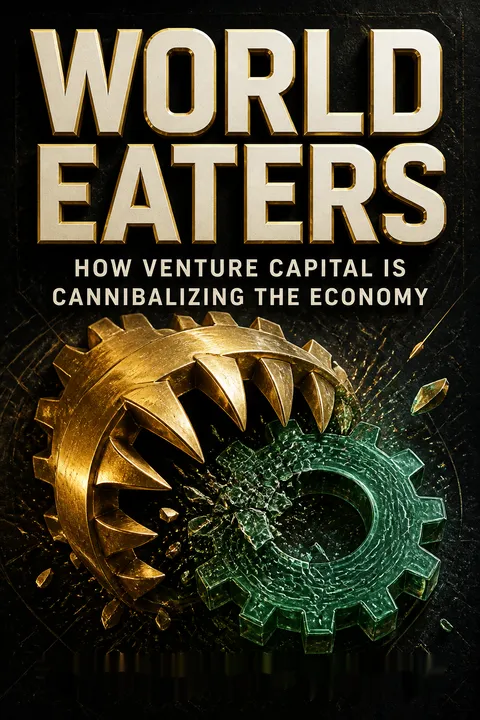

Key Takeaways
1. Venture Capital's "Power Law" Dogma Drives Reckless Growth
For venture capitalists, the job has become not about finding companies that are creating breakthrough innovations that could spur large-scale value creation, but about pursuing power law returns that can make them very rich.
The "Grand Slam" Mentality. Venture capital (VC) operates under a "power law" principle, where a tiny fraction of investments generate the vast majority of returns, akin to the high-risk, high-reward nature of 19th-century whaling ventures. This observation has hardened into a methodology: VCs actively pursue these "grand slam" outcomes, optimizing their portfolios for a few astronomical successes while accepting many failures. This approach prioritizes financial upside above all else, often overlooking the actual value a company creates.
Engineered Risk-Taking. This pursuit of power law returns leads VCs to push all portfolio companies into a "get-big-fast" playbook, even if it means taking on unnecessary risks. The "Blitzscaling" philosophy, popularized by Reid Hoffman, explicitly advocates for prioritizing speed over efficiency and accepting "collateral damage" as a feature, not a bug. This mindset forces companies to make thoughtless and often irresponsible decisions, externalizing costs onto society.
Megafunds Intensify Pressure. The rise of megafunds (over $500 million) further exacerbates this dynamic. To deliver the expected 3-5x returns, these massive funds require multi-billion dollar winners, pushing entrepreneurs to take on even greater risks to achieve larger outcomes. This creates immense pressure on startups to maximize market share and valuation at all costs, with little leeway for ethical considerations or sustainable growth.
2. The VC Monoculture Stifles Authentic Entrepreneurship
Entrepreneurs conflated fundraising with success and scale with impact.
The Venture Capital Treadmill. Many founders, especially "Conflicted Altruists" driven by a desire to solve real problems, are drawn into the VC ecosystem believing it's the only path to scale. Startup accelerators like Y Combinator reinforce a "unicorn" mindset, where anything less than billion-dollar valuation is deemed a "lifestyle business" and a failure. This creates an inescapable cycle where companies must continuously raise more capital to demonstrate value to future investors, rather than focusing on building a solid, sustainable business.
Distorted Business Models. The pressure to fit the VC mold often forces mission-driven companies to pivot away from their core purpose or target markets. For instance:
- LocalData, a profitable civic tech startup, was pushed by VCs to target the larger real estate market, leading to its demise.
- Good Eggs, a sustainable food delivery service, struggled when its software-scaling approach clashed with the high variable costs of a physical logistics business, leading to investor-driven retrenchment and the founder's departure.
This distortion leads to missed opportunities to address real problems and leaves disillusioned entrepreneurs in its wake.
VC Picks Winners, Not Solutions. By pumping enormous amounts of money into companies that promise rapid market capture, VCs effectively choose which business models succeed, often at the expense of more sustainable or socially beneficial alternatives. This dynamic is evident in the home cooking industry:
- Josephine failed trying to legalize home cooking first.
- Foodnome prioritized cook support and legal operation, but struggled to raise capital due to slower growth.
- Shef, in contrast, adopted an "Uber-like" expansion, operating in legal gray areas and prioritizing scale, quickly attracting over $100 million in VC funding.
This monoculture crowds out promising ideas that don't fit the hyperscale narrative, sacrificing genuine innovation for investor returns.
3. VC-Backed Gig Economy Models Exploit Labor and Erode Protections
The product they’ve built, fundamentally, is not new. Drivers and couriers are not new jobs. What’s new is the business model.
Undermining Labor Bargains. Venture-backed gig economy companies have systematically eroded decades of New Deal labor protections by misclassifying workers as independent contractors rather than employees. This shifts the costs of doing business—like insurance, benefits, and vehicle expenses—onto the workers. The California Supreme Court's "ABC test" (requiring workers to be in full control, perform work outside the core business, and be established business entities) directly challenged this model.
Prop 22: A Blueprint for Exploitation. In response to California's AB5 law codifying the ABC test, gig companies like Uber and Lyft spent over $200 million to pass Proposition 22. This ballot initiative created a third classification status for gig workers, absolving companies of legal responsibility while offering minimal benefits. This victory set a dangerous precedent, becoming a blueprint for other industries (e.g., grocery, healthcare) to adopt similar exploitative labor models, further eroding worker protections nationwide.
The "Shadow Workforce" of Tech. Beyond gig platforms, VC's imperative for lean workforces has supercharged the practice of "contracting out" within tech companies. Thousands of "temps, vendors, and contractors" (TVCs) perform core functions (e.g., software engineering, content moderation) but receive significantly lower pay, fewer benefits, and no job security compared to full-time employees. This creates a dual-track workforce, disproportionately affecting women and people of color, who face:
- Precarious, short-term contracts.
- Fragmented management and lack of career advancement.
- Limited voice and protection against workplace issues.
This system allows tech companies to scale rapidly while externalizing labor costs and avoiding accountability for workplace inequities.
4. Venture Capital Exacerbates Housing Inequality and Predatory Practices
The returns that venture capital expects make the sheer size of the housing market an irresistible opportunity for investors, but their commitment to seek power law returns means the solutions they can fund are set up to exacerbate disparities in housing rather than reduce them.
Wall Street's Housing Grab. The 2008 financial crisis, which disproportionately devastated Black and Hispanic homeowners, created a lucrative opportunity for Wall Street. HUD's REO-to-Rental program subsidized firms to buy foreclosed single-family homes in bulk and convert them into rentals. This laid the groundwork for the Single-Family Rental (SFR) industry, where companies like Waypoint (and later Invitation Homes) used technology to manage vast portfolios, often exploiting tenants with hidden fees, poor maintenance, and aggressive eviction tactics.
Proptech's Role in Financialization. Venture capital has fueled this trend, with "Proptech" (property technology) firms emerging to provide the tools for large-scale SFR ownership. Companies like Mynd, co-founded by SFR pioneers, position themselves as platforms to "extract optimal value from assets owned by other people," further integrating Wall Street and Silicon Valley interests. This symbiotic relationship allows institutional investors to scale their holdings, driving up property values in communities of color and exacerbating the racial wealth gap.
"Predatory Inclusion" in Homeownership. VC-backed fractional ownership and rent-to-own (RTO) companies market themselves as democratizing access to real estate investing and homeownership for those priced out of traditional markets. However, these models often resemble "predatory inclusion," offering access on exploitative terms:
- Fractional ownership (e.g., Lofty AI) uses blockchain to sell "slices" of properties, exposing unsophisticated retail investors to significant risk and creating murky legal liabilities.
- RTO companies (e.g., Divvy Homes) lock prospective buyers into high "strike prices" that appreciate regardless of market conditions, often leading to lost equity and evictions.
These models prioritize company profits over genuine homeownership, leveraging desperation to juice returns while crowding out more sustainable, mission-aligned alternatives like Trio Residential.
5. Short-Term VC Incentives Create Systemic Economic and Societal Risks
Others—public market investors but also the general public—are left to deal with the fallout when the decisions that benefited early investors turn out to have negative consequences further down the road.
The Moral Hazard of Short Horizons. Venture capital funds typically have a lifespan of 5-10 years, but VCs often raise new funds every 2-3 years, creating immense pressure for quick "liquidity events" (acquisitions or IPOs). This short-term mindset incentivizes early investors to prioritize maximizing valuation at a specific point in time, rather than fostering sustainable, long-term value. This creates a moral hazard where VCs can cash out before the true, often negative, societal consequences of their portfolio companies' actions become apparent.
Stifling Long-Term Innovation. This short-termism also limits VC investment in critical sectors that require longer development timelines, such as clean energy and infrastructure. John Doerr's failed clean tech investments, for example, demonstrated how impatience for quick returns can derail promising solutions to global challenges. The venture model, designed for rapid software scaling, is ill-suited for capital-intensive, deep science areas, leading to missed opportunities for impactful innovation.
Fueling Predatory Pricing and Monopolies. The VC approach of subsidizing product costs to rapidly gain market share and eliminate competition, as seen with Uber, can be a form of predatory pricing. While difficult to prosecute under current antitrust laws, VCs effectively "recoup" their losses by selling shares at inflated valuations to later-stage investors, who believe the market dominance will eventually translate to profits. This strategy allows VCs to profit from anti-competitive behavior without bearing the long-term costs, contributing to monopolies and stifling a vibrant, competitive marketplace.
6. Alternative Funding Models Prove Sustainable Growth Without VC Hyperscale
We believe that we have a bigger mission than just driving as much profit as possible to our shareholders.
Beyond the Unicorn Myth. The prevailing VC dogma that only "unicorn" (billion-dollar) outcomes signify success is flawed; most VC funds don't outperform the stock market. A "Moneyball" approach, focusing on "singles, doubles, and triples," can yield consistent returns without the need for hyperscale. This strategy targets the 99.5% of startups that don't fit the traditional VC mold, recognizing that a diverse portfolio of moderately successful companies can be just as lucrative.
Indie.vc: A Blueprint for Optionality. Bryce Roberts's Indie.vc exemplifies this alternative. His innovative term sheet offers founders a choice:
- Convert to traditional equity if they pursue venture-scale growth.
- Pay back Roberts a 3-5x multiple from revenue share within 18-24 months if they prioritize sustainability.
This model gives founders the freedom to build businesses aligned with their mission, as seen with Nice Healthcare, which thrived and eventually raised traditional VC while retaining control. Indie.vc demonstrates that healthy returns are possible without forcing companies into a growth-at-all-costs mentality.
Bootstrapping and Mission-Driven Governance. Many entrepreneurs are successfully building significant businesses by rejecting traditional VC:
- ButcherBox's founder, Mike Salguero, bootstrapped the company after a negative VC experience, growing it to over $600 million by prioritizing mission, worker welfare, and long-term sustainability.
- Kickstarter, founded by creatives, became a Public Benefit Corporation (PBC) to legally enshrine its mission over pure profit, demonstrating that strong financial performance can coexist with social purpose.
- OpenAI and Anthropic AI have adopted bespoke governance models (nonprofit control, capped returns, Long-Term Benefit Trusts) to protect their missions from investor demands, highlighting the need for structures that align incentives with societal benefit.
7. Limited Partners Possess the Power to Reshape Venture Capital's Future
Reform to the system will only come from LPs.
The Linchpin of the System. Limited Partners (LPs)—wealthy individuals, university endowments, pension funds, and private foundations—are the ultimate arbiters of venture capital. They decide where billions flow, yet often remain passive, allowing fund managers to prioritize profit maximization regardless of societal impact. This inertia stems from:
- Fiduciary duty to grow endowments.
- Distance from investment decisions.
- Fear of exclusion from top-performing funds.
- Adherence to Modern Portfolio Theory, which treats VC as a small, high-risk component.
Overcoming these barriers is crucial for systemic change.
Mission-Aligned LPs' Hypocrisy. Many private foundations, like Ford and MacArthur, spend millions on grants to address tech's negative impacts while simultaneously investing heavily in the very VC funds that fuel these problems. This "chasm" between their grantmaking and investment strategies undermines their own missions. However, some, like the Wallace Global Fund, have demonstrated that 100% mission-aligned investing can yield competitive returns, proving that purpose and profit are not mutually exclusive.
A Call to Action for LPs. These mission-driven LPs have a unique opportunity to catalyze change. By shifting even a small portion of their capital from underperforming power-law funds to "Indie-style" investors, they could:
- Seed a new asset class of innovative, high-growth startups with sustainable business models.
- Gain first-mover advantage in a potentially lucrative, less volatile market.
- Align their investments with their stated missions, fostering positive environmental, social, and governance (ESG) outcomes.
This strategic reallocation, though challenging due to institutional inertia, is a powerful lever for systemic reform in the venture ecosystem.
8. Government Intervention Can Foster Responsible Innovation and Accountability
For capitalism to work, the people who are pushing the riskiest activities need to bear the brunt of the cost when it goes wrong, and it is government’s role to ensure that accountability exists.
Incentivizing "Moneyball" Investing. Government intervention can play a crucial role in fostering a more diverse and responsible risk capital ecosystem. The Small Business Administration (SBA) historically spurred VC growth through its SBIC program. Recent reforms, like the "accrual debenture" rule, aim to make SBIC capital more attractive to early-stage investors who fund "doubles and triples," providing a vital alternative to traditional VC for companies that don't fit the hyperscale mold.
Tax Code Tweaks for Systemic Change. The tax code can be leveraged to address the core drivers of VC's negative externalities:
- Limit Fund Sizes: Eliminate the "carried interest loophole" (which taxes fund managers' performance bonuses at lower capital gains rates) for funds above a certain threshold. This would reduce the incentive for VCs to raise ever-larger funds, which inherently demand reckless growth.
- Address Short-Termism: Mandate longer post-IPO lockup periods for early-stage investors. This would force VCs to consider a company's long-term value and sustainability, rather than just its inflated valuation at a quick exit, thereby mitigating predatory pricing strategies.
Shining a Light on Private Markets. The venture capital industry operates with minimal regulation, allowing for opacity and enabling fraud, as seen with the FTX collapse. Increased transparency and accountability are essential:
- Enhanced Reporting: Require larger private funds and companies (e.g., unicorns) to adhere to public company-like reporting standards, including quarterly activity reports and annual audits.
- Accountability for Harms: Hold VCs accountable for the negative externalities their portfolio companies create, especially when they enable predatory practices or anti-competitive behavior.
Given VC's outsized influence on the economy and its potential to destabilize broader markets (e.g., Silicon Valley Bank collapse), robust oversight is no longer optional but a systemic necessity.
People Also Read









Download PDF
Download EPUB
.epub digital book format is ideal for reading ebooks on phones, tablets, and e-readers.








































