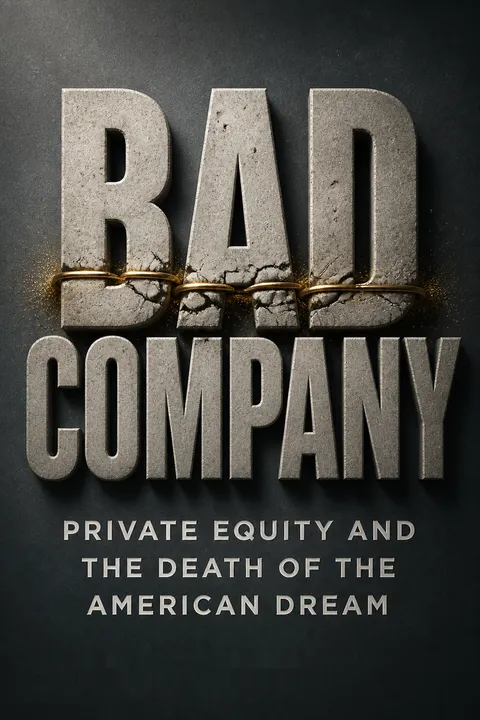

Key Takeaways
1. Private Equity Exists Solely to Maximize Shareholder Value, Regardless of Company Health.
Great Hill Partners, and private equity at large, exists solely to make money for shareholders, no matter what that means for the companies it owns.
Profit-driven mandate. Private equity firms bundle money from outside investors to buy and operate companies, with the primary goal of generating returns for these shareholders. The success of the acquired company is often incidental, a mere side effect of increasing profits for the firm and its investors. This singular focus on shareholder value, popularized by Milton Friedman, dictates that a company's social responsibilities are secondary to its financial performance.
Fees over performance. Private equity firms benefit from a complex fee structure, including management, transaction, and monitoring fees, which are often independent of the portfolio company's actual profitability. They also leverage tax breaks and can sell off company assets, pocketing the proceeds rather than reinvesting. This means a firm can profit even if the acquired company struggles or goes out of business, as demonstrated by Great Hill Partners' success despite Deadspin's collapse.
Incidental benefits. While private equity executives often claim to "improve" companies, any strengthening of the business is typically a means to a financial end, not an end in itself. The firm's goal is a profitable "exit" – selling the company or taking it public – within an average of seven years, a timeframe too short for genuine long-term growth strategies like R&D or product improvement. Instead, quick cost-cutting measures, like layoffs, become the preferred path to immediate returns.
2. Leveraged Buyouts Burden Acquired Companies with Crushing Debt, Shielding Private Equity Firms from Risk.
When a firm acquires a new company, it borrows money in the company’s name, not its own.
Debt-fueled acquisitions. The engine of the private equity machine is the "leveraged buyout" (LBO), where the vast majority of a company's purchase price (often 70-89%) is funded by bank loans. Crucially, these loans are taken out in the acquired company's name, not the private equity firm's. This means the target company, not its new owners, is legally responsible for repaying billions in debt.
Risk transfer. This structure insulates private equity firms from catastrophic failure. If the acquired company runs into financial trouble, the private equity owner is not obligated to bail it out. Even in bankruptcy, the firm, often worth orders of magnitude more than the portfolio company, won't cover the costs. The company and its employees shoulder the financial risk, while the private equity firm's exposure is minimal, often just 1-10% of the deal's value.
Crippling interest payments. The massive debt load from LBOs often means that a significant portion, sometimes over 100%, of the acquired company's annual earnings goes directly to interest payments. This leaves little to no money for operational improvements, innovation, or even paying down the principal. This financial burden makes long-term survival incredibly difficult, increasing the likelihood of bankruptcy and liquidation for the portfolio company.
3. Asset Stripping and Relentless Cost-Cutting Are Core Private Equity Strategies.
Cutting costs, on the other hand, pays off almost instantly.
Immediate profit drivers. Private equity firms prioritize strategies that yield quick returns, and cost-cutting is the most effective. This often involves shedding jobs, with studies showing employment shrinking by an average of 4.4% in the two years post-buyout, and over 25% in five years for publicly traded companies. These cuts are justified as "efficiencies" but often lead to reduced quality of goods or services.
Sale-leaseback agreements. A common tactic is to divide a portfolio company into its core business and its real estate holdings. The firm then sells the real estate to a third party (often another entity controlled by the PE firm or a partner) and forces the acquired company to lease back its own properties. This generates immediate cash for the PE firm but saddles the company with new, costly rent payments, further draining resources from operations.
Neglecting long-term investment. Instead of investing in research and development, product improvement, or sales strategies—which are years-long processes—private equity focuses on short-term financial engineering. This can include optimizing supply chains to reduce operating costs, but rarely involves enhancing the customer experience or modernizing infrastructure. The result is often a decline in the company's ability to compete and innovate, making its eventual failure more likely.
4. Private Equity Thrives on Opacity and Political Influence, Resisting Regulation.
Yet despite all that power and influence, private equity’s workings remain opaque to most people. That’s by design.
Designed for secrecy. The "private" in private equity signifies a deliberate lack of transparency. Unlike publicly traded companies, private equity firms report far less about their structure, operations, and portfolio company performance. This opacity makes it nearly impossible for workers, customers, or communities to understand the true financial health or strategic intentions of their employers or service providers.
Lobbying and political donations. Hundreds of millions of dollars are spent annually on lobbying and political donations, distributed roughly equally between Republicans and Democrats. This bipartisan influence ensures that neither party demonstrates significant interest in further regulating the industry. This political shield allows private equity to maintain its advantageous tax breaks and operate with minimal scrutiny, even when its practices lead to widespread job losses or community harm.
Resisting reform. Efforts to introduce legislation, such as Senator Elizabeth Warren's Stop Wall Street Looting Act, which aimed to tax monitoring fees, ban early dividends, prioritize severance in bankruptcy, and hold firms responsible for debt, have consistently failed. Even less radical proposals, like closing the "carried interest" loophole (which taxes PE profits at a lower capital gains rate), have been blocked by influential politicians like Kyrsten Sinema, who received substantial industry contributions.
5. The Retail Industry's Demise Was Accelerated by Private Equity's Debt-Driven Model.
Amazon didn’t kill Toys R Us. Here’s what did.
A cautionary tale. Toys R Us, once a retail titan, became a poster child for private equity's destructive impact. Acquired in a $6.6 billion leveraged buyout by KKR, Bain Capital, and Vornado, the company was immediately saddled with over $5 billion in debt. This debt, taken out in Toys R Us's name, meant annual interest payments of over $400 million, consuming 80-120% of its earnings.
Missed opportunities. Drowning in debt, Toys R Us couldn't afford to adapt to the changing retail landscape. It failed to:
- Develop a robust e-commerce presence (after outsourcing to Amazon, then starting from scratch).
- Modernize its stores or enhance the in-store customer experience.
- Invest in proper employee training or adequate staffing.
Instead, the focus was on "lean operations" and cost-cutting, further eroding its competitive edge against rivals like Amazon and Walmart.
Profits from liquidation. Despite Toys R Us's eventual liquidation, which resulted in 33,000 layoffs and no severance for employees, the private equity firms involved still profited. KKR and Bain Capital, through management fees, consulting fees, and refinancing gains, made more than their initial investments. The real estate partner, Vornado, also profited from sale-leaseback agreements. The Toys R Us saga starkly illustrates how private equity can profit from a company's failure, with workers bearing the brunt of the consequences.
6. Healthcare Becomes a Profit Engine for Private Equity, Often at the Expense of Patient Care.
These are people for whom health care is just one aspect of what they’re engaged in, and what they’re engaged in is to make money as fast as they can.
Financialization of care. Private equity's interest in healthcare surged in the 2010s, viewing it as a stable, recession-proof industry with an aging population and rising spending. Firms like Apollo Global Management acquired hospital chains like LifePoint Health, often through massive leveraged buyouts that burdened the hospitals with billions in debt. This shifted the focus from patient care to maximizing shareholder value.
Service cuts and price hikes. To generate profits, private equity-owned hospitals often resort to:
- Eliminating unprofitable services: Riverton Memorial Hospital, under LifePoint/Apollo, permanently closed its obstetrics and inpatient mental health units, forcing residents to travel long distances for basic care.
- Increasing prices: Studies show private equity-owned hospitals charge significantly more than Medicare rates, with SageWest (Riverton/Lander) having the highest price disparity in Wyoming.
- Staff reductions: SageWest's workforce shrunk by nearly 40% after its merger and private equity acquisition, leading to overworked staff and potential safety concerns.
Dangerous consequences. Research indicates that private equity acquisition can lead to a significant increase in serious preventable medical complications, such as patient falls, bedsores, and infections. The tragic death of a psychiatric patient at SageWest Lander, due to inadequate staffing and supervision, highlights the direct human cost of prioritizing profits over patient safety. For private equity, healthcare is just another widget to make money, with little regard for the well-being of communities.
7. Local Journalism Is Systematically Dismantled by Private Equity's Obsession with Profits.
The highest levels of world finance have become intertwined with the highest levels of mass media ownership, with the result of tighter control over the systems on which most of the public depends for its news and information.
From public good to profit center. Journalism, traditionally considered a public good, has become a target for private equity firms like Alden Global Capital and Fortress Investment Group (owner of GateHouse/Gannett). These firms view newspapers not as essential community institutions but as "declining assets" from which to extract maximum cash flow. This financialization has led to a systematic dismantling of local news.
Aggressive cost-cutting. Private equity owners implement ruthless cost-cutting measures, including:
- Massive layoffs: Newsrooms are gutted, with some losing over 70% of their staff, leading to "ghost newspapers" with little to no local reporting.
- Asset sales: Historic newsroom buildings and printing plants are sold off, often to other PE-controlled entities, and then leased back at a cost to the newspaper.
- Consolidation: Multiple local papers are merged, eliminating "redundancies" like dedicated reporters for local teams, further reducing unique local coverage.
Erosion of democracy. The decline of local journalism under private equity has profound societal consequences:
- Fewer candidates run for office.
- Political polarization increases.
- Private companies violate more laws, and government corruption rises.
- Towns without local news pay more to borrow money, leading to higher taxes.
Despite these impacts, private equity firms like Gannett and Alden prioritize continuous dividend payments and management fees over investing in the quality or sustainability of their news products.
8. Affordable Housing Is Exploited by Private Equity Landlords, Displacing Vulnerable Residents.
The economic crash in the fall of 2008—prompted in part by 10 million foreclosures against homeowners who’d been awarded much larger loans than they could afford to pay back—upended America’s housing landscape.
Post-recession opportunity. The 2008 financial crisis created a perfect storm for private equity in residential real estate: plummeting home prices and fewer people able to buy. Firms like CIM Group and Pretium Partners began acquiring thousands of individual homes and large apartment complexes, seeing an opportunity for guaranteed returns as real estate values appreciate.
Aggressive profit extraction. Private equity landlords maximize profits through:
- Rent hikes: Despite promises of modest increases, residents often face annual jumps of 9% or more, pricing out low- and middle-income tenants.
- Neglected maintenance: Essential repairs are delayed or ignored, leading to issues like mold, leaks, pests, and broken utilities, while cosmetic upgrades are prioritized.
- Eviction threats: Firms initiate numerous eviction proceedings, even during public health emergencies, to pressure tenants into paying or vacating, often using misleading notices.
- New fees: Tenants are hit with increased charges for utilities, parking, and even temporary relocations, regardless of actual usage or the cause of the displacement.
Government-backed exploitation. Fannie Mae and Freddie Mac, government-sponsored enterprises meant to make housing affordable, provide low-interest loans that heavily finance private equity's acquisitions. While these agencies have affordable housing goals, they lack strong enforcement mechanisms for rent control or maintenance standards, effectively subsidizing firms that displace vulnerable residents. This makes private equity a major player in every segment of the rental housing economy, from apartments to mobile home parks.
9. The "Free Market" Narrative Masks Private Equity's Exploitative Practices and Unequal Power.
In Friedman’s free enterprise system, bosses and workers each have power over one another, each fully in control of their own destinies.
A flawed premise. Milton Friedman's "shareholder theory" posits that a free market ensures mutual benefit and prevents exploitation, as all parties voluntarily participate with equal power and information. However, the rise of private equity has fundamentally destroyed this precondition. Workers often lack basic information about their employers' true ownership, financial health, or strategic intentions, making genuine "voluntary cooperation" impossible.
Information asymmetry. Private equity's deliberate opacity creates a massive power imbalance. Firms hoard critical financial knowledge, disguising their tactics through complex corporate structures and legal loopholes. This means workers are often blindsided by layoffs, service cuts, or bankruptcies, unable to anticipate or influence decisions that directly impact their livelihoods and communities.
Zero-sum game. The industry's claim that it helps pensioners by generating high returns often masks a zero-sum reality: profits for retired teachers and firefighters are frequently generated by cutting wages, eliminating benefits, or laying off working-class employees in other sectors. This "capitalism's washing machine" effect benefits private equity executives most, who reap the lion's share of profits while putting in minimal personal investment and bearing little risk.
10. Grassroots Activism and Alternative Models Offer Hope for Resistance Against Private Equity.
Never doubt that a small group of thoughtful, committed citizens can change the world. Indeed, it is the only thing that ever has.
Collective action works. Despite the immense power of private equity, individuals and communities are fighting back. The Toys R Us workers, organized by Rise Up Retail, successfully pressured KKR and Bain Capital to establish a $20 million hardship fund for laid-off employees by appealing to pension fund boards. This demonstrated that even powerful firms are sensitive to public pressure and the concerns of their limited partners.
Building new institutions. When existing institutions fail under private equity, communities are creating alternatives. In Riverton, Wyoming, residents formed the Riverton Medical District to build a new, locally-owned nonprofit hospital after SageWest (LifePoint/Apollo) cut essential services. Through persistent fundraising and leveraging government loans, they secured $54 million, proving that community-driven solutions are viable even in underserved areas.
Nonprofit and tenant-led models. In journalism, nonprofit newsrooms like Votebeat and Chalkbeat are filling the void left by private equity-gutted newspapers, prioritizing community benefit over commercial gain. In housing, tenant unions are winning victories against corporate landlords, securing protections against evictions and rent hikes, and even inspiring firms like Pretium Partners to sell homes to affordable-housing organizations. These efforts, often focused at local and state levels, show that change is possible when people organize.
11. Private Equity's Reach Extends to Every Aspect of Life, Making It Everyone's Problem.
If it doesn’t play a role in your life yet, just wait. Private equity is everybody’s problem now.
Ubiquitous influence. Private equity's rapid expansion means its influence is deeply ingrained in daily life, often invisibly. It controls:
- 8% of private hospitals and 4 of the 5 largest for-profit daycare chains.
- A growing swath of commercial and residential real estate, including millions of homes.
- America's oil, gas, and coal production, supermarket chains, pet stores, and public utilities.
- Even cultural assets like Cirque du Soleil and Taylor Swift's early albums.
This pervasive control means that even if private equity doesn't own your employer or home, it likely impacts your healthcare, children's education, or local services.
The Steward Health Care scandal. The 2024 bankruptcy of Steward Health Care, a chain of 33 hospitals acquired by Cerberus Capital Management, exposed the extreme consequences of private equity's practices. Despite Cerberus making $800 million, Steward faced $9 billion in debt, unpaid rent, and allegations of patient deaths due to equipment and staffing issues. The company's elaborate "Project Easter" scheme to disguise its financial ruin highlights the industry's deliberate lack of transparency.
A call to action. The growing anger about wealth inequality and the disproportionate power of the ultrarich, shared across political divides, indicates a new readiness among Americans to confront private equity. While regulating such a powerful industry requires immense willpower, the increasing number of people directly affected by its practices—like Liz, Roger, Natalia, and Loren—are starting legal battles, organizing grassroots campaigns, and pushing for new legislation. The fight against private equity is no longer a niche concern but a widespread movement for economic justice.
People Also Read








Download PDF
Download EPUB
.epub digital book format is ideal for reading ebooks on phones, tablets, and e-readers.








































