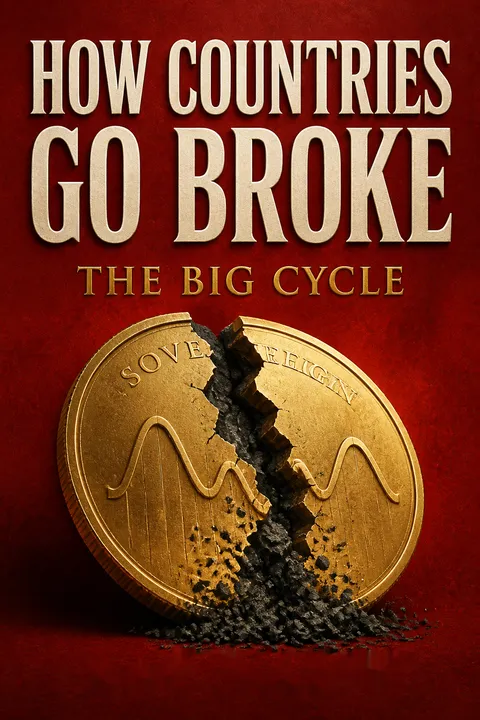

Key Takeaways
1. The Big Debt Cycle is a Timeless, Universal Economic Engine
Throughout the millennia and across countries, what has driven the Big Debt Cycle and has created the big market and economic problems that go along with it is the creation of unsustainably large amounts of debt assets and debt liabilities relative to the amounts of money, goods, services, and investment assets in existence.
Cyclical nature. The economy operates as a perpetual motion machine driven by debt cycles, both short-term (averaging 6 years) and long-term (averaging 80 years). These cycles are fundamental to how money, credit, and economic activity interact with human nature, leading to inevitable booms and busts. Credit, easily created, fuels spending and asset prices, but also creates debt that must eventually be repaid, leading to an inherent cyclicality.
Debt accumulation. Over time, a bias towards creating more credit leads to debt rising, with each short-term cycle typically ending with higher debt levels than the last. This accumulation eventually makes debt burdens unsustainable, culminating in a "Big Debt Cycle" that ends in a crisis. This pattern has been observed across thousands of years and diverse civilizations, from ancient Chinese dynasties to modern empires.
Ponzi scheme analogy. The Big Debt Cycle functions like a Ponzi scheme or musical chairs, where investors hold increasing amounts of debt assets, believing they can convert them into money with buying power. However, as debt assets grow relative to real things, this conversion becomes impossible, leading to a realization and a rush to sell, triggering a crisis.
2. Debt Crises Progress Through Predictable Stages, Culminating in Devaluation
Described most simply, the Big Debt Cycle moves from sound/hard money and credit to increasingly loose money and credit to a debt bust that leads to a return to sound/hard money and credit brought about by necessity.
Archetypical progression. Big Debt Cycles typically unfold through five stages:
- Sound Money Stage: Low debt, sound money, competitive country, debt fuels productive growth.
- Debt Bubble Stage: Cheap, readily available money, debt-financed economic boom, speculative investments, unsustainable debt growth.
- Top Stage: The bubble pops due to tightening money and unsustainable debt growth, leading to a self-reinforcing contraction.
- Deleveraging Stage: Painful reduction of debt to sustainable levels through defaults, restructurings, and/or devaluations.
- Big Debt Crisis Recedes: A new equilibrium is reached, and a new cycle begins, often with a return to sounder money principles.
Symptoms as signals. Each stage exhibits distinct symptoms, allowing observers to identify the cycle's progression and anticipate likely future events. For instance, a surge in debt service relative to income or net selling of government debt are major red flags indicating a move towards crisis.
Central bank's choice. During the deleveraging stage, central banks face a critical choice: maintain "hard" money, leading to defaults and deflationary depressions, or make money "soft" by printing it, leading to devaluation. Historically, they almost always choose to print and devalue to avoid the more severe consequences of widespread defaults.
3. Central Banks Inevitably Print Money, Devaluing Currency to Resolve Debt
When that happens, the central bank is forced to choose between a) printing a lot of money, which devalues it, and b) not printing a lot of money and having a big debt default crisis. In the end, the central bank always prints and devalues.
The ultimate lever. When debt burdens become too great, and free-market demand for debt falls short, central banks, if the debt is denominated in their own currency, inevitably resort to "printing money" (creating new reserves) to buy government debt. This process, known as debt monetization or quantitative easing, alleviates the immediate debt problem by providing liquidity.
Consequences of monetization. While preventing outright default, extensive money printing has predictable consequences:
- Devaluation: Reduces the buying power of money and debt assets.
- Inflation: Increases the prices of goods, services, and most financial assets.
- Negative Real Returns: Bondholders suffer losses in real terms as inflation outpaces nominal interest rates.
This mechanism effectively transfers the balance sheet hit from the government to the central bank and the holders of the currency.
Central bank "going broke." A central bank "goes broke" when the interest it pays on its liabilities (reserves) exceeds the interest it earns on the debt it holds, leading to negative cash flow and net worth. While it doesn't default (it can print money), this signals a "death spiral" where more printing is needed to cover losses, further devaluing the currency and accelerating selling.
4. Five Interconnected Forces Drive the Overall Big Cycle of World Orders
Together, these forces make up the Overall Big Cycle of peace and prosperity and conflict and depression as things progress from one “order” to the next.
Intertwined dynamics. Beyond the debt/money/economic cycle, four other major forces interact to shape the "Overall Big Cycle" and drive radical changes in monetary, domestic political, and geopolitical orders:
- Internal Order/Disorder Cycle: Shifts in political harmony and conflict within countries, often leading to changes in governance.
- External Geopolitical Order/Disorder Cycle: Cycles of peace and war between countries, determining world leadership.
- Acts of Nature: Disruptions like droughts, floods, and pandemics, which can have profound economic and social impacts.
- Human Inventiveness/New Technologies: Advances that boost productivity but can also fuel bubbles or be weaponized.
Reinforcing feedback loops. These five forces are not isolated; they constantly influence and reinforce each other. For example, financial crises can exacerbate internal political conflicts, and geopolitical tensions can disrupt economic stability and supply chains.
Orders break down. Big Cycles end when existing "orders"—monetary systems, political governance, or international relations—break down, usually in a major crisis. These breakdowns are traumatic, occurring roughly once in a lifetime, and lead to the establishment of new orders.
5. History Rhymes: We Are in a Late-Stage Big Cycle of Conflict and Change
By my measures, the current configuration of conditions is most analogous with those that existed in 1905-14 and 1933-38 and many prior times in many countries throughout history, which, as just noted, is what I call Stage 5 of the Big Cycle.
Recognizing patterns. History doesn't repeat exactly, but it "rhymes." By studying past Big Cycles, particularly their late stages (Stage 5), we can identify analogous conditions and anticipate likely future developments. These periods are characterized by:
- Overindebtedness
- Inefficient governance
- Deep internal divisions
- Threats from rival countries
Emergence of strong leaders. During Stage 5, there's a strong tendency for populist, nationalistic, protectionist, militaristic, and autocratic leaders to emerge. These leaders often promise to restore national strength and are more willing to engage in conflict, both internally and externally, leading to significant shifts in global dynamics.
Unimaginable actions. Past late-stage cycles saw leaders take "unimaginable" actions to address debt and power struggles, such as:
- Freezing/seizing assets of adversary nations
- Imposing confiscatory taxes and capital controls
- Defaulting on/restructuring debts
- Changing the monetary system (e.g., de-linking from gold)
While not certain, these possibilities should be considered given current global conditions.
6. Unsustainable Imbalances Create Both Great Risks and Investment Opportunities
Debt crises provide great risks and opportunities that have been shown to both destroy empires and provide great investment opportunities for investors if they understand how they work and have good principles for navigating them well.
Identifying unsustainable trends. Successful investing hinges on identifying big, unsustainable conditions that are unlikely to persist. The most critical imbalance today is the rate of borrowing and debt accumulation outpacing income growth. This creates inherent instability and predictable future adjustments.
Betting against the crowd. Popular market memes, often based on extrapolating recent trends and emotional considerations, tend to be wrong at critical junctures. Investors who understand the underlying mechanics of the Big Cycle can position themselves to profit from the inevitable reversal of these unsustainable trends.
Diversification and risk control. Given the inherent uncertainties and the potential for "one really bad bet" to derail success, extreme risk aversion and robust risk controls are essential. This is achieved not by avoiding risky bets, but by diversifying across 15 or more uncorrelated, well-researched bets.
7. The US Faces a Looming Debt Crisis, Despite Its Reserve Currency Status
In fact, I judge the US government’s debt situation to be nearing the point of no return.
High long-term risk. The US government's debt situation presents a very high long-term risk, with current and projected debt and debt service levels at historical highs. The need for new debt sales and rollovers is immense, creating a precarious supply-and-demand dynamic.
Reserve currency mitigation. The dollar's status as the dominant world reserve currency is a significant risk mitigator, as it ensures high demand for US debt. However, this privilege is being undermined by:
- Irresponsible debt management
- Threats of sanctions (e.g., withholding payments)
- Poor returns from holding US debt
- Potential loss of US economic and geopolitical prominence
Short-term stability, long-term danger. While short-term risks appear low due to moderate inflation, growth, and healthy private sector finances, the underlying government debt problem is "growing like a cancer." A sudden drop in demand for US debt could rapidly escalate short-term risks, forcing the Fed to choose between intolerable interest rate hikes or massive money printing and devaluation.
8. Japan's "Lost Decades" Offer Crucial Lessons in Debt Management
The Japanese government’s handling of its debt problem from 1990 until 2013 exemplified exactly what not to do.
A cautionary tale. Japan's experience after its debt bubble burst in 1989-90 serves as a critical case study in how not to manage a deleveraging. Despite having the capacity for a "beautiful deleveraging" (debt in local currency, domestic debtors/creditors), policymakers made several missteps:
- Delayed Restructuring: Non-performing loans lingered on bank balance sheets for nine years.
- Rigid Policies: Ineffective cost-cutting and adaptation due to rigid employment policies.
- Insufficient Stimulus: Interest rates were not driven sufficiently below nominal growth and inflation for decades.
- Delayed Monetization: Meaningful debt monetization only began in 2013, after prolonged deflation.
Consequences of inaction. This prolonged mismanagement led to nearly two decades of continuous deflation and economic stagnation, creating a lasting psychological overhang. Japanese bondholders suffered significant real losses, and the yen depreciated sharply against other currencies and gold.
Lessons for others. Japan's case highlights the importance of swift, decisive, and balanced action during a debt crisis. The principle is clear: don't own government bonds when there are extreme amounts of debt monetization, and avoid prolonged periods of insufficient debt restructuring and monetary stimulus.
9. China's Rapid Rise Leads to a Classic Great Power Conflict
The most important things to know are that China has had a strengthening over the last 50 years that has been greater in magnitude than any other country’s in history.
Unprecedented rise. China's economic and geopolitical ascent over the last 50 years is unparalleled in human history, transforming it from a poor, isolated communist country to a formidable global power. This rise, fueled by "reform and open door" policies, has led to a classic great power conflict with the United States.
Internal and external pressures. China now faces a complex mix of challenges:
- Debt Crisis: A bursting debt bubble (especially in local government, corporate, and real estate sectors) requiring careful management.
- Internal Control: A shift towards more autocratic, Mao-like communist policies to consolidate power and address internal conflicts.
- Geopolitical Conflict: Intensifying "cold war" with the US, impacting trade, capital flows, and military preparedness.
- Climate Change: Significant environmental impacts requiring adaptation and investment.
- Technology War: A fierce competition with the US in advanced technologies like AI and chips.
Historical perspective. Chinese leaders, deeply aware of their long history and the "Century of Humiliation," view current US actions as attempts to contain China. They expect to eventually unify Taiwan with the mainland, seeing it as an indisputable part of China.
10. A "3% 3-Part Solution" Can Avert a US Government Debt Crisis
To achieve the goal of stabilizing debt relative to income, it would take about an 11% increase in taxes, about a 12% cut in spending, or about a 3% cut in interest rates, all else equal, if just one lever were used alone.
The 3% target. To prevent the US central government from "going broke," the budget deficit needs to be cut to 3% of GDP (from a projected 6%). This would significantly reduce the debt burden over the next 10-20 years, averting a potential "heart attack" for the financial system.
Three levers for adjustment. The 3% deficit reduction can be achieved by a combination of three levers:
- Spending Cuts: Reducing government expenditures.
- Tax Increases: Raising government revenue.
- Interest Rate Cuts: Lowering the cost of government borrowing (most impactful).
A balanced approach, such as a 4% cut in spending, a 4% increase in taxes, and a 1% cut in real interest rates, would spread the adjustment and mitigate negative economic impacts.
Fed's crucial role. The Federal Reserve's interest rate policy is the most powerful lever. A fiscal tightening combined with monetary easing is an optimal strategy: fiscal cuts reduce the deficit, while monetary easing supports economic growth and inflation, making debt burdens more manageable. This coordinated approach would bring private and public sector finances into better balance.
11. Human Nature and Cooperation Remain the Ultimate Determinants of the Future
If people deal with their problems and opportunities together rather than fight each other, they can get the best possible results.
The biggest force. Despite technological advancements, human nature remains largely unchanged, making how people deal with each other the most critical determinant of future outcomes. Cooperation for mutual benefit yields the best results, but extreme factionalism and the desire to "win at all costs" are prevalent.
Current challenges. The world is at a maximum point of uncertainty, with powerful technological advances potentially overshadowed by headwinds from:
- Debt: Unsustainable burdens in major economies.
- Internal Conflict: Deepening political polarization and social divisions.
- External Conflict: Intensifying great power rivalries and geopolitical tensions.
- Climate Change: Increasing frequency and cost of natural disasters.
These negative forces, if unmanaged, can squelch the productivity gains from new technologies, as seen in historical periods like the Industrial Revolutions and the 1920s.
The path forward. The next 5-10 years will bring enormous, transformative changes. The best strategy involves:
- Sound Fundamentals: Countries that educate their people, maintain strong finances, ensure internal order, avoid international wars, and adapt to technology will thrive.
- Cooperation: Leaders working together to manage shared problems (like debt and climate change) will lead to better outcomes than confrontation.
However, the current reality suggests a low probability of such cooperation, as opposing factions are deeply entrenched in conflict.
Review Summary
How Countries Go Broke: The Big Cycle offers insights into debt cycles and economic patterns, drawing on historical data and Dalio's experience. Readers appreciate the accessible format and depth of analysis, though some find it repetitive. The book explores how nations accumulate unsustainable debt and potential consequences, with a focus on the US situation. While praised for its macroeconomic perspective, some critics note a lack of new ideas and oversimplification of complex issues. Overall, it's considered valuable for understanding global financial stability, despite mixed opinions on its delivery and proposed solutions.
People Also Read






FAQ
1. What is How Countries Go Broke: The Big Cycle by Ray Dalio about?
- Comprehensive debt cycle analysis: The book explores the Big Debt Cycle, a recurring long-term pattern where countries accumulate unsustainable debt, leading to economic crises and shifts in monetary and political orders.
- Five major forces: Dalio identifies five interrelated forces—debt, internal conflict, external conflict, acts of nature, and technology—that drive the overall Big Cycle and shape the fate of nations.
- Historical and practical framework: Drawing on 50+ years of investing experience and 35 historical case studies, Dalio provides a template for understanding where countries are in their cycles and what may happen next.
2. Why should I read How Countries Go Broke: The Big Cycle by Ray Dalio?
- Timeless economic principles: Dalio distills universal lessons about debt, monetary policy, and economic cycles that have repeated across centuries and countries.
- Unique expert perspective: The author’s deep historical research and decades of macro investing experience offer a practical, tested framework for anticipating and navigating debt crises.
- Relevance to today’s world: Dalio connects his analysis to current global challenges, such as rising debt, political polarization, and geopolitical tensions, making the book highly relevant for investors, policymakers, and informed citizens.
3. What are the key takeaways from How Countries Go Broke: The Big Cycle by Ray Dalio?
- Debt cycles drive history: Long-term debt cycles are central to understanding economic booms, busts, and the rise and fall of nations.
- Interconnected forces: Economic, political, geopolitical, natural, and technological factors interact to create major shifts in world order.
- Policy responses matter: How governments and central banks manage debt crises—through restructuring, monetization, or coordinated policies—determines the severity and outcome of each cycle.
- Preparation and risk management: Dalio emphasizes the importance of diversification, risk control, and understanding cycles to navigate uncertain times.
4. What is the Big Debt Cycle according to How Countries Go Broke: The Big Cycle by Ray Dalio?
- Definition and duration: The Big Debt Cycle is a long-term process, typically lasting around 80 years, where debt accumulates to unsustainable levels and is eventually deleveraged through crisis and restructuring.
- Cycle stages: It moves from sound money and credit expansion, to debt bubbles and busts, followed by painful deleveraging and a return to monetary stability.
- Impact on nations: The cycle explains how excessive debt leads to economic crises, forcing governments and central banks to choose between default, devaluation, or inflation.
5. How does Ray Dalio explain the difference between short-term and long-term debt cycles in How Countries Go Broke: The Big Cycle?
- Short-term cycles: These last about six years and are managed by central banks adjusting interest rates to control economic activity and inflation, resulting in expansions and recessions.
- Long-term (Big) cycles: Composed of multiple short-term cycles, these build up debt to unsustainable levels, culminating in major crises and systemic changes.
- Limits of policy tools: While short-term cycles can be managed with monetary policy, long-term cycles end when debt burdens overwhelm the system, requiring more drastic solutions.
6. What are the five big forces driving the Overall Big Cycle in How Countries Go Broke: The Big Cycle by Ray Dalio?
- Debt and economic cycles: The accumulation and deleveraging of debt are central to economic booms and busts.
- Internal political order/disorder: Social cohesion or fragmentation influences how countries respond to crises.
- External geopolitical order/disorder: International conflicts and alliances shape global stability and power shifts.
- Acts of nature: Events like pandemics and natural disasters can disrupt economies and accelerate cycles.
- Human inventiveness: Technological advances can drive growth or disruption, influencing the trajectory of cycles.
7. What are the key stages and concepts in Ray Dalio’s Big Debt Cycle framework?
- Debt accumulation and bubbles: The cycle begins with rising debt and asset prices, fueled by optimism and easy credit.
- Crisis and deleveraging: Excessive debt leads to crises, forcing painful adjustments through restructuring or inflation.
- Monetary policy eras: Dalio defines stages like MP1 (interest rate policy), MP2 (quantitative easing), and MP3 (coordinated fiscal and monetary stimulus) as responses to different phases of the cycle.
- Recovery and new order: After deleveraging, economies return to stability, often with new monetary and political arrangements.
8. How does Ray Dalio describe the role of central banks when countries “go broke” in How Countries Go Broke: The Big Cycle?
- Lender of last resort: Central banks print money and buy government debt to prevent defaults and stabilize the financial system during crises.
- Central bank losses: Rising interest rates can cause central banks to incur losses on their bond holdings, potentially leading to a “death spiral” of more money printing and currency devaluation.
- Policy dilemma: Central banks must choose between maintaining hard money (risking defaults and deflation) or softening money (risking inflation and devaluation); historically, they tend to choose the latter.
9. What is a “beautiful deleveraging” in Ray Dalio’s framework from How Countries Go Broke: The Big Cycle?
- Balanced crisis management: A “beautiful deleveraging” combines deflationary debt restructuring with inflationary debt monetization to reduce debt burdens without causing runaway inflation or deep recession.
- Growth exceeds interest: The goal is for nominal economic growth to outpace nominal interest rates, lowering debt-to-income ratios while maintaining positive growth.
- Policy coordination: Success requires effective collaboration between governments and central banks to spread out the pain and restore stability.
10. What are the nine stages of the final debt crisis sequence in How Countries Go Broke: The Big Cycle by Ray Dalio?
- Debt buildup and crisis: Both private and government sectors accumulate excessive debt, leading to private sector crises and falling demand for government debt.
- Central bank intervention: As interest rates hit zero, central banks print money and buy bonds, but rising rates can trigger losses and a “death spiral.”
- Restructuring and recovery: Debt is restructured and devalued, extraordinary policies like capital controls are imposed, and eventually, deleveraging restores a new monetary equilibrium.
11. What lessons does Ray Dalio draw from the US, China, and Japan’s Big Debt Cycles in How Countries Go Broke: The Big Cycle?
- China’s rapid rise and risks: China’s ascent from poverty to power involved massive debt-fueled growth, but now faces a late-cycle debt bubble and tightening political control.
- Japan’s stagnation: Japan delayed necessary restructuring and monetary easing, resulting in decades of stagnation and deflation—a cautionary tale for other nations.
- Currency control matters: Both countries’ debts are mostly in local currency, giving them more control over deleveraging, but policy choices are crucial for successful outcomes.
12. What is Ray Dalio’s “3% 3-part solution” for US debt stabilization in How Countries Go Broke: The Big Cycle?
- Deficit reduction target: Dalio recommends reducing the US budget deficit to 3% of GDP to stabilize government debt relative to income.
- Three levers: The solution involves a mix of spending cuts (~4%), tax increases (~4%), and interest rate reductions (~1%) to balance fiscal tightening with monetary easing.
- Bipartisan and counter-cyclical: Dalio emphasizes the need for bipartisan agreement and acting when economic conditions are favorable, with a fallback plan if consensus cannot be reached.
Download PDF
Download EPUB
.epub digital book format is ideal for reading ebooks on phones, tablets, and e-readers.








































