

Key Takeaways
Your body tells the truth your words are trained to hide
Two brains, one honest. Navarro argues that humans run on a triune brain, but two parts matter for reading people. The neocortex is the thinking, speaking brain, and it lies easily because it can plan and deceive. The limbic system is the emotional survival brain, and it reacts instantly and involuntarily, so it leaks genuine feeling through the body. Navarro calls it the honest brain.
A killer caught by eyelids. In one case, an FBI agent listed possible murder weapons to a calm suspect. When the actual weapon, an ice pick (a detail withheld from the public), was named, the man's eyelids clamped shut and stayed down. That single involuntary leak flipped him from minor witness to prime suspect. He confessed. Roughly 60 to 65 percent of communication is nonverbal.
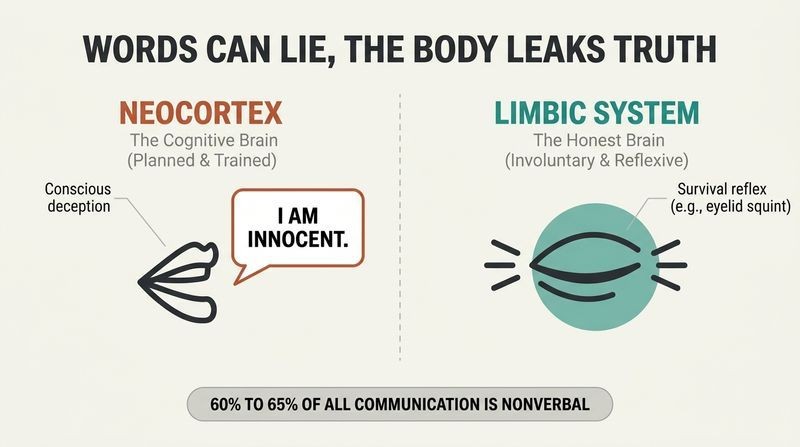
The premise echoes Paul Ekman's decades of facial coding and Antonio Damasio's neuroscience, which shows emotion precedes conscious reasoning. What's compelling is the reframe of the limbic system as a leak rather than a language. A caution worth naming: the triune brain model, coined by Paul MacLean in the 1950s, is now considered an oversimplification by many neuroscientists, since brain regions overlap in function far more than a three-layer cake implies. The practical wisdom survives the outdated anatomy, though. Involuntary reactions do carry information that rehearsed speech scrubs away, which is why interrogators, poker players, and clinicians all learn to watch the body, not just hear the story.
When threatened we freeze first, flee second, and fight last
The phrase is backwards. Popular culture says fight-or-flight, but Navarro insists the real sequence is freeze, flight, fight. Movement attracts predators, so the oldest response is to go still. Only if freezing fails do we distance ourselves, and only when cornered do we fight.
Freezing shows up everywhere. Survivors of the Columbine and Virginia Tech shootings played dead just feet from gunmen and lived. When Navarro's family heard an unexpected late-night doorbell, every hand in the room froze mid-motion, adults and children alike, before anyone knew it was only his sister. In modern life freezing looks subtle: held breath, shallow breathing, feet locked around chair legs, or the shoplifter hunching to shrink. Flight becomes leaning away or angling feet toward exits. Fight becomes verbal aggression, lawsuits, or invading personal space.
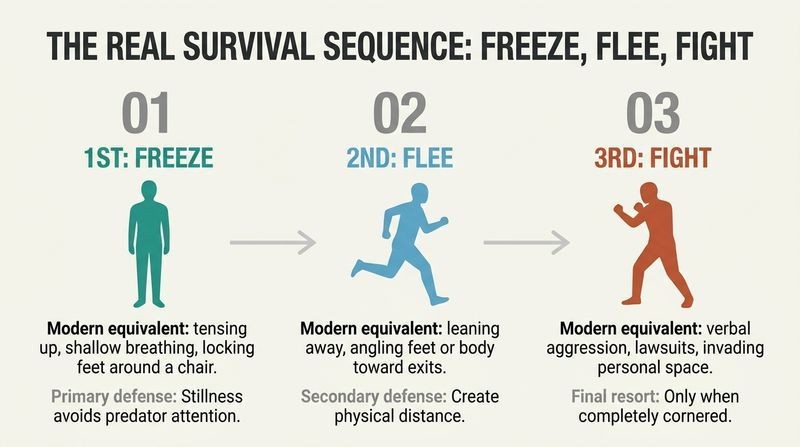
Trauma researchers like Bessel van der Kolk have popularized an expanded set, freeze, flight, fight, and fawn (appeasement), which fills a gap Navarro leaves open. His insight that stillness is primary matters practically, because most people scanning for lies expect fidgeting and miss the person who has gone unnaturally quiet. The reframe also dissolves a common misread: a frozen, breath-holding interviewee looks guilty but may simply be terrified. What's valuable here is teaching observers to treat freezing as a stress signal to investigate, not a verdict. The evolutionary framing is a useful mnemonic even where the precise ancestral mechanics remain speculative.
Read people from the feet up, because feet lie least
Honesty rises from the floor. Most people study the face first, yet the face is the most rehearsed and deceptive body part. Navarro reverses the scan: start at the feet and legs, which evolution wired to flee or kick danger long before we had language, and which we rarely think to control.
Feet keep talking under the table. Happy feet wiggle and bounce when someone gets good news, visible as a vibrating shirt or shoulders even when the face stays stoic, as with a poker player dealt a winning hand. Feet angle toward exits when people want to leave. During a Barbara Walters interview, actress Kim Basinger jiggled her feet throughout, but when asked about a troubled investment her foot jumped from jiggling to kicking, an instant visceral rejection of the question.
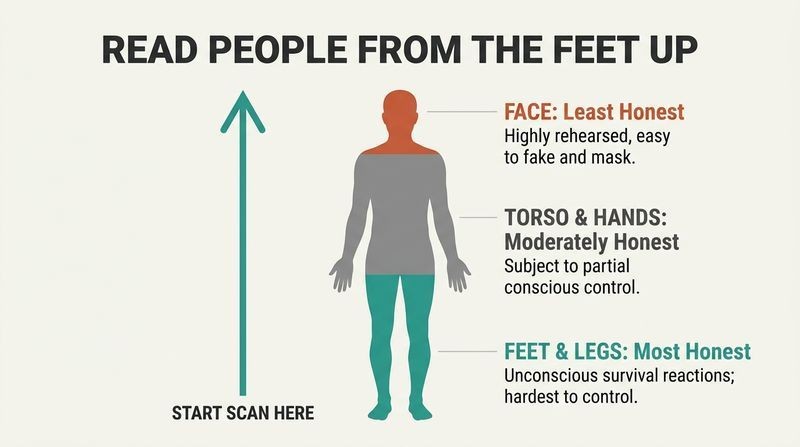
Zoologist Desmond Morris made a similar claim decades earlier, that honesty leaks downward because we monitor our faces most and our feet least. There is testable logic here: attention is a finite resource, and social training concentrates on facial management. Still, the claim deserves nuance. Feet can be constrained by furniture, culture, footwear, and simple restlessness, and restless-leg tendencies create false positives. Navarro himself stresses reading changes from baseline rather than static poses. The deeper principle, allocate observation to the channels a person is least likely to be policing, generalizes well beyond feet and is arguably the book's most transferable operating rule.
Self-soothing gestures betray stress the instant it strikes
Pacifiers reveal the hidden nerve. Navarro calls self-comforting motions pacifying behaviors: touching the neck, stroking the face, rubbing the thighs, exhaling with puffed cheeks, playing with a necklace, or adjusting a tie. The brain orders the body to soothe itself after something unpleasant, releasing calming sensations. These do not prove lying, but they pinpoint exactly which question or moment caused distress.
The neck gives people away. Men grip or massage the neck; women often cover the suprasternal notch, the small hollow at the base of the throat. Searching for a fugitive, Navarro watched a mother's hand fly to her neck dimple each time he raised the possibility her son was inside. It happened only on that topic. He searched the house and found the son hiding in a closet.
This maps neatly onto the psychology of adaptors, self-directed movements that regulate arousal, studied since the 1960s. The mechanism is plausible: stroking nerve-rich skin activates parasympathetic calming, which is why the gestures cluster around the neck and face. The genuine advance is treating pacifiers as a targeting tool rather than a lie detector. Instead of asking is this person deceptive, the observer asks what just spiked their stress, a far more answerable question. The risk is confirmation bias, since a determined watcher can find neck touches everywhere. Navarro's own discipline, link the pacifier to a specific stimulus, is the safeguard that keeps this from becoming pseudoscience.
Learn someone's normal before you judge their nervous
Deviation is the signal. A gesture means little in isolation. Navarro's decoding rests on four disciplines: establish a baseline of how a person normally sits, breathes, and holds their hands; read behavior in context; watch for clusters of multiple tells pointing the same way; and flag sudden changes. He compares it to a parent who never looks in a healthy child's throat and so cannot recognize the sick one.
A frozen hug speaks. A boy who always races to hug his uncle instead stands stiff and rigid one year. Nothing is said, but the deviation from his own baseline is a warning worth investigating. Context matters too: trembling and disorientation after a car accident are expected, not suspicious, because the limbic system has hijacked the thinking brain.
This is the book's methodological backbone and its most defensible claim, because it neutralizes the biggest error in amateur body-language reading: assuming universal meaning for a gesture. Crossed arms might mean defensiveness, cold, or comfort. Only the deviation from an individual's own pattern carries reliable information. The approach parallels statistical process control in engineering, where you cannot detect an anomaly without first charting the normal range. It also aligns with clinical medicine's reliance on a patient's own history over population averages. The demand for clusters rather than single cues is essentially requiring corroborating evidence, a sound epistemic habit that separates careful observers from horoscope-style overreaders.
Sort every gesture into just two buckets: comfort or discomfort
The master lens. When a behavior baffles you, Navarro says, ask one question: does this look like comfort or discomfort? Comfort shows as contentment, relaxation, and openness. Discomfort shows as tension, stress, and closing off. Most cues fall cleanly into one bucket, and that binary alone tells you how a person feels about what is happening right now.
Comfort opens, discomfort guards. People who feel safe expose vulnerable areas, lean in, mirror each other's posture (a synchrony Navarro calls isopraxism), let their legs cross, and tilt their heads. People under stress lean away, erect barriers with arms or objects, stiffen, and go still. A woman whose debit card kept getting rejected gripped her crossed arms tighter with each failure, her escalating discomfort visible in the tightening.
Reducing thousands of possible cues to a two-state classifier is smart cognitive design, because working memory cannot juggle a dictionary of gestures in real time. It resembles the approach-avoidance dichotomy that runs through affective neuroscience, where behavior ultimately resolves into moving toward or away from a stimulus. The framework's strength is also its limit: comfort and discomfort tell you the valence of someone's state, not its cause. A job candidate's discomfort could stem from a hard question, a hidden truth, or simply an intimidating room. Navarro is careful about this, but users hungry for certainty routinely collapse discomfort into guilt, which is precisely the leap that produces false accusations.
Steepled hands and jutting thumbs quietly advertise confidence
Hands rank your certainty. Because the brain devotes outsized attention to hands, they broadcast confidence vividly. The single most powerful high-confidence tell is steepling: touching the fingertips of both hands together, tent-like, without interlacing. Lawyers, judges, and executives do it constantly. Thumbs also matter, since thumbs held high (sticking out of pockets, gripping a lapel) signal high status and self-assurance.
Confidence can collapse mid-sentence. These signals shift in real time. Navarro watched a SWAT mission planner confidently drape his arms over two chairs, then instantly withdraw them and drop his hands between his knees the moment someone asked about a detail he had forgotten. Low confidence reads inversely: thumbs hidden in pockets with fingers dangling, hands wringing, or fingers interlaced and rubbing. He advises speakers to steeple and keep hands visible.
The visibility-of-hands finding has practical teeth: Navarro's informal classroom test showed interviewers rated people who hid their hands as sneaky or withholding. This dovetails with courtroom research on witness credibility and with evolutionary arguments that we scan hands for weapons and intent. Steepling as dominance display appears across primatology in expansive posturing. The caveat is cultural and idiosyncratic variation: steepling can read as arrogant or preachy in some contexts, and habitual gesturers muddy the signal. The most immediately useful takeaway is prescriptive rather than diagnostic, keep your hands open and visible, which lowers others' threat perception, a finding consistent with negotiation and rapport research.
Trust the face last, because we are trained to fake it
The rehearsed canvas. Parents drill children to smile at unwanted gifts and hide distaste, so the face becomes the most practiced liar on the body. Yet it still leaks through fast, involuntary channels. Pupils constrict and eyes squint at things we dislike, and dilate at what we like. Eye-blocking (shielding, rubbing, or hard-closing the eyes) signals rejection of what was just heard, a reflex so deep that children born blind do it too.
Two smiles, two meanings. A genuine smile pulls the mouth corners up and crinkles the eyes using muscles hard to fake. A social smile stretches the corners sideways with flat eyes. Disappearing or compressed lips signal stress, and when the mouth corners curl into an upside-down U, distress is high.
This leans directly on Ekman's research into the Duchenne smile, named for the 19th-century physiologist who identified that authentic joy recruits the involuntary orbital eye muscles most people cannot consciously fire. The eye-blocking data on congenitally blind children is genuinely striking evidence that these are hardwired, not learned, displays. The tension in the chapter is that Navarro spends pages decoding facial cues while insisting the face is least trustworthy. The resolution is his cluster rule: facial leaks are worth noticing but must be corroborated by more honest channels below the neck. Modern automated emotion-recognition systems, notably, still struggle with exactly the fake-versus-genuine distinction Navarro flags, validating his caution.
We aim our bellies and toes at whatever we love
Ventral fronting reveals allegiance. Our front side, the ventral plane holding face, chest, and belly, is our most vulnerable surface. We expose it to people and things we like, a move Navarro calls ventral fronting, and we angle it away, ventral denial, from what troubles us. When two people join a conversation and shift their whole torsos and feet to admit a newcomer, the welcome is genuine. A mere swivel at the hips means the person would rather be left alone.
Relationships cool from the front. Couples pulling apart emotionally stop touching and begin turning their torsos away, rotating only their heads toward each other when forced close. In meetings, allies lean toward one another; people in disagreement hold their bodies rigid and lean away, sometimes buttoning a jacket as a subtle shield.
The concept has intuitive force and situational utility, especially the newcomer test, which offers an instant read on whether you are welcome in a group. It connects to proxemics, Edward Hall's study of how humans use space and orientation to signal intimacy or exclusion. The ventral-exposure idea also aligns with attachment behavior, since infants orient their fronts toward caregivers. Where readers should stay skeptical: posture is heavily shaped by furniture, seating arrangements, and physical comfort, so a torso angled away might reflect a bad chair rather than a bad feeling. As always, the reliable signal is a change in orientation timed to a specific person, topic, or moment.
Arms stake out territory and telegraph your rank
Space equals status. Navarro draws on Edward Hall's finding that higher-status people claim more territory. Confident individuals spread out; the insecure pull in. Arms akimbo, hands on hips with elbows flared, is a dominance and authority display used instinctively by police and soldiers. The hooding gesture, leaning back with hands laced behind the head to look larger like a cobra, marks the dominant person in a room and vanishes the instant a higher-status boss enters.
Gravity reveals mood. Arms defy gravity when we feel good, flying up in celebration or swinging freely, and sink when we feel defeated. Navarro coached women executives to use arms akimbo to hold ground in male-dominated meetings, and warned undercover officers that the same stance blows their cover, since criminals read it as a cop's tell.
The territory-equals-power thesis has robust support in status research and primate ethology, where expansive posture correlates with rank. It also brushes against the contested power-posing literature: Amy Cuddy's claim that expansive stances raise testosterone and lower cortisol largely failed replication, though the interpersonal signaling effect, that others perceive you as more dominant, has held up better than the hormonal one. That distinction is useful for readers, since arms akimbo may not change your internal chemistry but does change how you are read. Navarro's tactical framing, deploy or suppress the display depending on whether you want to project or hide authority, treats body language as adjustable equipment rather than fixed fate.
Even seasoned FBI experts spot lies at coin-flip odds
There is no Pinocchio effect. After a career as a so-called human lie detector, Navarro delivers a humbling verdict: no single behavior reliably indicates deception, not one. Studies since the 1980s show judges, police, agents, and spouses detect lies at roughly chance, about 50/50. Even rare naturals rarely exceed 60 percent. The polygraph runs only 60 to 80 percent depending on the operator. Most cues mistaken for lying are simply signs of stress, which is why innocent people, pressured hard, give false confessions.
Use a paradigm, not a verdict. Rather than hunting a magic tell, Navarro reads three patterns: comfort versus discomfort, emphasis (honest people gesture emphatically; liars underemphasize), and synchrony (truthful words, timing, and head movements align). A palms-up rogatory gesture while insisting believe me is suspect, since the truthful assert rather than plead.
This is the book's most important and most counterintuitive chapter, and its intellectual honesty elevates the whole project. It aligns with Aldert Vrij's and Bella DePaulo's meta-analyses, which find that deception cues are weak, inconsistent, and swamped by individual and situational variation. The practical stakes are enormous: the Central Park jogger case and countless coerced confessions show what happens when investigators mistake stress for guilt. Navarro's refusal to sell certainty, in a genre that profits from it, is admirable. The lasting lesson inverts the book's own marketing: body language is a tool for understanding feelings and generating better questions, not for playing human polygraph. Read discomfort, then investigate its cause.
Analysis
Navarro's contribution sits at an unusual intersection: a working FBI counterintelligence agent translating peer-reviewed nonverbal science into field-tested practice. That dual pedigree is the book's greatest strength and its subtle tension. The science it leans on, Ekman on facial affect, Hall on proxemics, Vrij on deception, is legitimate, but the connective tissue is anecdote drawn from interrogations, and anecdotes are chosen for how cleanly they confirm the thesis. Readers get vivid cases (the ice-pick killer, the fugitive's mother, the kicking foot) but no error rate for Navarro's own reads. The honorable exception is the deception chapter, where he demolishes the very expertise the cover promises, conceding that lie detection barely beats chance. That candor reframes the entire enterprise: this is a book about reading emotional state, not catching liars.
The methodology holds up better than the mechanism. The triune-brain and evolutionary-savanna framing is a storytelling scaffold that modern neuroscience treats skeptically, yet the operating rules, baseline first, context always, clusters over single cues, changes over static poses, comfort versus discomfort, are genuinely sound and mirror good epistemic practice in medicine and statistics. They are, essentially, safeguards against the pattern-matching overconfidence the pop body-language genre encourages.
The book's shadow risk is the reader who absorbs the cues but skips the discipline, converting discomfort into guilt and neck-touches into confessions. Navarro repeatedly warns against this; the format of quick tells invites it anyway. The most durable value is a shift in perception rather than a decoder ring: humans broadcast their feelings continuously through channels they do not police, and an observer who allocates attention to those channels, while staying humble about causation, will simply understand people better. That is a modest, defensible, and genuinely useful claim, more valuable than the mind-reading the title implies.
Review Summary
What Every Body Is Saying receives mixed reviews. Many readers find it informative and insightful, praising Navarro's expertise and real-world examples. They appreciate the detailed breakdown of nonverbal cues and their meanings. However, some criticize the book for being repetitive, obvious, or too focused on law enforcement scenarios. Several reviewers note that while interesting, the information can be difficult to apply in everyday situations. Overall, readers generally find value in the book's content, even if they don't agree with every aspect of Navarro's approach to body language interpretation.
People Also Read





FAQ
What's What Every Body is Saying about?
- Focus on Nonverbal Communication: The book is a guide to understanding nonverbal cues and body language, authored by Joe Navarro, a former FBI agent.
- Practical Applications: It illustrates how nonverbal signals can reveal truths about intentions and emotions in various contexts, from personal relationships to professional settings.
- Scientific Basis: The book combines practical advice with scientific research, explaining how our limbic brain influences our nonverbal behaviors.
Why should I read What Every Body is Saying?
- Enhance Communication Skills: Reading this book can significantly improve your ability to interpret the feelings and intentions of others.
- Learn from Experience: Joe Navarro shares real-life examples from his FBI career, providing practical insights applicable in everyday situations.
- Understand Human Behavior: It offers a deeper understanding of human psychology, particularly how nonverbal cues can often be more honest than spoken words.
What are the key takeaways of What Every Body is Saying?
- Importance of Nonverbal Cues: Nonverbal communication accounts for 60-65% of interpersonal communication, making it crucial to understand body language.
- Limbic System's Role: The limbic brain governs our emotional responses and is responsible for many nonverbal behaviors.
- Practical Techniques: Navarro provides actionable techniques for observing and interpreting body language, such as focusing on feet and legs.
What are the best quotes from What Every Body is Saying and what do they mean?
- "The silent language of the body can be yours to master.": This emphasizes the power of nonverbal communication in enhancing interactions.
- "Reading people successfully... is a skill that requires constant practice and proper training.": It highlights that interpreting nonverbal cues can be developed through observation and practice.
- "Nonverbal behaviors comprise approximately 60 to 65 percent of all interpersonal communication.": This underscores the significance of body language in communication.
What is nonverbal communication according to What Every Body is Saying?
- Definition of Nonverbal Communication: It refers to the transmission of messages through body language, facial expressions, gestures, and posture.
- Types of Nonverbal Cues: Includes kinesics (body movements), proxemics (personal space), haptics (touch), and vocalics (tone of voice).
- Honesty of Nonverbal Signals: Nonverbal cues are often more truthful than verbal communication because they are less consciously controlled.
How can I improve my ability to read body language from What Every Body is Saying?
- Practice Observation: Navarro emphasizes the importance of being a competent observer of your environment.
- Learn the Commandments: The book outlines ten commandments for observing and decoding nonverbal communication.
- Focus on Context: Understanding the context in which nonverbal behaviors occur is crucial for accurate interpretation.
What are the ten commandments for observing nonverbal communication in What Every Body is Saying?
- Be a Competent Observer: Actively observe your surroundings and the people in them.
- Observe in Context: Always consider the context of the situation to accurately interpret nonverbal cues.
- Recognize Universal Behaviors: Learn to identify and decode nonverbal behaviors that are universally recognized across cultures.
What role does the limbic system play in nonverbal communication as described in What Every Body is Saying?
- Emotional Center: The limbic system is responsible for our emotional responses and governs many of our nonverbal behaviors.
- Automatic Responses: Reactions from the limbic brain occur reflexively and without conscious thought.
- Honesty of Limbic Behaviors: These responses are instinctual, making them reliable indicators of a person's true feelings.
How does What Every Body is Saying suggest using nonverbal cues in everyday interactions?
- Enhance Personal Interactions: By understanding and interpreting nonverbal cues, you can improve communication with others.
- Detect Deception: The book provides insights into recognizing signs of discomfort or dishonesty through body language.
- Build Rapport: Learning to read and respond to nonverbal signals can help establish stronger connections.
What are some common nonverbal behaviors of the arms discussed in What Every Body is Saying?
- Gravity-Related Movements: Happy and confident individuals exhibit expansive arm movements.
- Arm Withdrawal: When feeling threatened or uncomfortable, people often withdraw their arms or cross them over their bodies.
- Self-Restraint: Restricted arm movements can signal discomfort or insecurity.
What does Joe Navarro say about detecting deception in What Every Body is Saying?
- Complexity of Deception: Detecting lies is challenging, and many behaviors associated with stress can be misinterpreted as deceit.
- Comfort and Discomfort: Observing changes in body language can provide clues about a person's honesty.
- No Definitive Signs: Deception cannot be identified through a single cue but rather through a combination of behaviors and context.
How does What Every Body is Saying address the importance of context in interpreting nonverbal behavior?
- Contextual Interpretation: Nonverbal cues must be understood within the context of the situation.
- Cultural Differences: Cultural backgrounds can influence nonverbal communication, making it essential to consider these factors.
- Situational Awareness: Being aware of the environment and interaction dynamics helps in accurately assessing nonverbal signals.
About the Author
Other books by Joe Navarro

Download PDF
Download EPUB
.epub digital book format is ideal for reading ebooks on phones, tablets, and e-readers.








































