


Key Takeaways
Your mind has no firewall — every choice can be covertly engineered
The Ellipsis Manual's central premise is unsettling: human psychology has hundreds of exploitable loopholes, and the brain's conviction that it can't be manipulated is itself the biggest loophole. The book presents a complete system — the Ellipsis Progression — for moving someone from doubt to willing obedience through a sequence of profiling, authority-building, linguistic manipulation, and trance development.
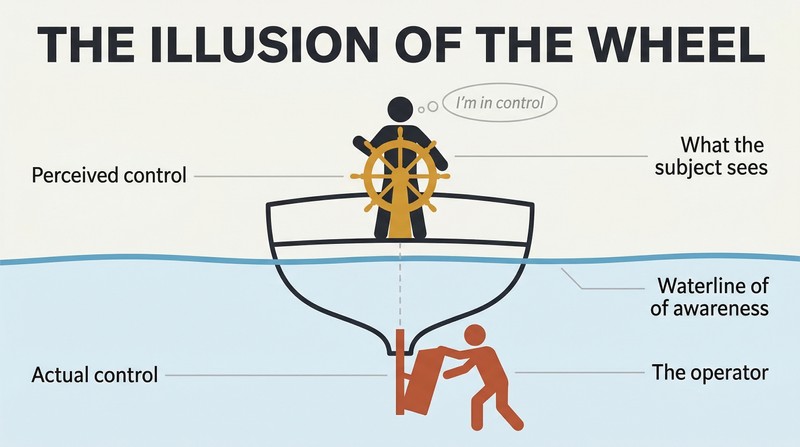
Hughes uses a ship metaphor to describe the process: imagine subjects at the wheels of their own ships, feeling in control, while the operator secretly controls the rudder beneath the waterline. Subjects never credit the operator for behavioral changes — they assign responsibility for their actions to themselves. This illusion of free will is the system's greatest asset, built on stacking dozens of covert techniques from behavioral analysis to embedded hypnotic commands.
Score gestures mathematically using the Behavioral Table of Elements
The BToE catalogs 122+ human behaviors on a periodic-table-style chart, each scored with a deception rating from 1.0 to 4.0. Behaviors are plotted on two axes: vertically from head to feet, horizontally from low-stress to high-deception. Each cell contains 14 data points including confirming gestures, amplifying gestures, cultural prevalence, and the timeframe when deception is most visible (before, during, or after a statement).
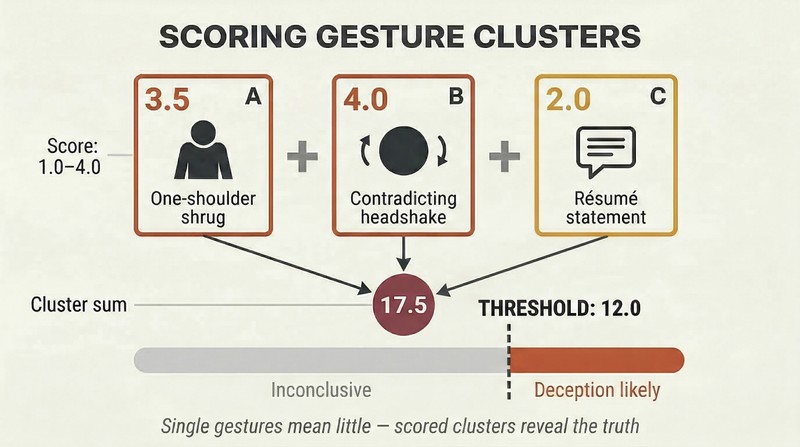
Gestures are analyzed in clusters called groups, not isolation. In a sample interrogation, a suspect saying "I did not do anything" while shrugging one shoulder, shaking his head no, and giving a résumé statement about his church involvement scored 17.5 — well above the 12-point threshold for near-certain deception. Single gestures mean little; scored clusters reveal the truth.
Map someone's deepest need to find the back door to their mind
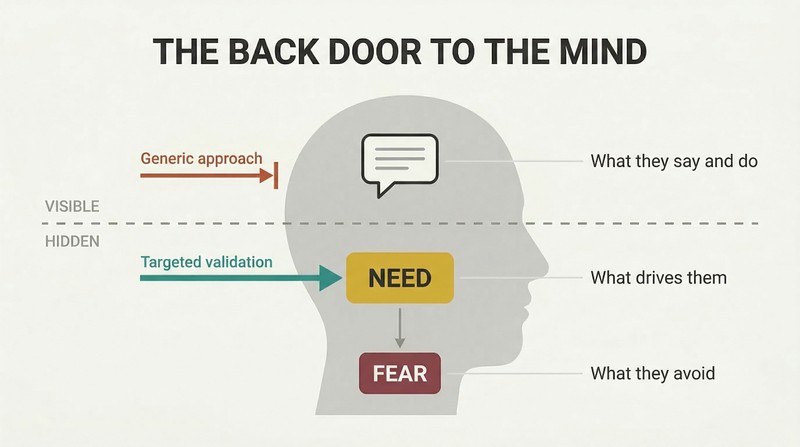
The Human Needs Map identifies 17 psychological needs — from appreciation and approval to uniqueness and success — each with an associated fear and exploitable weakness. A person who needs to feel intelligent fears dismissal and is vulnerable to compliments on intellectual ability. Someone driven by protection fears weakness and will sacrifice resources to feel safe. The map is designed to be memorized by visualizing rooms in a house.
Profiling someone's need takes minutes, not hours. Hughes describes approaching a store employee who talks about reorganizing an aisle — instantly flagging an approval need. The operator then crafts language that validates that specific desire: "It's great to see someone with such an awesome work ethic." The subject's defenses lower because the operator is speaking directly to the need driving their behavior.
Authority alone outperforms every persuasion technique combined
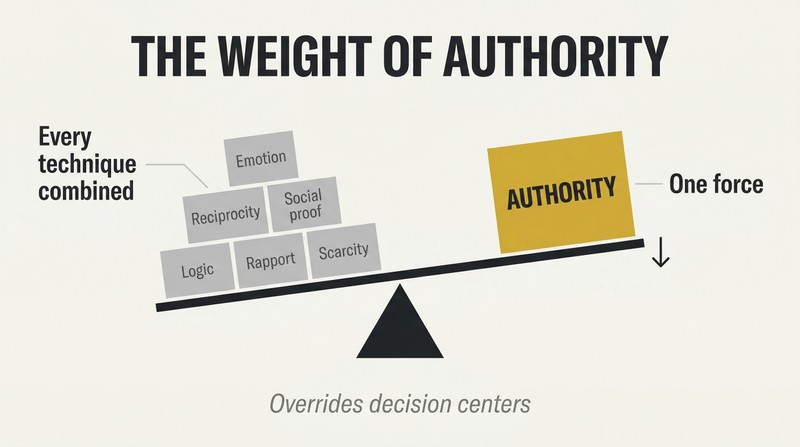
Stanley Milgram's 1961 experiments showed that ordinary people would deliver apparently lethal electric shocks simply because a man in a lab coat told them to. A follow-up study by Sheridan and King used real shocks on a puppy — all female subjects and half of males obeyed to the end, many weeping. Hughes draws a striking comparison: Milton Erickson mastered every hypnotic technique in existence, yet Charles Manson — who knew none of them — commanded followers to kill, purely through perceived authority.
Hughes prescribes five pillars for building this authority: Control (slow, deliberate movement and breathing), Discipline (rigorous personal standards), Leadership (producing automatic followership), Gratitude (eliminating negative inner conflict), and Enjoyment (radiating magnetic positivity). These aren't performance tricks — they must be woven into daily life to broadcast congruent unconscious signals.
Break someone's routine to bypass their mental autopilot
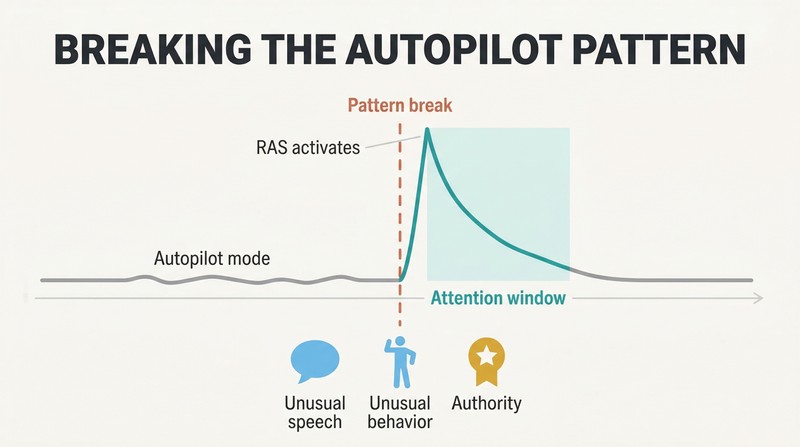
The brain conserves resources by running habitual programs — what Hughes calls Autopilot Mode. A store employee greeting her hundredth customer runs the same mental script as the first. The Reticular Activating System, the brain's gatekeeper, only activates full attention when something deviates from the expected pattern. That deviation creates a brief window of heightened focus the operator can exploit.
Three categories shut off autopilot:
1. Unusual speech — unexpected volume, tone, word choice, confusion, or accent
2. Unusual behavior — atypical gestures, gait, touch, or appearance
3. Authoritative presence — projecting status that commands automatic attention
Hughes illustrates this with "Sarah," a mall kiosk worker whose brain shifts between employee mode, driver mode, and nightclub mode. Approaching her with a stimulus that doesn't fit her current autopilot program forces her RAS online.
Harvest someone's own words to build your influence arsenal
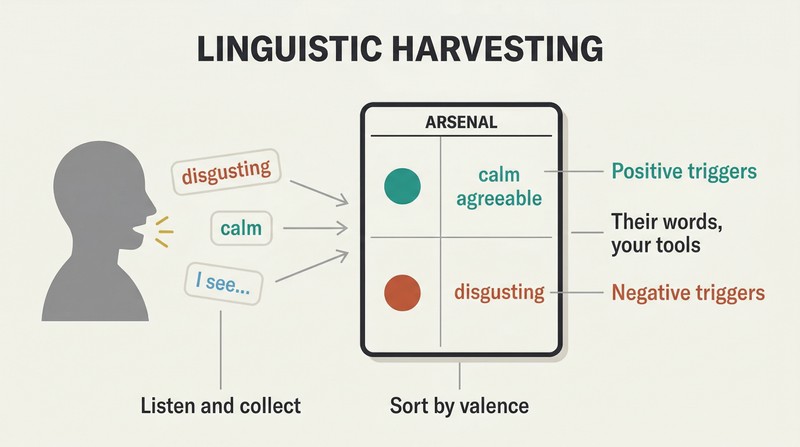
Linguistic Harvesting means collecting subjects' adjectives, sensory preferences, and pronoun patterns during casual conversation, then deploying those same words later in hypnotic and persuasive language. When someone says their neighborhood is "disgusting" and their home is "calm" and "agreeable," those exact words become ammunition — negative adjectives for creating aversion, positive ones for building compliance.
People process reality through dominant sensory channels. Visual people say "I see what you mean"; auditory people say "that sounds right"; kinesthetic people say "I feel you." Hughes also tracks Gestural Hemispheric Tendency — which side of the body someone uses when discussing negative versus positive topics. If they gesture right when angry, the operator can later move to that side to unconsciously activate negativity — or to the opposite side to create warmth.
Hide commands inside normal sentences using tiny shifts in tone
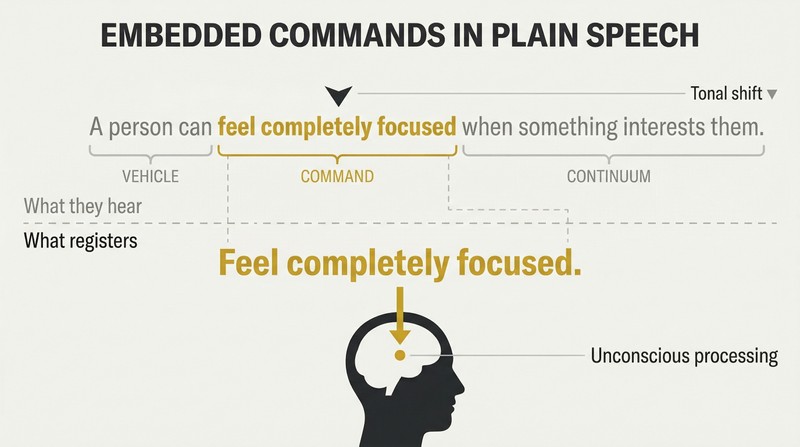
Embedded commands are directives hidden within conversational speech, marked by subtle changes in volume, pitch, and tactical pauses. The structure has three parts: a vehicle ("A person can..."), the command ("feel completely focused"), and a continuum ("when something interests them"). The command words receive a slight downward tonal shift — an unconscious signal that registers as instruction rather than suggestion.
Presuppositions amplify the effect. "When you start to feel a sense of trust with someone, what does it feel like?" assumes the subject already knows this feeling. "Did you notice the lights become dimmer?" presupposes the lights changed, asking only whether you noticed. Double binds offer false choices — "Do you feel more focused when you tune everything out, or when you collect all your attention in one place?" — where both options produce the operator's desired state.
Confuse someone and the next clear thing you say becomes gospel
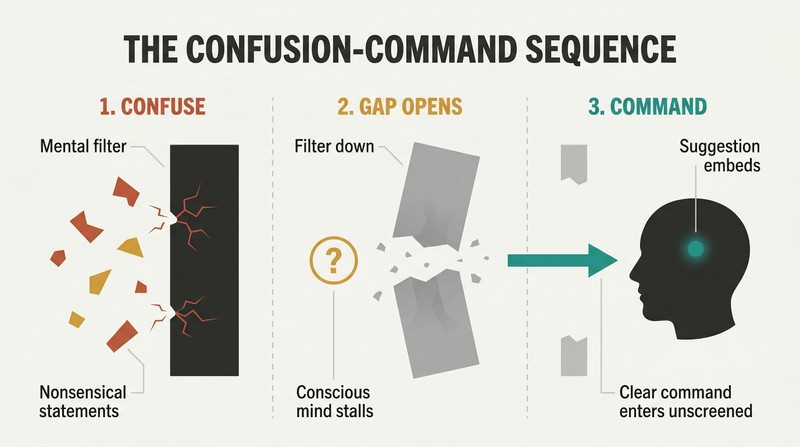
Confusion exploits desperation. When the brain can't make sense of incoming information, it grasps the next solid thing offered — like a drowning person reaching for a log. Hughes prescribes deliberately nonsensical statements spoken with total conviction: "Nobody knows what's going to happen a week ago isn't even the right place to start." The subject's conscious mind stalls. In that gap, a simple command slips through unscreened.
The formula is straightforward: speak the confusion with certainty, immediately follow with a clear suggestion that moves the subject in your desired direction, then return to normal conversation. The human need for continuity pulls subjects back on track, and the average person remembers less than 20 percent of any conversation — meaning the confusion-command sequence vanishes into the conversational noise while the suggestion embeds itself.
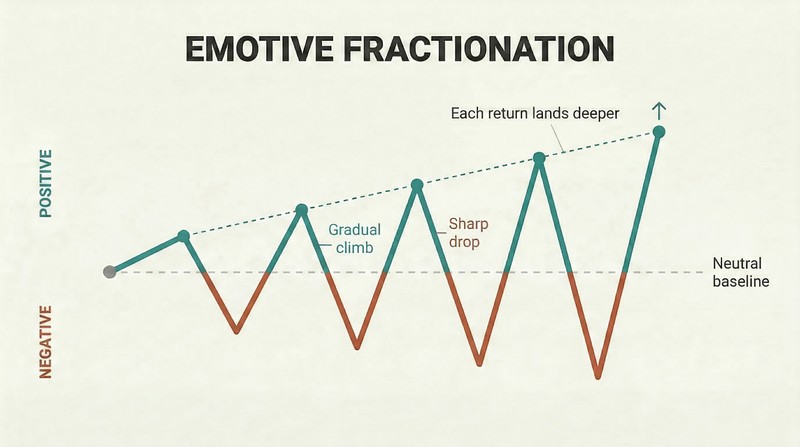
Cycle emotions up and down — each return lands deeper
Emotive Fractionation borrows from hypnotherapy, where clinicians repeatedly induce and break trances to deepen each re-entry. In conversation, the operator creates emotional highs — connection, excitement, trust — then deliberately drops the mood with sad or anxious topics. The positive state isn't destroyed; it's interrupted. When the operator rebuilds it, the return feels stronger because of the contrast.
Television evangelists use this instinctively, speeding up and slowing down speech rates to cycle congregations between energized action-taking and malleable stillness. Hughes prescribes building positive emotions like climbing a hill — gradually, with sensory detail and personal compliments — then dropping into the negative like falling off a cliff. After five or six cycles, the emotional state the operator wants becomes the subject's default orientation.
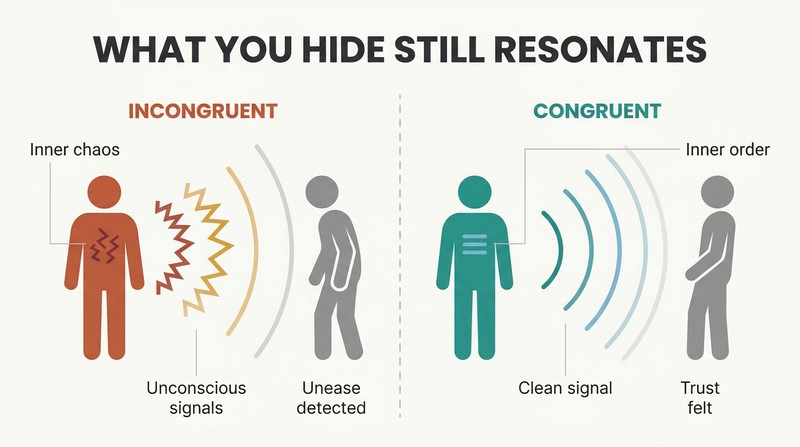
Your inner conflicts silently broadcast through every interaction
Unfinished tasks leak unconsciously. Hughes compares interpersonal psychology to pianos in a store: strike middle C on one, and every other C string vibrates in resonance. Your anxiety, dishonesty, or inner chaos "plucks strings" that subjects' unconscious minds register, no matter how well you think you've covered it up. Leaving laundry undone while attending a business meeting sends signals you can't consciously suppress.
The fix is radical personal congruence. Hughes prescribes managing your life so thoroughly that nothing leaks: impeccable hygiene, slow and controlled movements, disciplined schedules, and deep gratitude practice. Even the speed of your blinks broadcasts nervousness. The depth awareness habit — noticing how many people were involved in growing the lettuce in your taco salad — trains the mind to see past social masks and project genuine warmth that subjects instinctively trust.
Analysis
The Ellipsis Manual represents an ambitious and ethically fraught attempt to synthesize behavioral analysis, covert hypnosis, NLP, and intelligence tradecraft into a unified system for engineering human behavior. Chase Hughes draws from genuine psychological research — Milgram's obedience studies, Ekman's facial coding, Pavlovian conditioning — while extending these findings far beyond their empirical foundations. The Behavioral Table of Elements is the book's most original contribution: a systematic attempt to make body language interpretation replicable and courtroom-presentable, moving it from interpretive art toward something approaching quantitative science.
The book's greatest strength is its insistence that influence begins with observation, not technique. Most persuasion literature hands readers a toolkit and says 'deploy this.' Hughes argues that technique without profiling is like surgery without diagnosis — and he's substantively right. The Human Needs Map, Social Stability Scale, and linguistic harvesting framework create a profiling pipeline that makes subsequent techniques exponentially more precise. This sequence — observe, profile, then influence — is genuinely more sophisticated than anything in mainstream NLP or sales training.
However, the book suffers from significant overconfidence. The deception rating scores are presented with false precision; no peer-reviewed validation exists for the specific numeric thresholds. The CIA/MKULTRA sections, while historically documented, blend verified experiments with speculative reconstruction in ways that occasionally strain credibility. The ethical disclaimer — 'this manual is for entertainment only' — reads as performative when followed by detailed instructions for creating alter personalities.
What makes the book genuinely dangerous and genuinely valuable is its architectural exposure of compliance. By reverse-engineering how cults recruit, interrogators break resistance, and con artists build trust, Hughes has produced a rare artifact: a map of human psychological vulnerability that functions equally as weapon and vaccine. Readers who understand these techniques become harder to manipulate — knowing how the machinery works makes you far less likely to be caught in its gears.
Review Summary
The Ellipsis Manual receives mixed reviews, with an overall rating of 4.05 out of 5. Positive reviews praise its wealth of information on human behavior, influencing techniques, and practical applications. Critics highlight inconsistent formatting, unclear explanations, and potentially unethical implications. Some readers find the content fascinating and valuable for personal and professional development, while others consider it manipulative or poorly organized. The book's sections on lie detection, rapport building, and personality profiling are noted as particularly useful, though some readers struggle with the technical language and abbreviations used.
Glossary
Behavioral Table of Elements (BToE)
Periodic table of human behaviorsA chart organizing 122+ human behaviors on two axes—body region (head to feet, top to bottom) and deception likelihood (low-stress to high-deception, left to right). Each cell contains 14 data points including a deception rating, confirming gestures, amplifying gestures, cultural prevalence, and the timeframe (before, during, or after a statement) when the behavior most indicates deception.
Ellipsis Progression
Timeline from approach to obedienceA visual chart showing the chronological progression of behavioral engineering, from initial approach through profiling, authority development, linguistic manipulation, trance development, and activation of full control. The left column shows expected subject behaviors (doubt → trust → hyper-focus → unconscious agreement), the middle shows operational phases, and the right shows applicable techniques.
Human Needs Map
17 psychological needs as loopholesA framework identifying 17 core human needs—appreciation, approval, acceptance, protection, freedom, strength, respect, intelligence, pleasure, comfort, privacy, pity, caretaker, attractiveness, uniqueness, admiration, and success. Each need has an associated fear and exploitable weakness. Designed as a memorizable 'house' layout where adjacent rooms indicate correlated personality types.
Autopilot Mode
Brain's habitual behavior patternsThe brain's tendency to run automated behavioral programs in familiar environments and roles, conserving cognitive resources. A store employee, driver, or student each operates from a role-specific script. Disrupting this autopilot through unusual speech, behavior, or authoritative presence activates the Reticular Activating System and creates a window of heightened suggestibility.
Attentional Captivity
Total focus excluding outside stimuliA state where subjects become so focused on the operator or conversation that outside noises, distractions, and competing thoughts temporarily fade from conscious awareness. Analogous to being absorbed in a movie and forgetting you're in a theater. This is the first operational goal in most Ellipsis Progression interactions and the foundation for deeper trance and influence work.
Linguistic Harvesting
Collecting subjects' words for reuseThe systematic collection of a subject's adjectives, sensory-channel preferences, pronoun patterns, and emotionally charged phrases during conversation. These harvested words are later deployed in hypnotic language, embedded commands, and persuasive framing—creating influence that feels eerily familiar to the subject because it literally speaks in the language of their own thoughts.
Gestural Hemispheric Tendency (GHT)
Body-side mapping to positive/negativeThe observed tendency of individuals to gesture toward one side of their body when discussing positive topics and toward the other side for negative topics. Operators note which side maps to which valence, then later move their own bodies or gestures to the subject's negative or positive side to unconsciously influence emotional associations with topics being discussed.
Emotive Fractionation
Cycling emotions to deepen statesA conversational technique based on the clinical hypnosis principle that repeatedly entering and exiting a state deepens it each time. The operator builds positive emotional states (connection, excitement, trust), deliberately breaks them with negative or neutral topics, then rebuilds them with greater intensity. Each cycle strengthens the desired state through contrast and rehearsal.
Corrugation Programming
Creating alter egos without traumaEllipsis's proprietary four-phase method for creating programmable alter personalities in subjects without using physical trauma. The phases are Alignment (connecting training to subjects' needs), Entrainment (progressive obedience conditioning), Training (trance responsiveness and visualization), and Separating (creating the alter via the Mental Hallway technique). Designed for both therapeutic 'helper' creation and intelligence operations.
Hughes Social Stability Scale
Three-axis subject vulnerability ratingA profiling tool that rates subjects on three dimensions, each scored 1-3: locus of control (external to internal), following behavior (absorbs others' emotions vs. emotionally insulated), and esteem (seeks validation vs. self-assured). Combined with Human Needs Map identification, this produces a stability profile like 'Approval, Power, 1, 3, 2' that reveals specific psychological leverage points.
FAQ
What's The Ellipsis Manual about?
- Behavior Engineering Focus: The Ellipsis Manual by Chase Hughes explores the analysis and engineering of human behavior, offering tools to influence and understand others effectively.
- Practical Applications: It combines behavior profiling techniques with covert influence methods, applicable in fields like therapy, intelligence, and sales.
- Comprehensive Training: The book serves as both a reference and a training guide, detailing body language, psychological techniques, and ethical considerations.
Why should I read The Ellipsis Manual?
- Unique Insights: It provides insights into intelligence techniques and advanced behavior profiling methods not commonly found in other literature.
- Practical Techniques: Readers gain actionable techniques for improving social skills and professional effectiveness.
- Comprehensive Framework: The manual offers a structured framework for understanding and applying behavior engineering, suitable for both beginners and experienced practitioners.
What are the key takeaways of The Ellipsis Manual?
- Understanding Influence: Influence requires deep mastery and practice, emphasizing understanding human behavior and psychology.
- Behavioral Analysis: Introduces the Behavioral Table of Elements for analyzing and interpreting nonverbal communication.
- Ethical Considerations: Discusses ethical implications, urging responsible use of behavior engineering techniques.
What are the best quotes from The Ellipsis Manual and what do they mean?
- "If you’re not doing the programming, you are being programmed.": Highlights the importance of proactive influence over one's behavior and others'.
- "We are quite perfectly wired to follow, to obey, and to be programmed by our environment.": Emphasizes human susceptibility to social influence and environmental cues.
- "Mastering the piano takes years of daily drive, patience, and hands-on practice.": Compares learning influence to mastering a skill, underscoring the need for dedication.
What is the Behavioral Table of Elements in The Ellipsis Manual?
- Comprehensive Framework: A systematic categorization of human gestures and behaviors for analyzing nonverbal communication.
- Data Points: Includes gesture names, confirming gestures, deception ratings, and cultural prevalence for nuanced understanding.
- Practical Application: Useful in interviews, interrogations, and everyday interactions for behavior analysis.
How does The Ellipsis Manual address ethics in behavior engineering?
- Ethical Framework: Emphasizes ethics, stating the manual is for entertainment and educational purposes only.
- Awareness of Manipulation: Discusses potential manipulation and ethical implications, urging consideration of impact on others.
- Personal Responsibility: Stresses responsibility for actions and influence consequences, encouraging thoughtful technique use.
What techniques for influencing behavior are covered in The Ellipsis Manual?
- Covert Influence Techniques: Includes linguistic manipulation, psychological priming, and metaphor use to guide thoughts and emotions.
- Behavior Profiling: Teaches profiling based on body language and verbal cues for tailored influence approaches.
- Establishing Authority: Discusses projecting authority to enhance influence effectiveness and gain compliance.
What is the significance of the Reticular Activating System (RAS) in The Ellipsis Manual?
- Gatekeeper Function: Filters information and directs attention to important stimuli, crucial for influencing behavior.
- Focus and Attention: Helps focus on specific stimuli, aiding in attentional captivity during interactions.
- Behavior Modification: Understanding RAS manipulation enhances suggestibility and compliance in subjects.
How can I apply the techniques from The Ellipsis Manual in everyday life?
- Practice Daily: Encourages regular practice in social settings and keeping a journal for progress tracking.
- Tailor Techniques: Advises adapting techniques to fit different scenarios for effective behavior engineering.
- Observe and Analyze: Active observation of body language and verbal cues enhances technique application.
What role does rapport play in The Ellipsis Manual?
- Foundation of Influence: Essential for effective influence, creating trust and connection between operator and subject.
- Techniques for Building Rapport: Includes mirroring body language, using similar speech patterns, and making genuine compliments.
- Long-term Relationships: Lays groundwork for long-term relationships and increased trust in future interactions.
How does Chase Hughes define presuppositions in The Ellipsis Manual?
- Implied Truths: Statements implying truths without direct expression, influencing information reception.
- Powerful Linguistic Tools: Bypass critical thinking, enhancing communication effectiveness.
- Skill Development: Encourages recognizing and using presuppositions to improve communication skills.
What is the significance of double binds in The Ellipsis Manual?
- Illusion of Choice: Creates a conversational illusion of choice, leading to the desired outcome.
- Subconscious Influence: Influences decision-making at a subconscious level, easing compliance.
- Practical Application: Provides structures for creating double binds to enhance persuasive abilities.

Download PDF
Download EPUB
.epub digital book format is ideal for reading ebooks on phones, tablets, and e-readers.








































