

Key Takeaways
Your ancient survival brain leaks truths your mouth conceals
The limbic system is the honest brain. Navarro, a 25-year FBI counterintelligence agent, argues that of the brain's three layers, the limbic (emotional, mammalian) region reacts to the world instantly, reflexively, and without conscious editing. Because it evolved to keep us alive, it fires in real time and cannot be easily faked. The neocortex, our thinking brain, is the liar: it crafts the polished words we choose.
Behavior betrays intention. He caught a killer because when the ice pick (the secret murder weapon) was named, the suspect's eyelids clamped shut. A rape suspect swore he turned left while his hand gestured right, toward the crime scene. These involuntary tells, driven below awareness, made the body more truthful than the tongue.
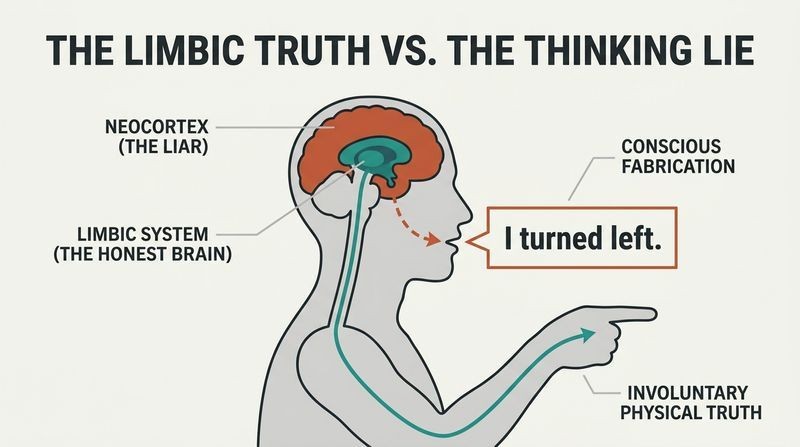
The triune brain model Navarro leans on (Paul MacLean's reptilian, limbic, neocortex framework) is now considered oversimplified by neuroscientists; emotion and cognition are more intertwined than a tidy three-layer cake suggests. Yet the practical kernel holds: autonomic responses governed by the sympathetic nervous system are genuinely harder to suppress than speech. This dovetails with polygraph logic and Paul Ekman's leakage research. What's compelling is the reframe of observation as a survival skill immigrants and children intuitively develop when words fail them, which is exactly how the young Cuban exile Navarro says he learned to read faces.
Read people from the feet up, not the face down
Feet are the most honest body part. Most people scan faces first, but Navarro insists the face is where we practice deception, coached since childhood to fake smiles and hide dislike. The feet and legs, our original tools for fleeing predators, still react before our conscious mind catches up, and almost nobody monitors them.
Watch what the lower limbs reveal. Happy feet wiggle and bounce when someone gets good news (a poker player dealt a flush, a mother hearing her child's voice). Feet that shift toward the exit signal a desire to leave. A woman dangling her shoe during a date signals comfort; when she slips it back on, interest has cooled. Customs officers learned that travelers declaring "nothing to hide" while pointing their feet away are often concealing something.
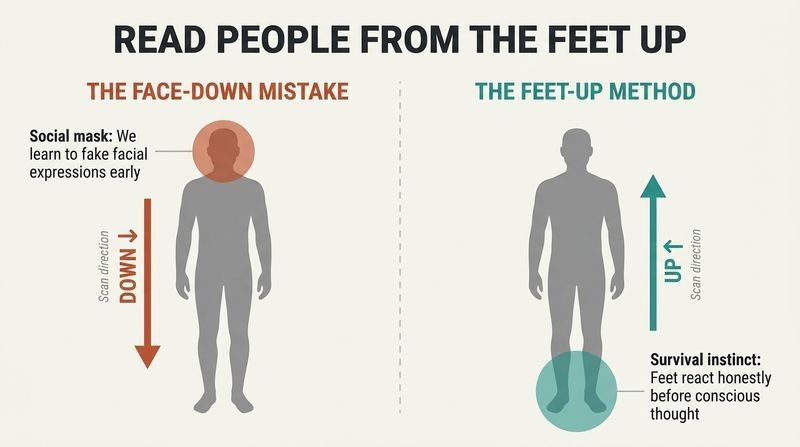
The bottom-up approach is a genuinely counterintuitive contribution. Because the face is the most socially rehearsed canvas, it is the least reliable, an inversion of common intuition. This aligns with the psychological principle that behaviors under less conscious monitoring carry more diagnostic value. A caution worth flagging: much of the foot evidence here is anecdotal and interpreted by an expert who already suspected something. Controlled studies on foot-direction as a deception cue are thin. Still, as a mental habit, redirecting attention below the table costs nothing and surfaces signals competitors and interviewers routinely ignore.
Sort every gesture into comfort or discomfort
The master question is binary. When uncertain what a behavior means, Navarro says to ask one thing: does this look like comfort (contentment, relaxation, confidence) or discomfort (stress, tension, anxiety)? Nearly every signal lands in one bucket. The limbic brain seeks safety and broadcasts distress when it fails to find it.
Comfort and discomfort look distinct. Comfortable people open up, expose their vulnerable fronts, mirror your posture, and let limbs relax. Uncomfortable people block, distance, freeze, and shrink. At an airport gate when a flight is canceled, bodies telegraph misery without a word. This comfort/discomfort domain became the backbone of Navarro's FBI model for interviewing, because it sidesteps the impossible task of directly reading truth and instead maps emotional weather.
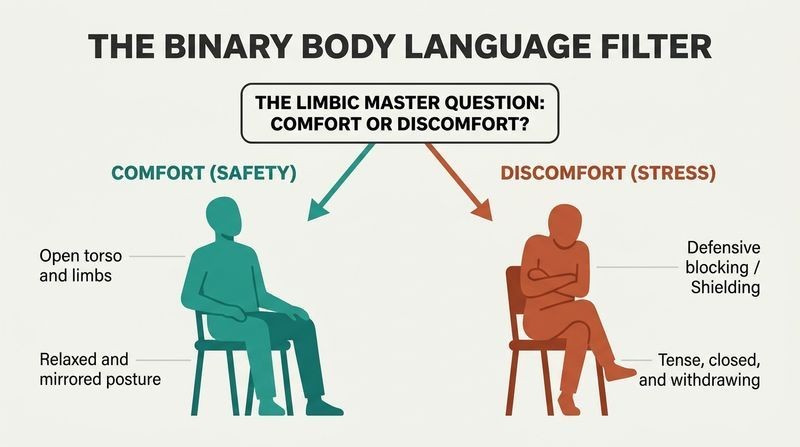
This binary is the book's most portable tool precisely because it lowers the cognitive load. Rather than memorizing hundreds of discrete cues, the observer runs one classifier. It resembles the affect-as-information approach in psychology, where feelings function as quick appraisals of a situation. The limitation is that comfort and discomfort are not the same as honesty and dishonesty, a distinction Navarro is careful to preserve. Someone can be deeply uncomfortable yet completely truthful (nervous innocents in interrogation rooms). The binary tells you where the emotional heat is, not why, which is both its strength and its ceiling.
When people soothe themselves, something just stressed them
Pacifiers are self-soothing tells. After the limbic brain registers a threat, it recruits the hands to calm the body down through what Navarro calls pacifying behaviors: touching the neck, stroking the face, rubbing the thighs (the leg cleanser), ventilating a collar, exhaling with puffed cheeks. These stimulate nerve endings and release calming chemistry.
The stressor precedes the pacifier. A mother touched her neck's suprasternal notch (the hollow above the breastbone) only when asked if her fugitive son was inside; he was hiding in a closet. A job candidate wiped his palm hard on his thigh the instant Facebook embarrassment came up. Pacifiers do not prove lying, but they flag exactly which question or topic disturbed someone, giving the observer a thread to pull.
Reframing fidgeting as adaptive rather than random is powerful. These behaviors map onto what psychologists call self-regulation or adaptors, and they parallel infant self-soothing (thumb-sucking) that never fully disappears, just grows socially disguised into gum-chewing and pen-tapping. The diagnostic move Navarro adds is temporal: pair the pacifier with its trigger. That causal linking is what separates skilled reading from vague vibes. The honest caveat he supplies matters greatly: pacifying signals discomfort, not deceit. Overzealous interrogators who conflate the two have extracted false confessions, a real-world cost that keeps this insight from being a parlor trick.
Build a baseline, then hunt for deviations in clusters
No single gesture means anything alone. Navarro's observation method rests on three pillars. First, establish a person's baseline: how they normally sit, gesture, and hold their face when relaxed. You cannot spot the abnormal without knowing the normal, like a parent who never checked a healthy child's throat.
Then watch for change, context, and clusters.
1. Deviation: a child who always hugs Uncle Harry but freezes this year signals something changed.
2. Context: trembling after a car crash is expected, not suspicious.
3. Clusters: stress cues followed by pacifiers, read together, build confidence like puzzle pieces.
4. Universal tells (lip compression) versus idiosyncratic ones unique to a person.
5. Subtlety: observe unobtrusively, never stare.
This is the methodological spine that keeps the book from becoming a superstitious catalog of "crossed arms means X." It mirrors sound scientific reasoning: control condition first, then measure the delta, then require converging evidence before concluding. The clusters principle is essentially triangulation, and the baseline requirement is a defense against confirmation bias. The famous invisible-gorilla study Navarro cites (half of viewers miss a gorilla walking through a scene) underscores how bad default human attention is. The discipline he prescribes, concerted observation as a trainable muscle, is the difference between looking and genuinely seeing.
We aim our bellies at what we like and shield them from what we don't
The torso reveals allegiance. Navarro calls it ventral fronting when we expose our vulnerable front (chest, belly, the soft side) toward people and ideas we favor, and ventral denial when we angle away from what repels us. Couples drifting apart stop touching and lean into silent space between them. Colleagues who agree lean together; those who disagree hold rigid and tilt away.
Barriers signal discomfort. When leaning away is impossible, people erect shields: crossing arms, buttoning a jacket near someone disliked, clutching a pillow, hugging a notebook. A young man pressed a couch cushion to his chest only when questioned about a crime, releasing it during small talk. Presidents shed suit jackets at Camp David to nonverbally say "I am open to you."
Ventral orientation is an elegant, underused lens because it operates at the scale of whole-body posture, which is harder to fake than a facial expression and easier to spot across a room. It connects to proxemics and to attachment behavior: we orient our most defenseless surfaces toward safety. One nuance worth adding is that crossed arms are wildly overinterpreted in pop psychology; Navarro himself notes many people simply find the pose comfortable or are cold. The signal is not the crossed arms per se but the sudden shift into them plus a tight self-grip, again reinforcing that change from baseline, not static posture, carries the meaning.
Steepled fingers and jutting thumbs broadcast confidence; hidden thumbs betray doubt
Hands display self-assurance in real time. Navarro calls hand steepling (fingertips touching like a church spire, palms apart) perhaps the single most powerful confidence tell. High-status professionals do it unconsciously. When doubt strikes, steepled fingers collapse into interlaced, wringing hands within milliseconds, then re-steeple when confidence returns.
Thumbs are a confidence gauge.
1. Thumbs up, sticking out of pockets (as John F. Kennedy often stood), signal high status and conviction.
2. Thumbs buried in pockets with fingers dangling out signal insecurity, like a child awaiting a scolding.
Navarro fixed hotel guards in Bogota who looked weak simply by getting their thumbs out of their pockets. He coaches women to steeple visibly rather than low under tables, where they undercut the authority they possess.
The hands earn outsized attention because the brain devotes disproportionate neural real estate to them, an evolutionary legacy of needing to spot weapons fast. That makes hand cues both highly visible and highly leaked. Steepling as a dominance display echoes ethological work on how animals enlarge themselves when confident. The actionable flip side is self-presentational: because observers unconsciously decode these signals, you can deliberately steeple to project competence in a pitch or on the witness stand. That crosses into the territory of embodied cognition research suggesting posture may even feed back into felt confidence, though that literature has faced replication challenges and deserves caution.
Eyes block, squint, and shrink at what the brain rejects
Eye-blocking is ancient censorship. When we dislike what we see or hear, the limbic brain shields the eyes: eyelids clamp, hands cover, or the whole face turns away. Even children born blind cover their eyes at bad news, proving how hardwired it is. Navarro cracked a hotel-fire case by watching a guard's eyes block only on questions about his location, revealing he had abandoned his post, not set the fire.
Pupils and eyebrows keep score. After a startle, pupils dilate at what we like and constrict at what we dislike, everything sharpening into focus for defense. A cornered spy's pupils constricted and eyes squinted at two names on cards, identifying his accomplices without a word. Arched eyebrows and flashbulb eyes signal delight; lowered brows signal weakness that predators exploit.
Pupillometry is real science: Eckhard Hess's mid-century studies documented pupil dilation to pleasant stimuli, and the effect is now used in consumer and cognitive research. The subtlety is that pupil size also tracks light and cognitive load, so field interpretation is noisier than a lab. The eyebrow findings connect to Ekman's facial-action coding, where brow lowering accompanies anger and concentration. A practical warning embedded here: the widespread belief that liars avoid eye contact is flatly wrong. Navarro notes that psychopaths and practiced con artists increase eye contact precisely because everyone expects the opposite, a reminder that folk wisdom about the eyes often inverts the truth.
When face and words clash, believe the fleeting negative flash
The face both reveals and deceives. Humans produce over ten thousand expressions, making the face richly informative, yet it is also the most trained liar, since we are taught from toddlerhood to mask displeasure. Genuine smiles engage the eyes (crow's feet, mouth pulled up); fake social smiles only stretch the mouth sideways. Disappearing, compressed lips signal stress; an upside-down U mouth marks real distress; a sneer signals contempt.
Trust the microgesture. When someone's words say one thing but a split-second nose-crinkle of disgust says another, side with the negative. Navarro watched a bride-to-be flash disgust at the word "marriage"; months later she called off the wedding. The first, involuntary reaction beats the socially corrected one that follows a beat later.
The rule of siding with the negative rests on a sound sequencing logic: the limbic response fires before the neocortex applies a social mask, so the earliest micro-signal is the least edited. This is essentially Ekman's microexpression theory, and the contempt-sneer finding echoes John Gottman's marriage research, where contempt was the single strongest predictor of divorce. The genuine-versus-fake smile distinction (the Duchenne smile involving orbicularis oculi) is among the most replicated findings in affective science. The caveat: microexpressions are genuinely hard to catch at full speed, and training programs claiming to teach them show mixed results. The principle is sound; reliable execution is harder than the anecdotes imply.
No gesture proves lying; even experts barely beat a coin flip
There is no Pinocchio effect. Navarro's most sobering chapter dismantles the fantasy of the human lie detector. Decades of research show most people, including judges, FBI agents, and spouses, detect deception at roughly chance, about fifty-fifty. Even gifted rare individuals rarely exceed 60 percent. The polygraph itself runs only 60 to 80 percent accurate. The behaviors laypeople mistake for lying, sweaty palms, gaze aversion, fidgeting, are stress signals, and stress is not guilt.
The cost of false certainty is ruined lives. Innocent people have given false confessions because interrogators mistook nervousness for deceit, as in the Central Park jogger case. Navarro's realistic advice: build comfort, watch for discomfort, synchrony, and emphasis as a guide only, and never brand someone a liar on a single cue.
This is the book's ethical core and its most credible claim, backed by robust meta-analytic evidence (Bond and DePaulo's work confirms near-chance accuracy across thousands of studies). It is refreshingly humble coming from someone marketed as a human lie detector. The deeper point connects to signal detection theory: when a cue has a high false-positive rate, confident use of it manufactures wrongful accusations. Liars often show less emphasis and gesture, and asynchrony between words and head movements, but these are probabilistic tendencies, not proof. The takeaway reframes the entire enterprise: aim to read emotional state accurately, and treat deception as, at best, an uncertain inference downstream.
Analysis
What Every Body is Saying occupies an unusual niche: a field manual written by a practitioner whose stakes were literal life and death, not academic tenure. That origin gives the book both its authority and its methodological limits. Navarro's central contribution is not any single tell but a disciplined interpretive stance: read the emotionally leaky limbic body from the feet upward, establish a baseline, demand clusters, honor context, and collapse the chaos of signals into one master question of comfort versus discomfort. This is genuinely useful because it replaces the pop-psychology myth of decoder-ring gestures with a probabilistic, evidence-weighing habit of mind.
The book's greatest intellectual honesty is its refusal to promise lie detection. In a genre saturated with charlatans, Navarro spends his final chapter arguing that deception detection is nearly impossible and that misreading stress as guilt has jailed innocents. This aligns squarely with the deception research consensus (near-chance accuracy) and elevates the book above its competitors.
The weaknesses are structural. The evidence is overwhelmingly anecdotal, drawn from cases where Navarro already suspected the outcome, leaving his interpretations vulnerable to hindsight and confirmation bias. The triune-brain foundation is neuroscientifically dated. And the sheer catalog of cues risks encouraging exactly the reductive reading he warns against. A reader who absorbs the discipline (baseline, clusters, context, comfort/discomfort) gains a durable skill; a reader who memorizes "arms akimbo means dominance" learns a party trick that will mislead.
Situated among peers, the book pairs naturally with Ekman on facial microexpressions, Gottman on contempt in relationships, and Cialdini on rapport. Its enduring value is practical epistemology: it teaches observers to see more, infer cautiously, and hold conclusions loosely. The nonverbal channel, Navarro persuades us, is real, rich, and constant, but it whispers probabilities, never verdicts.
Review Summary
Readers find the book informative and engaging, appreciating Navarro's real-world examples from his FBI career. Many note the practical applications in daily life, from improving communication to detecting deception. Some criticize the book for being basic or repetitive, while others value its scientific approach. Overall, it's well-received as an introduction to nonverbal communication, though more advanced readers may find it elementary.
People Also Read





Glossary
Limbic system
The honest, reactive emotional brainThe brain region Navarro calls the honest brain because it reacts to the environment instantly, reflexively, and without conscious control, governing survival responses. Since its signals bypass deliberate editing, the nonverbal behaviors it drives (in feet, torso, hands, and face) tend to reveal genuine feelings, unlike the neocortex, the thinking brain that produces consciously crafted, often deceptive speech.
Freeze, flight, fight
Survival responses in that orderNavarro's corrected sequence of the limbic threat response. Faced with danger, humans first freeze (stop moving to avoid detection), then attempt flight (distancing or blocking behaviors), and only as a last resort fight (aggression, including verbal). He argues the popular phrase fight-or-flight is backward and incomplete, since freezing is the first and most common reaction.
Pacifying behaviors
Self-soothing actions after stressAutomatic self-calming gestures the brain triggers after registering discomfort, such as touching the neck, stroking the face, rubbing the thighs (leg cleanser), ventilating the collar, or exhaling with puffed cheeks. They stimulate nerve endings to release calming chemistry. Crucially, a pacifier follows a stressor, so it flags which topic or question disturbed someone, though it never proves deception.
Comfort/discomfort domain
Master binary for reading behaviorNavarro's core interpretive framework: when unsure what a behavior means, classify it as comfort (relaxation, openness, confidence) or discomfort (tension, blocking, distancing). It forms the backbone of his FBI model for detecting deception by mapping emotional state rather than attempting to read honesty directly.
Ventral fronting / ventral denial
Aiming or shielding the body's frontVentral fronting is exposing the vulnerable front of the body (chest, belly) toward people or ideas we favor. Ventral denial is angling or turning that front away from what we dislike or distrust. Because the front houses vital organs, the limbic brain protects it from threats, making torso orientation an honest indicator of true sentiment.
Steepling
Fingertips touching, signaling confidenceA hand gesture where the spread fingertips of both hands touch like a church spire, with palms apart, considered by Navarro the most powerful display of confidence. It signals conviction in one's thoughts or position. When confidence drops, steepled hands collapse into interlaced, wringing fingers, then re-steeple as assurance returns.
Isopraxism
Mirroring that signals rapportThe mirroring of another person's posture, gestures, tone, and demeanor, which subconsciously communicates comfort and harmony. Rooted in communal survival, it appears when two people lean toward each other or adopt matching stances. Its absence (asynchrony) signals a lack of rapport and is a barrier to effective communication or a successful interview.
Turtle effect
Shoulders rising to hide headA weak-shoulder display in which the shoulders slowly rise toward the ears so the neck seems to disappear, like a losing team walking off the field. It signals insecurity, low confidence, humiliation, or negative emotion, and appears when someone is uncomfortable and subconsciously trying to shrink or hide in the open.
Eye-blocking
Shielding eyes from unwanted inputA limbic protective behavior in which the brain shields the eyes from undesirable images or information through squinting, prolonged eyelid closure, pupil constriction, or covering the eyes with hands. So hardwired that even people born blind cover their eyes at bad news. It indicates dislike, disagreement, concern, or perceived threat in real time.
No Pinocchio effect
No single tell proves lyingNavarro's principle, credited to researcher Mark Frank, that no nonverbal behavior reliably indicates deception. Decades of research show most people detect lies at chance levels. Behaviors mistaken for lying (sweaty palms, fidgeting, gaze aversion) are stress responses, not proof of dishonesty. The realistic goal is reading comfort, synchrony, and emphasis as guides, never verdicts.
FAQ
What's What Every Body is Saying about?
- Understanding Nonverbal Communication: The book delves into the significance of nonverbal cues, highlighting how body language can reveal true emotions and intentions.
- Detecting Deception: It offers insights into identifying signs of discomfort and potential deception through careful observation of body language.
- Practical Applications: Joe Navarro, a former FBI agent, shares real-life examples and techniques applicable in various settings, from personal to professional environments.
Why should I read What Every Body is Saying?
- Expert Insights: Authored by Joe Navarro, a seasoned FBI agent, the book provides authoritative knowledge on nonverbal communication and deception detection.
- Enhance Interpersonal Skills: Readers can improve their ability to read others, leading to better relationships and more effective communication.
- Practical Techniques: The book is filled with actionable advice and techniques that can be easily implemented in everyday interactions.
What are the key takeaways of What Every Body is Saying?
- Nonverbal Signals Matter: Nonverbal cues often convey more than spoken words, making it crucial to pay attention to body language.
- Comfort vs. Discomfort: Understanding the comfort/discomfort equation is vital for detecting deception; comfortable individuals are more likely to be truthful.
- Context is Key: Observing nonverbal behaviors in context is essential for accurate interpretation, as the same gesture can have different meanings depending on the situation.
What are the best quotes from What Every Body is Saying and what do they mean?
- Complexity of Deceit: “The truth is that identifying deceit is so difficult.” This highlights the challenge of detecting lies, even for trained professionals.
- No Single Indicator: “There are no nonverbal behaviors that, in and of themselves, are clearly indicative of deception.” This emphasizes the need to consider multiple cues.
- Comfort in Conversations: “The more comfortable a person is when speaking with us, the easier it will be to detect the critical nonverbals of discomfort associated with deception.” This stresses the importance of creating a comfortable environment for honest communication.
What specific methods does Joe Navarro suggest for detecting deception?
- Observe Body Language: Pay close attention to nonverbal cues such as posture, gestures, and facial expressions to reveal underlying emotions.
- Establish a Baseline: By observing a person's normal behavior in a relaxed state, deviations indicating discomfort or deception can be identified.
- Look for Clusters of Behavior: Instead of relying on a single gesture, look for multiple nonverbal signals that together suggest discomfort or dishonesty.
How does the comfort/discomfort equation work in What Every Body is Saying?
- Comfort Indicates Truthfulness: Comfortable individuals are more likely to express themselves honestly and openly, leading to more natural body language.
- Discomfort Signals Deception: Signs of discomfort, such as fidgeting or avoiding eye contact, can indicate that a person may be hiding something or lying.
- Contextual Awareness: Understanding the context of the interaction is crucial; discomfort may arise from various sources, not just deception.
What are some common nonverbal behaviors that indicate discomfort?
- Fidgeting and Restlessness: Nervous habits like tapping fingers or shifting in seats can signal discomfort.
- Closed Body Language: Crossing arms or legs can indicate defensiveness or a desire to create distance.
- Facial Expressions: Discomfort can manifest in facial cues, such as furrowed brows or tight lips.
How can I apply the concepts from What Every Body is Saying in my daily life?
- Practice Observation: Consciously observe the body language of people around you in various settings, such as at work or social gatherings.
- Engage in Active Listening: Pay attention to both verbal and nonverbal communication, noting any discrepancies.
- Build Rapport: Use the techniques outlined in the book to create a comfortable environment in conversations, leading to more honest exchanges.
What role do hands play in nonverbal communication according to What Every Body is Saying?
- Expressive Tools: Hands can emphasize points, convey emotions, and indicate confidence or insecurity through gestures.
- Territorial Displays: Hand positions, such as arms akimbo, can signal dominance or territoriality in social interactions.
- Pacifying Behaviors: Actions like rubbing hands together or touching the face can indicate stress or discomfort.
How does Joe Navarro differentiate between a real smile and a fake smile in What Every Body is Saying?
- Muscle Involvement: A real smile engages the zygomaticus major and orbicularis oculi muscles, causing the eyes to crinkle.
- Emotional Authenticity: Fake smiles lack the emotional depth of real smiles and typically do not involve the eyes.
- Observation of Context: Genuine smiles are often accompanied by other positive body language and occur in appropriate contexts.
What is the importance of context in interpreting nonverbal cues according to What Every Body is Saying?
- Contextual Variability: The same gesture can have different meanings depending on the situation, making context crucial for accurate interpretation.
- Avoid Misinterpretation: Without context, nonverbal cues can be easily misread, leading to incorrect conclusions about a person's feelings or intentions.
- Holistic Understanding: Observing the entire interaction, including verbal and nonverbal elements, provides a more comprehensive understanding of the communication.
About the Author
Other books by Joe Navarro


Download PDF
Download EPUB
.epub digital book format is ideal for reading ebooks on phones, tablets, and e-readers.








































