


Plot Summary
Three Worlds, One Cataclysm
Vis1 escapes the Labyrinth's red dome alongside Caeror2 — Ulciscor's9 supposedly dead brother — and emerges into Obiteum, a barren mirror of his world. The verdant hills of Solivagus are gone, replaced by miles of blasted rock beneath a colossal red glass sphere.
Caeror2 explains that millennia ago, the world was split into three copies — Res, Obiteum, Luceum — to weaken an enemy called the Concurrence. The device Vis1 activated didn't transport him; it copied him.
Versions of him now exist in all three worlds simultaneously, making him 'Synchronous' — perhaps the only person who can stop the next Cataclysm. These mass cullings recur roughly every three hundred years. It has been three hundred and two. Caeror's2 plan is breathtakingly simple in statement and impossible in scope: they must kill a god.
The Druid Falls
In Luceum, Vis1 wakes on a small boat, his left arm gone, surrounded by tattooed strangers speaking a language he doesn't know. One man — Cian, a druid in a white cloak — secretly speaks enough ancient Vetusian to warn Vis1 that warriors plan to kill him, and orchestrates an escape to King Rónán's lands.
But their refuge proves fragile. When pursuers catch up at a small farming village, Cian steps forward to confront them, confident in the sacred inviolability of his druidic status.
A warrior's blade separates his head from his body mid-sentence. In the chaos that follows, a farmer dies protecting his children, his wife kills the attacker, and Vis1 arranges his own apparent death — swapping his cloak onto the farmer's body and severing its arm to match his silhouette.
The Censor's Offer
Back in Res, Vis1 attends Callidus's23 funeral in the Necropolis, his missing arm still raw beneath a dangling sleeve. The ceremony is Catenan pageantry at its worst — half the mourners are there to be seen — but when Tertius Ericius,12 the Hierarchy's Censor and Callidus's23 father, pulls Vis1 aside among the tombs, the conversation strips to bone.
Vis1 chose Governance over Military or Religion, and Ericius12 wants to know why. Vis1 tells him the truth: he intends to find whoever is responsible for the Iudicium massacre.
The Censor's12 sharp eyes reveal he suspects the same people Vis1 does — someone inside the Republic's own power structure. In exchange for Vis's1 loyalty, Ericius12 offers protection and a path forward. But first, Vis1 must go through the Aurora Columnae — the ceremony he has spent his entire life refusing.
Complete the Journey, Warrior
The Forum is packed as Vis1 places his hand on the Aurora Columnae's warm stone and whispers the words of ceding. Nothing happens. The magistrate frowns. Behind Vis,1 Lanistia8 — his blind former tutor, the woman who trained him to fight — begins to mutter. Her glasses fall.
Her eyeless face locks onto him with desperate focus, and she draws a dagger. She moves through the guards like water through sand, killing with terrifying precision while repeating a single phrase that freezes Vis's1 blood: the same words the dead bodies chanted as they chased him from the Labyrinth.
Ulciscor9 wraps her in the massive chains encircling the obelisk. She weeps the phrase one final time before losing consciousness. Caten erupts with accusations. Military blames Governance. Governance blames Military. The fractures in the Republic deepen into chasms.
The Mind Behind Dead Eyes
In Obiteum's subterranean crypts of Qabr, Caeror2 teaches Vis1 how Will works differently here — not to strengthen and manipulate, but to restore and sustain. A dead man can be brought back as a iunctus, aware and functional so long as the imbuer's Will compensates for whatever killed them.
An Instruction Blade through the heart forces absolute obedience. Vis1 practices daily on Tash, a volunteer iunctus, straining to establish empathic Harmonic connections that let him see through Tash's eyes and issue commands. When the link finally takes, Vis1 doesn't experience triumph.
He experiences Tash's terror — a man paralyzed, unable to scream, utterly helpless beneath someone else's will. Vis1 retches and nearly refuses to continue. But Caeror2 is patient and honest: this ability is their only weapon against the thousands of iunctii Ka controls.
Deaglán's Borrowed Life
In Luceum, the farmer's widow Gráinne22 hauls Vis1 to her father Onchú's farm and nurses him back to health. He takes the name Deaglán — close enough to Diago that it feels honest, foreign enough to be safe. Weeks stretch into months of physical labor and simple meals. He feeds animals, scares crows, learns the language from Gráinne's22 children Róisín and Tadhg.
His body adapts to its missing arm. The constant terror that has stalked him since Suus loosens its grip for the first time in years. Evenings around the rushlight, eating broth and teasing one another, become something sacred. No Hierarchy. No ceding. No lies. When Onchú gruffly tells him he is welcome as family, the word aches with a truth Vis1 hasn't felt since his homeland burned.
Adoption Changes Everything
At his Placement exams, Vis1 faces a crisis: his missing arm makes competing with other Sextii nearly impossible. A mysterious contact — the scarred man from the Iudicium, who calls himself Ostius11 — reveals an ability called Adoption: Vis1 can seize control of any Will imbued in an object simply by touching it and holding it in his mind.
During the boulder throw, Vis1 secretly pushes the stone with Adopted Will, scoring near the top. When Tertius Decimus24 — Iro's father — challenges his Domitor title with a chariot race, Vis1 partners with Aequa5 and exploits Adoption again, Adopting Will that Iro recklessly imbued into his chariot during the final lap. Aequa5 crosses the finish line. Iro crashes and is badly injured. Vis1 has a devastating new power that no one in the Hierarchy can know about.
Impaled Into Duat
Gleaners swarm Qabr in the night, slaughtering the tiny community. Vis1 imbues one — Duodecim — and commands it to conceal their exchange. Caeror2 vanishes with Tash to create a diversion, leaving Vis1 with no exit except the one entering the city alive would never permit.
So he instructs Duodecim to impale him through the chest with its stone blade, making the wound survivable, and carry him to Duat along with the other corpses. The pain is beyond description. Every shallow breath slices new flesh against the razor edge pinning him.
For hours, he hangs limp among a swarm of body-laden Gleaners, forcing himself to absolute stillness as the massive black pyramid grows larger against the stars. When they finally reach Duat and the blade is pulled free, Vis1 lies gasping on obsidian, alone inside the enemy's fortress.
The Crannog Brotherhood
At Loch Traenala, the warrior school hidden on a lake crannog, Vis1 — now Deaglán — trains alongside Tara,7 King Rónán's scarred, disinherited daughter, and four other elite students. He deliberately holds back, planning to leave with the druids rather than fight.
But when scouts from the exiled Gallchobhar16 locate their position, instinct overrides strategy. The group ambushes the raiding party at night. Deaglán1 drives his spear through a man's stomach and watches the light leave his eyes. Afterward, sitting around a campfire with his bloodied companions, something shifts.
Each of them shares their wounds — Tara's7 scar inflicted by assassins, Conor's21 father's disappointment, Seanna's rejection. And Deaglán,1 for the first time since Suus, tells the complete truth of who he is. They do not flinch. They call him brother.
The Principalis Confesses
On Solivagus, Vis1 activates an ancient device in the ruins and collapses, involuntarily speaking in technical Vetusian about gate defenses and a system called the sanguis imperium. When he wakes, Veridius6 finally drops his mask.
The Principalis6 shouts — truly shouts, for the first time — that every student he sent to die tears him apart, that the Cataclysm is real, and that Vis1 is their only hope. Over hours, he lays out the full picture: the Concurrence, the Rending, three mirror worlds, and a man called Ka who triggers the culls.
Caeror2 ran the Labyrinth seven years ago to fight this battle. Lanistia8 tried to save him and lost her eyes. Marcus sacrificed himself so Vis1 could survive. The weight of the revelation is crushing — and Veridius's6 final advice even more so. Stay hidden. Do nothing. Wait.
Ahmose's Last Sermon
For months in Duat's western quarter, Vis1 and Ahmose14 — a nervous, irritable iunctus who becomes a true friend — survive by hiding in tunnels and using Vis's1 ability to commandeer Overseers.
They ally with Netiqret,13 a coolly lethal assassin who knows the city's every secret passage, hoping she can get them across the poisonous Infernis to the living eastern side. When Netiqret13 demands Ahmose's14 death as a security risk, Vis1 refuses. But Ahmose14 makes his own choice.
Spotted by former acquaintances, he climbs a wall near the river and delivers a furious denunciation of Ka to the gathering crowd — calling him a liar, exposing the Gleaners' existence, proclaiming the afterlife a fabrication. Then, smiling at Vis1 in the crowd, he falls backward into the acid-green water. His body dissolves. The crowd cheers Ka's justice.
The King Still Breathes
Deaglán1 follows a strange pulse in his mind across moonlit hills and finds a lone figure warming his hands at a fire. The man speaks Common. He turns. Smiles. It is King Cristoval15 — Vis's1 father, hanged by the Hierarchy five years ago.
He is dead: no heartbeat, sustained only by a powerful Vitaerium medallion. Military woke him for interrogation after his execution. Later, the mysterious Ostius11 freed him and brought him to Luceum to watch over his son.
Through a night of tears and laughter and reunion, Cristoval15 explains everything — why Suus was invaded, the weapon Estevan used at the naumachia, the Cataclysms his scholars discovered. Then he begs Deaglán1 not to march to war with his friends. His son refuses. There are some arguments a father must lose.
The Basilica Shatters
At the Festival of Pletuna, Ostius11 transports Vis1 between worlds — through Luceum and into the Basilica, Military's innermost sanctum in Caten. Vis1 Adopts the Will from the massive stone voting circle on the floor, becoming temporarily stronger than a Princeps.
Ostius11 forces the assembled senators to sign a confession of their involvement in the Iudicium and naumachia attacks. When Vis1 refuses to execute them — choosing to take them prisoner instead — Ostius11 reveals his true name to the room and then Diago, Vis's1 alupi companion, leaps.
The wolf tears through the leadership of Military in under a minute. Ostius11 vanishes the bodies between worlds, leaving only the Princeps's severed head centered on the voting circle with a Vetusian inscription: death conquers all. The civil war Vis1 never wanted has arrived.
Duat's Artery Severed
Returning to Qabr through Duat's toxic drainage system, Vis1 opens the mutalis door with his blood and discovers the crook and flail — golden instruments that destroy any substance on contact when activated. He fights his way back into Duat through an outer entrance, killing Overseers as their bodies burst apart in crimson mist.
Standing on the great obsidian bridge spanning the poisoned Infernis — the only connection between Duat's living east and its dead west — he hacks downward. Cracks spiderweb. Stone crumbles into the green water far below.
Gleaners swarm from Ka's pyramid toward him, exactly as he planned. The bridge collapses beneath his feet and he plunges into the acid river, using the crook and flail as shields against falling debris. The Gleaners abandon their posts at the pyramid to deal with the catastrophe. The path to Ka opens.
Decimus Takes Everything
Vis1 and Aequa5 are preparing to free Lanistia8 from prison when Tertius Decimus24 appears on the rooftop above them. Iro has died from his chariot-race injuries. The Tertius24 holds Aequa5 by the head and tells Vis1 he wants him to understand loss and helplessness.
Then he closes his fist. The sound is something no human should ever have to hear. Aequa's5 body drops. Vis1 charges, breaks his hand on the Tertius's24 imbued body, and is thrown into a wall.
Decimus24 methodically snaps both of Vis's1 legs above the ankle and walks away, knowing the prison guards will execute the Sapper inmates tonight. Alone with Aequa's5 shattered form, Vis1 weeps — then harnesses his fury. He tears metal triangles from his hidden armor, fashions braces around his broken bones, and stands.
Fornax Rises from the Lake
At the druid Lir's20 instruction, Deaglán1 wades into a lake at dusk as the water begins to froth. Buildings emerge — hundreds of structures rising from the deep, an entire city revealing itself in the twilight. Inside its central temple, an Aurora Columnae pulses gold beside a pool filled with ancient weapons.
When Deaglán1 touches the obelisk, the system screams a panicked alarm — Synchronous — and two silver sentinels attack. Every weapon he grabs shrieks its rejection through his mind.
Cornered and desperate, he achieves the impossible: a Harmonic connection to one sentinel, commanding it to protect him. It tears the head from its counterpart. When it carries him to the city's edge, a thousand obsidian statues track his passage but dare not close. He escapes clutching a silver arm ripped from the fallen sentinel.
The God Sleeps
Netiqret's13 daughter Kiya — still linked to the Nomarch despite years outside it — sacrifices what remains of her restored mind to blind Duat's surveillance. Vis1 enters the sealed temple, sprints past empty colonnades, and ascends Ka's pyramid. A thousand golden steps.
The city watches from below. Gleaners converge but Kiya's interference holds. At the summit, behind a door that opens only to blood, Vis1 finds not a throne room but a cluttered study — scrolls, diagrams, comfortable chairs.
And in its center, a man in his forties lying on a triangular stone table, eyes closed, utterly still. Handsome. Unremarkable. Not a monster, to look at. The crook confirms his identity by passing harmlessly through his chest. Vis1 draws his knife. The Gleaners are almost at the door. He plunges the blade into Ka's heart.
Silverhand Emerges
Gallchobhar16 has captured Deaglán1 and killed the druid Lir.20 At Caer Áras, before the besieged walls and both armies, the massive Champion stabs Deaglán,1 chains the silver arm to him as a drowning weight, and kicks him into the lake. Deaglán1 sinks.
His father15 is already there — waiting underwater, knowing exactly what would happen. Cristoval15 presses his Vitaerium medallion against his son's neck. Life floods Deaglán1 even as it drains from his father15 for the final time.
The silver arm, instead of dragging him down, bonds to him — light as a limb, responsive as flesh. He walks from the lake at dawn, dripping and radiant, and challenges Gallchobhar.16 His silver hand shatters the Champion's blade. His spear finds Gallchobhar's16 heart. Fiachra's army scatters. The siege breaks.
Eighty Thousand Rise
In Res, Ka's iunctus guides Vis1 and Eidhin4 beneath the Necropolis at Agerus to a tunnel stretching the length of the mountain range, filled with eighty thousand preserved corpses. Ka needs Vis1 to end the civil war; Vis1 needs the power to do it.
Eidhin4 begs him not to — raising the dead is an abomination. Vis1 imbues three bodies. A Cascade begins: each iunctus cedes to him, then wakes more. Rippling outward, faster and faster. Will floods into Vis1 in ever-growing waves. The tunnel fills with confused, murmuring voices.
Then from the crowd, two figures push forward — dark hair, sun-kissed skin, brown eyes that mirror his own. His mother. His sister. Alive, somehow, among the dead the Hierarchy preserved. He runs to them. And behind him, quiet and familiar and impossible: a friend's voice calls his name.
Analysis
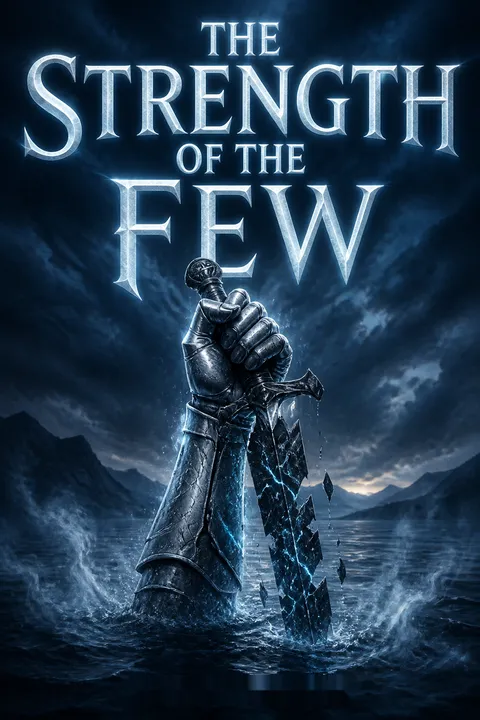
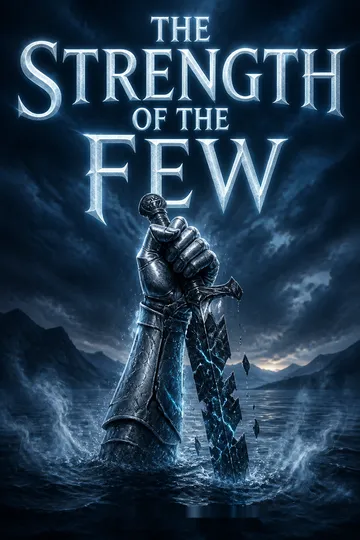
The Strength of the Few interrogates a question that most fantasy novels answer with convenient moral clarity: what happens when the 'right thing' requires doing something monstrous? Vis1 is asked to puppeteer the dead, to ally with assassins, to orchestrate political massacres, and finally to raise eighty thousand corpses as an army — each escalation a moral Rubicon he crosses with full awareness and genuine anguish. The novel refuses to let him off the hook with necessity as absolution. His friend Eidhin4 watches him wake the dead and says only that he is still with him, not that what Vis1 is doing is right.
The three-world structure serves as more than narrative spectacle. Each version of Vis1 encounters a different system of control — the Hierarchy's Will-based meritocracy, Ka13's divine authoritarianism, Luceum's honor-bound tribalism — and each system produces its own characteristic corruption. The Hierarchy creates senators who kill children for political advantage. Ka creates a city where the dead filter poison through their bodies so the living can drink. Luceum's sacred customs allow a champion to behead a druid without consequence. The novel argues that no system of power is immune to capture by the ruthless, and that the institutions we build to protect the many inevitably become tools for the few.
Islington's deepest theme, though, is about what we owe the dead. Every major choice in the novel involves someone already gone: Callidus's23 murder drives Vis's1 political career, Caeror's2 supposed death launched the entire conspiracy, and the final gambit literally requires raising the dead to fight. The book suggests that grief is not just an emotion but a form of currency in power structures — weaponized by Decimus,24 leveraged by Ostius,11 and ultimately reclaimed by Vis1 when he chooses to fight not despite his losses but because of them.
Review Summary
The Strength of the Few by James Islington receives largely positive reviews, rated 4.48/5. Readers praise its ambitious storytelling, three-POV structure, and expanded worldbuilding across multiple worlds. Many consider it the best fantasy of 2025, comparing it favorably to Brandon Sanderson. The complex plot, emotional depth, and character development—particularly Vis's journey—are highlights. However, some criticize pacing issues, underdeveloped secondary characters, romance execution, and controversial character deaths. Readers note it demands full attention and trust in Islington's architect-style planning. Most agree the explosive Act III justifies the wait.
People Also Read
Characters
Vis / Diago / Deaglán
Synchronous prince in exileBorn Diago, prince of the conquered island kingdom of Suus, he has spent five years hiding his identity behind layers of assumed names—Vis Telimus in the Hierarchy, Deaglán among Luceum's warriors, Siamun in Duat's shadows. The Labyrinth copied him into three parallel worlds, making him Synchronous and potentially the only person who can prevent a civilization-ending Cataclysm. Beneath his competence lies a young man shaped equally by loss and love. His father's15 execution, his sister Cari's drowning, and his friend Callidus's23 death have taught him that caring for others is both his greatest strength and most exploitable weakness. He despises the Hierarchy's system of Will yet grudgingly masters it, hates violence yet proves devastatingly effective at it, and craves a simple, honest life that his abilities will never permit him to have.
Caeror Telimus
Ulciscor's lost brotherUlciscor's9 younger brother, presumed dead after his Iudicium seven years ago, Caeror actually survived by passing through the Gate to Obiteum. Wiry and scarred—one ear missing, a deep slash across his cheek—he compensates for seven years of isolation in a nightmare world with an almost manic cheerfulness that proves genuine rather than performed. His relationship with Vis1 is one of mentor and student, but also of two profoundly lonely men finding family in each other. Caeror's optimism is deliberate, a conscious choice to model resilience for those around him. He loved Lanistia8 before his supposed death, and the raw pause he takes before declining to hear about her speaks volumes about what he has sacrificed. He teaches Vis1 everything about Obiteum's form of Will with patience that borders on saintly.
Emissa Corenius
Vis's conflicted former loveA Military Quintus and daughter of Magnus Quartus Corenius, Emissa is brilliant, beautiful, and burdened by a childhood spent as her father's investment—pushed relentlessly, secretly put through the Aurora Columnae at fifteen to boost her training. She stabbed Vis1 during the Iudicium believing his contaminated blood meant he was one of the undead, a mistake that shattered their romance even as she proved the depth of her feelings through its horror. She works with Veridius6 to prevent the Cataclysm while serving as Military's eyes, occupying a moral grey zone with pragmatic grace. Her vulnerability surfaces only in unguarded moments—the catch in her voice when she admits she thought Vis1 was already dead. She represents the tragedy of good people trapped inside corrupt systems.
Eidhin Breac
Vis's immovable Cymrian brotherA massive, redheaded Cymrian warrior-scholar bound to the Hierarchy by a deal his father struck to protect their conquered people. Eidhin communicates primarily through grunts, deadpan observations, and rare smiles that light up rooms precisely because they are so infrequent. His moral compass is the steadiest in the story—he refused Veridius's6 offer to free his people because the compromise required felt worse than the bondage. Beneath his stoic exterior lies a man quietly devastated by the death of his twin brother Cathair during the Republic's invasion. His friendship with Vis1 operates on absolute trust built through action rather than words: when Vis1 needs someone to commit blackmail, break the law, or simply hold him while he weeps, Eidhin is there without question or hesitation.
Aequa Claudius
Vis's fiercest Governance allyDaughter of Senator Advenius, Aequa is a raven-haired Governance Quintus whose cobalt-blue eyes and athletic grace conceal a woman still processing her own trauma from the naumachia and Iudicium. She missed saving Callidus23 because she lost his tracker while being chased by the Anguis—a simple, miserably unfortunate accident that haunts her. Where Vis1 broods, Aequa needles; her teasing serves as both affection and therapy. She wakes from nightmares with every muscle sore, as if fighting all night. She earned the Quintus promotion Vis1 was denied, and her immediate instinct was to refuse it on his behalf—a loyalty that proves she values friendship over advancement. Her relationship with Vis1 is uncomplicated in the best sense: mutual trust, mutual respect, mutual terror at the state of the world.
Veridius Julii
Academy Principalis with secretsThe Principalis of the Catenan Academy is a masterful performer whose warmth, concern, and gentle humor are so perfectly calibrated that even Vis1—who knows the man sent students to their deaths—cannot fully dismiss them as artifice. Dirty-blond hair perpetually tidy, blue eyes perpetually empathetic, Veridius discovered the threat of the Cataclysms alongside Caeror2 and Lanistia8 years ago, then spent the intervening time trying desperately and secretly to find someone who could prevent it. Every student he sent through the Labyrinth was a calculated sacrifice he privately mourns. His explosive outburst at Vis1—screaming that he keeps going because he has to—is the first crack in a decade of composure. He represents the agonizing question of whether terrible means can ever justify necessary ends.
Tara ap Rónán
Scarred princess turned warriorKing Rónán's disinherited daughter, Tara carries a deep scar from cheek to eye—inflicted by assassins sent not to kill her but to disqualify her from succession under the Old Ways, which bar the physically blemished from ruling. Rather than let her father choose between his principles and her birthright, fourteen-year-old Tara volunteered for Loch Traenala's warrior school. She is the finest fighter Vis1 has ever seen, capable of defeating three opponents simultaneously while using only one hand. Her emotional armor is nearly as impenetrable as her combat technique: she smiles rarely, speaks bluntly, and judges others solely by their commitment. When she finally calls Vis1 by his chosen name rather than the dismissive 'Leathfhear'—Half-man—it carries the weight of a coronation.
Lanistia Scipio
Blind warrior bound by voicesOnce Caeror's2 lover and one of the Academy's most formidable fighters, Lanistia lost her eyes attempting to save him during his Iudicium seven years ago. She navigates through the Will of her Septimii, sees through their ceded power in a manner unique to her. Brusque, sardonic, and terrifyingly competent, she trained Vis1 with an unforgiving discipline that masked genuine care. Her attack on Vis1 at the Aurora Columnae was involuntary—a compulsion triggered by proximity to Will that manifests as an irresistible voice commanding her to complete some ancient warrior's journey. She knows the horror of losing control over her own body, of watching herself kill while screaming internally to stop. That trauma deepens her already fierce protectiveness of those she loves.
Ulciscor Telimus
Vis's driven adoptive fatherA Magnus Quintus in Military who adopted Vis1 from an orphanage to investigate his brother Caeror's2 supposed suicide, Ulciscor is powerful, intimidating, and consumed by a seven-year obsession that Caten turned into a joke. His decision to threaten Vis1 with a Sapper to force him through the Labyrinth remains a wound between them, but beneath his ruthlessness lies a man whose every action stems from grief and love for his lost brother. He and Vis1 gradually shift from master-and-tool to something approaching mutual respect.
Relucia Telimus
Ulciscor's wife, Anguis spyDark-skinned and curly-haired, Relucia wears a simpering socialite's persona like armor, capable of switching from vacuous chatter to cold calculation between heartbeats. She is an Anguis operative planted in the Telimus9 family, working toward revolutionary change through methods Vis1 finds abhorrent. Her own father put her in a Sapper for three years as a child to sell her Will for profit—a trauma that fuels both her hatred of the Hierarchy and her willingness to accept violence as the currency of change.
Ostius
World-jumping puppet masterTall, thin, and scarred from forehead to chin, Ostius moves between Res and Luceum with a casual defiance of physics. Nephew to Military's Princeps Exesius, he operates with playful cruelty and opaque motives, using the Anguis as tools while pursuing goals far larger than revolution. He provides Vis1 with critical intelligence and dangerous abilities while constantly positioning him as a piece on some vast, invisible board. His cheerful brutality—kicking his uncle's face in while chatting—suggests something fundamentally broken behind the charm.
Tertius Ericius
The Censor, Callidus's fatherThe Hierarchy's Censor—effectively its chief auditor—Ericius is a slender, limping man whose angular features echo his dead son's23. Power radiates from him despite his unimposing frame. His grief is controlled, his political instincts sharp, and his willingness to support Vis1 genuine but ultimately self-serving. He sponsors Vis's1 career in Governance while navigating the fracturing Senate with the steady competence of a man accustomed to operating within broken systems.
Netiqret
Duat's deadliest motherAn elegant, grey-haired assassin who kills people neatly so their bodies can be enslaved by wealthy buyers, Netiqret has spent twenty years trying to restore her daughter Kiya—a child iunctus absorbed into Duat's controlling Nomarch system. Her poise never cracks, her knowledge of the city is encyclopedic, and her willingness to test Vis1 through violence reveals a woman who has long since decided that delicacy is a luxury she cannot afford. Her final sacrifice of Kiya's remaining consciousness to help Vis1 is the first truly selfless act she allows herself.
Ahmose
Vis's reluctant friend in DuatA nervous, irritable iunctus craftsman whom Vis1 rescues from being transformed into a Gleaner. Ahmose spent a decade in Duat's western quarter as a faithful servant of Ka, genuinely believing in the promise of an afterlife. Vis's1 revelations about Ka's true nature rob him of that comfort, leaving him with the terrifying awareness that death is now his permanent end. His bravery emerges not despite his anxiety but through it—a man who fears everything yet still stands beside the person dismantling his world.
King Cristoval
Vis's dead-but-present fatherThe executed king of Suus, sustained as an iunctus by a powerful Vitaerium medallion. Cristoval is everything Vis1 remembers—wise, warm, commanding—and everything he feared losing. His presence in Luceum as a secret guardian represents both profound comfort and agonizing moral weight. He would cross any line to protect his son, even the line between life and death.
Gallchobhar
Treacherous Champion of RónánAn impossibly massive warrior who served as King Rónán's Champion after secretly orchestrating the attack that scarred Tara7 and killed his predecessor. Gallchobhar radiates physical menace and political cunning in equal measure. His exile by Deaglán's1 accusation transforms him from court politician to Fiachra's weapon, and his casual murder of the druid Lir20 reveals a man who has convinced himself that sacred laws apply only to those weaker than him.
Livia Ericius
Callidus's sharp-tongued sisterCallidus's23 younger sister, assigned to Vis's1 pyramid and openly hostile toward him. Her anger masks grief: she blames Vis1 not for killing her brother but for surviving when he did not. Gradually, her hostility softens into grudging respect as she recognizes Vis's1 genuine commitment to honoring Callidus's23 memory.
Indol Quiscil
Senator's defecting sonThe former top-ranked student at the Academy, Indol defected from Military to Religion for reasons he keeps close. His father, Dimidius Quiscil, was among the Military senators behind the Iudicium attack. Indol carries the weight of his father's crimes with quiet devastation, committed to justice despite knowing it means condemning his own blood.
Kadmos
Telimus family DispensatorThe stringy-haired Dispensator of Domus Telimus, Kadmos is part physician, part father figure, and wholly devoted to the family he serves. His pain-numbing tea keeps Vis1 functional through injuries that should be crippling.
Lir
Druid caught between loyaltiesA blond, blue-eyed druid who escorts Deaglán1 to Caer Áras and later to Fornax. Deeply troubled by the Grove's corruption under Ruarc, Lir walks the impossible line between sacred neutrality and practical necessity.
Conor
Cheerful crannog warriorA sandy-haired, irrepressibly cheerful student at Loch Traenala whose dimpled grin serves as emotional ballast for the entire warband. First to embrace Deaglán1 as brother after the raiders' ambush.
Gráinne
Farm mother who saved VisThe blonde, lean farmer's widow who hauls Deaglán1 to safety, nurses him back to health, and gives him the closest thing to a normal life he has known since Suus.
Callidus Ericius
The friend who died protectingVis's1 brilliant, ill-ranked Academy friend whose death during the Iudicium—tortured by an Anguis operative who mistook him for Vis1—is the wound that refuses to heal, driving much of Vis's1 fury.
Tertius Decimus
Iro's grief-maddened fatherA Religion senator consumed by the loss of both his children. His restrained civility conceals a growing psychopathy that erupts in devastating violence against those he holds responsible.
Plot Devices
Adoption
Stealing imbued Will from objectsAdoption is Vis's1 most dangerous secret: the ability to seize control of Will that someone else has imbued into an object, simply by touching it and holding its image in his mind. It contradicts everything the Hierarchy teaches about Will being controllable only by its original imbuer. Vis1 discovers it during his Placement exams and uses it to secretly enhance his boulder throw, then exploits it repeatedly—in the chariot race against Iro, to bypass prison locks, to strip the Military voting circle of its accumulated power in the Basilica. The ability makes him potentially the most dangerous person in the Republic, which is precisely why he must hide it: if the Hierarchy learned an individual could simply take their Will, the entire system of ceding would collapse.
Iron Triangles
Mask, arm, armor, and weaponsA hundred iron triangles that Vis1 secretly forges and Harmonically imbues, forming a mesh of interconnected pieces he wears constantly beneath his clothing. Through mental command, he can rearrange them into virtually any configuration: a protective chest plate, a functional false left arm complete with articulated fingers, a featureless iron mask that conceals his identity, hovering blades that attack at range, or scaffolding braces that allow him to walk on two broken legs. The Harmonic connection means maintaining them requires constant but manageable mental effort, and their iron composition means they don't shatter on impact the way stone Razors would. They become the physical signature of 'Carnifex'—the masked figure who haunts Caten's streets during the civil war.
The Crook and Flail
Mutalis weapons destroying all matterGolden ceremonial implements hidden behind a mutalis-infused door in Qabr's deepest chamber, the crook and flail activate when smeared with blood and annihilate anything they contact—obsidian walls explode, stone bridges crumble, human bodies burst into red mist. Only someone Synchronous can survive touching them while active. When Vis1 first accidentally strikes a wall with an activated crook, the entire hallway detonates. He uses them to breach Duat's outer entrance, destroy the Infernis bridge to draw Gleaners away from Ka's pyramid, and ultimately ascend to confront Ka himself. They represent the terrifying intersection of ancient power and modern desperation—weapons too destructive to use responsibly but too necessary to leave untouched.
Instruction Blades
Commanding iunctii absolutelyThin obsidian swords, originally created by Ka, that when stabbed through a iunctus's heart force the dead person to answer questions truthfully and obey commands for as long as the wielder's hand remains on the hilt. Caeror2 uses one to interrogate Djedef and discover he's been compromised by Ka. In Res, Military uses them in the secret Necropolis prison to extract intelligence from preserved corpses—a horrifying system that Vis1 encounters when Emissa3 shows him the Anguis prisoner. The blades represent the fundamental violation at the heart of this world's power structures: the dead cannot consent, cannot resist, and cannot escape. Their existence is both tactically invaluable and morally corrosive to everyone who uses them.
Vitaeria / Khepri Medallions
Sustaining life through imbued WillScarab-engraved stone discs that imbue their wearers with Will, functioning as life-support systems across all three worlds. In Obiteum, they protect against the toxic atmosphere and allow iunctii to function despite mortal wounds. In Res, they sustain the critically ill. In Luceum, King Cristoval's15 Vitaerium is the only thing keeping his dead body animate—and when he gives it to his drowning son, it costs him his existence permanently. The Vitaeria's origin remains mysterious even to the Hierarchy, who have studied them for a century without understanding how they work. Their true source—Obiteum's form of Will, which can directly affect living bodies—is one of the story's central revelations about the interconnection of the three worlds.
Hierarchy Series
About the Author
Other books by James Islington


Download PDF
Download EPUB
.epub digital book format is ideal for reading ebooks on phones, tablets, and e-readers.








































